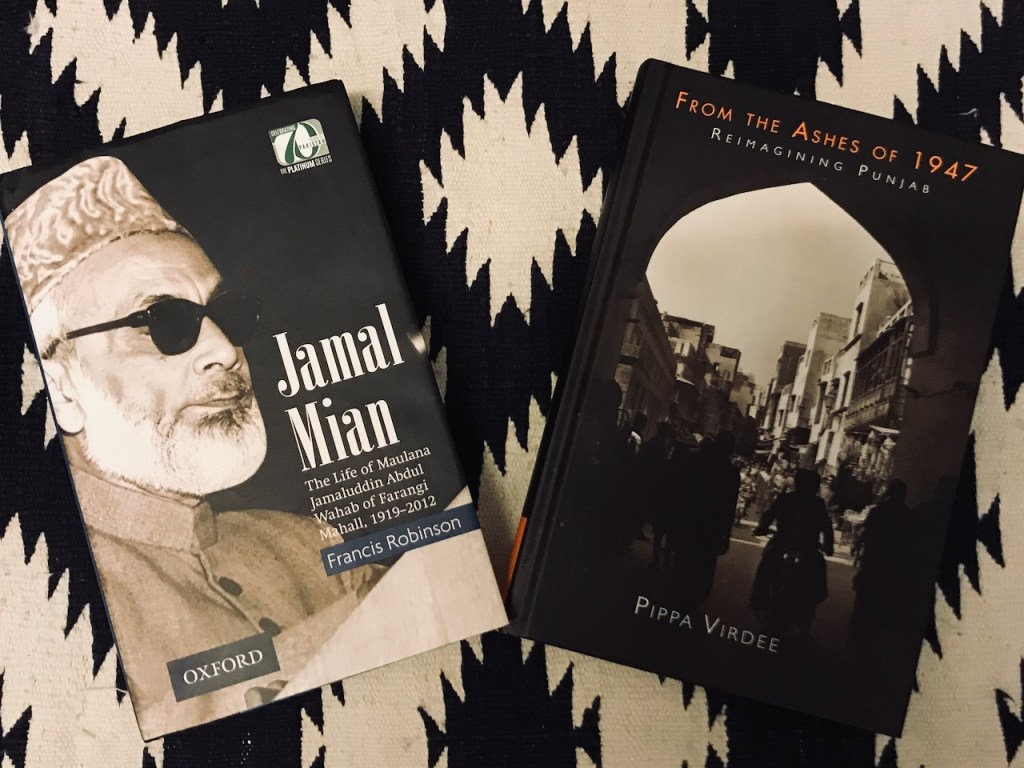
The two books are placed on a traditional handmade dhurrie/dari by my mother.
ONE is the biography of Jamal Mian (1919-2012), a life across British India, independent India, East Pakistan and Pakistan. The kind of life, which would be unimaginable to most people of the subcontinent today. At the core, this is a detailed history of the changing political landscape of North India told through the life and times of an extraordinary life. The story unfolds with authority and simplicity, the kind of old-fashioned narrative history writing that barely exists. Stories and history writing are barely written like like because they do not command the short-term impact and they take years, generations to unfold through the relationship of the historian and his subject. But importantly it brings together the life and times of an individual and his milieu – showcasing the kind of “Hindustan” that no longer exists, other than in history books.
Pippa Virdee, FRANCIS ROBINSON. Jamal Mian: The Life of Maulana Jamaluddin Abdul Wahab of Farangi Mahall, 1919–2012, The English Historical Review, ceaa186, https://doi.org/10.1093/ehr/ceaa186
TWO is an account of the province(s) of Punjab; rising From the Ashesof 1947 but simultaneously being reimagined. This too is about a political landscape that has been transformed and only exists in the history books, kinder memories and sepia imaginations of some of its people. It is about the shorter, shocking and longer, hardening consequences of dividing the land of five rivers. It too has been written over a long period and reveals the changing nature of my understanding of Partition, from the beginning of my doctoral work in 2000, to the point of this publication in 2017. It has changed further still because history is about engaging with the past through the unfolding present and “reveals how far nostalgia combined with the lingering aftershocks of trauma and displacement have shaped memories and identities in the decades since 1947.”
Sarah Ansari, PIPPA VIRDEE. From the Ashes of 1947: Reimagining Punjab, The American Historical Review, Volume 125, Issue 2, April 2020, Pages 635–636, https://doi.org/10.1093/ahr/rhz695
When we visualise India’s Partition of 1947, we almost always do so through the images of Margaret Bourke-White. For the past seven decades, her images have saturated the cover of numerous books, newspaper articles, magazine features, documentaries et al related to Partition. She was, of course, one of the most iconic photographers of the last century. Born in 1904 (d. 1971) in New York City and raised in rural New Jersey, she was the daughter of Joseph White (who was of Jewish descent from Poland) and Minnie Bourke, an Irish Orthodox Catholic. Joseph was an inventor and engineer and perhaps thus an early influence on his daughter’s eventual interest.
This interest matched the tenor of those times, as Henry R Luce, the publisher tycoon realising the potential of photography, felt that America was ready for a magazine that documented events the through photographs. In 1936, Luce bought Life magazine and relaunched it, with Bourke-White becoming one of the first photojournalist to be offered a berth there (Kapoor: 13). America then was in the midst of the Great Depression and Bourke-White ‘took to documentary photography in order to disseminate the idea of inconvenient truth’ for a readership of 2.86 million people (Bhullar: 301).
In India, she is primarily known for her photographs that captured the Partition-related violence and migration, as it ushered in the new dawn of independence. Her photographic essay, The Great Migration: Five Million Indians Flee for Their Lives, was published in Life magazine on 3 November 1947. It had commissioned her to cover the exchange of populations that was taking place across the plains of the divided Punjab and she writes thus what she saw: “All roads between India and Pakistan were choked with streams of refugees. In scenes reminiscent of the Biblical times, hordes of displaced people trudged across the newly created borders to an uncertain future” (Kapoor: 14).
Recently, in 2010, Pramod Kapoor published Witness to life and freedom:Margaret Bourke-White in India & Pakistan with a reprint of over 100 of her photographs. Kapoor wrote about them thus: “They offer a kind of stately, classical view of misery, of humanity at its most wretched, yet somehow noble, somehow beautiful”. His book gives us into a glimpse beyond the frames. Bourke-White had arrived in India in March 1946 and travel around documenting low life and high people: “She was there to photograph Gandhi at his spinning wheel. She was there to photograph Jinnah with his fez. And soon after, both men were to meet their Maker” (Kapoor: 14). Her frames on them served to reinforce their pervading stereotypes of the saint and shrewd. Kapoor details:
“Margaret photographed Gandhi many times afterward. He called her, fondly, she thought, ‘the torturer’. His inconsistencies puzzled her rational mind; it was not until she saw his self-sacrificing bravely in the face of India’s convulsive violence that she began to think him akin to the saint she made him out to be with her camera. She also photographed Mohammed Ali Jinnah; whose features were as sharp as the creases in his western business suits. Jinnah would almost single-handedly bring about the partition of India and the creation of Pakistan”.
Bourke-White documented the aftermath of the so-called Direct-Action Day in August 1946, which was announced by Jinnah following the failure of the Cabinet Mission Plan. Her photographs of the riots in Calcutta then are sometimes confused with the images she took following the Partition, a year later. The article ‘The Vultures of Calcutta’ featured in the 9 September 1946 issue of Life, showing vultures waiting to prey on the bodies of dead victims was later, intermittently and inaccurately, used for depicting the carnage in August 1947.
Vicki Goldberg, the biographer of Bourke-White, writes that when she heard about the Calcutta Riots, Bourke-White immediately flew to Calcutta, and “badgered photographer Max Desfor (1913-2018), the first foreigner to photograph the aftermath of the riots, to tell her where to find the most carnage. While others were sickened by the sight of the bodies, Bourke-White kept working and wrote the scene reminded her of concentration camps in Germany: “the ultimate result of racial and religious prejudice” (Forbes: 7). Desfor’s images were not published by the Associated Press because they were “too revolting for its readers”. Bourke-White’s comrade was Lee Eitingon, a Life reporter based in India, in whose words, “Both of us were whatever the female equivalent of macho is. The smells were so terrible, the officers accompanying us would have handkerchiefs over their faces. We would not…that was part of the time and the period. Being women, we had to be tougher” (Kapoor: 27).
Much of Bourke-White’s archive are housed in Syracuse University’s Bird Library Special Collections section. Here “one can find some of the original photos that include the British soldiers who accompanied Bourke-White and Lee Eitingon” but, as Forbes notes, “the soldiers were cropped from the published pictures”, which dramatically changes the visual narrative (12). It now appears that Bourke-White staged photographs: “Eitingon wrote about her directing a group of starving Sikh refugees…to go back again and again”. She adds, “they were too frightened to say no. They were dying”. When Eitingon protested, Bourke-White told her “to give them money!” (Forbes: 11-12). Even Patrick French writes about how some of these images were staged. When the contact sheets were discovered, they provided an insight into the wider context in which these photographs were being taken. Some of this approach of a pushy, zealous and ambitious American, has been noted in the writing of Claude Cookman. In his examination of how Bourke-White and her French counterpart Henry Cartier-Bresson (1908-2004) approached the coverage of Gandhi’s funeral he notes:
“Flash had become a contentious issue in Bourke-White’s coverage of Gandhi. She had used a flash bulb to make her famous portrait of Gandhi by his spinning wheel. Gandhi…tolerated the technique, but his inner circle never did. They thought flash was disrespectful, and they feared the bright light would harm his sensitive eyes. Flash became a serious liability for Bourke-White in her coverage of Gandhi’s funeral. With her camera concealed, she slipped into the room, where his body lay surrounded by grieving relatives, supporters and government officials. It was about 6:30 p.m.…When she ignited a flash bulb to make her exposure, his followers became enraged by her violation of their privacy and grief. They seized her camera and threatened to destroy it. Hannah Sen intervened, calming the group. After Bourke-White’s film was removed and exposed to the light, Mrs. Sen escorted her from the room. She returned the camera with the understanding that Bourke-White would leave Birla House and not return. Not one to give up after one rebuff, she reloaded her camera and tried to re-enter the room to get another picture. Eventually, Bourke-White yielded to Mrs. Sen’s pleas to honour her promise and left empty-handed. The stereotype of the rude, aggressive American news photographer, who would trample on anybody’s toes or sensitivities to get the picture was a commonplace during the 1940s…Cartier-Bresson deplored this rough-and-tumble approach to photo-journalism: ‘We are bound to arrive as intruders’, he wrote, ‘it is essential, therefore, to approach the subject on tiptoe. It’s no good jostling or elbowing’. As part of his approach, he rejected artificial lighting: ‘And no photographs taken with the aid of flashlight either, if only out of respect…Unless a photographer observes such conditions as these, he may become an intolerably aggressive character’. When Cartier-Bresson wrote this rejection of flash in 1952, he may well have been recalling Bourke-White’s experience at Gandhi’s wake four years earlier” (Cookman: 200).
Geraldine Forbes also notes the differences between Cartier-Bresson and Bourke-White. The former is less known but his images exude a sensitivity, absent in the work of Bourke-White. Upon receiving a photography award, Bourke-White claimed, “The photographer must know. It is his sacred duty to look on two sides of a question and find the truth”. And she cited her work to reference this point (Kapoor: 26). However, when we look at her work, we rarely observe that her work, almost entirely based on the Punjab migration, has yet been made to stand for Independence/Partition exclusively, without acknowledging the vast and diverse range of experiences. The visual record which is taken as “the truth” is rarely explored critically or contextually, while less said so of the racial-ethnic cultural capital of a white American female to travel freely to photograph this momentous carnage at the end of empire. These were foreign journalists writing for a predominately American and western audience, yet these photographs have come to represent Partition.
References:
Dilpreet Bhullar, ‘The Partition of the Indian Subcontinent Seen through Margaret Bourke-White’s Photographic Essay: ‘The Great Migration: Five Million Indians Flee for their Lives’, Indian Journal of Human Development, (2012) 6 (2): 299-307.
Claude Cookman, ‘Margaret Bourke-White and Henri Cartier-Bresson: Gandhi’s funeral’, History of Photography 22, no. 2 (1998): 199-209.
Geraldine Forbes, ‘Margaret Bourke-White: Partition for Western Consumption’, In Reappraising the Partition of India edited by K. Mitra and S. Gangopadhyay (Readers Service, 2019), pp. 3-16.
Patrick French, ‘A New Way of Seeing Indian Independence and the Brutal ‘Great Migration’, Time, 14 August 2016.
Vicki Goldberg, A Biography. New York: Harper & Row. 1986.
Pramod Kapoor, Witness to Life and Freedom: Margaret Bourke-White in India & Pakistan. New Delhi: Roli & Janssen. 2010.
Asma Naeem, ‘Partition and the Mobilities of Margaret Bourke-White and Zarina’, American Art 31, no. 2 (2017): 81-88.
Introduction In 19th-century colonial India, language was more than a tool for communication. It was also a marker of identity for communities. While language helped reshape identities in the colonial backdrop, languages themselves were also influenced by policies and practices. Given the diversity of languages and their varying functionality in a place like India, the […]
A fragment of my personal history in celebration of International Women’s Day and in memory of my own mother, who played such an important part in shaping my ideas. Visit the Indian Memory Project to read the full piece which I wrote in 2013.
While the present nation-states of Pakistan and Afghanistan are Islamic Republics, there was a time when the religion of Buddha registered a strong presence in areas, now part of these states. Back in 2001, when the ‘Buddhas of Bamiyan’ were blasted by the Taliban in Afghanistan, the visuals were received with astonishment and horror across the world. These ancient, iconic carvings were UNESCO protected monuments and represented the classic syncretic style of Gandhara art. The Taxila Museum in Punjab province of Pakistan is home to the largest collection of ancient Gandharan artefacts in the country dating back to the time from the 1st to the 7th c. AD. Most of these were excavated at the nearby ruins of the ancient city of Taxila. The museum itself dates back to 1918.
John Marshall (1876-1958), was one of the most famous directors of the Archaeological Survey of India and excavator of the city of Taxila. Marshall began the excavations at Taxila in 1913, which carried on for another twenty years, apart from laying the foundation stone of the museum in Taxila. Later, he produced An Illustrated Account of Archaeological Excavation of Taxila in 1951. This 3-volume work details the Taxila excavations of 1913-1934 and opens with an apt description of the importance of topography in situating ancient Taxila:
‘The remains of Taxila are situated immediately to the east and north-east of Sarai-kala, a junction on the railways, 20 miles north-west of Rawalpindi. The valley in which they lie is a singularly pleasant one, well-watered by the Haro river and its tributaries, and protected by a girdle of hills – on the north and east by the snow mountains of Hazara and the Murree ridge, on the south and west by the well-known Margalla spur and other lower eminences. This position on the great trade route, which used to connect Hindustan with Central and Western Asia, coupled with strength of its natural defences, the fertility of its soil, and a constant supply of good water, readily account for the importance of the city in early times’.
While Buddha (5th-4th c. BC) did not venture to Gandhara, growth of Buddhism in this region happened under the Mauryan Empire (322-185 BC). Gandhara was a province of the Persian Empire under Darius I. In 327 BC, Alexander advanced as far as Taxila in his conquests, but shortly thereafter, the region was consolidated with the territorial reach the Mauryan dynasty. It was Chandragupta’s grandson, Emperor Ashoka, who converted to Buddhism in c. 263 BC, following the especially bloody Kalinga War.
It was under the Kushans’ (people of Scythian origin) rule that the Gandhara region assumed its important place in the history of Buddhism and especially its art. Under ruler Kanishka in the 1st c. AD, ‘Buddhist sages made Gandhara a sacred region by the compilation of texts associating local sites with previous incarnations of the Buddha’ (1956). The Kushans’ ‘greatest contribution of Gandhara to the art of Asia was the invention of the Buddha image. The first anthropomorphic representation of the Great Teacher was probably related to the emergence of the devotional sects of Buddhism and demand for the portrayal of the object of worship in an accessible human form in place of the entirely symbolic portrayals of the master in the art of early Hinayana Buddhism’ (1960).
Great Stupas were subsequently built in the region, of which some still survive and are preserved in the Taxila Museum. In Takht-i-Bahi (Mardan, KP province), there is a large Buddhist monastic complex, which forms an important site of this period in the region, representing the Gandhara school of art and architecture. Dating from 1st – 2nd c. AD, Buddhism flourished here, leading to a new, syncretic Greco-Buddhist art/architecture & culture. Mediterranean and Persian influences gave Gandhara sculpture characteristics, which distinguishes it from other Buddhist art notably the Mathura school (1956).
While the archaeological evidence of the extent and importance of Gandhara only came to light in early-20th c., textual evidence and knowledge about it was available through accounts by Chinese Buddhist pilgrims. They recorded and left behind incredibly detailed descriptions of their travels, for example, the stories of Fa Hsien’s journey in c. 400 AD, the journey of Sung Yun in the 6th c., and the most detailed of all, Hiuen Tsang’s Hsi Yii Chi, Records of the Western Countries, composed in early-7th c. (1960).
Gupta, Jyotirindra Das, and Jyotirindra Dasgupta. Language conflict and national development: Group politics and national language policy in India. Univ of California Press, First published 1970. PP.46-7
Gupta, Jyotirindra Das, and Jyotirindra Dasgupta. Language conflict and national development: Group politics and national language policy in India. Univ of California Press, First published 1970. PP.46-7
Swaran Singh (Civil Lines, Jullundur City) to Sardar Baldev Singh, 6 March 1951 (Nehru Papers post-47 file 75)
“A very serious situation has arisen in Jullundur district over the language controversy. You must be already aware of the propaganda which was carried on by a certain class of Hindus for persuading the Harijan classes to state at the time of census that Hindi was their mother tongue. Partly as a result of this propaganda and partly on account of the predominance of Hindus amongst the enumerators, a very large section of Harijan population has been recorded as Hindi-speaking population…Illiterate Harijans in the villages who cannot speak or understand even one word of Hindi have been recorded as Hindi-speaking individuals. This has naturally caused resentment in the minds of the Sikhs and they have in a quiet and peaceful manner told the Harijans that the latter have nothing to do with them and a state of peaceful boycott prevails in a fairly large number of villages…The Hindu communalists nakedly in some cases and under the grab of Congress and nationalism in other cases, have fully exploited this situation. They have instigated the Harijans to pick up some quarrel or the other and thus to afford a pretext to the police to make arrests. During the last 3-4 days over 100 persons have already been arrested from villages situated in the different tehsils of the district. Of the arrested persons, about 30-40 so far are the Harijans and the remaining persons are Sikhs, mostly Jats. The action is taken for breach of peace and bails are purposely delayed in order to demoralize the rural people…I had a long talk with [Chief Minister] Dr. Gopi Chand who was on tour at Jullundur yesterday, but as usual he is extremely indecisive. [Some] MLAs are doing their worst to instigate the Harijans and are poisoning the ears of the local officers. Lala Jagat Narain [future founder/editor of Punjab Kesari] has been particularly poisonous in his writings. A very serious situation prevails, and I won’t be surprised if the province is hurled into chaos and if serious effort is not made to straighten out this matter…The self-styled leaders, the press and the local officers should be made to realize that they are playing with fire and the consequence can be extremely disastrous”.
PV Bhaskaran (Deputy Director – Intelligence Bureau) to HVR Iengar (Ministry of Home Affairs), VP Menon (Ministry of States) & Dharma Vira (Pr. PS to PM), 15 March 1951 (Nehru Papers post-47 file 75)
“The bitter animosity which has been witnessed in Punjab and the PEPSU between the Sikhs and the Hindus over the Punjabi-Hindi language controversy in the census has had unpleasant repercussions for the Harijans in many centres of these two states. There have been several complaints of the coercion [arson] and economic boycott [departure] of the Harijans of the PEPSU by the Sikhs, [across villages] in Kapurthala and Patiala district(s). Security proceedings have had to be commenced against Harijans and Sikh Jats…
A deputation of Hindus and Harijans of [some] villages of Kapurthala district, waited on the District Commissioner with complaints of oppression, but were reported to have been told that they had themselves invited this trouble by furnishing Hindi as their language, while living in a Punjabi-speaking area…of Sikh Zamindars. Some of them complained that Akali workers had forcibly obtained their thumb impressions on applications, which sought to have their language changed from Hindi to Punjabi. Some harassment of Harijan women has also been mentioned, [amidst] reported, [en]forced [departures]…Some Harijans, apparently acting under intimidation, actually applied to the DC to alter their language from Hindi to Punjabi in the census returns. In Sangrur district, the Harijans are reported to have been boycotted by the Sikh Zamindars, with the result that they had to march long distance to the town to fetch their food-grains and other daily necessities of life. The districts of Bhatinda and Fatehgarh Saheb were the [other] areas from which such trouble has been reported [with] Harijans of rural areas reported to have moved to town for safety.
In Punjab, Jullundur district has been the worst affected. 98 Jat Sikhs and 45 Harijans have been arrested in this district. A Harijan was murdered by Jat Sikhs…on February 28. Some of the houses of the Harijans who furnished Hindi as their language were reported to have been set on fire…It is reported that the Harijans of these areas have refused to remove the dead bodies of the animals belonging to the Sikhs, and that the latter have boycotted them…Similar complaints have also been made against the Sikhs by the Hindus and the Harijans of some centres of Gurdaspur district…Hoshiarpur and Ferozepur district have also been scenes of similar communal trouble.
The PEPSU Achhut Federation has protested strongly against the “unprovoked high-handedness and injustice” done to Harijans during the census and has demanded their immediate resettlement in their own villages. [There was] a well-attended conference of the depressed classes’ league at Patiala on March 4. A resolution was then accepted, urging the central government to order an independent enquiry on the high-handedness of the Sikhs and the maltreatment of the Harijans of Punjab and the PEPSU in the course of the census operations. [A] speaker warned that the Harijans could cause havoc by staging a week’s hartal of sweepers. [Another] warned the Sikhs not to poison the atmosphere with the language controversy.
The Harijan Sabha of Amritsar convened a meeting on March 6 and warned the Harijans to beware of the tactics of both the Hindus and the Sikhs, and to remain aloof as a separate group. The government was also requested to take the necessary action against the aggressors, failing which, it was warned that a movement of satyagraha would be commenced by refusing to do scavenging and other menial services. The Sweepers Federation of Simla also held a meeting, to deplore the communal tension created by the census operations due to the coercion of the Sikhs. One of the speakers…threatened a strike of sweepers. Resolutions were adopted protesting against the victimisation of the Harijans and demanding the appointment of an enquiry committee consisting of officials drafted from other states.
A refugee camp has been set up at Amritsar by the Hindu Mahasabha and the RSSS, with the assistance of the local Scheduled Castes Federation, to shelter the Harijans who have been migrating from rural areas…There are now only 25 inmates in this camp, but about 245 other Harijans are in shelter in the town with the help of local Hindu hide merchants…This situation was mentioned by NC Chatterjee of the Hindu Mahasabha, at a public meeting at Amritsar on March 11, when he said that the social boycott of the Harijans of Punjab would lead to civil war and anarchy. [A] Punjab Hindu Mahasabha [speaker] advised the Sikhs to stop their oppression of the Harijans in rural areas, warning them that the Sikhs might similarly be victimised in other states of India where they were n a minority.
As is well-known, Master Tara Singh and other leaders of the Shiromani Akali Dal have been bitterly critical of the Hindus and their action in recording Hindi as their language in the census…[Their] visit in Patiala, in the last week of February, gave rise to rumours of impending communal disturbances…Several refugees are reported to have left…Unless firm measures are taken both at official and non-official levels, there may be the danger of the situation getting out of hand”.
Further reading: Singh, Atamjit. “The Language Divide in Punjab.” South Asian Graduate Research Journal 4, no. 1 (1997). Available via Apna.org
Habib Jalib was born in 1928 in Hoshiarpur, East Punjab. He migrated to Pakistan after partition and worked as a proof reader in Daily Imroze, Karachi. Read further about him: https://www.letsstartthinking.org/Pakistan/personalities/habib-jalib.php. All his poetry is available via Rekhta. Below is the poem Bagiya Lahoo Luhan-The Garden Is A Bloody Mess. The poem is about the oppression in East Pakistan in 1971 but unfortunately it continues to resonate, even today.
Bagiya Lahoo Luhan
Haryali ko aankhen tarsen bagiya lahoo luhan
Pyar ke geet sunaoon kis ko shehar hue weeran
Bagiya lahoo luhan

Dasti hain suraj ki kirnen chand jalaye jaan
Pag pag maut ke gehre saye jeewan maut saman
Charon ore hawa phirti hai le kar teer Kaman
Bagiya lahoo luhan

Chhalni hain kaliyon ke seeney khoon mein lat paat
Aur nahjaney kab tak hogi ashkon ki barsaat
Dunya walon kab beeteinge dukh ke yeh din raat
Khoon se holi khel rahe hain dharti ke balwan
Bagiya lahoo luhan
The Garden Is A Bloody Mess
Our eyes yearn for greenery
The garden is a bloody mess
For whom should I sing my songs of love
The cities are all a wilderness
The garden is a bloody mess

The rays of the sun, they sting
Moonbeams are a killing field, no less
Deep shadows of death hover at every step
Life wears a skull and bone dress
All around the air is on prowl
With bows and arrows, in full harness
The garden is a bloody mess

The battered buds are like a sieve
The leaves drenched in blood smears
Who knows, for how long
We’ll have this rain of tears
People how long do we have to bear
These days and nights of sorrow and distress
This oppressor’s blood bath is a frolicsome play
For the mighty of the world, a mark of their prowess
The garden is a bloody mess

Source: Revolutionary Democracy
“In 1949, while in Lahore, Sahir Ludhianvi wrote a revolutionary poem, ‘Avaaz-e-Adam’ (The Voice of Man), in which ‘hum bhi dekhenge’ remains a memorable phrase. It ended on the optimistic – and one could say provocative – assertion that the red flag of communism would fly high. Pakistan had already decided to become a frontline state in Western attempts to contain Soviet Communism. It was trying desperately to convince the US that it could be a strong ally in its anti-Communism policy. Pakistan also wanted to portray itself as a trusted ally for the West, not just in South Asia but also in the Middle East. But after the poem was published, Sahir was threatened by intelligence agencies and he migrated to India. In effect, ‘hum bhi dekhenge’ came to symbolise Sahir’s farewell to Pakistan, which he felt would be a puppet of the West, and his search for sanctuary in Nehru’s India.” Source: The Wire.
aavaaz-e-aadam
Dabegi kab talak aavaaz-e-Aadam hum bhi dekhenge
rukenge kab talak jazbaat-e-barham hum bhi dekhenge
chalo yoonhi sahi ye jaur-e-paiham hum bhi dekhenge

dar-e-zindaan se dekhen ya urooj-e-daar se dekhen
tumhen rusva sar-e-bazaar-e-aalam hum bhi dekhenge
zara dam lo maal-e-shaukat-e-jam hum bhi dekhenge

ye zoam-e-quvvat-e-faulaad-o-aahan dekh lo tum bhi
ba-faiz-e-jazba-e-imaan-e-mohkam hum bhi dekhenge
jabeen-e-kaj-kulaahi ḳhaak par ḳham hum bhi dekhenge

mukaafaat-e-amal tareeḳh-e-insaan ki rivaayat hai
karoge kab talak naavak faraaham hum bhi dekhenge
kahaan tak hai tumhaare zulm mein dam hum bhi dekhenge

ye hangaam-e-vidaa-e-shab hai ai zulmat ke farzando
sahar ke dosh par gulnaar parcham hum bhi dekhenge
tumhen bhi dekhna hoga ye aalam hum bhi dekhenge
The Voice of Man
We too shall see till when one can suppress the voice of Adam
We too shall see till when can be stopped the angry emotion(s)
We too shall see, sure, just like this, the constant oppression.

Whether we view from the door of the dungeon or the elevation of the scaffold
We too shall see you dishonoured in the marketplace of the world
Just take a moment’s breath, we too shall see the consequences of the grandeur of Jamshed.

You too behold this vanity of power
We too shall see this by the kindness of the firm belief’s fervour
We too shall see a bend upon the dusty face that wears the jaunty headgear.

Retribution is a tradition of human history
Till when will you amass the arrows, we too shall see
We too shall see how far will you persist with your tyranny.

O sons of darkness this is the time for departure
We too shall see the morning shoulder the flag of red colour
We too shall see, you too shall have to see this clamour.

Source: ‘We Too Shall See, You Too Will Have to See This Clamour’: A Tribute To Sahir Ludhianvi by Raza Naeem, NayaDaur





















 BAGICHA