Tag Archives: Partition

Educating Rita: Who Gets to Study the Humanities Now?

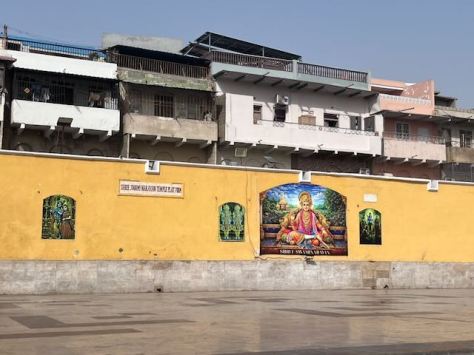
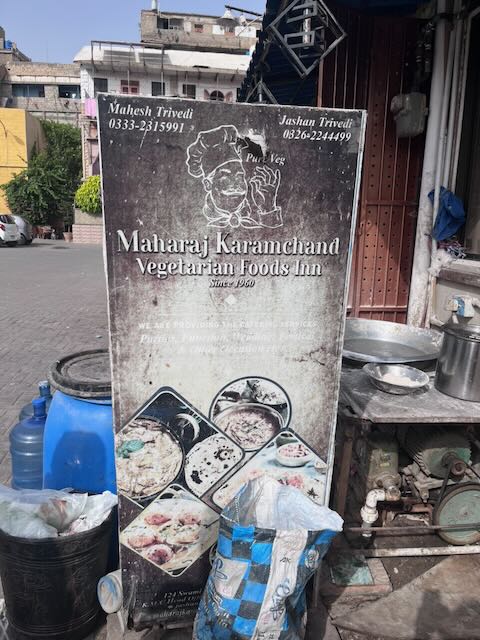
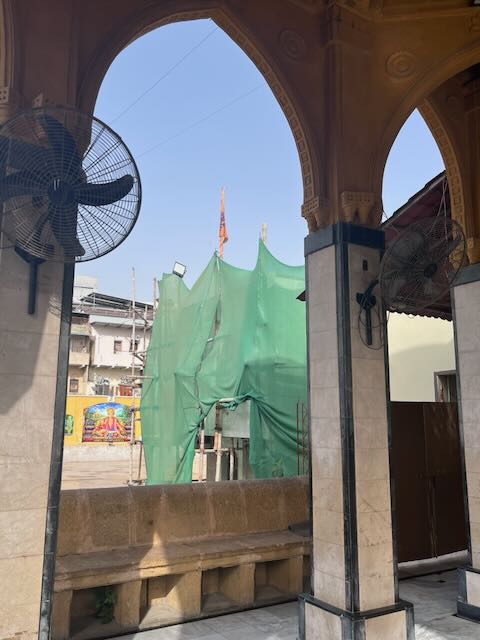
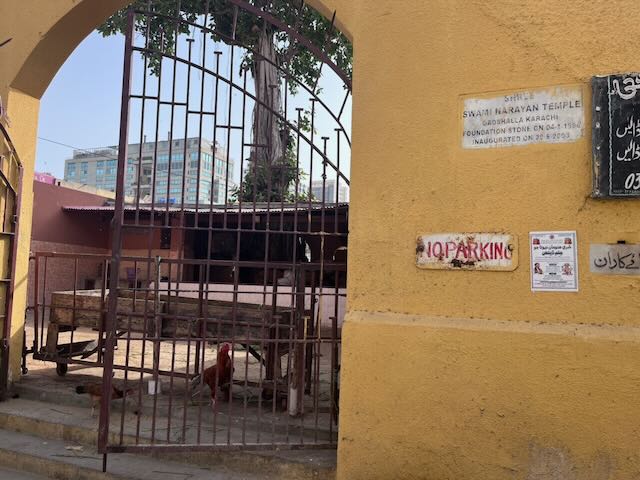
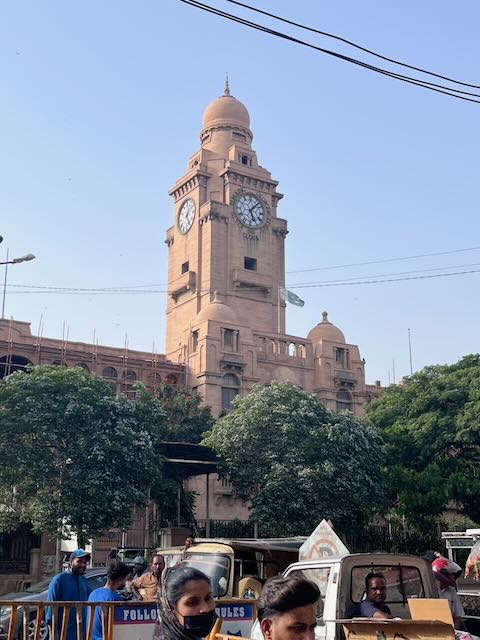
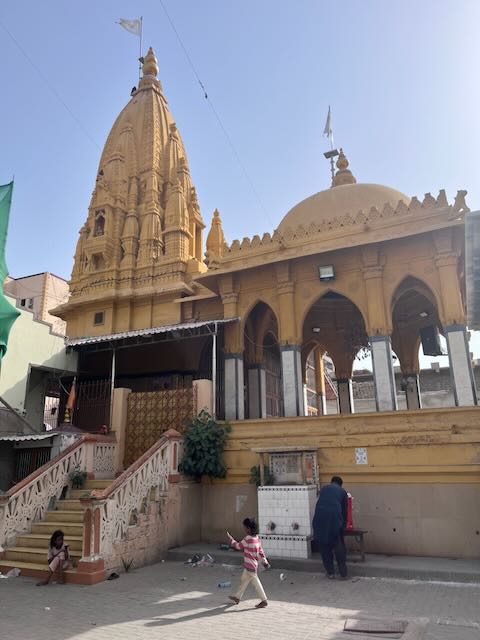
Pictures: Decay and Hope, Karachi, © Pippa Virdee, 2026

Brace yourself, this is a longer-than-usual blog piece, and one that is close and personal.

Recently, I came across a report from the Sutton Trust that reignited an old debate: is university education still worth it? A new survey found that the proportion of people who believe a degree is not worth the time and money has risen from 14% in 2005 to 34% today. As my own journey in this field keeps changing shape, I find myself constantly reflecting on why I came into it in the first place.

Where it started

I was the first person in my family to go to university, and as a recent migrant to the UK, I hardly understood the significance of a degree. And yet a few moments stand out clearly.

I had a difficult time adjusting to a grey, dull, cold country, and I struggled at school until my A-levels. That was when I discovered the power of studying and the possibilities that education could open up. My preference had actually been art, but Thatcher’s Britain left an indelible mark on me, and on my politics. It taught me how much history and politics mattered, so much so that I abandoned the idea of studying art at university. Even so, influences from the art world, such as William Morris, remained with me.

And, like the 1983 film Educating Rita, directed by Lewis Gilbert and starring Julie Walters, I wanted something else. Having grown up in working-class Coventry among people with few aspirations, I found it hard to want something different, something beyond marriage and children. I took my cue from a few of the “clever girls” at school who were applying to university, and since my A-level results were decent enough, I thought: I too can do this!

My mother

While Educating Rita was the external inspiration, the real one was right at home. My single mother, who never benefited from formal education herself, constantly encouraged me to educate myself and make something of my life. She struggled throughout her life, but she was remarkably resilient and strong, rebuilding and reinventing herself every time life threw another challenge at her. I drew strength from that then, and now when she is no more.

She would have preferred that I became a doctor, a lawyer, something “respectable,” but she supported my decision to study politics and history anyway, despite pressure from other family members who looked down on these subjects. I decided to stay at home rather than leave her alone, which narrowed my choices to Coventry and Warwick. I had offers from both, and to the dismay of my teachers, I chose Coventry.

Coventry, not Warwick

I would have started in 1992, the year 35 polytechnics became universities but, after deferring, I began in 1993. With little guidance or mentorship, I had almost no sense of the difference between Warwick and Coventry. Had I known, I might have made a more calculated choice. Instead, it was an emotional decision, based on instinct and on a course on India and Pakistan that caught my eye at Coventry, taught by someone who would go on to become my PhD supervisor.

Looking back, I think it was also a choice about fitting in. I simply sensed, as someone from a working-class background, that I did not belong at Warwick. Unlike Susan in Educating Rita, who studied English, I read International and Political Studies, a combination of politics, history, and international relations. Interestingly, this kind of combined degree has now made a comeback, partly as a result of rationalisation across the sector. Single-honours degrees are difficult to sustain in today’s market, and a combined programme can be an attractive package in the age of austerity.

Degrees then and now

Returning to the Sutton Trust report: the big difference today is that a degree is now intrinsically tied to employability. Students increasingly come to get a degree, rather than to get an education, and that distinction matters. I was incredibly fortunate to study without the financial pressures students face now. Had those pressures existed then, I probably wouldn’t have gone to university at all.

My undergraduate years were instrumental in opening up my world and my life. They transformed my ability to think, to articulate, to reason, and to question what I thought I knew. I left university without much clarity about what I wanted to do next, but that didn’t matter, because the three years themselves had taught me so much. Far more than the rigour of eight courses a year, each ending in a three-hour exam meant to prove I’d learned something. There were essays too, handwritten at first, typed by my final year, but the ratio was 25% coursework to 75% exam. Everything rested on those three hours at the end of the year. We thankfully now have much more diversity in assessment, but with the challenges of AI, the classroom exam is also making a comeback.

Like Susan, I left university a different person: more confident and genuinely surprised at how much I’d enjoyed the experience. So much so that I decided to keep studying part-time while working. I wouldn’t have made it through my undergraduate or postgraduate years without paid work on the side, even though fees were nowhere near today’s levels. During my MA, I worked first in academic bookselling until I was made redundant as the early tremors of Amazon (which launched in 1998) began shaking the book trade and then in banking, which simply didn’t fulfil me. Interestingly, I was working at a major high-street bank that was closing down branches at the time. The signs were all there in the late 1990s about how innovations in technology were changing our high streets and retail habits.

A turning point

I eventually decided the private sector wasn’t for me and chose something that felt more virtuous instead: the public sector. Of course, I quickly realised that this wasn’t any better! At the same time, I continued with my part-time MA, operating on something close to a pay-as-you-go model. That kind of flexibility barely exists today, outside perhaps the Open University, yet with the support of my tutors, it was possible then. In today’s system, I would likely have been terminated from the programme for missing coursework deadlines. But in a more generous era, when academics still had some autonomy and personal relationships mattered, you weren’t just a number.

Then, one day, a letter arrived with an advert for a PhD studentship. It was from Professor Ian Talbot, Coventry University. I saw it and dismissed it almost instantly; truthfully, I barely knew what a PhD entailed. But the seed was sown, and the rest is history (pun intended).

The studentship, covering fees and maintenance for three years, had been established by the nephews of Sir Penderel Moon (Indian Civil Service). They wanted someone to examine the violence and casualties of Partition; a subject long mired in debate about the true scale of loss at the time of British departure from India. Penderel Moon had produced his classic study Divide and Quit in 1961, drawn from his postings in Punjab, and afterwards edited volumes 5 to 12 of the Transfer of Power (1970-83) documents.

The PhD years were a constant exercise in pinching myself and thinking, is this really me? Am I really doing this, meeting these amazing people and minds? Some of that, I think now, was lacking what Bourdieu meant by cultural capital: the sense that certain ways of speaking, certain reference points, certain forms of ease in a room, are themselves a kind of inherited wealth, one I hadn’t been given. And some of it was what Appadurai calls the capacity to aspire: the idea that aspiration itself is unevenly distributed, that some of us have to learn, almost from scratch, how to imagine a future different from the one we were handed.

The Sutton Trust puts it plainly: graduates from non-graduate families often don’t catch up with graduates from graduate families, because higher education improves social mobility but doesn’t erase the effects of family background. While meritocracy in education is a wonderful idea, and it has helped to uplift many, the internalised habits, manners, language and style that come from our background remain with us. That feeling of being an impostor is directly related to what Bourdieu and Appadurai describe, not a personal failing, but a structural one. But through my academic journey, and in my first monograph, I turned to Catherine Hall, who writes:

For the most part, however, in all sectors of higher education we remain on the margins. But the margins can be a very productive terrain — a space from which both to challenge establishments and develop our own perspectives, build our own organisations, confirm our own collectivities. The hopes for feminist history in the 1990s cannot be the same as they were in the 1970s, for we are living in a very different political world, and some of the harsh lessons we have learned about both exclusivity and marginality must inform our practice in the future. The dream remains — a kind of history that excites and engages, that retains its critical edge, is open to new voices, and always in a dynamic relation to the political world in which we live. Catherine Hall, White, Male and Middle Class: Explorations in Feminism and History (Cambridge: Polity Press, 1992), p. 34.

The inspiration I drew from this ultimately led me to revise and publish my doctoral research as my monograph, From the Ashes of 1947: Reimagining Punjab (CUP, 2018)

Shrinking UK HE

I felt more at “home” in a post-92 institution, and the opening up of education was crucial for me, both as a student and eventually in my professional capacity. But since then, so much has changed in Britain. The optimism of the Blair years and “Cool Britannia” has given way to a “Global Britain” that is anxiously searching for a place in the world beyond Europe. We are on our way to having a seventh prime minister in the past ten years; the longevity of Thatcher and of Blair as her true successor seems like a different age in this era of musical prime ministerial chairs.

This rise and fall in political and national fortunes are being mirrored, brutally, in the education system itself, and post-92s have been absorbing the impact longest. As far back as 2015, the withdrawal of the teaching grant from non-STEM subjects hit post-92s hardest, prompting warnings that humanities provision would shrink back to “a narrower and narrower social circle of those who could afford to indulge their interests.”

A decade on, that warning reads less like a prediction than a description. Modern foreign languages provision has nearly halved since 2011; English studies have fallen by close to the same margin. In 2026, the University of Hertfordshire, a post-92 institution built on access and employability, suspended recruitment to its undergraduate history, philosophy, English, linguistics and creative writing degrees outright. As John Holmwood of the Campaign for the Public University has put it, post-92s have long been the “heavy lifters of social mobility,” the institutions through which working-class people bettered themselves through higher education. It is precisely that function that is now being dismantled.

Specific discipline studies, such as the Royal Historical Society briefing, confirmed that 88% of history departments in post-92 universities have seen explicit staffing cuts, compared to a lower (though still severe) 68% in pre-92 universities.

What makes this a class story, not just a funding story, is where the losses land. A 2025 British Academy report found large parts of the country are already humanities’ “cold spots,” with no provision at all within a commutable sixty kilometres, a divide that falls hardest on students who cannot simply relocate to wherever a course still survives. A student in a well-off city with three universities on their doorstep has choices. A student tied to a single local institution by money, family, or circumstance does not.

It would be wrong now to pretend Russell Group universities are exempt from the above; they are not. The UCU’s tracker recorded 105 institutions pursuing redundancies, restructures or closures as of late 2025, with Russell Group members accounting for 41% of the sector’s £303 million severance spend in 2024–25 despite being a smaller and wealthier cohort. Nottingham seeks to cut 150 posts, mostly in the humanities, and has withdrawn language degrees. Exeter is consulting on cutting a similar number, 85% of them in humanities, arts and social sciences. Sheffield cut 614 jobs in a year. Bristol pushed voluntary severance specifically at its humanities faculty. Leicester closed Film Studies and Modern Languages entirely, rescinding around 300 offers. A small example in a pool of many.

The consumer vs public good

So, the crisis has widened. But it has not reversed the underlying pattern: market competition means students increasingly gravitate to the universities with the strongest reputations, which makes closures disproportionately likely at exactly the lower-tariff institutions that working-class and first-generation students are more likely to attend. Post-92s were hollowed out first and hardest; the Russell Group is now losing humanities jobs too, which are largely at the margins of institutions that remain, on the whole, intact. Peter Fleming makes a good case for linking the neoliberalisation of HE and its ultimate decline in Dark Academia: How Universities Die.

That distinction matters because it is the same distinction Bourdieu and Appadurai pointed to. The people most likely to need the humanities to develop the cultural capital, the confidence, the capacity to aspire that I stumbled into almost by accident, are the people increasingly least likely to have local, affordable access to them. A degree in history or politics did not just give me a qualification; it gave me a way of thinking that money and background hadn’t. Strip that access away from the institutions serving people like the one I was, and you are not trimming a subject choice. You are closing a door that, for a certain kind of working-class kid, was the only door going.

The current implosion taking place across the sector does not seem to concern people; there is an almost visceral lack of trust and faith in “experts” and universities. This, of course, is not accidental. People who question, challenge, and think critically are inconvenient in a populist, post-truth world increasingly shaped by AI. Education should be a safe space in which we can teach and debate ideas freely. Except, right now, it is not. History itself is contested ground.

What lessons should we be learning? How do we make sense of the present through the past? Everything we experience, personally or politically, has a historical context, and that context is the key to understanding now. History gives us the tools and the language to articulate our thoughts and make sense of the world around us. I went to university as an idealist. I left with some of that idealism intact, but with a good deal of cynicism too, the kind that teaches you to always ask questions, never assume knowledge, apply reason, be critical, seek evidence, and fact-check your sources. This is why history matters, and why we must defend it. And more so in the age of AI.

Between Worlds: On Hate, History, and the Possibility of Belonging

Peshawar © 2017 Pippa Virdee

The last three days have been an uncomfortable reminder of how far we have slipped — or perhaps how far we never truly moved — in our relationship with hatred and bigotry. Yet within that discomfort, I also found unexpected moments of beauty and hope, each one a small act of resistance against the noise.

A Sufi Voice in Leamington Spa

On Saturday, I visited the Gurdwara in Leamington Spa to hear Dr Asma Qadri, a scholar of Punjabi language, literature, and culture, speak on Punjabi poetry and the Sufi tradition. Her focus was Baba Farid (1173–1268), a figure of remarkable spiritual and literary stature. In the Guru Granth Sahib — the sacred scripture of Sikhism — there are 112 shaloks (couplets) attributed to Baba Farid, and at their heart is a message of interfaith harmony, compassion, and non-violence. That a Muslim saint’s words were enshrined in a Sikh scripture centuries ago speaks volumes about a pluralism that many today seem intent on dismantling.

Farid, if you are maltreated
Do not react with violence and projection
Visit the Other
And kiss his feet in humility and affection!

Source: Harjeet Singh Gill, Sufi Rhythms, Patiala University, 2007

Baba Farid was born near Multan, his lineage traceable to Kabul, from where his family had migrated to the Indus Valley. He later moved to Delhi, where he received spiritual instruction from Khwaja Qutbuddin Bakhtiar Kaki, a saint of the Chishti Order. He eventually returned to Punjab and settled in Ajodhan (present-day Pakpattan), from where he led the Chishti Order until his death.

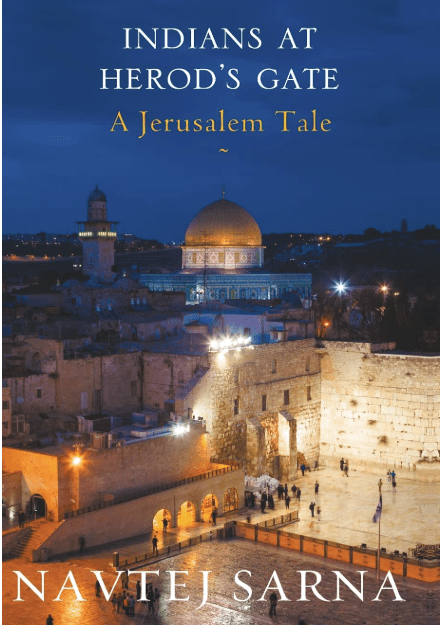
What is perhaps less widely known is that Farid is believed to have travelled to Jerusalem around 1200 CE — not long after Saladin had recaptured the city from the Crusaders. A small shrine there, still accessible, is said to mark his presence. Navtej Sarna, a former Indian Ambassador to Israel (2008–2012), writes about this connection in his book Indians at Herod’s Gate: A Jerusalem Tale (Rupa, 2014) — a quiet, often-overlooked thread linking the Indian subcontinent to the Holy City over eight centuries. Read further: Indians Herods Gate and Jerusalem’s 800-year-old Indian hospice

After the lecture, our group of three — drawn from different faith backgrounds — sat together for langar, the community meal served at Gurdwaras. There is something deceptively simple and profoundly radical about langar. The act of sitting together, regardless of religion, caste, or status, and eating the same food dissolves hierarchies that societies expend enormous energy to maintain. It is a challenge that remains genuinely difficult in parts of India, where communal and caste taboos still govern not just what people eat, but with whom and where. In that shared meal, something ancient and necessary was quietly affirmed.

The Descent into Dystopia

The following day, I made the mistake of listening to a News Agents podcast: Why MAGA Hates Britain. I say mistake not because the journalism was poor — it wasn’t — but because the content was genuinely dispiriting. The podcast drew on interviews conducted at the Conservative Political Action Conference (CPAC), where the blatant hostility toward Muslims was on full display. What struck me was not just the bigotry itself, but the absolute self-assurance with which it was expressed — the sense of a parallel world, hermetically sealed from doubt or nuance, in which hatred had been fully normalised and even celebrated.

It is worth noting that CPAC is not a fringe gathering. It draws senior politicians, media figures, and policymakers, including Britain’s shortest-serving prime minister, Liz Truss, who has found the political validation that eluded her at home in MAGA circles. When hatred is mainstreamed in those spaces, it travels outward with authority and legitimacy. The podcast was a sobering record of that.

A Fragment from 1947

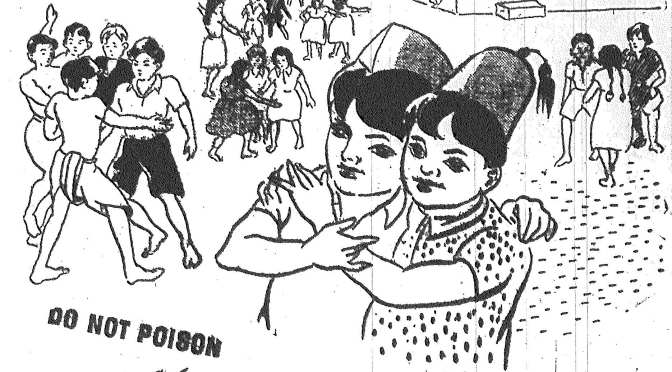
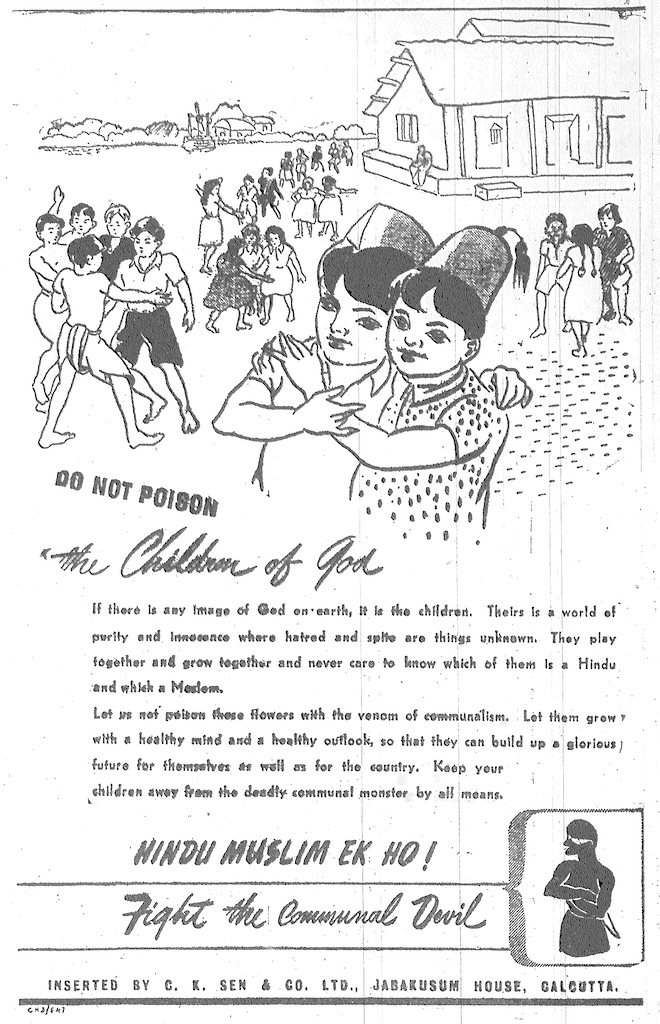
Turning away in revulsion, I returned to my own research — a space in which I can explore the ideas that still feel worth holding onto. Almost serendipitously, I came across an advertisement from September 1947 in the Bombay Chronicle, published just weeks after Partition had carved the subcontinent into India and Pakistan, leaving 1-2 million dead and over 15 million people displaced. The advert’s message was striking in its urgency and its pathos: the violence and bloodshed that had torn communities apart must now be put aside. The “children of God” must be taught how to live together rather than being “poisoned” by the hatred that had consumed the preceding years.

The text reads: If there is any image of God on earth, it is the children. Theirs is a world of purity and innocence where hatred and spite are things unknown. They play together and grow together and never care to know which of them is a Hindu and which a Moselm. Let us not poison these flowers with the venom of communalism. Let them grow with a healthy mind and a healthy outlook, so that they can build up a glorious future for themselves as well as for the country. Keep your children away from the deadly communal monster by all means. Hindu Muslim Ek Ho! Advertisement inserted by C.K. Sen & Co. Ltd.
Bombay Chronicle 26 September 1947. Photo taken by Pippa Virdee from NMML, Delhi.

What moved me most was the implicit admission within that language: that society had already been poisoned, and that the antidote required active, deliberate effort. It was a call not to innocence but to conscious repair.

The Distance That Grows

That advertisement also stirred a more melancholic reflection. There was a time, however brief and fragile, when greater openness between India and Pakistan seemed imaginable — when the possibility of travel, communication, and even reconciliation had not yet been foreclosed. The Wagah-Attari border crossing, for decades a symbol of that flickering possibility, remains closed following the Pahalgam attack of April 2025. Yet that closure is not merely a consequence of one incident. It reflects a deeper estrangement — one that has steadily worsened since the BJP came to power in 2014, as the distance between the two countries has grown not just diplomatically but also culturally, emotionally, and imaginatively.

When borders close, it is not only people who are separated. It is stories, families, histories, and the ordinary human exchanges that quietly resist the narratives of enmity.

On Connecting the Moments

What struck me, looking back across these three days, was how tightly these experiences were bound together — the lecture on a 13th-century Sufi poet, the langar table, the CPAC recordings, the 1947 advertisement, the closed border. They form a kind of map of where we are and where we might yet go.

We are constantly surrounded by voices that insist conflict is natural, that difference is danger, that the world is a zero-sum competition between faiths and peoples. But Baba Farid’s couplets, preserved across centuries and across religious traditions, suggest otherwise. The langar meal, served to strangers, suggests otherwise. Even that desperate 1947 advertisement, placed in the shadow of catastrophe, suggests otherwise — because in the middle of all that devastation, they still believed it was worth trying to preserve unity over enmity.

Conflict has never resolved anything. It only plants the seeds for the next generation’s hatred. What endures are the moments when we chose differently — when we visited the Other, and sat with them, and ate.

It remains up to us to remember our neighbours — not as symbols, threats, or abstractions, but as people, first and foremost. This message is a recurring theme in advertising campaigns that, while not so distant in time, feel increasingly remote in spirit. The YouTube clips, from just a decade ago, speak a language of interfaith harmony that the intervening years — and the political choices made within them — have done their best to drown out. That they once existed, and were made for mass audiences, is itself worth remembering.


Hindu Muslim Unity: Best Creative and Inspirational Indian Ads | Part 1 | Creative Ads

Hindu Muslim Unity: Best Creative and Inspirational Indian Ads | Part 2 | Creative Ads
Humsaye Maa Jaye by Bushra Ansari and Asma Abbas – Official Video

Reimagining Punjab Through Ustad Daman’s Poetry

Model Town, Lahore. © 2017 Pippa Virdee

During the writing of my book, “From the Ashes of 1947: Reimagining Punjab,” I endeavoured to incorporate some of the poetry and literature that encapsulated the emotions and sentiments of the aftermath of the Partition of Punjab. My intention was to highlight the contributions of Ustad Daman, a lesser-known figure in certain regions of South Asia but a significant figure for many, particularly in Lahore, the city of his birth. As another year passes and we inch towards the 80 years of the Partition, his work assumes a heightened relevance in the contemporary context.

Ustad Daman, whose real name was Chiragh Din, hailed from Lohari Gate within the historic old city of Lahore. His father was a tailor who owned his own small shop. His elder brother, Feroz Din, joined his father in managing the business, but young Chiragh had no inclination to pursue the family trade. Instead, he harboured aspirations for education and a clerk’s position. He attended school, but this did not result in a clerk’s job. Disappointed, he returned to tailoring and established his own shop. However, his heart was truly captivated by poetry. He would abandon his shop to attend poetry readings. Inspired by his mentor, Ustad Hamdam, he adopted the pseudonym Damdam, but later changed it to Daman. (Source: Apnaorg)

The pivotal moment came when he received his first payment for reciting poetry in a public gathering. This marked the commencement of his journey as a poet. Initially, Daman composed poetry on conventional subjects, such as matters of the heart. However, as the independence movement gained momentum prior to partition, political themes began to permeate his poetry. Daman was a member of a group of traditional Punjabi poets who would recite poetry extemporaneously, while their pupils maintained the records. This tradition earned them the title of Ustads (mentors). (Source: Apnaorg)

Below are some references and material that highlight the significance of Ustad Daman.

Folk Punjab has a digital archive of his poetry including ‘Es mulk di wand kolon yaro’.

Ustad Daman, ‘The Poet Laureate of the Twentieth Century Punjab’ Fowpe Sharma, Revolutionary Democracy

Ustad Daman lived and wrote poetry as someone always on the wrong side of the establishment By Dr. Afzal Mirza, Apanorg.

Rammah, Safir. “West Punjabi Poetry: From Ustad Daman to Najm Hosain Syed.” Jounral of Punjab Studies 13, no. 1&2 (2006): 216.

Below the opening of Chapter 10, Virdee, P., 2018. From the Ashes of 1947. Cambridge University Press.

Embracing Nostalgia Through Music and Gardening

A long weekend spent revamping the garden has left me feeling quietly thankful—grateful not only for the beauty of blooming flowers but the often-overlooked moments that bring small moments of joy to us. These are the everyday miracles that ground us, offering us gentle reminders to be present, and to be grateful for the life and family that support us and get us through difficult times. They act as pillars, always there in the background but without whom we could not exist.

In August 2016, I began this blog as a space to document my experiences during a visiting fellowship in Lahore, as well as to share other events and observations that captured my interest along the way. This has grown into a broader canvas—one where I could share photographs, music, and reflections, often framed with a touch of historical context. Over time, the blog has become not just a repository of memories, but also a means of connecting with others.

When I first considered what to name this space, I wanted something that could symbolise both personal growth and a diversity of ideas. I eventually chose Bagicha—the Urdu and Punjabi word for “garden.” The name felt right, evoking a place where different thoughts, emotions, and inspirations could coexist and bloom. Like any real garden, this blog has required time and care, and though life’s demands have occasionally interrupted the rhythm of posting, I’ve done my best to return and tend to it regularly.

This past weekend, I turned my attention to my actual garden, which had begun to show signs of wear and neglect. I found myself hoping that this act of renewal would also translate into a more productivity for my Blogging and provide inspiration for other writing projects over the coming summer.

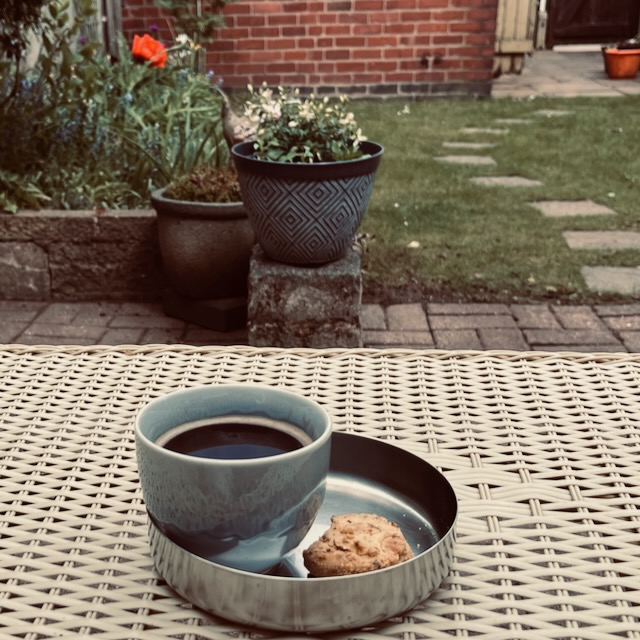
After the work was completed, I treated myself to a quiet moment with a cup of coffee and a Karachi Bakery biscuit, enjoying the fruits of my labour over the long May Bank Holiday weekend. As I unwound, scrolling casually through Instagram, I stumbled upon a deeply nostalgic song: Mai Tenu Yaad Aawan Ga (You Will Remember Me), sung by the legendary Surinder Kaur and Asa Singh Mastana. This version, recorded in Toronto in 1980, is hauntingly melodic—its rich tones and heartfelt lyrics evoke a bygone era.

Surinder Kaur, often hailed as the “Nightingale of Punjab,” remains one of the most celebrated folk singers in South Asian musical history. Her voice, both powerful and tender, became a defining sound of Punjabi folk music in the 20th century. Asa Singh Mastana, her equally iconic counterpart, was known not only for his duets with Kaur but also for his contributions to Bollywood as a playback singer. Both Kaur (born 1929 in Lahore) and Mastana (born 1926 in Sheikhupura) belonged to pre-Partition era and migrated to Delhi after 1947. They continued the musical journeys that had begun in Lahore and helped shape the soundscape of post-Partition Punjab.

Their music carries the weight of memory, migration, and resilience. Listening to them, one feels transported—not just to another time, but to a shared emotional and cultural landscape that continues to resonate deeply.

Listen to this timeless song and linger for a while in its emotional undertones. I’ve also included some photographs to accompany the mood—a small attempt to honour the spirit of nostalgia and historical connections that Bagicha has tried to capture.

Top Posts in 2024

I hope you have been enjoying the photos and blog pieces from 2024 and rather belatedly I’m sharing the top posts from last year.

  1. Mein Tenu Phir Milangi – I will meet you yet again by Amrita Pritam

2. Ajj Aakhaan Waris Shah Nu By Amrita Pritam

3. Sahir Ludhianvi and the anguish of Nehruvian India

4. Poetry Corner: Lahore

5. “My spiritual guru is Nanak Dev and my trade guru is Baba Vishvakarma”

6. 23 Sir Ganga Ram Mansion: The house of Amrita Sher-Gil

7. 70 years ago: extracts of the Sunderlal Report, Hyderabad 1948

8. (Inhabiting) the Space between Black and White: Indian/Sikh Community in Kenya

9. How the Photographs of Margaret Bourke-White became the Images of Partition.

10. 1881: the first full census in British India

What makes you feel nostalgic?

Carefree Days with Pran Nevile, April 2016. © Pippa Virdee

Today’s daily prompt on WordPress was “What makes you feel nostalgic?” I of course immediately started thinking and letting my mind wonder into the past. The past that is often nostalgic and romantic; it is after all the 31 December! Immediately one memory came back like a flash.

I recall the numerous times that I went to visit Pran Nevile at his home in Gurgaon, where we would have meet, chat, drink and eat. And almost always there would be music playing in the background, the kind of music that transports you to a bygone era, along with the conversation. These “Carefree Days” are no more, but those precious memories remain.

Beyond the nostalgia I remember I wrote a tribute for Pran, which was supposed to have been published but I suspect it never was. I most likely didn’t follow up because of work distractions. Upon a keyword search (thank goodness for that!) I found the tribute on my laptop straightaway. I sat there with the melodic voice of Begum Akhtar in the background and re-read the piece, feeling sad but happy to have met someone like Pran at the beginning of my own journey. It makes a fitting post for today’s prompt, as I will always associate Pran with the nostalgia of a pre-partitioned Punjab that is no more.

Pran Nevile (1922-2018): A Tribute

I first met Pran Nevile in 2001, when I embarked on a new journey in my life of pursuing a PhD. He was recommended to me by my supervisor, Prof. Ian Talbot. We met, like on many subsequent occasions, at his favourite place in New Delhi, the India International Centre (IIC). I was beginning my research into the impact Partition had on Punjab, exploring this through first-hand accounts of people, who were forced to abandon their homes and leave during that tumultuous and violent time. Pran was born in Lahore in 1922 and thus could recollect stories from the colonial period thereby contextualising this impact on Punjab following Partition. At the time I didn’t know much about Pran, beyond that he had written a book on Lahore and that he had a previous career in the Indian Foreign Service. In many ways, I was an outsider to both the intellectual Delhi circle and academia, more generally. We sat in the café at the IIC and had tea, while chatting about an array of subjects. Almost straightaway we bonded as he radiated with an old-school genteel charm that belongs to a by-gone era; certainly not of the India and Pakistan today. He paid me a wonderful/witty compliment, by saying that when I speak in Punjabi, I sound like a Punjaban and when I speak in English, I am a mem. He would repeat this on numerous occasions. This was the beginning a friendship, which endured until he passed away on 11 October 2018. He was my connection to the pre-partitioned Punjab, and I was his connection to Lahore, exchanging notes and comparing the-then and now. 

Growing up in Lahore

Pran’s family lived in Nisbet Road in the walled city of Lahore, where his father had migrated to in the early 1910s from their ancestral village of Vairowal, in neighbouring Amritsar district. Following his education at the DAV School, he was successful in getting a scholarship and got admission to the prestigious Government College Lahore, from where he graduated in 1943 in MA Economics. He recollects many of his early memories of growing up in Lahore in his autobiography, Carefree Days (2016), recounting the days of “pastimes, fairs and festivals”, which would keep them amused all year round. His favourite pastime though was kite flying, as he writes: “I cannot recall anything more thrilling than kite flying in my boyhood” (pp. 10-11). Pran, like many others, lamented the later ban on kite flying in Lahore, which has seen the demise of the popular Basant festival.

Writing Lahore: A Sentimental Journey (1992), a book that instantly resonated with many Lahoris, enabled Pran to visit the city of his childhood. He was one of the lucky ones because he was able to visit Lahore with ease, a romance that he rekindled with this tribute to the city of his birth. He often recited, Jine Lahore nahin Vekhya oh Jamya hi Nahin (One who has not seen Lahore is as good as not having been born at all) (p. 193). Like many other people who left their ancestral homes (thinking they would be back), he had a photographic imprint of the city in his mind, remembering every nook and cranny of the congested Androon Shehr. Professor Tahir Kamran organised a two-day conference at GC University on ‘Punjab and the Raj’ in 2006 and Pran was invited to speak at this conference. I distinctly remember a moment from then, when another friend from Lahore, Bilal Ahmed was driving the car, and Pran was seated in the front and me in the back. We were in the walled city, trying to locate a venue and unsure about the exact location. Immediately, Pran started to navigate and provide directions. He said he can never forget the streets of his Lahore, despite all the changes since his he was a student in the city. It was a heart-warming and amusing moment we never forgot.  

Never-ending Retirement

Pran graduated during the political and international upheaval of World War Two. His desire was topursue a PhD at the London School of Economics, but the uncertainty of that period prompted him to take up an opportunity at the Bureau of Public Information in 1944 as an assistant journalist. After a series of different posts, he was selected for the Indian Foreign Service Board in 1955 as second secretary (commercial) (Carefree Days, p. 46). He joined the Ministry of External Affairs as an attaché in March 1959 and subsequently was posted in Warsaw (1962), Belgrade (1966) and Moscow (1969). By 1974, he was back at the Ministry of Commerce as deputy secretary (East Europe). After that came the opportunity to go to Chicago in 1977, which he recalls ended his “eventful official link with the socialist world of East Europe” (p. 148). During this period, he also had a short stint in Geneva which allowed him to develop his links with the UNDP, which ultimately paved the way for a second career. Soon after in May 1979, he took premature retirement, leaving after 35 years of professional life. He was now the programme coordinator for the UNCTAD, based in Geneva and this allowed him to rekindle his relationship with East Europe until 1985, when he returned back to India. One of the highlights of this stint surely was when he took on the role of a priest and performed the marriage rites for one of his friends in Geneva; a story he often shared with relish.

For a conventional diplomat, Pran was more austere and radical in his personal life. As he recalls in his autobiography, he developed an “abhorrence for this ostentatious tamasha and meaningless jubilation” (p. 49) that surrounded elaborate engagements and wedding ceremonies. In this endeavour, he developed a friendship with Savitri (daughter of an uncle who was married to Pran’s father’s first cousin!), often acting as her mentor and encouraging her towards the pursuit of knowledge and education. He first noticed her in July 1941, as a young man discovering his own self, and by January 1947, they had eloped and had a civil ceremony in Delhi. Early reservations against this marriage were put aside by their families, and he remained with Savitri until she died in 2013. A spark in him went after that.

The Last Calling

After his retirement from work, he decided to embark on yet another career, but this time, it started as an unplanned script. It was in 1987, when he first started making frequent trips to the IIC, spending his days in the library and often using this as office space for his writing. Initially, he only ventured towards his expertise area and wrote on economic matters, but it was not long before his real passion emerged and he turned his gaze towards other subjects, which included his hometown Lahore, nautch girls, dance and music. Feedback from these early forays in small articles gave him confidence to continue with this newfound passion; although one of his earliest writings dates back to 1949, when he wrote ‘Problem of the Mother-in-Law’ which was published in Caravan magazine. His first full-length literary work was inevitably on Lahore, as he recalls: “My desire was to take the reader on a pilgrimage to my Lahore of a bygone era of peace and plenty” (p. 171). The idea for the book was actually conceived way back in 1963 in Hotel Astoria, Geneva. On his seventieth birthday he received the advance copy from the publisher of his first book, Lahore: A Sentimental Journey.

This journey led him to write prolifically on the era of the British Raj. Being a product of that era, he imbued the character of the Brown Sahib and carved out a niche for himself, focusing on the social and cultural history of the British Raj. His fascination for visual and performing arts led him to unearth a vivid and richer history, which he energised many around him with. During the last few years of his life, he reserved his love for K.L. Saigal, the “immortal singer and superstar” (p. 189). My own recollections of Pran were always of visiting him in Gurgaon, chatting at length while nibbling on namkeens, and with the nostalgia of 1940s and 1950s music playing in the background. Those days are no more nor are those, which is his own words read:   

“I belong to the vanishing generation of pre-partition days who were forced to leave their homeland but carried ‘Lahore’ in their hearts like the memory of a first love. Overpowered by nostalgia, we still recall the days when Lahore had attained the reputation of being the ‘Paris of the East’ where people of different communities live in harmony in the sunshine of their common heritage, historic bonds and flamboyant Punjabi culture.” (Carefree Days, p. 194).

Women, Violence and the Silences: 1984

© Pippa Virdee 2024

Forty years ago, Delhi witnessed some of the worst violence since 1947. It was the events of October-November 1984, that prompted Urvashi Butalia to revisit the Partition of 1947 and to excavate the history of the violence that was perpetrated towards women. Both 1947 and 1984 have left indelible scars on the people and region. The opening in her book, The Other Side of Silence (1998), is worth quoting detail:

“Then, in October 1984 the prime minister, Indira Gandhi, was assassinated by her security guards, both Sikhs. For days afterwards Sikhs all over India were attacked in an orgy of violence and revenge. Many homes were destroyed and thousands died. In the outlying suburbs of Delhi more than three thousand were killed, often by being doused in kerosene and then set alight. They died horrible, macabre deaths. Black burn marks on the ground showed where their bodies had lain. The government – now headed by Mrs Gandhi’s son Rajiv remained indifferent, but several citizens’ groups came together to provide relief, food and shelter. I was among the hundreds of people who worked in these groups. Every day, while we were distributing food and blankets, compiling lists of the dead and missing, and helping with compensation claims, we listened to the stories of the people who had suffered. Often older people, who had come to Delhi as refugees in 1947, would remember that they had been through a similar terror before. ‘We didn’t think it could happen to us in our own country,’ they would say. This is like Partition again.” (Page 4-5) “It took 1984 to make me understand how ever-present Partition was in our lives too, to recognize that it could not be so easily put away inside the covers of history books. I could no longer pretend that this was a history that belonged to another time, to someone else.” (page 6)

But history keeps repeating itself, again and again. In 1984, people still had fresh memories of 1947, and so those three days of carnage evoked the spectre of Partition once again. Yet each time this happens, there is collective amnesia and each time there is no justice for the “chief sufferers”, the women who bear the brunt of political-communal violence. Below are a selection of articles and abstracts available on the subject and organised chronologically. At the end, there is a recent documentary by The Quint on “The Kaurs of 1984” which brings to the fore the accounts of the women who endured this and who have continued their fight for justice. .

The Justice G.T. Nanavati commission was a one-man commission, a retired Judge of the Supreme Court of India, appointed by the National Democratic Alliance (NDA) government in May 2000, to investigate the “killing of innocent Sikhs” during the 1984 anti-Sikh riots. The report was finally published in 2005.

Mander, Harsh. “Conflict and Suffering: Survivors of Carnages in 1984 and 2002.” Economic and Political Weekly (2010): 57-65. Even through these were separated by 18 years of history, there is tragically a great deal in common between the communal massacres that played out on the streets of Delhi in 1984 and in settlements and bye-lanes across Gujarat in 2002. This paper documents some of the findings of the research conducted with survivors of these two major pogroms over more than a year in the widows’ colony established by the Delhi government in Tilak Vihar and in four of the worst-hit district of Gujarat. It examines the paths of suffering, renegotiation and healing separately for the direct victims and the vicariously affected.

Kaur, Ravinder. “Wound, Waste, History Rereading 1984.” Economic and Political Weekly (2014): 34-38. Wounds are expected to heal. Our very conception of victims and victimhood is based on this hopeful axiom. But not all wounds heal, some remain in a constant state of decay, degenerate, and ultimately risk turning into waste too. It is this possibility of waste that this article explores. The 1984 violence is one of those historical wounds that has neither faded from public memory nor fully healed. At the heart of this unhealing wound is the question of justice that has long been denied to the victims. The judicial affidavits prepared in early 1985 not only narrate the violence that unfolded systematically, but three decades later testify to the inability of the state apparatus to help heal its wounded citizens

Saluja, Anshu. 2015. “Engaging with Women’s Words and Their Silences: Mapping 1984 and Its Aftermath.” Sikh Formations 11 (3): 343–65. doi:10.1080/17448727.2015.1102554. In studying the 1984 pogrom and its aftermath, I have attempted to capture the voices of women of succeeding generations of the victim families and to gauge some sense of the arduous path which these women have had to tread on. In the present paper, I have examined and assessed the ways and means which women survivors of the 1984 pogrom have relied on to cope with their sense of trauma and hurt, and to negotiate everyday existence. In accounts seeking to document and map the experiences of trauma survivors, the themes which they raise and the issues that they speak of are taken into cognisance, while the gaps in their speech often remain unnoticed and unexplained. But these silences and gaps need to be recognised and highlighted as much as the speech of the survivors. Women survivors of 1984 also do not speak of their own agency, leaving it mostly unarticulated in words. Gauging a sense of this requires going beyond the words that are spoken and attempting, even if tentatively, to unravel and interpret the silences.

Kaur, Ishmeet. “Narrating the Experience: Oral Histories and Testimonies of the 1984 anti-Sikh Carnage Victims.” Journal of Punjab Studies 23 (2016). http://giss.org/jsps_vol_23/6_kaur.pdf This essay attempts to understand the word “testimony” and asks how oral histories can also become testimonial. It considers how new histories can unfold from oral accounts of the victims in the context of 1984 anti-Sikh carnage in Delhi. It argues that formal testimonies may misrepresent events by diminishing the gravity of the violence experienced by the victims, while oral narrations may be considered useful historical sources. As a case study, we consider selected affidavits submitted to Nanavati Commission in 2000, as well as oral narratives of the survivors recorded during a field visit to the Tilak Vihar widow’s colony in April 2015.

Arora, Kamal. “Legacies of violence: Sikh women in Delhi’s” Widow Colony”.” PhD diss., University of British Columbia, 2017. https://open.library.ubc.ca/soa/cIRcle/collections/ubctheses/24/items/1.0343994 This dissertation examines how Sikh women who survived the anti-Sikh massacre in 1984 in Delhi, India, cope with the long-term legacies of violence and trauma amid the backdrop of the urban space of the city. After the assassination of then Prime Minister Indira Gandhi by her Sikh bodyguards, approximately thirty-five hundred Sikh men were killed in October and November 1984. Many of the survivors, Sikh widows and their families, were relocated shortly after to the “Widow Colony,” a designated slum also known as Tilak Vihar, within the boundary of Tilak Nagar in West Delhi, as a means of rehabilitation and compensation. The work arises from fieldwork carried out between December 2012 and March 2014. I begin by discussing in depth the space of the Widow Colony and its relation to the rest of the city of Delhi. I then analyze the events of the 1984 massacre through the narratives of Sikh widows and how they remember their experiences of violence. I discuss how violence can have long-term ramifications for everyday life in arenas such as kinship networks, economic stability, health and wellness, and social life. These experiences are further amplified by gender, caste, and class. I also examine the impact of the stigma of widowhood in this community. This research seeks to interrogate how memories of violence inform, and are constituted by, embodied, affective practices carried out in a gendered space produced by the state. I argue that Sikh widows cope with long-term trauma by creating new forms of sociality and memory through their everyday lives and religious practices in the Widow Colony. The memory of the 1984 violence figures heavily among the Sikh diaspora. Thus, I also explore the relationship between the Widow Colony and Sikhs in the transnational arena.

Arora, Kamal, ““I Get Peace:” Gender and Religious Life in a Delhi Gurdwara” Religions 11, no. 3: 135 2020. https://doi.org/10.3390/rel11030135 In October and November of 1984, after the assassination of Prime Minister Indira Gandhi by her Sikh bodyguards, approximately 3500 Sikh men were killed in Delhi, India. Many of the survivors—Sikh widows and their kin—were relocated thereafter to the “Widow Colony”, also known as Tilak Vihar, within the boundary of Tilak Nagar in West Delhi, as a means of rehabilitation and compensation. Within this colony lies the Shaheedganj Gurdwara, frequented by widows and their families. Based on ethnographic fieldwork, I explore the intersections between violence, widowhood, and gendered religious practice in this place of worship. Memories of violence and experiences of widowhood inform and intersect with embodied religious practices in this place. I argue that the gurdwara is primarily a female place; although male-administered, it is a place that, through women’s practices, becomes a gendered counterpublic, allowing women a place to socialize and heal in an area where there is little public space for women to gather. The gurdwara has been re-appropriated away from formal religious practice by these widows, functioning as a place that enables the subversive exchange of local knowledges and viewpoints and a repository of shared experiences that reifies and reclaims gendered loss.

Agarwal, Yamini. Urban Marginalization, Exclusion and Education-the Widows’ Colony in Delhi. Bonn: Max-Weber-Stiftung-Deutsche Geisteswissenschaftliche Institute im Ausland, 2020. This paper examines the many exclusions and marginalities experienced in urban neighbourhoods which are formed as a result of communal violence. It draws on an ethnographic study of Tilak Vihar, also known as the Colony of Widows, where the survivors of the 1984 anti-Sikh violence were resettled. By examining their life histories, the paper explores how women survivors have been caught up in a vicious circle of poverty and lack of educational and occupational opportunities due to their location in a highly stigmatized and gendered space. This has affected the education of their children, as reflected in limited school choices and poverty forcing young people to drop out of schools to fend for their families. The paper also looks into the role of community groups in Tilak Vihar, which have become the main source of support for families given the retreat of the state from this space. The paper underscores the everyday violence that survivors experience due to their gender and spatial location.

Saluja, Anshu. “Gendered Erasures in Memory: Silencing of Cases of Sexual Violence in 1984.” Sikh Formations 20 (3): 149–63, 2024. doi:10.1080/17448727.2024.2384843. In this paper, I have addressed the issue of sexual violence in the specific context of the 1984 anti-Sikh carnage in Delhi. Though a significant number of cases of sexual assault took place in Delhi in November 1984, they have largely remained shrouded in obscurity. I have attempted to analyse the reasons, prompting a near total silence on these instances. In undertaking this inquiry, the paper reflects on the selective, and often disempowering, nature of memory-making and preservation. It goes on to ask the critical question: what constitutes legitimate memory?

Kaur, Jasleen, and Vinita Mohindra. “Spectral Wounds of 1984: Sikh Massacre in Harpreet Kaur’s The Widow Colony: India’s Unsettled Settlement.” Sikh Formations, March, 1–11, 2024. doi:10.1080/17448727.2024.2321416. In 1984, Sikhs were massacred following the assassination of Prime Minister Indira Gandhi. Cultural expressions attempt to foreground the haunting legacies of this genocide. This paper explores Harpreet Kaur’s documentary, The Widow Colony- India’s Unsettled Settlement which unfolds as trauma testimony of the understudied conflict, contextualizing the spectral wounds of Sikh widows and their struggle for survival. Using hauntology and postmemory as critical lens, this article examines the spectral wounds of 1984 Sikh genocide. It also focuses on the gendered dimensions of violence against Sikh women by enunciating their doubly victimized sensibility through their experiences of shame, trauma and suffering.

Kaur, Jasleen, and Vinita Mohindra. “(Un)Dead Past of 1984 Sikh Massacre in Jaspreet Singh’s Helium.” Sikh Formations, September, 1–19, 2024. doi:10.1080/17448727.2024.2408859. Prime Minister Indira Gandhi’s assassination followed the 1984 state-sanctioned massacre of Sikhs. This historical violence haunts survivors, and its mediation in cultural texts reshapes the interplay between history and memory, voicing forgotten narratives. However, the complex historical agency and collective silences on the 1984 Sikh genocide leave its cultural and literary representations undertheorized. Jaspreet Singh’s Helium (2013), serving as a cultural archive, delves into the haunting legacies of this genocide, highlighting its role in memorializing historical loss. Applying hauntology and Agamben’s homo sacer, this article investigates how spectral wounds reveal dystopic violence, excluding Sikhs from legal protection.

The Kaurs of 1984. Quint Documentary.

Ludhiana and Lyallpur: A tale of two cities

I was preparing for a forthcoming History conference in Lyallpur when I started browsing and jumped from one rabbit hole to another. Sometimes research is like that, you need to explore and get lost in the lanes of history to find something. I did get the inspiration I wanted but I also ended up with more information than I needed. Amongst all of this is a list of some well-known people who were born in Ludhiana or Lyallpur. I was more interested in the direct links between these cities and the people that migrated between these two, as my I have a long-standing research and personal interest in both cities. However, those links were not always present, but it is still interesting to see the kind of people who emerged from these localities and migrated following the Partition.

Ludhiana and Lyallpur were in fact only small towns before Partition, and interestingly both have iconic colonial clock towers in the town centre; both are important industrial textile hubs in the region; both had 62% ‘other’ populations prior to 1947 (according to the 1941 census, 62% Muslims lived in Ludhiana and 62% Sikhs/Hindus in Lyallpur); and finally, both function as important diasporic cities in contemporary Punjab(s).

Typically I tried to find women, but sadly the list of people is mostly male bar two! I hope to continue adding to the list as I find more people or please leave a comment if you know any other people with Ludhiana-Lyallpur links.

Note: the source for the information below is mainly through browsing and do not claim it as my own work. I have only selected a people I was interested in and that were born before 1947 and migrated following the Partition.

From Ludhiana…

Abu Anees Muhammad Barkat Ali Ludhianvi (1911 – 1997) was a Muslim Sufi who belonged to the Qadiri spiritual order. He was the founder of the non-political, non-profit, religious organisation, Dar-ul-Ehsan. Abu Anees’s followers spread all around the world and especially in Pakistan. He was born in Ludhiana where his father was a landlord.

Agha Ali Abbas Qizilbash also known as Agha Talish, (1923 –1998) was a Pakistani actor who made his debut in 1947 and was mostly known and recognized in Pakistan for playing character actor or villain roles. Talish was honoured by a Pride of Performance award, by the Government of Pakistan in 1989. Talish was born in Ludhiana, and his breakthrough film in Pakistan was film producer Saifuddin Saif’s Saat Lakh (1957) where his on-screen performance for this popular hit song was widely admired, Yaaro Mujhe Maaf Rakho Mein Nashe Mein Hoon.

Ajaz Anwar (1946-) is a Pakistani painter. He was a gold medalist at Punjab University, and he completed his M.A. in Fine Arts from Punjab University. Later, he went to teach at National College of Arts Lahore. His watercolour paintings show the grandeur of the old buildings and the cultural life in Lahore. Born in Ludhiana in 1946, his father was a cartoonist who apparently had stirred his passion from childhood and from whom he drew his inspiration.

Anwar Ali (1922-2004) was a Pakistani Editorial Newspaper Cartoonist in Pakistan Times based in Lahore. Anwar Ali was the creator of famous character Nanna, was the first newspaper cartoonist associated with The Pakistan Times. He was born in Ludhiana, where he spent his childhood. He did his BA from Government College Ludhiana.

Chaudhary Abdul Hayee Gujjar (1921 – 1980), popularly known by his pen name Sahir Ludhianvi, was an Indian poet who wrote primarily in Urdu in addition to Hindi. He is regarded as one of the greatest film lyricists and poets of twentieth century India. Sahir was born in Karimpura, Ludhiana to a Punjabi Muslim Gujjar family.

Habib-ur-Rehman Ludhianvi (1892 – 1956) was one of the founders of Majlis-e-Ahrar-e-Islam. He belonged to an Arain (tribe) and was a direct lineal descendant of Shah Abdul Qadir Ludhianvi, the freedom fighter against British Colonial rule during the Indian Rebellion of 1857. He chose to stay back in Ludhiana to continue representing the thousands of Muslims still remaining there after the partition in August 1947. The ancestral masjid in Field Ganj still exists today.

Hameed Akhtar (1923 – 2011), was a newspaper columnist, writer, journalist and the secretary-general of the Progressive Writers Association in Pakistan. He was also the father of TV actresses Saba Hameed, Huma Hameed and Lalarukh Hameed. He finished his basic education in Ludhiana and was a childhood friend of renowned poets Sahir Ludhianvi and Ibn-e-Insha

Munawar Sultana (1924- 1995) was born in Ludhiana and was a Pakistani radio and film singer. She is known for vocalizing first ever hit Lollywood songs like, “Mainu Rab Di Soun Tere Naal Piyar Ho Gya” (Film: Pheray 1949), “Wastae Rab Da Tu Jaanvi We Kabootra” (Film: Dulla Bhatti 1956),and “Ae Qaid-e-Azam, Tera Ehsan Hay, Ehsan” (Film: Bedari 1957).

Saadat Hasan Manto (1912 – 1955) was a Pakistani writer, playwright and author who was active in British India and later, after the 1947 partition of India, in Pakistan. Saadat Hassan Manto was born in Paproudi village of Samrala, in Ludhiana district to a Muslim family of barristers. Ethnically the family were Kashmiri.

From Lyallpur

Grahanandan Nandy Singh (1926 – 2014) was an Indian field hockey player who won two gold medals, at the 1948 and 1952 Summer Olympics. There is a documentary film on the team by Bani Singh titled, ‘Taangh/Longing’. Singh began playing hockey while studying at the Government College in Lahore, serving as captain of their hockey team in 1945 and 1946. After the Partition, he moved to Calcutta and played for Bengal when he was selected to the 1948 Indian Olympic team.

Harnam Singh Rawail (1921 – 2004), often credited as H. S. Rawail, was an Indian filmmaker. He debuted as a director with the 1940 Bollywood film Dorangia Daku and is best known for romantic films like Mere Mehboob (1963), Sunghursh (1968), Mehboob Ki Mehndi (1971) and Laila Majnu (1976). Rawail was born in Lyallpur and moved to Mumbai to become a filmmaker.

Inderjeet Singh (1926 –2023), also known as Imroz, was an Indian visual artist and poet. He was the partner of the poet, novelist, and writer Amrita Pritam, and they lived together until Amrita’s death in 2005. Inderjeet Singh was born in Chak number 36, Lyallpur.

Jagjit Singh Lyallpuri (1917 –2013) was an Indian politician. He was the oldest surviving member of the founding Central Committee of the Communist Party of India (Marxist). Prior to the Partition of India, Lyallpuri’s family owned roughly 150–180 acres in Lyallpur. The family moved to Ludhiana following the Partition.

Jaswant Rai Sharma (1928 –2017), popularly known by his pen name Naqsh Lyallpuri, was an Indian ghazal and Bollywood film lyricist. He is best known for the songs “Rasm-e-Ulfat Ko Nibhayen” (Dil Ki Rahen, 1973), “Ulfat Mein Zamaane Ki” (Call Girl, 1974), “Tumhe Ho Na Ho” (Gharonda, 1977), “Yeh Mulaqaat Ek Bahana Hai ” (Khandaan, 1979), “Pyar Ka Dard Hai” (Dard, 1981), and “Chitthiye Ni Dard Firaaq Vaaliye” (Henna, 1991). He was born in Lyallpur to a Punjabi Brahmin family, where his father was a mechanical engineer.

Lal Chand Yamla Jatt (1910 – 1991) was a noted Indian folk singer in the Punjabi-language. His trademark was his soft strumming of the tumbi and his turban tying style known traditionally as “Turla”. Many consider him to be the pinnacle of the Punjabi music and an artist who arguably laid the foundation of contemporary Punjabi music in India. He was born to Khera Ram and Harnam Kaur in Chak No. 384, Lyallpur. After partition, they relocated to the Jawahar Nagar, Ludhiana.

Prithviraj Kapoor (1906 –1972) was an Indian actor who is also considered to be one of the founding figures of Hindi cinema. He was associated with Indian People’s Theatre Association as one of its founding members and established the Prithvi Theatres in 1944 as a travelling theatre company based in Bombay. He was born in Samundri into a Punjabi Hindu Khatri family. His father, Dewan Basheshwarnath Kapoor, was a police officer in the Indian Imperial Police. His grandfather, Dewan Keshavmal Kapoor, and his great-grandfather, Dewan Murli Mal Kapoor, were Tehsildars in Samundri near Lyallpur.

Romesh Chandra (1919 – 2016) was a leader of the Communist Party of India (CPI). He took part in the Indian independence struggle as student leader of CPI after joining it in 1939. He held various posts within the party. He became president of the World Peace Council in 1977. He was born in Lyallpur and got his degree in Lahore and another one from Cambridge.

S.D. Narang (1918-1986) was born in Lyallpur. He was a director and producer, known for Dilli Ka Thug (1958), Anmol Moti (1969) and Shehnai (1964). He graduated in Biology from Government College, Lahore and did his MBBS from King Medical Collage, Lahore.

Sunder Singh Lyallpuri (1878 – 1969) was a leading Sikh member of the Indian independence movement, a general of the Akali Movement, an educationist, and journalist. Lyallpuri played a key role in the development of the Shiromani Akali Dal, and in the Gurdwara Reform Movement of the early 1920s and also founding member of Central Sikh League.

Teji Harivansh Rai Srivastava Bachchan (1914 – 2007) was an Indian social activist, the wife of Hindi poet Harivansh Rai Bachchan and mother of Bollywood actor Amitabh Bachchan. Teji was Born into a Punjabi Sikh Khatri family in Lyallpur.