Tag Archives: Punjab

Between Worlds: On Hate, History, and the Possibility of Belonging

Peshawar © 2017 Pippa Virdee

The last three days have been an uncomfortable reminder of how far we have slipped — or perhaps how far we never truly moved — in our relationship with hatred and bigotry. Yet within that discomfort, I also found unexpected moments of beauty and hope, each one a small act of resistance against the noise.

A Sufi Voice in Leamington Spa

On Saturday, I visited the Gurdwara in Leamington Spa to hear Dr Asma Qadri, a scholar of Punjabi language, literature, and culture, speak on Punjabi poetry and the Sufi tradition. Her focus was Baba Farid (1173–1268), a figure of remarkable spiritual and literary stature. In the Guru Granth Sahib — the sacred scripture of Sikhism — there are 112 shaloks (couplets) attributed to Baba Farid, and at their heart is a message of interfaith harmony, compassion, and non-violence. That a Muslim saint’s words were enshrined in a Sikh scripture centuries ago speaks volumes about a pluralism that many today seem intent on dismantling.

Farid, if you are maltreated
Do not react with violence and projection
Visit the Other
And kiss his feet in humility and affection!

Source: Harjeet Singh Gill, Sufi Rhythms, Patiala University, 2007

Baba Farid was born near Multan, his lineage traceable to Kabul, from where his family had migrated to the Indus Valley. He later moved to Delhi, where he received spiritual instruction from Khwaja Qutbuddin Bakhtiar Kaki, a saint of the Chishti Order. He eventually returned to Punjab and settled in Ajodhan (present-day Pakpattan), from where he led the Chishti Order until his death.

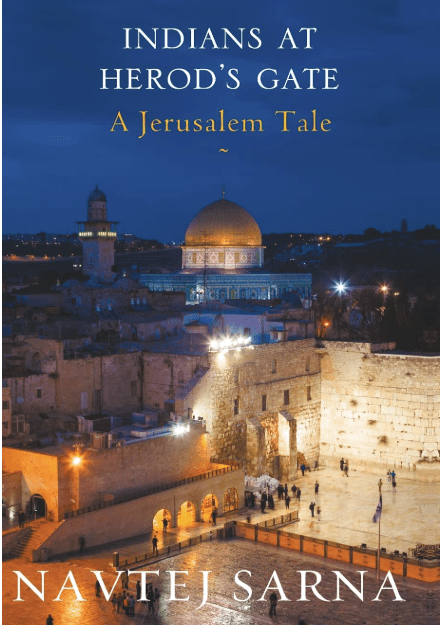
What is perhaps less widely known is that Farid is believed to have travelled to Jerusalem around 1200 CE — not long after Saladin had recaptured the city from the Crusaders. A small shrine there, still accessible, is said to mark his presence. Navtej Sarna, a former Indian Ambassador to Israel (2008–2012), writes about this connection in his book Indians at Herod’s Gate: A Jerusalem Tale (Rupa, 2014) — a quiet, often-overlooked thread linking the Indian subcontinent to the Holy City over eight centuries. Read further: Indians Herods Gate and Jerusalem’s 800-year-old Indian hospice

After the lecture, our group of three — drawn from different faith backgrounds — sat together for langar, the community meal served at Gurdwaras. There is something deceptively simple and profoundly radical about langar. The act of sitting together, regardless of religion, caste, or status, and eating the same food dissolves hierarchies that societies expend enormous energy to maintain. It is a challenge that remains genuinely difficult in parts of India, where communal and caste taboos still govern not just what people eat, but with whom and where. In that shared meal, something ancient and necessary was quietly affirmed.

The Descent into Dystopia

The following day, I made the mistake of listening to a News Agents podcast: Why MAGA Hates Britain. I say mistake not because the journalism was poor — it wasn’t — but because the content was genuinely dispiriting. The podcast drew on interviews conducted at the Conservative Political Action Conference (CPAC), where the blatant hostility toward Muslims was on full display. What struck me was not just the bigotry itself, but the absolute self-assurance with which it was expressed — the sense of a parallel world, hermetically sealed from doubt or nuance, in which hatred had been fully normalised and even celebrated.

It is worth noting that CPAC is not a fringe gathering. It draws senior politicians, media figures, and policymakers, including Britain’s shortest-serving prime minister, Liz Truss, who has found the political validation that eluded her at home in MAGA circles. When hatred is mainstreamed in those spaces, it travels outward with authority and legitimacy. The podcast was a sobering record of that.

A Fragment from 1947

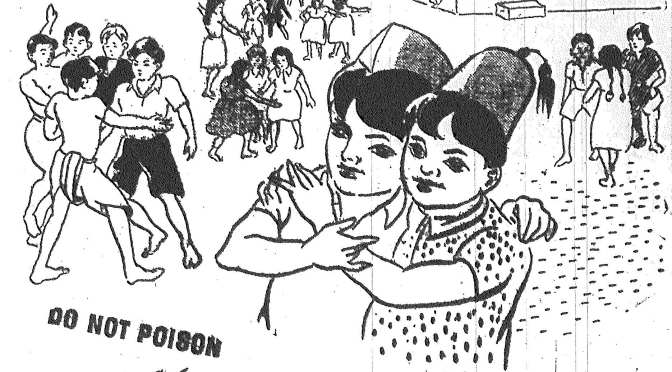
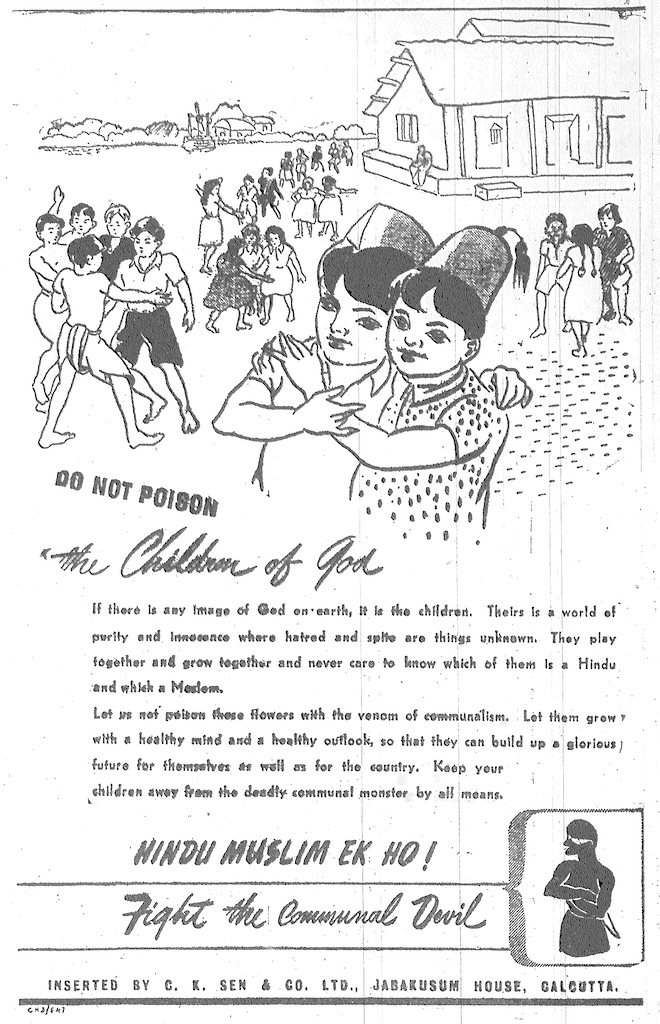
Turning away in revulsion, I returned to my own research — a space in which I can explore the ideas that still feel worth holding onto. Almost serendipitously, I came across an advertisement from September 1947 in the Bombay Chronicle, published just weeks after Partition had carved the subcontinent into India and Pakistan, leaving 1-2 million dead and over 15 million people displaced. The advert’s message was striking in its urgency and its pathos: the violence and bloodshed that had torn communities apart must now be put aside. The “children of God” must be taught how to live together rather than being “poisoned” by the hatred that had consumed the preceding years.

The text reads: If there is any image of God on earth, it is the children. Theirs is a world of purity and innocence where hatred and spite are things unknown. They play together and grow together and never care to know which of them is a Hindu and which a Moselm. Let us not poison these flowers with the venom of communalism. Let them grow with a healthy mind and a healthy outlook, so that they can build up a glorious future for themselves as well as for the country. Keep your children away from the deadly communal monster by all means. Hindu Muslim Ek Ho! Advertisement inserted by C.K. Sen & Co. Ltd.
Bombay Chronicle 26 September 1947. Photo taken by Pippa Virdee from NMML, Delhi.

What moved me most was the implicit admission within that language: that society had already been poisoned, and that the antidote required active, deliberate effort. It was a call not to innocence but to conscious repair.

The Distance That Grows

That advertisement also stirred a more melancholic reflection. There was a time, however brief and fragile, when greater openness between India and Pakistan seemed imaginable — when the possibility of travel, communication, and even reconciliation had not yet been foreclosed. The Wagah-Attari border crossing, for decades a symbol of that flickering possibility, remains closed following the Pahalgam attack of April 2025. Yet that closure is not merely a consequence of one incident. It reflects a deeper estrangement — one that has steadily worsened since the BJP came to power in 2014, as the distance between the two countries has grown not just diplomatically but also culturally, emotionally, and imaginatively.
When borders close, it is not only people who are separated. It is stories, families, histories, and the ordinary human exchanges that quietly resist the narratives of enmity.
On Connecting the Moments

What struck me, looking back across these three days, was how tightly these experiences were bound together — the lecture on a 13th-century Sufi poet, the langar table, the CPAC recordings, the 1947 advertisement, the closed border. They form a kind of map of where we are and where we might yet go.
We are constantly surrounded by voices that insist conflict is natural, that difference is danger, that the world is a zero-sum competition between faiths and peoples. But Baba Farid’s couplets, preserved across centuries and across religious traditions, suggest otherwise. The langar meal, served to strangers, suggests otherwise. Even that desperate 1947 advertisement, placed in the shadow of catastrophe, suggests otherwise — because in the middle of all that devastation, they still believed it was worth trying to preserve unity over enmity.

Conflict has never resolved anything. It only plants the seeds for the next generation’s hatred. What endures are the moments when we chose differently — when we visited the Other, and sat with them, and ate.

It remains up to us to remember our neighbours — not as symbols, threats, or abstractions, but as people, first and foremost. This message is a recurring theme in advertising campaigns that, while not so distant in time, feel increasingly remote in spirit. The YouTube clips, from just a decade ago, speak a language of interfaith harmony that the intervening years — and the political choices made within them — have done their best to drown out. That they once existed, and were made for mass audiences, is itself worth remembering.


Hindu Muslim Unity: Best Creative and Inspirational Indian Ads | Part 1 | Creative Ads

Hindu Muslim Unity: Best Creative and Inspirational Indian Ads | Part 2 | Creative Ads
Humsaye Maa Jaye by Bushra Ansari and Asma Abbas – Official Video

Reimagining Punjab Through Ustad Daman’s Poetry

Model Town, Lahore. © 2017 Pippa Virdee

During the writing of my book, “From the Ashes of 1947: Reimagining Punjab,” I endeavoured to incorporate some of the poetry and literature that encapsulated the emotions and sentiments of the aftermath of the Partition of Punjab. My intention was to highlight the contributions of Ustad Daman, a lesser-known figure in certain regions of South Asia but a significant figure for many, particularly in Lahore, the city of his birth. As another year passes and we inch towards the 80 years of the Partition, his work assumes a heightened relevance in the contemporary context.

Ustad Daman, whose real name was Chiragh Din, hailed from Lohari Gate within the historic old city of Lahore. His father was a tailor who owned his own small shop. His elder brother, Feroz Din, joined his father in managing the business, but young Chiragh had no inclination to pursue the family trade. Instead, he harboured aspirations for education and a clerk’s position. He attended school, but this did not result in a clerk’s job. Disappointed, he returned to tailoring and established his own shop. However, his heart was truly captivated by poetry. He would abandon his shop to attend poetry readings. Inspired by his mentor, Ustad Hamdam, he adopted the pseudonym Damdam, but later changed it to Daman. (Source: Apnaorg)

The pivotal moment came when he received his first payment for reciting poetry in a public gathering. This marked the commencement of his journey as a poet. Initially, Daman composed poetry on conventional subjects, such as matters of the heart. However, as the independence movement gained momentum prior to partition, political themes began to permeate his poetry. Daman was a member of a group of traditional Punjabi poets who would recite poetry extemporaneously, while their pupils maintained the records. This tradition earned them the title of Ustads (mentors). (Source: Apnaorg)

Below are some references and material that highlight the significance of Ustad Daman.

Folk Punjab has a digital archive of his poetry including ‘Es mulk di wand kolon yaro’.

Ustad Daman, ‘The Poet Laureate of the Twentieth Century Punjab’ Fowpe Sharma, Revolutionary Democracy

Ustad Daman lived and wrote poetry as someone always on the wrong side of the establishment By Dr. Afzal Mirza, Apanorg.

Rammah, Safir. “West Punjabi Poetry: From Ustad Daman to Najm Hosain Syed.” Jounral of Punjab Studies 13, no. 1&2 (2006): 216.

Below the opening of Chapter 10, Virdee, P., 2018. From the Ashes of 1947. Cambridge University Press.

Dhurries: the Woven Threads of Memory


Earlier this year, I visited Ludhiana, Punjab, a place I try to make time for whenever I have an opportunity or a slight reason. As is often the case, no visit feels complete without visiting Mau Sahib, my father’s ancestral village near Phillaur. Although no immediate family members live there anymore, Mau Sahib holds a special place in our hearts, especially for my sister. She remembers it with warmth and nostalgia, as a place of her childhood.

Our visits have become something of a ritual—paying respects at the historic Gurudwara, partaking in the langar, and then visiting the nearby Sufi shrine. It’s a quiet pilgrimage that connects us with both our heritage and the memory of those who came before us.

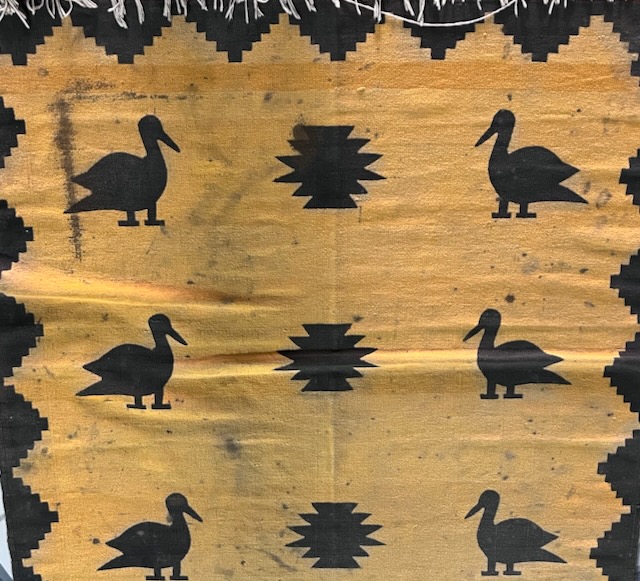
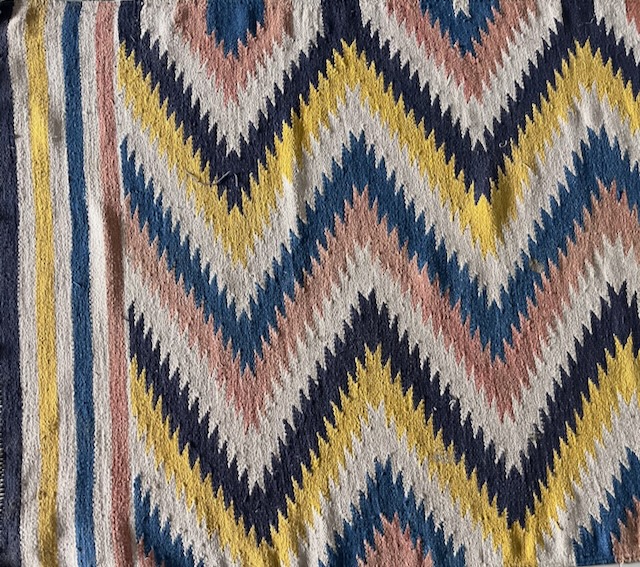
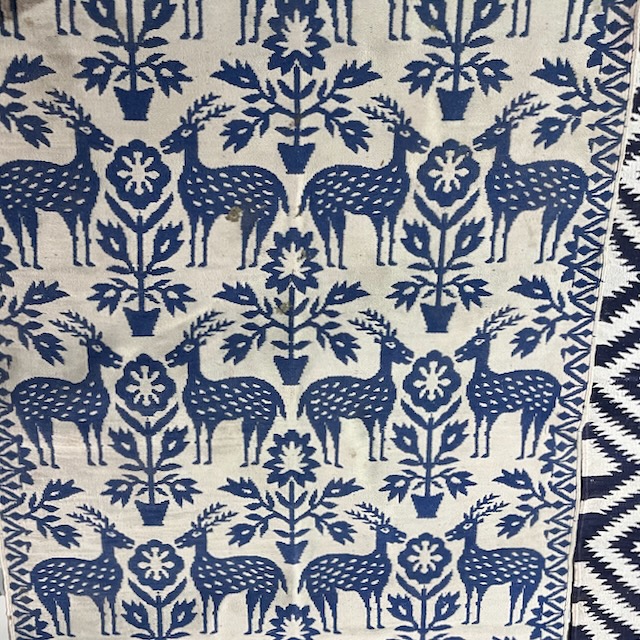
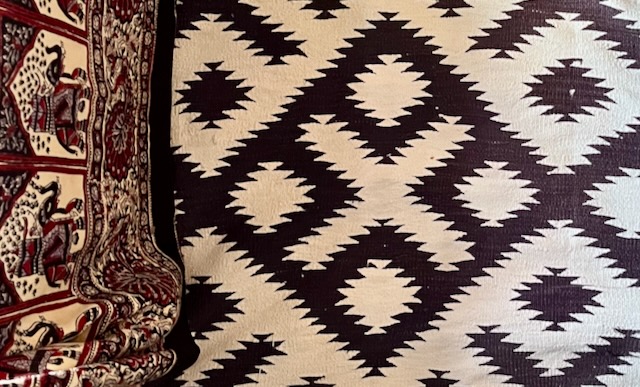
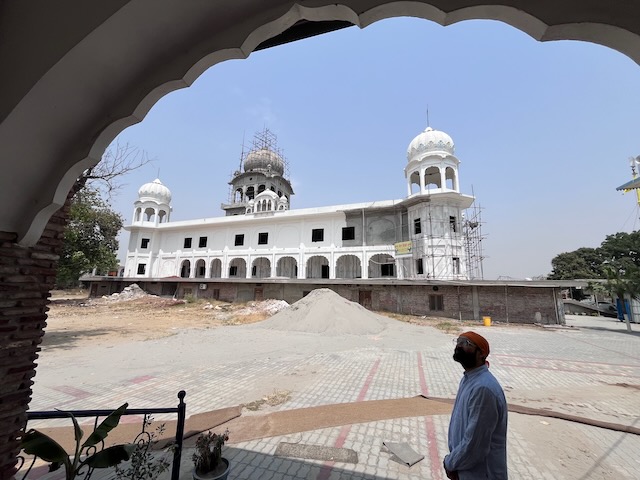
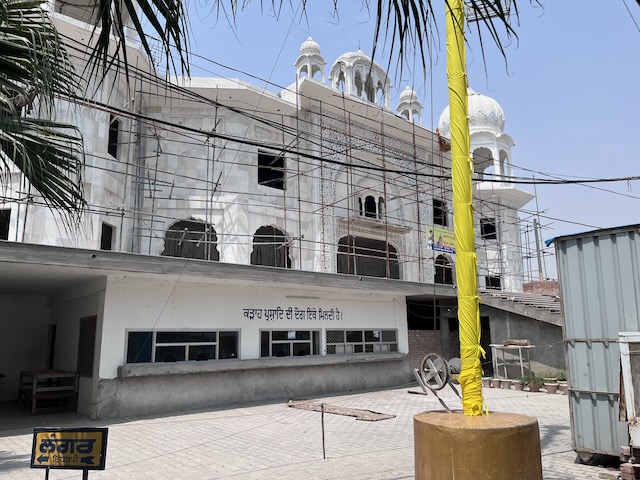
During this visit, the Gurdwara was undergoing renovations. Amid the scaffolding and signs of change, we made our way to the basement area; a large, echoing hall that was mostly empty and only partially completed. The Guru Granth Sahib rested there with solemn grace in the middle of the hall, surrounded by an assortment of vibrant dhurries scattered across the floor. The scene was simple yet striking. I couldn’t help but take photos of the colourful, handwoven patterns.

In that quiet moment, surrounded by these beautiful pieces of craft, I was instantly transported to my study back home. There, in the middle of my room, lies a black-and-white dhurrie—a treasured piece handmade by my mother. The rug, is now a relic and a reminder of her remarkable talent, one of many handcrafted creations she lovingly produced over the years.

At the time, I must admit, I didn’t fully appreciate the time, effort, and skill that went into these works of art. But today, that dhurrie is a cherished heirloom. It reminds me not only of her hands at work but also of the deeper cultural traditions that she carried within her.

For those unfamiliar, a dhurrie is a handwoven rug or flat-weave carpet, traditionally made in India and Pakistan. They were mostly made from cotton or jute and thus accessible for all. Dhurries are often lighter, reversible, more versatile and useful for everyday use; they can be used as floor coverings, bedding, or even wall hangings. In rural Punjabi households, you often find these dhurries spread out for meals, prayers, weddings, and community gatherings, making them silent witnesses to the everyday rituals and rhythms of life.

What makes them so striking are the geometric patterns, vivid stripes, or sometimes floral designs, each inspired by the region and culture from which they originate. The bold designs are usually in bright colours such as red, blue, yellow, as well as using black and white.

Historically, dhurrie weaving was a thriving cottage industry in rural India. But it was also something more intimate and symbolic, especially for women. Young brides-to-be were often taught the art from a young age. Many dhurries formed part of a woman’s dowry, and their patterns weren’t just decorative. They carried stories—symbols of personal, familial, and spiritual identity, passed down through generations, like a family recipe.

In many villages, it was common to see women sitting on charpoys under the shade, rhythmically working on pit looms while chatting about daily life. Though machine-made textiles are now more common, the tradition of handwoven dhurries survives in some artisan clusters, supported by cultural preservation efforts and a renewed appreciation for handmade goods.

As I stood in that hall, looking at the scattered dhurries beneath my feet, I realised how deeply woven this craft is into the fabric of our collective memory. These are not just utilitarian objects; they are vessels of heritage, art, and emotion. Each thread, each motif, tells a story.

In many ways, my mother’s dhurrie now tells mine. And you may well be wondering about the one I have? This was prized away from my sister my years ago. She had a number of them, given to her when she got married, and I convinced her to part with one which then travelled with me to England!

Embracing Nostalgia Through Music and Gardening

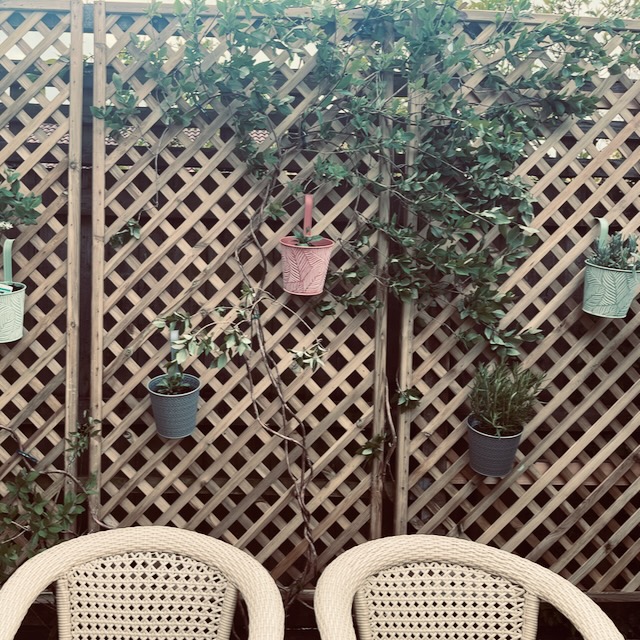
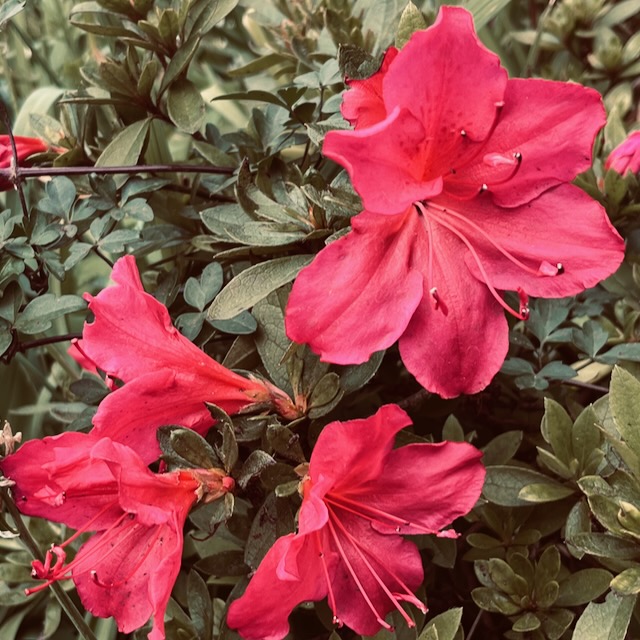
A long weekend spent revamping the garden has left me feeling quietly thankful—grateful not only for the beauty of blooming flowers but the often-overlooked moments that bring small moments of joy to us. These are the everyday miracles that ground us, offering us gentle reminders to be present, and to be grateful for the life and family that support us and get us through difficult times. They act as pillars, always there in the background but without whom we could not exist.

In August 2016, I began this blog as a space to document my experiences during a visiting fellowship in Lahore, as well as to share other events and observations that captured my interest along the way. This has grown into a broader canvas—one where I could share photographs, music, and reflections, often framed with a touch of historical context. Over time, the blog has become not just a repository of memories, but also a means of connecting with others.

When I first considered what to name this space, I wanted something that could symbolise both personal growth and a diversity of ideas. I eventually chose Bagicha—the Urdu and Punjabi word for “garden.” The name felt right, evoking a place where different thoughts, emotions, and inspirations could coexist and bloom. Like any real garden, this blog has required time and care, and though life’s demands have occasionally interrupted the rhythm of posting, I’ve done my best to return and tend to it regularly.

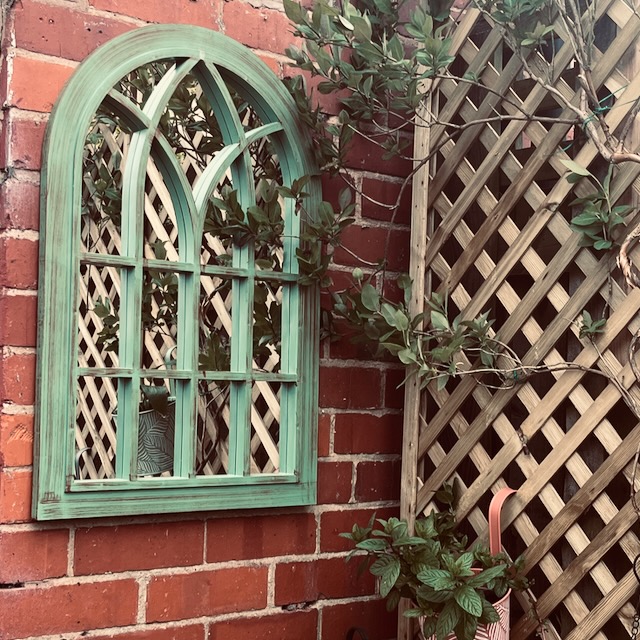
This past weekend, I turned my attention to my actual garden, which had begun to show signs of wear and neglect. I found myself hoping that this act of renewal would also translate into a more productivity for my Blogging and provide inspiration for other writing projects over the coming summer.

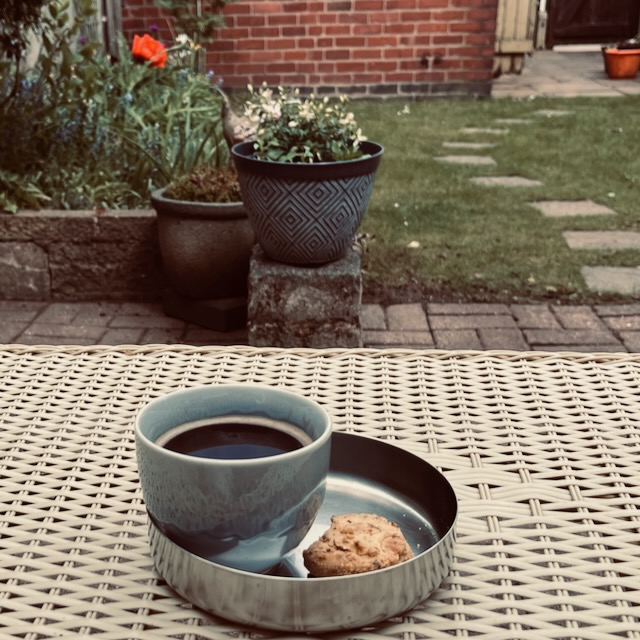
After the work was completed, I treated myself to a quiet moment with a cup of coffee and a Karachi Bakery biscuit, enjoying the fruits of my labour over the long May Bank Holiday weekend. As I unwound, scrolling casually through Instagram, I stumbled upon a deeply nostalgic song: Mai Tenu Yaad Aawan Ga (You Will Remember Me), sung by the legendary Surinder Kaur and Asa Singh Mastana. This version, recorded in Toronto in 1980, is hauntingly melodic—its rich tones and heartfelt lyrics evoke a bygone era.

Surinder Kaur, often hailed as the “Nightingale of Punjab,” remains one of the most celebrated folk singers in South Asian musical history. Her voice, both powerful and tender, became a defining sound of Punjabi folk music in the 20th century. Asa Singh Mastana, her equally iconic counterpart, was known not only for his duets with Kaur but also for his contributions to Bollywood as a playback singer. Both Kaur (born 1929 in Lahore) and Mastana (born 1926 in Sheikhupura) belonged to pre-Partition era and migrated to Delhi after 1947. They continued the musical journeys that had begun in Lahore and helped shape the soundscape of post-Partition Punjab.

Their music carries the weight of memory, migration, and resilience. Listening to them, one feels transported—not just to another time, but to a shared emotional and cultural landscape that continues to resonate deeply.

Listen to this timeless song and linger for a while in its emotional undertones. I’ve also included some photographs to accompany the mood—a small attempt to honour the spirit of nostalgia and historical connections that Bagicha has tried to capture.

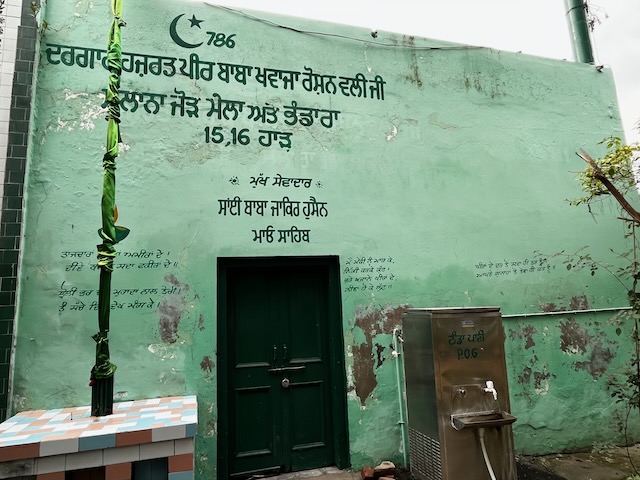
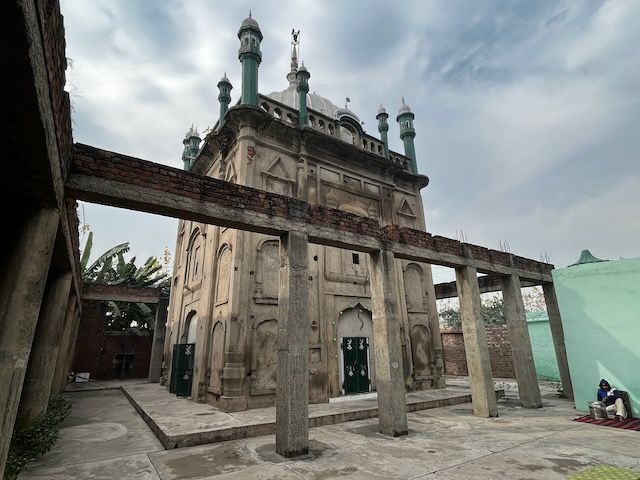
Mau Sahib Gurdwara and the Shrine of Baba Khawaja Roshan Wali

I recently visited Mau Sahib, my father’s ancestral village, located about 10 km from Phillaur in the Jalandhar district of Punjab. The village is home to a historic gurdwara associated with Guru Arjan Dev Ji, who was married to Mata Ganga there. Although we no longer have family residing in Mau Sahib, my sister and I continue to feel a deep spiritual connection to the place. It offers us a profound sense of warmth and belonging—a tether to our roots. Being older, my sister holds many more memories of life in Mau Sahib; by the time I was born, we had already moved to Ludhiana.

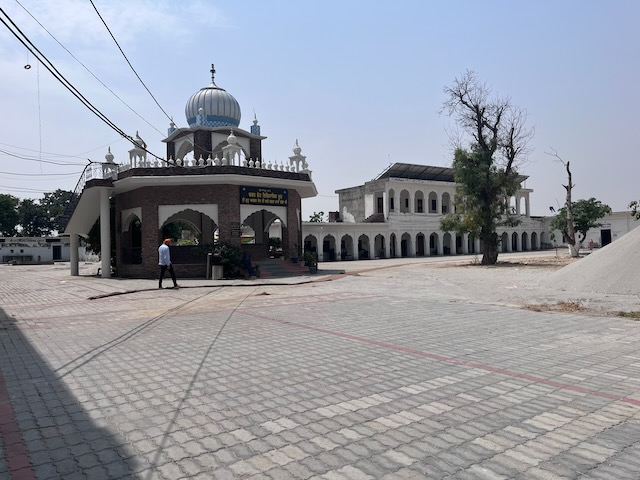
In recent years, the gurdwara has undergone extensive renovations after being taken over by the Shiromani Gurdwara Parbandhak Committee (SGPC), the central organisation established in 1920 to manage Sikh places of worship. For us, the gurdwara had always been a serene space—an anchor of peace and devotion, quietly resonating with those who visited and lived nearby. But with ongoing development, it has transformed into a large and imposing complex, drawing increasing public attention. This seems to reflect the growing trend of spiritual tourism, which, regardless of faith tradition, continues to expand.

Mau Sahib is also well known for its annual mela (fair) commemorating the marriage of Guru Arjan Dev Ji. Yet the mela carries a meaning that transcends the religious—imbued with secular and humanistic values, it is a story I was raised with and continue to cherish deeply.

The tale recounts that when Guru Arjan Dev Ji arrived in Mau Sahib to marry Mata Ganga, who was born there, a local leader opposed the union and imposed a condition that had to be met for the marriage to proceed. In fulfilling this demand, the Guru’s horse tragically died. As the newlywed couple prepared to depart, a local Muslim saint, Khwaja Roshan Wali, generously offered his own horse to Guru Arjan Dev Ji. Touched by this act of kindness, the Guru declared that anyone seeking blessings in Mau Sahib should first pay their respects at the dargah (shrine) of Khwaja Roshan Wali before visiting the gurdwara. To this day, the mela reflects this legacy: it begins at the dargah on the 15th and 16th in the month of Harh and continues at the gurdwara on the 21st, 22nd, and 23rd.

This tradition shaped my understanding of faith, coexistence, and the values of mutual respect. Growing up, it was always natural for us to visit both the shrine and the gurdwara when seeking blessings. However, I have noticed that in recent years, the narrative surrounding the shrine has become increasingly marginalised. At a time when populism and division are gaining ground, it is more important than ever to remember the spirit of those earlier times—when pluralism was not just accepted, but celebrated, and when communities of different faiths coexisted in mutual respect and harmony.

See and hear more about this in the following two short videos on the Gurdwara and the Shrine.

Baba Khawaja Roshan Wali ji

Notes from Lagos (Portugal): from Punjab to Lagos part 2

On a recent trip to Lagos, Portugal, I was struck by the presence of Indians, particularly young students, some were perhaps tourists and migrants who appeared to be seeking opportunities, others looked more settled and part of the local community.

The Indian diaspora in Portugal is diverse and can be broadly divided into three distinct regional groups:

  1. Gujaratis – The largest group, encompassing both Hindus and Muslims, reflects the deep-rooted trade and migration links between Gujarat and Portugal.
  2. Goans – Predominantly Christian, this group traces its heritage to Portugal’s colonial past, when Goa was under Portuguese rule for over four centuries. This historical connection has shaped their language, culture, and religious practices.
  3. Punjabis – Predominantly Sikhs, this community has migrated more recently, seeking opportunities in industries like hospitality and retail.

While walking around the streets of Lagos came alive with a rich tapestry of languages, including Gujarati, Punjabi, Hindi, Portuguese, and English, mingling seamlessly. This linguistic and cultural interplay highlighted the adaptability and integration of these communities within the Portuguese society.

Historical Roots and Migration Patterns

Historically, Portugal’s connection to India dates to the early 16th century when Vasco da Gama’s expeditions established trade and colonial links. [Read Lagos to Goa Part 1] Goa became a Portuguese territory in 1510, fostering a flow of people, goods, and cultural exchange between the two regions. Even after Goa’s annexation by India in 1961, ties between the two nations have persisted, enabling migration and cross-cultural connections.

Kristina Myrvold notes that significant Indian migration to Portugal began in the 1970s after the collapse of the Portuguese Empire and the 1974 democratic revolution. During this period, many Portuguese-speaking Hindus and Christians from former colonies like Mozambique and Goa migrated to Portugal. Later, in the 1990s, Portugal’s entry into the European Union and Schengen Zone made it an attractive destination for immigrants from India, including those with no prior cultural or linguistic ties to the country.

The Growing Sikh Community

Among the broader Indian diaspora, the growing number of Punjabi Sikhs particularly stood out during my visit. Many Indian restaurants appeared to be run by Sikhs, though ownership could belong to others. Myrvold explains that Sikh migration to Portugal began in the early 1990s, coinciding with a construction boom that created a high demand for labour. Many Sikhs initially worked in construction and agriculture, industries that required significant manpower. Over time, they expanded into other sectors, opening shops and restaurants, particularly in hospitality and retail.

Portugal’s relatively relaxed immigration policies and labour shortages during that period encouraged migration. Many Sikhs used Portugal as a stepping stone to secure residency or citizenship, drawn by the affordable cost of living and accessible legal pathways. This trend has driven the growth of the Sikh community in Portugal, which was estimated at 5,000 in 2007 and doubled to 10,000 by 2010. By 2024, the Indian Embassy in Portugal estimated the Sikh population at 35,000, highlighting their increasing settlement in the country.

Settlement and Challenges

Many Sikhs initially arrived in Portugal via other European countries, attracted by Portugal’s relatively lower cost of living and accessible legal pathways to residency and citizenship. Geographically, the Sikh community is spread across Portugal, with significant populations in major cities such as Lisbon and Porto, as well as in Albufeira and other towns along the Algarve. These regions have not only offered economic opportunities but also served as hubs for community life, where Sikhs have built places of worship, such as gurdwaras, and organized cultural events to preserve their traditions and strengthen community bonds.

The Sikhs community in Portugal is relatively new compared to other Indian groups with longer-established connections with the country. While travelling from Lagos to Faro, I had the chance to speak with a Sikh taxi driver who had been living in Albufeira for over 10 years. Despite the initial linguistic and cultural challenges, according to the taxi driver, the quality of life is much better in Portugal. They maintain their links with family back home in Jullundur but work and home is here.

The work is also seasonal and dependent on tourism, the summer being peak time to work long hours and earn double or triple the earnings to compensate for the winter periods when tourism drops. Looking into the future with rising living costs and increasing restrictions on settlement according to the taxi driver, it will make be harder for future migrants to establish themselves in Portugal.

Sources

Kristina Myrvold, ‘Sikhs in Portugal’ Religious Studies Commentaries, 11 August 2012. https://religionsvetenskapligakommentarer.blogspot.com/2012/08/sikherna-i-portugal.html

Inês Lourenco, From Goans to Gujaratis : a study of the Indian community in Portugal, Migration Policy Centre, CARIM-India Research Report, 2013/01 – https://cadmus.eui.eu/handle/1814/29463

Jennifer McGarrigle, and Eduardo Ascensão. “Emplaced mobilities: Lisbon as a translocality in the migration journeys of Punjabi Sikhs to Europe.” Journal of Ethnic and Migration Studies 44, no. 5 (2018): 809-828.

Pamila Gupta, “The disquieting of history: Portuguese (De) Colonization and Goan migration in the Indian Ocean.” Journal of Asian and African Studies 44, no. 1 (2009): 19-47.

Top Posts in 2024

I hope you have been enjoying the photos and blog pieces from 2024 and rather belatedly I’m sharing the top posts from last year.

  1. Mein Tenu Phir Milangi – I will meet you yet again by Amrita Pritam

2. Ajj Aakhaan Waris Shah Nu By Amrita Pritam

3. Sahir Ludhianvi and the anguish of Nehruvian India

4. Poetry Corner: Lahore

5. “My spiritual guru is Nanak Dev and my trade guru is Baba Vishvakarma”

6. 23 Sir Ganga Ram Mansion: The house of Amrita Sher-Gil

7. 70 years ago: extracts of the Sunderlal Report, Hyderabad 1948

8. (Inhabiting) the Space between Black and White: Indian/Sikh Community in Kenya

9. How the Photographs of Margaret Bourke-White became the Images of Partition.

10. 1881: the first full census in British India

What makes you feel nostalgic?

Carefree Days with Pran Nevile, April 2016. © Pippa Virdee

Today’s daily prompt on WordPress was “What makes you feel nostalgic?” I of course immediately started thinking and letting my mind wonder into the past. The past that is often nostalgic and romantic; it is after all the 31 December! Immediately one memory came back like a flash.

I recall the numerous times that I went to visit Pran Nevile at his home in Gurgaon, where we would have meet, chat, drink and eat. And almost always there would be music playing in the background, the kind of music that transports you to a bygone era, along with the conversation. These “Carefree Days” are no more, but those precious memories remain.

Beyond the nostalgia I remember I wrote a tribute for Pran, which was supposed to have been published but I suspect it never was. I most likely didn’t follow up because of work distractions. Upon a keyword search (thank goodness for that!) I found the tribute on my laptop straightaway. I sat there with the melodic voice of Begum Akhtar in the background and re-read the piece, feeling sad but happy to have met someone like Pran at the beginning of my own journey. It makes a fitting post for today’s prompt, as I will always associate Pran with the nostalgia of a pre-partitioned Punjab that is no more.

Pran Nevile (1922-2018): A Tribute

I first met Pran Nevile in 2001, when I embarked on a new journey in my life of pursuing a PhD. He was recommended to me by my supervisor, Prof. Ian Talbot. We met, like on many subsequent occasions, at his favourite place in New Delhi, the India International Centre (IIC). I was beginning my research into the impact Partition had on Punjab, exploring this through first-hand accounts of people, who were forced to abandon their homes and leave during that tumultuous and violent time. Pran was born in Lahore in 1922 and thus could recollect stories from the colonial period thereby contextualising this impact on Punjab following Partition. At the time I didn’t know much about Pran, beyond that he had written a book on Lahore and that he had a previous career in the Indian Foreign Service. In many ways, I was an outsider to both the intellectual Delhi circle and academia, more generally. We sat in the café at the IIC and had tea, while chatting about an array of subjects. Almost straightaway we bonded as he radiated with an old-school genteel charm that belongs to a by-gone era; certainly not of the India and Pakistan today. He paid me a wonderful/witty compliment, by saying that when I speak in Punjabi, I sound like a Punjaban and when I speak in English, I am a mem. He would repeat this on numerous occasions. This was the beginning a friendship, which endured until he passed away on 11 October 2018. He was my connection to the pre-partitioned Punjab, and I was his connection to Lahore, exchanging notes and comparing the-then and now. 

Growing up in Lahore

Pran’s family lived in Nisbet Road in the walled city of Lahore, where his father had migrated to in the early 1910s from their ancestral village of Vairowal, in neighbouring Amritsar district. Following his education at the DAV School, he was successful in getting a scholarship and got admission to the prestigious Government College Lahore, from where he graduated in 1943 in MA Economics. He recollects many of his early memories of growing up in Lahore in his autobiography, Carefree Days (2016), recounting the days of “pastimes, fairs and festivals”, which would keep them amused all year round. His favourite pastime though was kite flying, as he writes: “I cannot recall anything more thrilling than kite flying in my boyhood” (pp. 10-11). Pran, like many others, lamented the later ban on kite flying in Lahore, which has seen the demise of the popular Basant festival.

Writing Lahore: A Sentimental Journey (1992), a book that instantly resonated with many Lahoris, enabled Pran to visit the city of his childhood. He was one of the lucky ones because he was able to visit Lahore with ease, a romance that he rekindled with this tribute to the city of his birth. He often recited, Jine Lahore nahin Vekhya oh Jamya hi Nahin (One who has not seen Lahore is as good as not having been born at all) (p. 193). Like many other people who left their ancestral homes (thinking they would be back), he had a photographic imprint of the city in his mind, remembering every nook and cranny of the congested Androon Shehr. Professor Tahir Kamran organised a two-day conference at GC University on ‘Punjab and the Raj’ in 2006 and Pran was invited to speak at this conference. I distinctly remember a moment from then, when another friend from Lahore, Bilal Ahmed was driving the car, and Pran was seated in the front and me in the back. We were in the walled city, trying to locate a venue and unsure about the exact location. Immediately, Pran started to navigate and provide directions. He said he can never forget the streets of his Lahore, despite all the changes since his he was a student in the city. It was a heart-warming and amusing moment we never forgot.  

Never-ending Retirement

Pran graduated during the political and international upheaval of World War Two. His desire was topursue a PhD at the London School of Economics, but the uncertainty of that period prompted him to take up an opportunity at the Bureau of Public Information in 1944 as an assistant journalist. After a series of different posts, he was selected for the Indian Foreign Service Board in 1955 as second secretary (commercial) (Carefree Days, p. 46). He joined the Ministry of External Affairs as an attaché in March 1959 and subsequently was posted in Warsaw (1962), Belgrade (1966) and Moscow (1969). By 1974, he was back at the Ministry of Commerce as deputy secretary (East Europe). After that came the opportunity to go to Chicago in 1977, which he recalls ended his “eventful official link with the socialist world of East Europe” (p. 148). During this period, he also had a short stint in Geneva which allowed him to develop his links with the UNDP, which ultimately paved the way for a second career. Soon after in May 1979, he took premature retirement, leaving after 35 years of professional life. He was now the programme coordinator for the UNCTAD, based in Geneva and this allowed him to rekindle his relationship with East Europe until 1985, when he returned back to India. One of the highlights of this stint surely was when he took on the role of a priest and performed the marriage rites for one of his friends in Geneva; a story he often shared with relish.

For a conventional diplomat, Pran was more austere and radical in his personal life. As he recalls in his autobiography, he developed an “abhorrence for this ostentatious tamasha and meaningless jubilation” (p. 49) that surrounded elaborate engagements and wedding ceremonies. In this endeavour, he developed a friendship with Savitri (daughter of an uncle who was married to Pran’s father’s first cousin!), often acting as her mentor and encouraging her towards the pursuit of knowledge and education. He first noticed her in July 1941, as a young man discovering his own self, and by January 1947, they had eloped and had a civil ceremony in Delhi. Early reservations against this marriage were put aside by their families, and he remained with Savitri until she died in 2013. A spark in him went after that.

The Last Calling

After his retirement from work, he decided to embark on yet another career, but this time, it started as an unplanned script. It was in 1987, when he first started making frequent trips to the IIC, spending his days in the library and often using this as office space for his writing. Initially, he only ventured towards his expertise area and wrote on economic matters, but it was not long before his real passion emerged and he turned his gaze towards other subjects, which included his hometown Lahore, nautch girls, dance and music. Feedback from these early forays in small articles gave him confidence to continue with this newfound passion; although one of his earliest writings dates back to 1949, when he wrote ‘Problem of the Mother-in-Law’ which was published in Caravan magazine. His first full-length literary work was inevitably on Lahore, as he recalls: “My desire was to take the reader on a pilgrimage to my Lahore of a bygone era of peace and plenty” (p. 171). The idea for the book was actually conceived way back in 1963 in Hotel Astoria, Geneva. On his seventieth birthday he received the advance copy from the publisher of his first book, Lahore: A Sentimental Journey.

This journey led him to write prolifically on the era of the British Raj. Being a product of that era, he imbued the character of the Brown Sahib and carved out a niche for himself, focusing on the social and cultural history of the British Raj. His fascination for visual and performing arts led him to unearth a vivid and richer history, which he energised many around him with. During the last few years of his life, he reserved his love for K.L. Saigal, the “immortal singer and superstar” (p. 189). My own recollections of Pran were always of visiting him in Gurgaon, chatting at length while nibbling on namkeens, and with the nostalgia of 1940s and 1950s music playing in the background. Those days are no more nor are those, which is his own words read:   

“I belong to the vanishing generation of pre-partition days who were forced to leave their homeland but carried ‘Lahore’ in their hearts like the memory of a first love. Overpowered by nostalgia, we still recall the days when Lahore had attained the reputation of being the ‘Paris of the East’ where people of different communities live in harmony in the sunshine of their common heritage, historic bonds and flamboyant Punjabi culture.” (Carefree Days, p. 194).