While trawling through archives I came across some time ago, I found the following piece of writing in The Folio. Forman Christian College, Lahore dated April 1960. I was intrigued by this short, two-page article on what it was like for female students at the time. What stands out, of course, is how the boys regarded girls as being from “another sphere,” and how this sense of difference is reinforced across the college’s different staff and spaces.
BEING A GIRL STUDENT IN F.C.C. Merel Bhan, VI Year (English)
How well I remember the first day when I told a group of my older acquaintances that I had decided to join FC College for my MA classes. A short silence followed this statement, then a sudden burst of speech.
“You must behave in a most prim and proper way,” advised B-
“Never must you smile or laugh unless you are in the classroom, and except for a few necessary enquiries do not even try to speak with the boys,” declared S-
“But,” I protested, “how will I ever enjoy the next two years if I am not even allowed to speak or discuss a subject with my classmates?”
“Study and only study must be your aim,” said J- with great emphasis. “Always keep your eyes down and look straight ahead, never around you”.
Ah well, it was farewell to all the gay carefree days I had had as a student. From henceforth my college days were to be suddenly very dull, and I tried to resign myself to the fact.
At last the dread day approached and I arrived at the college half an hour earlier than classes were due to start. I wore a very carefully practised sober expression and carried a notebook and pencil – items which I had hitherto been inclined to ignore. My brother conducted me to my classroom. I stood outside, looked around at first, but then, seeing a huge bunch of boys staring at me as if I was a creature from outer space, fixed my gaze upon a spot on the wall immediately above me and so waited. At last another girl came up to me. We both greeted each other enthusiastically but then hastily checked ourselves.
We had both previously studied amongst three hundred of our own species, now we found ourselves suddenly flung into the midst of the very boys who had every day passed the Kinnaird College bus-stand, whistling to the girls and calling out loud remarks, or who had been most vociferous in disconcerting speakers at the various inter-collegiate debates. The advice we had received was the same. Now that there were two of us, reinforced by each other’s company, we entered the classroom.
A steady silence and blear of faces greeted us as we made our way to the closest bench. As our vision cleared saw boys of all shapes and sitting in the class and smoking. Then the inevitable question followed.
“From which college did you do your B.A.?” We replied, and that was the last chance for speech as great deal of information was volunteered to us about courses of study and the professors. Even our monosyllabic answers were not allowed to emerge in the face of that information. We were told how hard we would have to study to pass the December examination, the books we were to read and the books we should have read to provide us with a background. The professors, we were told, were miserly as far as doling out marks was concerned, and then were enlightened about what appealed to which professor. The first conclusion we drew was that we were now firmly in a trap. Not only was the M. A. to be dull, and also very difficult, but it seemed, according to the information we received, that our stay in the college would probably last only until the December examination.
Then we had our first lecture, which was very interesting and that, as well as what the senior girls told us about our college, did much towards toning down the earlier picture. We were told that the time-table was on the noticeboard, and all the girls, in a good, firm group, went to look at it. The notice-board was surrounded by boys of all kinds – bearded boys, chubby cherubie little boys, tall boys, bespectacled boys, fat boys, thin boys, boys with a poetic temperament who had quarrelled with their barbers, and boys sporting the Yul Brynner style. We could not peer over them or around them. We failed even to glimpse the time-table. A girl’s height was great disadvantage, I decided, particularly in a boys’ institution. I made a mental memorandum to buy a pair of high heeled shoes at the first opportunity, but even these, as I have since discovered, have failed to supply a remedy.
At the first lecture we had been supplied with a lengthy book list, and so after a week or two we went to the library to take out some of the books. All of them were out. The librarian told us that we had been very lazy and warned us to be quick next time. The next time, as soon as the book list was handed out, we decided to proceed immediately to the library. However, as the last book was named we heard the squeaking of chairs and a hustle behind us. We saw two boys flash through the door. This occurrence was explained when we walked into the library. All the book were drawn out. From then on we became part of the great “Scramble for books.” This was a great race to decided who would get a particular book first or at least be first on the reservation list. We girls whispered and planned now to get books on a particular subject a week before we were due to start work on it. We wrote down the names and numbers and very confidently handed it to the librarian. He look at it, shook his head, and said, “Sorry, Madam, they are out. However,” he added, “You can take this book.” He drew out the book and gave it to us. We were indeed the first to get it, but, we wondered, would it be worth reading if no one else had wanted to take it?
As we were such a large minority we believed in the maxim, “Unity is Strength,” and we would always sally forth in a group of eight. We would go first to the library or the class or the common room. As time went on and we began to feel more at home, we broke up into smaller groups, and instead of going to the common room to relax we started sitting the lawns. We began to pay visits to the tuckshop as we now regarded this college as ours as well. Thus we girl students were slowly emancipated. We began to have hilarious times here without feeling self-conscious.
Having now been in the college over a year I observed a few things which should prove to be invaluable precepts for girls hoping to join this college.
A girl student must always walk from one place to another at a moderate pace. To run is unforgivable. Even with the rain coming down at its heaviest she must keep up a stately pace, to avoid raising a laugh from the boys.
She must always consider herself as being from another sphere, as that is how the boys regard her. She is a curiosity, not a person belonging to the earth, and because of this she should not mind if the boys stare at her in the same way every day for two years. She is an alien being in their domain.
A girl is the Weaker Vessel. She must always keep that in mind only then can she bear the treatment meted out to her. Thus she can fully make use of the advantages of “Ladies First” — no waiting in queues for her. She must also always be willing to receive information on books and study as she is incapable of finding out for herself. Even if somebody hands her book on the sixteenth century to study Wordsworth from, she must not object. She can never know as much as a boy.
The only topic on which girls and converse is study, and that is usually in the form of much advice on the boys’ part. The girl student must receive unquestioningly.
Brace yourself, this is a longer-than-usual blog piece, and one that is close and personal.
Recently, I came across a report from the Sutton Trust that reignited an old debate: is university education still worth it? A new survey found that the proportion of people who believe a degree is not worth the time and money has risen from 14% in 2005 to 34% today. As my own journey in this field keeps changing shape, I find myself constantly reflecting on why I came into it in the first place.
Where it started
I was the first person in my family to go to university, and as a recent migrant to the UK, I hardly understood the significance of a degree. And yet a few moments stand out clearly.
I had a difficult time adjusting to a grey, dull, cold country, and I struggled at school until my A-levels. That was when I discovered the power of studying and the possibilities that education could open up. My preference had actually been art, but Thatcher’s Britain left an indelible mark on me, and on my politics. It taught me how much history and politics mattered, so much so that I abandoned the idea of studying art at university. Even so, influences from the art world, such as William Morris, remained with me.
And, like the 1983 film Educating Rita, directed by Lewis Gilbert and starring Julie Walters, I wanted something else. Having grown up in working-class Coventry among people with few aspirations, I found it hard to want something different, something beyond marriage and children. I took my cue from a few of the “clever girls” at school who were applying to university, and since my A-level results were decent enough, I thought: I too can do this!
My mother
While Educating Rita was the external inspiration, the real one was right at home. My single mother, who never benefited from formal education herself, constantly encouraged me to educate myself and make something of my life. She struggled throughout her life, but she was remarkably resilient and strong, rebuilding and reinventing herself every time life threw another challenge at her. I drew strength from that then, and now when she is no more.
She would have preferred that I became a doctor, a lawyer, something “respectable,” but she supported my decision to study politics and history anyway, despite pressure from other family members who looked down on these subjects. I decided to stay at home rather than leave her alone, which narrowed my choices to Coventry and Warwick. I had offers from both, and to the dismay of my teachers, I chose Coventry.
Coventry, not Warwick
I would have started in 1992, the year 35 polytechnics became universities but, after deferring, I began in 1993. With little guidance or mentorship, I had almost no sense of the difference between Warwick and Coventry. Had I known, I might have made a more calculated choice. Instead, it was an emotional decision, based on instinct and on a course on India and Pakistan that caught my eye at Coventry, taught by someone who would go on to become my PhD supervisor.
Looking back, I think it was also a choice about fitting in. I simply sensed, as someone from a working-class background, that I did not belong at Warwick. Unlike Susan in Educating Rita, who studied English, I read International and Political Studies, a combination of politics, history, and international relations. Interestingly, this kind of combined degree has now made a comeback, partly as a result of rationalisation across the sector. Single-honours degrees are difficult to sustain in today’s market, and a combined programme can be an attractive package in the age of austerity.
Degrees then and now
Returning to the Sutton Trust report: the big difference today is that a degree is now intrinsically tied to employability. Students increasingly come to get a degree, rather than to get an education, and that distinction matters. I was incredibly fortunate to study without the financial pressures students face now. Had those pressures existed then, I probably wouldn’t have gone to university at all.
My undergraduate years were instrumental in opening up my world and my life. They transformed my ability to think, to articulate, to reason, and to question what I thought I knew. I left university without much clarity about what I wanted to do next, but that didn’t matter, because the three years themselves had taught me so much. Far more than the rigour of eight courses a year, each ending in a three-hour exam meant to prove I’d learned something. There were essays too, handwritten at first, typed by my final year, but the ratio was 25% coursework to 75% exam. Everything rested on those three hours at the end of the year. We thankfully now have much more diversity in assessment, but with the challenges of AI, the classroom exam is also making a comeback.
Like Susan, I left university a different person: more confident and genuinely surprised at how much I’d enjoyed the experience. So much so that I decided to keep studying part-time while working. I wouldn’t have made it through my undergraduate or postgraduate years without paid work on the side, even though fees were nowhere near today’s levels. During my MA, I worked first in academic bookselling until I was made redundant as the early tremors of Amazon (which launched in 1998) began shaking the book trade and then in banking, which simply didn’t fulfil me. Interestingly, I was working at a major high-street bank that was closing down branches at the time. The signs were all there in the late 1990s about how innovations in technology were changing our high streets and retail habits.
A turning point
I eventually decided the private sector wasn’t for me and chose something that felt more virtuous instead: the public sector. Of course, I quickly realised that this wasn’t any better! At the same time, I continued with my part-time MA, operating on something close to a pay-as-you-go model. That kind of flexibility barely exists today, outside perhaps the Open University, yet with the support of my tutors, it was possible then. In today’s system, I would likely have been terminated from the programme for missing coursework deadlines. But in a more generous era, when academics still had some autonomy and personal relationships mattered, you weren’t just a number.
Then, one day, a letter arrived with an advert for a PhD studentship. It was from Professor Ian Talbot, Coventry University. I saw it and dismissed it almost instantly; truthfully, I barely knew what a PhD entailed. But the seed was sown, and the rest is history (pun intended).
The studentship, covering fees and maintenance for three years, had been established by the nephews of Sir Penderel Moon (Indian Civil Service). They wanted someone to examine the violence and casualties of Partition; a subject long mired in debate about the true scale of loss at the time of British departure from India. Penderel Moon had produced his classic study Divide and Quit in 1961, drawn from his postings in Punjab, and afterwards edited volumes 5 to 12 of the Transfer of Power (1970-83) documents.
The PhD years were a constant exercise in pinching myself and thinking, is this really me? Am I really doing this, meeting these amazing people and minds? Some of that, I think now, was lacking what Bourdieu meant by cultural capital: the sense that certain ways of speaking, certain reference points, certain forms of ease in a room, are themselves a kind of inherited wealth, one I hadn’t been given. And some of it was what Appadurai calls the capacity to aspire: the idea that aspiration itself is unevenly distributed, that some of us have to learn, almost from scratch, how to imagine a future different from the one we were handed.
The Sutton Trust puts it plainly: graduates from non-graduate families often don’t catch up with graduates from graduate families, because higher education improves social mobility but doesn’t erase the effects of family background. While meritocracy in education is a wonderful idea, and it has helped to uplift many, the internalised habits, manners, language and style that come from our background remain with us. That feeling of being an impostor is directly related to what Bourdieu and Appadurai describe, not a personal failing, but a structural one. But through my academic journey, and in my first monograph, I turned to Catherine Hall, who writes:
For the most part, however, in all sectors of higher education we remain on the margins. But the margins can be a very productive terrain — a space from which both to challenge establishments and develop our own perspectives, build our own organisations, confirm our own collectivities. The hopes for feminist history in the 1990s cannot be the same as they were in the 1970s, for we are living in a very different political world, and some of the harsh lessons we have learned about both exclusivity and marginality must inform our practice in the future. The dream remains — a kind of history that excites and engages, that retains its critical edge, is open to new voices, and always in a dynamic relation to the political world in which we live. Catherine Hall, White, Male and Middle Class: Explorations in Feminism and History (Cambridge: Polity Press, 1992), p. 34.
I felt more at “home” in a post-92 institution, and the opening up of education was crucial for me, both as a student and eventually in my professional capacity. But since then, so much has changed in Britain. The optimism of the Blair years and “Cool Britannia” has given way to a “Global Britain” that is anxiously searching for a place in the world beyond Europe. We are on our way to having a seventh prime minister in the past ten years; the longevity of Thatcher and of Blair as her true successor seems like a different age in this era of musical prime ministerial chairs.
This rise and fall in political and national fortunes are being mirrored, brutally, in the education system itself, and post-92s have been absorbing the impact longest. As far back as 2015, the withdrawal of the teaching grant from non-STEM subjects hit post-92s hardest, prompting warnings that humanities provision would shrink back to “a narrower and narrower social circle of those who could afford to indulge their interests.”
A decade on, that warning reads less like a prediction than a description. Modern foreign languages provision has nearly halved since 2011; English studies have fallen by close to the same margin. In 2026, the University of Hertfordshire, a post-92 institution built on access and employability, suspended recruitment to its undergraduate history, philosophy, English, linguistics and creative writing degrees outright. As John Holmwood of the Campaign for the Public University has put it, post-92s have long been the “heavy lifters of social mobility,” the institutions through which working-class people bettered themselves through higher education. It is precisely that function that is now being dismantled.
Specific discipline studies, such as the Royal Historical Society briefing, confirmed that 88% of history departments in post-92 universities have seen explicit staffing cuts, compared to a lower (though still severe) 68% in pre-92 universities.
What makes this a class story, not just a funding story, is where the losses land. A 2025 British Academy report found large parts of the country are already humanities’ “cold spots,” with no provision at all within a commutable sixty kilometres, a divide that falls hardest on students who cannot simply relocate to wherever a course still survives. A student in a well-off city with three universities on their doorstep has choices. A student tied to a single local institution by money, family, or circumstance does not.
It would be wrong now to pretend Russell Group universities are exempt from the above; they are not. The UCU’s tracker recorded 105 institutions pursuing redundancies, restructures or closures as of late 2025, with Russell Group members accounting for 41% of the sector’s £303 million severance spend in 2024–25 despite being a smaller and wealthier cohort. Nottingham seeks to cut 150 posts, mostly in the humanities, and has withdrawn language degrees. Exeter is consulting on cutting a similar number, 85% of them in humanities, arts and social sciences. Sheffield cut 614 jobs in a year. Bristol pushed voluntary severance specifically at its humanities faculty. Leicester closed Film Studies and Modern Languages entirely, rescinding around 300 offers. A small example in a pool of many.
The consumer vs public good
So, the crisis has widened. But it has not reversed the underlying pattern: market competition means students increasingly gravitate to the universities with the strongest reputations, which makes closures disproportionately likely at exactly the lower-tariff institutions that working-class and first-generation students are more likely to attend. Post-92s were hollowed out first and hardest; the Russell Group is now losing humanities jobs too, which are largely at the margins of institutions that remain, on the whole, intact. Peter Fleming makes a good case for linking the neoliberalisation of HE and its ultimate decline in Dark Academia: How Universities Die.
That distinction matters because it is the same distinction Bourdieu and Appadurai pointed to. The people most likely to need the humanities to develop the cultural capital, the confidence, the capacity to aspire that I stumbled into almost by accident, are the people increasingly least likely to have local, affordable access to them. A degree in history or politics did not just give me a qualification; it gave me a way of thinking that money and background hadn’t. Strip that access away from the institutions serving people like the one I was, and you are not trimming a subject choice. You are closing a door that, for a certain kind of working-class kid, was the only door going.
The current implosion taking place across the sector does not seem to concern people; there is an almost visceral lack of trust and faith in “experts” and universities. This, of course, is not accidental. People who question, challenge, and think critically are inconvenient in a populist, post-truth world increasingly shaped by AI. Education should be a safe space in which we can teach and debate ideas freely. Except, right now, it is not. History itself is contested ground.
What lessons should we be learning? How do we make sense of the present through the past? Everything we experience, personally or politically, has a historical context, and that context is the key to understanding now. History gives us the tools and the language to articulate our thoughts and make sense of the world around us. I went to university as an idealist. I left with some of that idealism intact, but with a good deal of cynicism too, the kind that teaches you to always ask questions, never assume knowledge, apply reason, be critical, seek evidence, and fact-check your sources. This is why history matters, and why we must defend it. And more so in the age of AI.
It is coming to 11 years since my mother died at the age of 83. She had great courage and conviction, illustrated in her decision to come to far-off England – and not go to the familiar India – from Kenya, a few years after my father’s untimely death in 1979. In doing so, with two young children, she was adding considerably to the challenges that she had faced hitherto. Alone, in an alien land, with two growing daughters, she drew upon her inner reserves of strength to provide for us. Moreover, what I do today is down to her encouragement and support throughout my life.
This was not always an easy position for her to take because of wider socio-economic pressures, but she saw education as the master-key to unlock many of these. As her youngest child, I was fortunate to be the first to go to university, for my sisters – we were all girls – were capable of more. She would have preferred that I study something “sensible” like law, medicine, finance, or engineering – like my father – but I showed no interest in these. Instead, I was motivated by art and politics as in 1988-90, an increasingly unequal Britain saw a churn and I was intrigued as Margaret Thatcher was losing her grip.
Studying politics and increasingly history was an unusual and therefore difficult step for me, but despite the misgivings, my mother – open to persuasion – supported me. She didn’t always understand my aims, for that matter nor did I, but instinctively it felt the right thing to pursue. I became increasingly aware of my social identity in university – beyond the name-calling in school – because I was one of only two “brown” girls in a cohort of approx. 70. But the rest of the group too came from different backgrounds, especially that of economic class. This introduction to class was a life-lesson in terms of one’s ability to aspire and imagine.
Thirty years on from when I entered university, this social reality has not changed. Rather it has only metamorphosed, and I now see class difference at play in the post-1992 university that I teach, among the students whom I encounter. Sure, the absolute number of black/brown students coming to study history and politics has increased albeit marginally. Anyhow, this post is not on this social phenomenon but the persona that my mother was, who encouraged me to follow my heart. In those days, it was enough, for the state supported education; there were no student fees, and I was eligible for a maintenance grant.
Otherwise, a mother’s goodwill alone would not have paid for my loan-laced BA/MA, which would have been too big a risk to take. I would not have then followed it up by applying for the Penderel Moon studentship for my PhD, at the turn of the century. My mother was incredibly proud when I got my doctorate, even as I was not untouched by an imposter syndrome. But time and its temper waxes and wanes, on gender, on humanities subjects, and on doubts of the two getting together. Today, the UK higher education is a near-total market, like much of the rest of its society and politics.
In which though, there is also some sliver of charity and that is why I write this post. It was at the Myton Hospice in 2012 that my mother spent her last few hours, with my sister and me, and tomorrow I am doing a 6-mile walk to help raise money for them. Simultaneously, I remember my mother, and reflect on her life and how she shaped me. I take great strength from her ability to start from nothing, having faith, and resilience to carry on with whatever life throws at us.
I share the link for Just Giving for Myton Hospice.
“Of all the social sciences, it is history which rouses the greatest interest in the minds of the politicians. There are various reasons for this. It has always had an inventive and purposive use. The line between history and mythology is thought to be thin; the past can be used to lend legitimacy to any aspect of the present….”
Extract published from ‘RSS and School Education’ from the book RSS, School Texts and the Murder of Mahatma Gandhi, written by Aditya Mukherjee, Mridula Mukherjee and Sucheta Mahajan, 2008. Published by Indian History Collective.
R. Mahalakshmi, ‘Communalising history textbooks’ Frontline, 2 August 2021
Sylvie Guichard. The Construction of History and Nationalism in India. Textbooks, Controversies and Politics. London / New York: Routledge, 2010.
Kusha Anand & Marie Lall (2022) The debate between secularism and Hindu nationalism – how India’s textbooks have become the government’s medium for political communication, India Review, 21:1, 77-107, DOI: 10.1080/14736489.2021.2018203
Neeladri Bhattacharya, ‘Teaching History in Schools: The Politics of Textbooks in India.’ History Workshop Journal, no. 67 (2009): 99–110. http://www.jstor.org/stable/40646212.
Romila Thapar, “The History Debate and School Textbooks in India: A Personal Memoir.” History Workshop Journal, no. 67 (2009): 87–98. http://www.jstor.org/stable/40646211.
Sanjay Joshi, Contesting histories and nationalist geographies: A comparison of school textbooks in India and Pakistan. South Asian History and Culture. 1. (2010) 357-377. 10.1080/19472498.2010.485379.
Yuji Kuronuma, ‘Hindu nationalism creeping into Indian textbooks’ Asia Nikkei, 25 June 2016.
Alex Traub, ‘India’s Dangerous New Curriculum’ The New York Review, 6 December 2018
S. S. Dikshit, Nationalism and Indian Education, Sterling Publishers, 1966.
Raksha Kumar, ‘Hindu right rewriting Indian textbooks’ Al Jazeera, 4 Nov 2014.
Eviane Leidig ‘Rewriting history: The ongoing controversy over textbooks in India’ LSE Blogs 1 June 2016.
Murali Krishnan, ‘Is the BJP altering textbooks to promote Hindu nationalism?’ DW 25 May 2022.
Seema Chishti, ‘Rewriting India’s History Through School Textbooks’ New Lines Magazine, 9 March 2023.
Kamala Visweswaran; Michael Witzel; Nandini Manjrekar; Dipta Bhog; Uma Chakravarti, “The Hindutva View of History: Rewriting Textbooks in India and the United States,” Georgetown Journal of International Affairs 10, no. 1 (Winter/Spring 2009): 101-112.
Naseem, Mohamed Ayaz, Ratna Ghosh, James McGill, and William C. Mcdonald. “Construction of the ‘other’in history textbooks in India and Pakistan.” In Interculturalism, society and education, pp. 37-44. Brill, 2010. DOI: https://doi.org/10.1163/9789460912498_004
Sridhar, M., and Sunita Mishra, eds. Language Policy and Education in India: Documents, contexts and debates. Routledge, 2016.
Krishan Kumar, Political agenda of education: A study of colonialist and nationalist ideas. SAGE Publications India, 2005.
Sanjay Seth. “Rewriting histories of nationalism: The politics of “moderate nationalism” in India, 1870–1905.” The American Historical Review 104, no. 1 (1999): 95-116. https://doi.org/10.2307/2650182
Carey A Watt. “Education for National Efficiency: Constructive Nationalism in North India, 1909–1916.” Modern Asian Studies 31, no. 2 (1997): 339-374. DOI: https://doi.org/10.1017/S0026749X00014335
Lars Tore Flåten, Hindu nationalism, history and identity in India: Narrating a Hindu past under the BJP. Taylor & Francis, 2016.
Marie Lall, “Educate to hate: The use of education in the creation of antagonistic national identities in India and Pakistan.” Compare: A Journal of Comparative and International Education 38.1 (2008): 103-119. https://doi.org/10.1080/03057920701467834
Janaki Nair, “Textbook Controversies and the Demand for a Past: Public Lives of Indian History.” History Workshop Journal. Vol. 82. No. 1, 2016. https://doi.org/10.1093/hwj/dbw023
Romila Thapar, “Politics and the rewriting of history in India.” Critical Quarterly 47.1‐2 (2005): 195-203.
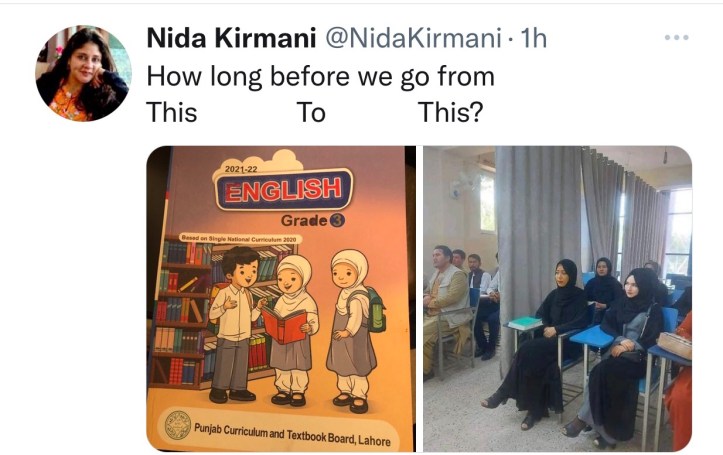
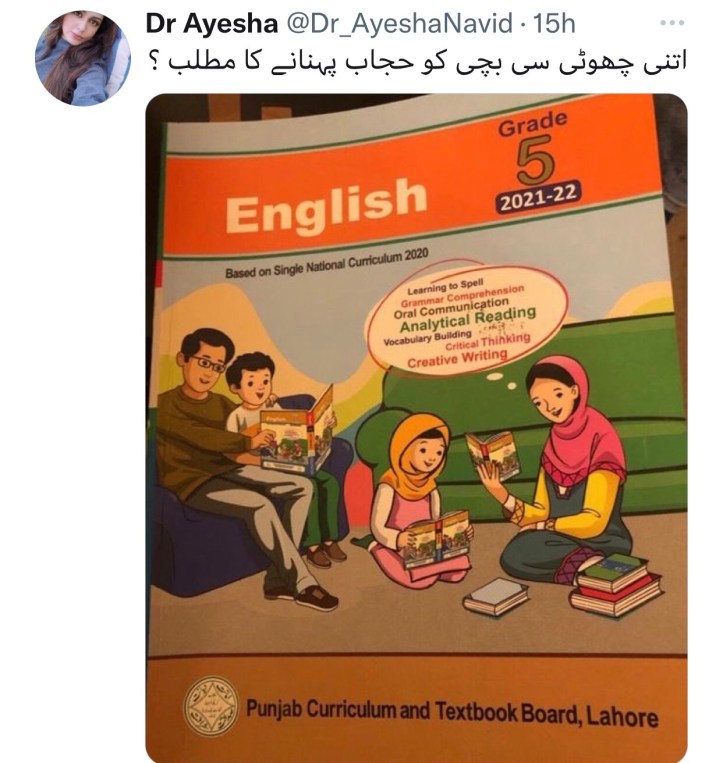
Yesterday morning started with a few tweets that I saw regarding the new Single National Curriculum being introduced in Pakistan. It has generated plenty of discussion and criticism, and rightfully so. The pictures and discussion in these tweets immediately took me back to the day before, when I was in fact going through the pages of Pakistan Quarterly, from the 1950s. I’ve been looking at the formative years of Pakistan and the role played by women, which is far too often side-lined or a footnote in support of the main body.
Below are extracts from two articles, which illustrate some of the discussions that were taking place on the importance of education in the making of a “new Pakistan” and the role of religion (especially girl’s education). Julian Duguid was a journalist, writer and wrote his article while posted in Pakistan. The second article though is by the Vice-Chancellor of Peshawar University, Raziuddin Siddiqi. Dr Siddiqi was born in 1908 and educated in the newly established Osmania University, Hyderabad. Indeed, he was from the first batch that graduated from there and later went on to serve as the Vice-Chancellor of Osmania. In 1950, however, Dr Siddiqi migrated to Karachi and joined Karachi University, at the request of the Government of Pakistan. There was a serious skills shortage in Pakistan following the Partition, and the development of educational institutions and an educated workforce was key to future prosperity.
Lifting of the Veil by Julian Duguid
Pakistan Quarterly, Vol. 2, No. 3, 1952
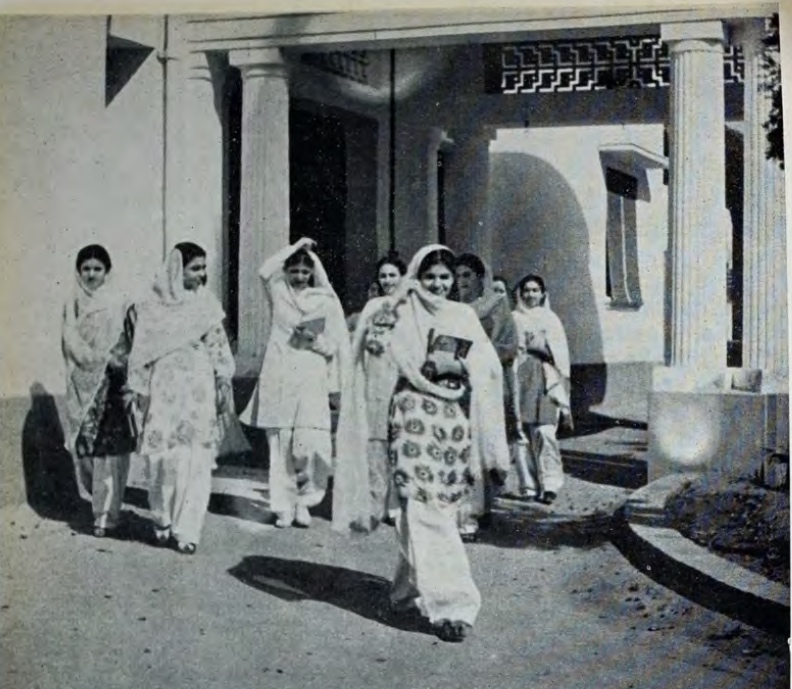
After hearing the story of the chaos, so bravely met and overcome, I watched with a special interest the young girl students whom it freed. A few still went in burqas, but most of them walked and bicycled as if they’d never heard of purdah. At lunch time, they passed Zam-Zammah, the gun on which Kim used to sit; and in the evenings they did athletics or played tennis. There was nothing whatever to distinguish them from any other healthy young students. Yet, even four years ago, many of them could hardly have dreamt of such freedom.
Of course, liberation on this scale has not gone quite uncriticised. Now and then, a fanatical old mullah, his beard abristle with zeal, will creep behind a girl and cut her hair off to teach her not to be shameless. When this happens, he is taken to the police-station and lectured on the new Pakistan and kept in jail for a few days to cool his ardour. He leaves unconvinced, and muttering; but his generation will pass, and then the veil will be lifted more and more widely among the middle-class city-dwellers as it is among the labouring village people whether in town or country.
It may take many years, but it will come.
Education in Pakistan by Raziuddin Siddiqi, Vice-Chancellor, Peshawar University.
Pakistan Quarterly, Vol. 3, No. 4, 1953.
Immediate steps were, therefore, taken in all Provinces to rehabilitate the old schools and Colleges and establish new ones. Classes were held in several shifts to cope with the enormous increase of students. Adequate measures were adopted for training school teachers in large numbers. Education was given high priority along with defence and law and order in the Central and Provincial budgets. A number of new Universities were established in order to provide suitable teachers for the schools and colleges. Educational materials, such as books, journals and scientific equipment, was imported in a large quantity from Europe and America. Young men and women were sent in considerable numbers for training abroad. A six years Plan was formulated to give effect to considered policy of all-round educational development.
It would not be out of place to give here a short account of our policy in this scheme of educational development. The fundamental aim before the authorities in this matter has been ensure to that each and every individual gets the best and highest education and training commensurate with his capabilities. Islam lays down the acquisition of knowledge as an integral part of the duties of every individual Muslim of either sex. It is a unique and distinguishing feature of this religion, which enjoins its followers to think and know for themselves. It has been explicitly stated in the Holy Quran that “God exalteth and elevates to higher ranks only those who are believers, and who have been accorded knowledge”.
Islam does not allow the sharp division of an individual’s existence into a religious and secular life, as believed necessary by the people following other religions. There is no priest-class among the Muslims. Non-observance of this essential principle of Islam, has been one of the main factors in the deterioration of our condition in the past. On the one hand the general body of Muslims were educated in secular schools, and knew very little of the fundamental principles of their religion. For even a little bit of information about their faith, they were entirely at the mercy of the ‘Mullas’. On the other hand, the ‘Mullas’ studied in religious institutions which were completely divorced from all modern knowledge. This was affecting adversely the national life at both ends. The educated young Muslims were generally absorbing atheistic or agnostic tendencies more and more, and instead of proving a source of strength to the community, were undermining its very existence. The ‘Mullas’ were becoming more and more ignorant, fanatic and narrow minded, thus bringing the religion itself into disrepute and contempt.
It was necessary, therefore, to evolve a new system of education, or rather to revive the older system of the early days of Islam in which all knowledge was one, and there was no artificial distinction between religious and non-religious knowledge.
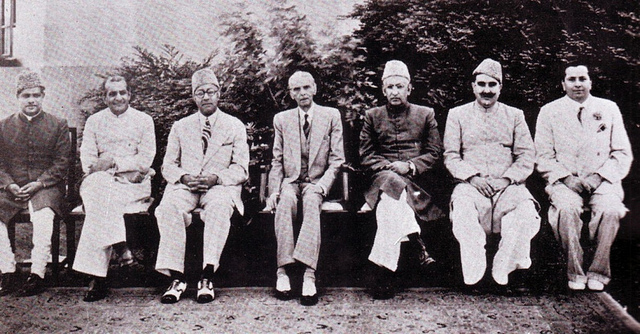
Fazlur Rehman, Ghulam Muhammad, Liaquat Ali Khan, M A Jinnah, Ibrahim Ismail Chundrigar, Abdul Rab Nishtar and Abdul Sattar Pirzada. Picture credit, Dr. Ghulam Nabi Kazi
Fazlur Rahman, then-Minister for Commerce & Education, was born in then-Dacca and was a lawyer-politician of the Bengal Provincial Muslim League, who had served as Revenue Minister of the pre-partitioned province. On 14 September 1949, he sent a 14-page letter (F. No. 14-313/49-Est) to Prime Minister Liaquat Ali Khan, in which he set out his trenchant comments and an accompanying template for the ‘two-fold task’ confronting them namely (1) ‘to lay the foundations of an educational system based on “Islam”’ and (2) to imbue children ‘with an international outlook’.
Recalling the first Pakistan Educational Conference of November 1947 and its resultant educational ideology and institutions – ‘the Advisory Board of Education, the Council of Technical Education and the Inter-University Board’ – he felt that the time had come to overcome ‘the existing system of education, with its alien background, Hindu and Christian ideas, foreign to our ideology’, for as long as it continued, it could not be expected ‘to produce men and women who would realise the value of the Islamic way of life and would make loyal and zealous citizens of Pakistan’.
For the successful achievement of this task, two things were essential: (i) text-books and (ii) teachers. As far as text-books were concerned, the need for Rahman was ‘to draw up the syllabus for every subject on the basis of Islamic ideology (as distinct from instruction in Islamic theology) and get text-books written by competent authors’. He wanted ‘Urdu readers – fundamentally the same all over Pakistan’, necessitating ‘a change in the existing system of publication – whose sole motive is profit-making’. Thus, ‘the Central Government should have them written under supervision’.
There was also the matter of ‘compiling a national history as a kind of reference book’ comprising researched topics like (a) ‘Islamic history and civilisation, (b) the rise and fall of Muslim states all over the world and (c) the contribution made by Muslims to the Indo-Pakistan sub-continent’. For the adoption of Islamic ideology, it was ‘essential to establish a Research Institute in Islamiyat’. As regards teachers and their training, ‘a number of Central Training Institutions’ were needed. These two were ‘fundamental problems which exclusively concerned the Central Government’.
While education was constitutionally the responsibility of the provinces – like in India – their ‘limited resources’ and its ‘all-Pakistan character’ made it ‘incumbent on the Central Government’ to take the lead – ‘from adult to university education’. For ‘democracy and illiteracy go ill together. The illiteracy percentage for India [before 1947] was nearly 90, but with the establishment of Pakistan and the exodus of non-Muslims (educationally more advanced) and the influx of Muslim refugees (to a large extent illiterate)’, there was an increased mass illiteracy in Pakistan.
Adult education, however, was not ‘mere imparting of literacy’ but included ‘spiritual, civic and vocational motives’ for the creation of a patriotic and productive citizenry. This involved infrastructure, implements, literature, teachers and audio-visual aids, for the provision of which, ‘the Central Government must assume certain powers’. Equally important was ‘the provision of free, universal, compulsory primary education’, involving a vast expenditure. ‘Free, compulsory secondary education’ was ‘unfeasible and must be left to future’.
Anyhow, the Central Government had the ‘clear responsibility’ to produce ‘patriotic citizens not warped by narrow provincialism or alien cultural elements as the Hindu influence in East Bengal’. National solidarity therefore required ‘the speedy revision of curricula and syllabi and re-writing of textbooks’. Another problem was the ‘place of Urdu in national life’. As Jinnah had made it ‘abundantly clear’ that Urdu was to be ‘the national language’ and as, by adopting Hindi in Devanagari script, India had ‘dealt a blow’ to Urdu – ‘the cultural heritage of Indian Muslims’.
For Rahman, language was a ‘potent means’ to maintain ‘cultural ascendancy and a separate political consciousness’. Urdu with its Persian and Arabic words was ‘alien in spirit to Hindu culture’, essentialising its ‘elimination from Indian national life’. Conversely, in Pakistan it was ‘a matter of vital necessity to have Urdu in Arabic declared forthwith as state language, a compulsory subject in schools’ overcoming the ‘narrow provincialism’ and ‘parochial mentality’ of East Bengal and Sind and resistance of West Punjab and NWFP ‘to assimilate the vocabulary and culture of these two’.
It was a no-brainer for ‘all employees of the Central Government be required to know Urdu’ and a Bureau of Translation be set up for all technical-scientific terms. In this connection, it is important to remember that in 1949, the Hindu community in East Bengal constituted one third of its population, among whom were ‘the caste Hindus – wedded to the Bengali language – the hard-core of resistance’. Rahman was concerned about their potential for ‘an anti-national mentality’ without ‘a pro-Islamic outlook’; ‘dependable citizens of Pakistan with due regard to their religious rights’.
His suggestion was to ‘reconstruct the Bengali language’ with ‘the Arabic script’ thereby ‘putting an end to the disruptive activity being carried in the name of the common culture of the two Bengals’. Moreover, the ‘present Bengali language with its Sanskrit script’ was ‘steeped in Hindu influence, full of Sanskrit words, Hindu mythology and [thus] anti-Islamic’. The Arabic script would ‘eliminate Hindu influence, facilitate adult education, link up East and West Pakistan [and] ensure East Bengal’s willing acceptance of Urdu as a national language’.
In technical education, Pakistan then had only 3 ‘engineering colleges’, like its 3 universities, for a population of 80 million, ‘impaired by the exodus of non-Muslim teachers’. A ‘Grants Committee’ for both was needed. Here, the ‘main obstacle’ was ‘the attitude of the Ministry of Finance’, to which education was a ‘provincial responsibility’. Rahman had forged the establishment of a History Board, Adult Education Centres in East Bengal, a Central Syllabus Committee with its Bengali sub-committee, a Committee of adopting Arabic script and a Committee on Technical Education.
His future proposals were less piece-meal and included the Central Government assuming ‘direct responsibility for the general planning and coordination of education’, a central-provincial sharing of adult education expenditure, central financial assistance for free, compulsory primary education in provinces, Urdu as state language, Arabic script for regional languages and centres for translation, Islamiyat, teachers’ training and a University Grants Committee.
First Cabinet of Pakistan – Ministers of Liaquat Ali Khan & Muhammad Ali Jinnah in 1947
Richard Southwell Bourke (1822-72), 6th Earl of Mayo, 4th Viceroy of India (1869-72)
Born and educated in Dublin; MP (Conservative Party) for Kildare (1847-52), Coleraine (1852-57) and Cockermouth (1857-68); Chief Secretary for Ireland (1852, 1858, 1866); Assassinated in Andaman Islands by Sher Ali Afridi (1872); Memorial Statue in Cockermouth (1875)
It was of course his legacy that is most associated with the city of Lahore, where the Mayo School of Industrial Art was set up in 1875, following his assassination in 1872. The Mayo School later became the National Collage of Arts (NCA) in 1958 and this still remains the premier institution for the Arts in Pakistan.
Lockwood Kipling was appointed the first Principal of Mayo School, alongside his other role of Curator of the Lahore Museum, which was the Ajaib Ghar in Rudyard Kipling’s Kim.







 BAGICHA