Tag Archives: women

Being a Girl Student in FCC…

While trawling through archives I came across some time ago, I found the following piece of writing in The Folio. Forman Christian College, Lahore dated April 1960. I was intrigued by this short, two-page article on what it was like for female students at the time. What stands out, of course, is how the boys regarded girls as being from “another sphere,” and how this sense of difference is reinforced across the college’s different staff and spaces.

BEING A GIRL STUDENT IN F.C.C. Merel Bhan, VI Year (English)

How well I remember the first day when I told a group of my older acquaintances that I had decided to join FC College for my MA classes. A short silence followed this statement, then a sudden burst of speech.

“You must behave in a most prim and proper way,” advised B-

“Never must you smile or laugh unless you are in the classroom, and except for a few necessary enquiries do not even try to speak with the boys,” declared S-

“But,” I protested, “how will I ever enjoy the next two years if I am not even allowed to speak or discuss a subject with my classmates?”

“Study and only study must be your aim,” said J- with great emphasis. “Always keep your eyes down and look straight ahead, never around you”.

Ah well, it was farewell to all the gay carefree days I had had as a student. From henceforth my college days were to be suddenly very dull, and I tried to resign myself to the fact.

At last the dread day approached and I arrived at the college half an hour earlier than classes were due to start. I wore a very carefully practised sober expression and carried a notebook and pencil – items which I had hitherto been inclined to ignore. My brother conducted me to my classroom. I stood outside, looked around at first, but then, seeing a huge bunch of boys staring at me as if I was a creature from outer space, fixed my gaze upon a spot on the wall immediately above me and so waited. At last another girl came up to me. We both greeted each other enthusiastically but then hastily checked ourselves.

We had both previously studied amongst three hundred of our own species, now we found ourselves suddenly flung into the midst of the very boys who had every day passed the Kinnaird College bus-stand, whistling to the girls and calling out loud remarks, or who had been most vociferous in disconcerting speakers at the various inter-collegiate debates. The advice we had received was the same. Now that there were two of us, reinforced by each other’s company, we entered the classroom.

A steady silence and blear of faces greeted us as we made our way to the closest bench. As our vision cleared saw boys of all shapes and sitting in the class and smoking. Then the inevitable question followed.

“From which college did you do your B.A.?” We replied, and that was the last chance for speech as great deal of information was volunteered to us about courses of study and the professors. Even our monosyllabic answers were not allowed to emerge in the face of that information. We were told how hard we would have to study to pass the December examination, the books we were to read and the books we should have read to provide us with a background. The professors, we were told, were miserly as far as doling out marks was concerned, and then were enlightened about what appealed to which professor. The first conclusion we drew was that we were now firmly in a trap. Not only was the M. A. to be dull, and also very difficult, but it seemed, according to the information we received, that our stay in the college would probably last only until the December examination.

Then we had our first lecture, which was very interesting and that, as well as what the senior girls told us about our college, did much towards toning down the earlier picture. We were told that the time-table was on the noticeboard, and all the girls, in a good, firm group, went to look at it. The notice-board was surrounded by boys of all kinds – bearded boys, chubby cherubie little boys, tall boys, bespectacled boys, fat boys, thin boys, boys with a poetic temperament who had quarrelled with their barbers, and boys sporting the Yul Brynner style. We could not peer over them or around them. We failed even to glimpse the time-table. A girl’s height was great disadvantage, I decided, particularly in a boys’ institution. I made a mental memorandum to buy a pair of high heeled shoes at the first opportunity, but even these, as I have since discovered, have failed to supply a remedy.

At the first lecture we had been supplied with a lengthy book list, and so after a week or two we went to the library to take out some of the books. All of them were out. The librarian told us that we had been very lazy and warned us to be quick next time. The next time, as soon as the book list was handed out, we decided to proceed immediately to the library. However, as the last book was named we heard the squeaking of chairs and a hustle behind us. We saw two boys flash through the door. This occurrence was explained when we walked into the library. All the book were drawn out. From then on we became part of the great “Scramble for books.” This was a great race to decided who would get a particular book first or at least be first on the reservation list. We girls whispered and planned now to get books on a particular subject a week before we were due to start work on it. We wrote down the names and numbers and very confidently handed it to the librarian. He look at it, shook his head, and said, “Sorry, Madam, they are out. However,” he added, “You can take this book.” He drew out the book and gave it to us. We were indeed the first to get it, but, we wondered, would it be worth reading if no one else had wanted to take it?

As we were such a large minority we believed in the maxim, “Unity is Strength,” and we would always sally forth in a group of eight. We would go first to the library or the class or the common room. As time went on and we began to feel more at home, we broke up into smaller groups, and instead of going to the common room to relax we started sitting the lawns. We began to pay visits to the tuckshop as we now regarded this college as ours as well. Thus we girl students were slowly emancipated. We began to have hilarious times here without feeling self-conscious. 

Having now been in the college over a year I observed a few things which should prove to be invaluable precepts for girls hoping to join this college.

A girl student must always walk from one place to another at a moderate pace. To run is unforgivable. Even with the rain coming down at its heaviest she must keep up a stately pace, to avoid raising a laugh from the boys.

She must always consider herself as being from another sphere, as that is how the boys regard her. She is a curiosity, not a person belonging to the earth, and because of this she should not mind if the boys stare at her in the same way every day for two years. She is an alien being in their domain.

A girl is the Weaker Vessel. She must always keep that in mind only then can she bear the treatment meted out to her. Thus she can fully make use of the advantages of “Ladies First” — no waiting in queues for her. She must also always be willing to receive information on books and study as she is incapable of finding out for herself. Even if somebody hands her book on the sixteenth century to study Wordsworth from, she must not object. She can never know as much as a boy. 

The only topic on which girls and converse is study, and that is usually in the form of much advice on the boys’ part. The girl student must receive unquestioningly.
A South Asian Feast at Edgbaston

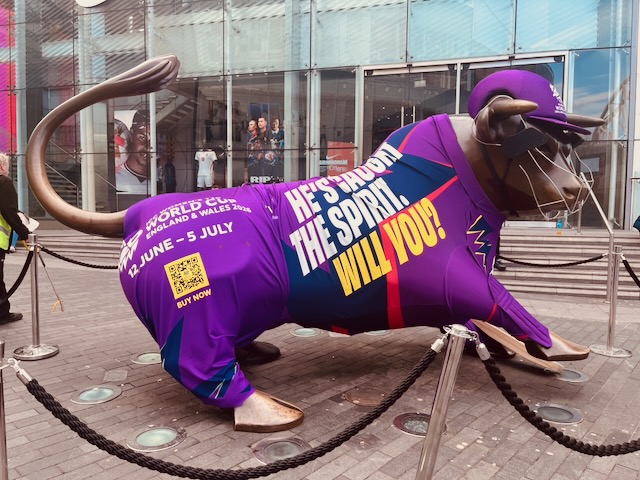
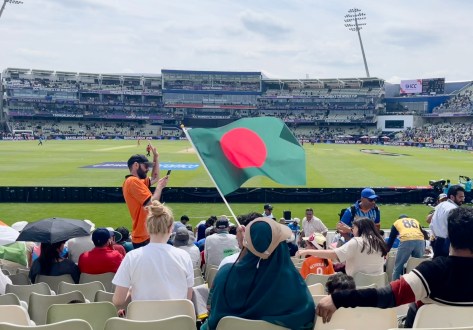
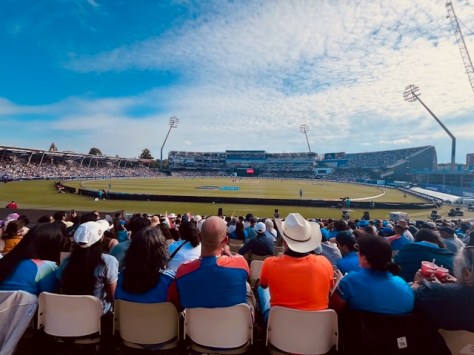
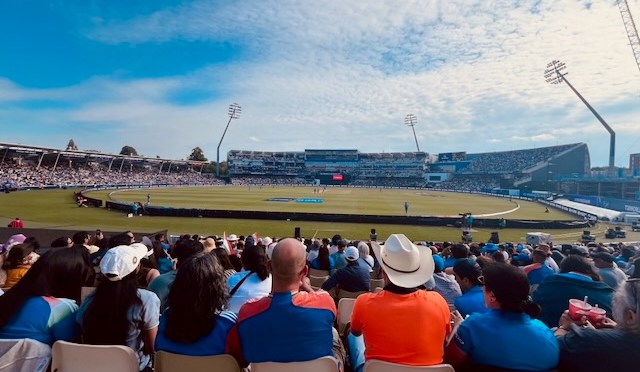
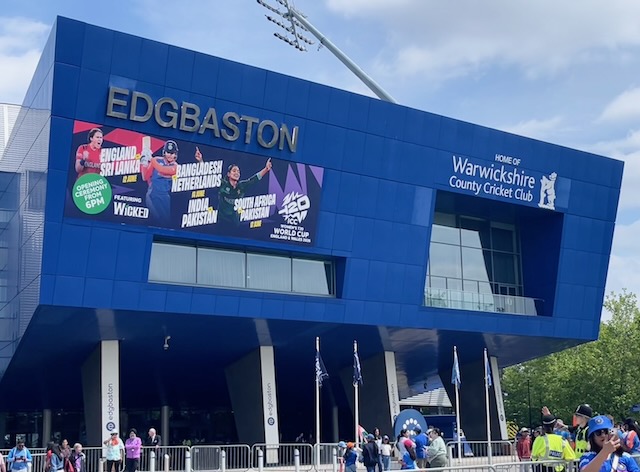
Last week, I indulged in some cricket. Not just any cricket match, but a South Asian feast at Edgbaston, for women’s T20. The morning match, like the morning itself, was relatively mild in temperature, and resulted in Bangladesh winning against the orange army, the Netherlands. But by the afternoon, the temperature was considerably higher during India’s match against Pakistan.

I’ll be honest — I’ve only been to one “proper” cricket match before, which was last year when India were playing England. The prospect of watching this old rivalry play out on the cricket pitch was enticing and irresistible, despite knowing how heated and at times even how ugly the audiences can be. It was also women’s cricket, which has come a long way, and determined to show some gender solidarity, I went along to the historic grounds.

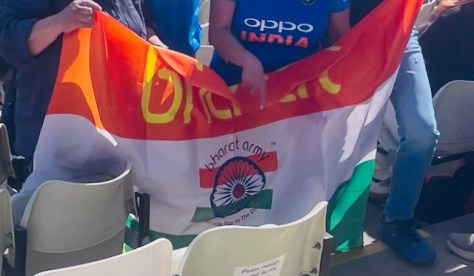
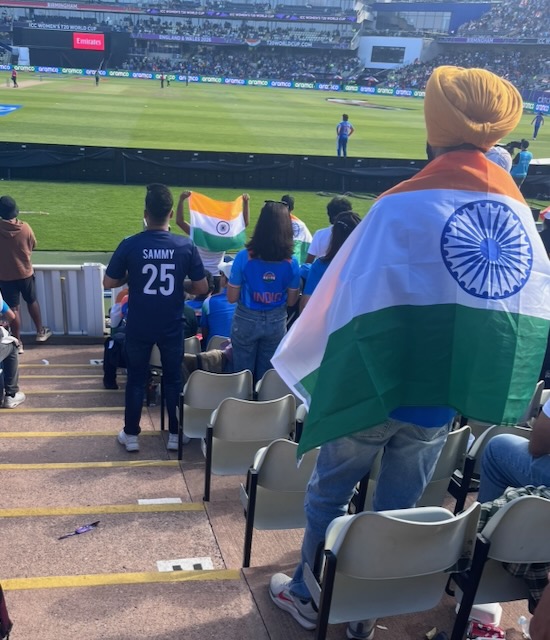
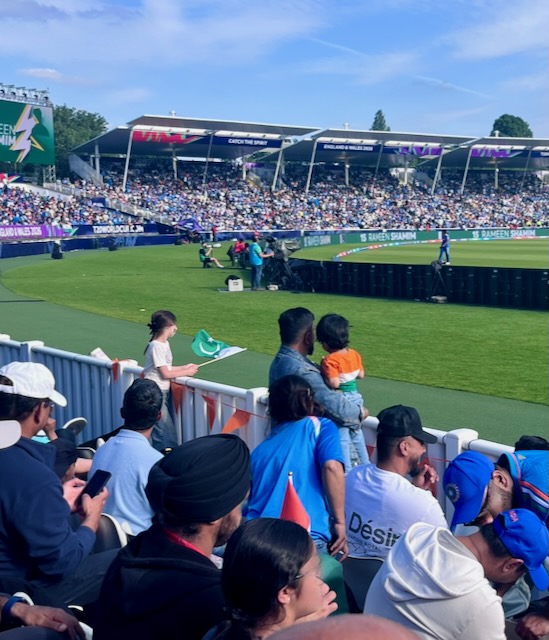
As I arrived at the ground, I could already sense that this match was going to draw large crowds. Indian blue dominated the space, with a few patches of green. Inside, I caught the tail end of the morning match and was in time to see Bangladesh seal victory against the Netherlands. The atmosphere was pleasant and inviting, reflecting the sportsmanship we associate with sport at its best. The Dutch team was incredibly obliging, posing for selfies and engaging warmly with supporters despite their loss.

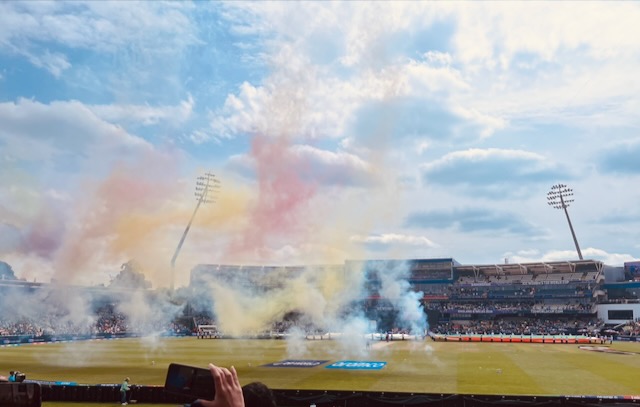
As the ground transformed between matches, the audience shifted, the tension changed, and crowds began to fill their seats. The ICC T20 match began without a handshake — mirroring the precedent set by the men’s teams and undeniably bringing politics into the sporting arena. As national flags were unfurled across the pitch and audiences rose for the anthems, I noticed the people in the row behind me did not stand for Pakistan’s anthem. From their mutterings, it was clear this was a deliberate decision. I was intrigued and irritated in equal measure. The crowd itself was multi-racial and British-born (Gujarati and East African heritages), yet they chose to imbibe and perform a fierce subcontinental nationalism thousands of miles away from home. This stood in sharp contrast to the joy of Bangladesh’s victorious chase against the Netherlands with the sudden, sharp shift in gravity when India and Pakistan took the field.

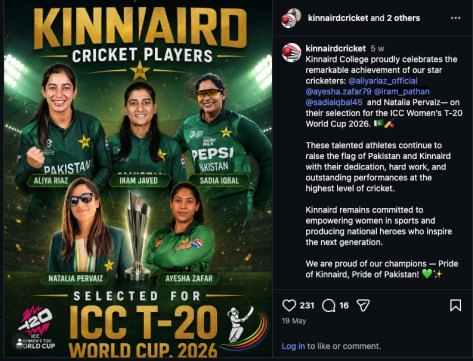
I had also been warned not to expect much from the Pakistan team, given how significantly India has invested in women’s cricket in recent years. I therefore found I was decidedly with the underdog; no one really likes a one-sided affair. Also, some years ago, I spent time at Kinnaird College for Women in Lahore for research, and while there, I was impressed by how important an institution it was, as many fine female cricketers have emerged from there. Five players in the current Pakistan squad have ties to the college, including Aliya Riaz, Ayesha Zafar, Iram Javed, Sadia Iqbal and Natalia Pervaiz.

However, despite a few glimpses of determination from the Pakistani side, the match was largely dominated by India’s women. The crowd was loud, raucous and seemingly oblivious to the fact that this one-sided contest was itself displaying the more unattractive face of nationalism. The problem with sport, of course, is that it forces you to pick a side — there is very little room to sit on the fence. As spectators, the crowd creates its own dynamic within the stadium.

Despite the crowd being very multi-racial and multi-religious, the vibe and the chants were distinctly Hindu, with the most popular in my vicinity being ‘Ganpati Bappa Morya’. This was among the sold-out crowd of 18,814, setting a new Women’s T20 World Cup attendance record for a group-stage double-header. While historic rivalries like these are great for drawing crowds and promoting women’s cricket, the flip side is that the political rivalry is imported as well. 

I slipped out of Edgbaston before the final ball was bowled, once it was clear that Pakistan’s fate was sealed. The Pakistani supporters were also gradually slipping away, as they were outnumbered by the Indian supporters and defeat was certain. I wanted to avoid the crowds, who were already in high spirits — literally and metaphorically. And yet, leaving early also meant carrying away a cleaner impression of the day. Because for all the noise in the stands, the tribalism, the political point-scoring, the refusal to stand for another nation’s anthem, it was the earlier match that offered a different story. The Dutch women who smiled and posed for photos despite their loss. The Bangladesh crowds pleasantly mingling with the Dutch spectators. The Pakistani team who played with dignity in front of a crowd that had largely already written them off.

Women, Violence and the Silences: 1984

© Pippa Virdee 2024

Forty years ago, Delhi witnessed some of the worst violence since 1947. It was the events of October-November 1984, that prompted Urvashi Butalia to revisit the Partition of 1947 and to excavate the history of the violence that was perpetrated towards women. Both 1947 and 1984 have left indelible scars on the people and region. The opening in her book, The Other Side of Silence (1998), is worth quoting detail:

“Then, in October 1984 the prime minister, Indira Gandhi, was assassinated by her security guards, both Sikhs. For days afterwards Sikhs all over India were attacked in an orgy of violence and revenge. Many homes were destroyed and thousands died. In the outlying suburbs of Delhi more than three thousand were killed, often by being doused in kerosene and then set alight. They died horrible, macabre deaths. Black burn marks on the ground showed where their bodies had lain. The government – now headed by Mrs Gandhi’s son Rajiv remained indifferent, but several citizens’ groups came together to provide relief, food and shelter. I was among the hundreds of people who worked in these groups. Every day, while we were distributing food and blankets, compiling lists of the dead and missing, and helping with compensation claims, we listened to the stories of the people who had suffered. Often older people, who had come to Delhi as refugees in 1947, would remember that they had been through a similar terror before. ‘We didn’t think it could happen to us in our own country,’ they would say. This is like Partition again.” (Page 4-5) “It took 1984 to make me understand how ever-present Partition was in our lives too, to recognize that it could not be so easily put away inside the covers of history books. I could no longer pretend that this was a history that belonged to another time, to someone else.” (page 6)

But history keeps repeating itself, again and again. In 1984, people still had fresh memories of 1947, and so those three days of carnage evoked the spectre of Partition once again. Yet each time this happens, there is collective amnesia and each time there is no justice for the “chief sufferers”, the women who bear the brunt of political-communal violence. Below are a selection of articles and abstracts available on the subject and organised chronologically. At the end, there is a recent documentary by The Quint on “The Kaurs of 1984” which brings to the fore the accounts of the women who endured this and who have continued their fight for justice. .

The Justice G.T. Nanavati commission was a one-man commission, a retired Judge of the Supreme Court of India, appointed by the National Democratic Alliance (NDA) government in May 2000, to investigate the “killing of innocent Sikhs” during the 1984 anti-Sikh riots. The report was finally published in 2005.

Mander, Harsh. “Conflict and Suffering: Survivors of Carnages in 1984 and 2002.” Economic and Political Weekly (2010): 57-65. Even through these were separated by 18 years of history, there is tragically a great deal in common between the communal massacres that played out on the streets of Delhi in 1984 and in settlements and bye-lanes across Gujarat in 2002. This paper documents some of the findings of the research conducted with survivors of these two major pogroms over more than a year in the widows’ colony established by the Delhi government in Tilak Vihar and in four of the worst-hit district of Gujarat. It examines the paths of suffering, renegotiation and healing separately for the direct victims and the vicariously affected.

Kaur, Ravinder. “Wound, Waste, History Rereading 1984.” Economic and Political Weekly (2014): 34-38. Wounds are expected to heal. Our very conception of victims and victimhood is based on this hopeful axiom. But not all wounds heal, some remain in a constant state of decay, degenerate, and ultimately risk turning into waste too. It is this possibility of waste that this article explores. The 1984 violence is one of those historical wounds that has neither faded from public memory nor fully healed. At the heart of this unhealing wound is the question of justice that has long been denied to the victims. The judicial affidavits prepared in early 1985 not only narrate the violence that unfolded systematically, but three decades later testify to the inability of the state apparatus to help heal its wounded citizens

Saluja, Anshu. 2015. “Engaging with Women’s Words and Their Silences: Mapping 1984 and Its Aftermath.” Sikh Formations 11 (3): 343–65. doi:10.1080/17448727.2015.1102554. In studying the 1984 pogrom and its aftermath, I have attempted to capture the voices of women of succeeding generations of the victim families and to gauge some sense of the arduous path which these women have had to tread on. In the present paper, I have examined and assessed the ways and means which women survivors of the 1984 pogrom have relied on to cope with their sense of trauma and hurt, and to negotiate everyday existence. In accounts seeking to document and map the experiences of trauma survivors, the themes which they raise and the issues that they speak of are taken into cognisance, while the gaps in their speech often remain unnoticed and unexplained. But these silences and gaps need to be recognised and highlighted as much as the speech of the survivors. Women survivors of 1984 also do not speak of their own agency, leaving it mostly unarticulated in words. Gauging a sense of this requires going beyond the words that are spoken and attempting, even if tentatively, to unravel and interpret the silences.

Kaur, Ishmeet. “Narrating the Experience: Oral Histories and Testimonies of the 1984 anti-Sikh Carnage Victims.” Journal of Punjab Studies 23 (2016). http://giss.org/jsps_vol_23/6_kaur.pdf This essay attempts to understand the word “testimony” and asks how oral histories can also become testimonial. It considers how new histories can unfold from oral accounts of the victims in the context of 1984 anti-Sikh carnage in Delhi. It argues that formal testimonies may misrepresent events by diminishing the gravity of the violence experienced by the victims, while oral narrations may be considered useful historical sources. As a case study, we consider selected affidavits submitted to Nanavati Commission in 2000, as well as oral narratives of the survivors recorded during a field visit to the Tilak Vihar widow’s colony in April 2015.

Arora, Kamal. “Legacies of violence: Sikh women in Delhi’s” Widow Colony”.” PhD diss., University of British Columbia, 2017. https://open.library.ubc.ca/soa/cIRcle/collections/ubctheses/24/items/1.0343994 This dissertation examines how Sikh women who survived the anti-Sikh massacre in 1984 in Delhi, India, cope with the long-term legacies of violence and trauma amid the backdrop of the urban space of the city. After the assassination of then Prime Minister Indira Gandhi by her Sikh bodyguards, approximately thirty-five hundred Sikh men were killed in October and November 1984. Many of the survivors, Sikh widows and their families, were relocated shortly after to the “Widow Colony,” a designated slum also known as Tilak Vihar, within the boundary of Tilak Nagar in West Delhi, as a means of rehabilitation and compensation. The work arises from fieldwork carried out between December 2012 and March 2014. I begin by discussing in depth the space of the Widow Colony and its relation to the rest of the city of Delhi. I then analyze the events of the 1984 massacre through the narratives of Sikh widows and how they remember their experiences of violence. I discuss how violence can have long-term ramifications for everyday life in arenas such as kinship networks, economic stability, health and wellness, and social life. These experiences are further amplified by gender, caste, and class. I also examine the impact of the stigma of widowhood in this community. This research seeks to interrogate how memories of violence inform, and are constituted by, embodied, affective practices carried out in a gendered space produced by the state. I argue that Sikh widows cope with long-term trauma by creating new forms of sociality and memory through their everyday lives and religious practices in the Widow Colony. The memory of the 1984 violence figures heavily among the Sikh diaspora. Thus, I also explore the relationship between the Widow Colony and Sikhs in the transnational arena.

Arora, Kamal, ““I Get Peace:” Gender and Religious Life in a Delhi Gurdwara” Religions 11, no. 3: 135 2020. https://doi.org/10.3390/rel11030135 In October and November of 1984, after the assassination of Prime Minister Indira Gandhi by her Sikh bodyguards, approximately 3500 Sikh men were killed in Delhi, India. Many of the survivors—Sikh widows and their kin—were relocated thereafter to the “Widow Colony”, also known as Tilak Vihar, within the boundary of Tilak Nagar in West Delhi, as a means of rehabilitation and compensation. Within this colony lies the Shaheedganj Gurdwara, frequented by widows and their families. Based on ethnographic fieldwork, I explore the intersections between violence, widowhood, and gendered religious practice in this place of worship. Memories of violence and experiences of widowhood inform and intersect with embodied religious practices in this place. I argue that the gurdwara is primarily a female place; although male-administered, it is a place that, through women’s practices, becomes a gendered counterpublic, allowing women a place to socialize and heal in an area where there is little public space for women to gather. The gurdwara has been re-appropriated away from formal religious practice by these widows, functioning as a place that enables the subversive exchange of local knowledges and viewpoints and a repository of shared experiences that reifies and reclaims gendered loss.

Agarwal, Yamini. Urban Marginalization, Exclusion and Education-the Widows’ Colony in Delhi. Bonn: Max-Weber-Stiftung-Deutsche Geisteswissenschaftliche Institute im Ausland, 2020. This paper examines the many exclusions and marginalities experienced in urban neighbourhoods which are formed as a result of communal violence. It draws on an ethnographic study of Tilak Vihar, also known as the Colony of Widows, where the survivors of the 1984 anti-Sikh violence were resettled. By examining their life histories, the paper explores how women survivors have been caught up in a vicious circle of poverty and lack of educational and occupational opportunities due to their location in a highly stigmatized and gendered space. This has affected the education of their children, as reflected in limited school choices and poverty forcing young people to drop out of schools to fend for their families. The paper also looks into the role of community groups in Tilak Vihar, which have become the main source of support for families given the retreat of the state from this space. The paper underscores the everyday violence that survivors experience due to their gender and spatial location.

Saluja, Anshu. “Gendered Erasures in Memory: Silencing of Cases of Sexual Violence in 1984.” Sikh Formations 20 (3): 149–63, 2024. doi:10.1080/17448727.2024.2384843. In this paper, I have addressed the issue of sexual violence in the specific context of the 1984 anti-Sikh carnage in Delhi. Though a significant number of cases of sexual assault took place in Delhi in November 1984, they have largely remained shrouded in obscurity. I have attempted to analyse the reasons, prompting a near total silence on these instances. In undertaking this inquiry, the paper reflects on the selective, and often disempowering, nature of memory-making and preservation. It goes on to ask the critical question: what constitutes legitimate memory?

Kaur, Jasleen, and Vinita Mohindra. “Spectral Wounds of 1984: Sikh Massacre in Harpreet Kaur’s The Widow Colony: India’s Unsettled Settlement.” Sikh Formations, March, 1–11, 2024. doi:10.1080/17448727.2024.2321416. In 1984, Sikhs were massacred following the assassination of Prime Minister Indira Gandhi. Cultural expressions attempt to foreground the haunting legacies of this genocide. This paper explores Harpreet Kaur’s documentary, The Widow Colony- India’s Unsettled Settlement which unfolds as trauma testimony of the understudied conflict, contextualizing the spectral wounds of Sikh widows and their struggle for survival. Using hauntology and postmemory as critical lens, this article examines the spectral wounds of 1984 Sikh genocide. It also focuses on the gendered dimensions of violence against Sikh women by enunciating their doubly victimized sensibility through their experiences of shame, trauma and suffering.

Kaur, Jasleen, and Vinita Mohindra. “(Un)Dead Past of 1984 Sikh Massacre in Jaspreet Singh’s Helium.” Sikh Formations, September, 1–19, 2024. doi:10.1080/17448727.2024.2408859. Prime Minister Indira Gandhi’s assassination followed the 1984 state-sanctioned massacre of Sikhs. This historical violence haunts survivors, and its mediation in cultural texts reshapes the interplay between history and memory, voicing forgotten narratives. However, the complex historical agency and collective silences on the 1984 Sikh genocide leave its cultural and literary representations undertheorized. Jaspreet Singh’s Helium (2013), serving as a cultural archive, delves into the haunting legacies of this genocide, highlighting its role in memorializing historical loss. Applying hauntology and Agamben’s homo sacer, this article investigates how spectral wounds reveal dystopic violence, excluding Sikhs from legal protection.

The Kaurs of 1984. Quint Documentary.

Leap of faith

It has been a while since I’ve had a chance to post something substantial on my Blog, for the pressures of term-time mean that there are few opportunities to sit down and ponder. However, today was 29th February and I wanted to post something, even if something small. I got my inspiration this morning, when I opened my email to find an editorial on the various Lit.Fests taking place in Pakistan recently, but hidden within this was a lament about women’s position in Pakistan and their battle against “suffocating patriarchy”. On the other hand, here in the UK, I was always told that on the 29th February, women can propose marriage! 

While there are hardly any bars on women proposing marriage on any other day of the year, traditionally this was considered here the “man’s” job/role. To be honest, I had never looked into where this myth came from, until today, when to my surprise, I discovered that this comes from a 5th century Irish tradition, also known as Ladies’ Privilege or Bachelor’s Day. The legend is that Saint Brigid of Kildare complained to Saint Patrick that women sometimes had to wait too long to marry because the men were too slow! In response, Saint Patrick decreed that on the extra day of a leap year, women could propose to men.

As we bid farewell to February, and welcome March, we will also celebrate international women’s day. The lived reality is that wherever you are, there is discrimination, oppression, intolerance, and worse. Take a leap of faith and believe in yourself, be the change you want to see. 

Leap Year Poem
BY MOTHER GOOSE
Thirty days hath September,
April, June and November.
All the rest have thirty-one,
Excepting February alone,
And that has twenty-eight days clear
And twenty-nine in each leap year.

Remembering Partition in the Punjab – podcast

Earlier in the summer I recorded a podcast with Realms of Memory. There are two episodes for those interested in understanding more about the history of Partition, especially how it impacted the Punjab. The talk was based on my book, ‘From the Ashes of 1947: Reimagining Partition’ published by Cambridge University Press (2018). In the podcast I also discuss some of the recent changes that have taken place in the study in Partition.

You can listen to the podcast via most streaming sites, or via Realms of Memory

Remembering Partition in the Punjab: Part 1

Remembering Partition in the Punjab: Part 2

My Body My Choice/Mera Jism Meri Marzi

Facing the waves at an undisclosed location, (c) Pippa Virdee, 2015.

The Evolution of “My Body, My Choice” By Lily Patterson, Voicesofgenz, Jul 27, 2020

An iconic tagline for feminists and activists across the globe, “My Body, My Choice” has packed a powerful punch in the fight for equality and, more specifically, womxn’s rights. Starting in the 1970s, the phrase was unofficially coined as a mantra belonging to the gender equality movement and was commonly heard at protests in a number of countries. Starting in the late 20th century, “My Body, My Choice” became words of empowerment and retaliation, particularly in the battle for reproductive rights and accessible abortions. In response to the oppression facing womxn and their reproductive power, feminists and protestors continue to use this phrase as a battle cry, an expression of the importance of bodily autonomy. Naturally, this response isn’t well-received by everyone, and is particularly opposed by pro-life supporters and government officials with anti-abortion agendas. As you can imagine, it isn’t exactly a popular mantra with sexists either. Regardless, “My Body, My Choice” continues to be an expression of the rights womxn deserve, and it is still consistently used in the battle for gender equality.

These words of strength have found their way around the world, and international chants for reproductive freedom and equality have rung proud. In a number of countries around the world, this tagline is met with brutal criticism. In recent months, womxn in Pakistan have been organizing marches and taking a stand against the injustices facing them in daily life. The phrase “Mera Jism Meri Marzi” (meaning “My Body, My Choice”) has made its home in the streets of Pakistan as activists demanding equality practically shout it from the rooftops. In Pakistan, this mantra holds true to its original intentions and is utilized as a powerful retaliation to sexist societal ideals and the archaic patriarchy. Other countries, including Zambia, England, Austria, Turkey, and more, have recently followed suit in chanting “My Body My Choice” as a bold statement about reproductive rights, gender equality, and other feminist ideals. The original intention of this tagline is described by Rameeza Ahmed, a journalist who covered the marches happening in Pakistan. “Whether she chooses to follow a certain religion or whether she chooses to walk around proudly without any clothes, it is her right to do as she wants and nobody else has a right to prevent her from exercising her choice,” states Ahmed.[Read complete article: https://www.voicesofgenz.com/post-1/the-evolution-of-my-body-my-choice]

my body. my choice written by Samantha Francesca, October 2017

I’ve never felt so much anger before towards anyone.
Have you ever looked someone in the eye and have them tell you that you should’ve kept the child that was planted in you by a stranger who drugged and ****** you?
Have you wiped the tears of a woman in despair because she was ***** and told she wasn’t allowed to get an abortion?
Have you curled up in a ball, trying to figure out who to tell about your personal experience of ****** assault and ****?
Tell me, person who says abortion is a sin and that it is relative to the holocaust, will my ****** support me?
Will my ****** pay for doctors visits?
Will my ****** pay the medicals bills for giving birth?
Will my ****** pay child support?
**** no and don’t tell me that I should always save the child.
Excuse me if I don’t want to carry my ******’s child inside of me.
My body. My choice.
MY BODY. MY CHOICE.

With abortion heading back to the Supreme Court, is it time to retire the ‘my body, my choice’ slogan? By Elizabeth Lanphier in The Conversation, 4 August 2021.

The slogan “my body, my choice” has been a feature of the reproductive rights movement in the U.S. and around the world since at least the 1960s. It’s now shorthand for concepts like bodily autonomy and self-determination. In the context of reproductive rights, “my body, my choice” asserts freedom from external control – specifically government control – over one’s reproductive choices.

It makes sense that “my body, my choice” gained steam in the years leading up to Roe v. Wade – a time when reproductive rights activists were fighting for the government to stay out of abortion decisions. Roe did just that by determining that abortion is a private choice between a pregnant person and their physician.

As a private matter, the Supreme Court determined that the government cannot interfere with one’s right to an abortion prior to fetal viability. In so doing, Roe established what philosophers call a “negative liberty,” or freedom from something. This freedom from interference was a crucial step toward reproductive rights in the U.S.

But in the decades since Roe, various states have taken steps to whittle away at the constitutionally protected right to abortion. “My body, my choice” frequently appears on signs at protests against abortion restrictions and in social media campaigns like #MyBodyMyChoice. [Read complete piece which discusses the philosophical and ethical debates around access and right to health care: https://theconversation.com/with-abortion-heading-back-to-the-supreme-court-is-it-time-to-retire-the-my-body-my-choice-slogan-163770]

City Monument – Masjid Mubarak Begum, Chawri Bazar

Like a wounded fairy tale. It is among Delhi’s most melancholic souvenirs. One of the domes no longer exists. The missing portion is wrapped in a …

City Monument – Masjid Mubarak Begum, Chawri Bazar

The shame of work

This morning I came across a newsflash on the BBC about “The risqué business of selling underwear in Pakistan”, which serves as a click bait because the article-proper is titled “Pakistan: The man trying to improve women’s underwear”. Its content immediately resonated with me. The quotes from female workers therein took me back to the research I did on the women, who worked for Pakistan International Airline (PIA) in 1960s. The factory in-focus, where they are making the garments, is based in Faisalabad (Lyallpur), a city I know well because of my own doctoral research, while the business was started by a Leicester born businessman. Leicester/DMU where I work, is city renowned for its garment factories and indeed DMU has long pioneered research in the increasingly sophisticated lingerie industry.

The interesting element is of course that in Pakistan, women’s undergarments are either on full display in congested stalls in busy bazaars, where a majority of women shop (buying, most likely, from a man) or they are curiously hidden (veiled) behind the blackened windows in fancy shopping malls. This stark class disparity is also symbolic of a cultural disparity in a society where working women of the sub-urban informal sector in r-urban areas, rarely have the luxury to be veiled, while the newly middle-class women, of families with the means to be pious, are more prone to and secluded in world of purdah.

The focus of the said article is about comfort and ensuring that women have access to underwear garments that are fit for purpose – and not just for optics. The fact that society treats these necessities in life as taboo, something to be embarrassed about and to snigger at because we are unsure how to respond, is a fine example of how a patriarchal society works to keep women confined in both public and private spaces.

When I was doing my research on PIA, the airline was established in 1955 in part to meet the needs of keeping East and West Pakistan connected, it was obvious that to get it off the ground, it needed staff, male and female. I was intrigued by the women who worked for PIA in the 1950s and 1960s, what motivated them, what their background was, given that in this still-more socially conservative age, women working as “airhostesses” or cabin crew were yet-more objectified, with age/size/marital status being important to the job. So, it was not surprising when such women encountered reluctance from the family members. 

These quotes from the BBC article could have been from the women I spoke with: (1) “We had two people who came back and said their families do not want them to work in an undergarment factory.” (2) “My father instantly refused…I had to ask him to let me go and see for myself and if…I don’t like the atmosphere at the factory, I won’t accept the job.”

Women who wanted to work for PIA endured similar sentiments. Families were reluctant or worse at their sisters/daughters working in this “forward” industry and the potential shame. But this was the 1950s/60s, and many of these women were away from home, flying high and experiencing a completely different world. In their taking off, they were breaking new ground, pioneering and enabling others to work in professions other than the usual “respectable” teaching/medicine. And so, to read these quotes from women today, 60 years later and working for a factory that is making undergarments is emblematic of how Pakistan has rolled on the road of more piety and rituals, as a ruse for rule; cover for control.

Faisalabad/Lyallpur is the third largest city in Pakistan, after Karachi and Lahore, and is the hub of the textile industry. It is often referred to as the Manchester of Pakistan. Following the Partition of British India, the city witnessed mass movement of people, both those who left for India and the large number of refugees that transformed this colonial town into the city that it is today. When I was doing my research on the city in the early-2000s, it was a conservative city despite the vast wealth being generated in its bazaars; 20 years on, it continues to be so, perhaps because of the new capital and its renewed performance of customs and commodification of shame.

Read further:

Pippa Virdee, ‘Women and Pakistan International Airlines in Ayub Khan’s Pakistan’, The International History Review, 2019, 41:6, 1341-1366, DOI: 10.1080/07075332.2018.1472622

Saher Baloch, ‘Pakistan: The man trying to improve women’s underwear’, BBC News, 13 June 2021. https://www.bbc.co.uk/news/world-asia-57268691.