Tag Archives: Partition

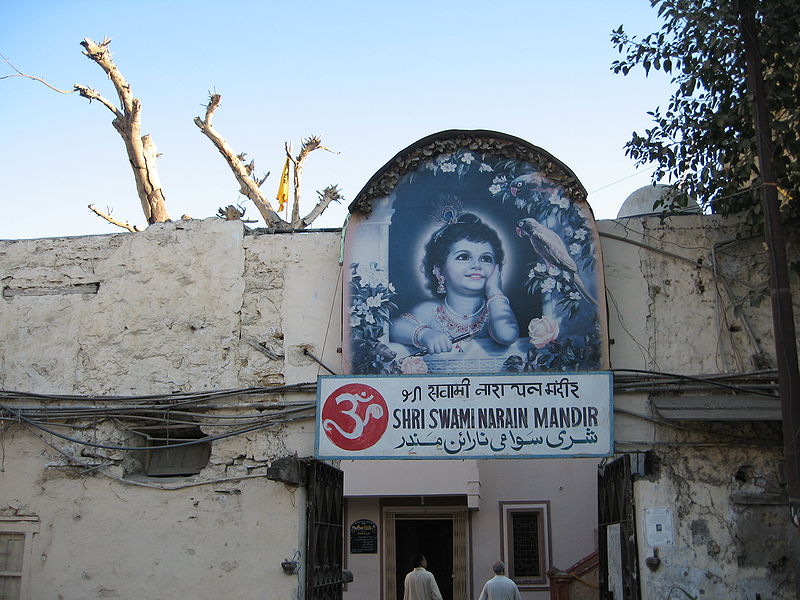
Swaminarayan Temple, Karachi: Past and Present

Shri Swaminarayan Mandir. Source: https://www.discover-pakistan.com/shri-swaminarayan-mandir.html.

Pities of Partition: Fragmented archives, claims and counter-claims, ‘actual facts’ & contested-truths, sacred and scarce, state against society, naya Pakistan & naya Bharat.

1. 31 January 1950, N. Gopalaswami Ayyangar (Minister for Transport & Railways, Govt. of Ind.) to N. Liaquat Ali Khan (Prime Minister, Govt. of Pak.):

‘I have been distressed about the action taken by the Pakistan authorities in relation to the Swaminarayan Temple at Karachi. When an allotment of a portion of the Swaminarayan Temple building was first made to a Muslim, our High-Commissioner at Karachi in December 1948, requested the Administrator, Karachi, to ensure that, for reasons of the sanctity of the temple and security of Hindus living in the temple precincts, the temple building should be reserved for the exclusive use of Hindus. By January 1949, the Administrator, Karachi, confirmed…that the Muslim allottee would be fixed up elsewhere… Later a committee of Hindus was also appointed to allot accommodation within the precincts of the temple. Lately the Administrator has abolished this committee and has withdrawn the previous assurance that the temple would be reserved for the exclusive use of Hindus. Meanwhile, further tenements in the precincts of the temple have been occupied by Muslims. The temple has not only catered for the religious and social needs of Hindus at Karachi but has also been used for accommodating Hindu refugees in transit to India…The Governments of India and Pakistan have undertaken to maintain the sanctity of the religious shrines within their territories. It is contrary to this agreement to disturb the sanctity of this temple, which is one of the important ones in Sind, particularly as Hindus in Karachi still continue to offer worship in the temple. I would strongly urge your taking suitable action in the matter…

2. 20 February 1950, N. Liaquat Ali Khan to N. Gopalaswami Ayyangar (in reply):

‘I made inquiries…The temple is surrounded by a big courtyard; all around the courtyard there are a number of tenements used as residential flats by Hindus, Muslims and others, but most of the flats do not open in the temple courtyard. A number of Muslims lived in these flats even before Pakistan was established. However, the sanctity of the temple is as well maintained as before. In order to obviate all chances of misapprehension on the part of the Hindu minority, the Administrator was willing to reserve all the flats around the temple exclusively for Hindus. Therefore, a committee of Hindus was appointed by him to recommend allotment of accommodation…It was however found that the committee took no interest in the work and allowed a number of flats to remain unoccupied. At the same time, it came to notice that the intending Hindu evacuees were transferring possession of the flats, with or without the connivance of the committee on pugree money. In view of the acute shortage of accommodation in Karachi and the recurring complaints of corruption, the Administrator had to dissolve the committee and resume the practice of making allotments direct…Preference is always given to Hindus, but when they are not available, residential accommodation cannot be allowed to remain vacant in the present-day conditions. I would reiterate that so far as the temple is concerned, its sacred position is fully maintained and the Hindus of Karachi continue to offer worship in it without let or hindrance. The High Commissioner for India recently held some of his Independence Day celebrations at the temple, which goes to show that he considered the premises exclusive enough…As regards the allocation of this whole area as a transit camp for Hindus, it is regretted that in view of the present acute shortage of accommodation, it is not possible to reserve any area in the city for this purpose. An offer is however being made to the High Commissioner for India, for allotment of sufficient land just outside Karachi for maintaining a regular transit camp…’

3. 16 March 1950, N. Gopalaswami Ayyangar to N. Liaquat Ali Khan (in reply):

‘I write to acknowledge your letter…Before replying, I had necessarily to obtain full information from our High Commissioner at Karachi in respect of the specific points you have raised…This information has since been received…You will find from [it] that the information given to you – such as that a number of Muslims lived in the flats even before Pakistan was established, that the committee of Hindus set up for advising on the allotment of accommodation took no interest in the work, that possession of some of the flats had been transferred with or without the connivance of the committee on pugree money etc. – is not in accordance with actual facts. I trust you will agree that the temple and its precincts together with the flats physically connected with it, should, for obvious reasons, be allowed to be occupied exclusively by Hindus for residential purposes and for serving as a transit camp for Hindus who pass through Karachi on their way to and back from India. You will appreciate, I am sure, the Hindu sentiment in regard to this…temple… [which] has been used as such a transit camp for over two years…I understand that our High Commissioner has been offered land at Malir for locating a transit camp. Malir is 14 miles away and the inconveniences of locating a transit camp at such a place are obvious…It is impossible for us to accept the offer and I do hope that you will be good enough to reconsider the whole matter…’

Source: File No. 12 (4)-PMS/50 (Government of Pakistan, Prime Minister’s Secretariat)

4. 12 January 2014, ‘City Faith – Shri Swaminarayan temple’, The Karachi Walla:

‘A…landmark on M.A. Jinnah Road…the temple is 200 years old according to the priest in-charge…The priest was originally from Thar. The architecture of temple is very similar to those of Jain temples in Karoonjhar range…The temple is built in the honour of Shri Swaminarayan who…lived his life in Gujrat…Naturally a link has been established between this temple and those in Gujrat and every few years, priests from both sides visit each other. The compound accommodates a Sikh Gurdwara as well. There is a sacred cowshed at the back and a gate, which leads to a neighbourhood with those fabulous balconies from yore. It is the biggest temple in Karachi and naturally a centre of celebrations during…festivals. There’s a significant Hindu population living around the temple…’

5. ‘The Shri Swaminarayan Mandir…:

‘…was built in 1849…over 32,306 square yards…on the M. A. Jinnah Road in Karachi city. The temple celebrated its anniversary of 150 years in April 2004. The temple is located at the centre of a Hindu neighbourhood in Karachi, and it is believed that not only Hindus but also adherents of Islam visit the temple…There is a sacred cowshed within the premises of this temple. [It] became a refugee camp in 1947…People who wished to settle in India from all over Sindh awaited their departure to India by ship at this temple, where they were also visited by Muhammad Ali Jinnah, during this period. In 1989, for the first time since 1947, a group of sadhus from the Shri Swaminarayan Mandir, Ahmedabad (India) visited the temple. Since then, small groups…visit every few years in a pilgrimage’.

How the Photographs of Margaret Bourke-White became the Images of Partition.

When we visualise India’s Partition of 1947, we almost always do so through the images of Margaret Bourke-White. For the past seven decades, her images have saturated the cover of numerous books, newspaper articles, magazine features, documentaries et al related to Partition. She was, of course, one of the most iconic photographers of the last century. Born in 1904 (d. 1971) in New York City and raised in rural New Jersey, she was the daughter of Joseph White (who was of Jewish descent from Poland) and Minnie Bourke, an Irish Orthodox Catholic. Joseph was an inventor and engineer and perhaps thus an early influence on his daughter’s eventual interest.

This interest matched the tenor of those times, as Henry R Luce, the publisher tycoon realising the potential of photography, felt that America was ready for a magazine that documented events the through photographs. In 1936, Luce bought Life magazine and relaunched it, with Bourke-White becoming one of the first photojournalist to be offered a berth there (Kapoor: 13). America then was in the midst of the Great Depression and Bourke-White ‘took to documentary photography in order to disseminate the idea of inconvenient truth’ for a readership of 2.86 million people (Bhullar: 301).

In India, she is primarily known for her photographs that captured the Partition-related violence and migration, as it ushered in the new dawn of independence. Her photographic essay, The Great Migration: Five Million Indians Flee for Their Lives, was published in Life magazine on 3 November 1947. It had commissioned her to cover the exchange of populations that was taking place across the plains of the divided Punjab and she writes thus what she saw: “All roads between India and Pakistan were choked with streams of refugees. In scenes reminiscent of the Biblical times, hordes of displaced people trudged across the newly created borders to an uncertain future” (Kapoor: 14).

Recently, in 2010, Pramod Kapoor published Witness to life and freedom: Margaret Bourke-White in India & Pakistan with a reprint of over 100 of her photographs. Kapoor wrote about them thus: “They offer a kind of stately, classical view of misery, of humanity at its most wretched, yet somehow noble, somehow beautiful”. His book gives us into a glimpse beyond the frames. Bourke-White had arrived in India in March 1946 and travel around documenting low life and high people: “She was there to photograph Gandhi at his spinning wheel. She was there to photograph Jinnah with his fez. And soon after, both men were to meet their Maker” (Kapoor: 14). Her frames on them served to reinforce their pervading stereotypes of the saint and shrewd. Kapoor details:

“Margaret photographed Gandhi many times afterward. He called her, fondly, she thought, ‘the torturer’. His inconsistencies puzzled her rational mind; it was not until she saw his self-sacrificing bravely in the face of India’s convulsive violence that she began to think him akin to the saint she made him out to be with her camera. She also photographed Mohammed Ali Jinnah; whose features were as sharp as the creases in his western business suits. Jinnah would almost single-handedly bring about the partition of India and the creation of Pakistan”.

Bourke-White documented the aftermath of the so-called Direct-Action Day in August 1946, which was announced by Jinnah following the failure of the Cabinet Mission Plan. Her photographs of the riots in Calcutta then are sometimes confused with the images she took following the Partition, a year later. The article ‘The Vultures of Calcutta’ featured in the 9 September 1946 issue of Life, showing vultures waiting to prey on the bodies of dead victims was later, intermittently and inaccurately, used for depicting the carnage in August 1947.

Vicki Goldberg, the biographer of Bourke-White, writes that when she heard about the Calcutta Riots, Bourke-White immediately flew to Calcutta, and “badgered photographer Max Desfor (1913-2018), the first foreigner to photograph the aftermath of the riots, to tell her where to find the most carnage. While others were sickened by the sight of the bodies, Bourke-White kept working and wrote the scene reminded her of concentration camps in Germany: “the ultimate result of racial and religious prejudice” (Forbes: 7). Desfor’s images were not published by the Associated Press because they were “too revolting for its readers”. Bourke-White’s comrade was Lee Eitingon, a Life reporter based in India, in whose words, “Both of us were whatever the female equivalent of macho is. The smells were so terrible, the officers accompanying us would have handkerchiefs over their faces. We would not…that was part of the time and the period. Being women, we had to be tougher” (Kapoor: 27).

Much of Bourke-White’s archive are housed in Syracuse University’s Bird Library Special Collections section. Here “one can find some of the original photos that include the British soldiers who accompanied Bourke-White and Lee Eitingon” but, as Forbes notes, “the soldiers were cropped from the published pictures”, which dramatically changes the visual narrative (12). It now appears that Bourke-White staged photographs: “Eitingon wrote about her directing a group of starving Sikh refugees…to go back again and again”. She adds, “they were too frightened to say no. They were dying”. When Eitingon protested, Bourke-White told her “to give them money!” (Forbes: 11-12). Even Patrick French writes about how some of these images were staged. When the contact sheets were discovered, they provided an insight into the wider context in which these photographs were being taken. Some of this approach of a pushy, zealous and ambitious American, has been noted in the writing of Claude Cookman. In his examination of how Bourke-White and her French counterpart Henry Cartier-Bresson (1908-2004) approached the coverage of Gandhi’s funeral he notes:

“Flash had become a contentious issue in Bourke-White’s coverage of Gandhi. She had used a flash bulb to make her famous portrait of Gandhi by his spinning wheel. Gandhi…tolerated the technique, but his inner circle never did. They thought flash was disrespectful, and they feared the bright light would harm his sensitive eyes. Flash became a serious liability for Bourke-White in her coverage of Gandhi’s funeral. With her camera concealed, she slipped into the room, where his body lay surrounded by grieving relatives, supporters and government officials. It was about 6:30 p.m.…When she ignited a flash bulb to make her exposure, his followers became enraged by her violation of their privacy and grief. They seized her camera and threatened to destroy it. Hannah Sen intervened, calming the group. After Bourke-White’s film was removed and exposed to the light, Mrs. Sen escorted her from the room. She returned the camera with the understanding that Bourke-White would leave Birla House and not return. Not one to give up after one rebuff, she reloaded her camera and tried to re-enter the room to get another picture. Eventually, Bourke-White yielded to Mrs. Sen’s pleas to honour her promise and left empty-handed. The stereotype of the rude, aggressive American news photographer, who would trample on anybody’s toes or sensitivities to get the picture was a commonplace during the 1940s…Cartier-Bresson deplored this rough-and-tumble approach to photo-journalism: ‘We are bound to arrive as intruders’, he wrote, ‘it is essential, therefore, to approach the subject on tiptoe. It’s no good jostling or elbowing’. As part of his approach, he rejected artificial lighting: ‘And no photographs taken with the aid of flashlight either, if only out of respect…Unless a photographer observes such conditions as these, he may become an intolerably aggressive character’. When Cartier-Bresson wrote this rejection of flash in 1952, he may well have been recalling Bourke-White’s experience at Gandhi’s wake four years earlier” (Cookman: 200).

Geraldine Forbes also notes the differences between Cartier-Bresson and Bourke-White. The former is less known but his images exude a sensitivity, absent in the work of Bourke-White. Upon receiving a photography award, Bourke-White claimed, “The photographer must know. It is his sacred duty to look on two sides of a question and find the truth”. And she cited her work to reference this point (Kapoor: 26). However, when we look at her work, we rarely observe that her work, almost entirely based on the Punjab migration, has yet been made to stand for Independence/Partition exclusively, without acknowledging the vast and diverse range of experiences. The visual record which is taken as “the truth” is rarely explored critically or contextually, while less said so of the racial-ethnic cultural capital of a white American female to travel freely to photograph this momentous carnage at the end of empire. These were foreign journalists writing for a predominately American and western audience, yet these photographs have come to represent Partition.

References:

Dilpreet Bhullar, ‘The Partition of the Indian Subcontinent Seen through Margaret Bourke-White’s Photographic Essay: ‘The Great Migration: Five Million Indians Flee for their Lives’, Indian Journal of Human Development, (2012) 6 (2): 299-307.  

Claude Cookman, ‘Margaret Bourke-White and Henri Cartier-Bresson: Gandhi’s funeral’, History of Photography 22, no. 2 (1998): 199-209.

Geraldine Forbes, ‘Margaret Bourke-White: Partition for Western Consumption’, In Reappraising the Partition of India edited by K. Mitra and S. Gangopadhyay (Readers Service, 2019), pp. 3-16.

Patrick French, ‘A New Way of Seeing Indian Independence and the Brutal ‘Great Migration’, Time, 14 August 2016.

Vicki Goldberg, A Biography. New York: Harper & Row. 1986.

Pramod Kapoor, Witness to Life and Freedom: Margaret Bourke-White in India & Pakistan. New Delhi: Roli & Janssen. 2010. 

Asma Naeem, ‘Partition and the Mobilities of Margaret Bourke-White and Zarina’, American Art 31, no. 2 (2017): 81-88.

Pramod K. Nayar, ‘The Trailblazing Lens of Photojournalist Margaret Bourke-White’, The Wire, 28 Sept 2019.

Bio/profile/work:

Alan Taylor, ‘The Photography of Margaret Bourke-White’, The Atlantic, 28 August 2019.

The Pioneering Photography of Margaret Bourke-White by Google Arts & Culture

The Life Picture Collection

Original Life Magazines

The ‘Jingle Trucks’ and the emergence of Truck Art

TurckArt - 3
© 2017 Pippa Virdee

Earlier in June, I shared a piece about Pakistani Truck Artist Haider Ali and his homage to George Floyd. It resonated with many people. At the same time, I was also writing a separate piece around the cultural landscape and art scene in Pakistan. Originally, I had planned to include something about Truck Art, which I have always been intrigued and charmed by. I even wrote about it but in the end, I had to exclude it from the final version. But words are never wasted, and here I share some of that in an extended version.

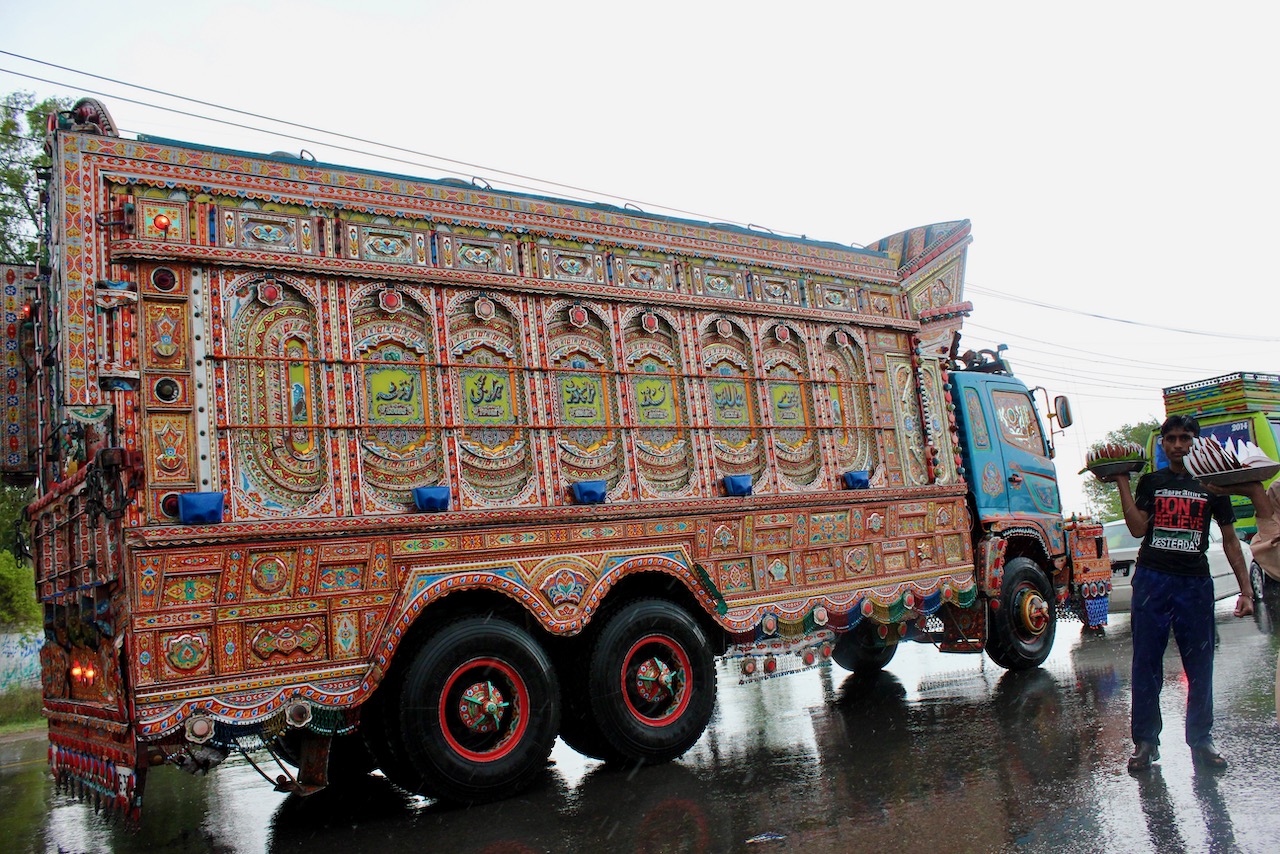
Anyone who has visited Pakistan, seen it on screen or in pictures, would have encountered the vibrant, highly distinctive, and perhaps even outlandish, painted trucks. This form of decorating and customising trucks is popular in South Asia, but the designs and passion displayed are quite exceptional in Pakistan. Over the years these truck designs have transformed and evolved from depicting religious iconography and Sufi saints to a much more dynamic art-form. The lively and loud paintings incorporate animals, fauna and flora in a psychedelic array of colours. The artwork is paired with poetry, calligraphy, popular idioms, and popular iconography to represent an individual expression of the trucker’s identity and background. On the surface, they may appear the same but deeper inspection reveals the regional identity and character of the person and the location. Although it is thought that specialism in truck art was prevalent in NWFP/KP, it has travelled through migration of labour to the port city of Karachi, where it has found fertile ground and flourished.

History

The exact origins of this kind of art-form are unknown, but it does date back to the early 20th century. According to Paracha, a more restrained version of this art-form was present in the subcontinent in the 1940s. That of course would also have something to do with the lack of accessibility to the materials used to paint and decorate these trucks. Paracha suggests that, “It first appeared on trucks and lorries driven by Sikh transporters who would paint a portrait of their spiritual Gurus, or those who helped form the Sikh religion. The portraits were painted with the loudest of colours. Simultaneously, Muslim transporters and drivers began to paint portraits of famous Sufi saints on their trucks and lorries.”

On Pinterest there is a popular quote suggesting that “In the 1920s, the Kohistan Bus Company hired Ustad Elahi Buksh, a master craftsman, to decorate their buses to attract passengers. It was not long after that truck owners followed with their own designs. Within the last few years trucks and buses have been further embellished with full lighting systems.”

TurckArt - 6Another source elaborates and suggests: “This extraordinary tradition has its routes in the days of the Raj when craftsmen made glorious horse drawn carriages for the gentry. In the 1920s, the Kohistan bus company asked the local Michaelangelo, Ustad Elahi Buksh, a master craftsman to decorate their buses to attract passengers. Buksh employed a community of artists from the Punjabi town of Chiniot, whose ancestors had worked on many great palaces and temples dating back to the Mughal Empire.”

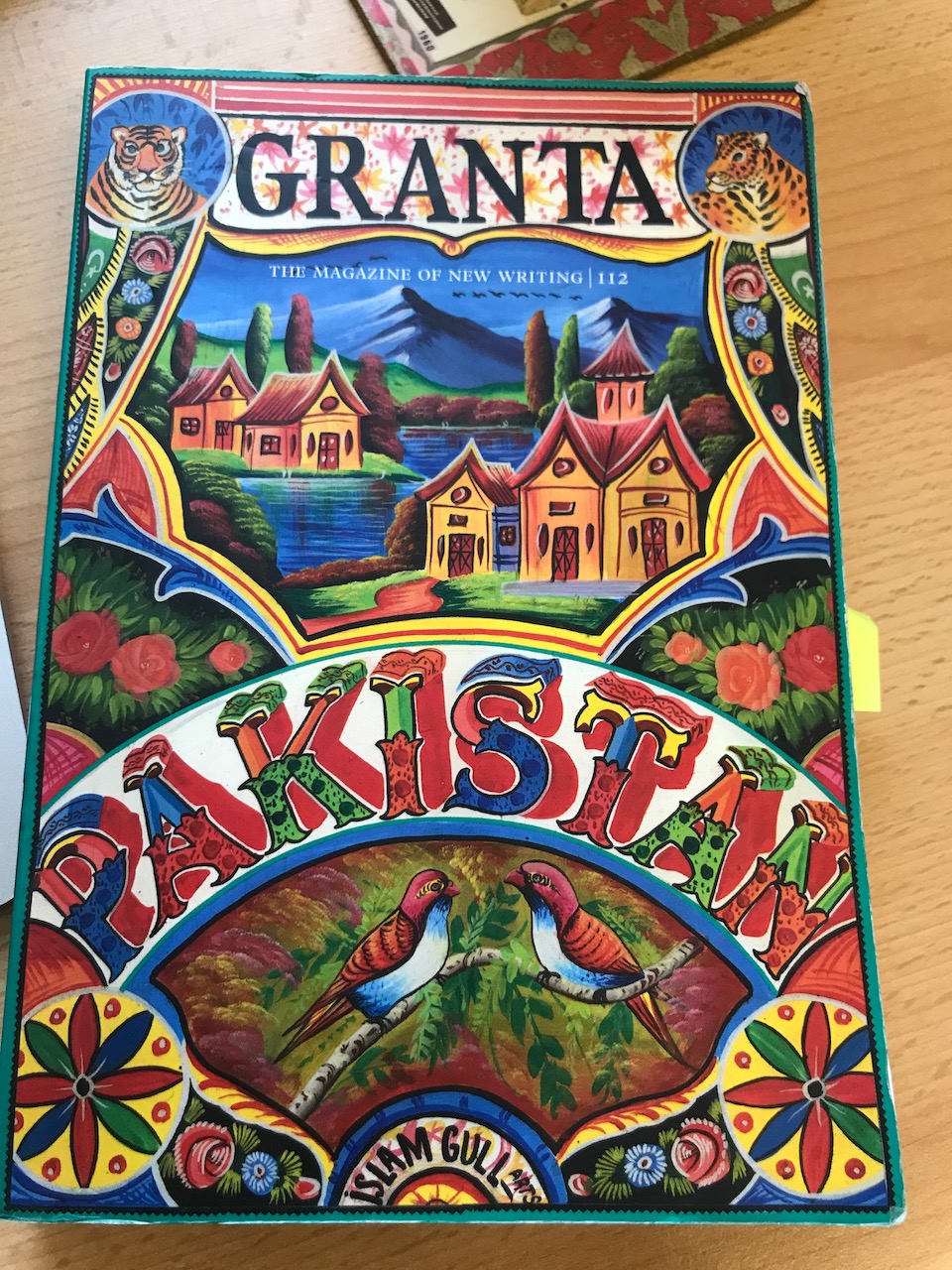
The special edition of Granta in 2010 also suggests that there were links with the “ornate horse-drawn carriages of the Raj to the pioneering craftsmanship featured on the Kohistan Bus Company’s fleet in the 1920s.”

TurckArt - 4
© 2017 Pippa Virdee

Design

The vast majority of the privately-owned Pakistani trucks are decorated with any combination of paint, wood carvings, mirror work, hammered metal work. They are heavily decorated and most often highly personalised to driver’s vision or interests. No one truck is the same. The truck drivers spend large sums of money on customising their trucks, which are not just “painted” but also involve structural work to modify the interior and exterior. According to Jamal Elias, in 2007 the cost of customising these trucks could go up to Rs. 400,000 (US$7,000 at the time), which included having the “coachwork completed on a Bedford truck, the iconic vehicle of Pakistani truck arts. In contrast, the cost of decorating a triple-axle unibody vehicle such as a Hino or Nissan in the Balochistan style was between US$12,000 and US$16,000.” (Elias, 2012). The vast majority (96%) of freight in Pakistan is carried by trucks for transporting goods and this art-form by extension then generates livelihoods for many households.

Samina Zia Sheikh (2018) writing about the expansion of truck art as popular culture notes how, “Decoration of these trucks gives us clear idea of competition between owners of these vehicles in execution of outrageous and daring images, designs and ornamental patterns. These aesthetically adorned vehicles are pleasure for the eyes of observers. Truck art represents a truck driver’s journey that drives this vehicle for long hours.”

The ‘jingle trucks’ as they are referred to sometimes play an important function for the drivers. Sheikh notes that the, “Hanging chains on the front and back-fenders with different shapes like bell, hearts, pīpal leaf or pān kā pattā attached with ghungrū, give off delightful jingling sound whenever vehicle hits furrows or ditches on road. Nazir Hussain is an expert in this field and, working since sixteen years, tells that this work is not only an element of embellishment but has its significant importance in decoration and otherwise. Jingling sounds of chains on rough roads works well on the psyche of truckers and helps them concentrate on driving more watchfully. He said, the sound of ghugrū and zanjīr keeps the driver active and awake during long routes of driving.”

Master of Truck Art “Haider Ali”

Profile of Haider Ali

Karachi based artist, Haider Ali, has played an important part in taking this art-form to an international audience with his first exhibition in 2002 at the Smithsonian Folklife Festival. The festival was important because, for the first time, it allowed international markets and artists to see and experience this work first-hand, as painter Haider Ali and bodywork expert Jamiluddin shipped a truck from Karachi to Washington DC. For Haider, who has worked for many years, it is important that young artists are trained properly, especially if this craft is to carry on and grow.

Haider Ali’s family originally belonged from Jullundur before the 1947 Partition of Punjab. His family migrated and settled in Karachi, which has become a hub for Truck artists. The whole neighbourhood around Garden Market in Karachi is devoted to truck decorations. Haider recalls that the market started around 1955 and gradually grew as the usage of trucks started growing in the 1960s. He recalls how truck owners would come and request that they paint images often associated with their own homes, villages and interests. These moving visual memories of home would travel with them while they criss-crossed the land and breath of Pakistan.

Haider Ali Truck Artist – Profile

At the same time Elias suggests that, “Pakistani truck is a cultural vehicle in the sense that it carries in it and on it an array of cultural messages and expectations…It is also the most widespread expression of visual material culture in the country, saying more about the visual regime of Pakistan than other forms of art and visual expression that are traditionally treated as legitimate windows into the beliefs, practices, and dispositions of members of Pakistani society at an individual and a collective level.” (Elias, 2012)


© 2020 Pippa Virdee

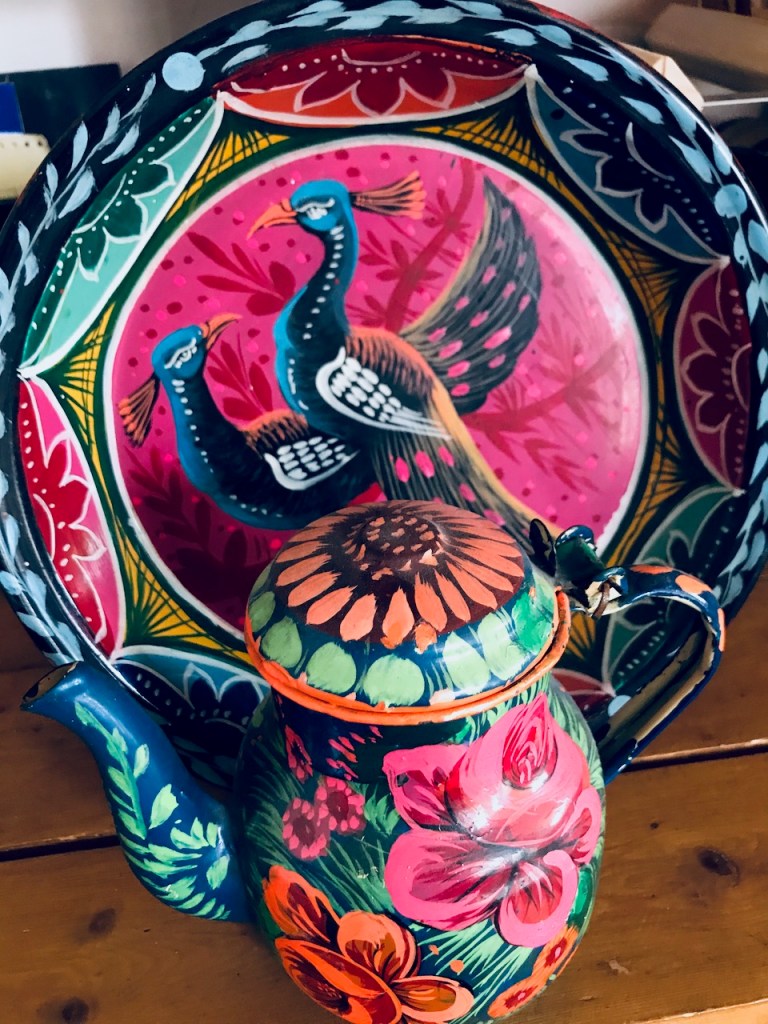
This unique form of self-expression has today taken on a completely new life in popular imagination. It has carved out a space in the re-branding of modern Pakistan and usage now extends far and beyond the world of Trucks. Popular amongst tourists, keen to take a little piece of Pakistan, the world of Truck art is also very reminiscent of Canal Barge art.

References

Jamal J. Elias. ‘Truck Decoration and Religious Identity: Material Culture and Social Function in Pakistan.’ Material Religion 1 (1): 48–70. 2005.

Jamal J. Elias, ‘The Politics of Pashtun and Punjabi Truck Decoration.’ In Bashir, Shahzad, and Robert D. Crews. Under the Drones: Modern Lives in the Afghanistan-Pakistan Borderlands, Harvard University Press, 2012. Pp. 192-214. Ebook.

Samina Zia Sheikh, ‘Impact of truck art, as popular culture on Pakistani society’, International Journal of Multidisciplinary and Current Research, Vol. 6, Sep/Oct 2018.

Nadeem F. Paracha, ‘The elusive history and politics of Pakistan’s truck art’, Dawn, 19 August 2016.

Pakistan’s Truck Art by Matthieu Aikins, for the Pulitzer Centre, May 2013.

GRANTA 112 Pakistan, 2010.

Anna Schmid, ‘Truck Art as Arena of Contest‘, Journal of Social Sciences, 4:4, 235-241, 2000.

Moving Museums: The Art of Pakistani Trucks, RadioFreeEurope.


© 2017 Pippa Virdee


Flavours of India – Punjab

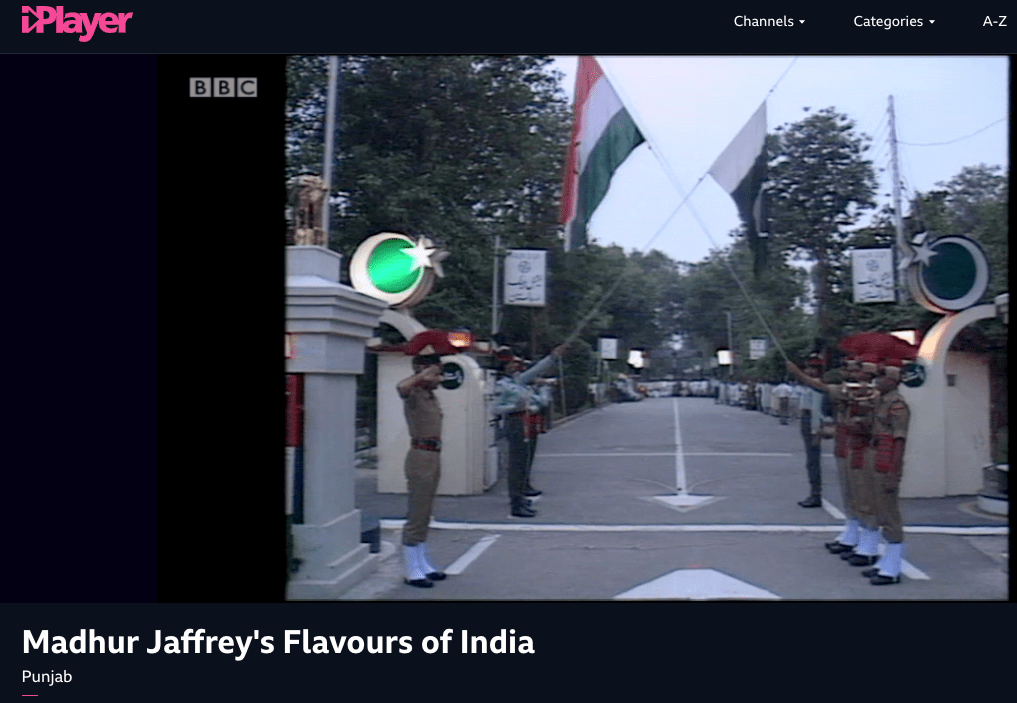
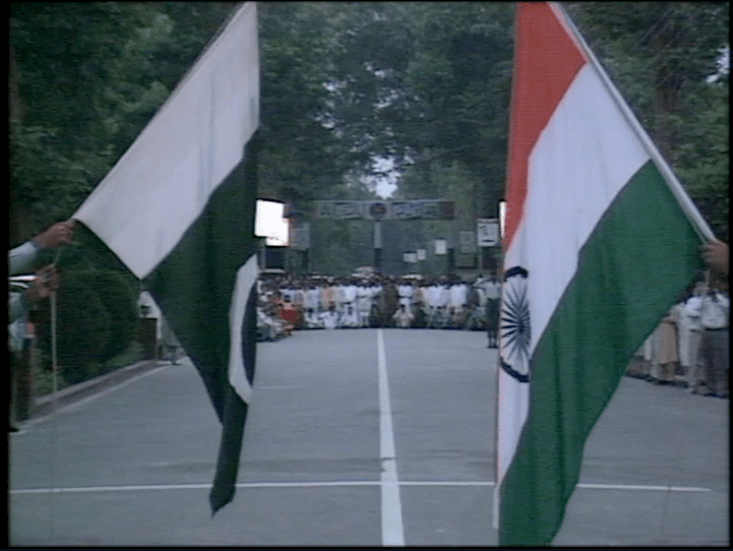
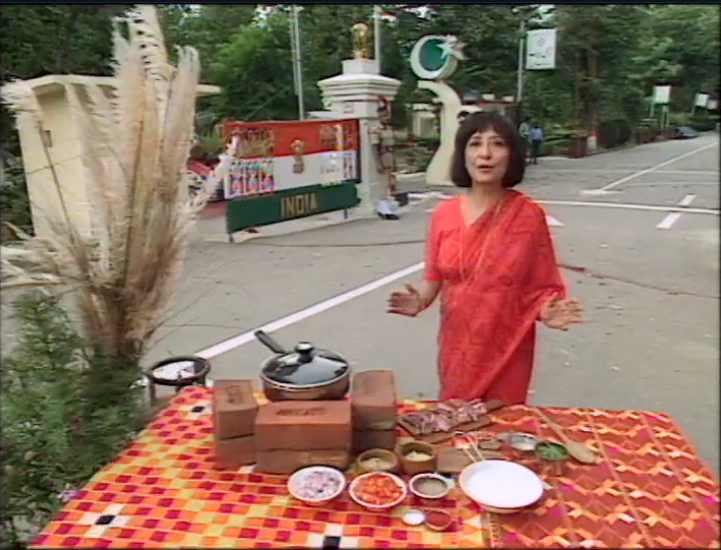
I accidentally stumbled across Madhur Jaffrey’s Flavour of India, which is being repeated on BBC iPlayer. I remember watching this when there were hardly any Indian chefs or Indian cooking on mainstream TV, so I decided to watch some of these again…it is a Sunday morning! As I sat through the episode on Punjab, near the end of the programme I was amazed to see her making lamb chops on the Wagah-Attari border. I have crossed this border numerous of times and I have also seen now much it has changed from a leafy road with colonial bungalows acting as the immigration/custom points to a harsh border with a daily dose of jingoism and national pride on full display. These few minutes have just reminded me how much India (and Pakistan) has changed since 1995. I wonder where the BSF walla tasting the lamb chop is today…

Other posts on Wagah-Attari:

The Spectre of Partition

No Mans Land: the Wagah-Attari Border

Borders and Boundaries

The Persistence of Caste

Bhimrao Ramji Ambedkar (14 April 1891 – 6 December 1956)

© 2017 Pippa Virdee

Ambedkar, Bhimrao Ramji, and Frances W. Pritchett. Pakistan or Partition of India. Thacker, 1946

The Muslim League’s Resolution on Pakistan has called forth different reactions. There are some who look upon it as a case of political measles to which a people in the infancy of their conscious unity and power are very liable. Others have taken it as a permanent frame of the Muslim mind and not merely a passing phase and have in consequence been greatly perturbed.The question is undoubtedly controversial. The issue is vital and there is no argument which has not been used in the controversy by one side to silence the other. Some argue that this demand for partitioning India into two political entities under separate national states staggers their imagination; others are so choked with a sense of righteous indignation at this wanton attempt to break the unity of a country, which, it is claimed, has stood as one for centuries, that their rage prevents them from giving expression to their thoughts. Others think that it need not be taken seriously. They treat it as a trifle and try to destroy it by shooting into it similes and metaphors. “You don’t cut your head to cure your headache,” “you don’t cut a baby into two because two women are engaged in fighting out a claim as to who its mother is,” are some of the analogies which are used to prove the absurdity of Pakistan. In a controversy carried on the plane of pure sentiment, there is nothing surprising if a dispassionate student finds more stupefaction and less understanding, more heat and less light, more ridicule and less seriousness. My position in this behalf is definite, if not singular. I do not think the demand for Pakistan is the result of mere political distemper, which will pass away with the efflux of time. As I read the situation, it seems to me that it is a characteristic in the biological sense of the term, which the Muslim body politic has developed in the same manner as an organism develops a characteristic. Whether it will survive or not, in the process of natural selection, must depend upon the forces that may become operative in the struggle for existence between Hindus and Musalmans. I am not staggered by Pakistan; I am not indignant about it; nor do I believe that it can be smashed by shooting into it similes and metaphors. Those who believe in shooting it by similes should remember that nonsense does not cease to be nonsense because it is put in rhyme, and that a metaphor is no argument though it be sometimes the gunpowder to drive one home and imbed it in memory. I believe that it would be neither wise nor possible to reject summarily a scheme if it has behind it the sentiment, if not the passionate support, of 90 p.c. Muslims of India. I have no doubt that the only proper attitude to Pakistan is to study it in all its aspects, to understand its implications and to form an intelligent judgement about it.

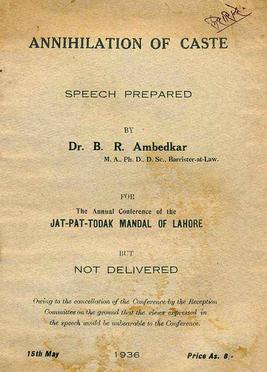
First_edition_of_Annihilation_of_CasteAmbedkar, Bhimrao Ramji. Annihilation of Caste: The annotated critical edition. Verso Books, 2014.
The Annihilation of Caste was an undelivered speech written in 1936 and to be delivered at the Jat-Pat Todak Mandal (Society for the Abolition of Caste system). However, the organiser found elements within the speech objectionable and Ambedkar refused to censor his words.

Roy, Arundhati, B. R. Ambedkar, and S. Anand. Annihilation of Caste: The Annotated Critical Edition. (2014). 

Other contemporary abominations like apartheid, racism, sexism, economic imperialism and religious fundamentalism have been politically and intellectually challenged at international forums. How is it that the practice of caste in India – one of the most brutal modes of hierarchical social organisation that human society has known – has managed to escape similar scrutiny and censure? Perhaps because it has come to be so fused with Hinduism, and by extension with so much that is seen to be kind and good – mysticism, spiritualism, non-violence, tolerance, vegetarianism, Gandhi, yoga, backpackers, the Beatles – that, at least to outsider, it seems impossible to pry it loose and try to understand it.

Listen to The Doctor and The Saint: The Ambedkar—Gandhi debate: Race, Caste and Colonialism with Arundhati Roy (2014)


O’Boyle, Jane “The New York Times and the Times of London on India Independence Leaders Gandhi and Ambedkar, 1920–1948” American Journalism, Volume 35, 2018 – Issue 2, 214-235.

During the years before India’s independence, the Times of London published news stories that were derisive and skeptical of Mahatma Gandhi, reflecting a national policy to diminish his power in the process to “quit India.” The Times was respectful of the untouchables’ leader Bhimrao Ambedkar and his civil rights movement for untouchables, perhaps to further distract from Gandhi’s popularity. The New York Times lavished positive attention on Gandhi and largely ignored Ambedkar altogether. The American newspaper framed a hero of colonial independence and never his oppression of untouchables, adhering to news policy during the Jim Crow era of racial persecution.

Teltumbde, Anand. The Persistence of Caste: The Khairlanji murders and India’s hidden apartheid. Zed, 2010. 

While the caste system has been formally abolished under the Indian Constitution, according to official statistics, every eighteen minutes a crime is committed in India on a Dalit-untouchable. The Persistence of Caste uses the shocking case of Khairlanji, the brutal murder of four members of a Dalit family in 2006, to explode the myth that caste no longer matters. In this exposé, Anand Teltumbde locates the crime within the political economy of post-Independence India and across the global Indian diaspora. This book demonstrates how caste has shown amazing resilience – surviving feudalism, capitalist industrialization and a republican constitution – to still be alive and well today, despite all denial, under neoliberal globalization.

Teltumbde, Anand. “Deconstructing Ambedkar,” Economic and Political Weekly (May 2, 2015).

Electoral politics became competitive bringing to the fore vote blocks in the form of castes and communities, both skilfully preserved in the Constitution in the name of social justice and religious reforms, respectively. The competing Ambedkar icons offered by various political manufacturers in India’s electoral market have completely overshadowed the real Ambedkar and decimated the potential weaponry of Dalit emancipation. The rhetoric of aggressive development, modernity, open competition, free market, etc, necessitated the projection of a new icon which would assure people, particularly those of the lower strata whom it would hit most, of the possibility of a transition from rags to riches with the adoption of the free-market paradigm.

Further Reading

Ministry of External Affairs (GoI): Writings & Speeches of Dr. Babasaheb Ambedkar https://www.mea.gov.in/books-writings-of-ambedkar.htm

Jaffrelot, Christophe. India’s silent revolution: the rise of the lower castes in North India. Orient Blackswan, 2003.

Jodhka, Surinder S. “Caste: why does it still matter?.” In Routledge Handbook of Contemporary India, pp. 259-271. Routledge, 2015.

Pandey, Gyanendra. A history of prejudice: race, caste, and difference in India and the United States. Cambridge University Press, 2013.

The Spectre of Partition

IMG_20170811_162942
Wagha-Attari Border. © 2017 Pippa Virdee

Sharing a screen grab from the last page of my book From the Ashes of 1947Balraj Sahni captured the human tragedy of Partition in this poem, the spectre of which still continues to haunt us everyday. We seem to be unable to be human first.

Screenshot 2020-02-26 at 10.31.46

Laal/Red

“In 1949, while in Lahore, Sahir Ludhianvi wrote a revolutionary poem, ‘Avaaz-e-Adam’ (The Voice of Man), in which ‘hum bhi dekhenge’ remains a memorable phrase. It ended on the optimistic – and one could say provocative – assertion that the red flag of communism would fly high. Pakistan had already decided to become a frontline state in Western attempts to contain Soviet Communism. It was trying desperately to convince the US that it could be a strong ally in its anti-Communism policy. Pakistan also wanted to portray itself as a trusted ally for the West, not just in South Asia but also in the Middle East. But after the poem was published, Sahir was threatened by intelligence agencies and he migrated to India. In effect, ‘hum bhi dekhenge’ came to symbolise Sahir’s farewell to Pakistan, which he felt would be a puppet of the West, and his search for sanctuary in Nehru’s India.” Source: The Wire.

© 2019 Pippa Virdee
aavaaz-e-aadam
Dabegi kab talak aavaaz-e-Aadam hum bhi dekhenge
rukenge kab talak jazbaat-e-barham hum bhi dekhenge
chalo yoonhi sahi ye jaur-e-paiham hum bhi dekhenge

dar-e-zindaan se dekhen ya urooj-e-daar se dekhen
tumhen rusva sar-e-bazaar-e-aalam hum bhi dekhenge
zara dam lo maal-e-shaukat-e-jam hum bhi dekhenge

ye zoam-e-quvvat-e-faulaad-o-aahan dekh lo tum bhi
ba-faiz-e-jazba-e-imaan-e-mohkam hum bhi dekhenge
jabeen-e-kaj-kulaahi ḳhaak par ḳham hum bhi dekhenge

mukaafaat-e-amal tareeḳh-e-insaan ki rivaayat hai
karoge kab talak naavak faraaham hum bhi dekhenge
kahaan tak hai tumhaare zulm mein dam hum bhi dekhenge

ye hangaam-e-vidaa-e-shab hai ai zulmat ke farzando
sahar ke dosh par gulnaar parcham hum bhi dekhenge
tumhen bhi dekhna hoga ye aalam hum bhi dekhenge
The Voice of Man
We too shall see till when one can suppress the voice of Adam
We too shall see till when can be stopped the angry emotion(s)
We too shall see, sure, just like this, the constant oppression.

Whether we view from the door of the dungeon or the elevation of the scaffold
We too shall see you dishonoured in the marketplace of the world
Just take a moment’s breath, we too shall see the consequences of the grandeur of Jamshed.

You too behold this vanity of power
We too shall see this by the kindness of the firm belief’s fervour
We too shall see a bend upon the dusty face that wears the jaunty headgear.

Retribution is a tradition of human history
Till when will you amass the arrows, we too shall see
We too shall see how far will you persist with your tyranny.

O sons of darkness this is the time for departure
We too shall see the morning shoulder the flag of red colour
We too shall see, you too shall have to see this clamour.

Source: ‘We Too Shall See, You Too Will Have to See This Clamour’: A Tribute To Sahir Ludhianvi by Raza Naeem, NayaDaur

Read/listen to Sahir on Rekhta

Sahir Ludhianvi – Making of Dreamer – Freudian Poet of the Indian Cinema by Anil Pundlik Gokhale. CounterCurrents.org

Freedom and Fear: India and Pakistan at 70

IMG_2257
© 2017 Pippa Virdee

The role of any democratic country, with a well-defined rule of law, is to protect ALL its citizens, ensuring that their rights and freedoms are safeguarded. It is in fact difficult to imagine these lands without the heterogeneity that forms the essence of being South Asian. It is this vibrancy and diversity that gives it character and strength. To move toward a homogenous culture is not only problematic but also dangerous because it is based on exclusivity.

Extract:

In the midst of the monsoon of August 1947, British India ceased to be and gave way to two independent nations. The logic of this partition being religious and regional, the older and larger India was reinforced as a Hindu majoritarian society, while the newer and smaller Pakistan emerged as an Islamic country. No partitions are total and absolute but this one was especially terrible and ambiguous; it left about a 20 percent religious minority population on both sides. Moreover, it created two wings of Pakistan with a hostile Indian body-politic in the middle.

This event was not entirely of subcontinental making. The British Empire in Asia cracked under the hands of the Japanese army during World War II, most spectacularly with the fall of Singapore in February 1942, and began to crumble in South Asia after the war. Along with India and Pakistan, Burma (today’s Myanmar) and Ceylon (Sri Lanka) also emerged independent (both in 1948) at this time. All this was to bring about many changes, both internally in India and internationally. Europe, the ravaged battlefield of the world wars, ceased to be the center of the Western world, with political and economic power shifting decisively to the Soviet Union and the United States, representing two contrasting and conflicting ideological visions for the post-1945 world.

The end of British rule in South Asia happened alongside the emergence of this conflict, christened the Cold War. The road to freedom and partition of India and the creation of Pakistan was a long one and accompanied with fundamental social, economic, and political changes. From the mutiny of 1857 to the massacre of 1919 in Jallianwala Bagh, Amritsar; from the formation of the Indian National Congress in 1885 to the establishment of the All-India Muslim League in 1906; from fighting for king and country in two world wars to seeking self-rule in the interwar years; and from the development of an elaborate civil and military bureaucratic and infrastructural apparatus and a space for provincial politics – all these were to completely transform Indian society.

This transformation and its underlying tensions ultimately contributed to that final moment, when in the middle of August 1947, Britain finally bid farewell to its prized colony after being there in one form or another as traders, marauders, administrators, and rulers for over 300 years. Weakened by World War II, the British were forced to accept the new realities of a determined nationalist struggle and an emerging new world order in which old-fashioned colonialism no longer seemed feasible. The journey toward this reality was slow and painful.

This year, on August 14 and 15, the Pakistani and Indian state and society, respectively, will mark 70 years of freedom. The bulk of both countries will be in celebratory mode as much of them were in 1947. Neither will want to remember the hard history of this freedom, nor face the harsh realities of it today. Back in 1947, Mohammad Ali Jinnah was in Karachi and Jawaharlal Nehru in Delhi, both welcoming a new dawn of freedom, but also engulfed in the fear and flames of communal violence. The worst of this was in the partitioned province of the Punjab in North India, where from March 1947 onward in Rawalpindi, communal violence and forced migration of people completely changed the landscape. Over the next year, but largely concentrated in August-December 1947, approximately 1 million were massacred and over 10 million were forced to move from one side of the Radcliffe line to the other. Bengal in East India, the other province to be partitioned, experienced similar, if slower, migration but not murder on the same scale. Other provinces, like Sindh, United Province, Bihar, Assam, Bombay, and the North-Western Frontier Province, also saw religious riots and exchanges of refugee populations.

Partitions are never easy; they are fraught with physical uprooting and dislocation, emotional and psychological separations, and, often, bitter memories of enmities. The partition of British India, though, appeared inescapable in early 1947, once constitutional attempts to secure a confederal arrangement for the Muslims in India to live in a post-colonial Hindu-majority country, without fear, collapsed. The movement for a home for Indian Muslims had gained currency in the interwar period, with poet-philosopher Muhammad Iqbal’s presidential address to the 25th session of the All-India Muslim League in December 1930, envisioning “a consolidated, North-West Indian Muslim State” amalgamating “the Punjab, North-West Frontier province, Sind, and Baluchistan” and self-governing “within or without the British Empire.” It culminated, almost 10 years later, in March 1940, in the lawyer- politician Jinnah’s speech at another session of the League. Describing Muslims as a “nation,” not merely a community, Jinnah demanded “homeland, territory, and state” for them.

Full article in The Diplomat, Issue 33, August 2017 or contact me.