Below are some books in chronological order during the decades following from August 1947 when India and Pakistan were created. The are from different historical and political vantages and show the enduring struggle in Kashmir and how it has been represented. Above are pictures from a protest organised on 15 August 2019 outside the Indian High Commission in London following the Government of India’s decision to revoke Article 370.
Michael Brecher, The Struggle for Kashmir, Ryerson Press, 1953.
Prem Nath Bazaz, The History of Struggle for Freedom in Kashmir: Cultural and Political, from the Earliest Times to the Present Day, Kashmir Publishing Company, 1954.
Josef Korbel, Danger in Kashmir, Princeton University Press, 1954.
Christopher Birdwood, Two Nations and Kashmir, Robert Hale, 1956.
Aziz Beg, Captive Kashmir, Allied Business, 1957.
Sisir Gupta, Kashmir: Study in India-Pakistan Relations, ICWA, 1966.
Alastair Lamb, The Crisis in Kashmir 1947–1966, Routledge & Kegan Paul, 1966.
Muhammad Yusuf Saraf, Kashmiris’ fight for freedom, Vol. 1 (1819–1946) and Vol. II (1947–1978), Feroze Sons (1977, 1979).
Prem Nath Bazaz, Democracy through intimidation and terror, Delhi: Heritage, 1978.
Sheikh Abdullah and M.Y. Taing, Atish-e-Chinar, Srinagar Shaukat, 1985.
S.T. Hussain, Sheikh Abdullah-a biography (based on Atish-e-Chinar) Wordclay, 2009.
B.C. Taseer, The Kashmir of Sheikh Mohammad Abdullah, Lahore: Feroze Sons, 1986.
U.K. Zutshi, Emergence of political awakening in Kashmir, Manohar Publications, 1986.
Alastair Lamb, Kashmir: A Disputed Legacy 1846-1990, Roxford, 1991.
Robert G. Wirsing. India, Pakistan, and the Kashmir Dispute: On Regional Conflict and Its Resolution, New York: St. Martin’s. 1994.
Victoria Schofield, Kashmir in the Crossfire, Bloomsbury, 1996.
Iffat Malik, Kashmir: Ethnic Conflict International Dispute, OUP 2002.
Mridu Rai, Hindu Rulers: Muslim Subjects: Islam, Rights and the History of Kashmir, Princeton University Press, 2004.
Chitralekha Zutshi, Languages of Belonging: Islam, Regional Identity, and the Making of Kashmir, Hurst, 2004.
Praveen Swami, India, Pakistan and the Secret Jihad: The Covert War in Kashmir, 1947-2004, Routledge, 2006.
Andrew Whitehead, A Mission in Kashmir, Penguin, 2007.
Sanjay Kak, ed. Until my Freedom has Come, Penguin, 2011.
A.G. Noorani, Article 370: A Constitutional History of Jammu and Kashmir, The Kashmir dispute: 1947–2012, OUP, 2011.
Christopher Snedden, The Untold Story of the People of Azad Kashmir. Hurst, 2012.
Shonaleeka Kaul, The Making of Early Kashmir, OUP, 2018.
Duschinski, Bhan, Zia and Mahmood, eds. Resisting Occupation in Kashmir, University of Pennsylvania Press, 2018.
The role of any democratic country, with a well-defined rule of law, is to protect ALL its citizens, ensuring that their rights and freedoms are safeguarded. It is in fact difficult to imagine these lands without the heterogeneity that forms the essence of being South Asian. It is this vibrancy and diversity that gives it character and strength. To move toward a homogenous culture is not only problematic but also dangerous because it is based on exclusivity.
Extract:
In the midst of the monsoon of August 1947, British India ceased to be and gave way to two independent nations. The logic of this partition being religious and regional, the older and larger India was reinforced as a Hindu majoritarian society, while the newer and smaller Pakistan emerged as an Islamic country. No partitions are total and absolute but this one was especially terrible and ambiguous; it left about a 20 percent religious minority population on both sides. Moreover, it created two wings of Pakistan with a hostile Indian body-politic in the middle.
This event was not entirely of subcontinental making. The British Empire in Asia cracked under the hands of the Japanese army during World War II, most spectacularly with the fall of Singapore in February 1942, and began to crumble in South Asia after the war. Along with India and Pakistan, Burma (today’s Myanmar) and Ceylon (Sri Lanka) also emerged independent (both in 1948) at this time. All this was to bring about many changes, both internally in India and internationally. Europe, the ravaged battlefield of the world wars, ceased to be the center of the Western world, with political and economic power shifting decisively to the Soviet Union and the United States, representing two contrasting and conflicting ideological visions for the post-1945 world.
The end of British rule in South Asia happened alongside the emergence of this conflict, christened the Cold War. The road to freedom and partition of India and the creation of Pakistan was a long one and accompanied with fundamental social, economic, and political changes. From the mutiny of 1857 to the massacre of 1919 in Jallianwala Bagh, Amritsar; from the formation of the Indian National Congress in 1885 to the establishment of the All-India Muslim League in 1906; from fighting for king and country in two world wars to seeking self-rule in the interwar years; and from the development of an elaborate civil and military bureaucratic and infrastructural apparatus and a space for provincial politics – all these were to completely transform Indian society.
This transformation and its underlying tensions ultimately contributed to that final moment, when in the middle of August 1947, Britain finally bid farewell to its prized colony after being there in one form or another as traders, marauders, administrators, and rulers for over 300 years. Weakened by World War II, the British were forced to accept the new realities of a determined nationalist struggle and an emerging new world order in which old-fashioned colonialism no longer seemed feasible. The journey toward this reality was slow and painful.
This year, on August 14 and 15, the Pakistani and Indian state and society, respectively, will mark 70 years of freedom. The bulk of both countries will be in celebratory mode as much of them were in 1947. Neither will want to remember the hard history of this freedom, nor face the harsh realities of it today. Back in 1947, Mohammad Ali Jinnah was in Karachi and Jawaharlal Nehru in Delhi, both welcoming a new dawn of freedom, but also engulfed in the fear and flames of communal violence. The worst of this was in the partitioned province of the Punjab in North India, where from March 1947 onward in Rawalpindi, communal violence and forced migration of people completely changed the landscape. Over the next year, but largely concentrated in August-December 1947, approximately 1 million were massacred and over 10 million were forced to move from one side of the Radcliffe line to the other. Bengal in East India, the other province to be partitioned, experienced similar, if slower, migration but not murder on the same scale. Other provinces, like Sindh, United Province, Bihar, Assam, Bombay, and the North-Western Frontier Province, also saw religious riots and exchanges of refugee populations.
Partitions are never easy; they are fraught with physical uprooting and dislocation, emotional and psychological separations, and, often, bitter memories of enmities. The partition of British India, though, appeared inescapable in early 1947, once constitutional attempts to secure a confederal arrangement for the Muslims in India to live in a post-colonial Hindu-majority country, without fear, collapsed. The movement for a home for Indian Muslims had gained currency in the interwar period, with poet-philosopher Muhammad Iqbal’s presidential address to the 25th session of the All-India Muslim League in December 1930, envisioning “a consolidated, North-West Indian Muslim State” amalgamating “the Punjab, North-West Frontier province, Sind, and Baluchistan” and self-governing “within or without the British Empire.” It culminated, almost 10 years later, in March 1940, in the lawyer- politician Jinnah’s speech at another session of the League. Describing Muslims as a “nation,” not merely a community, Jinnah demanded “homeland, territory, and state” for them.
Full article in The Diplomat, Issue 33, August 2017 or contact me.
Buddhist iconography is an important element in India’s national flag and national emblem, and Buddhist sites in India, such as the Ajanta Caves and Bodh Gaya are well known. In contrast, Pakistan’s engagement with its own Buddhist heritage has received far less attention. Andrew Amstutz (University of Arkansas, USA) explains his ongoing research that examines…
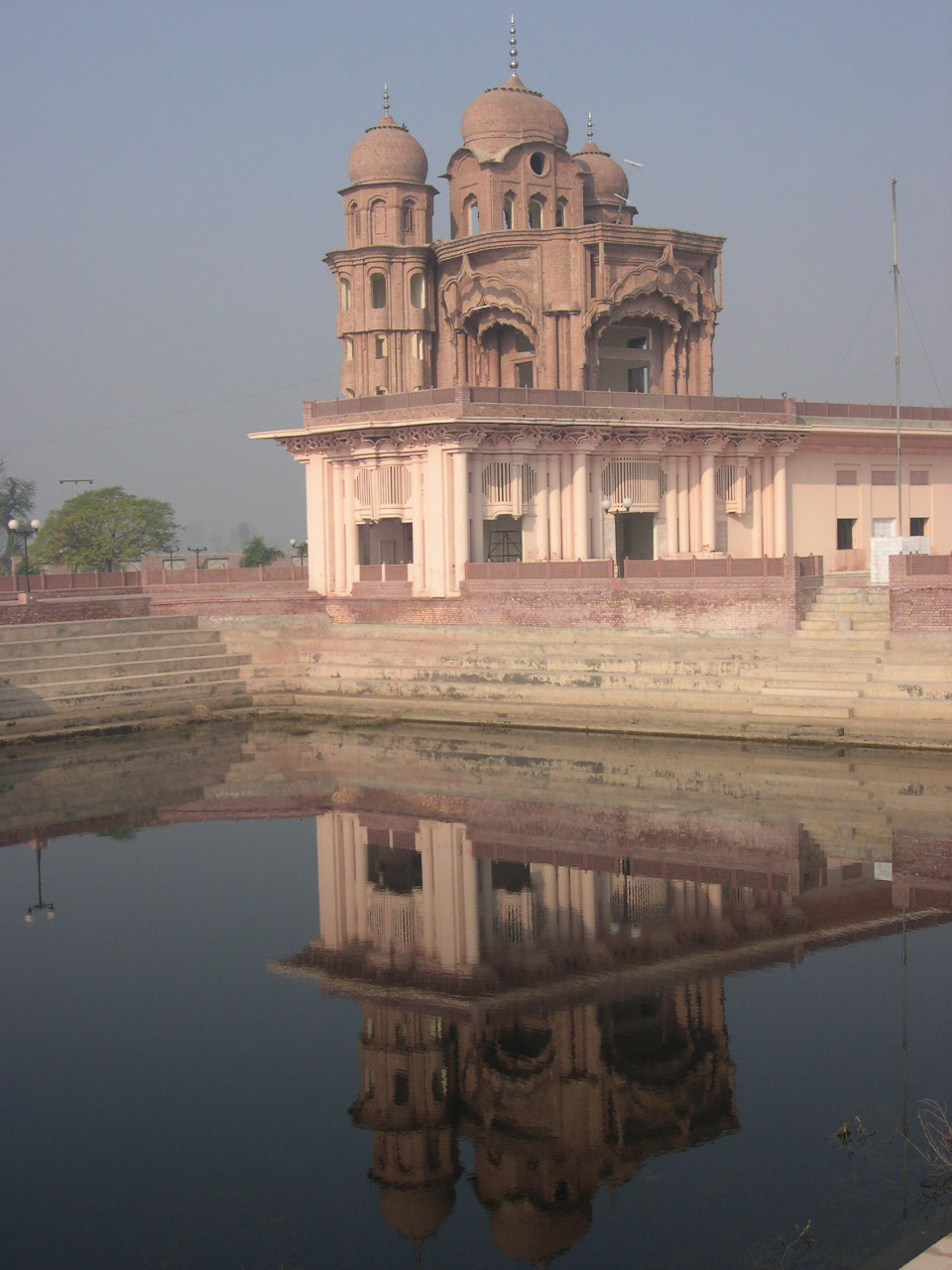
Gurdwara Sri Rori Sahib, Eminabad, Gujranwala (c) 2004 Pippa Virdee
A reflective essay on the lack of women in history writing and Punjab history. This was originally published in The Friday Times, 5 July 2019.
My first visit to Pakistan was in 2002. It was primarily to do research as a PhD student. At that time, I came with the religious baggage of belonging to a Sikh family and venturing into the known unknown. When I finally got my visa, I was very excited about travelling to the ‘near other’; unknown yet somehow familiar. After all, I rationalised, the cultural region of Punjab is, well, Punjab across both sides of the Radcliffe Line. And so, the journey into Pakistan’s history begun, a space in which the personal and the academic intermingled and boundaries became a metaphor for more than just the relationship between India and Pakistan.
The Sikhs in Pakistan are a small community; one of the smallest minorities in Pakistan. Exact numbers are difficult to estimate but they vary from around 6,000 to perhaps 20,000. They are largely concentrated around places like Peshawar, Nankana Sahib and Lahore. The interesting thing is that apart from the ethnic Punjabi Sikhs, many of the Sikhs that remained in Pakistan after 1947 were Pathan Sikhs. The latter were scattered in small numbers across Balochistan, Federally Administered Tribal Areas and Khyber Pakhtunkhwa. Most have been forced to relocate since, often seeking sanctuary in numbers. Though small, the Sikh community over the past few years has come to enjoy some state patronage. In an otherwise ‘Islamic’ milieu, Sikh men are easily identifiable by their turbans. Added to this are the old persistent colonial stereotypes of the Sikhs being a ‘martial’ race (even in Pakistan). And of course, the ‘Khalistani’ Sikhs have the sympathetic ears of the Pakistan establishment since the early 1980s. Thus, in Pakistan today, the medieval shadow of the Sikh-Muslim rivalry of Mughal India, as well as the pall of 1947 have receded to create a strange co-existence and a convenient acceptance of current realpolitik rather than a bitter dwelling in the past. However, this convenient relationship does not necessarily translate easily or well in the Sikh diaspora, especially here in the United Kingdom, where I am based.
While my main purpose for visiting Pakistan in 2002 was for my doctoral research, there was inevitably an interest to visit Sikh Gurdwaras and shrines; those remnants of pre-1947 which still existed. I have subsequently visited Pakistan more times than I can remember and have seen the changes in many of these shrines and their localities. Over the last 15 years, there has been a transformation of many of these shrines; from being small and poorly maintained to now being considered as one of the growing areas for pilgrim tourism in Pakistan. Every year, especially at the time of Vaisakhi and Guru Nanak’s birth anniversary, pilgrims come in their thousands from the UK, USA, Canada, which are home to significant Sikh diaspora communities. Depending on political temperatures, Indian Sikhs also make this pilgrim trip. For instance, this year, the Government of Pakistan issued 2,200 visas to Sikhs pilgrims in India for Vaisakhi. There is much trepidation amongst these of falling under the radar of intelligence agencies on both sides. Beyond the politics of two paranoid and securitised states though, growth in this tourism has benefitted local communities, as infrastructure around the ‘important’ shrines has improved to facilitate foreign tourists. These bring in the much-needed foreign exchange. They travel, stay, eat, drink, shop and thus spend their foreign currencies in Pakistan and, ultimately, some of this does make its way into the local economy. But this development is localised and centred around a handful of shrines, with the majority still largely neglected.
Social media and its ability to connect across borders, has spurred on a handful of people to seek adventure in Pakistan and document the ‘lost’ history of the Sikhs. Conversely, there has been more interest in these forgotten histories within Pakistan too. Combined with increased pilgrim tourism, there is almost a fascination and a sense of lost kinship that many Sikh Punjabis have with Pakistan and Pakistani Punjabis. These complex historicised feelings are under-girded by a common language, culture, biradari connections, and bhaichara. There is an old romantic connection that many have with reaching Lahore (formally Maharaja Ranjit Singh’s capital) captured in the phrase, Jis Lahore Nai Dekhya O Jamyai Nai/ Jine Lahore Nai Vekhya O Jamya Nai, meaning ‘One who has not seen Lahore has not been born’! This has been recited countless times and it helps to maintain the old pluralistic image of colonial Lahore. In this quest then, for the lost history of Sikhs in Pakistan, there has been a profusion of activity which has generated research in universities, fictional/non-fiction literature and pictorial books on Sikhs. These latter easily detract and divert from the difficult issues of politics, while sticking to the sites of nostalgia and neglect. Even the research at Pakistani universities (not exclusively though) is largely focused on the Ranjit Singh period (1801-39). When the bearded young man boasts of Ranjit Singh, of the contribution of the Punjabi (but usually Sikh) soldiers, of the great martial tradition, they rarely give women a thought.
These histories perpetuate and create a myth of the splendour associated with this lost history of the Sikhs. Even hard leftists have a soft spot for an otherwise unelected, unrepresentative, hereditary maharaja. While this greater interest and curiosity amongst scholars and students is welcome, it also serves to reinforce old stereotypes by avoiding the more difficult question of the broader issue of non-Islamic histories of Pakistan. Moreover, the study of history and its periodisation retains much of the colonial interpretations, hardly allowing us to interrogate these boundaries intellectually and dispassionately.
In the quest for academic “impact” and to connect with the general public, many academics in the west have been compelled to promote themselves. Social media again has been the route for this seemingly altruistic self-promotion. Articles, blogs and personal posts on social media, of travelling around Pakistan and bonding with the locals, for people’s immediate consumption and gratification. Moreover, the Punjabis express this in their usual flamboyant style of visiting their ‘lost’ Punjab, bonding with the local Punjabis and then sharing these ‘amazing’ bonding experiences. On closer inspection though, these all have something else in common. They are all invariably shared by men and are about their fraternal experiences. Statistically, we know that on average women are 26 percent less likely to own a mobile than men and 70 percent less likely to use mobile internet. Naturally, this means less women are visible and even when they are, they use it differently. Women largely use social networking to make connections and keep in touch with family or friends, in contrast men use social media to gather information they need to build influence. In South Asia, this discrepancy stems from the fact that men usually have better educational opportunities, have mobile phones, have greater levels of digital literacy, and this advantage over women fuels their privileged status.
Much of this social conditioning starts from the home, through to schools and universities. The social system perpetuates and emboldens men, making them entitled from a young age. As young women, we often have to fight our way to pursue our aspirations and dreams. Wanting to study politics and history at university for me was not easy because this was not considered an appropriate subject for a girl, even though it eventually reaped rewards. Universities themselves are supposed to be some of the most intellectually progressive spaces but actually they are not. They are just a reflection of society itself. They have the same prejudices and reflect the same class, caste, gender biases that society has. This is reflected in the largely male student body in South Asia, and although the number of girls is increasing and often, they perform better, many still see this as way of improving their choice of marriage partners. This is not a criticism of their desire to improve their lives, but rather a reflection of the limited value of education. The staff fraternity also tends to be male-dominated, especially the senior staff. Although this is no better than in the UK where the Royal Historical Society recently published a study on Race, Ethnicity and Equality (2018) and found that there was an over-whelming dominance of white male professors compared to females and the numbers are even smaller for those from Black and Ethnic minorities.
These centres of learning, therefore, do not reflect the voices of everyone because even here, the skewed societal power structures remain intact. Men control the institutions and therefore they control the narrative. They are the gatekeepers of knowledge and learning and without challenging these structures the narrative cannot be changed.
My experiences of being a (Sikh) woman living and working in Pakistan (largely Lahore and the Punjab) has been quite ordinary in many ways and extraordinary in other ways. I have never been given a free taxi ride; unlike the numerous accounts one reads of visiting Sikhs (i.e. Sikh men) who have struck a long-lost kinship with the taxi driver, who then from the kindness of his heart refuses to charge the client. In fact, I have struggled to speak with taxi drivers and men in public spaces in Punjabi because they consider this to be impolite. Unlike men, I am usually compelled to speak in the Urdu, which imposes a certain level of distance and formality to the conversation. While I cannot have my ‘bromances’ with most of those around me, I can, however, quietly enter the zenana spaces. And these, like the history pages that neglect them, are often hidden away.
I have learnt over the years that women, whether in South Asia or in the West, do not boast of their achievements. They work like ants, running around, keeping busy and building structures out of crumbs. The obstacles they encounter en route can be difficult and they are not always successful. More often than not they will encounter men who are in positions of authority and wield substantial power over the lives (and bodies) both in the home and the outside world. And the outside world is designed by men and for the needs of men. They would rarely acknowledge the privileged position they have in the home and the outside world and the freedom this gives them.
While I have spent many years working in Pakistan, on Punjab’s history, I have rarely felt the need to write about my “non-academic” experiences. The motivation has largely come from the fact that despite all these years, there is still not enough progress and even today there are few female historians coming forward. Even today we are judged on how we look, what we wear rather than what we think and write. Intellectually there is a stale and over-bearing concern for constantly writing about conflict, nationalism, religion, battles, and hero-worshipping; a reflection perhaps of an insecure male society that seeks glory from former victories to validate its present. The only way we can get diversity in the way we view and write about our history is to have that diversity in the people who write it. As a society we need to challenge these hyper-masculinised and hyper-nationalised histories that distort our past and shape our future. If we want to be part of the narrative, we have to take responsibility for writing it. As women we need to make ourselves visible in both the past and the present.
Perched outside his workshop in Lahore’s Walled City, Mohamed Tahir plays a harmonium while watching the passing melee. The melancholy sounds of the instrument are barely audible over the din of motorbikes and wheel cutters, but still they evoke something of Lahore’s history, a world that lives on beneath the dust and frantic rhythms of […]
The Lahore Gymkhana Club is a place I have been able to visit on many occasions. It is an exclusive club for the elite in Lahore with a long waiting list for membership. The Club’s website proudly reads:
Gymkhana; A World in its Own
Donning chinos and a polo shirt while sinking a birdie putt on the 15th hole, the retired bureaucrat on the lush pastures of the eclectic golf course continues being oblivious to the disrupting traffic outside the boundary walls, while the eminent 70-year-old writer sketching out a plot for his highly anticipated sequel continues penning down characters originating from his ever so powerful imagination in the same library that he’s been sitting for the last 30 years. A group of ex-service men calmly carry on the tradition of expressing ambivalent opinions on the country’s next elections while making an opening bid in the card room, and some foreign delegates continue analyzing aspects of the much debated foreign policy while sipping their cappuccinos and lattes in the serene view of the golf course.
An idea that took the shape of a property in the 1870’s, is an identity in itself today. The Lahore Gymkhana membership continues to comprise of individuals inhabiting top positions in their respective fields, such as government ministries, armed forces, banks, MNC’s, sports, the judiciary and the media, both nationally and internationally. Together, they ensure the prestige of the club.
The original Gymkhana was actually founded as The Lahore and Mian Mir Institute in 1878 in Lawrence Gardens, opposite the Governor House. The Club was based in the Lawrence and Montgomery Halls (named after Sir John Laird Mair Lawrence, first Chief Commissioner (1853-57) and Viceroy of India (1863-69) and Robert Montgomery, second Lt. Governor of the Punjab (1859-65) respectively).
In 1906, the name changed to the Lahore Gymkhana and in 1972 the two halls were taken over by the Punjab Government and the Gymkhana club was relocated to the newly built facility at The Upper Mall, where it currently stands.
Hobson-Jobson. A Glossary of Colloquial Anglo-Indian Words and Phrases, and of Kindred Terms, Etymological, Historical, Geographical and Discursive, a historical dictionary of Anglo-Indian words and terms from Indian languages that came into use during the British rule of India. It was complied by Henry Yule and Arthur Coke Burnell and first published in 1886; it has been in print ever since. The dictionary takes you into the world of nineteenth century British India and connects provides the reader with a definition and etymology of words/phrases. The Club’s statement on its website and the world of nineteenth century colonial British India are not too dissimilar. The entry for the Gymkhana in Hobson-Jobson reads:
GYM-KHANA, s. This word is quite modern, and was unknown 40 years ago. The first use we can trace is (on the authority of Maior John Trotter) at Rurki in 1861, when a gymkhana was instituted there. It is a factitious word, invented, we believe, in the Bombay Presidency and probably based upon gend-khilna (‘ball-house’) the name usually given in Hind. to an English racket-court. It is applied to a place of public resort at a station, where the needful facilities for athletics and games of sorts are provided, including (when that was in fashion) a skating-rink, a lawn-tennis ground, and so forth. The gym may have been simply a corruption of gend shaped by gymnastics [of which the English public school short form gym passed into Anglo-Indian jargon]. The word is also applied to a meeting for such sports; and in this sense it has travelled already as far as Malta, and has since become common among Englishmen abroad. [The suggestion that the word originated in the P.-H. jamd’at-khana, ‘a place of assemblage,’ is not probable.]
– “Their, proposals are that the Cricket Club should include in their programme the games, &c., proposed by the promoters of a gymkhana Club, so far as not to interfere with cricket, and should join in making a rink and lawn-tennis, and badminton courts, within the cricket-ground enclosure.” – Pioneer Mail, Nov, 3.
– “Mr. A-F- can always be depended on for epigram, but not for accuracy. In his letters from Burma he talks of the Gymkhana at Rangoon as a sort of establissement [sic] where people have pleasant little dinners. In the ‘Oriental Arcadia,’ which Mr. F- tells us is flavoured with naughtiness, people may do strange things, but they do not dine at Gymkhanas.” –lbid. July 2.
– “R. E. Gymkhana at Malta, for Polo and other Ponies, 20th June, 1881.” Heading in Royal Engineer Journal, Aug. 1, p. 159.
– “I am not speaking of Bombay people with their clubs and gymkhanas and other devices for oiling the wheels of existence….” – Tribes on My Frontier, 9.
Produced by the Films Division, Ministry of Information & Broadcasting, these short news reviews by the Government of India give us a glimpse of old India. Produced one-year after Partition/Independence, the review shows Pandit Nehru in Karachi, messages of inter-communal harmony, tolerance and equality at the Urs of Ajmer Sharif Dargah, elephant diplomacy in the US, dance, theatre and hockey matches.