Tag Archives: Pakistan

PIA, the jet-age and working women

pia-good-daughters
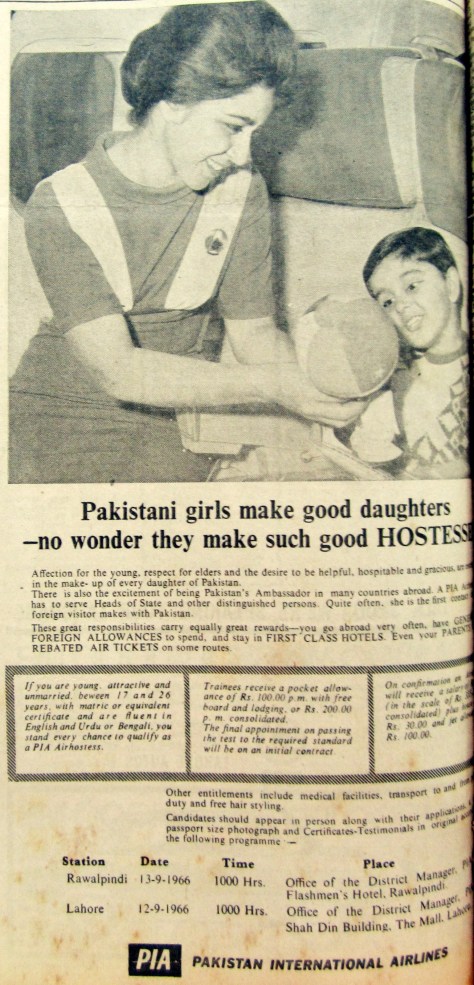
The Pakistan Times, 11 September 1966

The coming of the jet-age: women, advertising and tourism in Pakistan

Appearing on 23 September, 1956, The Pakistan Times article, ‘About women travellers’ is a commentary by their woman correspondent on travelling in the jet-age and ends optimistically with, ‘Times are changing rapidly. Gone are the days when women could not move unchaperoned, for now they travel the globe, and although there are no undiscovered continents, they still travel paths yet untrodden by women.’ This article appeared at a time when Orient Airways was merging with Pakistan International Airlines Corporation to form what is now more popularly known as PIA.

Shortly after PIA’s establishment, in 1959 the new managing director, Air Commodore Nur Khan, took over; he was considered to be a dynamic and forward-thinking visionary and well placed to take advantage of the coming jet-age that would revolutionise air travel. By its own admission, PIA considered his tenure as the ‘golden years of PIA’. Enver Jamall, former chairman and chief executive of PIA, highlights the competition PIA had with Air-India, which had already placed orders for Boeing 707s to be delivered in 1960. There was much determination within PIA to be the first airline in the East to operate jets and so an agreement was reached with Pan American World Airways (Pan Am) for the lease of one of its Boeing 707s. This would operate on the London-Karachi-Dacca route with an extension to New York once a week. The flights began in March 1960, giving PIA the coveted prize and the route was a financial and operational success.[1]

Writing on the tenth anniversary since independence the General Manager of PIA, Zafarul Ashan, notes how the bold concept of air transport helped Pakistan maintain national unity. He goes further and adds that ‘In air transportation, more than in anything else, the Pakistanis discovered their true genius, striving as a modern nation to achieve a happy blend of the values of their rich cultural past with values and concepts of this age.’ Ultimately, PIA’s impact extended beyond merely connecting the two wings. Apart from the trade between the two wings, the ‘low cost air transport within Pakistan started a revolution in the travel habits’ of people and ‘it opened up new venues of business and recreation.’[2] With the jet age, there was simultaneously an emerging middle class with more disposable income both globally and within in Pakistan. So while the majority of the early travellers were wealthy businessmen, the affluent middle class was the way ahead for expansion. Nur Khan recognised this opportunity for growth and expansion.

PIA also made some interesting strategic moves. In 1955, the first flight ‘to the glittering, glitzy capital city of London, via Cairo and Rome’ started. There was some criticism of this from the public who regarded other projects as more urgent for a developing country like Pakistan but this was rebuked with the substantial foreign exchange earned through the international service. Indeed the foreign tourist market was crucial to the business model in the early days of PIA, it is only by the 1970s that the shift towards catering for the diaspora market takes place. Travelling abroad was an aspirational luxury for an elite group of Pakistanis but PIA in its early years was also tapping into the lucrative international tourist market. This is certainly evident in the early marketing and advertising by PIA, they were appealing to the foreign market and indeed the airline was successfully establishing a reputation for excellent services and was increasingly capturing the international market.[3] It was consistently considered as one of the best airlines in the East and was increasingly competing with likes of Pan Am and the British Overseas Airways Corporation (BOAC) for foreign tourists coming to Pakistan.

What is often over-looked in this story is the role of the women in promoting the PIA brand. PIA often used traditional notions of womanhood in their ads to attract more girls into the profession. We can see this from the text below taken from a 1966 tagline:

‘Pakistani girls make good daughter – no wonder they make such good Hostesses’

The advert depicts a young, elegant lady playing with a child on board a flight and continues, ‘Affection for the young, respect for elders and the desire to be helpful, hospitable and gracious…make-up of every daughter of Pakistan.’ These attributes can easily be applied to any “good” daughter (and potential daughter-in-law). But instead of representing the home, PIA airhostesses were ‘Pakistan’s Ambassador in many countries abroad’ and often she would be the first point of contact that a foreign visitor would make with Pakistan.[4] While playing on some of the traditional roles of women, the advert is also breaking new ground by legitimising the role of the airhostess. It sends out a message that this is a “respectable” profession and thereby quelling any fears parents may have about their daughters wanting to join the profession. On the other hand, the use of glamorous young females in exotic locations, also promotes an image of Pakistan which modern, progressive, internationalist and welcoming. There is then a dual role in the marketing and branding of the advertising.

There is also a sense that this was an age of new discovery and opportunity, democratisation in the travel and adventure industry, no longer the preserve of wealthy elites. An ever-increasing number of people now had the opportunity to explore and venture into new areas and the newly created nation of Pakistan had many attractions. The Government of Pakistan was also keenly promoting tourism, as is evident in the promotional literature of the 1960s. Foreign travelogues and magazines like the National Geographic were similarly featuring Pakistan as a tourist destination. While Karachi was the hub of activity, it was the old Silk Route, Peshawar, Swat, Chitral, Gilgit and the Karakorum Highway that attracted the adventure tourists. Mack Millar was a flight instructor assisting PIA during its early days and notes. ‘Although PIA is a national airline and the Pakistani government was founded to give the Muslim people their won country, the airline, like the nation itself, shows a wonderful tolerance for people of other persuasion. Many of the pilots are of mixed lineage-Anglo-Indian and Portuguese-Goanese, for example-and many are Christians.’[5] The feeling is that this was a more tolerant age; it was more open to foreigners and ideas. Internally it presented opportunities for Pakistanis to be part of an international community. The social and political changes that have taken place in Pakistan in the past 40 years have polarised this landscape.

The advances made in air travel were crucial to the existence of having a nation state divided by 1100 miles of hostile land mass. Zafarul Ashan was only too aware of this, ‘Nothing could have been worse than isolation for the cultural development and the expansion of the economy of the two wings. Political equality demanded that East and West Pakistan should be brought very close to each other in terms of time.’[6] The timing for Pakistan’s existence as a nation-state is therefore crucial in that the airline industry was just beginning to take off during the 1940s and not long after, the jet-age would revolutionise air travel. But along with this, a number of other opportunities also opened up. Foreign travel increasingly filtered down to the classes and was no longer just an elite activity. Out of this emerged a tourist industry attracting people to visit Pakistan and a domestic market, based not just on travel between the wings of Pakistan but looking to travel and experience the world beyond Asia. It also fundamentally opened opportunities for women to work and explore the globe. In an age where women were restricted to largely working in “respectable” jobs like teaching or medicine, here PIA was making the idea of working in the airline industry and as an airline hostesses a respectable profession. This was ground-breaking for the age.

[1] ‘Birth of a Nation; Birth of an Airline: The History of PIA,’ Enver Jamall in The Putnam Aeronautical Review 1990.

[2] The Pakistan Times, ‘P.I.A. Plans for Increased Capacity’ by Zafarul Ashan, 14 Aug 1957.

[3] The Pakistan Times, Independence Supplement, ‘PIA is flying high’ 14 Aug 1960.

[4] The Pakistan Times, 11 Sep 1966.

[5] Ed Mack Miller, ‘Pakistan International Airlines Great People to Fly With’ Flying, March 1963

[6] The Pakistan Times, ‘P.I.A. Plans for Increased Capacity’ by Zafarul Ashan, 14 Aug 1957.

A version of this appeared in The News on Sunday [link: http://tns.thenews.com.pk/the-coming-of-the-jet-age/#.WI_D3JJOuHk%5D

Gurdwara Panja Sahib

Gurdwara Panja Sahib, Hasan Abdul, Pakistan, 2004. The gurdwara is revered because it has the presence of a rock believed to have the hand print of Guru Nanak.

This slideshow requires JavaScript.

Dividing Punjab, 1947

Map of Punjab. Scale 1:16 Miles.

Muslim majority Tehsils and contiguous majority areas of Muslims.

Available in the National Documentation Wing, Islamabad.

By the summer of 1947, it was obvious that a one-state solution for British departure from India was not a possibility and so serious discussions were necessary regarding the division of British India. Above is one of the maps used by the Punjab Muslims League, Boundary Commission Office to make its case about how to divide the Punjab.

The 3 June Plan, or as it was more popularly known as the Mountbatten Plan, was accepted by the main leaders, Nehru, Jinnah and the Sikh leader Sardar Baldev Singh. According to the Plan, the areas of Bengal and the Punjab would be divided between Muslim and non-Muslim districts. The Commission consisted of four judges, Justice Din Muhammad and Justice Muhammad Munir (both Muslim) and Justice Mehr Chand Mahajan (Hindu) and Justice Teja Singh (Sikh). The Commission chairman was the British barrister, Sir Cyril Radcliffe. During the public sittings, all the parties were allowed to present their cases to the Commission.

The Muslim case largely rested on the basis that their population majority in contested areas should be considered a major consideration in demarcation of the boundary line. Amongst the numerous documents used by the Commission, the map above highlights the Muslim majority tehsils and contiguous majority areas of Muslims. The yellow area in the middle is around Amritsar in central Punjab. Punjab generally and more specifically this area was incredibly complex and mixed in terms of communal composition and so immediately it is obvious that the dividing up people and land would be no easy task. How would they undo hundreds of years of people living together, co-existing and now being forced into accepting a new nation state? In addition to looking at the distribution of different communities, the Boundary Commission also examined the existing boundary lines of the tehsils, the location of the railway lines, the Grand Trunk Road (which is the main artery of the Punjab and indeed North India, connecting Kabul right through to Calcutta), the rivers and canals, the irrigation system, natural boundaries etc and some of these are marked on the map. Of course each community further made a case before the judges to make recommendations about where the line should be. This is particularly pertinent in areas where we see the concentration or pockets of the “other” community. Justice Mehr Chand Mahajan in his report makes an interesting point about the city of Lahore, which historically and at the time of partition was claimed by all communities. The city has a rich history and was once the seat of power under Ranjit Singh. The Justice says:

“The town of Lahore in my view stands on a special footing. It has been metropolis of the Punjab for several hundred years. Both east and west have contributed to its prosperity. Its economic life has mainly been developed by the enterprise of the non-Muslims. In truth both the Muslims and non-Muslims can legitimately claim Lahore as their own town thought on different grounds…. If I could, I would have suggested that this town should be left in the joint management of both the communities as a free city, it freedom being guaranteed by the two Dominions with a suitable constitution in which one community may not dominate over the other.” (Kirpal Singh (ed), Select Documents on Partition of Punjab 1947 India and Pakistan (Delhi: National Book Shop, 1991, p333-4).

See some of the documents related to Indian independence at British Library: http://www.bl.uk/reshelp/findhelpregion/asia/india/indianindependence/indiapakistan/index.html

Read commentary and analysis by Lucy Chester, ‘The 1947 Partition: Drawing the Indo-Pakistani Boundary’. http://www.unc.edu/depts/diplomat/archives_roll/2002_01-03/chester_partition/chester_partition.html

The Afghani Burger

Since last year Pakistan has requested that an estimated two million Afghan refugees (no one really knows the true figure) in Pakistan should leave and return back “home”. This has caused enormous amount of chaos along the Pakistan-Afghan border, not to mention the huge amount of distress and uncertainty for the people themselves. In these times when Europe is mostly focused on the refugees crisis in its own borders, there is a tendency to overlook the fact the majority of the world’s refugees are in fact located largely in neighbouring countries from which they flee. According to the UNHCR figures the top five hosting countries are:

Turkey 2.5m

Pakistan 1.6m

Lebanon 1.1m

Iran 979,400

Ethiopia 736,100

Visit the UNCHR website for a quick overview of figures, they are quite illuminating: http://www.unhcr.org/uk/figures-at-a-glance.html

The Afghani refugees initially arrived in Pakistan following the Soviet invasion of Afghanistan in 1979. They poured into Pakistan to seek sanctuary and most of them made new, but admittedly temporary, lives along the two provinces bordering Afghanistan. In the late 80s this figure was approximately 3.3 million, all located in refugee camps along Afghan-Pakistan border. A second wave of refugees poured into Pakistan following the US-led war in Afghanistan after 2001. By the end of 2001 the numbers rose up to approximately 5 million. By the end of 2012 there were however, almost 2 million Afghan nationals living in Pakistan largely in Khyber Pakhtunkhwa and Baluchistan province but others were scattered across the country. Some of these people have been there for such a long time that this is the only home they have known. While they have legal refugee status in Pakistan, the Government of Pakistan still considers them citizens of Afghanistan, even though many have subsequently been born in Pakistan. Large numbers of refugees have already been repatriated back to Afghanistan with the assistance of the UNHCR; their future is yet again uncertain.

Despite this many of them have made their lives in the “foreign” land that has become “home”. They carve out a living whichever way they can and the Afghani burger place is a just a small way in which they hang onto their identity. I first came across this when a colleague insisted that when one is in Islamabad an Afghani Burger is a must. Intrigued to find out more we visited a shabby looking place, the modern day dhaba. The place is quite small, unassuming and ordinarily I would have walked past it. The burger itself is not a burger; it is more of a wrap to be precise. The food is made on site and in front of your eyes to entice you. The contents of the wrap include a mix of different influences, chips (limp and apparently Afghani style), frankfurters (made with chicken or beef), salads, and an assortment of different sauces/chutneys – eastern influenced mint ones, the ubiquitous tomato sauce (with added spices) and some eastern spices thrown in too.

Read more about the Afghani burger phenomenon in Dawn: http://www.dawn.com/news/1130547

Motivating the Afghanis in Pakistan is essentially the instinctive need for survival and whilst the State (and Pakistani citizens) does not consider them citizens, it does not stop the success and popularity of the Afghani burger from spreading. Food is of course the easiest and most sublime ways in which people both retain their identity and also share it with those around; it starts to infuse the landscape until it is absorbed into the existing culture. The result is that the Afghani burger has given life and thrived in a stale, bureaucratic city to give it some character. The politics remain but no one questions the joy that food can bring to the people and places far away from “home”.

The One-Unit, 1955

one-unit-pakisatnLike the previous post, to commemorate the inauguration of the One-Unit in Pakistan, three postage stamps were issued:
  • 1½-anna, bottle green.
  • 2-anna, dark brown.
  • 12-anna, deep red.

The picture above is a first day cover issued on 7 December 1955, with a 1 ½ anna stamp which I just happened to came across during my stroll at the book fair on The Mall, Lahore which is held on Sundays.

One of the biggest challenges facing Pakistan after independence was maintaining the links between the two wings. This led to wider constitutional issues and so even after eight years of existence Pakistan did not have a constitution; it was still operating on colonial laws. Moreover, the two wings were divided by more a thousand (hostile Indian) miles. This of course would present challenges to the most stable of regimes and this is just a nascent nation trying to carve out a post colonial identity.

To bridge the multiple gaps between the two wings, the Government of Pakistan under Prime Minister Muhammad Ali Bogra, decided that all four of the provinces in West Pakistan should be merged to constitute one-unit against East Pakistan. This would in effect mean that Bengalis, Punjabis, Sindhis, Pathans, Balochis would cease to have their regional identity and adhere to a yet another artificial political construct designed to posit the two wings against each other.

While geographically these two vast areas are split into two units, ethnic, religious and linguistic differences remained despite the political rationalization that was being put forward. Furthermore, while Urdu and Bengali were both accepted as state languages, English, the language of the colonial power and spoken a small minority of people, remained the official language of Pakistan. There was of course inevitably resistance from the four provinces who were being asked to relinquish their regional identity in a direct counter-measure against increased Bengali nationalism.

The uneasy relationship between the linguistic and ethnic differences encapsulated in the two wings of Pakistan created a divide which was difficult to resolve by the time the first general election was held at the end of 1970. In reality the longer-term impact of the one-unit was to create further division rather than bringing coherence and rationalization to the administrative landscape in Pakistan.

The first session of the National Assembly, Dacca, 1956

national-assembly-pakistan

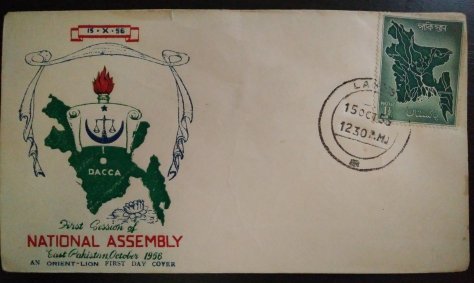
To commemorate the first session at Dacca, East Pakistan, of the National Assembly of Pakistan, three postage stamps were issued on and from the 15th October 1956:—

  • 1½-anna, bottle green
  • 2-anna, dark brown
  • 12-anna, deep red

The picture above is the first day cover with a 1 ½ anna stamp. I just came across it during a stroll at the book fair on The Mall, Lahore which is held on Sundays. The commemorative stamp was issued on the eve of Pakistan becoming the first Islamic Republic in the world. At the time Pakistan was made up of two wings, East Pakistan (now Bangladesh) and West Pakistan. The National Assembly of Pakistan is the lower house of parliament and initially met in the capital Karachi. However, this was the first session of the National Assembly in Dacca and in fact the last time as well because two years later Ayub Khan became the first military dictator in Pakistan and eventually by the 1971, the country was on the brink of splitting up.

The stamp encapsulates the period when Pakistan ended its status as a dominion and was declared an Islamic Republic of Pakistan on 23 March. Hence this is day is celebrated as Republic Day in Pakistan. This of course is also the same day that Mohammad Ali Jinnah adopted the Pakistan Resolution (Lahore Resolution) outlining the two-nation theory. The full text of the 1940 Resolution is available via: http://www.columbia.edu/itc/mealac/pritchett/00islamlinks/txt_jinnah_lahore_1940.html.

The Constituent Assembly became the interim National Assembly with Governor General Iskander Mirza as the first President of Pakistan. The Assembly had 80 members, half each from East Pakistan and West Pakistan. A turning point in Pakistan’s history, the Constitution required the president to be a Muslim and he (typically it was a he), had the power appoint the Prime Minister and he was also empowered with the ability to remove the Prime Minister, if there was a lack of confidence in his abilities. The Constitution of 1956 was written almost ten years after Pakistan was created, but crucially it set in motion a dangerous precedent; the President had the power to suspend fundamental rights in case of an emergency. Crucially though the Constitution of 1956 was short-lived because by 7 October, 1958, General Mirza dissolved the constitution and declared Martial law in Pakistan.


Borders and Boundaries

As an academic my main pre-occupation has been centred around the partition of India and creation of Pakistan in 1947. I have been fortunate enough to have been able to spend time on both sides of the border, comparing the impact of this division on the people of Punjab; the area that has been severely affected by the decision taken in 1947. From being the bread basket of British India and the major recruiting ground for the colonial Indian army, East Punjab becomes the hostile border with Pakistan and West Punjab, while politically dominate, recedes culturally. The culturally, linguistically and economically rich land of Punjab is Balkanised after 1947 and now exists as a mere skeleton of its former self. The land has been reconfigured along religious identities which evaporate the pluralistic history; it tries to re-imagine itself for the new global order but lacks the former strength it had.

For the past 14 years I have crossed the official border crossing at Wagha/Attari between India and Pakistan numerous times; I’m lucky because I don’t have a green or blue passport, both of which immediately open you up tedious amounts of scrutiny. By virtue of being “foreign” and at the same time a “desi”, you get to experience this place in a different manner. Although I have Indian heritage, the Indians are on the whole sterner, matter of fact during the immigration and customs. Sometimes I will strike a conversation and there is rare chance to get their views. For example, during my last trip, the Indian official wanted me to recommend some history books to read, especially those that were impartial. On the Pakistan side, there are of course always questions, inquisitions about what, why, who…but there appears to be more “conversation”. There is always intrigue and sometimes joy that a “foreigner” would want to spend time in Pakistan. I have also been unlucky enough to be stuck on both sides of the border just as it is about to close for crossing. And both sides have blamed the other, “madam ji, we will let you go through but the Indians/Pakistanis will not accept you”. Both behave in this rather childish and tit for tat manner. It is a shame then that politics is also conducted in this manner. While Delhi and Islamabad exchange words of war, the ordinary people suffer, as they have suffered in the past 69 years.

The new global trend for hyper nationalism, as seen in the impact Trump is having in America, the growing influence, both emotionally and politically, of right wing politics can also be seen in the UK, France, Denmark, Sweden, and so socially progressive countries which are now retracting and adopting more defensive policies. While in India, the impact of Modi and his cosy relationship with RSS has unleashed and legitimatised a form of nationalism and patriotism which makes it difficult to question governments and their policies. In the name of showing loyalty to the state, Indianess/Hinduness and the armed forces, it has become unpatriotic to say anything which may offend. Have we become so insecure that we cannot even tolerate any scrutiny? Surely we need reflect on our past and how we face the challenges of an increasingly globalised society. We cannot live in isolation, putting up barriers, preventing the movement of people and creating homogenous spaces. India and Pakistan did this in 1947 and we live with the legacies of that today. Homogenous (religiously or ethnically) societies does not equate with security, peace and harmony. Look at the challenges Pakistan has faced since it was founded as a country for the Muslims of India. Working together for a solution is the only option. But amongst this raft of change has also been the enormous disconnect between the politicians and the people and this is a global challenge.

It is therefore staggering to think that as we approach 70 years of independence, little has been gained and little has been achieved in our relationship with our closest neighbour. We cannot deny that we were once attached together and there are many cultural, ethnic, linguistic commonalities that unite us, yet we are determined to focus on the differences and maintain the status quo of a sibling rivalry. Unfortunately, there is no parent who can step in try to patch up things, we have to be mature enough to do that ourselves. Otherwise, this rivalry will remain for the next 70 years. People away from border states like Punjab and especially Kashmir cannot comprehend the negative impact this rivalry has had on the mind-set and livelihoods of the people. They live in the shadows of this rivalry, even though there is much more which unites them than divides them. They also have a right to live in peace and aspire for prosperity, we should not be so selfish to deny them this.

Gurdwara Rori Sahib, Eminabad

Gurdwara Rori Sahib is two km from Eminabad and about 55 km north of Lahore. It is located not too far from Gujranwala and the Grand Trunk Road. The Gurdwara marks an important site, where Guru Nanak after the destruction of the town had stayed with Bhai Lalo. The plaque at the gurdwara reads, ‘This is the holy place where Guru Nanak Dev ji came in his first pilgrimage. Guru Nanak dev I came here at Bhai Laalo ji’s home (Eminabad). It was a beautiful and silent place away from city, this’s why Guru Nanak ji sat down here and was prayed the almighty god regularly.’

The gurdwara was originally constructed on a large estate of nine marabbas. This has gradually been reduced down now. The land was originally endowed to the gurdwara during Maharaja Ranjit’s period and the gurdwara’s architecture is also from this period. The location and size of the gurdwara attracted large crowds of Sikhs, particularly during the Vaisakhi festival in April. There used to be a week-long fair during this period and attracted people from all the surrounding areas. The estate left today is a reminder of the old grandeur that would have existed when there was a sizeable Sikh population prior to 1947.

The entrance to Rori Sahib is grand, imposing and awe-inspiring, with the beautiful exposed red brick. The dome work and the columns are all in cut brick work. Accompanying the gurdwara is a large sarovar, which when I revisited the gurdwara ten years later, the water had evaporated.

Below are some of the pictures from when I first visited the gurdwara in 2006 and then most recently in October 2016.

Rori Sahib pictures from 2006.


Rori Sahib revisited in 2016.