Tag Archives: Pakistan

How the Photographs of Margaret Bourke-White became the Images of Partition.

When we visualise India’s Partition of 1947, we almost always do so through the images of Margaret Bourke-White. For the past seven decades, her images have saturated the cover of numerous books, newspaper articles, magazine features, documentaries et al related to Partition. She was, of course, one of the most iconic photographers of the last century. Born in 1904 (d. 1971) in New York City and raised in rural New Jersey, she was the daughter of Joseph White (who was of Jewish descent from Poland) and Minnie Bourke, an Irish Orthodox Catholic. Joseph was an inventor and engineer and perhaps thus an early influence on his daughter’s eventual interest.

This interest matched the tenor of those times, as Henry R Luce, the publisher tycoon realising the potential of photography, felt that America was ready for a magazine that documented events the through photographs. In 1936, Luce bought Life magazine and relaunched it, with Bourke-White becoming one of the first photojournalist to be offered a berth there (Kapoor: 13). America then was in the midst of the Great Depression and Bourke-White ‘took to documentary photography in order to disseminate the idea of inconvenient truth’ for a readership of 2.86 million people (Bhullar: 301).

In India, she is primarily known for her photographs that captured the Partition-related violence and migration, as it ushered in the new dawn of independence. Her photographic essay, The Great Migration: Five Million Indians Flee for Their Lives, was published in Life magazine on 3 November 1947. It had commissioned her to cover the exchange of populations that was taking place across the plains of the divided Punjab and she writes thus what she saw: “All roads between India and Pakistan were choked with streams of refugees. In scenes reminiscent of the Biblical times, hordes of displaced people trudged across the newly created borders to an uncertain future” (Kapoor: 14).

Recently, in 2010, Pramod Kapoor published Witness to life and freedom: Margaret Bourke-White in India & Pakistan with a reprint of over 100 of her photographs. Kapoor wrote about them thus: “They offer a kind of stately, classical view of misery, of humanity at its most wretched, yet somehow noble, somehow beautiful”. His book gives us into a glimpse beyond the frames. Bourke-White had arrived in India in March 1946 and travel around documenting low life and high people: “She was there to photograph Gandhi at his spinning wheel. She was there to photograph Jinnah with his fez. And soon after, both men were to meet their Maker” (Kapoor: 14). Her frames on them served to reinforce their pervading stereotypes of the saint and shrewd. Kapoor details:

“Margaret photographed Gandhi many times afterward. He called her, fondly, she thought, ‘the torturer’. His inconsistencies puzzled her rational mind; it was not until she saw his self-sacrificing bravely in the face of India’s convulsive violence that she began to think him akin to the saint she made him out to be with her camera. She also photographed Mohammed Ali Jinnah; whose features were as sharp as the creases in his western business suits. Jinnah would almost single-handedly bring about the partition of India and the creation of Pakistan”.

Bourke-White documented the aftermath of the so-called Direct-Action Day in August 1946, which was announced by Jinnah following the failure of the Cabinet Mission Plan. Her photographs of the riots in Calcutta then are sometimes confused with the images she took following the Partition, a year later. The article ‘The Vultures of Calcutta’ featured in the 9 September 1946 issue of Life, showing vultures waiting to prey on the bodies of dead victims was later, intermittently and inaccurately, used for depicting the carnage in August 1947.

Vicki Goldberg, the biographer of Bourke-White, writes that when she heard about the Calcutta Riots, Bourke-White immediately flew to Calcutta, and “badgered photographer Max Desfor (1913-2018), the first foreigner to photograph the aftermath of the riots, to tell her where to find the most carnage. While others were sickened by the sight of the bodies, Bourke-White kept working and wrote the scene reminded her of concentration camps in Germany: “the ultimate result of racial and religious prejudice” (Forbes: 7). Desfor’s images were not published by the Associated Press because they were “too revolting for its readers”. Bourke-White’s comrade was Lee Eitingon, a Life reporter based in India, in whose words, “Both of us were whatever the female equivalent of macho is. The smells were so terrible, the officers accompanying us would have handkerchiefs over their faces. We would not…that was part of the time and the period. Being women, we had to be tougher” (Kapoor: 27).

Much of Bourke-White’s archive are housed in Syracuse University’s Bird Library Special Collections section. Here “one can find some of the original photos that include the British soldiers who accompanied Bourke-White and Lee Eitingon” but, as Forbes notes, “the soldiers were cropped from the published pictures”, which dramatically changes the visual narrative (12). It now appears that Bourke-White staged photographs: “Eitingon wrote about her directing a group of starving Sikh refugees…to go back again and again”. She adds, “they were too frightened to say no. They were dying”. When Eitingon protested, Bourke-White told her “to give them money!” (Forbes: 11-12). Even Patrick French writes about how some of these images were staged. When the contact sheets were discovered, they provided an insight into the wider context in which these photographs were being taken. Some of this approach of a pushy, zealous and ambitious American, has been noted in the writing of Claude Cookman. In his examination of how Bourke-White and her French counterpart Henry Cartier-Bresson (1908-2004) approached the coverage of Gandhi’s funeral he notes:

“Flash had become a contentious issue in Bourke-White’s coverage of Gandhi. She had used a flash bulb to make her famous portrait of Gandhi by his spinning wheel. Gandhi…tolerated the technique, but his inner circle never did. They thought flash was disrespectful, and they feared the bright light would harm his sensitive eyes. Flash became a serious liability for Bourke-White in her coverage of Gandhi’s funeral. With her camera concealed, she slipped into the room, where his body lay surrounded by grieving relatives, supporters and government officials. It was about 6:30 p.m.…When she ignited a flash bulb to make her exposure, his followers became enraged by her violation of their privacy and grief. They seized her camera and threatened to destroy it. Hannah Sen intervened, calming the group. After Bourke-White’s film was removed and exposed to the light, Mrs. Sen escorted her from the room. She returned the camera with the understanding that Bourke-White would leave Birla House and not return. Not one to give up after one rebuff, she reloaded her camera and tried to re-enter the room to get another picture. Eventually, Bourke-White yielded to Mrs. Sen’s pleas to honour her promise and left empty-handed. The stereotype of the rude, aggressive American news photographer, who would trample on anybody’s toes or sensitivities to get the picture was a commonplace during the 1940s…Cartier-Bresson deplored this rough-and-tumble approach to photo-journalism: ‘We are bound to arrive as intruders’, he wrote, ‘it is essential, therefore, to approach the subject on tiptoe. It’s no good jostling or elbowing’. As part of his approach, he rejected artificial lighting: ‘And no photographs taken with the aid of flashlight either, if only out of respect…Unless a photographer observes such conditions as these, he may become an intolerably aggressive character’. When Cartier-Bresson wrote this rejection of flash in 1952, he may well have been recalling Bourke-White’s experience at Gandhi’s wake four years earlier” (Cookman: 200).

Geraldine Forbes also notes the differences between Cartier-Bresson and Bourke-White. The former is less known but his images exude a sensitivity, absent in the work of Bourke-White. Upon receiving a photography award, Bourke-White claimed, “The photographer must know. It is his sacred duty to look on two sides of a question and find the truth”. And she cited her work to reference this point (Kapoor: 26). However, when we look at her work, we rarely observe that her work, almost entirely based on the Punjab migration, has yet been made to stand for Independence/Partition exclusively, without acknowledging the vast and diverse range of experiences. The visual record which is taken as “the truth” is rarely explored critically or contextually, while less said so of the racial-ethnic cultural capital of a white American female to travel freely to photograph this momentous carnage at the end of empire. These were foreign journalists writing for a predominately American and western audience, yet these photographs have come to represent Partition.

References:

Dilpreet Bhullar, ‘The Partition of the Indian Subcontinent Seen through Margaret Bourke-White’s Photographic Essay: ‘The Great Migration: Five Million Indians Flee for their Lives’, Indian Journal of Human Development, (2012) 6 (2): 299-307.  

Claude Cookman, ‘Margaret Bourke-White and Henri Cartier-Bresson: Gandhi’s funeral’, History of Photography 22, no. 2 (1998): 199-209.

Geraldine Forbes, ‘Margaret Bourke-White: Partition for Western Consumption’, In Reappraising the Partition of India edited by K. Mitra and S. Gangopadhyay (Readers Service, 2019), pp. 3-16.

Patrick French, ‘A New Way of Seeing Indian Independence and the Brutal ‘Great Migration’, Time, 14 August 2016.

Vicki Goldberg, A Biography. New York: Harper & Row. 1986.

Pramod Kapoor, Witness to Life and Freedom: Margaret Bourke-White in India & Pakistan. New Delhi: Roli & Janssen. 2010. 

Asma Naeem, ‘Partition and the Mobilities of Margaret Bourke-White and Zarina’, American Art 31, no. 2 (2017): 81-88.

Pramod K. Nayar, ‘The Trailblazing Lens of Photojournalist Margaret Bourke-White’, The Wire, 28 Sept 2019.

Bio/profile/work:

Alan Taylor, ‘The Photography of Margaret Bourke-White’, The Atlantic, 28 August 2019.

The Pioneering Photography of Margaret Bourke-White by Google Arts & Culture
The Life Picture Collection

Original Life Magazines

A bouquet of five flowers and the Battle for Pakistan

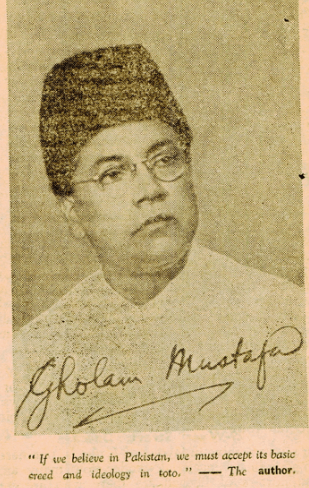
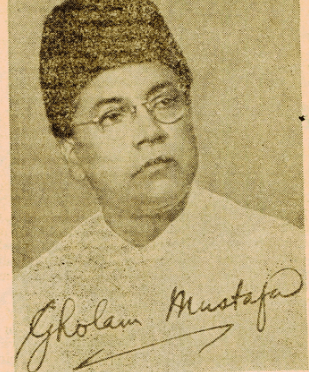
Picture taken from ‘The Battle for Pakistan’ pamphlet

I recently came across Golam Mostofa and his rather state-centric as opposed to peoples-oriented 20-page pamphlet on The Battle for Pakistan, which examines the entangled questions of state-language and the basis of Pakistan. Mostofa was the secretary of the East Bengal Government’s Language Reform Committee, while being a strong proponent of the two-nation theory and an advocate for Urdu as the national language for Pakistan.

As the ideological imagination, and its linguistic articulation, in early-Pakistan was taking shape, Firoz Khan Noon (Governor of East Pakistan) had his vision of converting Bengalis into Urdu speakers by using religion to play on their sentiments (Jalal 2014, 87). Urdu was deemed the only language that could strengthen national unity over ethnic groups. Noon commissioned various argumentative material to this end, including Mostofa’s pamphlet that presented a case for adopting Urdu in East Pakistan. Below are some extracts from the pamphlet, which was published c. 1952.

The Ideology of Pakistan

An unwarranted bitterness has been created over the question, of whether Urdu or Bengali should be the State-language of Pakistan. This sort of domestic quarrel at this nascent stage of Pakistan is really very sad…Long before the announcement of the Quaid-i-Azam, I said at a public meeting in Dacca that Urdu should be the State-language of Pakistan, though, of course, Bengali should not be discarded. The following extract from the report of the Hindustan Standard will bear me out:

“Poet Gholam Mustafa said that those who wanted to make Bengali as the State-language of Pakistan were looking at a narrow angle of geographical limits; but if they consider Pakistan as a dynamic unifying force in the world, they could not brush aside Urdu. He was inclined to the view that Bengali language was responsible for the decline of the Bengali Muslims as that language reflects the idea of non-Muslims”. (12-11-1947)

Significance of State-Language

The very expression “State-language” pre-supposes the existence of a State. The State-language of a State should therefore be that language by which the interests of the State can be served best. [emphasized in original] …The question of the safety and integrity of the State therefore comes first in determining a State-language. If we quarrel amongst ourselves over this issue and the ‘State’ disappears as a result thereof, what shall we do with the ‘language’ left behind? Language is a means to an end, not an end in itself. When the British conquered this country, they made English the State-language, not for our convenience, but for the interests and ideals of their State. The same principle will apply equally to Pakistan.

Our Problems

The argument of those who say that Bengali should be the State-language of Pakistan because of the numerical superiority of the Bengali Muslims has no leg to stand upon. Had numerical strength been the only determining factor in solving national problems like this, surely, we could not get Pakistan in India, as the Hindus commanded an overwhelming majority over us…Ideals cannot be judged by votes alone.

Pakistan is one State. It is, as it were, a bouquet of five flowers, none of which can be separate from the others. There is no such thing as Eastern Pakistan and Western Pakistan…The different provinces are to the Pakistan State what the limbs are to the body. If the limbs fall out and do not co-operate with one another, the body cannot exist…Pakistan is still beset with various dangers and difficulties…If Bengali and Urdu are both given the status of two State-languages, one for the East, the other for the West, it will only serve the purpose of the enemies. It will give rise to narrow provincialism among us, culminating in the ultimate separation between the two wings.

The demand for Bengali as the State-language of Pakistan therefore signified the triumph of Hindu culture and, as such, is in itself a strong symptom for the intravenous injection of Urdu in the cultural life of the Bengali Muslims. It is really very amazing that the Bengali Muslims are unwilling to accept Urdu for fear of Punjabi domination, but are quite agree-
able to be slaves of Bengali culture which is dominated by the Hindus.

On analysis, it will be found that the ‘Bengali for Bengal’ movement owes its origin to the borrowed idea of nationalism. Bengali Muslims are a separate unit having distinct culture of their own – this territorial patriotism has prompted the agitators to go in for Bengali. But they do not perhaps know that there is no such nationalism in Islam. Islam is preacher of internationalism or extra-territorialism.

Conclusion

We have got Pakistan. But real Pakistan is still far away…It is a thorny path and, as such, we have got to sacrifice much before we reach our goal. We must not be satisfied with our geographical Pakistan. Pakistan is an ideal…Islam is appearing in a new historic role and Pakistan will be the stage board of that great episode. For that ultimate goal, the entire Muslim World should first of all unite under one banner. Egypt, Arabia, Iran, Syria, Afghanistan, Pakistan, Indonesia: all the Muslim States of the world are therefore combining together to form a “Sixth Continent”. Will the Muslims of East Pakistan lag behind?

Following biographical details are provided on Wikipedia: Golam Mostofa (1897 – 13 October 1964): “Mostofa started teaching at Barakpore Government School in 1920. He retired as headmaster of Faridpur Zila School in 1949…His book Biswanabi (1942), a biography based on the life of the Prophet Muhammad, provided him with recognition.”

Other references

Jalal, Ayesha. The Struggle for Pakistan. Harvard University Press, 2014.

‘Remembering poet Golam Mostofa’: https://www.observerbd.com/2014/10/16/48987.php

Poem Hunter: https://www.poemhunter.com/golam-mostafa/biography/.

Flavours of India – Punjab

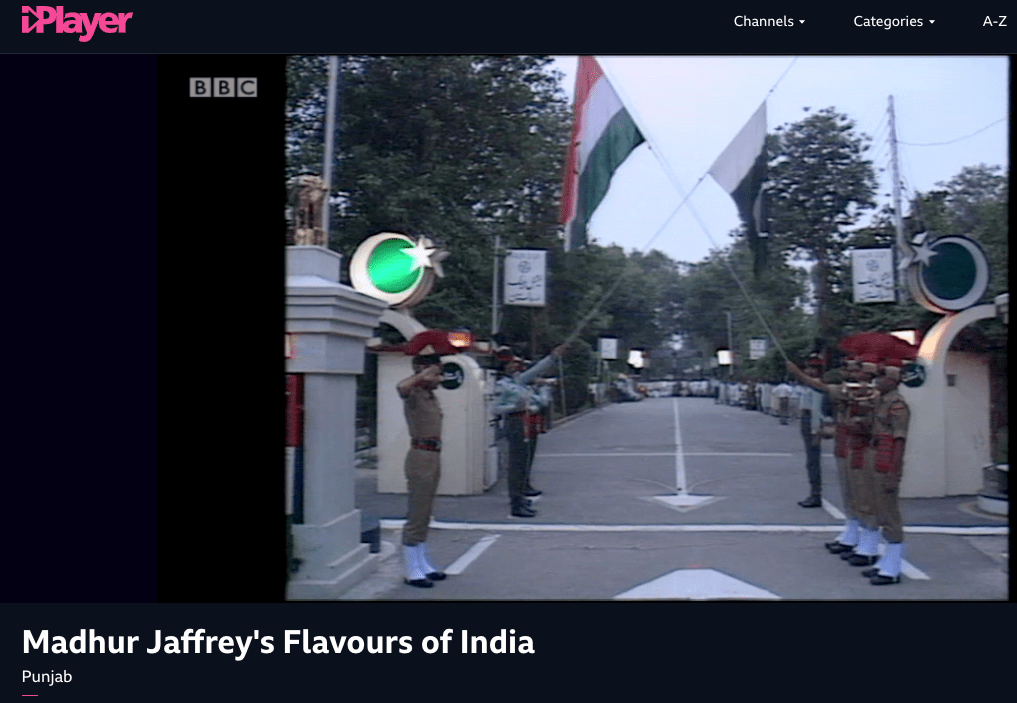
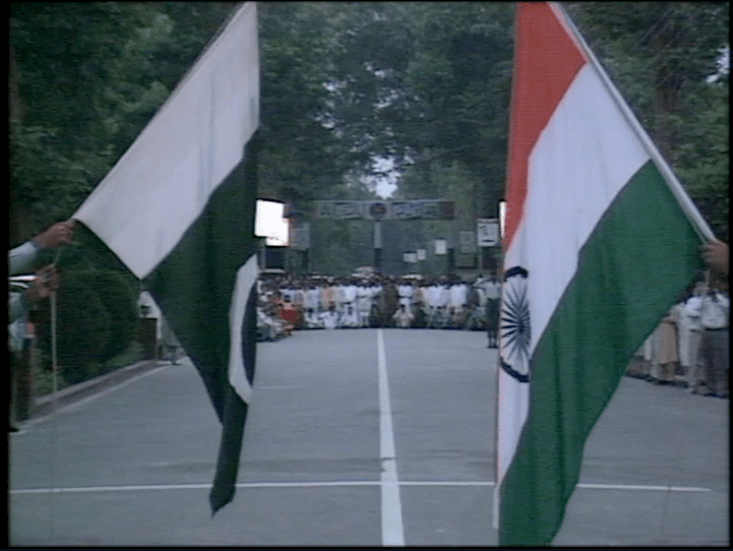
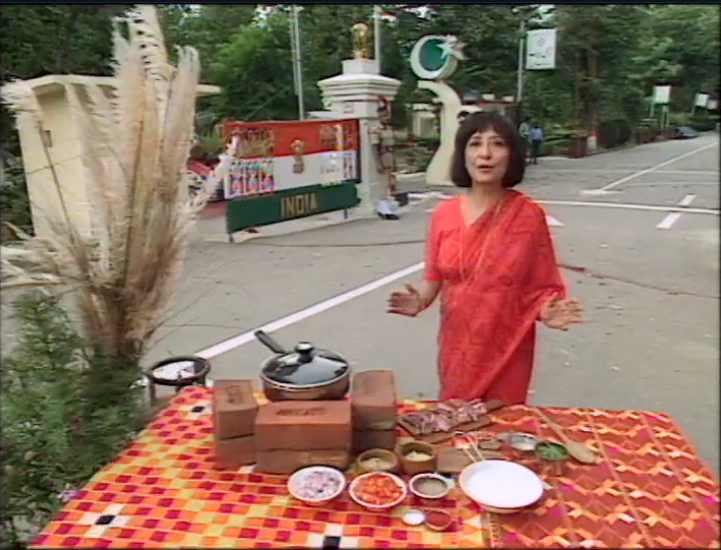
I accidentally stumbled across Madhur Jaffrey’s Flavour of India, which is being repeated on BBC iPlayer. I remember watching this when there were hardly any Indian chefs or Indian cooking on mainstream TV, so I decided to watch some of these again…it is a Sunday morning! As I sat through the episode on Punjab, near the end of the programme I was amazed to see her making lamb chops on the Wagah-Attari border. I have crossed this border numerous of times and I have also seen now much it has changed from a leafy road with colonial bungalows acting as the immigration/custom points to a harsh border with a daily dose of jingoism and national pride on full display. These few minutes have just reminded me how much India (and Pakistan) has changed since 1995. I wonder where the BSF walla tasting the lamb chop is today…

Other posts on Wagah-Attari:

The Spectre of Partition

No Mans Land: the Wagah-Attari Border

Borders and Boundaries

The Spectre of Partition

IMG_20170811_162942
Wagha-Attari Border. © 2017 Pippa Virdee

Sharing a screen grab from the last page of my book From the Ashes of 1947Balraj Sahni captured the human tragedy of Partition in this poem, the spectre of which still continues to haunt us everyday. We seem to be unable to be human first.

Screenshot 2020-02-26 at 10.31.46

The Remains of Buddha in Taxila

While the present nation-states of Pakistan and Afghanistan are Islamic Republics, there was a time when the religion of Buddha registered a strong presence in areas, now part of these states. Back in 2001, when the ‘Buddhas of Bamiyan’ were blasted by the Taliban in Afghanistan, the visuals were received with astonishment and horror across the world. These ancient, iconic carvings were UNESCO protected monuments and represented the classic syncretic style of Gandhara art. The Taxila Museum in Punjab province of Pakistan is home to the largest collection of ancient Gandharan artefacts in the country dating back to the time from the 1st to the 7th c. AD. Most of these were excavated at the nearby ruins of the ancient city of Taxila. The museum itself dates back to 1918.

John Marshall (1876-1958), was one of the most famous directors of the Archaeological Survey of India and excavator of the city of Taxila. Marshall began the excavations at Taxila in 1913, which carried on for another twenty years, apart from laying the foundation stone of the museum in Taxila. Later, he produced An Illustrated Account of Archaeological Excavation of Taxila in 1951. This 3-volume work details the Taxila excavations of 1913-1934 and opens with an apt description of the importance of topography in situating ancient Taxila:

‘The remains of Taxila are situated immediately to the east and north-east of Sarai-kala, a junction on the railways, 20 miles north-west of Rawalpindi. The valley in which they lie is a singularly pleasant one, well-watered by the Haro river and its tributaries, and protected by a girdle of hills – on the north and east by the snow mountains of Hazara and the Murree ridge, on the south and west by the well-known Margalla spur and other lower eminences. This position on the great trade route, which used to connect Hindustan with Central and Western Asia, coupled with strength of its natural defences, the fertility of its soil, and a constant supply of good water, readily account for the importance of the city in early times’.

While Buddha (5th-4th c. BC) did not venture to Gandhara, growth of Buddhism in this region happened under the Mauryan Empire (322-185 BC). Gandhara was a province of the Persian Empire under Darius I. In 327 BC, Alexander advanced as far as Taxila in his conquests, but shortly thereafter, the region was consolidated with the territorial reach the Mauryan dynasty. It was Chandragupta’s grandson, Emperor Ashoka, who converted to Buddhism in c. 263 BC, following the especially bloody Kalinga War.

It was under the Kushans’ (people of Scythian origin) rule that the Gandhara region assumed its important place in the history of Buddhism and especially its art. Under ruler Kanishka in the 1st c. AD, ‘Buddhist sages made Gandhara a sacred region by the compilation of texts associating local sites with previous incarnations of the Buddha’ (1956). The Kushans’ ‘greatest contribution of Gandhara to the art of Asia was the invention of the Buddha image. The first anthropomorphic representation of the Great Teacher was probably related to the emergence of the devotional sects of Buddhism and demand for the portrayal of the object of worship in an accessible human form in place of the entirely symbolic portrayals of the master in the art of early Hinayana Buddhism’ (1960).

Great Stupas were subsequently built in the region, of which some still survive and are preserved in the Taxila Museum. In Takht-i-Bahi (Mardan, KP province), there is a large Buddhist monastic complex, which forms an important site of this period in the region, representing the Gandhara school of art and architecture. Dating from 1st – 2nd c. AD, Buddhism flourished here, leading to a new, syncretic Greco-Buddhist art/architecture & culture. Mediterranean and Persian influences gave Gandhara sculpture characteristics, which distinguishes it from other Buddhist art notably the Mathura school (1956).

While the archaeological evidence of the extent and importance of Gandhara only came to light in early-20th c., textual evidence and knowledge about it was available through accounts by Chinese Buddhist pilgrims. They recorded and left behind incredibly detailed descriptions of their travels, for example, the stories of Fa Hsien’s journey in c. 400 AD, the journey of Sung Yun in the 6th c., and the most detailed of all, Hiuen Tsang’s Hsi Yii Chi, Records of the Western Countries, composed in early-7th c. (1960).  


Sources:

Marshall, John. Taxila: An Illustrated Account of Archaeological Excavations Carried out at Taxila under the Orders of the Government of India between the years 1917 and 1934. 3 Volumes. Cambridge University Press, 1951.

Rowland, Benjamin. Gandhara Sculpture from Pakistan Museums. Asia Society, 1960.

Gandhara Sculpture in the National Museum of Pakistan, published for the Department of Archaeology by The Department of Advertising, Films and Publications. Printed by Ferozsons, October 1956.

Further Reading:

Asif H., Rico T. ‘The Buddha Remains: Heritage Transactions in Taxila, Pakistan’. In: Rico T. (eds) The Making of Islamic Heritage. Heritage Studies in the Muslim World. Palgrave Macmillan, (2017).

Van Aerde, M. E. J. J. ‘Revisiting Taxila: A new approach to the Greco-Buddhist archaeological record.’ Ancient West & East 2018 (2018).

Hara/Green

Habib Jalib was born in 1928 in Hoshiarpur, East Punjab. He migrated to Pakistan after partition and worked as a proof reader in Daily Imroze, Karachi. Read further about him: https://www.letsstartthinking.org/Pakistan/personalities/habib-jalib.php. All his poetry is available via Rekhta. Below is the poem Bagiya Lahoo Luhan-The Garden Is A Bloody Mess. The poem is about the oppression in East Pakistan in 1971 but unfortunately it continues to resonate, even today.

Bagiya Lahoo Luhan
Haryali ko aankhen tarsen bagiya lahoo luhan
Pyar ke geet sunaoon kis ko shehar hue weeran
Bagiya lahoo luhan 

Dasti hain suraj ki kirnen chand jalaye jaan
Pag pag maut ke gehre saye jeewan maut saman
Charon ore hawa phirti hai le kar teer Kaman
Bagiya lahoo luhan 

Chhalni hain kaliyon ke seeney khoon mein lat paat
Aur nahjaney kab tak hogi ashkon ki barsaat
Dunya walon kab beeteinge dukh ke yeh din raat
Khoon se holi khel rahe hain dharti ke balwan
Bagiya lahoo luhan
The Garden Is A Bloody Mess 
Our eyes yearn for greenery
The garden is a bloody mess
For whom should I sing my songs of love
The cities are all a wilderness
The garden is a bloody mess

The rays of the sun, they sting
Moonbeams are a killing field, no less
Deep shadows of death hover at every step
Life wears a skull and bone dress
All around the air is on prowl
With bows and arrows, in full harness
The garden is a bloody mess 

The battered buds are like a sieve
The leaves drenched in blood smears
Who knows, for how long
We’ll have this rain of tears
People how long do we have to bear
These days and nights of sorrow and distress
This oppressor’s blood bath is a frolicsome play
For the mighty of the world, a mark of their prowess
The garden is a bloody mess 

Source: Revolutionary Democracy

Laal/Red

“In 1949, while in Lahore, Sahir Ludhianvi wrote a revolutionary poem, ‘Avaaz-e-Adam’ (The Voice of Man), in which ‘hum bhi dekhenge’ remains a memorable phrase. It ended on the optimistic – and one could say provocative – assertion that the red flag of communism would fly high. Pakistan had already decided to become a frontline state in Western attempts to contain Soviet Communism. It was trying desperately to convince the US that it could be a strong ally in its anti-Communism policy. Pakistan also wanted to portray itself as a trusted ally for the West, not just in South Asia but also in the Middle East. But after the poem was published, Sahir was threatened by intelligence agencies and he migrated to India. In effect, ‘hum bhi dekhenge’ came to symbolise Sahir’s farewell to Pakistan, which he felt would be a puppet of the West, and his search for sanctuary in Nehru’s India.” Source: The Wire.

© 2019 Pippa Virdee
aavaaz-e-aadam
Dabegi kab talak aavaaz-e-Aadam hum bhi dekhenge
rukenge kab talak jazbaat-e-barham hum bhi dekhenge
chalo yoonhi sahi ye jaur-e-paiham hum bhi dekhenge

dar-e-zindaan se dekhen ya urooj-e-daar se dekhen
tumhen rusva sar-e-bazaar-e-aalam hum bhi dekhenge
zara dam lo maal-e-shaukat-e-jam hum bhi dekhenge

ye zoam-e-quvvat-e-faulaad-o-aahan dekh lo tum bhi
ba-faiz-e-jazba-e-imaan-e-mohkam hum bhi dekhenge
jabeen-e-kaj-kulaahi ḳhaak par ḳham hum bhi dekhenge

mukaafaat-e-amal tareeḳh-e-insaan ki rivaayat hai
karoge kab talak naavak faraaham hum bhi dekhenge
kahaan tak hai tumhaare zulm mein dam hum bhi dekhenge

ye hangaam-e-vidaa-e-shab hai ai zulmat ke farzando
sahar ke dosh par gulnaar parcham hum bhi dekhenge
tumhen bhi dekhna hoga ye aalam hum bhi dekhenge
The Voice of Man
We too shall see till when one can suppress the voice of Adam
We too shall see till when can be stopped the angry emotion(s)
We too shall see, sure, just like this, the constant oppression.

Whether we view from the door of the dungeon or the elevation of the scaffold
We too shall see you dishonoured in the marketplace of the world
Just take a moment’s breath, we too shall see the consequences of the grandeur of Jamshed.

You too behold this vanity of power
We too shall see this by the kindness of the firm belief’s fervour
We too shall see a bend upon the dusty face that wears the jaunty headgear.

Retribution is a tradition of human history
Till when will you amass the arrows, we too shall see
We too shall see how far will you persist with your tyranny.

O sons of darkness this is the time for departure
We too shall see the morning shoulder the flag of red colour
We too shall see, you too shall have to see this clamour.

Source: ‘We Too Shall See, You Too Will Have to See This Clamour’: A Tribute To Sahir Ludhianvi by Raza Naeem, NayaDaur

Read/listen to Sahir on Rekhta

Sahir Ludhianvi – Making of Dreamer – Freudian Poet of the Indian Cinema by Anil Pundlik Gokhale. CounterCurrents.org

Speaking Easy: Allama Iqbal’s Grandson – Yousaf Salahuddin

via Speaking Easy: Allama Iqbal’s Grandson – Yousaf Salahuddin – on his Current Project and the Future of Art and Culture in Pakistan
Originally published 5 Sept 2012 but relevant today.

If you want to read further also see this article in The Friday Times by Muhammad Asif Nawaz, The old world charms of Mian Salli, originally published 25 July 2014.