By Pippa Virdee and Arafat Safdar in South Asian Chronicle.
Khushwant Singh’s novel Train to Pakistan was published in 1956, almost ten years after the partition of India/ creation of Pakistan in 1947. Its publication inaugurated what has been called ‘South Asian Partition Fiction in English’ (Roy 2010). It remains, to date, one of the most poignant and realistic fictional accounts depicting the welter of partition and saw a sensitive screen adaptation in 1998 by Pamela Rooks. It captures one of the most horrific symbols of partition—that of the burning, charred and lifeless trains that moved migrants and evacuated refugees from one side of the border to the other. The trains that previously served to bring people and goods from disparate worlds closer together were overnight turned into targets of mob attacks and transporters of mass corpses. They thus became an emblem, a much-photographed representation (Kapoor 2013) of the wider violence and ethnic cleansing that was taking place in Panjab (Ahmed 2002: 9-28); one of the two regions divided to make way for the two new nation-states.
Selecting some key individuals in the village, relevant to and representative of our efforts to excavate the myths and memories associated with partition, and situating their sensibilities vis-à-vis the sentiments exhibited in the novel, we conducted interviews to collect and compare experiential accounts. An attempt in the Wildean spirit to attest that ‘life imitates art far more than art imitates life’, the article, located in the Faqiranwalla of 2017, looks back to the Mano Majra of 1947. In doing so, not only does it reflect on this intervening time-span and what it has done to those remembrances, but, also brings to fore the well-remarked realisation that, in this case too, ‘the past is another country’ (Judt 1992). Like in the novel then and life today, the connecting link in this article too, between Faqiranwalla and Mano Majra, is the train, as both share the overweening presence of the railways in the village, through which its life is/was governed.
Read full article: https://edoc.hu-berlin.de/handle/18452/19508
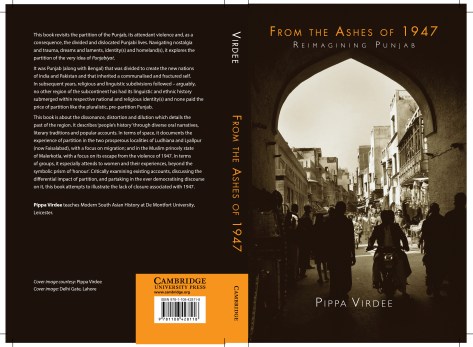
Watch the panel discussion with Pippa Virdee (De Montfort University, UK), Afzal Saahir (Poet and Radio Host) and Sajid Awan (Quaid-e-Azam University) of my book From the Ashes of 1947 at the Afkar-e-taza, January 2018 Panel Discussion
This week Coventry successfully won the bid to be the city of culture in 2021. Subsequently, there have been numerous articles about Coventry in the media, reflecting both the history and lived experiences of the city. The response has also been mixed in the sense that some people have continued to dwell on the lack of culture and “beauty” in the city, and in part this is true. The more optimistic see this as an opportunity to revive the glorious past with renewed energy.
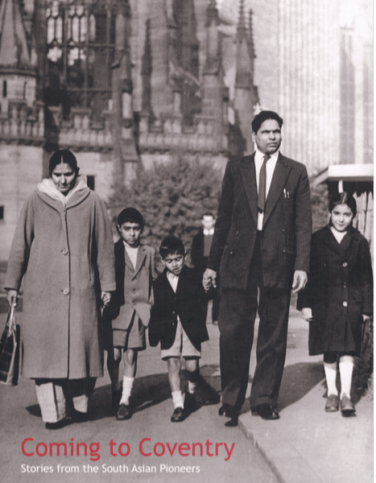
As I reflect on the city’s bid to become the city of culture, I remember an oral history project, which I did in 2005-6, Coming to Coventry. It was funded by the HLF and supported by The Herbert and documented the migration of South Asians to Coventry from the 1940-60s. We collected over fifty oral accounts of people, who migrated here and, through these testimonies and the beautiful pictures that people shared with us, we documented their journeys to Coventry in search of a better life. Many of the early migrants had intended to go back home but gradually, some of them made Coventry their home. They contributed to the growth and development of the city in the heyday of the post-war years. The 1970s were, of course, to bring about change and the consequent downturn was not kind to Coventry.
The time through the duration of the project gave me an insight into the city, which I did not fully comprehend before. It made me reflect on my own experiences of migrating to it. Coventry is a city that I came to, not out of choice but as a child accompanying my mother. At the time, I had no preconceptions of the city and my response was only that of a child, who could not quite understand the upheaval of migration and dislocation to a “foreign” land. It could have been anywhere and I suspect the response would have been the same. Nonetheless, Coventry became my home while growing up in 1980s Britain: a challenge in itself. In the backdrop were Thatcher’s Britain, the Falkland’s war, the vibrant music of the 80s, racism and the declining car industry in Coventry. Gradually the former car plants gave way for housing and retail parks. The city changed and adapted, as did I. But the years of the Thatcher administration left its mark on me, especially when I was beginning to see and understand the society around me, even though the Prime Minister would have us believe that there was no such thing as society. Studying politics, sociology and art seemed to me a perfect combination in response to the excesses of Thatcherism.
The pursuit of knowledge led me to University and I had two choices, University of Warwick or the newly created Coventry University. Despite having a place at the former, due to personal circumstances, I chose the latter. I had felt out of place at a visit to the former and besides, something caught my eye on the courses offered at Coventry University, namely, the opportunity to study the history of India and Pakistan – from where I and my parents originally came from. As that has become my life’s calling, I have stayed in Coventry, despite subsequent other opportunities. There is something quite strong and resilient in the city, which has kept me here, in my adopted home of over three decades. It is, as many have pointed out not the most attractive city and lacks many amenities, yet, there is a subaltern robustness and romance to Coventry. The city, for all its drawbacks, is standing, attempting to reinvent and reimagine itself. For me, it provides my base, which is provincial, on-the-margins and of the under-dog; these feed the spirit and space to keep hoping and doing.
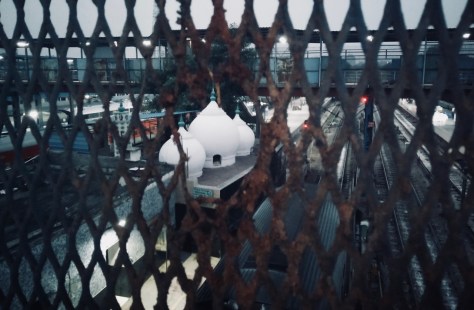
The Masjid at the Taj Mahal, Agra. (C) 2017 Pippa Virdee
By Maaz Bin Bilal
I want to tell them frankly that mere declarations of loyalty to the Indian Union will not help them at this critical juncture. They must give practical proof of their declarations.
— You Cannot Ride Two Horses (Speech by Sardar Patel on 6 January 1948, in Lucknow)
I
Why did you sell your house now, O Khadim?
As hereditary guard of the Taj Mahal, must you not be prim
and proper, when for Pakistan has left,
all your family, most of your kin?
II
There are four reasons for the sale, Sahib:
I owed debts, and I have daughters to be married,
The refugees living in my house misused it,
My sons have gone, I need money, for when I die, to be buried.
III
Tut, tut, I am sorry, I am not convinced,
Why now? Never before you felt pinched?
Go fetch positive proof of your faith, in a month,
else lose your job, we believe in your guilt.
IV
Here, Sir, I have brought back from Lahore,
my two single daughters, orphaned grandchildren—four.
The rest won’t come, they fear their old neighbours,
Sadly, I came to know that the young forgotten heroine of the independence movement passed away at the weekend. I interviewed Fatima Sughra in 2009 and only came across her by accident. Below is an extract from the amazing interview with her and sadly many Pakistanis are not even aware her or that she quietly lived in Johar Town, Lahore. At the age of 14 she became involved in local processions/protests being organized by the women working for the All-India Muslim League. Inspired by what was going on Fatima joined them and recalls one eventful day:
I was studying in 9th class. Fatima Begum was very active worker of the Muslim League. She worked with Quaid-i-Azam. She established the imposing Jinnah Islamia College on Multan Road, Lahore. Quaid-i-Azam inaugurated this college. There were usually meetings of the Muslim League in her house. She was sister-in-law of one of my aunty. I often visited my auntie’s house and at the time could not understand what was happening…I only thought that the Muslim League is our party, a party of the Muslims.
I was born in 1931; our house was between Mochi Gate and Shah Alam Gate Lahore. I was 14 and half year old that time and studying in 9th class. In those days, there was a disobedient movement against the Khizr Government and the Muslim League leadership made regular protests and processions in the streets. I read Zamindar newspaper and came to know that Begum Shahnawaz, Begum Salma Tassaduq Hussain, Begum Jalandhri and Fatima Begum were arrested in Lahore. I asked for permission from my father to participate in the processions; finally he allowed me. I along with my friends reached the Assembly Hall that day. I saw at that time a big crowd was shouting and chanting slogans: ‘(Zindabad) Long live Muslim League; long live Qauid-i-Azam; Pakistan will be created whatever it cost to the Muslims (bun kay ray ga Pakistan).
I think it was in February or March 1947. Daily processions were arranged and we took processions to the Radio station, at Mall Road, Jail Road, High Court and Civil Secretariat. We took the procession to the inner city. Hindus laughed at us. I remember the day I took off the Union Jack and replaced it with hoisting a [makeshift] Muslim League flag. Many Muslim women, (who had never stepped out from their house before) came out from their houses and took over the street of the city. This was happening all over because the Begums [elite Muslim League Women leadership] went door to door and convinced the Muslim women to come out from their homes for the protests. I do know what sort of passion was inside me at time; I just jumped over the Secretariat Gate.
There was a girl who was very tall…. I think her name was Begum Aslam. I put my foot on her shoulder and reached at the top of the Secretariat building Lahore. I did not know even, I pulled out the doori (thread) and flag…That day Begum Hadiat Ullah was leading the procession she said to me: ‘are you alright? I shouted, yes, I am alright’. The crowds were shouting slogans. I became very emotional and replaced the Union Jack with the Muslim League flag. Afterwards the Police arrived there; some boys escorted me and helped to get down from the stairs. The police sprayed heavy tear gas and used lati charge over the crowd. I rented a tonga and paid 4 anna and reached home safely. At home I told my mother about hoisting of Muslim League flag……she replied: ‘ok, I know you are doing such things every day’. At our house the daily Zamindar used to come every day and there was big news in the next day’s issue: Fatima Fada Hussian took off the Union Jack and hoisted the Muslim League flag. My father kissed me when I was sleeping because of this act. My father was very proud on me and said to me ‘my daughter I’m proud of you, you have done a big task’. That day I did break my fasting and again went to join the street processions. Begum Sikandar Hayat, Zahida Hayat, Asmat Hayat and Shamim were with me. They had been released from jail. We brought them in the Nasar Bagh in a procession. There was a big gathering and all Begums delivered very stimulating speeches. They called me on the stage and put a har of fruits around my neck. My friend ate most of the fruits and remaining part I showed to mum when I went home. [Laughing]
My father was a well-reputed person in our mohalla and people of the mohalla asked him many things about us. In those days, the people were very good and they cared about other people of mohalla. Now-a-days nobody cared about anything.
I had little interest in politics. I just went to join the processions for enjoyment. I thought that Muslim League represented the Muslims and Quaid-i-Azam was their leader and struggling for the creation a Muslim country. When I hoisted the Muslim League flag in the Secretariat building, many people came to my house to congratulate me and my family. I became a renowned girl.
I got certificate and gold medal. In 1987, Pakistan Government arranged a similar sort of the 1947 flag hoisting occurrence in the Lahore Secretariat building. I did perform and climbed at the Secretariat building even in this old age.
This was an extract from an interview conducted with Fatima Sughra in her house in Johar Town, 2009.
In an unassuming side street of an old residential area in Sonipat is a hidden gem and remnant of the past. Durga Mandir of Mohalla Kalan in Sonipat is still popularly known as Badi Masjid (big/greater Mosque). The latter should give an insight into the former life of this Mandir, which once was a Masjid. Even today looking at the exterior of this mandir it could quite easily be confused for a masjid. It stands tall and looks grand in the red stone façade with a courtyard for Friday prayers which probably attracted many of the local Muslims in pre-partitioned Punjab. Apart from the obvious changes of installing flags and idols, the three main domes and minarets are easily identifiable with that of a small Juma masjid.
Like many other places of East Punjab, the Muslims of Sonipat migrated to Pakistan, leaving behind their homes and places of worship. These were quickly claimed by the incoming Hindus and Sikhs. Muslims were often the second largest group in these areas. For example, Muslims were significantly present in cities like Hissar (28%), Gurgaon (34%), Karnal (32%) and Ambala (32%) Rohtak (17%); all of these are part of present-day Haryana State. Most of the Muslims abandoned their homes in the ensuing violence of August 1947 and fled to Pakistan. Similarly, in Pakistan, many of the old abandoned religious (Gurdwaras and mandirs) buildings were converted/neglected by the incoming populations to be utilised for their own purposes. See link below for more about this.
In this case, the masjid has been converted into a Durga Mandir, a temple for worshiping Goddess Durga. It is now known as ‘Sri Sanatan Dharm Sabha Panji Durga Mandir.’ The Goddess Durga assumes the central position in the mandir and is surrounded by other deities; outside in the courtyard is an encased idol of Baba Sai. The dome interior has recently been filled to mask the obvious Islamic style architecture but the exterior remains as before. The link below provides further information on the Badi Masjid but more interesting are the photos. The short article was posted in October 2015, and the pictures shared are quite different from when I went to visit the site recently. The interior now has been changed to hide all signs of its former existence as a masjid. The pictures from 2015 show the perfect domes and remnants of frescoes and tiling from before. The fact that much of the interior has been transformed in the past two years is telling of the Hindutva agenda prevailing in the region.
Sonipat in August 1947 was a small city in united Punjab, then it became a city in East Punjab and eventually a part of Haryana after the reorganisation of East Punjab in 1966. There is little in the history books about the intervening years before it became part of Haryana, yet a lot has changed in this area. Looking at Sonipat today, it is difficult to tell that this historic city was once communally diverse with Punjabi Hindus, Sikhs, Muslims and Christians. Today it feels very much like a Hindu city. Perhaps the latter is more of a reflection of the current climate in India. But hidden away are these old structures that remind us of a different time and a different history.
Now that the euphoria over independence day “celebrations” and remembering partition are over, it is worthwhile remembering that it was in fact today, 70 years ago, that the Radcliffe Line was made public. Millions of people woke up on 15 August not knowing which side of border they would be on, today their fate was sealed. Sitting in Delhi on this day, having seen the way both Pakistan and India remember 14/15 August 1947, it is a stark reminder of how chaotic this process must have been.
The month of August in the sub-continent is when the monsoon rains gush down intermittently. The heavy rains leave places incapacitated due to the deluge that falls. Even today, where there is improved drainage, the monsoon rains have the capacity to bring towns and cities to a standstill. So, thinking about this back in August 1947, it is staggering to think that the last Viceroy, Louis Mountbatten, decided that 15 August would be the date for independence. The date was chosen because it coincided with the date when Japan surrendered after it was devastated by the nuclear bombs in Hiroshima and Nagasaki. Mountbatten was clearly sentimental about the date because he was Supreme Allied Commander of South-East Asia when Japan surrendered. But he also failed to show any foresight when it came to the sub-continent. All the leaders failed to anticipate that millions of people would be engulfed by violence and thus forced to flee and that too in the difficult month of August. This only added further to their misery and fuelled diseases in refugee camps. It must be kept in mind that the violence that was unleashed in August 1947 was not an isolated incident, it was a culmination and continuation of previous episodes of horrific communal/political violence in which many lost their lives and were displaced. It was thus not entirely unexpected, nor was it just spontaneous.
The British media (TV, Radio and Print) has decided to cover partition/independence extensively and interestingly for this decennial anniversary they have been giving full coverage to the voices of ordinary people. The BBC has had a full season of programmes (one of which I contributed to) devoted to India and Pakistan at 70. I have personally spent the last sixteen years working on partition and its wider impact on the Punjab region, so the ordinary voices are not new to me. In fact, this trend in scholarship has been evolving and growing for the past twenty years. What is sobering is how the coverage has differed in India, Pakistan and the UK. I can only speak about these three because I know them well and they were of course at the epicentre of this.
While there is still a huge gap in our understanding of empire and its consequences, these programmes are important in reaching out to ordinary citizens, to educate, to inform, to illuminate the travesty of empire and its end. They also serve as important markers of remembering, but that alone is not enough. Which is why being in India/Pakistan during the days of August has been important. It highlights the disparity between the diaspora and those who live here. Capturing and sharing the narratives of survivors is important but from an academic perspective, what do these voices mean, what do they tell us, why are they still relevant? The memorialisation of this memory and how it tells this story is also significant. There is little worth in collecting hundreds and thousands of accounts by survivors if this is not contextualised or critically framed in the existing historiography. A simple account of someone’s life and their experiences is important but what about beyond that? What lessons can we take from this?
And our politicians are still in the business of selling a myth of a glorious past and a dream for the future. It is that future which needs to be critically examined in relation to the previous seventy years. Pakistan today seems fragile as ever but (and more importantly its people) it is a resilient country. For the best part of the last seventy years Pakistan has been swinging between military dictatorship and democratic rule, while India, largely a democracy, has been busy playing and expanding upon the Hindutva card. A future in which we see a further entrenchment of Islamic Pakistan and Hindu India is entirely possible and while not a recent development, it does need to be contextualised firstly in colonial history and secondly in the how the developments of the past seventy years led to this. Of concern for everyone should be that in this vision to be exclusively majoritarian, both India and Pakistan would lose an asset: its significant minorities. The diversity in all its richness is what makes these countries vibrant and valuable, they should be celebrated rather than suppressed and targeted. And so, seventy years on, while we remember the people who suffered in the great partition, let us not forget that there a battle going on today for the hearts and minds of people. Which is why it is seemingly more poignant being here in the sub-continent at this moment because it is a reminder of the unfinished business of azaadi beyond empire.
In the midst of the monsoon of August 1947, British India ceased to be and gave way to two independent nations. The logic of this Partition being religious and regional, the older and larger India was reinforced as a Hindu majoritarian society, while the newer and smaller Pakistan emerged as an Islamic country. No Partitions are total and absolute but this one was especially terrible and ambiguous and left a little less-or-more than 20% religious minority population on both sides. Moreover, it created two wings of Pakistan with a hostile Indian body-politic in the midst.
This event was not entirely of sub-continental making. The British Empire in Asia had begun to crack at the hands of the Japanese army during World War Two, most spectacularly with the fall of Singapore in February 1942, and crumbled in South Asia afterwards. Along with India and Pakistan, the-then Burma and Ceylon (both 1948) too emerged independent at this time. All this was to bring about many changes, both internally in India and internationally. Europe, the ravaged battlefield of the World Wars, ceased to be the centre of the Western world, with political and economic power shifting decisively to the former Soviet Union and the United States, representing two contrasting and conflicting ideological visions for the post-1945 world.
The end of the British rule in South Asia happened alongside the emergence of this conflict, christened the Cold War. The road to freedom and partition of India and creation of Pakistan was a long one and accompanied with fundamental social, economic and political changes. From the mutiny of 1857 from Calcutta to Delhi to the massacre of 1919 in Jallianwala Bagh, Amritsar, from the formation of the Indian National Congress in 1885 to the establishment of the All-India Muslim League in 1906, from fighting for King and country in two World Wars to seeking self-rule in the inter-war years, and, from the development of an elaborate civil and military bureaucratic and infrastructural apparatus and a space for provincial politics, all these were to completely transform Indian society.
 This week Coventry successfully won the bid to be the city of culture in 2021. Subsequently, there have been numerous articles about Coventry in the media, reflecting both the history and lived experiences of the city. The response has also been mixed in the sense that some people have continued to dwell on the lack of culture and “beauty” in the city, and in part this is true. The more optimistic see this as an opportunity to revive the glorious past with renewed energy.


 BAGICHA