Earlier in the summer I recorded a podcast with Realms of Memory. There are two episodes for those interested in understanding more about the history of Partition, especially how it impacted the Punjab. The talk was based on my book, ‘From the Ashes of 1947: Reimagining Partition’ published by Cambridge University Press (2018). In the podcast I also discuss some of the recent changes that have taken place in the study in Partition.
You can listen to the podcast via most streaming sites, or via Realms of Memory
Punjabi Khoj Garh is a centre of research, publication and advocacy on the history, culture, literature, music, and art of the Punjab. It was established on 10 March 2001 and Iqbal Qaiser, an independent scholar, has tirelessly built up this institute over the past 20 years. It is maintained by the Punjabi Khoj Garh Trust and individuals who work voluntarily to maintain and upkeep the Centre. They welcome all sorts of researchers with facilities and materials for their work on Punjab.
For further details contact: Iqbal Qaiser, Punjabi Khoj Garh, Lalliyani (Musfafar Abad), District Kasur, Pakistan. Follow them on Facebook.
Saadat Hasan Manto (1912–1955), one of the greatest storytellers of the 20th century that South Asia has produced. Writing mainly in the Urdu language, he produced 22 collections of short stories, a novel, five series of radio plays, three collections of essays and two collections of personal sketches. His best short stories are held in high […]
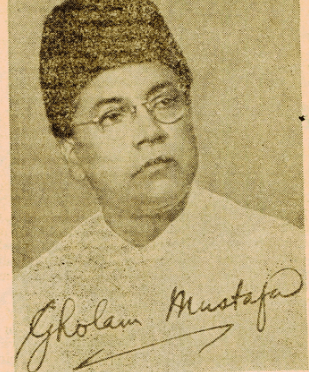
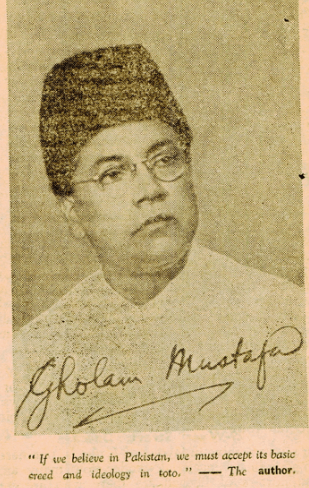
Picture taken from ‘The Battle for Pakistan’ pamphlet
I recently came across Golam Mostofa and his rather state-centric as opposed to peoples-oriented 20-page pamphlet on The Battle for Pakistan, which examines the entangled questions of state-language and the basis of Pakistan. Mostofa was the secretary of the East Bengal Government’s Language Reform Committee, while being a strong proponent of the two-nation theory and an advocate for Urdu as the national language for Pakistan.
As the ideological imagination, and its linguistic articulation, in early-Pakistan was taking shape, Firoz Khan Noon (Governor of East Pakistan) had his vision of converting Bengalis into Urdu speakers by using religion to play on their sentiments (Jalal 2014, 87). Urdu was deemed the only language that could strengthen national unity over ethnic groups. Noon commissioned various argumentative material to this end, including Mostofa’s pamphlet that presented a case for adopting Urdu in East Pakistan. Below are some extracts from the pamphlet, which was published c. 1952.
The Ideology of Pakistan
An unwarranted bitterness has been created over the question, of whether Urdu or Bengali should be the State-language of Pakistan. This sort of domestic quarrel at this nascent stage of Pakistan is really very sad…Long before the announcement of the Quaid-i-Azam, I said at a public meeting in Dacca that Urdu should be the State-language of Pakistan, though, of course, Bengali should not be discarded. The following extract from the report of the Hindustan Standard will bear me out:
“Poet Gholam Mustafa said that those who wanted to make Bengali as the State-language of Pakistan were looking at a narrow angle of geographical limits; but if they consider Pakistan as a dynamic unifying force in the world, they could not brush aside Urdu. He was inclined to the view that Bengali language was responsible for the decline of the Bengali Muslims as that language reflects the idea of non-Muslims”. (12-11-1947)
Significance of State-Language
The very expression “State-language” pre-supposes the existence of a State. The State-language of a State should therefore be that language by which the interests of the State can be served best. [emphasized in original] …The question of the safety and integrity of the State therefore comes first in determining a State-language. If we quarrel amongst ourselves over this issue and the ‘State’ disappears as a result thereof, what shall we do with the ‘language’ left behind? Language is a means to an end, not an end in itself. When the British conquered this country, they made English the State-language, not for our convenience, but for the interests and ideals of their State. The same principle will apply equally to Pakistan.
Our Problems
The argument of those who say that Bengali should be the State-language of Pakistan because of the numerical superiority of the Bengali Muslims has no leg to stand upon. Had numerical strength been the only determining factor in solving national problems like this, surely, we could not get Pakistan in India, as the Hindus commanded an overwhelming majority over us…Ideals cannot be judged by votes alone.
Pakistan is one State. It is, as it were, a bouquet of five flowers, none of which can be separate from the others. There is no such thing as Eastern Pakistan and Western Pakistan…The different provinces are to the Pakistan State what the limbs are to the body. If the limbs fall out and do not co-operate with one another, the body cannot exist…Pakistan is still beset with various dangers and difficulties…If Bengali and Urdu are both given the status of two State-languages, one for the East, the other for the West, it will only serve the purpose of the enemies. It will give rise to narrow provincialism among us, culminating in the ultimate separation between the two wings.
The demand for Bengali as the State-language of Pakistan therefore signified the triumph of Hindu culture and, as such, is in itself a strong symptom for the intravenous injection of Urdu in the cultural life of the Bengali Muslims. It is really very amazing that the Bengali Muslims are unwilling to accept Urdu for fear of Punjabi domination, but are quite agree- able to be slaves of Bengali culture which is dominated by the Hindus.
On analysis, it will be found that the ‘Bengali for Bengal’ movement owes its origin to the borrowed idea of nationalism. Bengali Muslims are a separate unit having distinct culture of their own – this territorial patriotism has prompted the agitators to go in for Bengali. But they do not perhaps know that there is no such nationalism in Islam. Islam is preacher of internationalism or extra-territorialism.
Conclusion
We have got Pakistan. But real Pakistan is still far away…It is a thorny path and, as such, we have got to sacrifice much before we reach our goal. We must not be satisfied with our geographical Pakistan. Pakistan is an ideal…Islam is appearing in a new historic role and Pakistan will be the stage board of that great episode. For that ultimate goal, the entire Muslim World should first of all unite under one banner. Egypt, Arabia, Iran, Syria, Afghanistan, Pakistan, Indonesia: all the Muslim States of the world are therefore combining together to form a “Sixth Continent”. Will the Muslims of East Pakistan lag behind?
Following biographical details are provided on Wikipedia: Golam Mostofa (1897 – 13 October 1964): “Mostofa started teaching at Barakpore Government School in 1920. He retired as headmaster of Faridpur Zila School in 1949…His book Biswanabi (1942), a biography based on the life of the Prophet Muhammad, provided him with recognition.”
Other references
Jalal, Ayesha. The Struggle for Pakistan. Harvard University Press, 2014.
Firoz Khan Noon (left), Governor, East Bengal (31 March 1950 – 31 March 1953) to Al-Haj Khwaja Nazimuddin (right), Prime Minister of Pakistan (17 October 1951 – 17 April 1953), 28 February 1952
When Pakistan was created in August 1947, it was made up of two wings, East and West. In 1951, when its first census took place, the combined population of both wings was 76 million; 34 million in West and 42 million in East. The Bengalis made up the majority of the population of East and this made Bengali/Bangla the language spoken by the numerical majority of Pakistan. But Urdu was seen as the national language, while being the mother tongue of barely 5 per cent of the population then. However, it was more than a language; it was attached to the very core of the Pakistan Movement as the Quaid-i-Azam Mohd. Ali Jinnah declared in Dacca (Dhaka) in 1948. Yet, soon thereafter, the fractures and fissures between the two wings began to open up, due to the discriminatory and step-brotherly treatment of the East Pakistanis; not just in the language sphere.
By 1952, there were large-scale demonstrations and unrest centred around the University of Dhaka and on 21 February 1952, these ended in violence, in which the police clamped down on the protestors resulting in numerous casualties. Since 2000, the United Nations has observed 21 February as the International Mother Language Day. Bengali/Bangla was eventually recognised as an official language of Pakistan (alongside Urdu) in article 214(1), when the first constitution of Pakistan was enacted on 29 February 1956. Longer term though, this parity in the Constitution failed to address the underpinning problems and East Pakistan eventually became Bangladesh following the civil war of 1971.
The letter below, sent a week after these protests, from Malik Firoz Khan Noon, a prominent landowning Punjabi and future PM (1957-58) of Pakistan, then-Governor, East Bengal Governor to Sir Khwaja Nazimuddin, an aristocrat Bengali and Jinnah’s successor as Governor-General (1948-51) of Pakistan, then-PM (1951-53), shows the failure to recognise the legitimate grievances of the language movement.
Noon to Nazimuddin, 28 February 1952
The Vice-Chancellor and other members of the Executive Committee have closed the University. Some students are leaving: others will try to hang on in Dacca. Out in the districts no untoward incidents have taken place except this that students have been trying to make themselves a nuisance at railway stations and in the cities, and the papers who write explaining true facts are not allowed by the students to be distributed by the hawkers in the district headquarter towns. The Government are now planning to drop pamphlets from the air throughout the province. I do not think that the Muslim League Ministers or other leaders can go out into the province as yet for three or four weeks to explain their point of view, but our propaganda has been very weak: almost non-existent. The Government point of view has not had the chance to go before the public yet.
I feel that both in Western Pakistan and in East Pakistan our propaganda machine should be put into full force and the true situation exposed to the public, viz. that this was a conspiracy between the communists and some of the caste Hindus of Calcutta, and certain political elements in East Pakistan who wanted to replace the Ministry: the students were made the cat’s paw. Their idea was to set up a puppet Ministry here, with Fazlul Huq as the Chief Minister, and then negotiations were to start for the unification of the two Bengals. I feel that it is most important that this true position must be exposed to the public who should realise the danger that we still continue to face in this province. The language question was only a subterfuge very cleverly exploited. In this province we are doing what we can to put forth our point of view, and Mr Fazl-i-Karim – Education Secretary – who has just returned from abroad has been asked to take charge of this work.
The second point to which I should like to draw your attention is that during the coming session of the Central Legislature, this Bengali language question must be settled once for all, and I do not think that you can get out of it without accepting Bengali as one of the state languages, but it must be Bengali written in the Arabic script. The sooner this resolution is passed the sooner will this controversy be settled. I have no doubt that the Hindus will create trouble about the script, but no Muslim will be able to raise his voice against the Arabic script, because in this way we shall have all the Provincial languages written in the same Arabic script, and this is most essential from the national point of view. I am told that during the time of Shaista Khan, Bengali was written in the Arabic script: there are some books in the museum here written in that script. If Bengali were written in the Arabic script – 85 % of the words being common between Urdu and Arabic if properly pronounced soon a new and richer language will emerge which may be called ‘Pakistani’. But something has to be done in this matter. We cannot let matters adrift.
The Arabic script will be the biggest disappointment to the Hindus who have been at the bottom of it, and that is the real crux of the whole question. The Jamiat ul Ulama-i-Islam in this province under the presidency of Pir Sahib of Sarsina and Secretary-ship of Maulana Raghib Asan have already passed a resolution demanding the writing of Bengali in the Arabic script, and no Muslim M.L.A. – either in Karachi or here – will be able to oppose the Arabic script. As a matter of fact, the Muslim League Party here last year went to the extent of passing a resolution saying that Arabic should be the national language of Pakistan. The object really was to do away with Urdu, but it is certainly a point which may be used by you in your speech, if necessary. The Aga Khan has written a very good pamphlet on this subject. It was going to be published but unfortunately it has been burnt with the Jubilee Press. The Aga Khan has promised his followers to be provided with a revised copy and I will try and let you have one as soon as it becomes available.
One of the main points the Aga Khan brought out was this that Persia changed their script from the old Pehlvi script into the Arabic script and in that way their literature became richer than ever, and by changing the script the Persian language did not lose anything nor would the Bengali language. He also tried and impressed that by enforcing the Arabic script the Bengali literature will be available to all other Muslim countries who will be able to appreciate the work of the Bengali authors. Similarly, the literature of all other Muslim countries will be open to Bengali Musalmans who know the Arabic script. He also pointed out in his pamphlet that every Musalman has to learn Arabic in any case because the boys and girls must read the holy Quran, and if they are conversant with the Arabic script why should this Dev Nagri script be thrust on them unnecessarily. It will be conceded on all hands that if in the schools in East Bengal boys and parents were given the option for children to learn Bengali either in the Arabic script or in the Dev Nagri script, they would all choose the Arabic script.
Quite a large amount of money is being earned by Calcutta Hindu authors who have the monopoly of all our school text books and it is they who are spending money in support of the Bengali language and would even spend money in support of the Dev Nagri Script. It should not be forgotten that people in West Bengal themselves have not asked for Bengali language to be accepted as a State language in Bharat: they have accepted Hindi as their national language.
S.M. Shamsul Alam (1991) ‘Language as political articulation: East Bengal in 1952’, Journal of Contemporary Asia, 21:4, 469-487, DOI: 10.1080/00472339180000311
Introduction In 19th-century colonial India, language was more than a tool for communication. It was also a marker of identity for communities. While language helped reshape identities in the colonial backdrop, languages themselves were also influenced by policies and practices. Given the diversity of languages and their varying functionality in a place like India, the […]
Gupta, Jyotirindra Das, and Jyotirindra Dasgupta. Language conflict and national development: Group politics and national language policy in India. Univ of California Press, First published 1970. PP.46-7
Gupta, Jyotirindra Das, and Jyotirindra Dasgupta. Language conflict and national development: Group politics and national language policy in India. Univ of California Press, First published 1970. PP.46-7
Swaran Singh (Civil Lines, Jullundur City) to Sardar Baldev Singh, 6 March 1951 (Nehru Papers post-47 file 75)
“A very serious situation has arisen in Jullundur district over the language controversy. You must be already aware of the propaganda which was carried on by a certain class of Hindus for persuading the Harijan classes to state at the time of census that Hindi was their mother tongue. Partly as a result of this propaganda and partly on account of the predominance of Hindus amongst the enumerators, a very large section of Harijan population has been recorded as Hindi-speaking population…Illiterate Harijans in the villages who cannot speak or understand even one word of Hindi have been recorded as Hindi-speaking individuals. This has naturally caused resentment in the minds of the Sikhs and they have in a quiet and peaceful manner told the Harijans that the latter have nothing to do with them and a state of peaceful boycott prevails in a fairly large number of villages…The Hindu communalists nakedly in some cases and under the grab of Congress and nationalism in other cases, have fully exploited this situation. They have instigated the Harijans to pick up some quarrel or the other and thus to afford a pretext to the police to make arrests. During the last 3-4 days over 100 persons have already been arrested from villages situated in the different tehsils of the district. Of the arrested persons, about 30-40 so far are the Harijans and the remaining persons are Sikhs, mostly Jats. The action is taken for breach of peace and bails are purposely delayed in order to demoralize the rural people…I had a long talk with [Chief Minister] Dr. Gopi Chand who was on tour at Jullundur yesterday, but as usual he is extremely indecisive. [Some] MLAs are doing their worst to instigate the Harijans and are poisoning the ears of the local officers. Lala Jagat Narain [future founder/editor of Punjab Kesari] has been particularly poisonous in his writings. A very serious situation prevails, and I won’t be surprised if the province is hurled into chaos and if serious effort is not made to straighten out this matter…The self-styled leaders, the press and the local officers should be made to realize that they are playing with fire and the consequence can be extremely disastrous”.
PV Bhaskaran (Deputy Director – Intelligence Bureau) to HVR Iengar (Ministry of Home Affairs), VP Menon (Ministry of States) & Dharma Vira (Pr. PS to PM), 15 March 1951 (Nehru Papers post-47 file 75)
“The bitter animosity which has been witnessed in Punjab and the PEPSU between the Sikhs and the Hindus over the Punjabi-Hindi language controversy in the census has had unpleasant repercussions for the Harijans in many centres of these two states. There have been several complaints of the coercion [arson] and economic boycott [departure] of the Harijans of the PEPSU by the Sikhs, [across villages] in Kapurthala and Patiala district(s). Security proceedings have had to be commenced against Harijans and Sikh Jats…
A deputation of Hindus and Harijans of [some] villages of Kapurthala district, waited on the District Commissioner with complaints of oppression, but were reported to have been told that they had themselves invited this trouble by furnishing Hindi as their language, while living in a Punjabi-speaking area…of Sikh Zamindars. Some of them complained that Akali workers had forcibly obtained their thumb impressions on applications, which sought to have their language changed from Hindi to Punjabi. Some harassment of Harijan women has also been mentioned, [amidst] reported, [en]forced [departures]…Some Harijans, apparently acting under intimidation, actually applied to the DC to alter their language from Hindi to Punjabi in the census returns. In Sangrur district, the Harijans are reported to have been boycotted by the Sikh Zamindars, with the result that they had to march long distance to the town to fetch their food-grains and other daily necessities of life. The districts of Bhatinda and Fatehgarh Saheb were the [other] areas from which such trouble has been reported [with] Harijans of rural areas reported to have moved to town for safety.
In Punjab, Jullundur district has been the worst affected. 98 Jat Sikhs and 45 Harijans have been arrested in this district. A Harijan was murdered by Jat Sikhs…on February 28. Some of the houses of the Harijans who furnished Hindi as their language were reported to have been set on fire…It is reported that the Harijans of these areas have refused to remove the dead bodies of the animals belonging to the Sikhs, and that the latter have boycotted them…Similar complaints have also been made against the Sikhs by the Hindus and the Harijans of some centres of Gurdaspur district…Hoshiarpur and Ferozepur district have also been scenes of similar communal trouble.
The PEPSU Achhut Federation has protested strongly against the “unprovoked high-handedness and injustice” done to Harijans during the census and has demanded their immediate resettlement in their own villages. [There was] a well-attended conference of the depressed classes’ league at Patiala on March 4. A resolution was then accepted, urging the central government to order an independent enquiry on the high-handedness of the Sikhs and the maltreatment of the Harijans of Punjab and the PEPSU in the course of the census operations. [A] speaker warned that the Harijans could cause havoc by staging a week’s hartal of sweepers. [Another] warned the Sikhs not to poison the atmosphere with the language controversy.
The Harijan Sabha of Amritsar convened a meeting on March 6 and warned the Harijans to beware of the tactics of both the Hindus and the Sikhs, and to remain aloof as a separate group. The government was also requested to take the necessary action against the aggressors, failing which, it was warned that a movement of satyagraha would be commenced by refusing to do scavenging and other menial services. The Sweepers Federation of Simla also held a meeting, to deplore the communal tension created by the census operations due to the coercion of the Sikhs. One of the speakers…threatened a strike of sweepers. Resolutions were adopted protesting against the victimisation of the Harijans and demanding the appointment of an enquiry committee consisting of officials drafted from other states.
A refugee camp has been set up at Amritsar by the Hindu Mahasabha and the RSSS, with the assistance of the local Scheduled Castes Federation, to shelter the Harijans who have been migrating from rural areas…There are now only 25 inmates in this camp, but about 245 other Harijans are in shelter in the town with the help of local Hindu hide merchants…This situation was mentioned by NC Chatterjee of the Hindu Mahasabha, at a public meeting at Amritsar on March 11, when he said that the social boycott of the Harijans of Punjab would lead to civil war and anarchy. [A] Punjab Hindu Mahasabha [speaker] advised the Sikhs to stop their oppression of the Harijans in rural areas, warning them that the Sikhs might similarly be victimised in other states of India where they were n a minority.
As is well-known, Master Tara Singh and other leaders of the Shiromani Akali Dal have been bitterly critical of the Hindus and their action in recording Hindi as their language in the census…[Their] visit in Patiala, in the last week of February, gave rise to rumours of impending communal disturbances…Several refugees are reported to have left…Unless firm measures are taken both at official and non-official levels, there may be the danger of the situation getting out of hand”.
Further reading: Singh, Atamjit. “The Language Divide in Punjab.” South Asian Graduate Research Journal 4, no. 1 (1997). Available via Apna.org
When Faiz passed away at the age of 73, Dawn described him as:
The greatest Urdu poet of his time, Faiz became a legend in his lifetime for his intrepid struggle against what he himself once described as “the dark and dastardly superstitions of centuries untold”. He understood the agony of the dispossessed and the disinherited and he sang of them and for them to the last.
While these songs and poems need no introduction, he also wrote enduring prose. On his 35th death anniversary, pasted below are some selections:
‘The Role of the Artist’, Ravi (Lahore) 1982:
‘Who are we – we the writer, poets and artists and what can we contribute, if anything, to avert the moral calamities threatening mankind? We are the offspring, in the direct line of descent of the magicians and the sorcerers and music makers of old…They found for the hopes and fears of their people, for their dreams and longings, words and music that the people could not find for themselves. And by blending their collective will to a desired end, they would sometime make the dream come true…In our part of the world through long centuries…the magician of old became the post-mystic or the mystic poet, the forerunner of the modern humanist, who defied both emperor and priest to articulate the ills and afflictions of his fellow beings, to expose the injustices of their masters and their master’s collaborators, who taught them to believe in, and fight for, justice, beauty, goodness and truth, irrespective of personal loss and gain…So that is who we are, inheritors of this magic…And never was the power of this magic more devoutly to be wished than in the world of today when so many powerful agencies are at work to deny the validity of all ethical human values, to obliterate all refinements of human feeling…by extolling cynicism, insensitivity and brutishness as the hallmark of a he-man and a she-woman…’
Source: Coming Back Home: Selected Articles, Editorials and Interviews of Faiz Ahmed Faiz, compiled by Sheema Majeed, introduction by Khalid Hasan, Karachi: OUP, 2008, pp. 40-1.
‘The Writer’s Choice’:
‘Literature like science is a social activity…Literature unfolds in a similar fashion…the unexplored or dimly lit complexities of social reality, the given human situation of a given time. The impact…however, more insidious, more subtle and at the same time more direct…. The writer is directly manipulative and formative of the consciousness of the audience…He cannot plead, therefore, that he is unaware of, or unconcerned with, social implications…A writer may be tempted, coerced or bribed [by] vested interests to ignore, emasculate, or pervert the basic realities of social existence under various specious pretences, ‘pure’ literature, art for art’s sake, ‘pure’ entertainment etc., a mechanistic repudiation of these ‘purities’, however, poses another danger. In creative writing to ignore the demands and essentials of artistic creation can be inexcusable, although perhaps not as reprehensible, as the moral and social imperatives of reality. It is but another form of escapism…There is still considerable confusion in most African and Asian countries regarding the function of literature, the role of the writer and the modalities of literary expression. This confusion is partly a legacy of the colonial past, partly a recent import as a product of neo-colonialism…Whatever his social status, his intellect and education will automatically place him in the ranks of the elite minority…He will be called upon to make a choice of his audience – to write for his own class or to transcend the class barriers…’
Source: Coming Back Home: Selected Articles, Editorials and Interviews of Faiz Ahmed Faiz, compiled by Sheema Majeed, introduction by Khalid Hasan, Karachi: OUP, 2008, pp. 43-4.
‘Decolonizing Literature’:
‘When the process of colonial occupation got underway in Asia and Africa the literature and languages of the subject peoples were among the first victims of foreign cultural aggression. Its impact hit different communities in different ways depending on their level of social and cultural development, thus confronting each one of them with a different set of dilemmas in their quest for identity after liberation…(1) The study of Asian and African literatures should be incorporated in the relevant schemes of higher learning…Even language teaching in European languages need no longer be confined to European authors. (2) …publication and marketing of important Afro-Asian writings in still the monopoly of a few Western publishing houses…such publications are only marginal to their main business interests…The high cost of Western publications is another inhibiting factor…Efforts are needed for a re-orientation of the publication trade in Asian and African countries. (3) For many Asian and African writers, ‘international recognition’ still means some notice by the Western media. Some of them are thus induced to set their sights while writing on Western rather than their national readership…There are enough nations in Asia and Africa to make any writer ‘international’ without any Western certification…This needs some rectification not only in the outlook of the writer, but also of his readers’.
Source: Coming Back Home: Selected Articles, Editorials and Interviews of Faiz Ahmed Faiz, compiled by Sheema Majeed, introduction by Khalid Hasan, Karachi: OUP, 2008, pp. 49-52.




 BAGICHA