Tag Archives: history

“The image, the imagined, the imaginary”

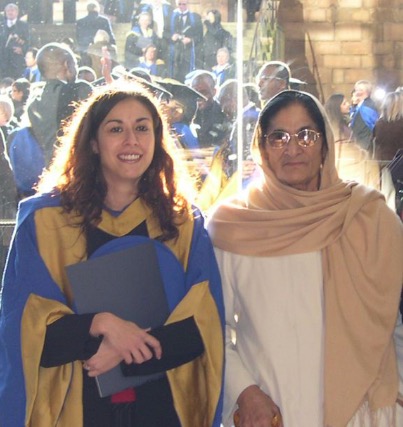
It is coming to 11 years since my mother died at the age of 83. She had great courage and conviction, illustrated in her decision to come to far-off England – and not go to the familiar India – from Kenya, a few years after my father’s untimely death in 1979. In doing so, with two young children, she was adding considerably to the challenges that she had faced hitherto. Alone, in an alien land, with two growing daughters, she drew upon her inner reserves of strength to provide for us. Moreover, what I do today is down to her encouragement and support throughout my life.

This was not always an easy position for her to take because of wider socio-economic pressures, but she saw education as the master-key to unlock many of these. As her youngest child, I was fortunate to be the first to go to university, for my sisters – we were all girls – were capable of more. She would have preferred that I study something “sensible” like law, medicine, finance, or engineering – like my father – but I showed no interest in these. Instead, I was motivated by art and politics as in 1988-90, an increasingly unequal Britain saw a churn and I was intrigued as Margaret Thatcher was losing her grip.

Studying politics and increasingly history was an unusual and therefore difficult step for me, but despite the misgivings, my mother – open to persuasion – supported me. She didn’t always understand my aims, for that matter nor did I, but instinctively it felt the right thing to pursue. I became increasingly aware of my social identity in university – beyond the name-calling in school – because I was one of only two “brown” girls in a cohort of approx. 70. But the rest of the group too came from different backgrounds, especially that of economic class. This introduction to class was a life-lesson in terms of one’s ability to aspire and imagine.

Thirty years on from when I entered university, this social reality has not changed. Rather it has only metamorphosed, and I now see class difference at play in the post-1992 university that I teach, among the students whom I encounter. Sure, the absolute number of black/brown students coming to study history and politics has increased albeit marginally. Anyhow, this post is not on this social phenomenon but the persona that my mother was, who encouraged me to follow my heart. In those days, it was enough, for the state supported education; there were no student fees, and I was eligible for a maintenance grant.

Otherwise, a mother’s goodwill alone would not have paid for my loan-laced BA/MA, which would have been too big a risk to take. I would not have then followed it up by applying for the Penderel Moon studentship for my PhD, at the turn of the century. My mother was incredibly proud when I got my doctorate, even as I was not untouched by an imposter syndrome. But time and its temper waxes and wanes, on gender, on humanities subjects, and on doubts of the two getting together. Today, the UK higher education is a near-total market, like much of the rest of its society and politics.

In which though, there is also some sliver of charity and that is why I write this post. It was at the Myton Hospice in 2012 that my mother spent her last few hours, with my sister and me, and tomorrow I am doing a 6-mile walk to help raise money for them. Simultaneously, I remember my mother, and reflect on her life and how she shaped me. I take great strength from her ability to start from nothing, having faith, and resilience to carry on with whatever life throws at us.  

I share the link for Just Giving for Myton Hospice.

Kitabe aur ta.aliim

“Of all the social sciences, it is history which rouses the greatest interest in the minds of the politicians. There are various reasons for this. It has always had an inventive and purposive use. The line between history and mythology is thought to be thin; the past can be used to lend legitimacy to any aspect of the present….”

R. Mahalakshmi, ‘Communalising history textbooks’

Resource list:

  • Extract published from ‘RSS and School Education’ from the book RSS, School Texts and the Murder of Mahatma Gandhi, written by Aditya Mukherjee, Mridula Mukherjee and Sucheta Mahajan, 2008. Published by Indian History Collective.
  • R. Mahalakshmi, ‘Communalising history textbooks’ Frontline, 2 August 2021
  • Sylvie Guichard. The Construction of History and Nationalism in India. Textbooks, Controversies and Politics. London / New York: Routledge, 2010.
  • Kusha Anand & Marie Lall (2022) The debate between secularism and Hindu nationalism – how India’s textbooks have become the government’s medium for political communication, India Review, 21:1, 77-107, DOI: 10.1080/14736489.2021.2018203
  • Neeladri Bhattacharya, ‘Teaching History in Schools: The Politics of Textbooks in India.’ History Workshop Journal, no. 67 (2009): 99–110. http://www.jstor.org/stable/40646212.
  • Romila Thapar, “The History Debate and School Textbooks in India: A Personal Memoir.” History Workshop Journal, no. 67 (2009): 87–98. http://www.jstor.org/stable/40646211.
  • Sanjay Joshi, Contesting histories and nationalist geographies: A comparison of school textbooks in India and Pakistan. South Asian History and Culture. 1. (2010) 357-377. 10.1080/19472498.2010.485379.
  • Yuji Kuronuma, ‘Hindu nationalism creeping into Indian textbooks’ Asia Nikkei, 25 June 2016.
  • Alex Traub, ‘India’s Dangerous New Curriculum’ The New York Review, 6 December 2018
  • S. S. Dikshit, Nationalism and Indian Education, Sterling Publishers, 1966.
  • Raksha Kumar, ‘Hindu right rewriting Indian textbooks’ Al Jazeera, 4 Nov 2014.
  • Eviane Leidig ‘Rewriting history: The ongoing controversy over textbooks in India’ LSE Blogs 1 June 2016.
  • Aminah Mohammad-Arif, “Textbooks, nationalism and history writing in India and Pakistan.” In Veronique Benei (ed) Manufacturing Citizenship, pp. 143-169. Routledge, 2007.
  • Murali Krishnan, ‘Is the BJP altering textbooks to promote Hindu nationalism?’ DW 25 May 2022.
  • Seema Chishti, ‘Rewriting India’s History Through School Textbooks’ New Lines Magazine, 9 March 2023.
  • Kamala Visweswaran; Michael Witzel; Nandini Manjrekar; Dipta Bhog; Uma Chakravarti, “The Hindutva View of History: Rewriting Textbooks in India and the United States,” Georgetown Journal of International Affairs 10, no. 1 (Winter/Spring 2009): 101-112.
  • Naseem, Mohamed Ayaz, Ratna Ghosh, James McGill, and William C. Mcdonald. “Construction of the ‘other’in history textbooks in India and Pakistan.” In Interculturalism, society and education, pp. 37-44. Brill, 2010. DOI: https://doi.org/10.1163/9789460912498_004
  • Sridhar, M., and Sunita Mishra, eds. Language Policy and Education in India: Documents, contexts and debates. Routledge, 2016.
  • Krishan Kumar, Political agenda of education: A study of colonialist and nationalist ideas. SAGE Publications India, 2005.
  • Sanjay Seth. “Rewriting histories of nationalism: The politics of “moderate nationalism” in India, 1870–1905.” The American Historical Review 104, no. 1 (1999): 95-116. https://doi.org/10.2307/2650182
  • Carey A Watt. “Education for National Efficiency: Constructive Nationalism in North India, 1909–1916.” Modern Asian Studies 31, no. 2 (1997): 339-374. DOI: https://doi.org/10.1017/S0026749X00014335
  • Lars Tore Flåten, Hindu nationalism, history and identity in India: Narrating a Hindu past under the BJP. Taylor & Francis, 2016.
  • Marie Lall, “Educate to hate: The use of education in the creation of antagonistic national identities in India and Pakistan.” Compare: A Journal of Comparative and International Education 38.1 (2008): 103-119. https://doi.org/10.1080/03057920701467834
  • Janaki Nair, “Textbook Controversies and the Demand for a Past: Public Lives of Indian History.” History Workshop Journal. Vol. 82. No. 1, 2016. https://doi.org/10.1093/hwj/dbw023
  • Romila Thapar, “Politics and the rewriting of history in India.” Critical Quarterly 47.1‐2 (2005): 195-203.

Going Digital…South Asian migration to Coventry

As everyone is talking about OpenAI, I decided to experiment and try it out for myself and see what it can generate. The speed with which it generates the material is amazing, and below is the request plus response.

Create a blog about South Asian migration to Coventry:

Welcome to the South Asian Migration to Coventry blog! Here, we will explore the history and current state of South Asian migration to Coventry, a city in the West Midlands of England. We will look at the reasons why people from South Asia have chosen to move to Coventry, the challenges they have faced, and the positive impact they have had on the city. We will also discuss the cultural and religious diversity that has been created by the influx of South Asian migrants and how it has enriched the city. We hope that this blog will provide an informative and interesting insight into the history and present of South Asian migration to Coventry. Coventry has a long history of South Asian migration. The first South Asian migrants to the city arrived in the 1950s and 1960s, when people from India, Pakistan, and Bangladesh moved to the city to find work in the car industry. This influx of South Asian migrants continued throughout the 1970s and 1980s, with many migrants settling in the city and bringing their families with them. This created a vibrant and diverse South Asian community in Coventry, which has grown and flourished over the years. Today, Coventry is home to a large and vibrant South Asian community. According to the 2011 census, over 11% of the city’s population is of South Asian origin. This community has had a huge impact on the city, bringing with it a rich cultural and religious diversity. South Asian migrants have also helped to revitalise the city’s economy, with many businesses and organisations being founded by South Asian entrepreneurs. Despite the positive impact that South Asian migrants have had on Coventry, they have also faced many challenges. These include racism and discrimination, as well as difficulties in finding employment and housing. However, the South Asian community in Coventry has remained strong and resilient, and has continued to make a positive contribution to the city. We hope that this blog will provide an interesting and informative insight into the history and present of South Asian migration to Coventry. We welcome your comments and feedback, and look forward to hearing your thoughts and experiences. Thank you for visiting!

Having written a book about South Asian Migration to Coventry, I can see this is a very superficial AI generated response and in places an inaccurate too, however the AI text has provided a brief overview of the community, with some data from the Census too. The first South Asians to settled in Coventry can be traced as far back as the 1930s, albeit in small numbers, but the more significant numbers were in the post-war era when Coventry was being rebuilt. While the AI generated text mentions work, diversity, contributions to the city etc, there are actually very little detail or specific examples. I can see why there has been so much interest in this, and for us who work in the education sector, this has huge repercussions.

south asian coventry
AI generated image “South Asian Coventry”

To accompany this AI generated blog post, I decided to source my photos from the Openverse and AI generated images from WordPress. With pictures there are clearly limitations, because presumably there is insufficient source material and thus I can’t find suitable pictures to accompany the theme of my post. This has been an interesting incursion into the world of AI, which I really do not know that much about, but it has provided some food for thought (pun intended!).

Please leave any comments or feedback.

Leave a comment

Mein Tenu Phir Milangi – I will meet you yet again by Amrita Pritam

Amrita Pritam’s poem recited by Gulzar
Main Tenu Fir Milaan Gi
Kithey? Kis Tarah? Pata Nai
Shayad Terey Takhayul Di Chinag Ban Ke
Terey Canvas Tey Utraan Gi
Ya Khowrey Terey Canvas Dey Utey
Ikk Rahasmayi Lakeer Ban Ke
Khamosh Tenu Tak Di Rawaan Gi

I will meet you yet again
How and where? I know not.
Perhaps I will become a
figment of your imagination
and maybe, spreading myself
in a mysterious line
on your canvas,
I will keep gazing at you.

Yaa Khowrey Sooraj Di Loo Ban Ke
Terey Rangaan Wich Ghulaan Gi
Yaa Rangaan Diyan Bahwaan Wich Baith Ke
Terey Canvas Nuu Walaan Gi
Pata Nai Kiss Tarah? Kithey?
Par Tenu Zaroor Milaan Gi

Perhaps I will become a ray
of sunshine, to be
embraced by your colours.
I will paint myself on your canvas
I know not how and where –
but I will meet you for sure.

Yaa Khowrey Ikk Chashma Bani Howaan Gi
Tey Jeevan Jharneyaan Da Paani Udd-da
Main Paani Diyaan Boondaan
Terey Pindey Tey Malaan Gi
Tey Ikk Thandak Jahi Ban Ke
Teri Chaati Dey Naal Lagaan Gi
Main Hor Kujh Nai Jaandi
Par Aena Jaandi
Ke Waqt Jo Vii Karey Ga
Aey Janam Mairey Naal Turey Ga

Maybe I will turn into a spring,
and rub the foaming
drops of water on your body,
and rest my coolness on
your burning chest.
I know nothing else
but that this life
will walk along with me.

Aey Jism Mukda Hai
Tay Sab Kujh Muk Jaanda
Par Chaityaan Dey Dhaagey
Kaainaati Kana Dey Hundey
Main Onhaan Kana Nuu Chunaan Gi
Dhaageyaan Nuu Walaan Gi
Tey Tenu Main Fair Milaan Gi…

When the body perishes,
all perishes;
but the threads of memory
are woven with enduring specks.
I will pick these particles,
weave the threads,
and I will meet you yet again.

Poetry in Punjabi by Amrita Pritam
Translation in English by Nirupama Dutt

Read further: Mein Tenu Phir Milangi: Remembering Amrita Pritam through Her Life, Love, and Works by Kartikeya Shankar. The Times of India, 17 July 2021

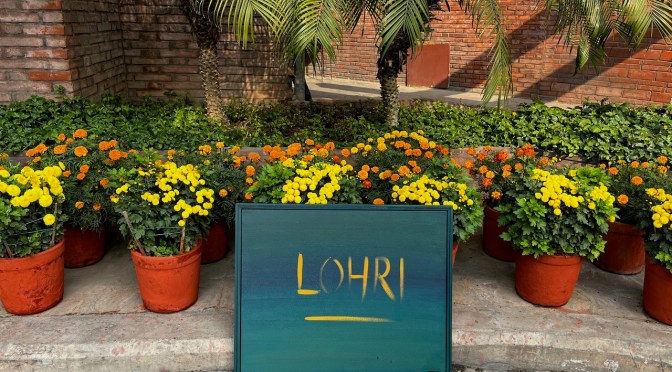
The festival of Lohri in Punjab

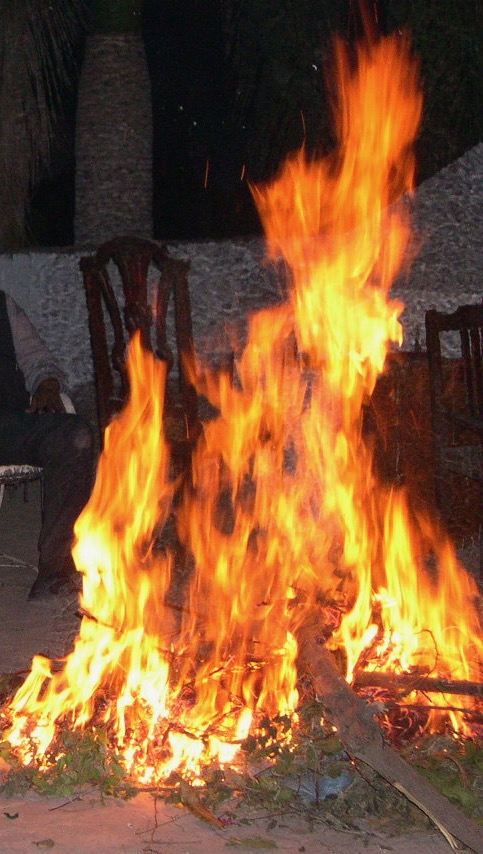
© Pippa Virdee 2004, celebrating lohri in Lahore.

A few days back I was in Punjab and Delhi, which were clouded and submerged in the winter chill and fog. With every passing comment about the cold, there is another reference, “it will only last until lohri, after that the weather will improve”. This points to the passing of the winter solstice and the changes in the season. Many of the popular festivals in Punjab are associated with seasonal changes, these are easy markers and reference points before formal calendars and dates arrived, and in this case the winter festival of lohri means anticipating longer and warmer days.

Growing up, there were always certain foods which we associated with lohri (and associated with the winter harvest). Rewris/revdis, jaggery and sesame-based dishes, and peanuts, are all warming and seasonal foods during the winter days of North India. Sarson da saag and makki di roti is another essential. Jaggery, sesame sweets and peanuts are quite often distributed and exchanged amongst friends and families. Traditionally, this special occasion was reserved for the birth of a son, but thankfully many have started celebrating the birth of a child, regardless of its gender.

In Indian Punjab the festival is public holiday but unfortunately across the border in Pakistan Punjab it is barely recognised. In recent years commentators and activists have been trying to revive it and re-introduce it to the wider public, with limited impact. Lohri is not and was not a religious festival, and yet the division of such festivals is emblematic of Partition, which increasingly entrenched what was deemed to be Hindu/Sikh and what was considered Islamic. In the video above for BBC Urdu, you can hear Mazhar Abbas narrate the history of lohri for a new generation.

Going back to Delhi, I was fortunate enough to meet up with Harinder Singh (1469) who was busy curating his lohri exhibition at the India International Centre. Do go and have a look, if you are around Delhi.

Read more about the history and origins of lohri.

Lohri: A joyous bonfire festival of Punjab to mark the end of winter by Mala Chandrashekhar

Lohri the legend of Dulla Bhatti by Aashish Kochhar

Watch lohri de rang with Noor Art and co.

Top posts in 2022

As I prepare to wind down for this year, here are 10 of the most popular posts of 2022.

  1. Ajj Aakhaan Waris Shah nu by Amrita Pritam
  2. How the photographs of Margaret Bourke-White became the images of partition
  3. 70 years ago extracts of the Sunderlal report Hyderabad, 1948
  4. The Status of Punjabi after 1947
  5. Sahir Ludhianvi and the anguish of Nehruvian India
  6. Two villages, two nations: Ganda Singh Wala-Hussainiwala
  7. Ludhiana’s Clock Tower (Ghanta Ghar)
  8. The ‘Jingle Trucks’ and the emergence of Truck Art
  9. 1881: the first full census in British India
  10. 23 Sir Ganga Ram mansion – the house of Amrita Sher-Gil

Indian Tiffin and Thali

It is the end of November and I find myself at a conference on 75 years of Pakistan Independence at The Lakshmi Mittal and Family South Asia Institute at Harvard University. On the sidelines of the conference I take a walk and observe the diversity on display around me.

MIT Latino Cultural Centre

In 1990 President George H. W. Bush approved a joint resolution designating November 1990 “National American Indian Heritage Month.” Similar proclamations, under variants on the name (including “Native American Heritage Month” and “National American Indian and Alaska Native Heritage Month”) have been issued each year since 1994. Read more about this.

At the same time I can’t help but notice that more detailed demographic data emerges from the ONS, in which ‘Leicester and Birmingham have become the first “super-diverse” cities in the UK, where most people are from black, Asian or minority ethnic (BAME) backgrounds, according to the 2021 census’. Read further ‘Diversity is a beautiful thing’: the view from Leicester and Birmingham. As I’m based in Leicester, I hope to explore some of the recent changes in the city in more detail.

In the meantime, I indulge in the desi ‘home made’ food offered by Mr Harpreet Singh at Singh’s Dhaba. He established his business in 1990 and like many other diasporic Sikhs he came from Virk, a village near Phagwara, in the Jalandhar district.

Welcome to Nankana Sahib

Nankana Sahib is the Birthplace of Guru Nanak. This town was originally known as Talwandi of Rai (Rai Bhoi di Talwandi) and today it forms the core of the small Sikh community in Pakistan. Every year on Guru Nanak’s birthday (Gurpurab), Sikhs (and others) gather around Nankana Sahib to remember the founder of the Sikh faith. Over the years the Gurdwara complex has grown considerable. I first went there in 2003 when it was a small gurdwara with a largely Pathan Sikh community of about 50 families who lived there. The last time I went there was on Gurpurab in 2016, and the small town was transformed into a mela of 20-30,000 people from around Pakistan, including the Nanak Panthis (mostly from Sindh) and Sikhs from around the globe (including India). The area now has district status and attracts the Sikh diaspora, who come here in huge numbers on pilgrim visas. The growth in the pilgrims and tourism is one of the main reasons for the growing investment in places like this and hence the transformation of this area.

I leave you with the voice of Nusrat Fateh Ali Khan – born in Lyallpur (Pakistan) with ancestral roots in Jalandhar (India) – who is performing/reciting Koi Bole Ram Ram Koi Khuda (Some call the Lord ‘Ram, Ram’, and some ‘Khuda’) at the Ramgarhia Sabha Gurdwara (Slough, UK) for the Sikh Diaspora in 1989 – many of whom appear to be from East Africa. But the words of the Guru and music know no borders.  

Ustad Nusrat Fateh Ali Khan Live in Slough Gurdawara, 1989 by Oriental Star Agency

If you are interested more in the shabad, the translation and the meaning, please click here.