Tag Archives: history

70 years ago: extracts of the Sunderlal Report, Hyderabad 1948.

Nizam Patel
The Nizam of Hyderabad receiving Sardar Patel after Operation Polo
sunderlal
Extract from the Sunderlal Report

Operation Polo is the code name of Hyderabad “police action” in September 1948. On Day 5 of this operation, 17 September 1948, the Nizam announced a ceasefire which ended the armed action. The operation led to massive communal violence and violations by the police. This prompted Jawaharlal Nehru to appoint a commission, led by Pandit Sunderlal, to investigate the situation. The findings of the report remained buried until 2013 when it was finally released and was accessible from Nehru Memorial Museum and Library (New Delhi).

Subject File No. 2. Sunderlal Papers, NMML.

We were asked by the Government of India to proceed to Hyderabad state on a goodwill mission and beg to submit our report. The delegation consisting of Pandit Sunderlal, Qazi Abdul Ghaffar and Maulana Abdulla Misri arrived in Hyderabad on 19th November and left for Delhi on 21st December 1948. During this period, we toured through 9 out of the 16 districts of the state, visiting 7 district headquarters, 21 towns and 23 important villages. In addition, we met over 500 people from 109 villages which we had not visited. Further, 31 public meetings and 27 private gatherings…were addressed by the members of the Mission.

At all these meetings, the main problem discussed was that of the creation and maintenance of cordial relations between the communities. Appeals were made to the people to forget the past and to work unremittingly for the establishment of peace and harmony amongst themselves….special emphasis was laid on the objective which was the established of a secular government…Ours was not a commission of investigation or enquiry into events proceeding of following the police action…All the same we feel it our duty to bring to your notice what we saw and gathered in our two weeks.

Killing and Looting

Hyderabad State has 16 districts comprising nearly 22,000 villages. Out of them only three districts remained practically free of communal trouble which affected the state during first the activities the Razakars and then during the reprisals that followed the collapse of that organisation. In another four districts the trouble had been more serious but nothing like the havoc that overtook the remaining eight. Out of these again the worst sufferers have been the districts of Osmanabad, Gulbarga, Bidar, and Nanded, in which four the number of people killed during and after the police action was not less than 18,000. In the other four districts viz Aurangabad, Bir, Nalgonda and Medak, those who lost their lives numbered at least 5,000. We can say at a very conservative estimate that in the whole state at least 27,000 to 40,000 people lost their lives during and after the police action. It is a significant fact that the four worst affected districts had been the main strongholds of Razakars and the people of these districts had been the worst sufferers at the hands of the Razakars. In the town of Latur, the home of Qasim Razvi, which had been a big business centre, with rich Kuchchi Muslim merchants, the killing continued for over 20 days. Out of a population of about 10,000 Muslims there, we found barely 3,000 still in the town.

Other Crimes

Almost everywhere, communal frenzy did not exhaust itself in murder, in which at some places even women and children were not spared. Rape, abduction, loot, arson, desecration of mosques, forcible conversions, seizure of houses and land, followed or accompanied the killing. The sufferers were Muslims who formed a hopeless minority in rural areas. The perpetrators of these atrocities were not limited to those who had suffered at the hands of Razakars, not to the non-Muslims of Hyderabad State. These latter were aided and abetted by individuals and bands of people, with and without arms, from across the borders, who had infiltrated through in the wake of the Indian army. We found definite indications that a numbers armed and trained men belonging to a well-known Hindu communal organisation from Sholapur and other Indian towns as also some local and outside communists participated in these riots and in some areas actually led the rioters.

The Army and the Police

Duty also compels us to add that we had absolutely unimpeachable and independent evidence to the effect that there were instances in which men belonging to the Indian army and also the local police took part in looting and even other crimes. During our tour we gathered, at not a few places, that soldiers encouraged, persuaded and in a few cases even compelled the Hindu mob to loot Muslim shops and houses. At one district town, the present Hindu head of the administration told us that there was a general loot of Muslim shops by the military…Complaints of molestation and abduction of girls, against Sikh soldiers particularly, were by no means rare…unfortunately there was a certain element in the army that was not free from communal feelings probably because some of them could not forget the atrocities committed elsewhere on their kith and kin. Before concluding this summary of atrocities committed we would like to affirm that we have not made any of the above statements lightly or without realising to the full our responsibility in making them…we are prepared to place before you all the relevant material collected.

The Razakar organisation, had in the Muslim mind stood as an effective barrier against the establishment of a Hindu Raj, the latter being synonymous to the average Hyderabadi Muslim with the demand by state Congress of a responsible government as it would in effect be based on the will of the Hindu majority. Barring a microscopic minority, the Muslim masses generally were unable to realise that their sufferings were the inevitable reprisals of the Hindu masses to the atrocities committed on the latter only a few weeks before by the Razakars, who had the active sympathy if not the actual support of practically every single Muslim in Hyderabad from the Nizam downwards. There were some exception of course, but it is doubtful if they number more than a few dozen. Such of them as dared to publicly oppose the Razakars’ activities paid heavily for their temerity. Even those Muslims who traced their happenings to their original cause, the Razakars, considered the police action as their immediate cause for which they held the Indian government responsible. Like the Razakars, the perpetrators of these crimes against the Muslim actively encouraged and nurtured the belief that they had the backing of the administration of the day.

Colour was lent to this belief by some actions and omissions of such people in authority as had been unable to purge their minds of the communal virus. The doubts and suspicions as regards the good faith and the absolute impartiality of the Indian government as between the Hindus and the Muslims, however baseless, were thus not the unnatural outcome of the indiscriminate sufferings of hundreds of thousands of Muslims in which tens of thousands lost their lives…in this campaign of retaliation at least a hundred were made to suffer for the sins of each guilty individual. Unfortunately, the conduct of some of the congressmen added to the distrust of the Muslim population…it was reported to us during our tour that at some places, persons claiming to be congressmen took the law in their own hands and adopted various devices of extracting money from panicky Muslims…such persons were going about approaching Muslims who had not left their homes or those who had returned extracting money from them against promises of so-called protection…Congressmen had auctioned cultivatable land left behind by Muslims on condition that half the crops were to be handed over to the Congress.

Doubts and suspicions in the minds of the literate Muslims were aggravated by yet another factor, namely the complaints of those who had been in state service before the police action and had lost their jobs. We have received a long list of names of persons dismissed, degraded, suspended or otherwise penalised in various departments…we are quite prepared to believe that some of these were men who could not be allowed to continue in the best interest of the administration but we have reasons to believe that a large number have suffered and are suffering for no fault of theirs. There may be cases of mere suspicion or false accusation. In fact, we have incontrovertible evidence of the innocence of some of these men. We are sure these men can be depended upon for their loyalty to the new regime. The fact also remains that these readjustments have landed a large number of Muslims families in considerable difficulties…the fact is that bitter experience has brought home to the Hyderabadi Muslims the dire consequences of communalism. Naturally they now want to live and let live. We believe that they would be perfectly happy and contented if they can be taken out of the present atmosphere of distrust and frustration.

‘Foreign marriages’

Model Town, Lahore
Model Town, Lahore. © 2017 Pippa Virdee

Going through some archival footage from The Pakistan Times I come across this gem from 28 April 1960 in Letters to the editor. Written in 1960 but some of the issues highlighted in the letter still exist even today, especially in the second paragraph. What is also fascinating is how many men were really marrying ‘foreign’ girls during this period? Was it really that prevalent, enough to prompt a letter to the editor? If anyone knows more or knows of such stories please do share these with me.

May I invite your attention to a grave social problem which is becoming more and more acute day by day.

It has been observed that large number of our young men who get an opportunity to go abroad for higher education, professional studies or training come back with foreign wives. This is very frustrating for our own eligible girls. It deprives them of intelligent marriage partners. On the other hand, those who marry these foreign ladies become status conscious and become eager to raise their standards of living. Their wives feel like fish out of water in our society. They cannot freely mix with us due to a great difference in cultural, social and religious background. Naturally, they try to divert their husbands from the country’s social stream. Thus these young men – our own kith and kin – virtually become foreigners in their own milieu. This is no fault of theirs. It is a natural process.

The question is why do these young men marry abroad? The answer is very simple, in our society they have no opportunity to come in contact with girls and hence no understanding can possibly develop between them. It does not need much imagination to foresee the serious consequences of this tendency, which is the product of our defective social pattern and of the ignorance of the parents. If they give their children even a limited opportunity to mix with one another and then chose their life companions our young men will not even dream of marrying aboard, this will make for social integration and give a chance to our girls to contract suitable marriages.

Abu Saeed Ahsan Islahi, Rawalpindi

Women and Sports (in Pakistan).

Screen Shot 2018-07-05 at 16.33.00
Women of Pakistan by Pakistan Publications. (Washington, D.C.: Printed by Gibson Bros., 1949).

Insert reads: Champion athletes of Pakistan photographed with Quaid-i-Azam Mohamed Ali Jinnah, founder and first Governor-General of Pakistan, and is Miss Fatima Jinnah, after the first All-Pakistan Olympic Games held in April, 1948.


Screen Shot 2018-07-05 at 17.36.27
‘A tennis player’ – Women of Pakistan by Pakistan Publications. (Washington, D.C.: Printed by Gibson Bros., 1949).

Trawling through some old archival material I came across Women of Pakistan, published in 1949, it offers a visual feast of material relating to women in early Pakistan. For an official publication, it is illuminating of the time when Pakistan had just been created. There is not much on the individual women themselves but certainly the pictures themselves are great importance. While I try to discover more about this early era of sports history, I would love to know more from those who might know of women who were involved in sports or have any stories to share themselves.


The Chattri

This slideshow requires JavaScript.

Tucked away in the secluded hills of the South Downs, East Sussex, is a lesser known history of the Indian soldiers who fought for the British Empire during World War One. More than 1.5 million Indian soldiers fought for the Allied powers during the four years of the Great War. Among these, over 130,000 served in France. Their major military contribution on the Western Front took place in the very first year of the War. At the end of 1915, a majority of these infantry brigades were withdrawn and sent to the Middle East [https://www.bl.uk/reshelp/findhelpsubject/history/history/asiansinbritain/indiansoldiersinworldwars/indiansoldiers.html]. Approximately 4,500 Indian soldiers served on the Western Front in the first 4-5 months of the War and, in December 1914, hundreds of Indian causalities from there were bought to Brighton to be treated. The Royal Pavilion, Corn Exchange and the Dome therein were all converted into military hospitals and provided over 700 beds. The workhouse on Elm Grove was renamed the Kitchener Hospital (named after the former Commander-in-Chief of the British Indian Army) and also took in patients. Subsequently, by 1916, almost 12,000 Indian soldiers were to be treated in Brighton with 4,306 placed in the famed Pavilion (http://www.eastsussexww1.org.uk/indian-soldiers-east-sussex/). The uniquely recognisable Royal Pavilion in Brighton has since, therefore, become associated with the recovery of the Indian soldiers. Interestingly, King George V had thought that this would be an apt location for the Indian soldiers to be treated and convalesce, given that the Royal Pavilion was built/inspired by the Indo-Saracenic style of architecture. The injured soldiers included a mixture of Muslims, Hindus and Sikhs and great care was taken to respect their religious customs, regional diversity and dietary requirements. Many of the soldiers prior to their admission to hospital would never have been to the UK. And, when 53 Hindu and Sikh soldiers among them died, they were cremated on the South Downs, with their ashes scattered in the nearby English Channel. The first of these cremations took place in December 1914, the last coming a year later. Their similarly ill-fated 19 Muslim counterparts were buried in a purpose built burial ground near the Shahjahan Mosque in Woking. Built in 1889, this mosque is the oldest of its kind in north-west Europe.

However, at times the patients at the Royal Pavilion were also kept purposefully apart from the inhabitants around them. Barbed wire was place around the perimeter of the Pavilion in order to keep the patients in and the residents of Brighton out. Military authorities were particularly concerned about the possibility of the female inhabitants of Brighton contracting a bout of ‘Khaki Fever’ [http://www.eastsussexww1.org.uk/indian-soldiers-east-sussex/]. According to Angela Woollacott, in late 1914 there was an epidemic of ‘Khaki Fever’ across Britain as young women were seemingly so attracted to the men in military uniform that they started to behave immodestly and perhaps even somewhat dangerously! [https://www.jstor.org/stable/260893?seq=1#page_scan_tab_contents]

It was in August 1915 that the idea of a memorial for the dead soldiers was proposed. Sir John Otter, who had been a lieutenant in Indian Medical Service, the then-Mayor of Brighton, proposed this idea to the India Office. Supportive of this idea, the India Office agreed to share the cost of building and erecting the memorial with Brighton Corporation. Construction on the memorial started in August 1920, with a young Indian architect E. C. Henriques being responsible for designing The Chattri (The Umbrella). The memorial was finally unveiled on 1 February 1921 by Edward, Prince of Wales. Unfortunately, it gradually fell into disrepair in the inter-war period and was restored only after the Second World War. The War Office had agreed to pay for the repairs to restore The Chattri and then, from 1951, the Royal British Legion contributed to its upkeep. Since 2000, a Sikh teacher, Davinder Dhillon, has been working hard to host an annual commemoration event, in June.  

The Chattri bears the following inscription in Hindi and English: “To the memory of all the Indian soldiers who gave their lives for their King-Emperor in the Great War, this monument, erected on the site of the funeral pyre where the Hindus and Sikhs who died in hospital at Brighton, passed through the fire, is in grateful admiration and brotherly affection dedicated”.

Breakdown of Deaths of Indians in Brighton Hospitals

Kitchener Hospital

36 deaths: 25 Hindus/Sikhs cremated at Patcham, 11 Mohammedans buried at Woking.

Royal Pavilion

18 deaths: 10 cremated at Patcham, eight buried at Woking.

York Place Hospital

20 deaths: 18 cremated at Patcham, two buried at Woking.

Total cremated on the Downs at Patcham: 53

Total buried at Woking: 21

Total deaths: 74

Source: http://www.chattri.org/indepthHistory/ih5.aspx

Further reading

Ashley, Susan LT. “Acts of heritage, acts of value: memorialising at the Chattri Indian Memorial, UK.” International Journal of Heritage Studies 22, no. 7 (2016): 554-567.

Das, Santanu. “Writing Empire, Fighting War: India, Great Britain and the First World War.” In India in Britain, pp. 28-45. Palgrave Macmillan, London, 2013.

Hyson, Samuel, and Alan Lester. “‘British India on trial’: Brighton Military Hospitals and the politics of empire in World War I.” Journal of Historical Geography 38, no. 1 (2012): 18-34.

Omissi, David, ed. Indian voices of the Great War: soldiers’ letters, 1914–18. Springer, 2016.

Woollacott, Angela. “‘Khaki Fever’ and Its Control: Gender, Class, Age and Sexual Morality on the British Homefront in the First World War.” Journal of Contemporary History 29, no. 2 (1994): 325-347.


The Chattri Memorial Group: http://www.chattri.org/about.aspx

How Brighton Pavilion became a temporary hospital for Indian soldiers in WW1 by Hardeep Singh:

https://www.telegraph.co.uk/history/world-war-one/11026562/How-Brighton-Pavilion-became-a-temporary-hospital-for-Indian-soldiers-in-WW1.html

India’s contribution to the First World War [IOR: L/MIL/17/5/2383]

Report on the Kitchener Indian Hospital, Brighton, 1916 [IOR: L/MIL/17/5/2016]

Visit The Chattri: https://www.brighton-hove.gov.uk/content/leisure-and-libraries/parks-and-green-spaces/chattri-memorial

Indian Soldiers in East Sussex: http://www.eastsussexww1.org.uk/indian-soldiers-east-sussex/

Why the Indian soldiers of WW1 were forgotten: https://www.bbc.co.uk/news/magazine-33317368

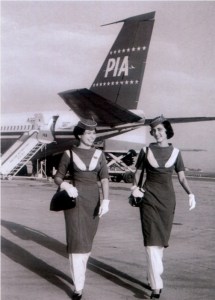
Women and Pakistan International Airlines in Ayub Khan’s Pakistan

pia-airhostesses

Abstract:

This article weaves together several unique circumstances that inadvertently created spaces for women to emerge away from the traditional roles of womanhood ascribed to them in Pakistan. It begins by tracing the emergence of the Pakistan International Airlines (PIA) as a national carrier that provided an essential glue to the two wings of Pakistan. Operating in the backdrop of nascent nationhood, the airline opens an opportunity for the new working women in Pakistan. Based on first-hand accounts provided by former female employees, and supplementing it with official documents, newspaper reports and the advertising used for marketing at the time, it seeks to provide an illuminating insight into the early history of women in Pakistan. While the use of women as markers of modernity and propaganda is not new, here within the context of Cold War and American cultural diplomacy, the ‘modernist’ vision of the Ayub-era in Pakistan (1958-69), and its accompanying jet-age provide a unique lens through which to explore the changing role of women. The article showcases a different approach to understanding the so-called ‘golden age’ of Pakistani history: a neglected area of the international history on Pakistan, which is far too often one-dimensional.

Link to the article: https://doi.org/10.1080/07075332.2018.1472622

The Final Resting Place: Gurdwara Kartarpur Sahib

This slideshow requires JavaScript.

In March 2017, in an impromptu adventure, I had the opportunity to visit Kartarpur Sahib in Pakistan. It came amidst an amazing road trip, which took me from the Radcliffe line to the Durand Line (almost). The trip was full of surprises – monuments (old and new) in situ and people on the move – and their discussion, especially of religious spaces and their historical significance. During one of these conversation, Dr. Yaqoob Khan Bangash (ITU Lahore) asked why the Sikhs never demanded Kartarpur Sahib during the discussions of the 1947 Radcliffe Boundary Commission.

Kartarpur is located in Narowal District in Pakistani Punjab. It is about 120 kms/2 hours away from Lahore and is located only 3 kms from the Indo-Pakistan border by the river Ravi. Indeed, Dera Baba Nanak is located about 1 km from the border, on the other side, east of the river Ravi in Indian Punjab. Both are visible to each other on clear days. The Gurdwara is the historic location where Guru Nanak (1469-1539) settled and assembled the Sikh community after his spiritual travels around the world. It is on the banks of the River Ravi and even today there is a nomadic and unkempt, wilderness feel to the place. Guru Nanak spent eighteen years living in Kartarpur, during which he spent time preaching to a growing congregation; the appeal of Nanak spreading from nearby areas to beyond and drawing the first Sangat to the area. Many devotees remained and settled in Kartarpur, dedicating their lives to the mission of Nanak.

The informal led to the formal, with the establishment of the first Gurdwara (the house of the guru) being built circa 1521-2. Here, free communal dinning (langar) was started, feeding all those that came and the langar remains a defining feature of Sikhism – providing free food to everyone without any prejudice. The food is simple and usually vegetarian. It is not a feast, nor does it offend anyone due to their dietary preferences. Everyone, rich or poor, sits together; equal in the house of the guru.

However, for Sikhs, Kartarpur is an especially significant place, as it marks not only the beginnings of Sikhism but also the final resting place of the first guru. The original Gurdwara complex was washed away by floods of the river Ravi and the present-day building was built with donations from Bhupinder Singh (1891-1938), Maharaja of Patiala. More recently, the Government of Pakistan has been contributing to its maintenance. The most fascinating thing about Kartarpur is the appeal of the Gurdwara to all communities. Baba Nanak is revered as a Pir, Guru and Fakir alike.

My trip to Kartarpur was during the “off-season” period and so, mostly Muslims were visiting the shrine/Gurdwara to offer their duas/prayers. Legend has it that when Guru Nanak died, his Hindu and Muslim devotees disagreed about how his last rites should be performed: cremation or burial? During this ruckus, Nanak appeared as an old man before his devotees and, seemingly, suggested delaying the decision until the following day. The following morning, the shroud covering the body was found with flowers, in place of the body. These flowers were divided, with the Hindus cremating theirs, and the Muslims buried theirs. And so, in the courtyard of the Gurdwara is a shrine to symbolise this story. Outside the Sikh tourism that takes place, which is limited, this shrine is mostly frequented by Muslims.

In August 1947, Kartarpur was in Gurdaspur district, which had all (almost) been delineated to be in Pakistan, until the late, controversial changes to the boundary line, which meant that parts of Gurdaspur went to India. Thus, at the last minute, Kartarpur ended being in close proximity of the international border. After Partition, the Sikhs were negligible in their numbers in Pakistan and Kartarpur remained closed and abandoned for over fifty years. More recently, there have been attempts to get a connecting corridor between the communities in India and Pakistan today, but this has not materialised. Going back to the question of why Kartarpur never figured as a specific request before the Boundary Commission, perhaps part of the answer lies in the fact that Sikhs believe in reincarnation of the soul and, therefore, death of the body is not the end of life’s journey.

‘Corridor connecting India with Kartarpur Sahib Shrine in Pakistan ruled out’ by Ravi Dhaliwal:

http://www.tribuneindia.com/news/punjab/community/-corridor-connecting-india-with-kartarpur-sahib-shrine-in-pak-ruled-out/400962.html

‘Visit to Kartarpur Sahib (Pakistan)’ by Dalvinder Singh Grewal: https://www.sikhphilosophy.net/threads/visit-to-kartarpur-sahib-pakistan.49707/

‘How Nanak’s Muslim followers in Pakistan never abandoned Kartarpur Sahib, his final resting place’ by Haroon Khalid: https://scroll.in/article/857302/how-nanaks-muslim-followers-in-pakistan-never-abandoned-kartarpur-sahib-his-final-resting-place

Everyone’s Guru by Yaqoob Khan Bangash: http://tns.thenews.com.pk/everyones-guru/#.WxAxiakh3OQ

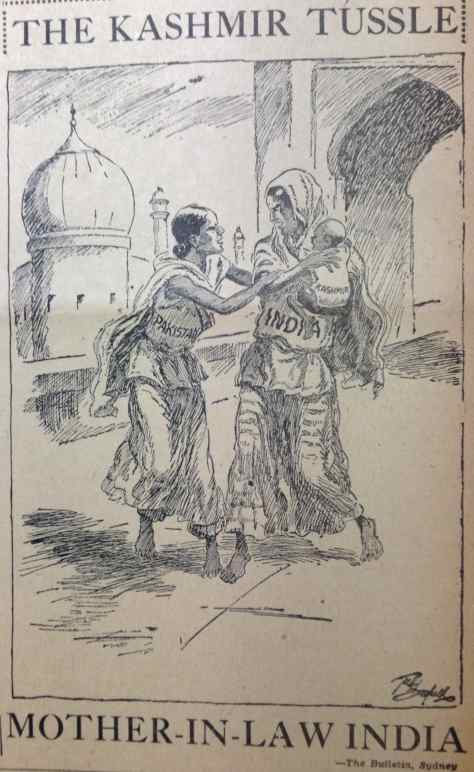
The Kashmir Tussle

The picture says it all, “The Kashmir Tussle” appearing in The Pakistan Times in July 1951.

5561 Kashmir
The Pakistan Times, 15 July 1951.

Two villages, two nations: Ganda Singh Wala-Hussainiwala


This slideshow requires JavaScript.

The villages of Ganda Singh Wala and Hussainiwala are two villages divided by Cyril Radcliffe’s line. Rather counter-intuitively in these times of Hindu/Sikh India and Muslim Pakistan, Ganda Singh Wala is a village in Kasur District in Punjab, Pakistan, while Hussainiwala is its Indian counterpart, located 11 km away from Ferozepur city. Until the early 1970s, this was the primary border crossing between the two countries but it now only functions as a ceremonial border. Like Wagha-Attari, the now-primary border crossing between India and Pakistan, there is a daily Retreat Ceremony with the lowering of the national flag. There are, however, a few differences between the two ceremonies as Ganda Singh-Hussainiwala is generally not open to foreign tourists and is therefore more intimate with fewer attendees coming largely from the local area. The seating, especially on Ganda Singh side, is right next to the Pakistani Rangers and thus provides a spectacular viewing of this daily spectacle.

While restricted to mostly locals, there remains some jingoistic overtures around it; more palpable during tense times between the two countries. The ceremony lasting 40 minutes, is shorter than the Wagha-Attari version and has less of a fanfare and build-up. People loiter around, catching the opportunity to be close to Indian/Pakistani people and take photos of the Rangers and Indian BSF. According to Ferozepur district’s webpage (http://ferozepur.nic.in/html/indopakborder.html), there was no joint parade and retreat ceremony here until 1970. It was apparently, “Inspector General BSF, Ashwani Kumar Sharma, called upon both authorities to have joint retreat ceremony and since than it has become a tradition”. In 2005, there were discussions about opening this border crossing, to no avail. Today it is easy to forget that this was once a thriving check-point. In 1970, Paul Mason, while travelling the sub-continent, excitedly crossed the border from Ganda Singh to Hussainiwala. He recalls this experience in his travelogue, Via Rishikesh: an account of hitchhiking to India in 1970 (2005):

“In the morning we have little difficulty in locating the Ministry of the Interior and are supplied the necessary chits which give permission for us to travel along the restricted road to the border. For the sum of two rupees apiece we obtain bus seats and are soon headed off down the dusty track, but the trip is much longer than I expect and it is mid-afternoon before we arrive at the Pakistani customs of Ganda Singh Wala.

At the customs post on the Indian side of the border, a worryingly intelligent young woman who reminds me much of my elder sister Margaret deals me with. I do my best to conceal my anxiety about the concealed roll of banknotes. She eyes me carefully and exchanges a few words with me before turning to the next in line without first acquainting herself with the contents of my underpants.

We have made it to India! We are here in India! At last! Amazing, amazing, amazing!

I take a look at stamp in my passport; it states simply; ‘ENTRY 16-10-70 Hussainiwala Distt, Ferozepore’ – not even a mention of India! Oh well, we’re here, and that’s all that counts!

We follow the flow of other new arrivals along a path beside a wide still river [Sutlej]. There is also a disused railway track, which presumably used to connect the two countries.”

[See full account: http://www.paulmason.info/viarishikesh/viarishikeshch16.htm]

We see from Mason’s account of the simplicity through which he crossed the border with only a slight mention of Ganda Singh and Hussainiwala printed in his passport (pictures of the entry stamps are available on his website above). Today when crossing via the land route, there is a clear stamp with Attari (India) and Wagha (Lahore) in the passport. Mason also mentions the hundreds of cars left abandoned at the border because it was too costly to take them across. But, this was at least possible to do then; impossible today. Equally, the disused railway track lies there abandoned but remains as a reminder of the two broken halves.

Ferozepur, India is the land of martyrs and Hussainiwala is the site of the National Martyrs Memorial, where Bhagat Singh, Sukhdev and Rajguru were cremated on 23 March 1931. This is also the cremation place of Batukeshwar Dutt, who was also involved in bombing the Central Legislative Assembly with Singh. Bhagat Singh’s mother, Vidyawati, was also cremated here according to her last wishes. Interestingly, the spot of the memorial, which is only 1 km away from Hussainiwala and on the banks of the Sutlej river and built in 1968, was originally part of Pakistan. On 17 January 1961, it was returned to India in exchange for 12 villages near Sulemanki Headworks.

Read ‘Making of a Memorial’ by K. S. Bains, http://www.tribuneindia.com/2007/20070923/spectrum/main2.htm

-, ‘Shaheedon ki dharti’ in The Tribune: http://www.tribuneindia.com/1999/99jul03/saturday/regional.htm#3

See a short clip of the ceremony at Ganda Singh Wala: https://www.youtube.com/watch?v=vZR-eLVYo6s

From before and beyond the international border that divides them, there is a story that connects these villages. Majid Sheikh writes about the ‘Spiritual connect of two villages’ in Dawn and brings out their historic connections. To commemorate a highly decorated soldier, Risaldar Major Ganda Singh Dutt, the British had named this village after him, while the village Hussainiwala derived its name during colonial days from Pir Ghulam Husseini, whose tomb is now in the BSF headquarters. Today they exist as two halves of the same story.

Read ‘Spiritual connect of two villages on both sides of the divide’ by Majid Sheikh: https://www.dawn.com/news/1379906