Category Archives: Short Essays

(Inhabiting) the Space between Black and White: Indian/Sikh Community in Kenya

This slideshow requires JavaScript.

Much of my early childhood in the late seventies and early eighties was spent growing up in Kenya (Nakuru and Nairobi), giving me fond memories of a nostalgic past. Having been back a number of times since, it is inevitably not quite the way I have preserved it in my recollections. Childhood memories are filtered, sedate and full of innocence. The contemporary is much more austere, different and distant. The Sikh community in Kenya is small, perhaps only a few thousand. It is close-knit, largely urban based and relatively wealthy. The wider South Asian community originate from a handful of places like Gujarat, Punjab and Goa but it does reflect microcosm of Indian society with its myriad of ethnicities, languages, religion and cuisine but one in which no one community dominates.

There is of course a long history of trade from the west coast of Indian subcontinent to the east coast of Africa from about the second century AD. However, most of the people of Indian origin moved during the British colonial period, initially as indentured labourers, who were brought to Eastern Africa to help with the construction of the Ugandan Railway during 1896 to 1901. The Indian labourers helped with the construction of the line that went from the coast of Mombasa to Kisumu near Lake Victoria (then-known as the Ugandan Railway). They already had experience from constructing the railways in British India, which started much earlier in the 1850s.

The Asian African Heritage Trust notes that:
“In these six years, these labourers and artisans, through difficult terrain, laid 582 miles (931 kilometres) of railway. They built the Salisbury Bridge, over 1,200 feet long, joining Mombasa Island to the mainland, 35 viaducts in the Rift Valley, and 1,280 smaller bridges and culverts. All this was done by hand. No machines were available to them in these massive and technical tasks. 31,983 workers came from India during these years on these contracts. 2,493 died in the construction. That is, four workers died for each mile of line laid; more than 38 dying every month during the entire six years. A further 6,454 workers became invalid. They also built the subsequent railway towns of Nakuru and Kisumu”.  (Asian African Heritage Trust: http://asianafricanheritage.com/index.htm)

Pascale Herzig notes that most of these indentured labourers left after the completion of the project but they were then followed by voluntary migrants (with a large Muslim population, from Gujarat). This second group moved to explore trade opportunities but within this group were also professionals such as teachers, doctors, administrators. And with globalisation, the Kenyan Asians have become much more of a transnational community. Today the petty trader with a small family run business exists alongside the transnational globe-trotter. The former is declining in numbers and latter is adapting with the new business opportunities in an interconnected world.

Many of the Sikhs that came to East Africa were skilled workmen from the Ramgharia community and were associated with the carpentry, blacksmithery and masonry. Quick to adapt and take advantage of these opportunities, they moved into construction and mechanical engineering in order to up-skill themselves. Over subsequent years, the community increased and established its roots in Kenya. The population census of the South Asians (India and Pakistan) below provides a good overview of how the population has grown and declined over a hundred-year period.

Year Population ±% p.a.
1911 11,787
1921 25,253 +7.92%
1931 43,623 +5.62%
1948 97,687 +4.86%
1962 176,613 +4.32%
1969 139,037 −3.36%
1979 78,600 −5.54%
1989 89,185 +1.27%
1999 89,310 +0.01%
2009 81,791 −0.88%

At its height, the Asian population of Nairobi was almost one third Asian in 1962 and 2% of Kenyans were of Asian origin, at the time of Kenya’s independence in 1963. Since then though, the numbers have declined considerably. Within the colonial racial hierarchies, the Indians occupied the spaces between the white and black, a legacy that has been hard to surrender (See further Burton, Brown over Black). They lived, and continue to do so, in their own communities, segregated from the rest which is a source of tension but also emanates from a source of fear. Indians often occupied the middle ranking positions in the colonial period, acting as the buffer between white and black, and, with the top layer gone, the privileged position of the “brown” people became a source of much antagonism and resentment. They were privileged in terms of education, job opportunities and many had established successful businesses. They lived in palatial houses and socially only mixed within their own communities and, thus unsurprisingly, were caught up in the wave of euphoria brought in by African nationalism. The outgoing colonial power however offered a fig-leaf:

“When Kenya received independence in 1963, the Indians were offered the choice of obtaining either British or Kenyan citizenship. Because the painful, post-independence experience of the Congo was still fresh then, and because many Indians felt that the growing demand for position and power from the newly educated African middle class would lead inevitably to their exclusion from the job market, only about 10 percent of the Indian population applied for Kenyan citizenship. The rest chose what later turned out to be “devalued” British passports”. [https://www.nybooks.com/articles/1971/10/07/the-lost-indians-of-kenya/] Ian Sanjay Patel suggests that around 20,000 Kenyan South Asian applied to register for Kenyan citizenship between 1963-1965, out of total population of 176,613. (P.214)

Patel’s recent book, We’re Here Because You Were There (2021) provides an interesting discussion on citizenship and belonging, while focusing on Kenya where his own ancestral roots are. He highlights how Kenyan South Asian British citizens appeared to belong to three different states, as they were resident in Kenya, but some had assumed British citizenship and of course their ancestral roots were in the sub-continent. (Patel p 215). The 1950 Indian Constitution had granted Indian citizenship to persons outside India, if they had parents or grandparents born in India. However, at the same time Apa Pant, the first Indian high commissioner in Nairobi, urged Indians to identify with Kenya rather than India. By 1955, India’s Citizenship Act further removed the possibility of duel nationality. (Patel, p 215).

During the unsuccessful coup attempt in Kenya, against then-President Daniel arap Moi in 1982, many of the Asian shops and homes were also targeted. The fear of violence, looting and nationalisation of business further reinforced the need to remain segregated and aloof in order to survive and preserve their livelihoods. Although many of the Asians fled and relocated, a sizeable Indian diaspora still exists in Kenya, which is quite distinct in character. Old established businesses still exist, and they are still one of the most prosperous communities in Kenya. And interestingly, in 2017, the government announced that the Asian community would be officially recognised as the 44th tribe in Kenya, perhaps an indication of the acceptance that Indians are an integral part of Kenya.

References:

Aiyar, Sana. Indians in Kenya. Harvard University Press, 2015.

Burton, Antoinette M. Brown over black: Race and the politics of postcolonial citation. Three Essays Collective, 2012.

Herzig, Pascale. South Asians in Kenya: Gender, generation and changing identities in diaspora. Vol. 8. LIT Verlag Münster, 2006.

Mangat, Jagjit S. A History of the Asians in East Africa, c. 1886 to 1945. Clarendon Press, 1969.

Onyango Omenya, Gordon. ‘A Global History of Asian’s Presence In Kisumu District of Kenya’s Nyanza Province.’ Les Cahiers d’Afrique de l’Est/The East African Review 51 (2016): 179-207.

Patel, Ian Sanjay. We’re Here Because You Were There. Verso, 2021.
Reflecting on Women Writing Punjabi History

dscn0577
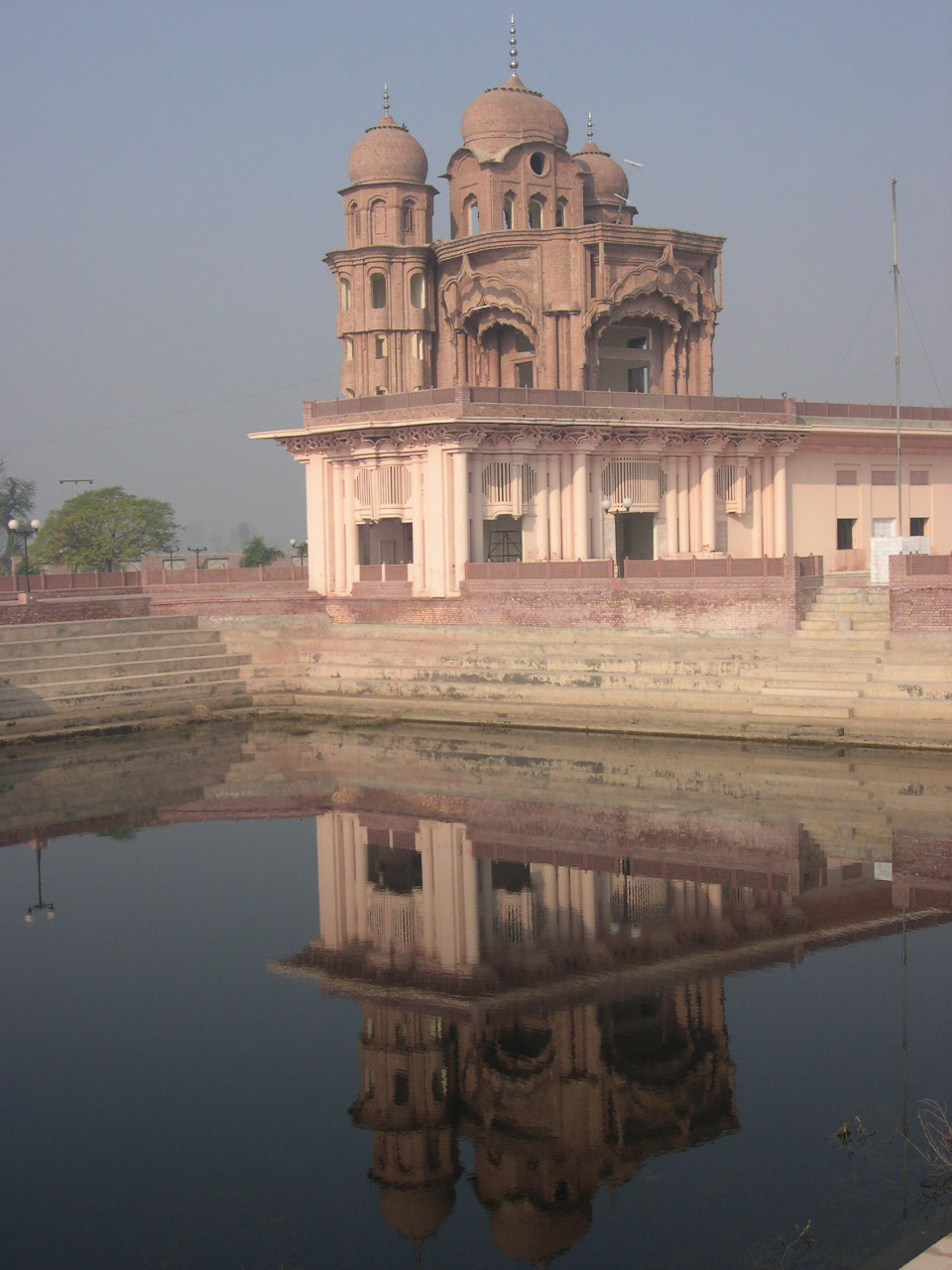
Gurdwara Sri Rori Sahib, Eminabad, Gujranwala (c) 2004 Pippa Virdee

A reflective essay on the lack of women in history writing and Punjab history. This was originally published in The Friday Times5 July 2019.

My first visit to Pakistan was in 2002. It was primarily to do research as a PhD student. At that time, I came with the religious baggage of belonging to a Sikh family and venturing into the known unknown. When I finally got my visa, I was very excited about travelling to the ‘near other’; unknown yet somehow familiar. After all, I rationalised, the cultural region of Punjab is, well, Punjab across both sides of the Radcliffe Line. And so, the journey into Pakistan’s history begun, a space in which the personal and the academic intermingled and boundaries became a metaphor for more than just the relationship between India and Pakistan.

The Sikhs in Pakistan are a small community; one of the smallest minorities in Pakistan. Exact numbers are difficult to estimate but they vary from around 6,000 to perhaps 20,000. They are largely concentrated around places like Peshawar, Nankana Sahib and Lahore. The interesting thing is that apart from the ethnic Punjabi Sikhs, many of the Sikhs that remained in Pakistan after 1947 were Pathan Sikhs. The latter were scattered in small numbers across Balochistan, Federally Administered Tribal Areas and Khyber Pakhtunkhwa. Most have been forced to relocate since, often seeking sanctuary in numbers. Though small, the Sikh community over the past few years has come to enjoy some state patronage. In an otherwise ‘Islamic’ milieu, Sikh men are easily identifiable by their turbans. Added to this are the old persistent colonial stereotypes of the Sikhs being a ‘martial’ race (even in Pakistan). And of course, the ‘Khalistani’ Sikhs have the sympathetic ears of the Pakistan establishment since the early 1980s. Thus, in Pakistan today, the medieval shadow of the Sikh-Muslim rivalry of Mughal India, as well as the pall of 1947 have receded to create a strange co-existence and a convenient acceptance of current realpolitik rather than a bitter dwelling in the past. However, this convenient relationship does not necessarily translate easily or well in the Sikh diaspora, especially here in the United Kingdom, where I am based.

While my main purpose for visiting Pakistan in 2002 was for my doctoral research, there was inevitably an interest to visit Sikh Gurdwaras and shrines; those remnants of pre-1947 which still existed. I have subsequently visited Pakistan more times than I can remember and have seen the changes in many of these shrines and their localities. Over the last 15 years, there has been a transformation of many of these shrines; from being small and poorly maintained to now being considered as one of the growing areas for pilgrim tourism in Pakistan. Every year, especially at the time of Vaisakhi and Guru Nanak’s birth anniversary, pilgrims come in their thousands from the UK, USA, Canada, which are home to significant Sikh diaspora communities. Depending on political temperatures, Indian Sikhs also make this pilgrim trip. For instance, this year, the Government of Pakistan issued 2,200 visas to Sikhs pilgrims in India for Vaisakhi. There is much trepidation amongst these of falling under the radar of intelligence agencies on both sides. Beyond the politics of two paranoid and securitised states though, growth in this tourism has benefitted local communities, as infrastructure around the ‘important’ shrines has improved to facilitate foreign tourists. These bring in the much-needed foreign exchange. They travel, stay, eat, drink, shop and thus spend their foreign currencies in Pakistan and, ultimately, some of this does make its way into the local economy. But this development is localised and centred around a handful of shrines, with the majority still largely neglected.

Social media and its ability to connect across borders, has spurred on a handful of people to seek adventure in Pakistan and document the ‘lost’ history of the Sikhs. Conversely, there has been more interest in these forgotten histories within Pakistan too. Combined with increased pilgrim tourism, there is almost a fascination and a sense of lost kinship that many Sikh Punjabis have with Pakistan and Pakistani Punjabis. These complex historicised feelings are under-girded by a common language, culture, biradari connections, and bhaichara. There is an old romantic connection that many have with reaching Lahore (formally Maharaja Ranjit Singh’s capital) captured in the phrase, Jis Lahore Nai Dekhya O Jamyai Nai/ Jine Lahore Nai Vekhya O Jamya Nai, meaning ‘One who has not seen Lahore has not been born’! This has been recited countless times and it helps to maintain the old pluralistic image of colonial Lahore. In this quest then, for the lost history of Sikhs in Pakistan, there has been a profusion of activity which has generated research in universities, fictional/non-fiction literature and pictorial books on Sikhs. These latter easily detract and divert from the difficult issues of politics, while sticking to the sites of nostalgia and neglect. Even the research at Pakistani universities (not exclusively though) is largely focused on the Ranjit Singh period (1801-39). When the bearded young man boasts of Ranjit Singh, of the contribution of the Punjabi (but usually Sikh) soldiers, of the great martial tradition, they rarely give women a thought.

These histories perpetuate and create a myth of the splendour associated with this lost history of the Sikhs. Even hard leftists have a soft spot for an otherwise unelected, unrepresentative, hereditary maharaja. While this greater interest and curiosity amongst scholars and students is welcome, it also serves to reinforce old stereotypes by avoiding the more difficult question of the broader issue of non-Islamic histories of Pakistan. Moreover, the study of history and its periodisation retains much of the colonial interpretations, hardly allowing us to interrogate these boundaries intellectually and dispassionately.

In the quest for academic “impact” and to connect with the general public, many academics in the west have been compelled to promote themselves. Social media again has been the route for this seemingly altruistic self-promotion. Articles, blogs and personal posts on social media, of travelling around Pakistan and bonding with the locals, for people’s immediate consumption and gratification. Moreover, the Punjabis express this in their usual flamboyant style of visiting their ‘lost’ Punjab, bonding with the local Punjabis and then sharing these ‘amazing’ bonding experiences. On closer inspection though, these all have something else in common. They are all invariably shared by men and are about their fraternal experiences. Statistically, we know that on average women are 26 percent less likely to own a mobile than men and 70 percent less likely to use mobile internet. Naturally, this means less women are visible and even when they are, they use it differently. Women largely use social networking to make connections and keep in touch with family or friends, in contrast men use social media to gather information they need to build influence. In South Asia, this discrepancy stems from the fact that men usually have better educational opportunities, have mobile phones, have greater levels of digital literacy, and this advantage over women fuels their privileged status.

Much of this social conditioning starts from the home, through to schools and universities. The social system perpetuates and emboldens men, making them entitled from a young age. As young women, we often have to fight our way to pursue our aspirations and dreams. Wanting to study politics and history at university for me was not easy because this was not considered an appropriate subject for a girl, even though it eventually reaped rewards. Universities themselves are supposed to be some of the most intellectually progressive spaces but actually they are not. They are just a reflection of society itself. They have the same prejudices and reflect the same class, caste, gender biases that society has. This is reflected in the largely male student body in South Asia, and although the number of girls is increasing and often, they perform better, many still see this as way of improving their choice of marriage partners. This is not a criticism of their desire to improve their lives, but rather a reflection of the limited value of education. The staff fraternity also tends to be male-dominated, especially the senior staff. Although this is no better than in the UK where the Royal Historical Society recently published a study on Race, Ethnicity and Equality (2018) and found that there was an over-whelming dominance of white male professors compared to females and the numbers are even smaller for those from Black and Ethnic minorities.

These centres of learning, therefore, do not reflect the voices of everyone because even here, the skewed societal power structures remain intact. Men control the institutions and therefore they control the narrative. They are the gatekeepers of knowledge and learning and without challenging these structures the narrative cannot be changed.

My experiences of being a (Sikh) woman living and working in Pakistan (largely Lahore and the Punjab) has been quite ordinary in many ways and extraordinary in other ways. I have never been given a free taxi ride; unlike the numerous accounts one reads of visiting Sikhs (i.e. Sikh men) who have struck a long-lost kinship with the taxi driver, who then from the kindness of his heart refuses to charge the client. In fact, I have struggled to speak with taxi drivers and men in public spaces in Punjabi because they consider this to be impolite. Unlike men, I am usually compelled to speak in the Urdu, which imposes a certain level of distance and formality to the conversation. While I cannot have my ‘bromances’ with most of those around me, I can, however, quietly enter the zenana spaces. And these, like the history pages that neglect them, are often hidden away.

I have learnt over the years that women, whether in South Asia or in the West, do not boast of their achievements. They work like ants, running around, keeping busy and building structures out of crumbs. The obstacles they encounter en route can be difficult and they are not always successful. More often than not they will encounter men who are in positions of authority and wield substantial power over the lives (and bodies) both in the home and the outside world. And the outside world is designed by men and for the needs of men. They would rarely acknowledge the privileged position they have in the home and the outside world and the freedom this gives them.

While I have spent many years working in Pakistan, on Punjab’s history, I have rarely felt the need to write about my “non-academic” experiences. The motivation has largely come from the fact that despite all these years, there is still not enough progress and even today there are few female historians coming forward. Even today we are judged on how we look, what we wear rather than what we think and write. Intellectually there is a stale and over-bearing concern for constantly writing about conflict, nationalism, religion, battles, and hero-worshipping; a reflection perhaps of an insecure male society that seeks glory from former victories to validate its present. The only way we can get diversity in the way we view and write about our history is to have that diversity in the people who write it. As a society we need to challenge these hyper-masculinised and hyper-nationalised histories that distort our past and shape our future. If we want to be part of the narrative, we have to take responsibility for writing it. As women we need to make ourselves visible in both the past and the present.

1984: Sundown to Bluestar

Golden Temple
© 2009 Pippa Virdee

Operation Bluestar and 1984 are etched on the memories of most people living in north India. It was the codename given for Indian military action to oust Jarnail Singh Bhindranwale and his followers from the buildings of the Harmandir Sahib, Amritsar by the Indian government. By the beginning of June 1984 it was clear that negotiations between the Indian government and Bhindranwale had failed and the build-up of the Indian Army around the Gurdwara complex meant that a full scale confrontation was imminent. Much like the Tiananmen Square protests of thirty years ago, the abiding memory of Operation Bluestar is of Indian military tanks charging into the holy complex of the Golden Temple. More controversially though has been the recent disclosure of the British government’s assistance to the Indian government prior to this operation.

Many of the documents at The National Archives (UK) pertaining to this period are still closed or retained for 40 years. However, a few of them were released.

Correspondence from February 1984 between Brian Fall (FCO) and Robin Butler (No 10). Correspondence Fall and Butler.

There is also a two-page message from PM Indira Gandhi to PM Margaret Thatcher on 14 June 1984. Gandhi to Thatcher.

The following articles are also worth reading around the British Government’s involvement:

British government ‘covered up’ its role in Amritsar massacre in India by Jamie Doward, The Guardian, 29 October 2017.

British special forces advised 1984 Amritsar raid by Phil Miller, Open Democracy, 21 January 2014.

Phile Miller provides more details about the Operation Sundown the covert operation that never happened via his Blog.

‘The First Step’ editorial by Faiz Ahmed Faiz

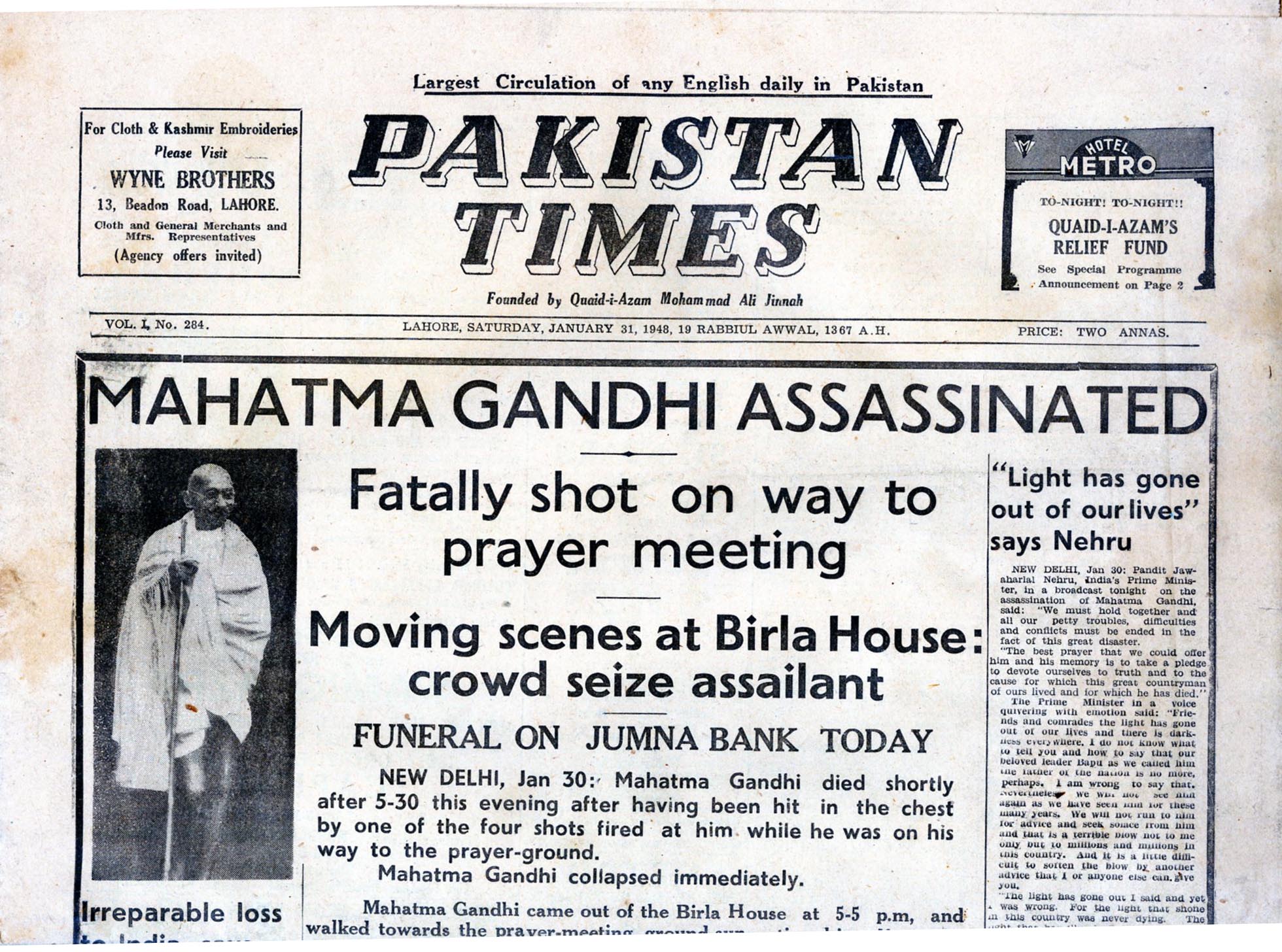
Pakistan-Times-31st-January-1948In 1948 Faiz Ahmed Faiz was the editor of The Pakistan Times. Following the assassination of Gandhi on 30 January 1948, he wrote the following editorial. It is a useful reminder of the challenges still facing India today. The RSS was founded in 1925 and banned on 4 February 1948 following Gandhi’s assassination, this remained in place until 11 July 1948. The ban was lifted once the RSS accepted the sanctity of the Constitution of India and respect towards the National Flag of India, both of which had to be explicit in the Constitution of the RSS.

The Pakistan Times, Lahore. 6 February 1948

Five days after the assassination of Mahatma Gandhi, the Indian Government has taken the first concrete step forward and banned the RSSS throughout the territories of the Indian Dominion. This has followed the resolution adopted by the Indian Cabinet on February 2 which declared the Government’s determination ‘to root out the forces of hate and violence that are at work in our country and imperil the freedom of the nation and darken her fair name.’ The communique issued by the Indian Ministry of Home Affairs announcing the ban further states that the RSSS have been found circulating leaflets exhorting people to resort to terroristic methods, to collect fire arms to create disaffection against the Government and suborn the police and the military. The Rashtriya Swayam Sevak Sangh has been functioning for many years now and under the garb of promoting the spiritual and physical well-being of the Hindus has organised itself as a militant fascist party, preaching hatred and spreading the cult of violence. When the recent phase of communal rioting started the RSSS with its other allies regarded it as an opportune moment to make a bid for power. As blood continued to flow and innocent heads hit the dust, as women were dishonoured and infants mercilessly butchered, the RSSS went from strength to strength. By the end of last year it had spread its tentacles to every Indian city and Province. Its propaganda reached every Hindu; it had not only a considerable mass following but succeeded in making influential friends in the Government in both the services and the Central and Provincial Cabinets. Nor was the Congress organisation free from its corroding influence. The Indian Government were not unaware of the part that the RSSS had played in the Punjab and else where. They were aware of its growing influence and must also have known of the conspiracy against the Central Government, of which the extermination of Indian Muslims and the murder of Mahatma Gandhi were a part. But even as late as November last year, at an All-India conference of Home Ministers, it was decided that no action should be taken against the RSSS as such but only those of its members who infringed the law of the land should be dealt with. This policy of drift and vacillations has taken a heavy toll; not only have thousands of innocent persons been killed and millions rendered homeless but India and the world have lost one of their greatest men. All this need not have been if the leaders in the Government of India had shown a fraction of the courage and vision of Mahatma Gandhi. The question which is agitating the minds of the people, not only in India and Pakistan but throughout the world today, is: what the future who will win? The dregs of Indian society who distributed sweets when the tragic event took place, have not given up the struggle and intend to lie low for some time so that the people’s sorrow is forgotten, their anger vitiated by direct action against a few scape-goats and their demand for a purge of the administration side-tracked by talk of ‘unity in the face of disaster’ and other meaningless slogans. Or will final victory still lie with Mahatma Gandhi and the millions in the country who support his aims and ideals? The first decision of the Government in this connection has received wide welcome. But it is universally felt that only if this decision is regarded by the Nehru Government as the first step in the fight against the forces of evil and darkness, then alone might we see the completion of the noble work for which Mahatma Gandhi died. If, however, it is the only step and after a few weeks or months the RSSS, under some other name, raises its ugly head, and its allies, the Hindu Mahasabha, the Akali party and the Princes are allowed to exist and stage a comeback of their perverted ideology then the future is dark and dismal and the Mahatma has lived and died in vain. The new Nehru-Patel unity, which was trumpeted in the recent meeting of the Congress Party in the Constituent Assembly is likely to lead to confusion, unless it is made clear that it is based on a definite agreement to carry out in toto Gandhiji’s policy and to give no quarter to the rabid communalists who have caused such great disasters. Much, of course, depends on the common people of India who know that their beloved leader’s murder was definitely not the ‘act of a foolish young man’ as Master Tara Singh and his like would have them believe, but a part of the huge conspiracy, which seeks to put in power the worst reactionaries in the land. In this struggle for the ideals for which Mahatma Gandhi stood, we in Pakistan are vitally concerned and have an important part to play. For the future of both peoples and both countries is inextricably linked together, and to the extent that we base our future policies on the last will and testament of Mahatma Gandhi-that without communal amity and without Indo-Pakistan accord there can be neither freedom nor progress for either-to that extent is the future happiness and prosperity of this sub-continent assured.

Editorial available in Faiẓ, Faiẓ Aḥmad, and Sheema Majid. Coming Back Home: Selected Articles, Editorials, and Interviews of Faiz Ahmed Faiz. Oxford University Press, 2008.

The Status of Punjabi after 1947

Reorg of Punjab 1966
Reorganisation of East Punjab after 1966. © Pippa Virdee 

Punjabi is an Indo-European (or Aryan) language and is the native language of Punjab, a land divided between India and Pakistan. It has approximately 100 million speakers, largely in north India and Pakistan but it is also widely spoken amongst the Punjabi diaspora around the world.

The Partition in 1947 not only divided the province of Punjab but it also divided the language, and this has been the source of much tension in post-47 in both India and Pakistan. Being a phonetic language, Punjabi was/is written largely in three different scripts: the Persian script (sometimes referred as Shahmukhi) is used mostly in Pakistan; Sikhs use the Gurmukhi script and less common is the Devanagari script which is associated with Hindu Punjabis. Punjabi interestingly was never given official state patronage; this is true for the Mughal period, Ranjit Singh’s reign and also under the British. The preferred state or official language was Persian and Urdu. Farina Mir argues that part of the problem under the British colonial period was the plurality of the scripts used to write Punjabi; all three scripts (Indo-Persian, Gurmukhi, and Devanagari) were used but none of them dominated (Farina Mir, The Social Space of Language: Vernacular Culture in British Colonial Punjab, London: University of California Press, 2010).

It is not until after 1947 that Punjabi begins to get official state patronage, at least in India that is. It is officially recognised as one of the 22 official state languages in India. In West Punjab (Pakistan), Punjabi is confined largely to an informal language with no official status despite being spoken by the majority of people. And even though the number of Punjabi speakers in Pakistan has been declining over the decades, Punjabi is still the most widely spoken language. East Punjab after the Partition in 1947 was a fragmented province of its former self. It consisted of territory that was an amalgamation of divided Punjab, Patiala and East Punjab States Union (the former princely states), and the Hill States to the north of the province. By the 1950s, a Punjabi Suba (province) movement had started which hoped to create a Punjabi-language state, taking inspiration from the linguistic reorganisation taking place in other parts of India. This is eventually achieved in 1966, with the Punjab Reorganisation Act that created a new state of Haryana and also transferred territory (such as the Hill States) to Himachal Pradesh.

Leading up to this though was of course an enormous amount of discussion and political agitation, so, it is interesting to see some of the initial correspondence between Bhim Sen Sachar, Chief Minister of East Punjab and Jawaharlal Nehru, the Prime Minister of India and Nehru to Vallabhbhai Patel, the Deputy Prime Minister on the question of introducing Punjabi as the medium of instruction in schools. 

BS Sachar to Nehru, 9 July 1949 (JN SG 26-I):

‘In my letter [of] 13 May, I referred to the two outstanding demands of the Sikhs, namely (I) representation in services, and (II) Punjabi in Gurmukhi script as the medium of instruction and court language…No compromise on them was considered possible…since then, I have had informal discussions on the language controversy with the Governor, my colleagues, various leaders of public opinion and the general view of government is as below. Before the Partition, Ambala division, excepting Ropar and Kharar tehsils of the Ambala district, spoke Hindustani, while Punjabi was spoken in the rest of the Punjab, barring Kangra district. After it, nearly a million displaced persons from the West Punjab moved into the Ambala division and, therefore, it cannot now be said that all the people [there] speak Hindustani. Nevertheless, the distinction which held good before exists even now, to a lesser a degree. With the gradual elimination of English and Urdu from the province, the question [of] their [replacement] has assumed great importance…the present controversy is not over the language [Punjabi] spoken but the script [Devanagari or Gurmukhi] in which it should be written…The unanimous demand of the Sikhs is that Punjabi in Gurmukhi should be adopted all over the province as medium of instruction, as the official and court language. This would not be acceptable to Hindus in general and especially to the Hindustani-speaking region of the Ambala division and Kangra district of the Jullundur division. It will be unfair to force it on them…The best solution would be to recognise the province as consisting of two distinct linguistic regions, Punjabi and non-Punjabi. Government would agree to the following: (i) Punjabi in Gurmukhi should be the medium of instruction in the Punjabi-speaking region of the province, up to and including the 5th class; (ii) In the Punjabi-speaking region, Hindi should be compulsorily taught as a second language from the 4th class; (iii) Reversal of the same arrangement in the non-Punjabi region; (iv) English and Urdu should for the present continue as the official and court languages. There are differences of opinion on two points: (i) whether girls’ schools should be allowed the option; (ii) whether the existing boundaries of the Jullundur and Ambala divisions should be regarded as correctly [representative]. The Sikhs would not agree to distinguish girls’ schools from boys’ schools…whereas Hindus should be in favour of it…The Sikhs would include the whole of Jullundur division and the whole of Ambala district in the Punjabi-speaking region whereas Hindus would like to exclude Kangra district and three tehsils, Ambala, Naraingarh and Jagadhari, of the Ambala district from it…No agreement on [these] appears to be possible…would be grateful [for your] decision on them’.

Nehru to Patel, 22 July 1949 (JN SG 26-II):

‘Giani Kartar Singh came to see me this morning…on the language issue in East Punjab…I told him that there is no point in our considering the [matter] unless we knew that the parties concerned would abide by our decision…He said that an agreement had been arrived at between the Hindu and Sikh Ministers and the Governor agreed…(1) Punjabi in Gurmukhi, (2) two linguistic areas, (3) Punjabi compulsory from 1st-5th standard in Punjabi area, Hindi vice-versa, (4) from 4th standard upwards, the other language should be compulsory…There was no agreement on the delimitation of linguistic areas. More especially, the Pahari Ilaqa – Sikhs considered as Punjabi areas…another point was Hindus wanted option to be exercised in regard to languages, the Sikhs did not…I made it quite clear that our general policy was against compulsion in regard to choice of the mother-tongue…I further pointed that Bengali, Marathi, Gujarati were well-developed languages…He confessed that Punjabi was not suited for higher education [but] should be used up to the Matriculation… [But] that there was a great deal of feeling behind the Sikh demand…I think some facts have to be obtained about the linguistic divisions of the province but the issue is quite clear…If the Punjabis want two linguistic divisions, they might have them but I just do not see how we can do away with the option of a parent to decide which shall be the mother-tongue…’

These two letters provide a glimpse into the discussions taking place in 1949. However, the two letters from 1951 provide a different lens, especially the DAV College correspondence which is clear that the medium of instruction should be Hindi, despite the considerations of the State Language Policy. 

Jullundur City, 3 May 1951, DAV College Managing Committee (Bal Raj, President) To the managers of all the schools in the Punjab under the control of the DAV College Managing Committee (JN SG 92 II):

Please refer to the Punjab Education Department on the State Language Policy in the schools: it is [an] ill-conceived policy…I am to convey to you in very unmistakable language the views of the DAV College Managing Committee vis-a-vis this policy. Our schools should go ahead in their work undeterred by considerations of State Language Policy. To us, teaching of Hindi in our schools is a matter of supreme importance and on this point, there is to be no compromise. We would much rather let our schools face the consequences than submit to any direction from the Education Department, that weakens the position of Hindi in them. In case there is any trouble on this score from Education Department, the schools affected can rely on our fullest support, and we shall see to it that they do not suffer.

In our schools, Hindi will be the medium of instruction for all classes and Punjab will start as optional vernacular from V in place of IV as laid down by the Education Department because we consider its teaching in IV class too early. It should be clearly understood that Punjabi from V class will be optional i.e. only for those students, who would like to learn it. Provision should, however, be made for teaching in Punjabi medium for students coming from outside, and effort should be made to switch them on to Hindi medium as early as possible.

It is just possible that the Local Bodies’ Schools or Khalsa Schools might not make provisions for teaching in Hindi medium on grounds of non-availability of suitable Hindi teaching personnel or lack of demand for Hindi medium on part of students or that Hindi students might be persuaded to receive instruction in Punjabi rather than in Hindi. Proper vigilance will have to be exercised over these schools, and in case they do not implement the state policy, they should be brought to our notice to be reported to the Education Department.

A strong public opinion will have to be created in your area in favour of Hindi, so that students wishing to be taught in Hindi medium declare fearlessly their desire to be taught in this medium, undeterred by the local influence or pressure from teachers, not well disposed towards this medium.

Amritsar, 21 July 1951, The Shiromani Gurdwara Parbanbhak Committee (Kartar Singh, Publicity Secretary) To Prime Minister Jawaharlal Nehru JN SG 92 (II)

Enclose herewith a copy of the [above] letter…A perusal of this document will reveal to you which way the wind blows in those quarters. On the one hand, the Hindu schools are exhorted to go ahead in their work of shutting their doors to Panjabi “undeterred by considerations of State Language Policy” and not to “submit to any direction from the Education Department”. On the other hand, the Local Bodies’ Schools and the Khalsa Schools are to be compelled to make all arrangements for the teaching of Hindi in accordance with the State Language Policy. The attitude…is not only one of flagrant defiance of the government’s orders, but is also calculated to accentuate communal bitterness and vitiate the general atmosphere in the province. Due notice be taken of such anti-national and subversive attitude and activity as is being exhibited by these people.

The Lahore Gymkhana Club


The Lahore Gymkhana Club is a place I have been able to visit on many occasions. It is an exclusive club for the elite in Lahore with a long waiting list for membership. The Club’s website proudly reads:

Gymkhana; A World in its Own

Donning chinos and a polo shirt while sinking a birdie putt on the 15th hole, the retired bureaucrat on the lush pastures of the eclectic golf course continues being oblivious to the disrupting traffic outside the boundary walls, while the eminent 70-year-old writer sketching out a plot for his highly anticipated sequel continues penning down characters originating from his ever so powerful imagination in the same library that he’s been sitting for the last 30 years. A group of ex-service men calmly carry on the tradition of expressing ambivalent opinions on the country’s next elections while making an opening bid in the card room, and some foreign delegates continue analyzing aspects of the much debated foreign policy while sipping their cappuccinos and lattes in the serene view of the golf course.

An idea that took the shape of a property in the 1870’s, is an identity in itself today. The Lahore Gymkhana membership continues to comprise of individuals inhabiting top positions in their respective fields, such as government ministries, armed forces, banks, MNC’s, sports, the judiciary and the media, both nationally and internationally. Together, they ensure the prestige of the club.

The original Gymkhana was actually founded as The Lahore and Mian Mir Institute in 1878 in Lawrence Gardens, opposite the Governor House. The Club was based in the Lawrence and Montgomery Halls (named after Sir John Laird Mair Lawrence, first Chief Commissioner (1853-57) and Viceroy of India (1863-69) and Robert Montgomery, second Lt. Governor of the Punjab (1859-65) respectively).

In 1906, the name changed to the Lahore Gymkhana and in 1972 the two halls were taken over by the Punjab Government and the Gymkhana club was relocated to the newly built facility at The Upper Mall, where it currently stands.

Hobson-Jobson. A Glossary of Colloquial Anglo-Indian Words and Phrases, and of Kindred Terms, Etymological, Historical, Geographical and Discursive, a historical dictionary of Anglo-Indian words and terms from Indian languages that came into use during the British rule of India. It was complied by Henry Yule and Arthur Coke Burnell and first published in 1886; it has been in print ever since. The dictionary takes you into the world of nineteenth century British India and connects provides the reader with a definition and etymology of words/phrases. The Club’s statement on its website and the world of nineteenth century colonial British India are not too dissimilar. The entry for the Gymkhana in Hobson-Jobson reads:

GYM-KHANA, s. This word is quite modern, and was unknown 40 years ago. The first use we can trace is (on the authority of Maior John Trotter) at Rurki in 1861, when a gymkhana was instituted there. It is a factitious word, invented, we believe, in the Bombay Presidency and probably based upon gend-khilna (‘ball-house’) the name usually given in Hind. to an English racket-court. It is applied to a place of public resort at a station, where the needful facilities for athletics and games of sorts are provided, including (when that was in fashion) a skating-rink, a lawn-tennis ground, and so forth. The gym may have been simply a corruption of gend shaped by gymnastics [of which the English public school short form gym passed into Anglo-Indian jargon]. The word is also applied to a meeting for such sports; and in this sense it has travelled already as far as Malta, and has since become common among Englishmen abroad. [The suggestion that the word originated in the P.-H. jamd’at-khana, ‘a place of assemblage,’ is not probable.]

  1. – “Their, proposals are that the Cricket Club should include in their programme the games, &c., proposed by the promoters of a gymkhana Club, so far as not to interfere with cricket, and should join in making a rink and lawn-tennis, and badminton courts, within the cricket-ground enclosure.” – Pioneer Mail, Nov, 3.

  2. – “Mr. A-F- can always be depended on for epigram, but not for accuracy. In his letters from Burma he talks of the Gymkhana at Rangoon as a sort of establissement [sic] where people have pleasant little dinners. In the ‘Oriental Arcadia,’ which Mr. F- tells us is flavoured with naughtiness, people may do strange things, but they do not dine at Gymkhanas.” –lbid. July 2.

  3. – “R. E. Gymkhana at Malta, for Polo and other Ponies, 20th June, 1881.” Heading in Royal Engineer Journal, Aug. 1, p. 159.

  4. – “I am not speaking of Bombay people with their clubs and gymkhanas and other devices for oiling the wheels of existence….” – Tribes on My Frontier, 9.

Read more about the Lahore Gymkhana since 1947.

Visit the Lahore Gymkhana website.

‘It’s a special place’ – the 101-year history of the Indian Gymkhana cricket club in The Guardian.

Roti, Communist aur Makaan

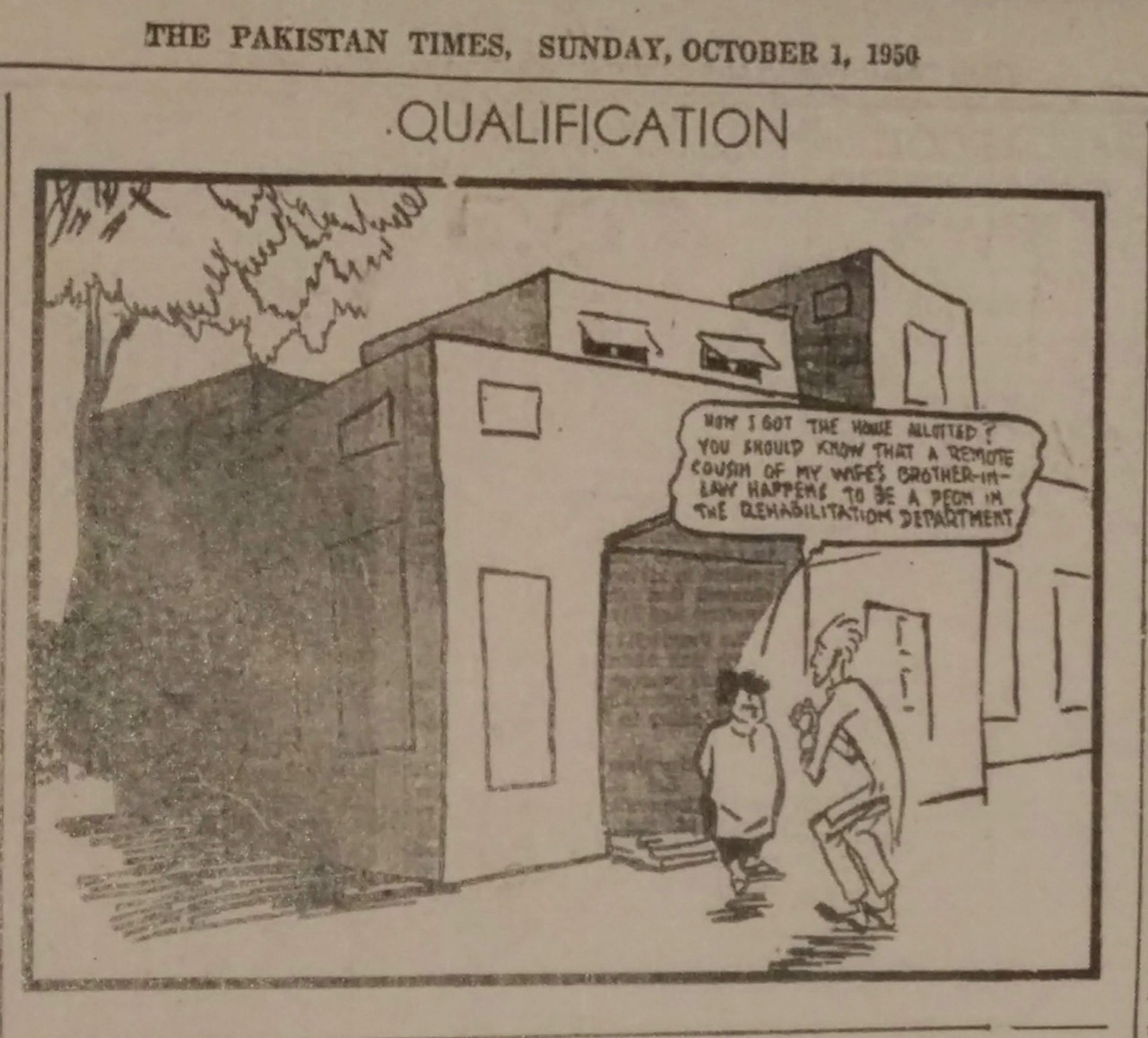
The Pakistan Times, 1 October, 1950. Qualification. “How I got the house allotted? You should know that a remote cousin of my wife’s brother-in-law happens to be a peon in the Rehabilitation Department.”

Qualification PT
© 2019 Pippa Virdee


The Pakistan Times, 16 September 1950, “They were demanding bread.” “Communists–Aren’t They?”

Communist PT
© 2019 Pippa Virdee

“Women’s World: Pakistanis in England”

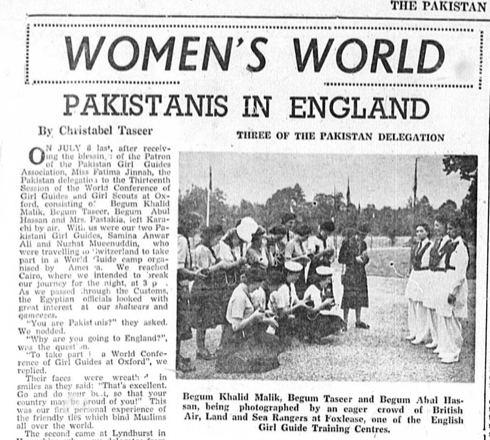
pt 10 sep 1950Women’s World in The Pakistan Times, Sunday September 10, 1950.

Pakistanis in England by Christabel Taseer

On July last, after receiving the blessings of the Patron of the Pakistan Girl Guides Association, Miss Fatima Jinnah, the Pakistan delegation to the Thirteenth Session of the World Conference of Girl Guides and Girl Scouts at Oxford consisting of Begum Khalid Malik, Begum Taseer, Begum Abul Hassan and Mrs Pastakia, left Karachi by air. With us were our two Pakistani Girl Guides, Samina Anwar Ali and Nuzhat Mueenuddin, who were travelling to Switzerland to take part in a World Guide Camp organised by America. We reached Cairo, where we intended to break our journey for the night. As we passed through the Customs the Egyptian officials looked with great interest at our shalwars and qameezes.
“You are Pakistanis?” they asked.
We nodded.

Why are you going to England?” was the question.

“To take part in a ‘World Conference of Girl Guides at Oxford”, we replied.

Their faces were wreathing in smiles as they sald: “That’s excellent. Go and do your best, so that your country may be proud of you!” This was our first personal experience of the friendly ties which bind Muslims all over the world.

The second came at Lyndhurst in Hampshire, when we delegates from different countries were attending demonstrations of British Guiding, One day, (just after Eid), we were walking across the grass to a Ranger camp, wearing our white and green Guide uniforms, when a young woman dressed English Guide uniform came running quickly towards us.
“Tell me, are you Pakistani Muslims?” she cried,
We answered “yes” and looked at her eager face In surprise.

“I, too, am a Muslim, a Turkish Muslim from Cyprus,” she replied, “and I am here for Guide training. I am so very happy to see you, particularly because you are Muslims like myself. Here I am the only Muslim in the camp. Yesterday was Eid and there was no one with whom to share the happiness of that day.”

We all embraced with enthusiasm and sat down to talk about our respective counties and about Guiding, there. We parted with regret at the end of our stay, but again at Oxford, at the wind-up of our ten days’ Conference, when we had a huge Camp Fire of 10,000 Girl Guides from all over England, there, as all the delegates from the twenty-four countries represented marched slowly across the huge field to their respective places, there in front of everybody, leaning across the ropes, waiting to shake our hands in friendship, was our Turkish friend from Cyprus, Hatlee Tahsin!

From the moment we Pakistani delegates appeared in uniform in English, whether in London of Lyndhurst or Oxford, we attracted attention. People had become used to the dark-blue Guide uniforms of the British, the green of the Americans, the khaki of the Greeks, even to the dark-blue saris of the Indians – but spotless while starched shalwars and qameezes, with folded dark green dupattas and green ties and white shoes, were something quite out of the ordinary. Wherever we went we were surrounded by photographers and Girl Guides, and questioned by people – “How do you keep your uniforms so clean?” “Do you really wear such clothes in your country?” By the time we had been in England for two weeks, wherever we went, whether we were in uniform or wearing silk salwar and qameez or garara, people knew that ours was the dress of Pakistan.

But we found that many people, particularly the Guide delegates from the smaller European countries, still did not know where Pakistan was, and we often had to bring out a map and point out our country to them. We had to answer many questions about our food and general living habits, social customs, education, position of women, the meaning of purdah. People were tremendously interested in us as a country and full of admiration for the progress we had made in the last three years. Many people said that it must be a wonderful experience to be in a new country, where everything has to be built up by one’s own efforts.

GREAT EXPERIENCE

The Conference itself which took place in St Hugh’s College, Oxford, was a great experience. Here in the Conference Hall were hung the flags of the twenty-four nations represented at the Conference, whose delegates, of faiths as divergent as Protestant, Catholic, Jewish, Muslim, Hindu, Parsee, had met because they were united by a common purpose, viz, to work for the girl and women of the world. Think of the magnitude of the of the movement stated in 1910, which is such that a girl from Pakistan or Egypt can stop a girl who is wearing the Guide badge on the street in America or England, shake her by the hand, call her sister, and at once be friends with her. Our two Pakistani Girl Guides, who had never been abroad before, were received in London with affection and friendship, because they were Girl Guides and they were able to travel on to Switzerland with American, English and Australian Guides whom they had never seen before, but with whom they at once felt at ease.

11 LANGUAGES

In our Conference Hall, women used to chat in eleven different languages, there were women from seven countries who knew more French than English, we had an American Chairman, an English Vice-Chairman, a Belgian translator, and so on, but we were all one. For ten days at Oxford we sat and discussed subjects as diverse as training programmes, camping, finances, public relations, constitution, future policy, – sometimes in English, sometimes in French,- we were entertained in castles and palaces and country homes, we were received in Buckingham Palace by Her Majesty the Queen, we listened to concerts, saw pageants and displays of dancing, and ended a very full fifteen days’ programmes with the gigantic Camp Fire programme at Oxford, on the 29th July, which was attended by 10,000 Guides from all parts of England and which was presided over by Princess Margaret. The Camp Fire was a stupendous sight. An enormous field filled with a sea of faces, all cheering lustily as the delegates from the twenty-four countries marched slowly across the field. Over 10,000girls and women were singing the songs which are known to the two and a half million Guides all over the world, all friendly and united because they were all Guides who had taken the same promised of service to mankind and who all lived recording to the precepts of the ten Guide laws. There they all were – over 10,000 of them, representing the two and a half million Guides in the jungles of Africa, the mountains of Switzerland, the forest of Canada, the Philippine Islands, the plains of Pakistan – Guides from large towns and tiny villages, of different races and creeds and cultures, all different, but nevertheless all one.