Triggered by a conversation today and dedicated to those who have not come across the work and poetry by Faiz Ahmed Faiz. Normally I would share something in Urdu (with a translation), as most of his work is in Urdu. However, then I came across this piece titled “When Autumn Came”, and I’ve not seen an Urdu version of this. If anyone knows of the the Urdu version please do leave the details in a comment. This poem is included in “The True Subject: Selected Poems by Faiz Ahmed Faiz” by Naomi Lazard (1987).
This is the way that autumn came to the trees:
it stripped them down to the skin,
left their ebony bodies naked.
It shook out their hearts, the yellow leaves,
scattered them over the ground.
Anyone could trample them out of shape
undisturbed by a single moan of protest.

The birds that herald dreams
were exiled from their song,
each voice torn out of its throat.
They dropped into the dust
even before the hunter strung his bow.

Oh, God of May have mercy.
Bless these withered bodies
with the passion of your resurrection;
make their dead veins flow with blood again.

Give some tree the gift of green again.
Let one bird sing.
Jabbar, Abdul. “NAOMI LAZARD’S ‘The True Subject: Selected Poems of Faiz Ahmed Faiz.’” Journal of South Asian Literature 26, no. 1/2 (1991): 156–70. http://www.jstor.org/stable/40873227.
This post is inspired by the sky outside, which immediately reminded me of Manto’s Mottled Dawn. Saadat Hasan Manto, born in Samrala, Ludhiana, is considered one of the most iconic Urdu writers of the twentieth century. He lived in Bombay until 1948 and worked as a successful screenplay writer for the film industry, but even he finally relented and left India for Pakistan. Khalid Hasan writes, “Manto left Bombay, a city that he loved and a city that he yearned for until his dying day, soon after Partition. He felt deeply disturbed by the intolerance and distrust that he found sprouting like poison weed everywhere, even in the world of cinema. He could not accept the fact that suddenly some people saw him not as Saadat Hasan but as a Muslim.” Mottled Dawn: Fifty Sketches and Stories of Partition (Intro. Daniyal Mueenuddin and trans. Khalid Hasan, Penguin Modern classics), brings together stories of dark humour and horror, powerfully capturing the tragedy of Partition. The book begins with the opening lines of Faiz Ahmed Faiz’s Subh-e Azadi – Mottled Dawn.
Below is the full poem by Faiz, courtesy of Penguin.
Subh‐e AzadiYeh daagh daagh ujaalaa, yeh shab gazidaa seherWoh intezaar tha jiska, yeh woh seher to nahinYeh woh seher to nahin, jis ki aarzoo lekarChale the yaar ki mil jaayegi kahin na kahinFalak ke dasht mein taaron ki aakhri manzilKahin to hogaa shab-e-sust mauj ka saahilKahin to jaa ke rukegaa safinaa-e-gham-e-dilJawaan lahu ki pur-asraar shahraahon seChale jo yaar to daaman pe kitne haath padeDayaar-e-husn ki besabr kwaabgaahon sePukaarti rahi baahein, badan bulaate raheBahut aziz thi lekin rukh-e-seher ki laganBahut qareen tha haseenaa-e-noor ka daamanSubuk subuk thi tamanna, dabi dabi thi thakanSuna hai, ho bhi chukaa hai firaaq-e-zulmat-o-noorSuna hai, ho bhi chukaa hai wisaal-e-manzil-o-gaamBadal chukaa hai bahut ehl-e-dard ka dastoorNishaat-e-wasl halaal, o azaab-e-hijr haraamJigar ki aag, nazar ki umang, dil ki jalanKisi pe chaaraa-e-hijraan ka kuch asar hi nahinKahaan se aayi nigaar-e-sabaa, kidhar ko gayiAbhi charaag-e-sar-e-raah ko kuch khabar hi nahinAbhi garaani-e-shab mein kami nahin aayiNajaat-e-deedaa-o-dil ki ghadi nahin aayiChale chalo ki woh manzil abhi nahin aayi —Faiz Ahmed Faiz
The Dawn of Freedom, August 1947
This light, smeared and spotted, this night‐bitten dawn
This isn’t surely the dawn we waited for so eagerly
This isn’t surely the dawn with whose desire cradled in our hearts
We had set out, friends all, hoping
We should somewhere find the final destination
Of the stars in the forests of heaven
The slow‐rolling night must have a shore somewhere
The boat of the afflicted heart’s grieving will drop anchor somewhere
When, from the mysterious paths of youth’s hot blood
The young fellows moved out
Numerous were the hands that rose to clutch
the hems of their garments,
Open arms called, bodies entreated
From the impatient bedchambers of beauty—
But the yearning for the dawn’s face was too dear
The hem of the radiant beauty’s garment was very close
The load of desire wasn’t too heavy
Exhaustion lay somewhere on the margin
It’s said the darkness has been cleft from light already
It’s said the journeying feet have found union
with the destination
The protocols of those who held the pain in their
hearts have changed now
Joy of union—yes; agony of separation—forbidden!
The burning of the liver, the eyes’ eagerness, the heart’s grief
Remain unaffected by this cure for disunion’s pain;
From where did the beloved, the morning breeze come?
Where did it go?
The street‐lamp at the edge of the road has no notion yet
The weight of the night hasn’t lifted yet
The moment for the emancipation of the eyes
and the heart hasn’t come yet
Let’s go on, we haven’t reached the destination yet
—Translated by Baran Farooqui
Saadat Hasan Manto (1912–1955), one of the greatest storytellers of the 20th century that South Asia has produced. Writing mainly in the Urdu language, he produced 22 collections of short stories, a novel, five series of radio plays, three collections of essays and two collections of personal sketches. His best short stories are held in high […]
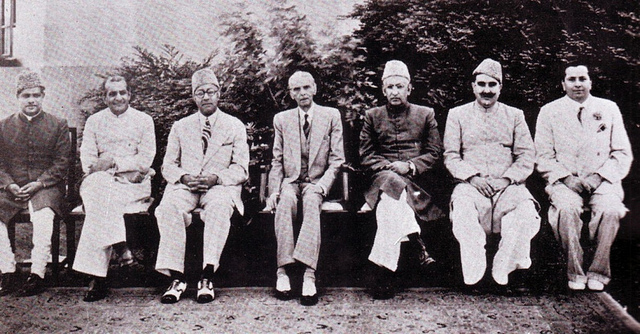
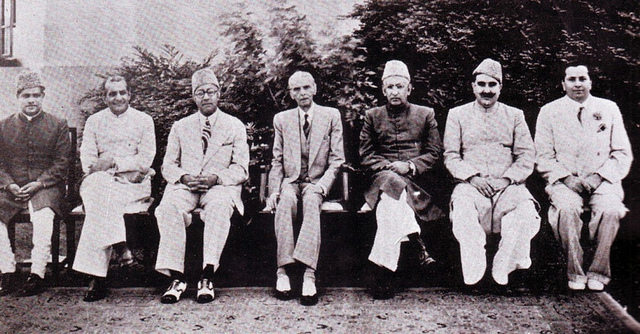
Fazlur Rehman, Ghulam Muhammad, Liaquat Ali Khan, M A Jinnah, Ibrahim Ismail Chundrigar, Abdul Rab Nishtar and Abdul Sattar Pirzada. Picture credit, Dr. Ghulam Nabi Kazi
Fazlur Rahman, then-Minister for Commerce & Education, was born in then-Dacca and was a lawyer-politician of the Bengal Provincial Muslim League, who had served as Revenue Minister of the pre-partitioned province. On 14 September 1949, he sent a 14-page letter (F. No. 14-313/49-Est) to Prime Minister Liaquat Ali Khan, in which he set out his trenchant comments and an accompanying template for the ‘two-fold task’ confronting them namely (1) ‘to lay the foundations of an educational system based on “Islam”’ and (2) to imbue children ‘with an international outlook’.
Recalling the first Pakistan Educational Conference of November 1947 and its resultant educational ideology and institutions – ‘the Advisory Board of Education, the Council of Technical Education and the Inter-University Board’ – he felt that the time had come to overcome ‘the existing system of education, with its alien background, Hindu and Christian ideas, foreign to our ideology’, for as long as it continued, it could not be expected ‘to produce men and women who would realise the value of the Islamic way of life and would make loyal and zealous citizens of Pakistan’.
For the successful achievement of this task, two things were essential: (i) text-books and (ii) teachers. As far as text-books were concerned, the need for Rahman was ‘to draw up the syllabus for every subject on the basis of Islamic ideology (as distinct from instruction in Islamic theology) and get text-books written by competent authors’. He wanted ‘Urdu readers – fundamentally the same all over Pakistan’, necessitating ‘a change in the existing system of publication – whose sole motive is profit-making’. Thus, ‘the Central Government should have them written under supervision’.
There was also the matter of ‘compiling a national history as a kind of reference book’ comprising researched topics like (a) ‘Islamic history and civilisation, (b) the rise and fall of Muslim states all over the world and (c) the contribution made by Muslims to the Indo-Pakistan sub-continent’. For the adoption of Islamic ideology, it was ‘essential to establish a Research Institute in Islamiyat’. As regards teachers and their training, ‘a number of Central Training Institutions’ were needed. These two were ‘fundamental problems which exclusively concerned the Central Government’.
While education was constitutionally the responsibility of the provinces – like in India – their ‘limited resources’ and its ‘all-Pakistan character’ made it ‘incumbent on the Central Government’ to take the lead – ‘from adult to university education’. For ‘democracy and illiteracy go ill together. The illiteracy percentage for India [before 1947] was nearly 90, but with the establishment of Pakistan and the exodus of non-Muslims (educationally more advanced) and the influx of Muslim refugees (to a large extent illiterate)’, there was an increased mass illiteracy in Pakistan.
Adult education, however, was not ‘mere imparting of literacy’ but included ‘spiritual, civic and vocational motives’ for the creation of a patriotic and productive citizenry. This involved infrastructure, implements, literature, teachers and audio-visual aids, for the provision of which, ‘the Central Government must assume certain powers’. Equally important was ‘the provision of free, universal, compulsory primary education’, involving a vast expenditure. ‘Free, compulsory secondary education’ was ‘unfeasible and must be left to future’.
Anyhow, the Central Government had the ‘clear responsibility’ to produce ‘patriotic citizens not warped by narrow provincialism or alien cultural elements as the Hindu influence in East Bengal’. National solidarity therefore required ‘the speedy revision of curricula and syllabi and re-writing of textbooks’. Another problem was the ‘place of Urdu in national life’. As Jinnah had made it ‘abundantly clear’ that Urdu was to be ‘the national language’ and as, by adopting Hindi in Devanagari script, India had ‘dealt a blow’ to Urdu – ‘the cultural heritage of Indian Muslims’.
For Rahman, language was a ‘potent means’ to maintain ‘cultural ascendancy and a separate political consciousness’. Urdu with its Persian and Arabic words was ‘alien in spirit to Hindu culture’, essentialising its ‘elimination from Indian national life’. Conversely, in Pakistan it was ‘a matter of vital necessity to have Urdu in Arabic declared forthwith as state language, a compulsory subject in schools’ overcoming the ‘narrow provincialism’ and ‘parochial mentality’ of East Bengal and Sind and resistance of West Punjab and NWFP ‘to assimilate the vocabulary and culture of these two’.
It was a no-brainer for ‘all employees of the Central Government be required to know Urdu’ and a Bureau of Translation be set up for all technical-scientific terms. In this connection, it is important to remember that in 1949, the Hindu community in East Bengal constituted one third of its population, among whom were ‘the caste Hindus – wedded to the Bengali language – the hard-core of resistance’. Rahman was concerned about their potential for ‘an anti-national mentality’ without ‘a pro-Islamic outlook’; ‘dependable citizens of Pakistan with due regard to their religious rights’.
His suggestion was to ‘reconstruct the Bengali language’ with ‘the Arabic script’ thereby ‘putting an end to the disruptive activity being carried in the name of the common culture of the two Bengals’. Moreover, the ‘present Bengali language with its Sanskrit script’ was ‘steeped in Hindu influence, full of Sanskrit words, Hindu mythology and [thus] anti-Islamic’. The Arabic script would ‘eliminate Hindu influence, facilitate adult education, link up East and West Pakistan [and] ensure East Bengal’s willing acceptance of Urdu as a national language’.
In technical education, Pakistan then had only 3 ‘engineering colleges’, like its 3 universities, for a population of 80 million, ‘impaired by the exodus of non-Muslim teachers’. A ‘Grants Committee’ for both was needed. Here, the ‘main obstacle’ was ‘the attitude of the Ministry of Finance’, to which education was a ‘provincial responsibility’. Rahman had forged the establishment of a History Board, Adult Education Centres in East Bengal, a Central Syllabus Committee with its Bengali sub-committee, a Committee of adopting Arabic script and a Committee on Technical Education.
His future proposals were less piece-meal and included the Central Government assuming ‘direct responsibility for the general planning and coordination of education’, a central-provincial sharing of adult education expenditure, central financial assistance for free, compulsory primary education in provinces, Urdu as state language, Arabic script for regional languages and centres for translation, Islamiyat, teachers’ training and a University Grants Committee.
First Cabinet of Pakistan – Ministers of Liaquat Ali Khan & Muhammad Ali Jinnah in 1947
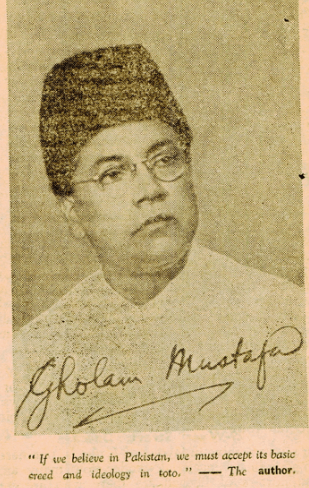
Picture taken from ‘The Battle for Pakistan’ pamphlet
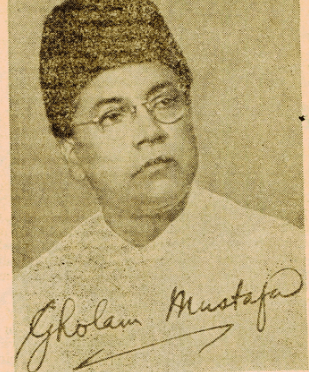
I recently came across Golam Mostofa and his rather state-centric as opposed to peoples-oriented 20-page pamphlet on The Battle for Pakistan, which examines the entangled questions of state-language and the basis of Pakistan. Mostofa was the secretary of the East Bengal Government’s Language Reform Committee, while being a strong proponent of the two-nation theory and an advocate for Urdu as the national language for Pakistan.
As the ideological imagination, and its linguistic articulation, in early-Pakistan was taking shape, Firoz Khan Noon (Governor of East Pakistan) had his vision of converting Bengalis into Urdu speakers by using religion to play on their sentiments (Jalal 2014, 87). Urdu was deemed the only language that could strengthen national unity over ethnic groups. Noon commissioned various argumentative material to this end, including Mostofa’s pamphlet that presented a case for adopting Urdu in East Pakistan. Below are some extracts from the pamphlet, which was published c. 1952.
The Ideology of Pakistan
An unwarranted bitterness has been created over the question, of whether Urdu or Bengali should be the State-language of Pakistan. This sort of domestic quarrel at this nascent stage of Pakistan is really very sad…Long before the announcement of the Quaid-i-Azam, I said at a public meeting in Dacca that Urdu should be the State-language of Pakistan, though, of course, Bengali should not be discarded. The following extract from the report of the Hindustan Standard will bear me out:
“Poet Gholam Mustafa said that those who wanted to make Bengali as the State-language of Pakistan were looking at a narrow angle of geographical limits; but if they consider Pakistan as a dynamic unifying force in the world, they could not brush aside Urdu. He was inclined to the view that Bengali language was responsible for the decline of the Bengali Muslims as that language reflects the idea of non-Muslims”. (12-11-1947)
Significance of State-Language
The very expression “State-language” pre-supposes the existence of a State. The State-language of a State should therefore be that language by which the interests of the State can be served best. [emphasized in original] …The question of the safety and integrity of the State therefore comes first in determining a State-language. If we quarrel amongst ourselves over this issue and the ‘State’ disappears as a result thereof, what shall we do with the ‘language’ left behind? Language is a means to an end, not an end in itself. When the British conquered this country, they made English the State-language, not for our convenience, but for the interests and ideals of their State. The same principle will apply equally to Pakistan.
Our Problems
The argument of those who say that Bengali should be the State-language of Pakistan because of the numerical superiority of the Bengali Muslims has no leg to stand upon. Had numerical strength been the only determining factor in solving national problems like this, surely, we could not get Pakistan in India, as the Hindus commanded an overwhelming majority over us…Ideals cannot be judged by votes alone.
Pakistan is one State. It is, as it were, a bouquet of five flowers, none of which can be separate from the others. There is no such thing as Eastern Pakistan and Western Pakistan…The different provinces are to the Pakistan State what the limbs are to the body. If the limbs fall out and do not co-operate with one another, the body cannot exist…Pakistan is still beset with various dangers and difficulties…If Bengali and Urdu are both given the status of two State-languages, one for the East, the other for the West, it will only serve the purpose of the enemies. It will give rise to narrow provincialism among us, culminating in the ultimate separation between the two wings.
The demand for Bengali as the State-language of Pakistan therefore signified the triumph of Hindu culture and, as such, is in itself a strong symptom for the intravenous injection of Urdu in the cultural life of the Bengali Muslims. It is really very amazing that the Bengali Muslims are unwilling to accept Urdu for fear of Punjabi domination, but are quite agree- able to be slaves of Bengali culture which is dominated by the Hindus.
On analysis, it will be found that the ‘Bengali for Bengal’ movement owes its origin to the borrowed idea of nationalism. Bengali Muslims are a separate unit having distinct culture of their own – this territorial patriotism has prompted the agitators to go in for Bengali. But they do not perhaps know that there is no such nationalism in Islam. Islam is preacher of internationalism or extra-territorialism.
Conclusion
We have got Pakistan. But real Pakistan is still far away…It is a thorny path and, as such, we have got to sacrifice much before we reach our goal. We must not be satisfied with our geographical Pakistan. Pakistan is an ideal…Islam is appearing in a new historic role and Pakistan will be the stage board of that great episode. For that ultimate goal, the entire Muslim World should first of all unite under one banner. Egypt, Arabia, Iran, Syria, Afghanistan, Pakistan, Indonesia: all the Muslim States of the world are therefore combining together to form a “Sixth Continent”. Will the Muslims of East Pakistan lag behind?
Following biographical details are provided on Wikipedia: Golam Mostofa (1897 – 13 October 1964): “Mostofa started teaching at Barakpore Government School in 1920. He retired as headmaster of Faridpur Zila School in 1949…His book Biswanabi (1942), a biography based on the life of the Prophet Muhammad, provided him with recognition.”
Other references
Jalal, Ayesha. The Struggle for Pakistan. Harvard University Press, 2014.
Firoz Khan Noon (left), Governor, East Bengal (31 March 1950 – 31 March 1953) to Al-Haj Khwaja Nazimuddin (right), Prime Minister of Pakistan (17 October 1951 – 17 April 1953), 28 February 1952
When Pakistan was created in August 1947, it was made up of two wings, East and West. In 1951, when its first census took place, the combined population of both wings was 76 million; 34 million in West and 42 million in East. The Bengalis made up the majority of the population of East and this made Bengali/Bangla the language spoken by the numerical majority of Pakistan. But Urdu was seen as the national language, while being the mother tongue of barely 5 per cent of the population then. However, it was more than a language; it was attached to the very core of the Pakistan Movement as the Quaid-i-Azam Mohd. Ali Jinnah declared in Dacca (Dhaka) in 1948. Yet, soon thereafter, the fractures and fissures between the two wings began to open up, due to the discriminatory and step-brotherly treatment of the East Pakistanis; not just in the language sphere.
By 1952, there were large-scale demonstrations and unrest centred around the University of Dhaka and on 21 February 1952, these ended in violence, in which the police clamped down on the protestors resulting in numerous casualties. Since 2000, the United Nations has observed 21 February as the International Mother Language Day. Bengali/Bangla was eventually recognised as an official language of Pakistan (alongside Urdu) in article 214(1), when the first constitution of Pakistan was enacted on 29 February 1956. Longer term though, this parity in the Constitution failed to address the underpinning problems and East Pakistan eventually became Bangladesh following the civil war of 1971.
The letter below, sent a week after these protests, from Malik Firoz Khan Noon, a prominent landowning Punjabi and future PM (1957-58) of Pakistan, then-Governor, East Bengal Governor to Sir Khwaja Nazimuddin, an aristocrat Bengali and Jinnah’s successor as Governor-General (1948-51) of Pakistan, then-PM (1951-53), shows the failure to recognise the legitimate grievances of the language movement.
Noon to Nazimuddin, 28 February 1952
The Vice-Chancellor and other members of the Executive Committee have closed the University. Some students are leaving: others will try to hang on in Dacca. Out in the districts no untoward incidents have taken place except this that students have been trying to make themselves a nuisance at railway stations and in the cities, and the papers who write explaining true facts are not allowed by the students to be distributed by the hawkers in the district headquarter towns. The Government are now planning to drop pamphlets from the air throughout the province. I do not think that the Muslim League Ministers or other leaders can go out into the province as yet for three or four weeks to explain their point of view, but our propaganda has been very weak: almost non-existent. The Government point of view has not had the chance to go before the public yet.
I feel that both in Western Pakistan and in East Pakistan our propaganda machine should be put into full force and the true situation exposed to the public, viz. that this was a conspiracy between the communists and some of the caste Hindus of Calcutta, and certain political elements in East Pakistan who wanted to replace the Ministry: the students were made the cat’s paw. Their idea was to set up a puppet Ministry here, with Fazlul Huq as the Chief Minister, and then negotiations were to start for the unification of the two Bengals. I feel that it is most important that this true position must be exposed to the public who should realise the danger that we still continue to face in this province. The language question was only a subterfuge very cleverly exploited. In this province we are doing what we can to put forth our point of view, and Mr Fazl-i-Karim – Education Secretary – who has just returned from abroad has been asked to take charge of this work.
The second point to which I should like to draw your attention is that during the coming session of the Central Legislature, this Bengali language question must be settled once for all, and I do not think that you can get out of it without accepting Bengali as one of the state languages, but it must be Bengali written in the Arabic script. The sooner this resolution is passed the sooner will this controversy be settled. I have no doubt that the Hindus will create trouble about the script, but no Muslim will be able to raise his voice against the Arabic script, because in this way we shall have all the Provincial languages written in the same Arabic script, and this is most essential from the national point of view. I am told that during the time of Shaista Khan, Bengali was written in the Arabic script: there are some books in the museum here written in that script. If Bengali were written in the Arabic script – 85 % of the words being common between Urdu and Arabic if properly pronounced soon a new and richer language will emerge which may be called ‘Pakistani’. But something has to be done in this matter. We cannot let matters adrift.
The Arabic script will be the biggest disappointment to the Hindus who have been at the bottom of it, and that is the real crux of the whole question. The Jamiat ul Ulama-i-Islam in this province under the presidency of Pir Sahib of Sarsina and Secretary-ship of Maulana Raghib Asan have already passed a resolution demanding the writing of Bengali in the Arabic script, and no Muslim M.L.A. – either in Karachi or here – will be able to oppose the Arabic script. As a matter of fact, the Muslim League Party here last year went to the extent of passing a resolution saying that Arabic should be the national language of Pakistan. The object really was to do away with Urdu, but it is certainly a point which may be used by you in your speech, if necessary. The Aga Khan has written a very good pamphlet on this subject. It was going to be published but unfortunately it has been burnt with the Jubilee Press. The Aga Khan has promised his followers to be provided with a revised copy and I will try and let you have one as soon as it becomes available.
One of the main points the Aga Khan brought out was this that Persia changed their script from the old Pehlvi script into the Arabic script and in that way their literature became richer than ever, and by changing the script the Persian language did not lose anything nor would the Bengali language. He also tried and impressed that by enforcing the Arabic script the Bengali literature will be available to all other Muslim countries who will be able to appreciate the work of the Bengali authors. Similarly, the literature of all other Muslim countries will be open to Bengali Musalmans who know the Arabic script. He also pointed out in his pamphlet that every Musalman has to learn Arabic in any case because the boys and girls must read the holy Quran, and if they are conversant with the Arabic script why should this Dev Nagri script be thrust on them unnecessarily. It will be conceded on all hands that if in the schools in East Bengal boys and parents were given the option for children to learn Bengali either in the Arabic script or in the Dev Nagri script, they would all choose the Arabic script.
Quite a large amount of money is being earned by Calcutta Hindu authors who have the monopoly of all our school text books and it is they who are spending money in support of the Bengali language and would even spend money in support of the Dev Nagri Script. It should not be forgotten that people in West Bengal themselves have not asked for Bengali language to be accepted as a State language in Bharat: they have accepted Hindi as their national language.
S.M. Shamsul Alam (1991) ‘Language as political articulation: East Bengal in 1952’, Journal of Contemporary Asia, 21:4, 469-487, DOI: 10.1080/00472339180000311
Introduction In 19th-century colonial India, language was more than a tool for communication. It was also a marker of identity for communities. While language helped reshape identities in the colonial backdrop, languages themselves were also influenced by policies and practices. Given the diversity of languages and their varying functionality in a place like India, the […]









 BAGICHA