I came across this fascinating article on ‘The Origin and Growth of Pakistan Railways’ by M. B. K. Malik in Pakistan Quarterly, 1962, Vol 11, No. 1. It provides a brief history of building the railways in British India, especially the motivations and impact this had on the two outer regions of Bengal and Punjab. What captured my interest was actually the objections put forward in the initial days. The first one is from the British perspective, but the second one is from a high-caste Hindu, who obviously envisages multiple problems for those guided by astrologers. Both however, express suspicion and concern at this new system of transport and the wider impact it will have on society and the environment. Of course the railways went on to be built in both Britain and British India, and became pivotal to colonial rule. The economy of empire, with key towns and port cities, coupled with the ability to swiftly move the colonial army from cantonment towns was only made possible because of the railways in British India. But that’s another story. Read below the extract from pages 22-23.
Pakistan Quarterly, 1962, 11, 1, Page 23
The earliest proposals to build railways in India had been made to the East India Company in England in 1844 by Mr. R. M. Stephenson and others. But the time was not propitious. The land had not yet recovered from the effects of the Sind Wars, and the British power and the Sikhs in the Punjab were on the verge of an armed conflict. Nor were the Court of Directors of the East India Company convinced of the feasibility of railways in India. Even in England and Europe railways had met with opposition. In 1835 John Bull had denounced the railways as a menace:
“If they succeed” wrote the paper, “they will give an unnatural impetus to society, destroy all the relations which exist between man and man, over-throw all mercantile regulations, over-turn the metropolitan markets, drain the provinces of all their resources, and create at the peril of life, all sorts of confusion and distress. If they fail, nothing will be left but the hideous memorials of public folly”. It further remarked : “Does anybody mean to say that decent people …. would consent to be hurried along through the air upon a railroad, from which, had a lazy schoolboy left a marble, or wicked one a stone, they would be pitched off their perilous track into the valley beneath; …. being at the mercy of a tin pipe copper boiler, or the accidental dropping of a pebble on the line of way?…. We denounce the mania as destructive of the country in a thousand particulars …. the whole face of the kingdom is to be tattooed with these or a odious deformities …. huge mounds are to intersect our beautiful valleys; the noise and stench of locomotive steam-engines are to disturb the quietude of the peasant, the farmer and the gentleman; and the roaring of the bullocks, the bleating of sheep and the grunting of pigs to keep up one continual uproar through the night along the lines of these most dangerous and disfiguring abominations”.
Objections by Hindus The orthodox Indians had religious objections. A civilian District Officer, posted in the province of Bihar during the sixties of the last century, has recorded an interesting story showing how orthodox Hindus regarded railway travelling in those days. The officer questioned a nobleman, who had just returned from his first journey by rail, about his views on railway travel. The nobleman replied that it made great noise and that it would be difficult for persons of his high caste to travel at all by such means:
The trains only go at stated times; now I cannot commence a journey except at the minute decided upon by my astrologer as a favourable moment for starting. This makes it very difficult for me to travel at all. Tomorrow I have to go to Muzafferpur, and the astrologer has decided that I must start at 1 A.M. Now my cousin Gadahur went by railway the other day with his wife, and daughter of six years old, and a baby. He started at an unfavourable moment. His wife and two children and a maid-servant were put in a palanquin, which was placed on a truck, which prevented their being seen; and he went in an ordinary carriage. Somehow or other a spark from the engine flew into the palanquin and set fire to some of the linen in which the baby was wrapped; and the servant in her confusion, thinking it was only a bundle of clothes, threw it out. The moment it was done she found out the mistake and they all shrieked. This was only a mile from the Patna station and the train soon stopped. The station master was very kind and did his best, but the palanquin was on fire, and the wife in getting out was seen by many persons. It is not a fit subject even for conversation”.
But all the objections came to naught. England was just entering the age of ‘railway mania’ and it was decided to construct railways in India through Guaranteed British Companies.
Langar at Gurdwara Pehli Patshahi, Lahore, Pakistan.
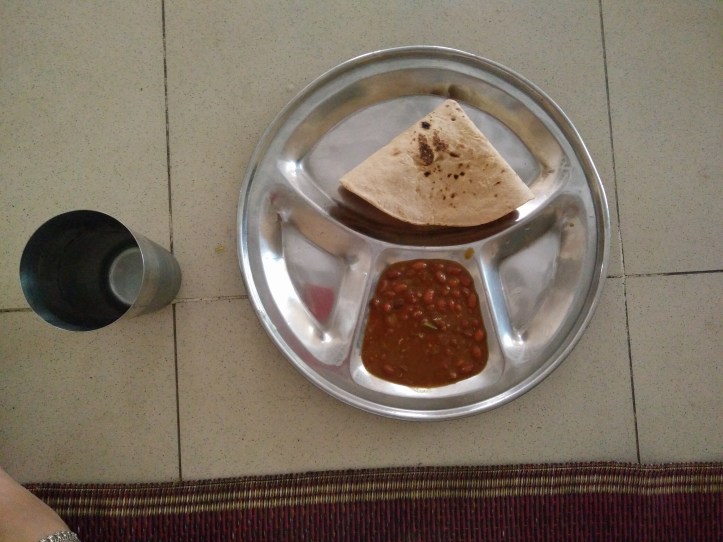
One of the earliest pieces I started with on this blog was with this picture of Guru ka Langar (or food for the congregation) in Lahore. The simplicity of daal (lentils) or in this case rajma (kidney beans) with roti (bread) is the basis of most langar served in a Gurdwara. As a child, I remember most children enjoyed going there in part because of the karah parshad (sweet halwa made from whole wheat flour) given at the end of the service and followed by the (free) food, which had its own distinctive divine taste, impossible to recreate at home.
Langar is the communal partaking of food when visiting Gurdwara. The concept has in recent years been popularised globally by Sikh organisations such as Khalsa Aid, which plan, produce and distribute langar to people across the crisis-ridden world, be it to the truckers stranded in Dover over the ongoing Christmas period or in recent war-torn Syria. With Langar spreading so does knowledge about and experience of the Sikh community. Currently, closer to the home of Sikhism in Punjab, Langar has been making headlines via the ongoing farmers’ movement against new farm laws in India. Communal kitchens have been set-up by the roadside to feed the thousands gathered on the borders of capital, Delhi.
Origins
The word ‘langar’ (meaning ‘anchor’) is thought to have come into the Punjabi language from Persian (Nesbitt: 29); although the idea was not unique to the Sikhs, as ‘both the Sufis and the Nath Yogis have a system of collective eating (langar khanah and bhandaras). The Sikhs, however, used it as venue for both service and charity and provided the food themselves [unlike] the Nath Yogis, who begged for food, and the Sufis, who often accepted land-grants to run their kitchens’ (Mann: 27).
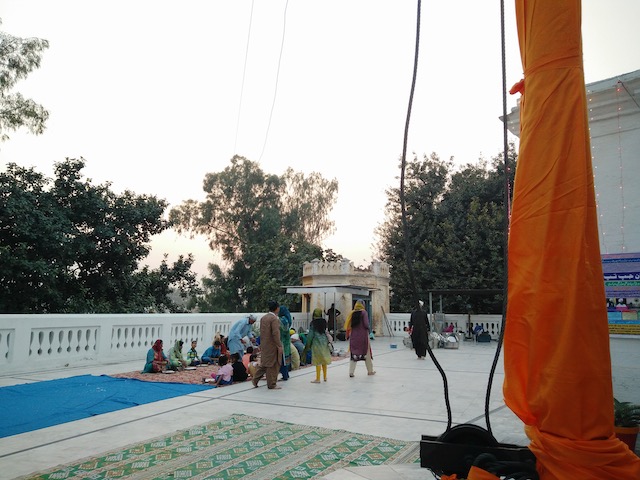
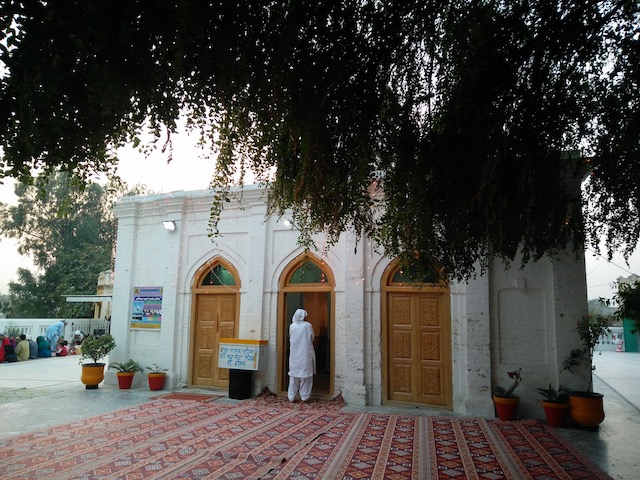
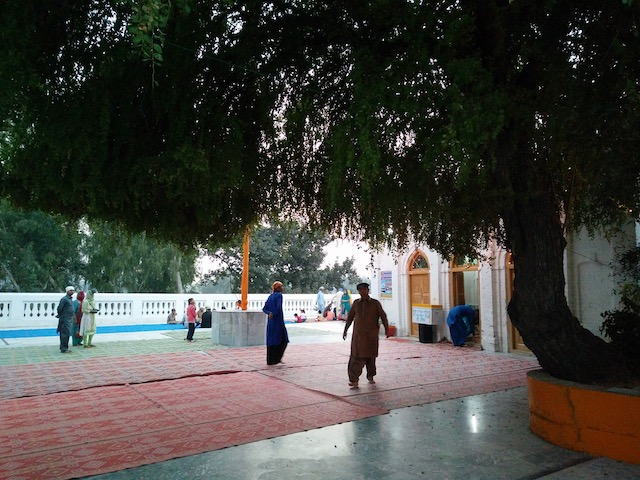
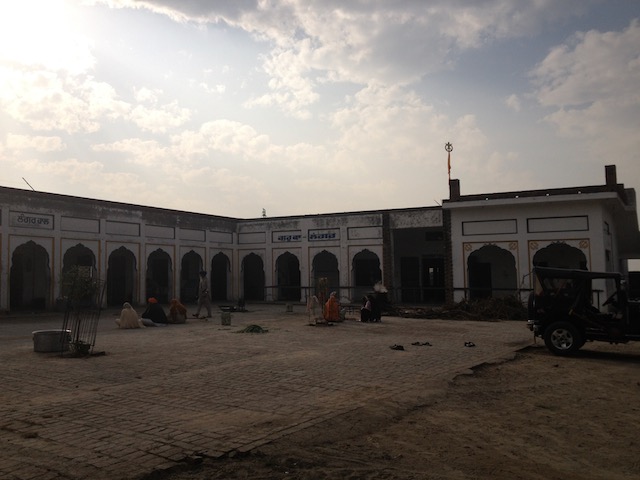
Pictures are of Gurdwara Sacha Sauda, Farooqabad, Pakistan and about 37 miles away from Lahore. This gurdwara is revered with the origins of the langar and is situated not far from Nankana Sahib, the birth place of Guru Nanak.
Baba Farid (1170s-1260s), a Sufi saint from the Chishti order, living in the Punjab, would distribute sweets amongst his visitors; a precursor to langar-khana near shrines, a practice documented in Jawahir al-Faridi (1620s) by a descendent of his. The khanqahs of the Chishti and other Sufi orders kept a langar open for the needy, but also others. It is said that ‘Khwaja Muinuddin established the tradition of an open kitchen for all who came…in an age of feudalism and violence’ (Talib: 6).
There is, of course, a much older practice of the alms house or dharmshala/sarai to feed travellers and poor for free, which is thought to have existed through the Gupta and Maurya (esp. Buddhist) times that is on either side of the BC/AD divide.
Faith
The connections between the Sufis and the Bhakti (devotional) traditions are well documented, inspired as both were by the idea of feeding the poor, the pilgrim and thereby removing divisions/discrimination among people. The idea concretised with the rooting of faith in the region and by early 17th century, it had become a recognised Sikh fixture (Desjardins).
Eleanor Nesbitt notes that, ‘in institutional terms, it was the third Guru, Amar Das [1479-1574], who gave prominence to the langar… [integral as] sharing food [was] to Guru Nanak’s Kartarpur community…it was Guru Amar Das who particularly emphasised the requirement for everyone to dine side by side, regardless of caste and rank’ (Desjardins: 29).
There were two women, who especially, ‘nurtured the development of the langar tradition in its formative period: Mata Khivi (1506-82) and Mata Sundri, the second and tenth Gurus’ wives’. The Guru Granth Sahib notes that ‘Khivi…is a noble woman, who…distributes the bounty of the Guru’s langar; the kheer—the rice pudding and ghee—is like sweet ambrosia’. After the death of Guru Gobind Singh (1666-1708), ‘his widow Mata Sundri worked hard to continue the free community kitchen service. Records show her active role in fundraising for this purpose when the very survival of Sikhism was in question… (Desjardins).
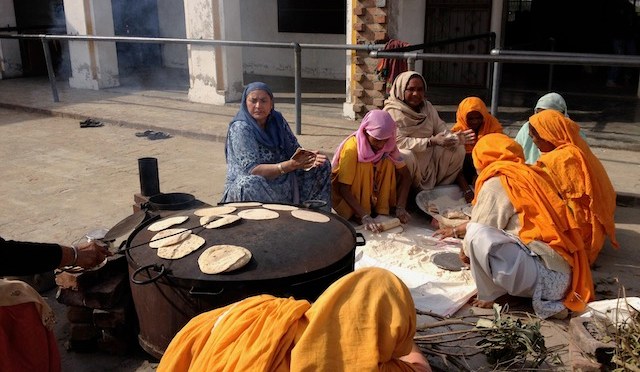
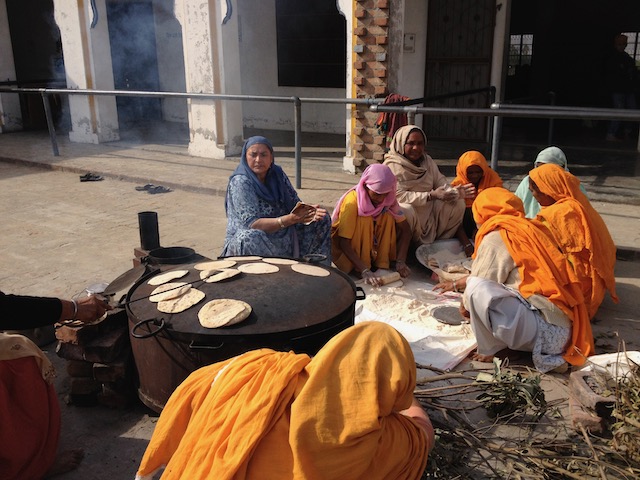
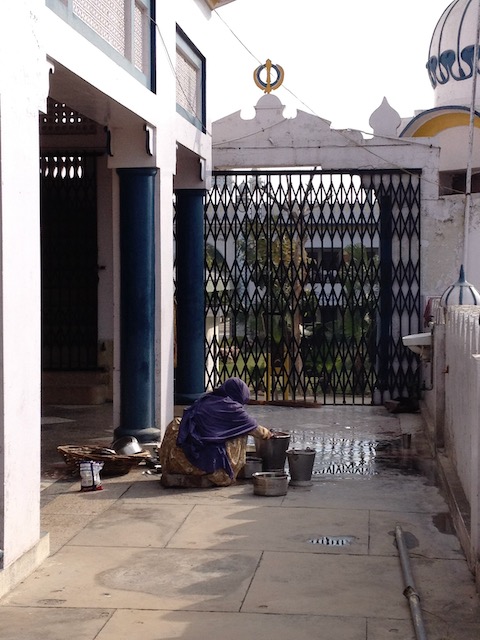
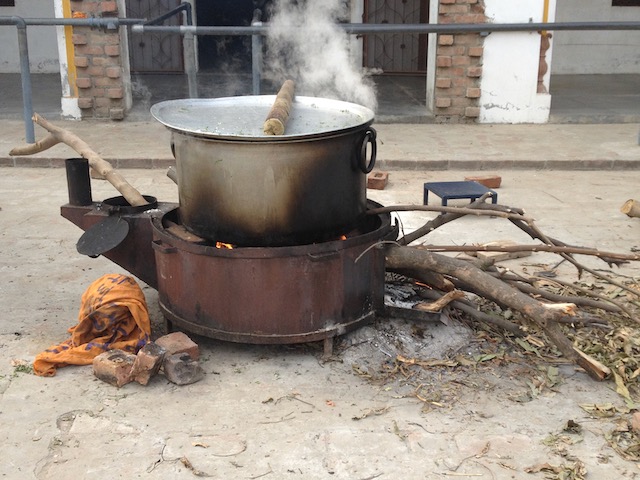
The langar since is thus an integral part of the faith/religion, its compassion through the concept of Seva (self-less service); essential for all practicing Sikhs. Donating food or money is not as important as the practice of giving one’s time and service. Today the most famous community kitchen serving langar has to be the Golden Temple (Amritsar), where around 100,000 people are served on a daily basis. However, most Sikhs grow up visiting and worshipping at small local gurdwaras, where everyday worshippers and volunteers prepare food on a daily basis. These photos are taken from the local gurdwara at Mao Sahib (my father’s village, Jalandhar district), where the congregation prepare, serve, consume the langar and then clean afterwards. As the gurdwaras become more institutionalised, and as the historic gurdwara Mao Sahib (associated with the fifth Guru Arjan and his consort Mata Ganga, d. 1621) has come under the administration of the SGPC (the Sikh body responsible for the management of gurdwaras), voluntary seva has been added to by paid sevadars.
The pictures are of Mao Sahib, 2012, when the langar hall was undergoing a renovation and some of the langar preparation was taking place outside.
Equality
The idea of sitting and sharing food together is fundamental among Sikhs because it demonstrates the abolition of caste and dramatically asserts humble equality amongst all the people; regardless of their religious or caste background. The food is generally simple and vegetarian, to appeal to all and offend no one. Four core Sikh principles are enshrined in the langar: equality, hospitality, service, and charity.
Eleanor Nesbitt writes about how, ‘the Gurus were reformers who abolished the caste system or that caste is Hindu, not Sikh’. It is important to remember how revolutionary this was/is in a caste-ridden society. Nesbitt notes how, ‘the langar subverted Brahminical rules about commensality, according to which only caste fellows could eat together’ (118). Instead, it was proclaimed that, ‘a Sikh should be a Brahmin in piety, a Kshatriya in defence of truth and the oppressed, a Vaishya in business acumen and hard work, and a Shudra in serving humanity. A Sikh should be all castes in one person, who should be above caste’ (117). The Gurus, like the Bhagats Namdev, Kabir, and Ravidas, proclaimed the irrelevance of people’s inherited status to their spiritual destiny. In Guru Nanak’s view:
Worthless is caste (Jati) and worthless an exalted name,
For all humanity there is but a single refuge (Adi Granth 83)
Quoted in Nesbitt: 118
Similarly, according to Guru Amar Das:
When you die you do not carry your Jati with you:
It is your deeds which determine your fate. (Adi Granth 363)
Quoted in Nesbitt: 118
References
Bowker, John (ed.), The Concise Oxford Dictionary of World Religions (OUP, 1997)
Report of a joint inquiry into the causes and impact of the riots in Delhi from 31 October to 10 November 1984. Published jointly by Gobinda Mukhoty, President, PUDR, 213, Jor Bagh, New Delhi- 110003 AND Rajni Kothari, President, PUCL, 1, Court Road, Delhi – 110054. November 1984
Following the assassination of Prime Minister Indira Gandhi by her Sikh Bodyguards on 31 October 1984, parts of Delhi, North India and other areas with Sikh populations became engulfed in an anti-Sikh pogrom. From 31 October to 3 November 1984 in the national capital, organised violence against the Sikh community was unleashed, unlike anything it had witnessed previously since the anti-Muslim carnage of September 1947. The ‘official’ claim later was that 2,800 Sikhs were killed in Delhi and 3,350 elsewhere in the country. However, independent sources suggest a much high figure. Among these, one of the first to come out was this fact-finding report by political scientist Rajni Kothari of the People’s Union For Civil Liberties and Gobinda Mukhoty of the People’s Union for Democratic Rights, which investigated the murders, looting and rioting that took place during those 10 days and published it later the same month. It starkly concluded that:
…the attacks on members of the Sikh Community in Delhi and its suburbs during the period, far from being a spontaneous expression of “madness” and of popular “grief and anger” at Mrs. Gandhi’s assassination, as made out to be by the authorities, were the outcome of a well organised plan marked by acts of both deliberate commissions and omissions by important politicians of the Congress (I) at the top and by authorities in the administration. Although there was indeed popular shock, grief and anger, the violence that followed was the handiwork of a determined group which was inspired by different sentiments altogether.
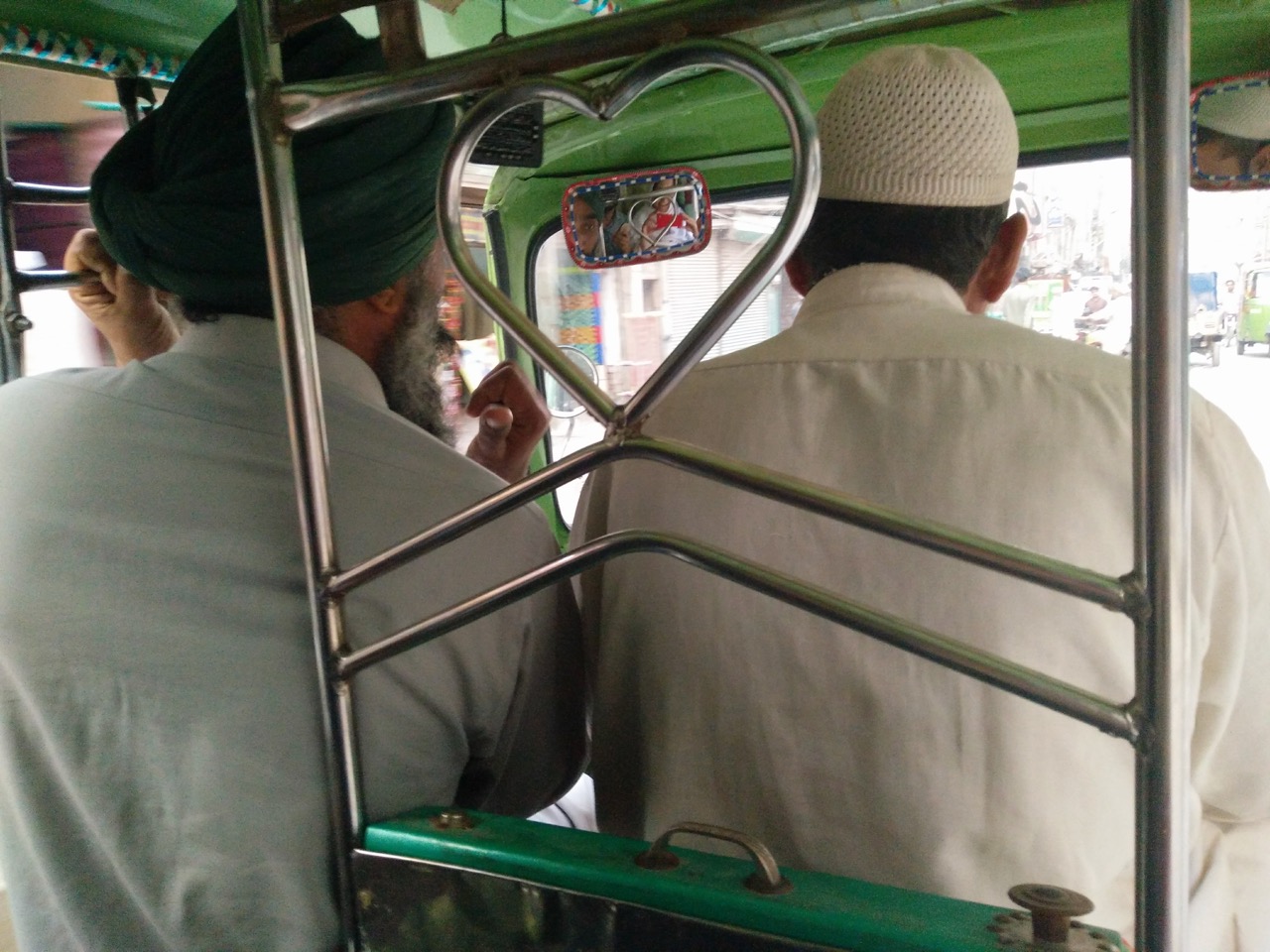
This picture was taken by me during one of the most memorable tuk tuk rides in Peshawar in 2017, when I was exploring the city and trying to find a gurdwara in the narrows lanes of the congested city. Along came this sardar ji who jumped on the tuk tuk and navigated us to Gurdwara Bhai Joga Singh. As the sounds and sights gather momentum around the opening of the Kartarpur corridor, I share this moment that speaks silently for the hopes of many.
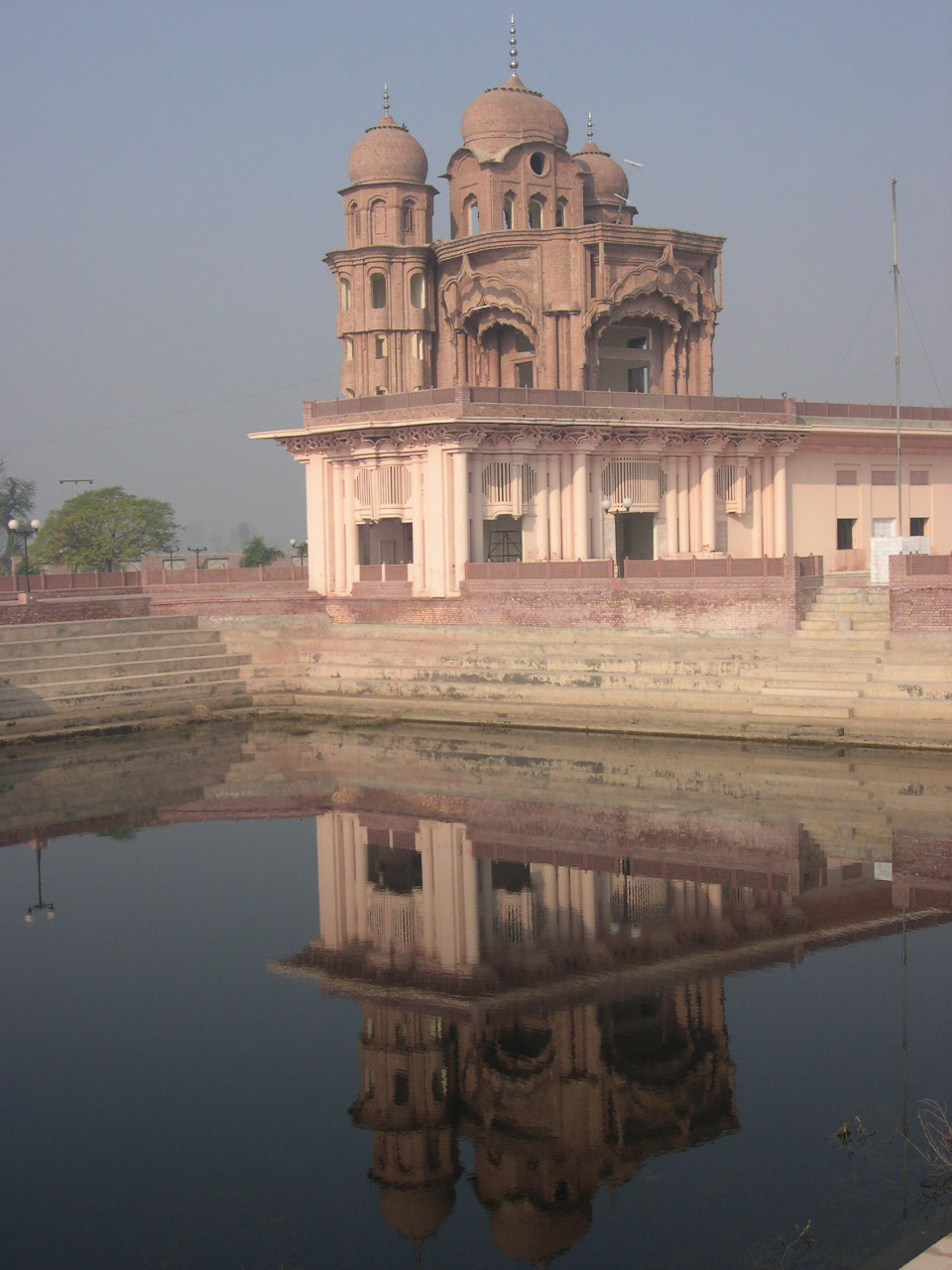
Gurdwara Sri Rori Sahib, Eminabad, Gujranwala (c) 2004 Pippa Virdee
A reflective essay on the lack of women in history writing and Punjab history. This was originally published in The Friday Times, 5 July 2019.
My first visit to Pakistan was in 2002. It was primarily to do research as a PhD student. At that time, I came with the religious baggage of belonging to a Sikh family and venturing into the known unknown. When I finally got my visa, I was very excited about travelling to the ‘near other’; unknown yet somehow familiar. After all, I rationalised, the cultural region of Punjab is, well, Punjab across both sides of the Radcliffe Line. And so, the journey into Pakistan’s history begun, a space in which the personal and the academic intermingled and boundaries became a metaphor for more than just the relationship between India and Pakistan.
The Sikhs in Pakistan are a small community; one of the smallest minorities in Pakistan. Exact numbers are difficult to estimate but they vary from around 6,000 to perhaps 20,000. They are largely concentrated around places like Peshawar, Nankana Sahib and Lahore. The interesting thing is that apart from the ethnic Punjabi Sikhs, many of the Sikhs that remained in Pakistan after 1947 were Pathan Sikhs. The latter were scattered in small numbers across Balochistan, Federally Administered Tribal Areas and Khyber Pakhtunkhwa. Most have been forced to relocate since, often seeking sanctuary in numbers. Though small, the Sikh community over the past few years has come to enjoy some state patronage. In an otherwise ‘Islamic’ milieu, Sikh men are easily identifiable by their turbans. Added to this are the old persistent colonial stereotypes of the Sikhs being a ‘martial’ race (even in Pakistan). And of course, the ‘Khalistani’ Sikhs have the sympathetic ears of the Pakistan establishment since the early 1980s. Thus, in Pakistan today, the medieval shadow of the Sikh-Muslim rivalry of Mughal India, as well as the pall of 1947 have receded to create a strange co-existence and a convenient acceptance of current realpolitik rather than a bitter dwelling in the past. However, this convenient relationship does not necessarily translate easily or well in the Sikh diaspora, especially here in the United Kingdom, where I am based.
While my main purpose for visiting Pakistan in 2002 was for my doctoral research, there was inevitably an interest to visit Sikh Gurdwaras and shrines; those remnants of pre-1947 which still existed. I have subsequently visited Pakistan more times than I can remember and have seen the changes in many of these shrines and their localities. Over the last 15 years, there has been a transformation of many of these shrines; from being small and poorly maintained to now being considered as one of the growing areas for pilgrim tourism in Pakistan. Every year, especially at the time of Vaisakhi and Guru Nanak’s birth anniversary, pilgrims come in their thousands from the UK, USA, Canada, which are home to significant Sikh diaspora communities. Depending on political temperatures, Indian Sikhs also make this pilgrim trip. For instance, this year, the Government of Pakistan issued 2,200 visas to Sikhs pilgrims in India for Vaisakhi. There is much trepidation amongst these of falling under the radar of intelligence agencies on both sides. Beyond the politics of two paranoid and securitised states though, growth in this tourism has benefitted local communities, as infrastructure around the ‘important’ shrines has improved to facilitate foreign tourists. These bring in the much-needed foreign exchange. They travel, stay, eat, drink, shop and thus spend their foreign currencies in Pakistan and, ultimately, some of this does make its way into the local economy. But this development is localised and centred around a handful of shrines, with the majority still largely neglected.
Social media and its ability to connect across borders, has spurred on a handful of people to seek adventure in Pakistan and document the ‘lost’ history of the Sikhs. Conversely, there has been more interest in these forgotten histories within Pakistan too. Combined with increased pilgrim tourism, there is almost a fascination and a sense of lost kinship that many Sikh Punjabis have with Pakistan and Pakistani Punjabis. These complex historicised feelings are under-girded by a common language, culture, biradari connections, and bhaichara. There is an old romantic connection that many have with reaching Lahore (formally Maharaja Ranjit Singh’s capital) captured in the phrase, Jis Lahore Nai Dekhya O Jamyai Nai/ Jine Lahore Nai Vekhya O Jamya Nai, meaning ‘One who has not seen Lahore has not been born’! This has been recited countless times and it helps to maintain the old pluralistic image of colonial Lahore. In this quest then, for the lost history of Sikhs in Pakistan, there has been a profusion of activity which has generated research in universities, fictional/non-fiction literature and pictorial books on Sikhs. These latter easily detract and divert from the difficult issues of politics, while sticking to the sites of nostalgia and neglect. Even the research at Pakistani universities (not exclusively though) is largely focused on the Ranjit Singh period (1801-39). When the bearded young man boasts of Ranjit Singh, of the contribution of the Punjabi (but usually Sikh) soldiers, of the great martial tradition, they rarely give women a thought.
These histories perpetuate and create a myth of the splendour associated with this lost history of the Sikhs. Even hard leftists have a soft spot for an otherwise unelected, unrepresentative, hereditary maharaja. While this greater interest and curiosity amongst scholars and students is welcome, it also serves to reinforce old stereotypes by avoiding the more difficult question of the broader issue of non-Islamic histories of Pakistan. Moreover, the study of history and its periodisation retains much of the colonial interpretations, hardly allowing us to interrogate these boundaries intellectually and dispassionately.
In the quest for academic “impact” and to connect with the general public, many academics in the west have been compelled to promote themselves. Social media again has been the route for this seemingly altruistic self-promotion. Articles, blogs and personal posts on social media, of travelling around Pakistan and bonding with the locals, for people’s immediate consumption and gratification. Moreover, the Punjabis express this in their usual flamboyant style of visiting their ‘lost’ Punjab, bonding with the local Punjabis and then sharing these ‘amazing’ bonding experiences. On closer inspection though, these all have something else in common. They are all invariably shared by men and are about their fraternal experiences. Statistically, we know that on average women are 26 percent less likely to own a mobile than men and 70 percent less likely to use mobile internet. Naturally, this means less women are visible and even when they are, they use it differently. Women largely use social networking to make connections and keep in touch with family or friends, in contrast men use social media to gather information they need to build influence. In South Asia, this discrepancy stems from the fact that men usually have better educational opportunities, have mobile phones, have greater levels of digital literacy, and this advantage over women fuels their privileged status.
Much of this social conditioning starts from the home, through to schools and universities. The social system perpetuates and emboldens men, making them entitled from a young age. As young women, we often have to fight our way to pursue our aspirations and dreams. Wanting to study politics and history at university for me was not easy because this was not considered an appropriate subject for a girl, even though it eventually reaped rewards. Universities themselves are supposed to be some of the most intellectually progressive spaces but actually they are not. They are just a reflection of society itself. They have the same prejudices and reflect the same class, caste, gender biases that society has. This is reflected in the largely male student body in South Asia, and although the number of girls is increasing and often, they perform better, many still see this as way of improving their choice of marriage partners. This is not a criticism of their desire to improve their lives, but rather a reflection of the limited value of education. The staff fraternity also tends to be male-dominated, especially the senior staff. Although this is no better than in the UK where the Royal Historical Society recently published a study on Race, Ethnicity and Equality (2018) and found that there was an over-whelming dominance of white male professors compared to females and the numbers are even smaller for those from Black and Ethnic minorities.
These centres of learning, therefore, do not reflect the voices of everyone because even here, the skewed societal power structures remain intact. Men control the institutions and therefore they control the narrative. They are the gatekeepers of knowledge and learning and without challenging these structures the narrative cannot be changed.
My experiences of being a (Sikh) woman living and working in Pakistan (largely Lahore and the Punjab) has been quite ordinary in many ways and extraordinary in other ways. I have never been given a free taxi ride; unlike the numerous accounts one reads of visiting Sikhs (i.e. Sikh men) who have struck a long-lost kinship with the taxi driver, who then from the kindness of his heart refuses to charge the client. In fact, I have struggled to speak with taxi drivers and men in public spaces in Punjabi because they consider this to be impolite. Unlike men, I am usually compelled to speak in the Urdu, which imposes a certain level of distance and formality to the conversation. While I cannot have my ‘bromances’ with most of those around me, I can, however, quietly enter the zenana spaces. And these, like the history pages that neglect them, are often hidden away.
I have learnt over the years that women, whether in South Asia or in the West, do not boast of their achievements. They work like ants, running around, keeping busy and building structures out of crumbs. The obstacles they encounter en route can be difficult and they are not always successful. More often than not they will encounter men who are in positions of authority and wield substantial power over the lives (and bodies) both in the home and the outside world. And the outside world is designed by men and for the needs of men. They would rarely acknowledge the privileged position they have in the home and the outside world and the freedom this gives them.
While I have spent many years working in Pakistan, on Punjab’s history, I have rarely felt the need to write about my “non-academic” experiences. The motivation has largely come from the fact that despite all these years, there is still not enough progress and even today there are few female historians coming forward. Even today we are judged on how we look, what we wear rather than what we think and write. Intellectually there is a stale and over-bearing concern for constantly writing about conflict, nationalism, religion, battles, and hero-worshipping; a reflection perhaps of an insecure male society that seeks glory from former victories to validate its present. The only way we can get diversity in the way we view and write about our history is to have that diversity in the people who write it. As a society we need to challenge these hyper-masculinised and hyper-nationalised histories that distort our past and shape our future. If we want to be part of the narrative, we have to take responsibility for writing it. As women we need to make ourselves visible in both the past and the present.
Three kilometres from the Indian border, in the tranquil green plains of the Narowal district of Punjab in Pakistan is an unassuming sacred shrine: Gurdwara Kartarpur Sahib. It’s the final resting place of Guru Nanak (1469-1539), founder of the Sikh faith.
On the other side of the river Ravi, about a kilometre inside the border in the Gurdaspur district of Punjab in India, is the bustling holy town of Dera Baba Nanak. Here stands Gurdwara Shri Darbar Sahib, associated with the life and family of the same first Sikh guru.
On a clear day, both are visible to each other. But the Radcliffe Line, drawn in August 1947 between Pakistan and India, ensures that travel for the average Indian or Pakistani is impossible across this international border. India’s Sikh community is roughly around 20m people – under 2% of India’s population of over a billion. More than half of them live in the Punjab, India and are cut off from the most significant shrines associated with the founder of their faith, all located in Punjab, Pakistan.
BBC Details Incidents. London BBC World Service 0015 2 Nov 84
[From “Radio Newsreel” program]
The outburst of anger against the Sikh community in India following the assassination of Mrs Gandhi by two Sikhs of her bodyguards has claimed about 150 lives and left more than 1,000 people injured. Mob vengeance took its tool in a number of centres and curfews have been imposed, including one in the capital, Delhi. Tim Llewelyn saw the violence there.
It was the worst day of violence in Delhi’s recent history. No area was spared – rich, poor, residential, commercial. Angry youths acting without apparent organisation gathered on the streets attacking Sikh stores, taxis, homes, and Sikhs themselves. Usually, they burned or looted whatever they could lay their hand on, twice Sikhs themselves and in one case, lynching two adults near a Sikh temple, then setting the corpses alight. Cars were attacked and burned because the mob in India identifies the Sikhs with the car and the taxi. Sometimes – but not always – the police intervened, and I watched the security forces with bayonets fixed rescue the man whose house was being put to the torch by the angry crowds of youths. A number of Sikh temples were surrounded and threatened but mostly escaped damage. They were often defended by Sikhs themselves brandishing their medieval weapons – swords and staves and spears. The prime minster, Rajiv Gandhi, has ordered that the violence must not be repeated. There are indefinite curfews in 30 towns and cities, including Delhi and parts of Calcutta.
52 Killed in Bihar. Paris AFP 0759 2 Nov 84
At least 52 people were today reported killed in Bihar state, bringing the nationwide death toll in the anti-Sikh violence sparked by Prime Minister Indira Gandhi’s murder by two Sikh bodyguards to about 200.
The PTI said the 52 deaths took place in Bokaro, in the northeastern state of Bihar, where police fired on rioters. Security forces were under order to shoot on sight anyone committing violence.
PTI said another 50 people were wounded in Bokaro.
Meanwhile in New Delhi, a dozen bodies were found in an express train which arrived from Ludhiana in the predominantly Sikh of Punjab early today, station officials reported. They gave no further details.
Death Toll Reaches 227. Paris AFP 1005 GMT 2 Nov 84
Fresh outbreak of sectarian violence rocked New Delhi and other Indian towns today as the death toll in the anti-Sikh backlash sparked by the assassination of Prime Minister Indira Gandhi soared to 227.
In East Delhi, Hindu mobs defied shoot-on-sight orders and Army and paramilitary troops to set fire to a cinema, police said. They also reported mob violence in two localities in south Delhi.
Police confirmed that 70 people had been killed in the capital since Mrs Gandhi was gunned down outside her home on Wednesday by two Sikh members of her bodyguard.
Bihar in the north-east, Uttar Pradesh in the north and Madhya Pradesh in central India were reported to be the worst hit among a dozen states reeling under the wave of violence, despite repeated calls by Prime Minister Rajiv Gandhi over the radio for calm.
The reports said that 92 people had so far been killed in Bihar, with 35 dead in Uttar Pradesh and 30 dead in Madhya Pradesh. Other casualties were reported in the western coastal state of Maharashtra.
The worst incidents occurred in Bihar state, where at least 52 people were killed as Hindus sought to revenge Mrs. Gandhi’s murder, the PTI reported.
The incidents took place in the steel town of Bokaro, PTI said, adding that the state authorities had issued security forces with shoot-on-sight orders to quell further violence. PTI said another 50 people were wounded.
Police Deputy Inspector-General Y.N. Srivastava told PTI that police in Bokaro opened fire on rival Sikh and Hindu mobs, killing one person and injuring two. Riot police were patrolling the streets.
Newspapers earlier reported other slayings in the industrial town of Ranchi as well as Hazaribagh, Arrah and Daltongaj, also in Bihar state.
An indefinite curfew was reportedly imposed on Ujjain in the central Indian state of Madhya Pradesh following a number of cases of arson and looting, while angry mobs violated curfew restrictions in nearby [words indistinct].
Trains arriving here from the Punjab reportedly carried bodies of people believed to have been lynched by crowds en route to the capital for Mrs Gandhi’s funeral tomorrow,
Eye witnesses and railway officials said they saw six bodies lying on New Delhi railway platform.
Other eye witnesses said that as many as 18 bodies were found in a train that ran between two Punjabi towns of Bhatinda and Ferozepur.
Prime Minister Rajiv Gandhi broadcast repeated radio calls for an end to the orgy of violence, but with little effect.
Death Toll Climbs. Paris AFP 1308 2 Nov 84
Thirty more people were killed in inter communal violence in New Delhi today, officials said, as the [word indistinct] nationwide death toll in violence sparked by the murder of Indira Gandhi climbed past 300.
A total of 100 people, including some reportedly burned alive in [word indistinct] New Delhi, have been killed in the capital since the prime minister was gunned down by Sikh bodyguards on Wednesday.
Police reportedly opened fire to separate Hindus and Sikhs clashing in a village in west Delhi. The groups exchanged fire, leaving some people dead before police intervened.
A toll compiled from official and unofficial sources and quoted by Indian news agencies put the dead at more than 300 nationwide.
Source: all daily reports are from the Foreign Broadcast Information Service Archive.





 BAGICHA