
Tag Archives: sufis

Between Worlds: On Hate, History, and the Possibility of Belonging

Peshawar © 2017 Pippa Virdee

The last three days have been an uncomfortable reminder of how far we have slipped — or perhaps how far we never truly moved — in our relationship with hatred and bigotry. Yet within that discomfort, I also found unexpected moments of beauty and hope, each one a small act of resistance against the noise.

A Sufi Voice in Leamington Spa

On Saturday, I visited the Gurdwara in Leamington Spa to hear Dr Asma Qadri, a scholar of Punjabi language, literature, and culture, speak on Punjabi poetry and the Sufi tradition. Her focus was Baba Farid (1173–1268), a figure of remarkable spiritual and literary stature. In the Guru Granth Sahib — the sacred scripture of Sikhism — there are 112 shaloks (couplets) attributed to Baba Farid, and at their heart is a message of interfaith harmony, compassion, and non-violence. That a Muslim saint’s words were enshrined in a Sikh scripture centuries ago speaks volumes about a pluralism that many today seem intent on dismantling.

Farid, if you are maltreated
Do not react with violence and projection
Visit the Other
And kiss his feet in humility and affection!

Source: Harjeet Singh Gill, Sufi Rhythms, Patiala University, 2007

Baba Farid was born near Multan, his lineage traceable to Kabul, from where his family had migrated to the Indus Valley. He later moved to Delhi, where he received spiritual instruction from Khwaja Qutbuddin Bakhtiar Kaki, a saint of the Chishti Order. He eventually returned to Punjab and settled in Ajodhan (present-day Pakpattan), from where he led the Chishti Order until his death.
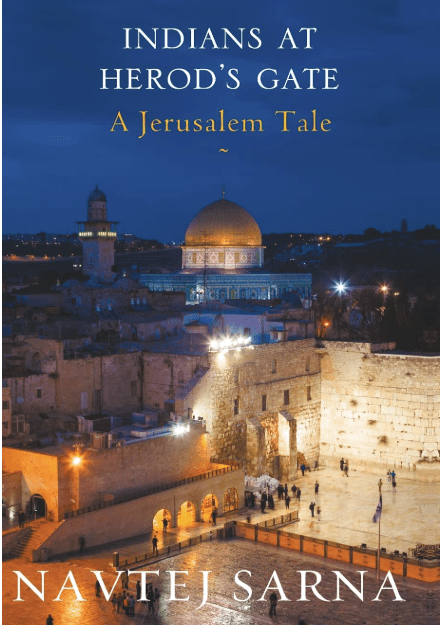
What is perhaps less widely known is that Farid is believed to have travelled to Jerusalem around 1200 CE — not long after Saladin had recaptured the city from the Crusaders. A small shrine there, still accessible, is said to mark his presence. Navtej Sarna, a former Indian Ambassador to Israel (2008–2012), writes about this connection in his book Indians at Herod’s Gate: A Jerusalem Tale (Rupa, 2014) — a quiet, often-overlooked thread linking the Indian subcontinent to the Holy City over eight centuries. Read further: Indians Herods Gate and Jerusalem’s 800-year-old Indian hospice

After the lecture, our group of three — drawn from different faith backgrounds — sat together for langar, the community meal served at Gurdwaras. There is something deceptively simple and profoundly radical about langar. The act of sitting together, regardless of religion, caste, or status, and eating the same food dissolves hierarchies that societies expend enormous energy to maintain. It is a challenge that remains genuinely difficult in parts of India, where communal and caste taboos still govern not just what people eat, but with whom and where. In that shared meal, something ancient and necessary was quietly affirmed.

The Descent into Dystopia

The following day, I made the mistake of listening to a News Agents podcast: Why MAGA Hates Britain. I say mistake not because the journalism was poor — it wasn’t — but because the content was genuinely dispiriting. The podcast drew on interviews conducted at the Conservative Political Action Conference (CPAC), where the blatant hostility toward Muslims was on full display. What struck me was not just the bigotry itself, but the absolute self-assurance with which it was expressed — the sense of a parallel world, hermetically sealed from doubt or nuance, in which hatred had been fully normalised and even celebrated.

It is worth noting that CPAC is not a fringe gathering. It draws senior politicians, media figures, and policymakers, including Britain’s shortest-serving prime minister, Liz Truss, who has found the political validation that eluded her at home in MAGA circles. When hatred is mainstreamed in those spaces, it travels outward with authority and legitimacy. The podcast was a sobering record of that.

A Fragment from 1947

Turning away in revulsion, I returned to my own research — a space in which I can explore the ideas that still feel worth holding onto. Almost serendipitously, I came across an advertisement from September 1947 in the Bombay Chronicle, published just weeks after Partition had carved the subcontinent into India and Pakistan, leaving 1-2 million dead and over 15 million people displaced. The advert’s message was striking in its urgency and its pathos: the violence and bloodshed that had torn communities apart must now be put aside. The “children of God” must be taught how to live together rather than being “poisoned” by the hatred that had consumed the preceding years.
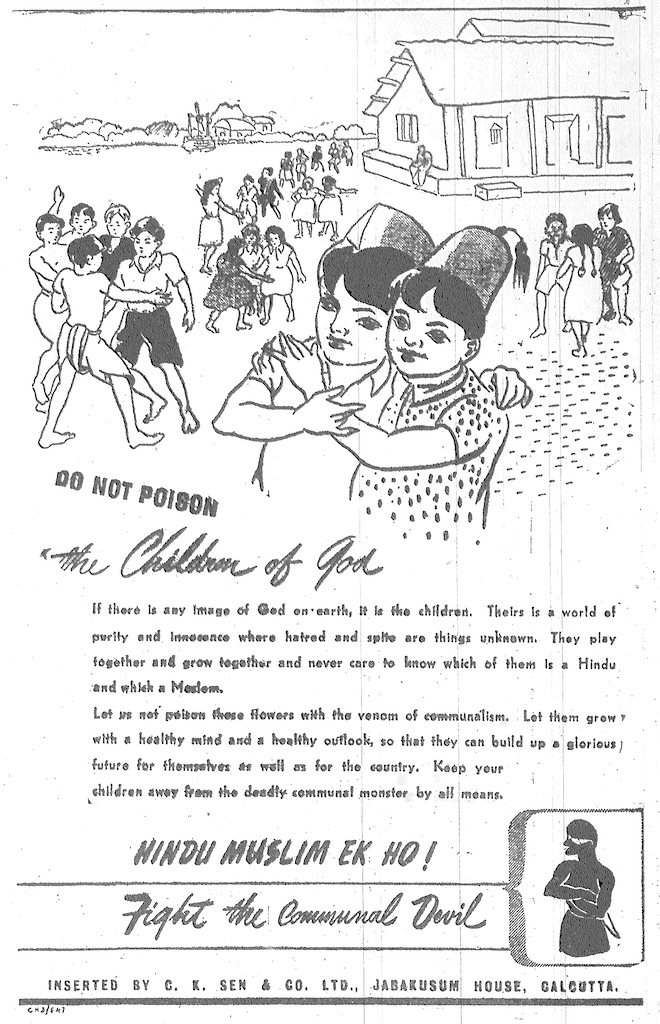
The text reads: If there is any image of God on earth, it is the children. Theirs is a world of purity and innocence where hatred and spite are things unknown. They play together and grow together and never care to know which of them is a Hindu and which a Moselm. Let us not poison these flowers with the venom of communalism. Let them grow with a healthy mind and a healthy outlook, so that they can build up a glorious future for themselves as well as for the country. Keep your children away from the deadly communal monster by all means. Hindu Muslim Ek Ho! Advertisement inserted by C.K. Sen & Co. Ltd.
Bombay Chronicle 26 September 1947. Photo taken by Pippa Virdee from NMML, Delhi.

What moved me most was the implicit admission within that language: that society had already been poisoned, and that the antidote required active, deliberate effort. It was a call not to innocence but to conscious repair.

The Distance That Grows

That advertisement also stirred a more melancholic reflection. There was a time, however brief and fragile, when greater openness between India and Pakistan seemed imaginable — when the possibility of travel, communication, and even reconciliation had not yet been foreclosed. The Wagah-Attari border crossing, for decades a symbol of that flickering possibility, remains closed following the Pahalgam attack of April 2025. Yet that closure is not merely a consequence of one incident. It reflects a deeper estrangement — one that has steadily worsened since the BJP came to power in 2014, as the distance between the two countries has grown not just diplomatically but also culturally, emotionally, and imaginatively.

When borders close, it is not only people who are separated. It is stories, families, histories, and the ordinary human exchanges that quietly resist the narratives of enmity.

On Connecting the Moments

What struck me, looking back across these three days, was how tightly these experiences were bound together — the lecture on a 13th-century Sufi poet, the langar table, the CPAC recordings, the 1947 advertisement, the closed border. They form a kind of map of where we are and where we might yet go.

We are constantly surrounded by voices that insist conflict is natural, that difference is danger, that the world is a zero-sum competition between faiths and peoples. But Baba Farid’s couplets, preserved across centuries and across religious traditions, suggest otherwise. The langar meal, served to strangers, suggests otherwise. Even that desperate 1947 advertisement, placed in the shadow of catastrophe, suggests otherwise — because in the middle of all that devastation, they still believed it was worth trying to preserve unity over enmity.

Conflict has never resolved anything. It only plants the seeds for the next generation’s hatred. What endures are the moments when we chose differently — when we visited the Other, and sat with them, and ate.

It remains up to us to remember our neighbours — not as symbols, threats, or abstractions, but as people, first and foremost. This message is a recurring theme in advertising campaigns that, while not so distant in time, feel increasingly remote in spirit. The YouTube clips, from just a decade ago, speak a language of interfaith harmony that the intervening years — and the political choices made within them — have done their best to drown out. That they once existed, and were made for mass audiences, is itself worth remembering.


Hindu Muslim Unity: Best Creative and Inspirational Indian Ads | Part 1 | Creative Ads

Hindu Muslim Unity: Best Creative and Inspirational Indian Ads | Part 2 | Creative Ads
Humsaye Maa Jaye by Bushra Ansari and Asma Abbas – Official Video

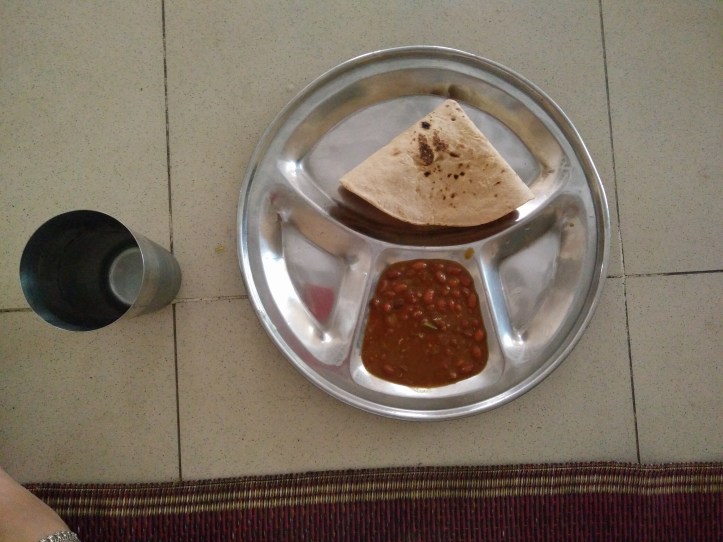
Guru ka langar

Langar at Gurdwara Pehli Patshahi, Lahore, Pakistan.

One of the earliest pieces I started with on this blog was with this picture of Guru ka Langar (or food for the congregation) in Lahore. The simplicity of daal (lentils) or in this case rajma (kidney beans) with roti (bread) is the basis of most langar served in a Gurdwara. As a child, I remember most children enjoyed going there in part because of the karah parshad (sweet halwa made from whole wheat flour) given at the end of the service and followed by the (free) food, which had its own distinctive divine taste, impossible to recreate at home. 

Langar is the communal partaking of food when visiting Gurdwara. The concept has in recent years been popularised globally by Sikh organisations such as Khalsa Aid, which plan, produce and distribute langar to people across the crisis-ridden world, be it to the truckers stranded in Dover over the ongoing Christmas period or in recent war-torn Syria. With Langar spreading so does knowledge about and experience of the Sikh community. Currently, closer to the home of Sikhism in Punjab, Langar has been making headlines via the ongoing farmers’ movement against new farm laws in India. Communal kitchens have been set-up by the roadside to feed the thousands gathered on the borders of capital, Delhi.

Origins

The word ‘langar’ (meaning ‘anchor’) is thought to have come into the Punjabi language from Persian (Nesbitt: 29); although the idea was not unique to the Sikhs, as ‘both the Sufis and the Nath Yogis have a system of collective eating (langar khanah and bhandaras). The Sikhs, however, used it as venue for both service and charity and provided the food themselves [unlike] the Nath Yogis, who begged for food, and the Sufis, who often accepted land-grants to run their kitchens’ (Mann: 27).

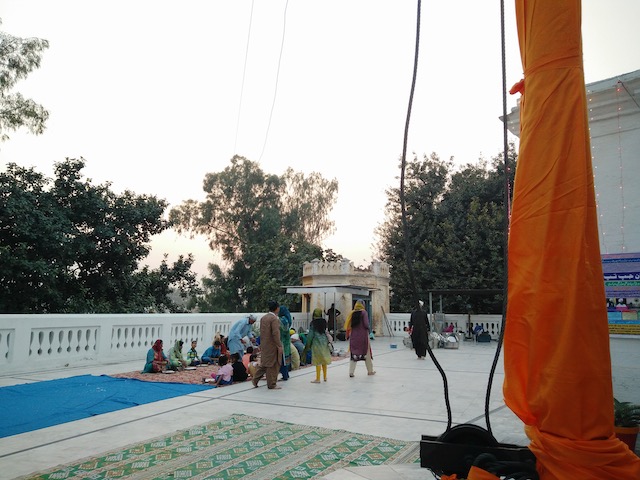
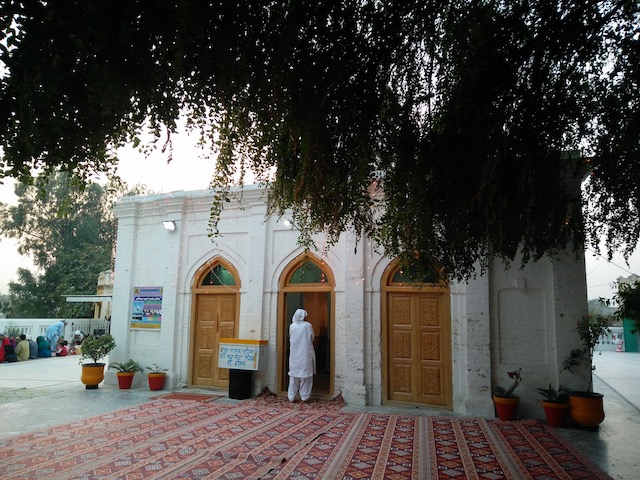
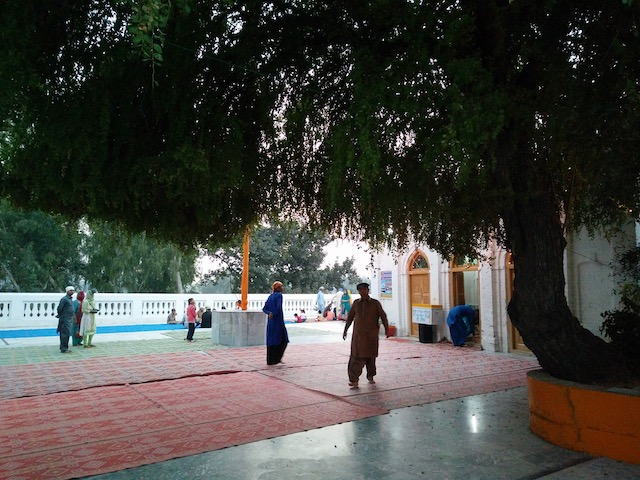
Pictures are of Gurdwara Sacha Sauda, Farooqabad, Pakistan and about 37 miles away from Lahore. This gurdwara is revered with the origins of the langar and is situated not far from Nankana Sahib, the birth place of Guru Nanak.

Baba Farid (1170s-1260s), a Sufi saint from the Chishti order, living in the Punjab, would distribute sweets amongst his visitors; a precursor to langar-khana near shrines, a practice documented in Jawahir al-Faridi (1620s) by a descendent of his. The khanqahs of the Chishti and other Sufi orders kept a langar open for the needy, but also others. It is said that ‘Khwaja Muinuddin established the tradition of an open kitchen for all who came…in an age of feudalism and violence’ (Talib: 6).

There is, of course, a much older practice of the alms house or dharmshala/sarai to feed travellers and poor for free, which is thought to have existed through the Gupta and Maurya (esp. Buddhist) times that is on either side of the BC/AD divide.   

Faith

The connections between the Sufis and the Bhakti (devotional) traditions are well documented, inspired as both were by the idea of feeding the poor, the pilgrim and thereby removing divisions/discrimination among people. The idea concretised with the rooting of faith in the region and by early 17th century, it had become a recognised Sikh fixture (Desjardins).

Eleanor Nesbitt notes that, ‘in institutional terms, it was the third Guru, Amar Das [1479-1574], who gave prominence to the langar… [integral as] sharing food [was] to Guru Nanak’s Kartarpur community…it was Guru Amar Das who particularly emphasised the requirement for everyone to dine side by side, regardless of caste and rank’ (Desjardins: 29).

There were two women, who especially, ‘nurtured the development of the langar tradition in its formative period: Mata Khivi (1506-82) and Mata Sundri, the second and tenth Gurus’ wives’. The Guru Granth Sahib notes that ‘Khivi…is a noble woman, who…distributes the bounty of the Guru’s langar; the kheer—the rice pudding and ghee—is like sweet ambrosia’. After the death of Guru Gobind Singh (1666-1708), ‘his widow Mata Sundri worked hard to continue the free community kitchen service. Records show her active role in fundraising for this purpose when the very survival of Sikhism was in question… (Desjardins).

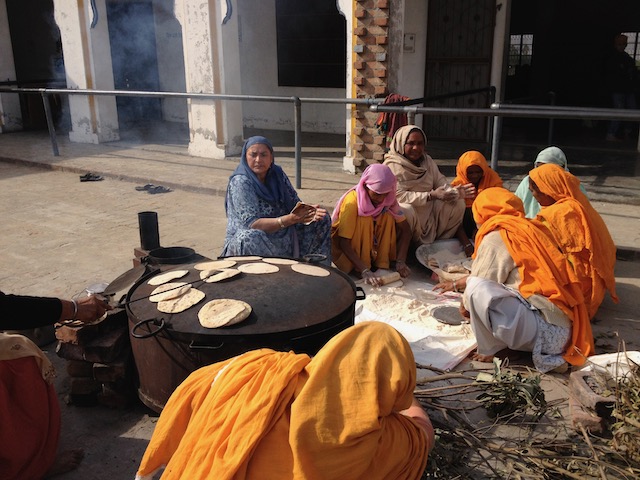
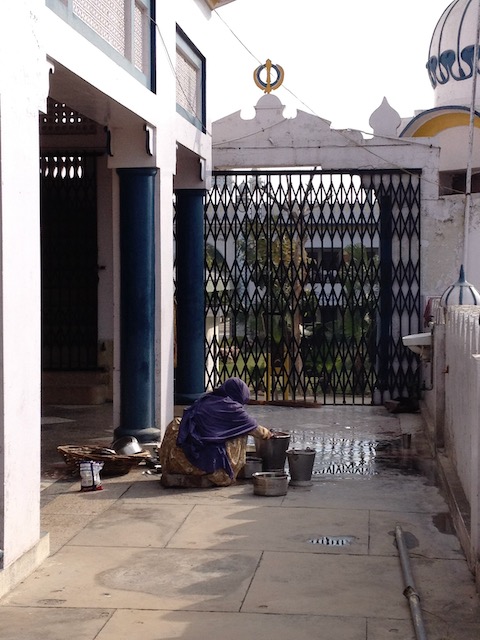
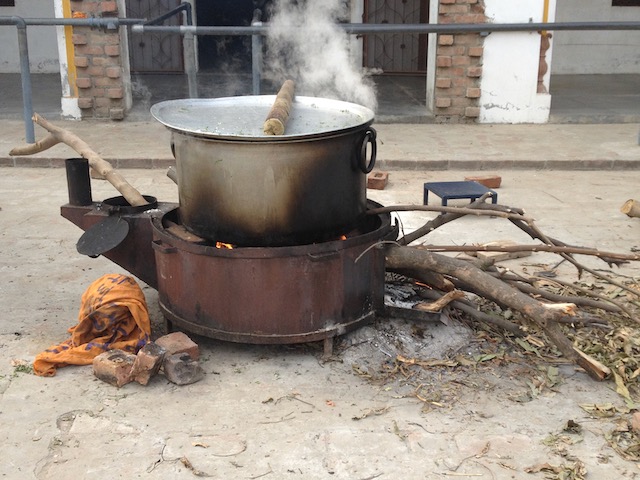
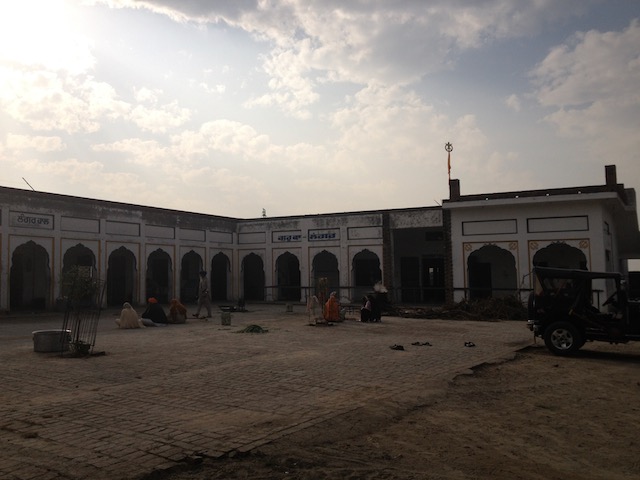
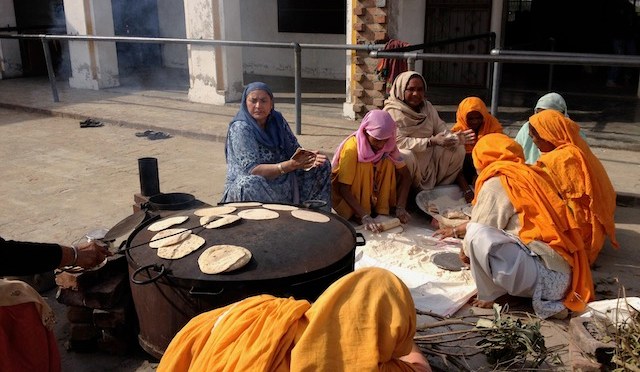
The langar since is thus an integral part of the faith/religion, its compassion through the concept of Seva (self-less service); essential for all practicing Sikhs. Donating food or money is not as important as the practice of giving one’s time and service. Today the most famous community kitchen serving langar has to be the Golden Temple (Amritsar), where around 100,000 people are served on a daily basis. However, most Sikhs grow up visiting and worshipping at small local gurdwaras, where everyday worshippers and volunteers prepare food on a daily basis. These photos are taken from the local gurdwara at Mao Sahib (my father’s village, Jalandhar district), where the congregation prepare, serve, consume the langar and then clean afterwards. As the gurdwaras become more institutionalised, and as the historic gurdwara Mao Sahib (associated with the fifth Guru Arjan and his consort Mata Ganga, d. 1621) has come under the administration of the SGPC (the Sikh body responsible for the management of gurdwaras), voluntary seva has been added to by paid sevadars.

The pictures are of Mao Sahib, 2012, when the langar hall was undergoing a renovation and some of the langar preparation was taking place outside.

Equality

The idea of sitting and sharing food together is fundamental among Sikhs because it demonstrates the abolition of caste and dramatically asserts humble equality amongst all the people; regardless of their religious or caste background. The food is generally simple and vegetarian, to appeal to all and offend no one. Four core Sikh principles are enshrined in the langar: equality, hospitality, service, and charity.

Eleanor Nesbitt writes about how, ‘the Gurus were reformers who abolished the caste system or that caste is Hindu, not Sikh’. It is important to remember how revolutionary this was/is in a caste-ridden society. Nesbitt notes how, ‘the langar subverted Brahminical rules about commensality, according to which only caste fellows could eat together’ (118). Instead, it was proclaimed that, ‘a Sikh should be a Brahmin in piety, a Kshatriya in defence of truth and the oppressed, a Vaishya in business acumen and hard work, and a Shudra in serving humanity. A Sikh should be all castes in one person, who should be above caste’ (117). The Gurus, like the Bhagats Namdev, Kabir, and Ravidas, proclaimed the irrelevance of people’s inherited status to their spiritual destiny. In Guru Nanak’s view:

Worthless is caste (Jati) and worthless an exalted name,

For all humanity there is but a single refuge (Adi Granth 83)

Quoted in Nesbitt: 118

Similarly, according to Guru Amar Das:

When you die you do not carry your Jati with you:

It is your deeds which determine your fate. (Adi Granth 363)

Quoted in Nesbitt: 118

References

Bowker, John (ed.), The Concise Oxford Dictionary of World Religions (OUP, 1997)

Desjardins, Michel, and Ellen Desjardins, ‘Food that builds community: the Sikh Langar in Canada’, Cuizine: The Journal of Canadian Food Cultures/Cuizine: revue des cultures culinaires au Canada 1, no. 2 (2009) https://www.erudit.org/en/journals/cuizine/2009-v1-n2-cuizine3336/037851ar/

Mann, Gurinder Singh, Sikhism (Prentice Hall, 2004)

Nesbitt, Eleanor, Sikhism: A Very Short Introduction (OUP, 2016)

Talib, Gurbachan Singh, Baba Sheikh Farid Shakar Ganj (NBT India, 1974)

More about Gurdwara Sacha Sauda: http://pakgeotagging.blogspot.com/2018/02/084-gurdwara-sacha-sauda-farooqabad.html