Tag Archives: Punjab

2 Nov 84.

BBC Details Incidents. London BBC World Service 0015 2 Nov 84

[From “Radio Newsreel” program]

The outburst of anger against the Sikh community in India following the assassination of Mrs Gandhi by two Sikhs of her bodyguards has claimed about 150 lives and left more than 1,000 people injured. Mob vengeance took its tool in a number of centres and curfews have been imposed, including one in the capital, Delhi. Tim Llewelyn saw the violence there.

It was the worst day of violence in Delhi’s recent history. No area was spared – rich, poor, residential, commercial. Angry youths acting without apparent organisation gathered on the streets attacking Sikh stores, taxis, homes, and Sikhs themselves. Usually, they burned or looted whatever they could lay their hand on, twice Sikhs themselves and in one case, lynching two adults near a Sikh temple, then setting the corpses alight. Cars were attacked and burned because the mob in India identifies the Sikhs with the car and the taxi. Sometimes – but not always – the police intervened, and I watched the security forces with bayonets fixed rescue the man whose house was being put to the torch by the angry crowds of youths. A number of Sikh temples were surrounded and threatened but mostly escaped damage. They were often defended by Sikhs themselves brandishing their medieval weapons – swords and staves and spears. The prime minster, Rajiv Gandhi, has ordered that the violence must not be repeated. There are indefinite curfews in 30 towns and cities, including Delhi and parts of Calcutta.


52 Killed in Bihar. Paris AFP 0759 2 Nov 84

At least 52 people were today reported killed in Bihar state, bringing the nationwide death toll in the anti-Sikh violence sparked by Prime Minister Indira Gandhi’s murder by two Sikh bodyguards to about 200.

The PTI said the 52 deaths took place in Bokaro, in the northeastern state of Bihar, where police fired on rioters. Security forces were under order to shoot on sight anyone committing violence.

PTI said another 50 people were wounded in Bokaro.

Meanwhile in New Delhi, a dozen bodies were found in an express train which arrived from Ludhiana in the predominantly Sikh of Punjab early today, station officials reported. They gave no further details.


Death Toll Reaches 227. Paris AFP 1005 GMT 2 Nov 84

Fresh outbreak of sectarian violence rocked New Delhi and other Indian towns today as the death toll in the anti-Sikh backlash sparked by the assassination of Prime Minister Indira Gandhi soared to 227.

In East Delhi, Hindu mobs defied shoot-on-sight orders and Army and paramilitary troops to set fire to a cinema, police said. They also reported mob violence in two localities in south Delhi.

Police confirmed that 70 people had been killed in the capital since Mrs Gandhi was gunned down outside her home on Wednesday by two Sikh members of her bodyguard.

Bihar in the north-east, Uttar Pradesh in the north and Madhya Pradesh in central India were reported to be the worst hit among a dozen states reeling under the wave of violence, despite repeated calls by Prime Minister Rajiv Gandhi over the radio for calm.

The reports said that 92 people had so far been killed in Bihar, with 35 dead in Uttar Pradesh and 30 dead in Madhya Pradesh. Other casualties were reported in the western coastal state of Maharashtra.

The worst incidents occurred in Bihar state, where at least 52 people were killed as Hindus sought to revenge Mrs. Gandhi’s murder, the PTI reported.

The incidents took place in the steel town of Bokaro, PTI said, adding that the state authorities had issued security forces with shoot-on-sight orders to quell further violence. PTI said another 50 people were wounded.

Police Deputy Inspector-General Y.N. Srivastava told PTI that police in Bokaro opened fire on rival Sikh and Hindu mobs, killing one person and injuring two. Riot police were patrolling the streets.

Newspapers earlier reported other slayings in the industrial town of Ranchi as well as Hazaribagh, Arrah and Daltongaj, also in Bihar state.

An indefinite curfew was reportedly imposed on Ujjain in the central Indian state of Madhya Pradesh following a number of cases of arson and looting, while angry mobs violated curfew restrictions in nearby [words indistinct].

Trains arriving here from the Punjab reportedly carried bodies of people believed to have been lynched by crowds en route to the capital for Mrs Gandhi’s funeral tomorrow,

Eye witnesses and railway officials said they saw six bodies lying on New Delhi railway platform.

Other eye witnesses said that as many as 18 bodies were found in a train that ran between two Punjabi towns of Bhatinda and Ferozepur.

Prime Minister Rajiv Gandhi broadcast repeated radio calls for an end to the orgy of violence, but with little effect.


Death Toll Climbs. Paris AFP 1308 2 Nov 84

Thirty more people were killed in inter communal violence in New Delhi today, officials said, as the [word indistinct] nationwide death toll in violence sparked by the murder of Indira Gandhi climbed past 300.

A total of 100 people, including some reportedly burned alive in [word indistinct] New Delhi, have been killed in the capital since the prime minister was gunned down by Sikh bodyguards on Wednesday.

Police reportedly opened fire to separate Hindus and Sikhs clashing in a village in west Delhi. The groups exchanged fire, leaving some people dead before police intervened.

A toll compiled from official and unofficial sources and quoted by Indian news agencies put the dead at more than 300 nationwide.


Source: all daily reports are from the Foreign Broadcast Information Service Archive.

Reportage: 1 Nov 84

Army Controls Kanpur. Paris AFP 0628 GMT 1 Nov 84

Army troops took control of the industrial city of Kanpur in northern Uttar Pradesh state early today following violence triggered by Prime Minister Indira Gandhi’s assassination by two Sikh members of her security guard yesterday.

Earlier, authorities clamped an indefinite curfew on four districts of the city or nearly four million people, PTI said.

PTI, quoting official sources, also reported a number of cases of arson and looting, but no further details were available.

Sikhs came under attack from angry Hindu crowds in several Indian cities, including New Delhi, yesterday as news of Mrs. Gandhi’s assassination spread.


Sporadic Violence in Country. Delhi Domestic Service 0837 GMT 1 Nov 84

There are reports of sporadic violence in some parts of the country following the assassination of Mrs Gandhi.

In Delhi, arson and violence have been reported from several areas. According to agency reports, curfew has been imposed in some places including Jammu, Kanpur, Patna, Sagar, Varanasi, and Raipur.

In Bombay, shops and business establishments have closed down as a mark of respect to the departed leader. In Trivandrum, people are wearing black badges to mourn the passing away of Mrs Gandhi.


AFP on Violence, Arrests. Paris AFP 0936 GMT 1 Nov 84

The authorities today imposed a curfew on the Indian capital as angry Hindus went on a rampage of burning and looting, seeking fresh revenge for the murder of Prime Minister Indira Gandhi by Sikh gunmen yesterday

A police announcement said the decision was made to stop the violence which last night left at least three Sikhs dead, according to eyewitnesses, and 200 injured, according to police.

Army troops patrolled the streets, amid reports of sporadic gunfire between police and unidentified gunmen holed up on rooftops.

Prime Minister Rajiv Gandhi, son of assassinated leader Mrs. Gandhi, held an emergency Cabinet meeting to review the situation. officials said.

In other parts of India, the Army reportedly took control of the industrial city of Kanpur in Uttar Pradesh while police in Bihar State were under orders to shoot troublemakers on sight.

Curfews were in force in most states.

Para-military forces fanned out across this city of six million people today as mobs armed with choppers and clubs set fire to houses, cars and other properties belonging to minority Sikhs in retaliation for Prime Minister Gandhi’s assassination, eyewitnesses said

“It is terrible, they are setting fire to houses, stopping vehicles and looking for Sikhs… it appears that we are in a jungle”, said a panicky resident from the southern district, where foreigners generally live.

One Sikh was found dead here, police said, but witnesses said they saw at least two bodies near the one recovered by police.

Police sources also said 200 people, mostly Sikhs, were injured and half of them were admitted to hospitals here as buses, trucks, cars, scooters, shops and Sikh temples were set on fire last night by outraged Hindus.

Security was tightened around New Delhi’s Sikh temples, which had come under attack yesterday.

Authorities banned the assembly of more than five people in public places were, but there was no report of any arrest.

There were no reports of any new casualties, as Sikhs here appeared to have gone underground for fear of reprisals.

Police this morning also reported cases of arson and looting in Ahmednagar, in the western coastal state of Maharashtra, where police had to open fire to disperse rioters, injuring three of them.

A total of 64 people were arrested following the incidents, in which about 30 shops and 13 vehicles were burned, police sources added.

In the central city of Jabalpur, police also burst tear gas shells to disperse looters and arsonists and similar incidents were reported in other localities, press reports said.


BBC on Worsening ‘Violence’. London BBC World Service 1200 GMT 1 Nov 84

Dispatch by correspondent Tim Llewelyn

There is no doubt that this worsening violence and uncontrollable anger is aimed at the Sikh community. Even as the Army took to the streets, backing up the police and paramilitary security units, large tracts of Delhi were the preserve of the mob. I saw taxis, taxi ranks, smart stores, and small shops and kiosks – almost exclusively Sikh-owned – set alight and burning furiously. Crowds besieged Sikh temples, though the police and Sikhs themselves mostly managed to prevent casualties or damage, the Sikhs brandishing their swords and clubs.

The violence has spread all over the city – residential areas as well as working class and commercial. Casualty figures are vague, but we know of at least five dead in Delhi over the past day, two of the policemen in an exchange of shots involving a mob outside a Sikh temple, and two Sikhs burned alive by frenzied attackers. In one incident, I watched a crowd surrounding a house and finally stuffing blazing wicker chairs to the windows to act as fire torches. Eventually the Army showed up, bayonets fixed, the crowd evaporated.

It is not just Delhi by any means. A similar pattern of anger harassment, and then burning and stealing has brought the Army out onto the streets in at least five other towns – Calcutta, Allahabad, Indore, Varanasi, and Kanpur. Curfews are being imposed in uncountable towns and districts in north and central India.

Sikhs I talked to in Delhi are not satisfied with the protection offered in the capital, and it did look in some incidents as if the police could have done more.


‘Large Scale Violence’ Reported. Paris AFP 1603 GMT 1 Nov 84

At least 65 people were killed, several hundred injured, and thousands rendered homeless today in an orgy of violence that swamped India in the wake of yesterday’s assassination of Prime Minister Indira Gandhi by two Sikh members of her security guard, local news agencies reported.

Large-scale violence hit 18 towns across India, forcing the administration to call out the Army and impose an indefinite curfew in certain parts of the capital. Curfews were also imposed in most other states.

The PTI news agency said that as many as 65 people, mostly Sikhs, died in the clashes. UNI put the death toll at 60.

An official government spokesman put the nationwide toll at 10.

In two cities of Kanpur and Patna police were given shoot at sight orders after Hindu mob violence against Sikh communities erupted. Earlier similar shoot-at-sight orders were issued in eastern Bihar State.

Source: all daily reports are from the Foreign Broadcast Information Service Archive.

Bhakra Nangal Dam

Located in Bilaspur, Himachal Pradesh, Bhakra Dam is one of the largest dams in India. Construction of the dam started soon after independence in 1948 and it was opened in 1963. Agreement for the project had been signed before independence in 1944 by the Punjab Revenue Minister, Sir Chhotu Ram and the Raja of Bilaspur. However, the idea behind the project was suggested around 1910 by the British. My father worked on the dam during its construction and lived in Nangal for ten years. The dam is unequivocally the dream of modern India that Jawaharlal Nehru had imagined.

This 20 minute documentary is made by Films Division which was a production house for the Ministry of Information and Broadcasting, Government of India. Established in 1948, it regularly made documentary films.

The Final Resting Place: Gurdwara Kartarpur Sahib

This slideshow requires JavaScript.

In March 2017, in an impromptu adventure, I had the opportunity to visit Kartarpur Sahib in Pakistan. It came amidst an amazing road trip, which took me from the Radcliffe line to the Durand Line (almost). The trip was full of surprises – monuments (old and new) in situ and people on the move – and their discussion, especially of religious spaces and their historical significance. During one of these conversation, Dr. Yaqoob Khan Bangash (ITU Lahore) asked why the Sikhs never demanded Kartarpur Sahib during the discussions of the 1947 Radcliffe Boundary Commission.

Kartarpur is located in Narowal District in Pakistani Punjab. It is about 120 kms/2 hours away from Lahore and is located only 3 kms from the Indo-Pakistan border by the river Ravi. Indeed, Dera Baba Nanak is located about 1 km from the border, on the other side, east of the river Ravi in Indian Punjab. Both are visible to each other on clear days. The Gurdwara is the historic location where Guru Nanak (1469-1539) settled and assembled the Sikh community after his spiritual travels around the world. It is on the banks of the River Ravi and even today there is a nomadic and unkempt, wilderness feel to the place. Guru Nanak spent eighteen years living in Kartarpur, during which he spent time preaching to a growing congregation; the appeal of Nanak spreading from nearby areas to beyond and drawing the first Sangat to the area. Many devotees remained and settled in Kartarpur, dedicating their lives to the mission of Nanak.

The informal led to the formal, with the establishment of the first Gurdwara (the house of the guru) being built circa 1521-2. Here, free communal dinning (langar) was started, feeding all those that came and the langar remains a defining feature of Sikhism – providing free food to everyone without any prejudice. The food is simple and usually vegetarian. It is not a feast, nor does it offend anyone due to their dietary preferences. Everyone, rich or poor, sits together; equal in the house of the guru.

However, for Sikhs, Kartarpur is an especially significant place, as it marks not only the beginnings of Sikhism but also the final resting place of the first guru. The original Gurdwara complex was washed away by floods of the river Ravi and the present-day building was built with donations from Bhupinder Singh (1891-1938), Maharaja of Patiala. More recently, the Government of Pakistan has been contributing to its maintenance. The most fascinating thing about Kartarpur is the appeal of the Gurdwara to all communities. Baba Nanak is revered as a Pir, Guru and Fakir alike.

My trip to Kartarpur was during the “off-season” period and so, mostly Muslims were visiting the shrine/Gurdwara to offer their duas/prayers. Legend has it that when Guru Nanak died, his Hindu and Muslim devotees disagreed about how his last rites should be performed: cremation or burial? During this ruckus, Nanak appeared as an old man before his devotees and, seemingly, suggested delaying the decision until the following day. The following morning, the shroud covering the body was found with flowers, in place of the body. These flowers were divided, with the Hindus cremating theirs, and the Muslims buried theirs. And so, in the courtyard of the Gurdwara is a shrine to symbolise this story. Outside the Sikh tourism that takes place, which is limited, this shrine is mostly frequented by Muslims.

In August 1947, Kartarpur was in Gurdaspur district, which had all (almost) been delineated to be in Pakistan, until the late, controversial changes to the boundary line, which meant that parts of Gurdaspur went to India. Thus, at the last minute, Kartarpur ended being in close proximity of the international border. After Partition, the Sikhs were negligible in their numbers in Pakistan and Kartarpur remained closed and abandoned for over fifty years. More recently, there have been attempts to get a connecting corridor between the communities in India and Pakistan today, but this has not materialised. Going back to the question of why Kartarpur never figured as a specific request before the Boundary Commission, perhaps part of the answer lies in the fact that Sikhs believe in reincarnation of the soul and, therefore, death of the body is not the end of life’s journey.

‘Corridor connecting India with Kartarpur Sahib Shrine in Pakistan ruled out’ by Ravi Dhaliwal:

http://www.tribuneindia.com/news/punjab/community/-corridor-connecting-india-with-kartarpur-sahib-shrine-in-pak-ruled-out/400962.html

‘Visit to Kartarpur Sahib (Pakistan)’ by Dalvinder Singh Grewal: https://www.sikhphilosophy.net/threads/visit-to-kartarpur-sahib-pakistan.49707/

‘How Nanak’s Muslim followers in Pakistan never abandoned Kartarpur Sahib, his final resting place’ by Haroon Khalid: https://scroll.in/article/857302/how-nanaks-muslim-followers-in-pakistan-never-abandoned-kartarpur-sahib-his-final-resting-place

Everyone’s Guru by Yaqoob Khan Bangash: http://tns.thenews.com.pk/everyones-guru/#.WxAxiakh3OQ

Ludhiana’s Clock Tower (Ghanta Ghar)

Ghanta Ghar is one of the most iconic landmarks of Ludhiana city. It stands tall amongst the hap-hazard development of the industrial city. Previously it was the pride and the centre piece of the historic area of Chaura Bazaar, which was the hub of economic and political activity in the city. Located at the entrance of the commercial centre, the Clock Tower was and still remains a landmark in the city’s landscape. The railway station is conveniently located a short (walking) distance away from the Clock Tower, allowing for trade activity to flourish easily in the area. Apart from commercial activity Ghanta Ghar also attracts political activities, as it is a convenient location to hold political party protests and dharanas. Today the Clock Tower has receded into the background as a flyover dominates the urban landscape. Although, Ludhiana as a city has grown manifold since the Ghanta Ghar was built, and much of the commercial activity has moved to The Mall Road or Ferozepur Road, Chaura Bazaar still remains popular amongst old and new inhabitants. There is the old charm of the traditional sub-continental bazaar with its nooks and crannies. The narrow lanes, tucked away behind the wide and partial Chaura Bazaar, remain hidden gems for jewellery – gold, silver or artificial. And then there are the scrumptious aloo tikkis, gol guppas and chaats to satisfy the hungry shopper. It is a shame that the Ludhiana Municipal Corporation has not invested more in the city’s historic sites and made more of these places. But, this is part of a wider problem with preservation of heritage and history in the sub-continent.

The history of the Clock Tower, of course, evokes the British colonial heritage: Ghanta Ghar/Clock Tower was designed by the then-Municipal Chief Engineer of Amritsar, John Gordon. The design reflects the traditional European Gothic style and uses an interesting red brick, which is striking even amongst the colourful and vibrant Chaura Bazaar. Although the construction began in 1862, it was not officially inaugurated until 1906 by Sir Charles Montgomery, who was the Lieutenant Governor of Punjab, along with Diwan Tek Chand, Deputy Commissioner of Ludhiana.

Ludhiana actually came under British rule in 1835, when Rajah Sangat Singh died. The Gazetteer of Ludhiana District (Punjab Government, 1888) notes that it was under Sir Claude Wade (1823-38) and his successors that the town increased in its size and importance. Trade expanded, and Ludhiana became a centre for trade in grain, sugar, cloth. The small presence of Kashmiri weavers (approximately 8-10 families) expanded after the famine in 1833 to around 1,500-2,000 Kashmiris, who settled in the town. Following the Sutlej campaign (1845-1847), Ludhiana district was formed, and the civil offices were removed to the cantonment side of the city. In 1854-55, the Grand Trunk Road was metalled and realigned to its present position.

The opening of the Railway from Delhi to Lahore in 1870 undoubtedly gave a great stimulus to trade and commercial activity in Ludhiana. In addition, the number of shops and sarais along the Grand Trunk Road, facing the station were also growing. According to the Gazetteer, the new town to the south of Chaura Bazaar had all the hallmarks of being modern. The streets were wide and straight, and the houses and shops were uniformly designed, giving them a modern appearance. ‘The principal streets, the Chaura Bazaar and the Hazuri Sarak, were designed by Sir Claude Wade himself; and, one of his projects, the Iqbal Ganj, is a standing proof that he was rather too sanguine about the speedy development of the two for which he did so much’ (p. 216).

The population of town was modest compared to the 1.6 million people living in the city today. In 1868 Ludhiana had 39,983 (Males 21,701 and Females 18,282) and in 1881 this rose to, 44,163 (Males 24,685 and Females 19,478)

CENSUS REPORT 1881

Total Population – 44,168

Hindus – 12,969; Sikhs – 1,077; Jains – 752; Muslims – 29,045; and Others – 320

The population of Ludhiana started to grow, most likely with opening of the railway and consequently the establishment of the town a collecting centre for the grain traffic. But in 1878, there was a huge loss of life due to malaria fever following the monsoon season. It was estimated that around 6-7 per cent of the population died especially, ‘half-starved Kashmiris and others of the lower classes not having sufficient stamina’ (p. 217). According to the 1881 census, the town was overwhelming Muslim and indeed even in 1947, Ludhiana was a Muslim majority town. The city today is dominated by the Sikhs but there are still some remnants of a former history scattered around the city, like the Ghanta Ghar and Chaura Bazaar.

From Mano Majra to Faqiranwalla: Revisiting the Train to Pakistan

New Delhi train station. © Pippa Virdee 2016

By Pippa Virdee and Arafat Safdar in South Asian Chronicle.

Khushwant Singh’s novel Train to Pakistan was published in 1956, almost ten years after the partition of India/ creation of Pakistan in 1947. Its publication inaugurated what has been called ‘South Asian Partition Fiction in English’ (Roy 2010). It remains, to date, one of the most poignant and realistic fictional accounts depicting the welter of partition and saw a sensitive screen adaptation in 1998 by Pamela Rooks. It captures one of the most horrific symbols of partition—that of the burning, charred and lifeless trains that moved migrants and evacuated refugees from one side of the border to the other. The trains that previously served to bring people and goods from disparate worlds closer together were overnight turned into targets of mob attacks and transporters of mass corpses. They thus became an emblem, a much-photographed representation (Kapoor 2013) of the wider violence and ethnic cleansing that was taking place in Panjab (Ahmed 2002: 9-28); one of the two regions divided to make way for the two new nation-states.

Selecting some key individuals in the village, relevant to and representative of our efforts to excavate the myths and memories associated with partition, and situating their sensibilities vis-à-vis the sentiments exhibited in the novel, we conducted interviews to collect and compare experiential accounts. An attempt in the Wildean spirit to attest that ‘life imitates art far more than art imitates life’, the article, located in the Faqiranwalla of 2017, looks back to the Mano Majra of 1947. In doing so, not only does it reflect on this intervening time-span and what it has done to those remembrances, but, also brings to fore the well-remarked realisation that, in this case too, ‘the past is another country’ (Judt 1992). Like in the novel then and life today, the connecting link in this article too, between Faqiranwalla and Mano Majra, is the train, as both share the overweening presence of the railways in the village, through which its life is/was governed.

Read full article: https://edoc.hu-berlin.de/handle/18452/19508

Südasien-Chronik – South Asia Chronicle 7/2017, S. 21-44 © Südasien-Seminar der Humboldt-Universität zu Berlin

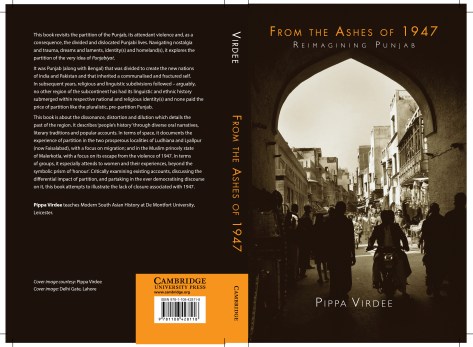
From the Ashes of 1947: Reimagining Punjab

From the Ashes_Full Cover

Full details: From the Ashes of 1947

Watch the panel discussion with Pippa Virdee (De Montfort University, UK), Afzal Saahir (Poet and Radio Host) and Sajid Awan (Quaid-e-Azam University) of my book From the Ashes of 1947 at the Afkar-e-taza, January 2018 Panel Discussion

Durga Mandir/Juma Masjid

This slideshow requires JavaScript.

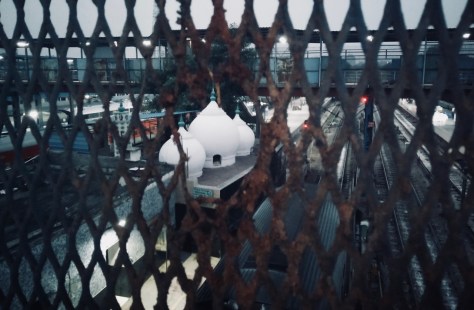
In an unassuming side street of an old residential area in Sonipat is a hidden gem and remnant of the past. Durga Mandir of Mohalla Kalan in Sonipat is still popularly known as Badi Masjid (big/greater Mosque). The latter should give an insight into the former life of this Mandir, which once was a Masjid. Even today looking at the exterior of this mandir it could quite easily be confused for a masjid. It stands tall and looks grand in the red stone façade with a courtyard for Friday prayers which probably attracted many of the local Muslims in pre-partitioned Punjab. Apart from the obvious changes of installing flags and idols, the three main domes and minarets are easily identifiable with that of a small Juma masjid.

Like many other places of East Punjab, the Muslims of Sonipat migrated to Pakistan, leaving behind their homes and places of worship. These were quickly claimed by the incoming Hindus and Sikhs. Muslims were often the second largest group in these areas. For example, Muslims were significantly present in cities like Hissar (28%), Gurgaon (34%), Karnal (32%) and Ambala (32%) Rohtak (17%); all of these are part of present-day Haryana State. Most of the Muslims abandoned their homes in the ensuing violence of August 1947 and fled to Pakistan. Similarly, in Pakistan, many of the old abandoned religious (Gurdwaras and mandirs) buildings were converted/neglected by the incoming populations to be utilised for their own purposes. See link below for more about this.

In this case, the masjid has been converted into a Durga Mandir, a temple for worshiping Goddess Durga. It is now known as ‘Sri Sanatan Dharm Sabha Panji Durga Mandir.’ The Goddess Durga assumes the central position in the mandir and is surrounded by other deities; outside in the courtyard is an encased idol of Baba Sai. The dome interior has recently been filled to mask the obvious Islamic style architecture but the exterior remains as before. The link below provides further information on the Badi Masjid but more interesting are the photos. The short article was posted in October 2015, and the pictures shared are quite different from when I went to visit the site recently. The interior now has been changed to hide all signs of its former existence as a masjid. The pictures from 2015 show the perfect domes and remnants of frescoes and tiling from before. The fact that much of the interior has been transformed in the past two years is telling of the Hindutva agenda prevailing in the region.

Sonipat in August 1947 was a small city in united Punjab, then it became a city in East Punjab and eventually a part of Haryana after the reorganisation of East Punjab in 1966. There is little in the history books about the intervening years before it became part of Haryana, yet a lot has changed in this area. Looking at Sonipat today, it is difficult to tell that this historic city was once communally diverse with Punjabi Hindus, Sikhs, Muslims and Christians. Today it feels very much like a Hindu city. Perhaps the latter is more of a reflection of the current climate in India. But hidden away are these old structures that remind us of a different time and a different history.

Read further about Sonepat’s Badi Masjid and see pictures from 2013. http://www.gounesco.com/badi-masjid-sonipat/

Pakistan’s long forgotten Hindu temples and gurdwaras. http://blogs.tribune.com.pk/story/15785/pakistans-long-forgotten-hindu-temples-and-gurdwaras/