Tag Archives: Partition

On Palestine: Nehru, Jinnah, Gandhi and Iqbal

It was Iqbal’s birth anniversary recently, and Purana Pakistan on Instagram had shared a poem he wrote in 1938; Shaam-o-Falasteen – Syria and Palestine. It prompted me to locate and share the political views of the political leadership at the time in British India. The views of both the Indian National Congress and the All-India Muslim League were immensely sympathetic and supportive of the Palestinian people and their rights. It was framed in wider British imperialism, and for Nehru, “the Arab struggle against British imperialism in Palestine is as much part of the great world conflict as India’s struggle for freedom” (1936). Below I share a selection of views from Nehru, Jinnah, Gandhi and Iqbal.

NEHRU, 1936

Press statement issued by Jawaharlal Nehru, 13 June 13, 1936

Few people, I imagine, can withhold their deep sympathy from the Jews for the long centuries of the most terrible oppression to which they have been subjected all over Europe. Fewer still can repress their indignation at the barbarities and racial suppression of the Jews which the Nazis have indulged in during the last few years, and which continue today. Even outside Germany, Jew-baiting has become a favourite pastime of various fascist groups.

This revival in an intense form of racial intolerance and race war is utterly repugnant to me and I have been deeply distressed at the sufferings of vast numbers of people of the Jewish race. Many of these unfortunate exiles, with no country or home to call their own, are known to me, and some I consider it an honour to call my friends. I approach this question therefore with every sympathy for the Jews. So far as I am concerned, the racial or the religious issue does not affect my opinion.

But my reading of war-time and post-war history shows that there was a gross betrayal of the Arabs by British imperialism. The many promises that were made to them by Colonel Lawrence and others, on behalf of the British Government, and which resulted in the Arabs helping the British and Allied Powers during the war, were consistently ignored after the war was over. All the Arabs, in Syria, Iraq, Trans-Jordan and Palestine, smarted under this betrayal, but the position of the Arabs in Palestine was undoubtedly the worst of all.

Having been promised freedom and independence repeatedly from 1915 onwards, suddenly they found themselves converted into a mandatory territory with a new burden added on— the promise of the creation of a national home for the Jews — a burden which almost made it impossible for them to realise independence.

The Jews have a right to look to Jerusalem and their Holy Land and to have free access to them. But the position after the Balfour declaration was very different. A new state within a state was sought to be created in Palestine, an ever-growing state with the backing of British imperialism behind it, and the hope was held out that this new Jewish state would, in the near future, become so powerful in numbers and in economic position that it would dominate the whole of Palestine.

Zionist policy aimed at this domination and worked for it, though, I believe, some sections of Jewish opinion were opposed to this aggressive attitude. Inevitably, the Zionists opposed the Arabs and looked for protection and support to the British Government. Such case as the Zionists had might be called a moral one, their ancient associations with their Holy Land and their present reverence for it. One may sympathise with it. But what of the Arabs? For them also it was a holy land — both for the Muslim and the Christian Arabs.

For thirteen hundred years or more they had lived there and all their national and racial interests had taken strong roots there. Palestine was not an empty land fit for colonisation by outsiders. It was a well-populated and full land with little room for large numbers of colonists from abroad. Is it any wonder that the Arabs objected to this intrusion? And their objection grew as they realised that the aim of British imperialism was to make the Arab-Jew problem a permanent obstacle to their independence. We in India have sufficient experience of similar obstacles being placed in the way of our freedom by British imperialism.

It is quite possible that a number of Jews might have found a welcome in Palestine and settled down there. But when the Zionists came with the avowed object of pushing out the Arabs from all places of importance and of dominating the country, they could hardly be welcomed. And the fact that they have brought much money from outside and started industries and schools and universities cannot diminish the opposition of the Arabs, who see with dismay the prospect of their becoming permanently a subject race, dominated, politically and economically, by the Zionists and the British Government.

The problem of Palestine is thus essentially a nationalist one— a people struggling for independence against imperialist control and exploitation. It is not a racial or religious one. Perhaps some of our Muslim fellow countrymen extend their sympathy to the Arabs because of the religious bond.

But the Arabs are wiser and they lay stress only on nationalism and independence, and it is well to remember that all Arabs, Christian as well as Muslim, stand together in this struggle against British imperialism. Indeed, some of the most prominent leaders of the Arabs in this national struggle have been Christians.

If the Jews had been wise, they would have thrown in their lot with the Arab struggle for independence. Instead, they have chosen to side with British imperialism and to seek its protection against the people of the country….

The Arabs of Palestine will no doubt gain their independence, but this is likely to be a part of the larger unity of Arab peoples for which the countries of western Asia have so long hankered after, and this again will be part of the new order which will emerge out of present-day chaos. The Jews, if they are wise, will accept the teaching of history, and make friends with the Arabs and throw their weight on the side of the independence of Palestine, and not seek a position of advantage and dominance with the help of the imperialist power.

Selected and edited by Mridula Mukherjee, former Professor of History at JNU and former Director of Nehru Memorial Museum and Library.

Source: https://www.nationalheraldindia.com/india/nehrus-word-zionist-aggression-against-palestinians-is-wrong

IQBAL, 1937
Iqbal writing in response to the Peel Commission’s recommendations, July 1937

We must not forget that Palestine does not belong to England. She is holding it under a mandate from the League of Nations, which Muslim Asia is now learning to regard as an Anglo-French institution invented for the purpose of dividing the territories of weaker Muslim peoples. Nor does Palestine belong to the Jews who abandoned it of their own free will long before its possession by the Arabs. 

Source: https://moderndiplomacy.eu/2023/01/19/jinnah-iqbal-and-pakistans-historical-opposition-to-israel/

Jinnah, 1937

Mr. Jinnah in his presidential address to the AIML in 1937, 

Great Britain has dishonored her proclamation to the Arabs – which had guaranteed to them complete independence of the Arab homelands…After having utilized them by giving them false promises, they installed themselves as the mandatory power with that infamous Balfour Declaration…fair-minded people will agree when I say that Great Britain will be digging its grave if she fails to honor her original proclamation…

You know the Arabs have been treated shamelessly—men who, fighting for the freedom of their country, have been described as gangsters, and subjected to all forms of repression. For defending their homelands, they are being put down at the point of the bayonet, and with the help of martial laws. But no nation, no people who are worth living as a nation, can achieve anything great without making great sacrifice such as the Arabs of Palestine are making.

Source: https://moderndiplomacy.eu/2023/01/19/jinnah-iqbal-and-pakistans-historical-opposition-to-israel/

GANDHI, 1946

331. JEWS AND PALESTINE

Hitherto I have refrained practically from saying anything in public regarding the Jew-Arab controversy. I have done so for good reasons. That does not mean any want of interest in the question, but it does mean that I do not consider myself sufficiently equipped with knowledge for the purpose. For the same reason I have tried to evade many world events. Without airing my views on them, I have enough irons in the fire. But four lines of a newspaper column have done the trick and evoked a letter from a friend who has sent me a cutting which I would have missed but for the friend drawing my attention to it. It is true that I did say some such thing in the course of a long conversation with Mr. Louis Fischer on the subject. I do believe that the Jews have been cruelly wronged by the world. “Ghetto” is, so far as I am aware, the name given to Jewish locations in many parts of Europe. But for their heartless persecution, probably no question of return to Palestine would ever have arisen. The world should have been their home, if only for the sake of their distinguished contribution to it.

But, in my opinion, they have erred grievously in seeking to impose themselves on Palestine with the aid of America and Britain and now with the aid of naked terrorism. Their citizenship of the world should have and would have made them honoured guests of any country. Their thrift, their varied talent, their great industry should have made them welcome anywhere. It is a blot on the Christian world that they have been singled out, owing to a wrong reading of the New Testament, for prejudice against them. “If an individual Jew does a wrong, the whole Jewish world is to blame for it.” If an individual Jew like Einstein makes a great discovery or another composes unsurpassable music, the merit goes to the authors and not to the community to which they belong.

No wonder that my sympathy goes out to the Jews in their unenviably sad plight. But one would have thought adversity would teach them lessons of peace. Why should they depend upon American money or British arms for forcing themselves on an unwelcome land? Why should they resort to terrorism to make good their forcible landing in Palestine? If they were to adopt the matchless weapon of non-violence whose use their best Prophets have taught and which Jesus the Jew who gladly wore the crown of thorns bequeathed to a groaning world, their case would be the world’s and I have no doubt that among the many things that the Jews have given to the world, this would be the best and the brightest. It is twice blessed. It will make them happy and rich in the true sense of the word and it will be a soothing balm to the aching world.

PANCHGANI, July 14, 1946; Harijan, 21-7-1946

Source: https://www.gandhiashramsevagram.org/gandhi-literature/mahatma-gandhi-collected-works-volume-91.pdf

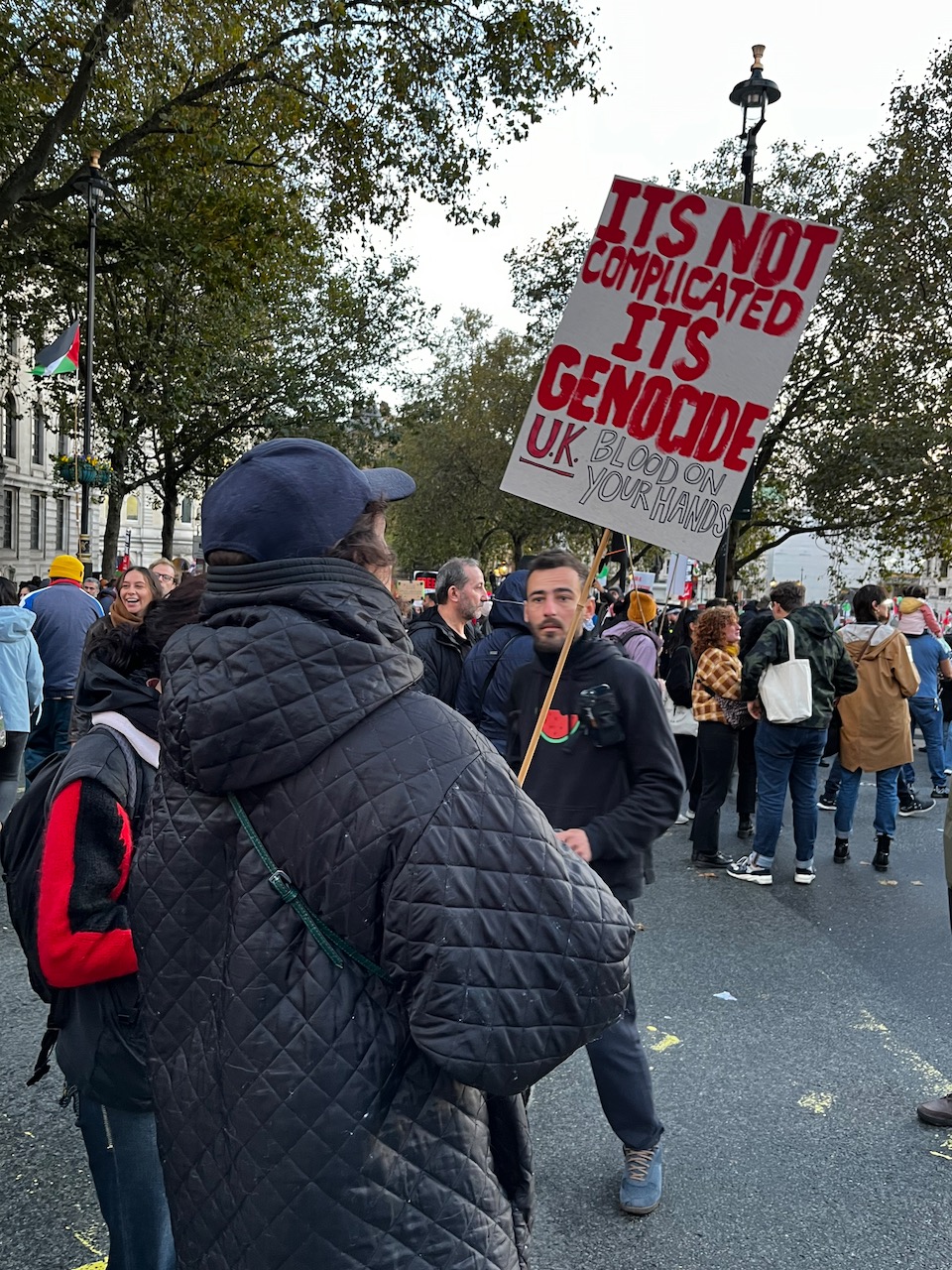
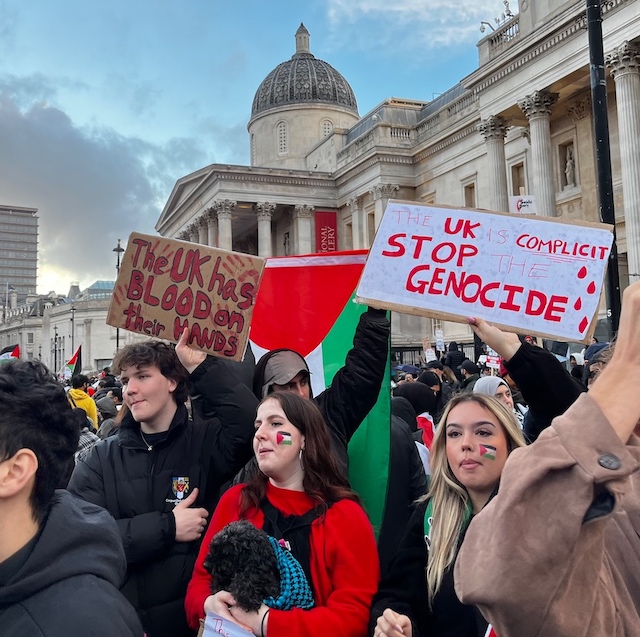
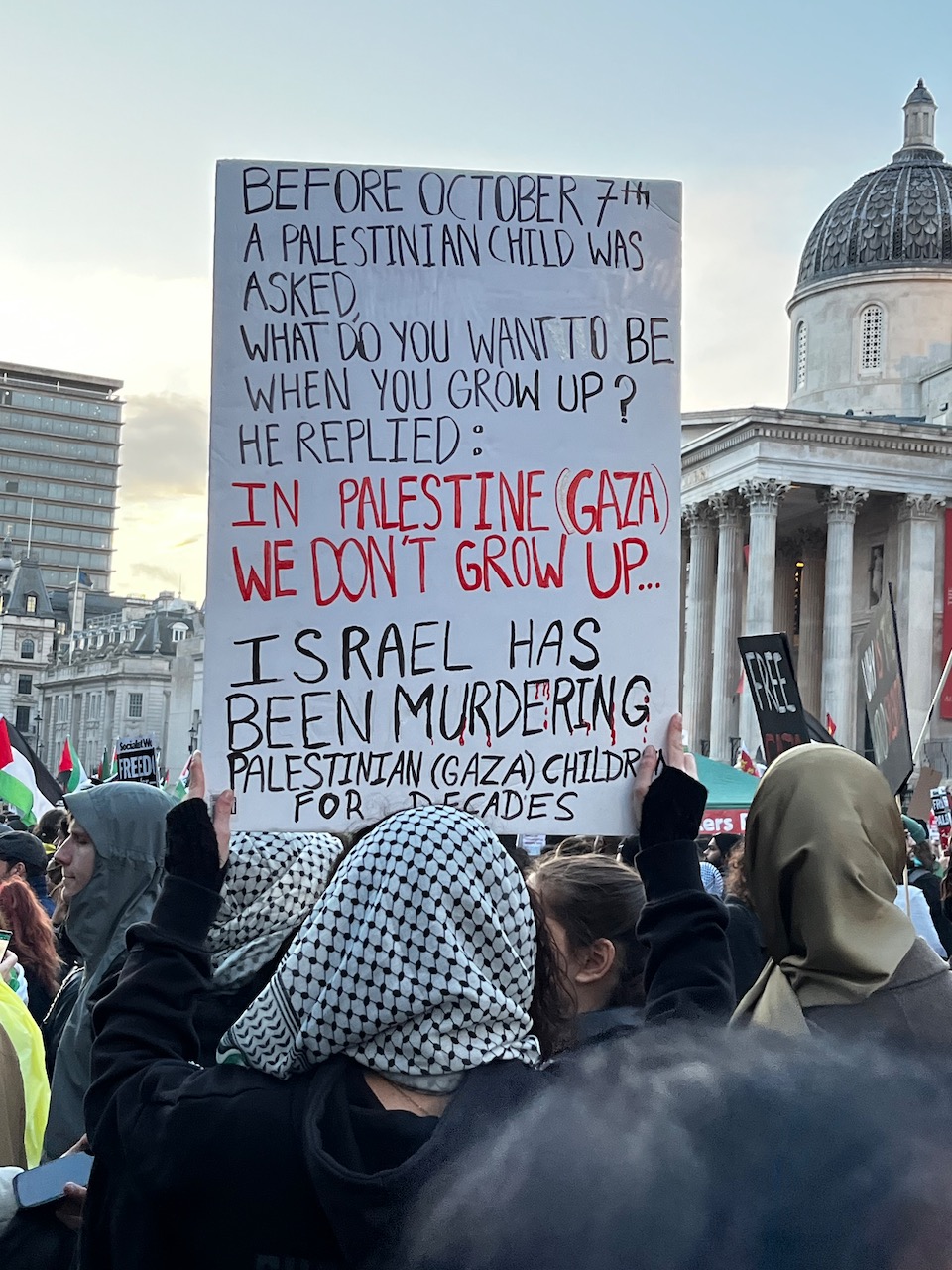
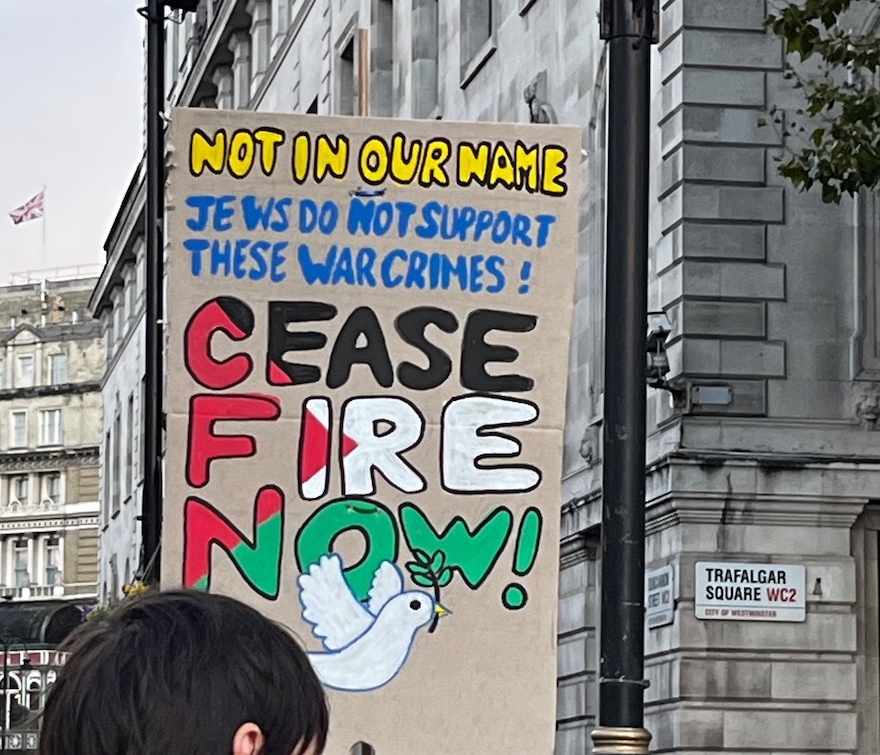
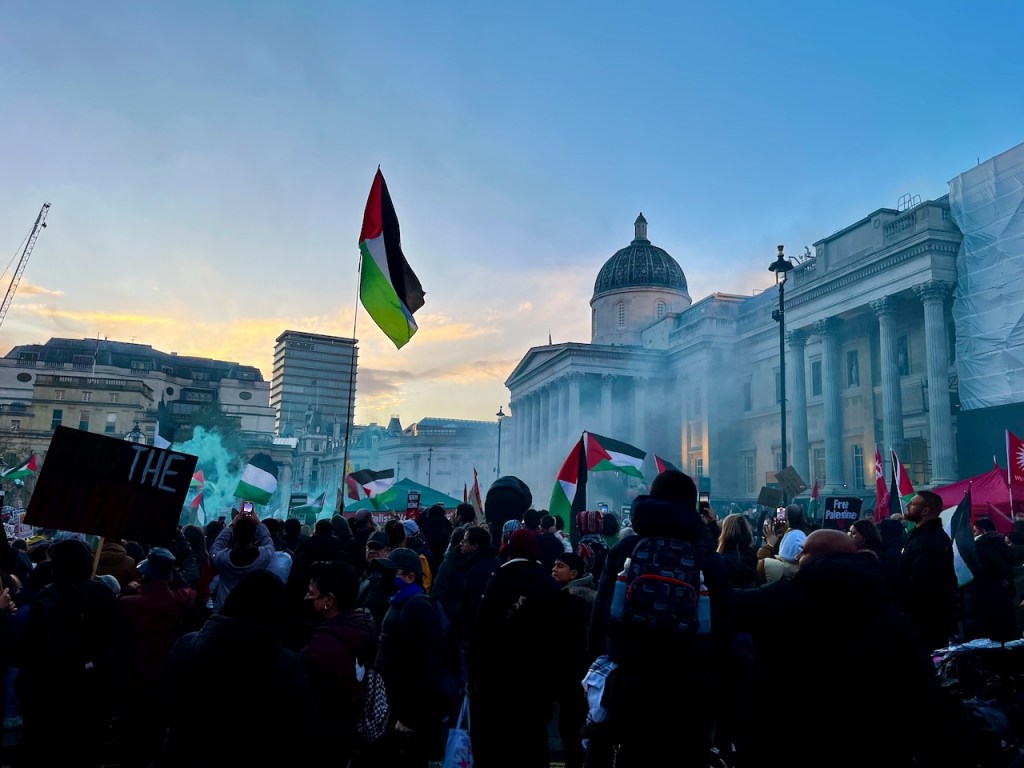
Below are a selection of photos from a recent protest in London.

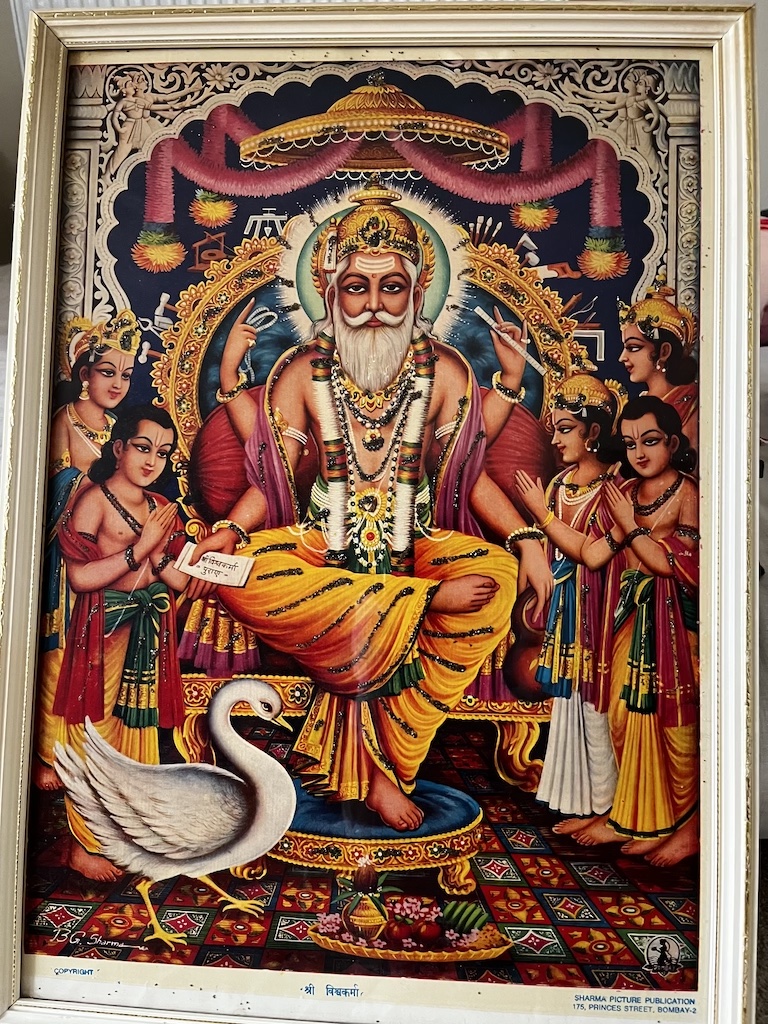
“My spiritual guru is Nanak Dev and my trade guru is Baba Vishvakarma”

While reading the news from India, the celebrations of Baba Vishwakarma Day caught my imagination. Not least because as I was speaking to my sister earlier on, who had mentioned that the electricity went off due to heavy rains, and the local ‘bijli walla’ won’t come to fix it today. Why I asked? Well because it’s Baba Vishwakarma Day!

The discussion inevitably led us to reminisce about the past and we started talking about Baba Vishwakarma and what it meant to us, especially when growing up. I recall my mother having a photo of Baba Vishwakarma in her prayer room, but the day after Diwali was especially important because this is when we celebrated Vishwakarma Day. She would offer special prayers with prasad (offering) consisting of sweet boondi, that was bought for this purpose. The conversation with my sister prompted me to go and find that picture, which I had kept as a keepsake for many years.

My mother stitched clothes, mostly salwar kameezes, to make ends meet, a talent that she was well-known for in the local community. She was meticulous, everyone who had clothes made by her was aware of her fine cutting and stitching skills, and how well presented her clothes were when she delivered them. I helped when I was able to, but my standards were never high enough! The sewing machine was at the heart of her (our) survival and also how she was able to reinvent herself from a housewife to a single parent with young daughters in a new place.

So why are the Ramgarhia community associated with Vishwakarma? This is because the deity is associated with machinery, technical work, tools and is often described as the God of carpenters, goldsmiths, blacksmiths, and those who work in skilled crafts. The Ramgarhias were originally a community of artisans who worked in these professions, and adapted and upskilled to mechanical work during the 19th century, but the old associations and traditions remain, at least for some.

These stories are now a part of my memory and history, even though the narrative today may be different. My parents belonged to a generation that was more open, less prescriptive and the religious boundaries were more porous. I went to gurdwaras, I took a dip in the Ganges, and we went to Sufi shrines, it was part of the collective identity. Although Punjab witnessed some of the most horrific communal violence in the 1947 Partition, the region is also ironically one of the most pluralistic. For a devout Sikh, my mother was perfectly at ease with the presence of Baba Vishwakarma and indeed Baba Balak Nath in her prayer room, both of whom have a strong presence in Ludhiana amongst the Ramgarhia Sikhs.  

So, while doing some research for this post, I came across a PhD from the University of Leeds by Sewa Singh Kalsi (1989). It made interesting reading and I share some key extracts, which provide a glimpse into the history and transformation of the Tarkhan/Ramgarhia Sikhs. Kalsi’s study focused on the city of Leeds (UK) but the extracts below show the emergence and transformation of this small but important community.

“The entry of the Tarkhans into the Sikh Panth can be traced to Bhai Lalo, a carpenter of the village Aimnabad, now in Pakistan. On his first travels (udasi) Guru Nanak stayed with Bhai Lalo where he composed his celebrated hymn enunciating his mission. He addressed this hymn to Bhai Lalo, condemning the mass slaughter by the army of Babur, the first Moghul emperor of India. Commenting on the status of Bhai Lalo within the Sikh Panth, McLeod says that “Even higher in the traditional estimation stands the figure of Bhai Lalo, a carpenter who plays a central part in one of the most popular of all ianam-sakhi (biography) stories about Guru Nanak” (1974:86). Gurdial Singh Reehal in Ramgarhia Itihas (History of the Ramaarhias) (1979) notes the names of seventy two distinguished Punjabi carpenters who worked closely with the Sikh Gurus and made valuable contributions to the development of Sikh tradition. He says that “Bhai Rupa, a prominent Tarkhan Sikh officiated at the wedding of the 10th Guru, Gobind Singh. His descendants known as Bagrian-wale (belonging to the village of Bagrian) were the royal priests of the Sikh rulers of Phulkian states. They administered the royal tilak (coronation ceremony) and officiated on royal weddings” (Reehal 1979:162). It seems plausible that the entry of Tarkhans into the Sikh Panth took place under the leadership of distinguished Tarkhan Sikhs over a long period.” P 104

“Most prominent among the followers of Guru Gobind Singh were two Tarkhan Sikhs, Hardas Singh Bhanwra and his son, Bhagwan Singh, who fought battles under his command. After his death in 1708, both leaders joined forces under Banda Bahadur to lead the Sikh Panth. Commenting on the position of Bhagwan Singh Bhanwra within the Sikh Panth, Gurdial Singh Reehal says that “Bhagwan Singh was appointed governor of Doaba (Jullundar and Hoshiarpur districts) by Banda Singh Bahadur” (1979:209). Jassa Singh Ramgarhia was the eldest son of Bhagwan Singh. He inherited the skills of his father and grandfather and became the leader of Ramgarhia misl (armed band). Jassa Singh built the fort of Ramgarh (this means literally the fort of God) to defend the Golden Temple, Amritsar. McLeod notes that “In 1749, however, he (Jassa Singh) played a critical role in relieving the besieged fort of Ram Rauni outside Amritsar. The fort was subsequently entrusted to his charge, rebuilt and renamed Ramgarh, and it was as governor of the fort that he came to be known as Jassa Singh Ramgarhia” (1974:79). The title of Ramgarhia was bestowed on Jassa Singh by the leaders of the Sikh misls. According to the Dictionary of Punjabi Language (1895), the word “Ramgarrya” means a title of respect applied to a Sikh carpenter. Describing the position held by Jassa Singh among the leaders of Sikh misls, Saberwal in Mobile Men says that “We have noted the part played by Jassa Singh Ramgarhia in the 18th century; though a Tarkhan, by virtue of his military stature he sometimes emerged as a spokesman for all twelve Sikh misls in relation to other centres of power” (1976:99).” P 105

“In order to understand the emergence of Ramgarhia identity, we must locate the processes which have enabled them to move in large numbers from jajmani relationships in the village to urban-industrial entrepreneurship both within India and East Africa. The extension of British rule to the Punjab opened up enormous opportunities for the Punjabi Tarkhans. They channelled their energy and resources into going abroad in search of wealth and towards participating in the urban-industrial growth in India. Their technical skills were harnessed to build railways, canals and administrative towns both in India and East Africa. The Ramgarhias were the majority Sikh group, approximately 90 per cent of the whole Sikh population in East Africa (Bhachu 1985:14; McLeod 1974:87). In East Africa, they established their social and religious institutions like the Ramgarhia associations, Ramgarhia gurdwaras and clubs. By the 1960’s, the Ramgarhias had moved from being skilled artisans, indentured to build the railways, to successful entrepreneurs, middle and high level administrators and technicians. Bhachu argues that “Support structures developed during their stay in East Africa have not only helped manufacture their ‘East Africanness’ but have also aided the perpetuation of their identity as ‘staunch Sikhs’ in the South Asian diaspora, independent of the original country of origin” (1985:13). In East Africa, the Ramgarhias demonstrated a remarkable capacity for maintaining the external symbols of Sikhism, which is a clear indication of their commitment to the Khalsa discipline.” P 107

“The Ramgarhias achieved a noticeable measure of economic success in the urban-industrial sector, both in India and in East Africa. They were able to discard the low status of a village Tarkhan by transforming themselves into wealthy contractors and skilled artisans employed in railway workshops and other industries. In cities they were associated with the Khatri Sikhs, the mercantile group in urban Punjabi society. In the Punjab, the distinctive feature has been the concentration of Ramgarhia Sikhs in particular towns i.e. Phagwara, Kartarpur, Batala, and Goraya. These towns are known for car parts industries, furniture, foundries and agricultural machinery owned by the Ramgarhia Sikhs. This newly achieved economic status was one of the factors which encouraged them to build religious, social and educational institutions belonging to their biradari. In the town of Phagwara, they have built an educational complex which includes a degree college, a teacher training college, a polytechnic, an industrial training institute and several schools.” P 108

And finally, a line from where I take the title of this piece. One of the people interviewed notes: “My spiritual guru is Nanak Dev and my trade guru is Baba Vishvakarma. Many Ramgarhias feel ashamed to be associated with our trade deity.” P 117.

Further references include my own book, in which I discuss the community in relation to the transformation of Ludhiana.

Bhachu, P. (1985). Twice migrants: east African Sikh settlers in Britain (Vol. 31100). Tavistock Publications.

Kalsi, Sewa Singh (1989) The Sikhs and caste : a study of the Sikh community in Leeds and Bradford. PhD thesis, University of Leeds.

Kaur, P. (2017) The dynamics of urbanisation in Ludhiana city. International Journal of Advanced Research and Development, Volume 2; Issue 6, 547-550.

McLeod, W.H. (1974) Ahluwalias and Ramgarhias: Two Sikh castes, South Asia: Journal of South Asian Studies, 4:1, 78-90, DOI: 10.1080/00856407408730689

Virdee, P. (2018). From the Ashes of 1947. Cambridge University Press.

Remembering Partition in the Punjab – podcast

Earlier in the summer I recorded a podcast with Realms of Memory. There are two episodes for those interested in understanding more about the history of Partition, especially how it impacted the Punjab. The talk was based on my book, ‘From the Ashes of 1947: Reimagining Partition’ published by Cambridge University Press (2018). In the podcast I also discuss some of the recent changes that have taken place in the study in Partition.

You can listen to the podcast via most streaming sites, or via Realms of Memory

Remembering Partition in the Punjab: Part 1

Remembering Partition in the Punjab: Part 2

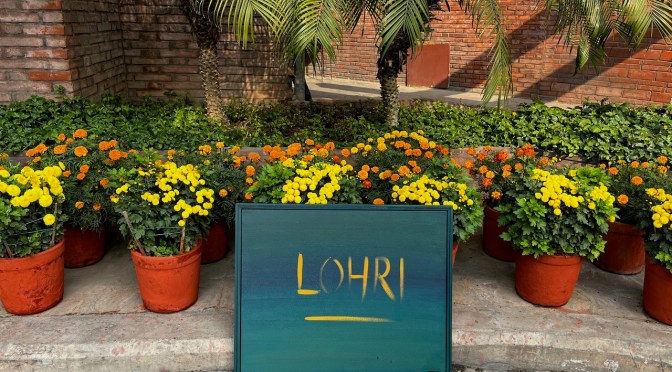
The festival of Lohri in Punjab

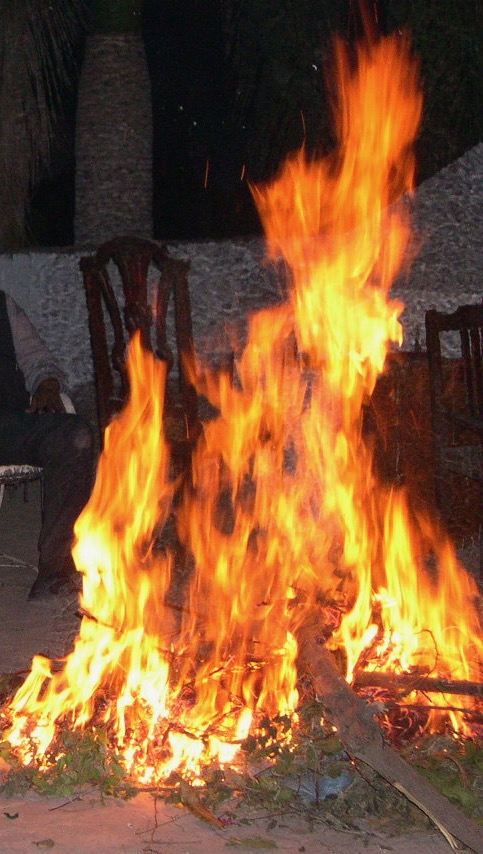
© Pippa Virdee 2004, celebrating lohri in Lahore.

A few days back I was in Punjab and Delhi, which were clouded and submerged in the winter chill and fog. With every passing comment about the cold, there is another reference, “it will only last until lohri, after that the weather will improve”. This points to the passing of the winter solstice and the changes in the season. Many of the popular festivals in Punjab are associated with seasonal changes, these are easy markers and reference points before formal calendars and dates arrived, and in this case the winter festival of lohri means anticipating longer and warmer days.

Growing up, there were always certain foods which we associated with lohri (and associated with the winter harvest). Rewris/revdis, jaggery and sesame-based dishes, and peanuts, are all warming and seasonal foods during the winter days of North India. Sarson da saag and makki di roti is another essential. Jaggery, sesame sweets and peanuts are quite often distributed and exchanged amongst friends and families. Traditionally, this special occasion was reserved for the birth of a son, but thankfully many have started celebrating the birth of a child, regardless of its gender.

In Indian Punjab the festival is public holiday but unfortunately across the border in Pakistan Punjab it is barely recognised. In recent years commentators and activists have been trying to revive it and re-introduce it to the wider public, with limited impact. Lohri is not and was not a religious festival, and yet the division of such festivals is emblematic of Partition, which increasingly entrenched what was deemed to be Hindu/Sikh and what was considered Islamic. In the video above for BBC Urdu, you can hear Mazhar Abbas narrate the history of lohri for a new generation.

Going back to Delhi, I was fortunate enough to meet up with Harinder Singh (1469) who was busy curating his lohri exhibition at the India International Centre. Do go and have a look, if you are around Delhi.

Read more about the history and origins of lohri.

Lohri: A joyous bonfire festival of Punjab to mark the end of winter by Mala Chandrashekhar

Lohri the legend of Dulla Bhatti by Aashish Kochhar

Watch lohri de rang with Noor Art and co.

Top posts in 2022

As I prepare to wind down for this year, here are 10 of the most popular posts of 2022.

  1. Ajj Aakhaan Waris Shah nu by Amrita Pritam
  2. How the photographs of Margaret Bourke-White became the images of partition
  3. 70 years ago extracts of the Sunderlal report Hyderabad, 1948
  4. The Status of Punjabi after 1947
  5. Sahir Ludhianvi and the anguish of Nehruvian India
  6. Two villages, two nations: Ganda Singh Wala-Hussainiwala
  7. Ludhiana’s Clock Tower (Ghanta Ghar)
  8. The ‘Jingle Trucks’ and the emergence of Truck Art
  9. 1881: the first full census in British India
  10. 23 Sir Ganga Ram mansion – the house of Amrita Sher-Gil

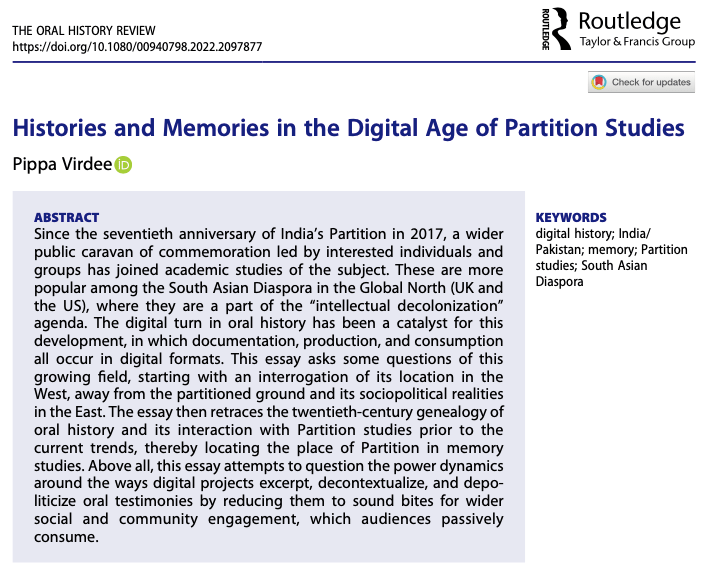
History, memory and knowledge production

Open The Oral History Review journal and article.

August is the time when anyone who has any interest in the history, politics, and society of South Asia will be talking, tweeting, and sharing about the time of Partition/Independence. Here in the UK, I have noticed how much discussion about Partition has entered the public discourse, whether it is TV, radio, newspapers etc. In this essay, recently published in The Oral History Review, I have attempted to show how the historiography of Partition has developed, especially over the past twenty-five years. It is an attempt to contextualise and understand how this field of Partition Studies has evolved and what role technology, new forms of social media and the South Asian diaspora, have played in taking this field into new directions. I was keen to highlight the disparities, and structural inequalities that have been produced and strengthened in this process, despite appearances to the contrary.

As a side-note and not completely unrelated to the article, access to information/knowledge must not be taken for granted as there are institutional and economic barriers, which prevent a level-playing field. This article is NOT open access because 1) my post-92 university in the UK does not subscribe to the costly Gold Open Access scheme, and 2) the article was not written with the support of any UKRI research grant. It means that my article will remain behind a paywall, unless an institution subscribes to the journal. Again, many institutions are now cutting back to save money (esp. post-92 universities) and so subscriptions to costly academic journals are often subject to scrutiny of disciplinary demands and budgetary considerations. It is likely that this article will only reach a limited number of people compared with any open access article, thus the readership, citations and engagement will remain confined.

If you have institutional access that’s great, if you don’t and you are interested in reading the full article, please feel free to contact me.

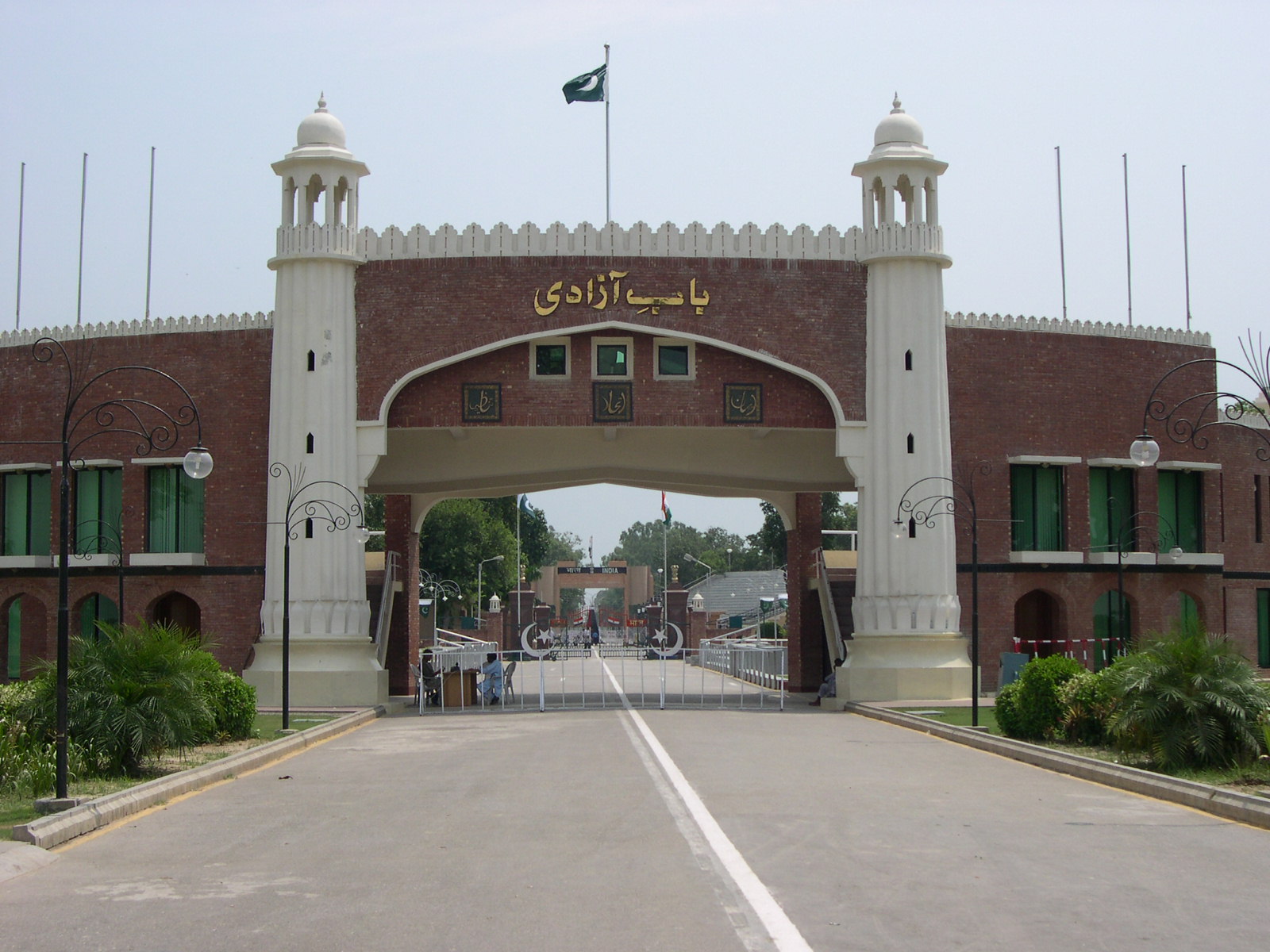
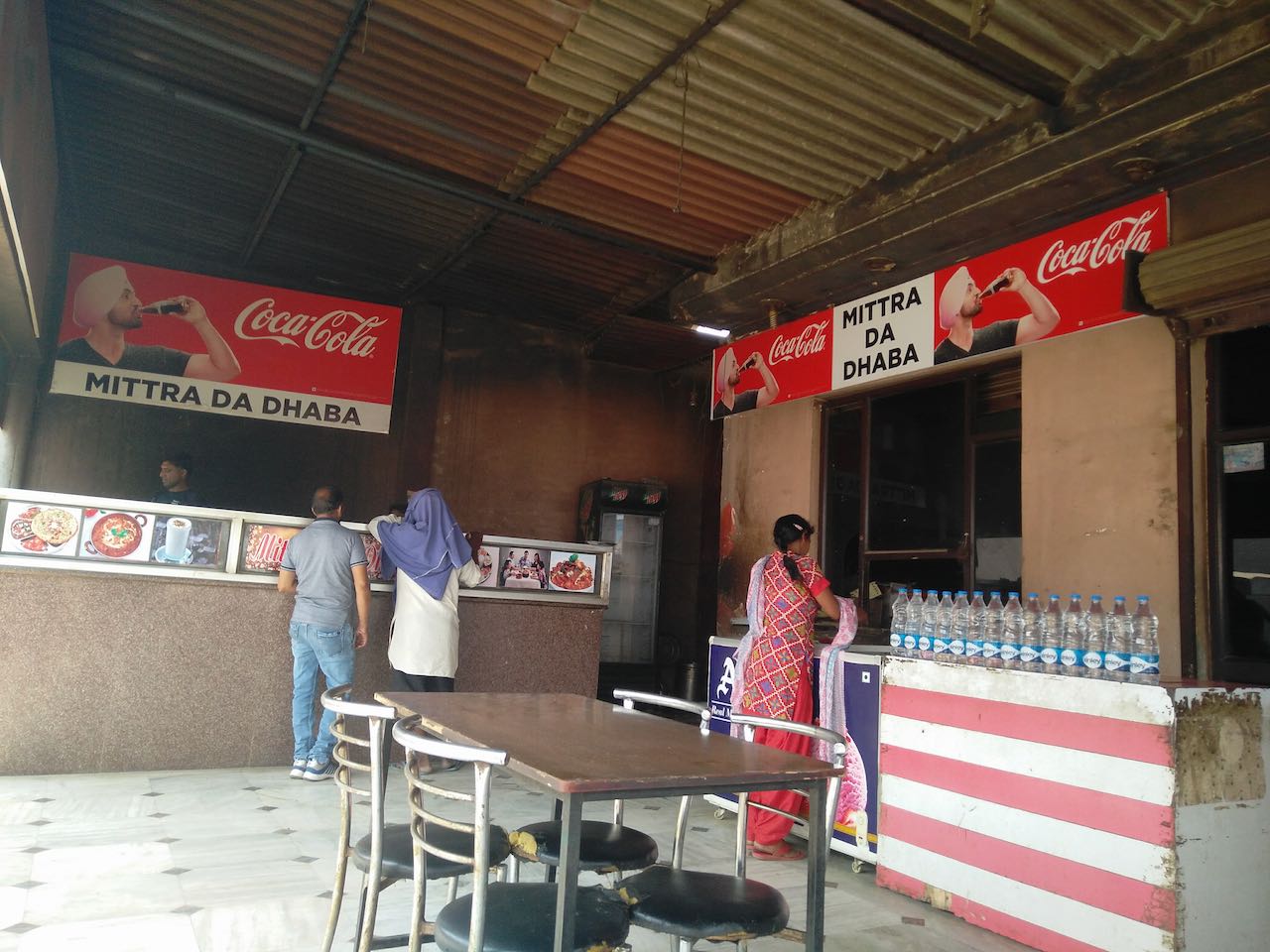
Mittra da Dhaba at the Wagah-Attari border

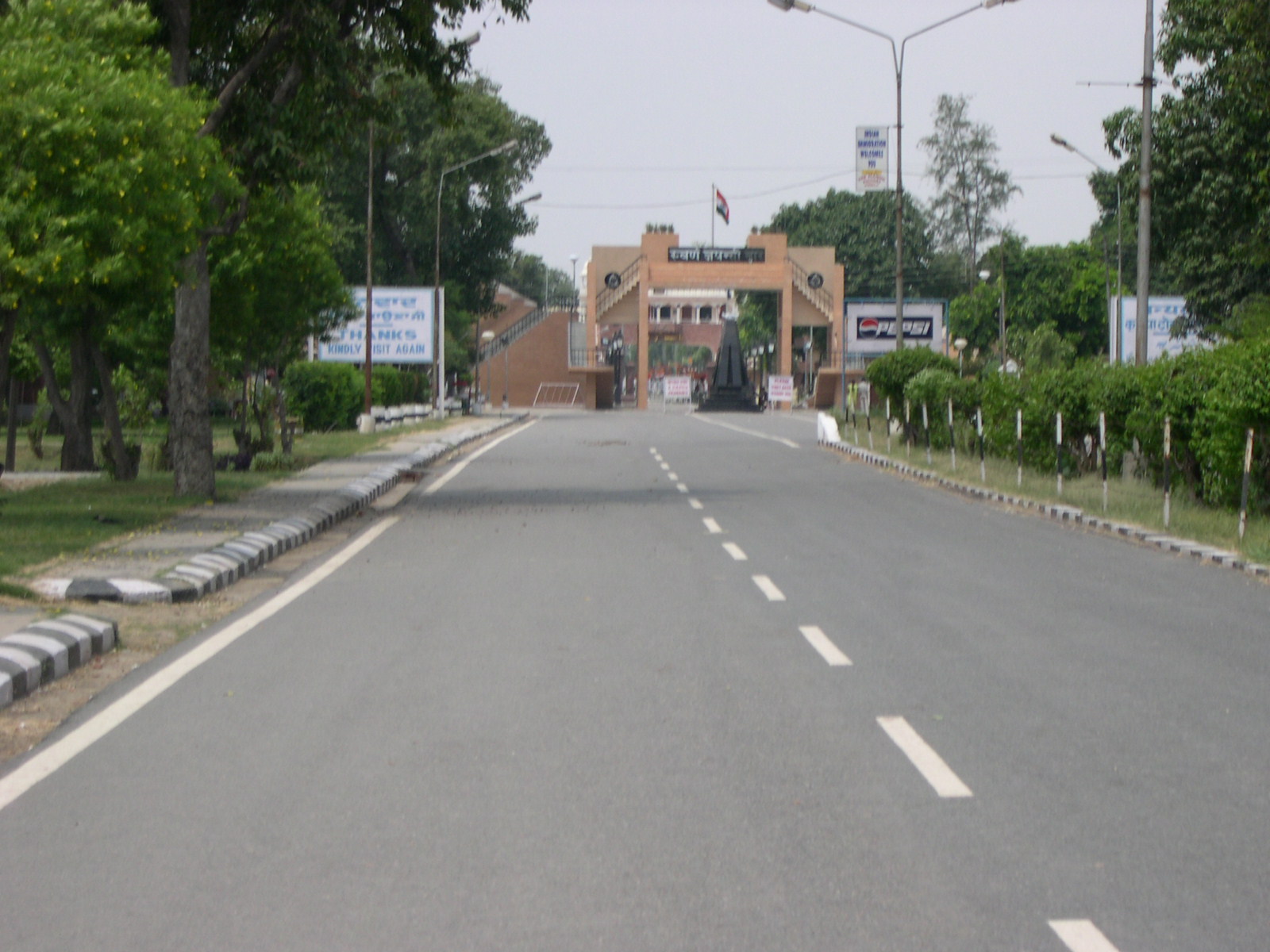
In 2001, I crossed the Wagah-Attari border for the first time. Since then, I have used this official land crossing between India and Pakistan numerous times, in the process seeing the border undergo multiple changes. It used to be the Grand Trunk Road split in half, with a few meters of “no man’s land” to separate them. I could literally walk from one side to the other, while remaining on the GT Road. Then, the authorities decided to uplift, gentrify, and replace the colonial bungalows. Gone was the quaint and informal space with scattered flower beds and plants and in came the flashy buildings, followed by the airport style security, customs, and immigration; culminating eventually in the hideous and expensive battle for who can hoist the largest flag and keep it flying high!

To be fair, the development of the check post at Wagah-Attari was probably a response to the expectation that relations between the two countries would improve, and with that the foot traffic would increase. The bungalows were not equipped to deal with high volumes of people. Hence, they first established the goods/transit depot on one side of the border, so as to divert the trucks carrying the items of import/export. This separated the trade traffic from the people traffic. Whilst the establishment of a goods depot offered signs of improved trade between the two countries, even this was subject to cordial relations.

With numerous crossings since then, I have seen the border change, not just physically but also its ambience and vibes that the place gives. Indeed, the new buildings and transit buses which take passengers from one side to other have functioned to create further distance between the lines of control. These were not there previously, and the cool formality evokes the illusion of being remote and separate. Borders do not have to be harsh and austere.

These moments and emotions are difficult to capture on camera, but they can be felt when encountering the staff and officials. When I first crossed the border, I had the compact Canon Sure Shot AF-7, which was a popular model in the 1990s and gifted to me. I enjoyed taking photographs, but cameras were not cheap then, and the 35mm film was expensive too, both to buy and to develop, so photos were taken sparingly. When I embarked on my doctoral research, taking my camera was essential for my trips to India and Pakistan, as it was an instrument to visually document my journey. I would normally pack 1-3 rolls of ISO 200 (sometimes also ISO 400) speed film, usually 36 EXP, good for general photographs. But one was never entirely sure until the film was taken back home, handed in for developing, which then produced the joy of physically going through the photographs a week later! Time had passed between undergoing the actual trip and now feeling those photographs in my hands, and the images allowed me to recreate and relive those moments again.

Today everything is instant. In a moment I can be taking a photograph at the border, and then share it with the wider public around the world via social media. The only caveat here is that, generally the phone signals are non-existent within 1-2 kilometres of the border area, so you would probably need to wait until you were able to pick up the phone signal. More importantly, this also disrupted any arrangements one had made to meet people on the other side. If I was crossing the border, I might contact my friends/family beforehand and say, I’m crossing at X time (keeping in mind the 30 minutes times difference between the two countries), so I estimate that I will be out at Y time (usually 60 minutes from one side to the other). But if things didn’t go to plan, there is no way of contacting the person to alert them of the delays. And when you did finally make it to the other side, there were always a small number of people anxiously waiting and looking to see when their friends/family will pass through those doors.

There are many other stories of this rather strange and intriguing no man’s land but to end with a more positive story, I share a picture of a dhaba at Attari, Mittra da dhaba (literal translation – friends’ roadside restaurant) is located close to the entrance to check post, catering to travellers and tourists who come for the daily lowering of the flag ceremony. I have gone there many times, but on one occasion in 2017, I asked the owner to pack some food for me, food which I planned to take across the border and share with my friends in Lahore. He took great care to make it extra special and pack the food tightly, so that it wouldn’t spill. I could see that it also brought him great joy to know that his food would travel to the other side. As we parted, he said come back and tell me if they enjoyed it! 

Alas, these stories are in the past tense, and with Covid the border faced further restrictions and closures. I have no idea if my friend is still there, I hope so. We need more friends in these otherwise hostile spaces.

Ajj Aakhaan Waris Shah Nu By Amrita Pritam

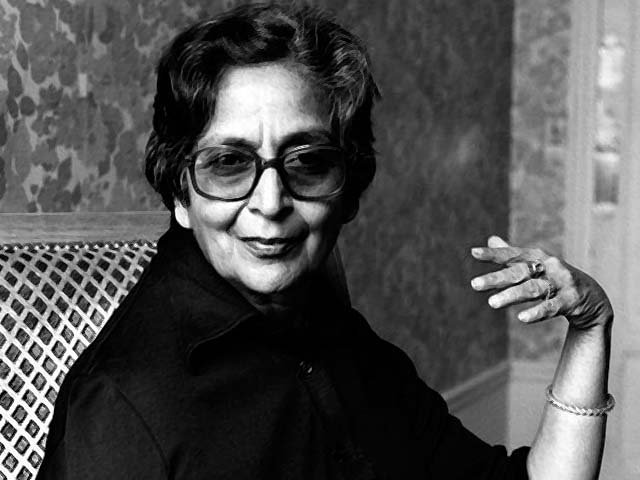
Amrita Pritam (1919-2005) was one the most distinguished Punjabi poets and fiction writers. She was born in Mandi Bahauddin, Punjab and was living in Lahore when in 1947 she, along with the millions others, was forced to migrate during the partition of the Punjab.

Her first collection of poems Amrit Lehrcm was published in 1936 when she was barely 17 years old. Starting as a romantic poet, she matured into a poetess of revolutionary ideas as a result of her involvement with the Progressive Movement in literature.

Ajj Aakhaan Waris Shah Nu (Today I Say unto Waris Shah) is a heartrending poem written during the riot-torn days that followed the partition of the country. (Apnaorg.com). The poem is addressed to Waris Shah, (1706 -1798), a Punjabi poet, best-known for his seminal work Heer Ranjha, based on the traditional folk tale of Heer and her lover Ranjha. Heer is considered one of the quintessential works of classical Punjabi literature.

Her body of work comprised over 100 books of poetry, fiction, biographies, essays, a collection of Punjabi folk songs and an autobiography that were all translated into several Indian and foreign languages

Ajj Aakhaan Waris Shah Nu (Today I Say unto Waris Shah – Ode to Waris Shah)

Translation from the original in Punjabi by Khushwant Singh. Amrita Pritam: Selected Poems. Ed Khushwant Singh. (Bharatiya Jnanpith Publication, 1992)

 To Waris Shah I turn today!

Speak up from the graves midst which you lie!

In our book of love, turn the next leaf.

When one daughter of the Punjab did cry

You filled pages with songs of lamentation,

Today a hundred daughters cry

0 Waris to speak to you.

O friend of the sorrowing, rise and see your Punjab

Corpses are strewn on the pasture,

Blood runs in the Chenab.

Some hand hath mixed poison in our live rivers

The rivers in turn had irrigated the land.

From the rich land have sprouted venomous weeds

flow high the red has spread

How much the curse has bled!

The poisoned air blew into every wood

And turned the flute bamboo into snakes

They first stung the charmers who lost their antidotes

Then stung all that came their way

Their lips were bit, fangs everywhere.

The poison spread to all the lines

All of the Punjab turned blue.

Song was crushed in every throat;

Every spinning wheel’s thread was snapped;

Friends parted from one another;

The hum of spinning wheels fell silent.

All boats lost the moorings

And float rudderless on the stream

The swings on the peepuls’ branches

I lave crashed with the peepul tree.

Where the windpipe trilled songs of love

That flute has been lost

Ranjah and his brothers have lost their art.

Blood keeps falling upon the earth

Oozing out drop by drop from graves.

The queens of love

Weep in tombs.

It seems all people have become Qaidos,

Thieves of beauty and love

Where should I search out

Another Waris Shah.

Waris Shah

Open your grave;

Write a new page

In the book of love.

NOTES

Waris Shah (1706 -1798) was a Punjabi poet, best-known for his seminal work Heer Ranjha, based on the traditional folk tale of Heer and her lover Ranjha. Heer is considered one of the quintessential works of classical Punjabi literature.

Qaido – A maternal uncle of Heer in Heer Ranjha is the villain who betrays the lovers.

The Punjab – the region of the five rivers east of Indus: Jhelum, Chenab, Ravi, Beas, and Sutlej.

When Amrita Pritam called out to Waris Shah in a heartrending ode while fleeing the Partition riots by Nirupama Dutt

I say unto Waris Shah by Amrita Pritam – Poem Analysis

Pritam, Amrita, and Rama Jha. “An Interview with Amrita Pritam.” Indian Literature 25, no. 5 (1982): 183-195.

Butalia, Urvashi. “Looking back on partition.” Contemporary South Asia 26, no. 3 (2018): 263-269.