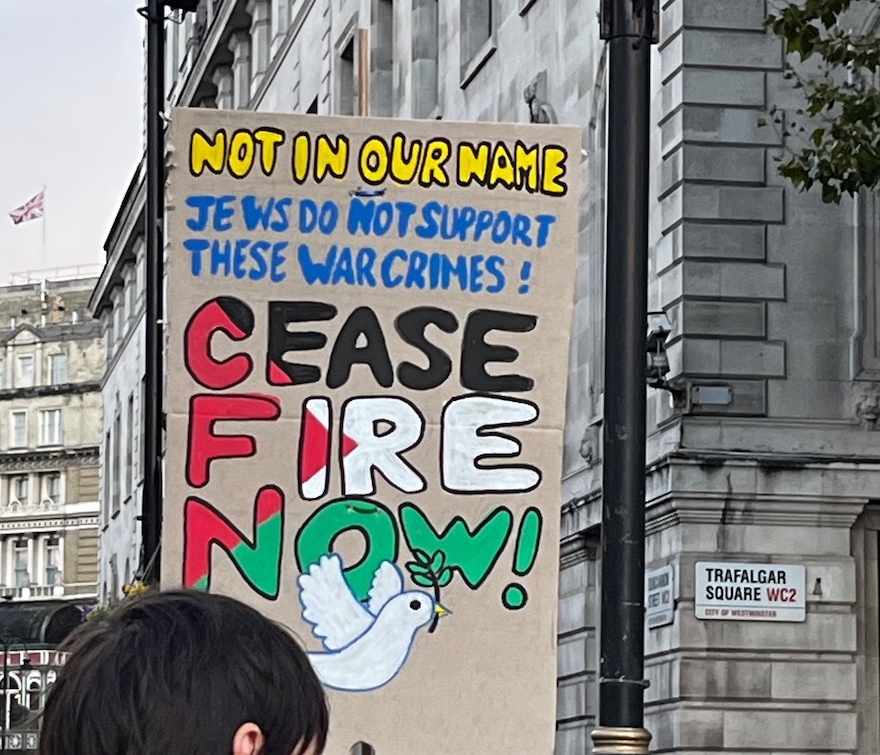
It was Iqbal’s birth anniversary recently, and Purana Pakistan on Instagram had shared a poem he wrote in 1938; Shaam-o-Falasteen – Syria and Palestine. It prompted me to locate and share the political views of the political leadership at the time in British India. The views of both the Indian National Congress and the All-India Muslim League were immensely sympathetic and supportive of the Palestinian people and their rights. It was framed in wider British imperialism, and for Nehru, “the Arab struggle against British imperialism in Palestine is as much part of the great world conflict as India’s struggle for freedom” (1936). Below I share a selection of views from Nehru, Jinnah, Gandhi and Iqbal.
NEHRU, 1936
Press statement issued by Jawaharlal Nehru, 13 June 13, 1936
Few people, I imagine, can withhold their deep sympathy from the Jews for the long centuries of the most terrible oppression to which they have been subjected all over Europe. Fewer still can repress their indignation at the barbarities and racial suppression of the Jews which the Nazis have indulged in during the last few years, and which continue today. Even outside Germany, Jew-baiting has become a favourite pastime of various fascist groups.
This revival in an intense form of racial intolerance and race war is utterly repugnant to me and I have been deeply distressed at the sufferings of vast numbers of people of the Jewish race. Many of these unfortunate exiles, with no country or home to call their own, are known to me, and some I consider it an honour to call my friends. I approach this question therefore with every sympathy for the Jews. So far as I am concerned, the racial or the religious issue does not affect my opinion.
But my reading of war-time and post-war history shows that there was a gross betrayal of the Arabs by British imperialism. The many promises that were made to them by Colonel Lawrence and others, on behalf of the British Government, and which resulted in the Arabs helping the British and Allied Powers during the war, were consistently ignored after the war was over. All the Arabs, in Syria, Iraq, Trans-Jordan and Palestine, smarted under this betrayal, but the position of the Arabs in Palestine was undoubtedly the worst of all.
Having been promised freedom and independence repeatedly from 1915 onwards, suddenly they found themselves converted into a mandatory territory with a new burden added on— the promise of the creation of a national home for the Jews — a burden which almost made it impossible for them to realise independence.
The Jews have a right to look to Jerusalem and their Holy Land and to have free access to them. But the position after the Balfour declaration was very different. A new state within a state was sought to be created in Palestine, an ever-growing state with the backing of British imperialism behind it, and the hope was held out that this new Jewish state would, in the near future, become so powerful in numbers and in economic position that it would dominate the whole of Palestine.
Zionist policy aimed at this domination and worked for it, though, I believe, some sections of Jewish opinion were opposed to this aggressive attitude. Inevitably, the Zionists opposed the Arabs and looked for protection and support to the British Government. Such case as the Zionists had might be called a moral one, their ancient associations with their Holy Land and their present reverence for it. One may sympathise with it. But what of the Arabs? For them also it was a holy land — both for the Muslim and the Christian Arabs.
For thirteen hundred years or more they had lived there and all their national and racial interests had taken strong roots there. Palestine was not an empty land fit for colonisation by outsiders. It was a well-populated and full land with little room for large numbers of colonists from abroad. Is it any wonder that the Arabs objected to this intrusion? And their objection grew as they realised that the aim of British imperialism was to make the Arab-Jew problem a permanent obstacle to their independence. We in India have sufficient experience of similar obstacles being placed in the way of our freedom by British imperialism.
It is quite possible that a number of Jews might have found a welcome in Palestine and settled down there. But when the Zionists came with the avowed object of pushing out the Arabs from all places of importance and of dominating the country, they could hardly be welcomed. And the fact that they have brought much money from outside and started industries and schools and universities cannot diminish the opposition of the Arabs, who see with dismay the prospect of their becoming permanently a subject race, dominated, politically and economically, by the Zionists and the British Government.
The problem of Palestine is thus essentially a nationalist one— a people struggling for independence against imperialist control and exploitation. It is not a racial or religious one. Perhaps some of our Muslim fellow countrymen extend their sympathy to the Arabs because of the religious bond.
But the Arabs are wiser and they lay stress only on nationalism and independence, and it is well to remember that all Arabs, Christian as well as Muslim, stand together in this struggle against British imperialism. Indeed, some of the most prominent leaders of the Arabs in this national struggle have been Christians.
If the Jews had been wise, they would have thrown in their lot with the Arab struggle for independence. Instead, they have chosen to side with British imperialism and to seek its protection against the people of the country….
The Arabs of Palestine will no doubt gain their independence, but this is likely to be a part of the larger unity of Arab peoples for which the countries of western Asia have so long hankered after, and this again will be part of the new order which will emerge out of present-day chaos. The Jews, if they are wise, will accept the teaching of history, and make friends with the Arabs and throw their weight on the side of the independence of Palestine, and not seek a position of advantage and dominance with the help of the imperialist power.
Selected and edited by Mridula Mukherjee, former Professor of History at JNU and former Director of Nehru Memorial Museum and Library.
IQBAL, 1937 Iqbal writing in response to the Peel Commission’s recommendations, July 1937
We must not forget that Palestine does not belong to England. She is holding it under a mandate from the League of Nations, which Muslim Asia is now learning to regard as an Anglo-French institution invented for the purpose of dividing the territories of weaker Muslim peoples. Nor does Palestine belong to the Jews who abandoned it of their own free will long before its possession by the Arabs.
Mr. Jinnah in his presidential address to the AIML in 1937,
Great Britain has dishonored her proclamation to the Arabs – which had guaranteed to them complete independence of the Arab homelands…After having utilized them by giving them false promises, they installed themselves as the mandatory power with that infamous Balfour Declaration…fair-minded people will agree when I say that Great Britain will be digging its grave if she fails to honor her original proclamation…
You know the Arabs have been treated shamelessly—men who, fighting for the freedom of their country, have been described as gangsters, and subjected to all forms of repression. For defending their homelands, they are being put down at the point of the bayonet, and with the help of martial laws. But no nation, no people who are worth living as a nation, can achieve anything great without making great sacrifice such as the Arabs of Palestine are making.
Hitherto I have refrained practically from saying anything in public regarding the Jew-Arab controversy. I have done so for good reasons. That does not mean any want of interest in the question, but it does mean that I do not consider myself sufficiently equipped with knowledge for the purpose. For the same reason I have tried to evade many world events. Without airing my views on them, I have enough irons in the fire. But four lines of a newspaper column have done the trick and evoked a letter from a friend who has sent me a cutting which I would have missed but for the friend drawing my attention to it. It is true that I did say some such thing in the course of a long conversation with Mr. Louis Fischer on the subject. I do believe that the Jews have been cruelly wronged by the world. “Ghetto” is, so far as I am aware, the name given to Jewish locations in many parts of Europe. But for their heartless persecution, probably no question of return to Palestine would ever have arisen. The world should have been their home, if only for the sake of their distinguished contribution to it.
But, in my opinion, they have erred grievously in seeking to impose themselves on Palestine with the aid of America and Britain and now with the aid of naked terrorism. Their citizenship of the world should have and would have made them honoured guests of any country. Their thrift, their varied talent, their great industry should have made them welcome anywhere. It is a blot on the Christian world that they have been singled out, owing to a wrong reading of the New Testament, for prejudice against them. “If an individual Jew does a wrong, the whole Jewish world is to blame for it.” If an individual Jew like Einstein makes a great discovery or another composes unsurpassable music, the merit goes to the authors and not to the community to which they belong.
No wonder that my sympathy goes out to the Jews in their unenviably sad plight. But one would have thought adversity would teach them lessons of peace. Why should they depend upon American money or British arms for forcing themselves on an unwelcome land? Why should they resort to terrorism to make good their forcible landing in Palestine? If they were to adopt the matchless weapon of non-violence whose use their best Prophets have taught and which Jesus the Jew who gladly wore the crown of thorns bequeathed to a groaning world, their case would be the world’s and I have no doubt that among the many things that the Jews have given to the world, this would be the best and the brightest. It is twice blessed. It will make them happy and rich in the true sense of the word and it will be a soothing balm to the aching world.
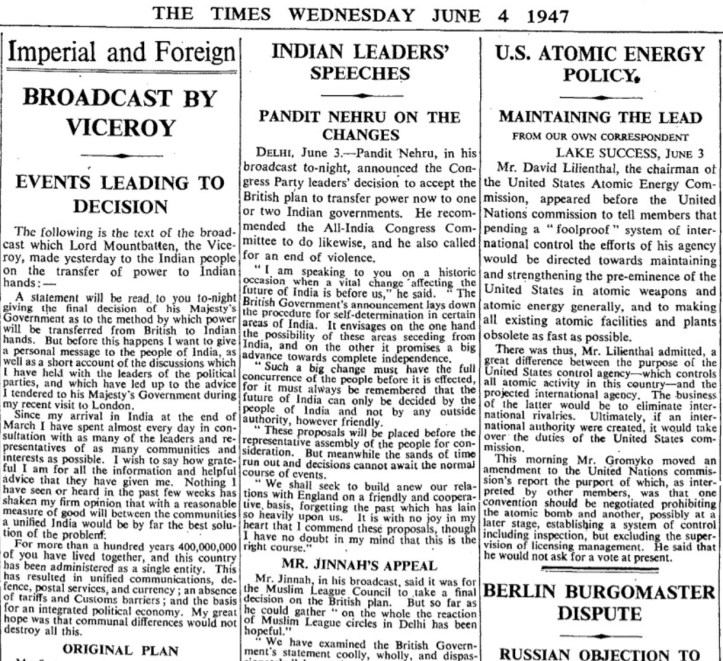
Below is the full transcript of the speech, which was delivered by Lord Mountbatten, the last Viceroy of India. It is followed by statements by Attlee, Nehru, Jinnah and Baldev Singh. The latter’s parting words make for interesting, wishful reading considering that it was the Sikh community that was impacted the most by this Partition Plan. This is also fully acknowledged by Mountbatten in his speech.
BROADCAST BY VICEROY EVENTS LEADING TO DECISION
The following is the text of the broadcast which Lord Mountbatten, the Viceroy, made yesterday to the Indian people on the transfer of power to Indian hands:-
A statement will be read to you tonight giving the final decision of his Majesty’s Government as to the method by which power will be transferred from British to Indian hands. But before this happens I want to give a personal message to the people of India, as well as a short account of the discussions which I have held with the leaders of the political parties, and which have led up to the advice I tendered to His Majesty’s Government during my recent visit to London.
Since my arrival in India at the end of March I have spent almost every day in consultation with as many of the leaders and representatives of as many communities and interests as possible. I wish to say how grateful I am for all the information and helpful advice that they have given me. Nothing I have seen or heard in the past few weeks has shaken my firm opinion that with a reasonable measure of good will between the communities a unified India would be far the best solution of the problem.
For more than a hundred years, 400,000,000 of you have lived together, and this country has been administered as a single entity. This has resulted in unified communications, defence, postal services and currency; an absence of tariffs and Customs Barriers; and the basis for an integrated political economy. My great hope was that communal differences would not destroy this.
ORIGINAL PLAN
My first course, in all my discussions, was therefore to urge the political leaders to accept unreservedly the Cabinet mission plan of May 16, 1946. In my opinion that plan provides the best arrangement that can be devised to meet the interests of all the communities of India. To my great regret it has been impossible to obtain agreement either on the Cabinet mission plan or on any other plan that would preserve the unity of India. But there can be no question of coercing any large areas in which one community has a majority to live against their will under a Government in which another community has a majority—and the only alternative to coercion is partition.
But when the Muslim League demanded the partition of India, Congress used the same arguments for demanding in that event the partition of certain provinces. To my mind this argument is unassailable. In fact neither side proved willing to leave a substantial area in which their community have a majority under the government of the other. I am, of course, just as much opposed to the partition of provinces as I am to the partition of India herself, and for the same basic reasons. For just as I feel there is an Indian consciousness which should transcend communal differences, so I feel there is a Punjabi and Bengali consciousness which has evoked a loyalty to their province. And so I felt it was essential that the people of India themselves should decide this question of partition.
The procedure for enabling them to decide for themselves whether they want the British to hand over power to one or two governments is set out in the statement which will be read to you. But there are one or two points on which 1 should like to add a note of explanation. It was necessary, in order to ascertain the will of the people of the Punjab. Bengal, and part of Assam, to lay down boundaries between the Muslim majority areas and the remaining areas, but I want to make it clear that the ultimate boundaries will be settled by a boundary commission and will almost certainly not be identical with those which have been provisionally adopted.
POSITION OF SIKHS
We have given careful consideration to the position of the Sikhs. This valiant community forms about an eighth of the population of the Punjab, but they are so distributed that any partition of this province would inevitably divide them. All of us who have the good of the Sikh community at heart are very sorry to think that the partition of the Punjab which they themselves desire, cannot avoid splitting them to a greater or lesser extent. The exact degree of the split will be left to the boundary commission on which they will, of course, be represented.
The whole plan may not be perfect: but like all plans its success will depend on the spirit of good will with which it is carried out. I have always-felt that once it was decided in what way to transfer power, the transfer should take place at the earliest possible moment, but the dilemma was that if we waited until a constitutional set-up for all India was agreed, we should have to wait a long time, particularly if partition were decided on, whereas if we handed over power before the Constituent Assemblies had finished their work we should leave the country without a constitution.
The solution to this dilemma, which I put forward, is that his Majesty’s Government should transfer power now to one or two governments of British India each having Dominion status as soon as the necessary arrangements can be made. This I hope will be within the next few months. I am glad to announce that his Majesty’s Government have accepted this proposal and are already having legislation prepared for introduction in Parliament this session. As a result of these decisions the special function of the India Office will no longer have to be carried out, and some other machinery will be set up to conduct future relations between his Majesty’s Government and India.
I wish to emphasize that this legislation will not impose any restriction on the power of India as a whole or of the two new States if there is partition, to decide in the future their relationship to each other and to other member states of the British Commonwealth.
Thus the way is now open to an arrangement by which power can be transferred many months earlier than the most optimistic of us thought possible, and at the same time leave it to the people of British India to decide for themselves on their future, which is the declared policy of his Majesty’s Government.
INDIAN STATES
I have made no mention of the Indian States, since the new decisions of his Majesty’s Government are concerned with the transfer of power in British India.
If the transfer of power is to be effected in a peaceful and orderly manner, every single one of us must bend all his efforts to the task. This is no time for bickering, much less for the continuation in any shape or form of the disorders and lawlessness of the past few months. Do not forget what a narrow margin of food we are all working on. We cannot afford any toleration of violence. All of us are agreed on that.
Whichever way the decision of the Indian people may go, I feel sure any British officials or officers who may be asked to remain for a while will do everything in their power to help implement that decision. His Majesty as well as his Government have asked me to convey to all of you in India their sincere good wishes for your future and the assurance of their continued good will.
I have faith in the future of India and am proud to be with you all at this momentous time. May your decisions be wisely guided and may they be carried out in the peaceful and friendly spirit of the Gandhi-Jinnah appeal.
MR. ATTLEE’S MESSAGE
A recording of the Viceroy’s message to the Indian people was broadcast in this country last night. It was introduced by the Prime Minister who said that the twofold purpose of the plan now put forward was to make possible the maximum degree of harmony and cooperation between the Indian political parties in order that the partition of India, if decided upon, might involve as little loss and suffering as possible, and secondly to enable the British Government to hand over its responsibilities in an orderly and constitutional manner at the earliest opportunity.
“I would make an earnest appeal to everyone to give calm and dispassionate consideration to these proposals,” Mr. Attlee went on. “It is, of course, easy to criticize them, but weeks of devoted work by the Viceroy have failed to find any alternative that is practicable. They have emerged from the hard facts of the situation in India”.
INDIAN LEADERS’ SPEECHES
PANDIT NEHRU ON THE CHANGES
DELHI, June 3.-Pandit Nehru, in his broadcast to-night, announced the Congress Party leaders’ decision to accept the British plan to transfer power now to one or two Indian governments. He recommended the All-India Congress Committee to do likewise, and he also called for an end of violence.
“I am speaking to you on a historic occasion when a vital change ‘affecting the future of India is before us,” he said. The British Government’s announcement lays down the procedure for self-determination in certain areas of India. It envisages on the one hand the possibility of these areas seceding from India, and on the other it promises a big advance towards complete independence.
“Such a big change must have the full concurrence of the people before it is effected, for it must always be remembered that the future of India can only be decided by the people of India and not by any outside authority, however friendly.
“These proposals will be placed before the representative assembly of the people for consideration. But meanwhile the sands of time run out and decisions cannot await the normal course of events.
“We shall seek to build anew our relations with England on a friendly and cooperative, basis, forgetting the past which has lain so heavily upon us. It is with no joy in my heart that I commend these proposals, though I have no doubt in my mind that this is the right course.”
MR. JINNAH’S APPEAL
Mr. Jinnah, in his broadcast, said it was for the Muslim League Council to take a final decision on the British plan. But so far as he could gather “on the whole the reaction of Muslim League circles in Delhi has been hopeful.”
“We have examined the British Government’s statement coolly, wholly, and dispassionately,” he went on. “We have to take momentous decisions, and have very big issues facing us in the solution of this complex political problem. Therefore we must galvanize and concentrate all our energies to see that the transfer of power is effected in a peaceful and orderly manner.
“It is clear that the plan does not meet in some important respects our point of view, and we cannot say or feel that we are satisfied or that we agree with some of the matters dealt with by the plan. It is for us now to consider whether the plan as presented to us by the British Government should be accepted by us as a compromise or a settlement. On this point I do not wish to prejudge the decision of the council of the All-India Muslim League, which has been summoned to meet on Monday. I appeal to every community in India, and especially to the Muslims, to maintain peace and harmony.”
Sardar Baldev Singh, the Sikh leader, said: We have closed a dreary chapter. It would be untrue if I were to say that we are altogether happy. Our common quest for freedom need never have divided and torn us asunder one from the other. This has actually taken place. The shadow of our differences has thrown its gloom over us. We have let ourselves be rent apart.”
The British plan did not please everybody, “not the Sikh community, anyway, but it is certainly something worthwhile. Let us take it at that.
“I believe with all my heart that the divisions that tend to keep us apart now will not last long. The very blueprint of our plans, so soon as we view it with care, will bind us together.”
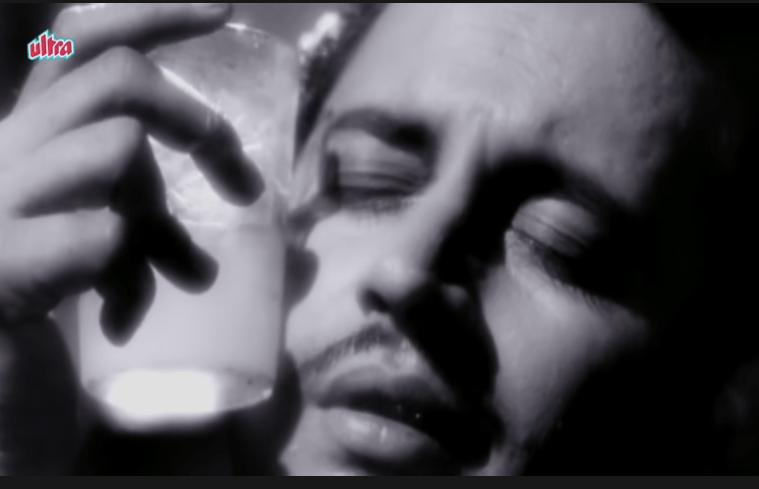
This song/poem written by Sahir Ludhianvi for the film Pyaasa, starring Guru Dutt, has as much relevance today as it did in 1957 at the height of the Nehruvian age. The lyrics and translation below are courtesy of Proud Indians, Are We? – Jinhe Naaz Hai Hind Par – Pyaasa By Deepa.
It is also worth reading the broader article, which is on Guru Dutt, “a man clearly ahead of his time.” Follow link for the song via YouTube. Make sure if you listen to any other versions that it has the last Antara of the song, which has been cut in some versions.
Ye kooche ye nilaam ghar dilkashi ke Ye lutate huye caravan zindagi ke Kahaan hain kahan hain muhafiz khudi ke Jinhe naaz hai hind par wo kahaan hain Kahaan hain kahaan hain kahaan hain
Look at these lanes, alluring houses which are up for sale/auction everyday. Look at these robbed caravans of life. Where are those protectors of self respect and pride? Where are those who say we are proud Indians? What are you exactly proud of?
Ye purpech galiyaan ye badnaam bazaar Ye gumnaam raahi ye sikkon ki jhankaar Ye ismat ke saude ye saudon pe taqraar Jinhe naaz hai hind par wo kahaan hain Kahaan hain kahaan hain kahaan hain
These complicated streets, these defamed, scandalized markets. The unknown pedestrians who walk in anytime with bagful of money. This trade of honour and chastity followed by the bargains of the same. Are we Indians proud for this? Where are those who say this?
Ye sadiyon se bekhauf sehmi si galiyaan Ye masli huyi adhkhili zard kaliyaan Ye bikti huyi khokhli rangraliyaan Jinhe naaz hai hind par wo kahaan hain Kahaan hain kahaan hain kahaan hain
These lanes which for years have been under pressure of fear, distress, angst. This place where the pale half blossomed buds are crushed (referring to young girls who fall prey to the flesh trade). The hollow festivities which are sold in this market. Show all this to those who say, they are proud of this country. Where are those people?
Wo ujle darichon mein paayal ki chhan chhan Thaki haari saanson pe table ki dhandhan Ye berooh kamron mein khaansi ki thanthan Jinhe naaz hai hind par wo kahaan hain Kahaan hain kahaan hain kahaan hain
The sound of the trinkets, anklets which come from the shimmering windows. Those tired, ill heartbeats which try to keep pace with the pace. This soul less room which filled with the unpleasant sound of coughing. For those who say they are proud Indians, please come and see this.
Ye phoolon ke gajre ye pikon ke chhinte Ye bebaak nazrein ye gustaakh fiqrein Ye dhalke badan aur ye bimar chehre Jinhe naaz hai hind par wo kahaan hain Kahaan hain kahaan hain kahaan hain
The flowers, the garlands, the stains of betel juice. The bold stares, the blunt, audacious comments. The deteriorating, decaying bodies and weak faces. Look at them, those who say, they are proud of their country.
Yahan piir bhi aa chuke hain jawaan bhi Tanaumand bete bhi abba miyaan bhi Ye biwi bhi hai aur behan bhi hai maa bhi Jinhe naaz hai hind par wo kahaan hain Kahaan hain kahaan hain kahaan hain
The ambassadors of religion, the young and the old, the sons and the fathers, all are regular visitors to this place. Here you will find someone’s wife, someone’s sister or mother too. Come and have a look at this place. Will this place make you proud?
Madad chaahti hai ye hawwa ki beti Yashoda ki hamjins Radha ki beti Payambar ki ummat Zulaykha ki beti Jinhe naaz hai hind par wo kahaan hain Kahaan hain kahaan hain kahaan hain
The girls, women here need help. They are no different from Eve, Yashoda, Radha, Zulaykha who are seen with regard and respect. Come and help them, they need you.
Zara mulk ke rahbaron ko bulaao Ye kooche ye galiyaan ye manzar dikhaao Jinhe naaz hai hind par unko laao Jinhe naaz hai hind par wo kahaan hain Kahaan hain kahaan hain kahaan hain
Someone please call the so called guides, leaders of the country. Show them these lanes, show them this miserable scene. Call them those who say they are proud of their country. Where are they?
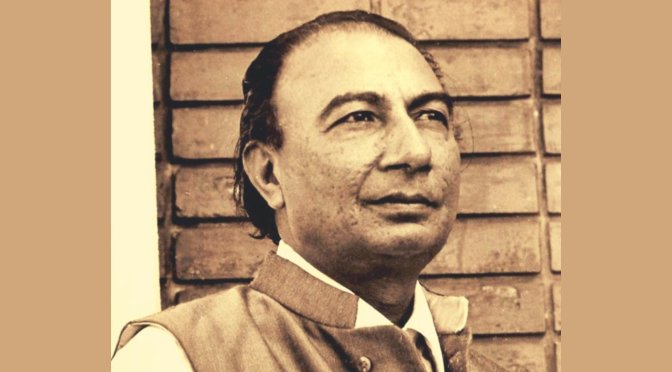
“In 1949, while in Lahore, Sahir Ludhianvi wrote a revolutionary poem, ‘Avaaz-e-Adam’ (The Voice of Man), in which ‘hum bhi dekhenge’ remains a memorable phrase. It ended on the optimistic – and one could say provocative – assertion that the red flag of communism would fly high. Pakistan had already decided to become a frontline state in Western attempts to contain Soviet Communism. It was trying desperately to convince the US that it could be a strong ally in its anti-Communism policy. Pakistan also wanted to portray itself as a trusted ally for the West, not just in South Asia but also in the Middle East. But after the poem was published, Sahir was threatened by intelligence agencies and he migrated to India. In effect, ‘hum bhi dekhenge’ came to symbolise Sahir’s farewell to Pakistan, which he felt would be a puppet of the West, and his search for sanctuary in Nehru’s India.” Source: The Wire.
aavaaz-e-aadam
Dabegi kab talak aavaaz-e-Aadam hum bhi dekhenge
rukenge kab talak jazbaat-e-barham hum bhi dekhenge
chalo yoonhi sahi ye jaur-e-paiham hum bhi dekhenge

dar-e-zindaan se dekhen ya urooj-e-daar se dekhen
tumhen rusva sar-e-bazaar-e-aalam hum bhi dekhenge
zara dam lo maal-e-shaukat-e-jam hum bhi dekhenge

ye zoam-e-quvvat-e-faulaad-o-aahan dekh lo tum bhi
ba-faiz-e-jazba-e-imaan-e-mohkam hum bhi dekhenge
jabeen-e-kaj-kulaahi ḳhaak par ḳham hum bhi dekhenge

mukaafaat-e-amal tareeḳh-e-insaan ki rivaayat hai
karoge kab talak naavak faraaham hum bhi dekhenge
kahaan tak hai tumhaare zulm mein dam hum bhi dekhenge

ye hangaam-e-vidaa-e-shab hai ai zulmat ke farzando
sahar ke dosh par gulnaar parcham hum bhi dekhenge
tumhen bhi dekhna hoga ye aalam hum bhi dekhenge
The Voice of Man
We too shall see till when one can suppress the voice of Adam
We too shall see till when can be stopped the angry emotion(s)
We too shall see, sure, just like this, the constant oppression.

Whether we view from the door of the dungeon or the elevation of the scaffold
We too shall see you dishonoured in the marketplace of the world
Just take a moment’s breath, we too shall see the consequences of the grandeur of Jamshed.

You too behold this vanity of power
We too shall see this by the kindness of the firm belief’s fervour
We too shall see a bend upon the dusty face that wears the jaunty headgear.

Retribution is a tradition of human history
Till when will you amass the arrows, we too shall see
We too shall see how far will you persist with your tyranny.

O sons of darkness this is the time for departure
We too shall see the morning shoulder the flag of red colour
We too shall see, you too shall have to see this clamour.

Source: ‘We Too Shall See, You Too Will Have to See This Clamour’: A Tribute To Sahir Ludhianvi by Raza Naeem, NayaDaur
Jawaharlal Nehru to Baldev Singh, 23 November 1948 (JN SG File No. 15 Pt.-II):
‘[Your] note about the Sikh position in East Punjab…I was surprised and depressed to read it. I entirely agree with you that we should help the Sikhs wherever possible. But [your] proposals seem to me basically opposed to the very things we proclaim and stand for. Our government as well as the Constituent Assembly have declared themselves to be totally opposed to communalism. We may not be able to put an end to [it], but in all governmental activities we can give it no place…The Constituent Assembly [came] to certain decisions last year in regard to minorities which are applicable to all of them…no government can apply one principle to one community and totally different principle to other communities…This means joint electorates, reservation where desired by the minority, but on the basis of population only and no weightage.
Regarding the carving out of a new province or transfer of Gurgaon district to Delhi, I have been opposing suggestions for provincial redistribution or division…I believe that something of this kind will have to be done but [not] I at this particular time when we are grappling with very difficult problems…Let this matter be considered dispassionately somewhat later. The Punjab, as you remind us, is a frontier province now and we cannot allow the situation in the East Punjab to deteriorate. Nor will it be desirable to think in terms of communal provinces when refashioning our provincial areas…Any untoward development in East Punjab might have serious repercussions on the Kashmir situation…As for the formation of constituencies, any attempt made to gerrymander in favour of this or that group would also lead to bitterness and conflict.
I would very much like to do something to convince the Sikhs that their fears are groundless. Indeed, I do not myself see why a progressive and enterprising community like the Sikhs should be afraid of the future…It would be doing an ill-turn to the Sikhs to treat them as the Muslim League wanted the Muslims to be treated before the Partition. What I have been specially distressed is the strained similarity between the present demands of some of the Sikh leaders and the old Muslim League demands…Can we not learn from bitter experience? You have rightly complained of some articles and cartoons in the few Delhi papers. But whatever these papers may have written, it pales into insignificance before the speeches and statements of Master Tara Singh…extraordinarily irresponsible…open incitement to war and to internal conflict…upset me a great deal’.
Tara Singh (District Jail, Banaras) to Nehru and Patel, 19 April 1949 (JN SG 23 Pt.-I):
‘Since I read in the “Statesman” that the consideration of formation of linguistic provinces in northern India has been indefinitely postponed, I have been deeply thinking how to convince you that the Sikhs are in urgent necessity of maintaining Panthic entity in order to protect their religion…the Sikhs in order to exist, must have a home in the Indian Union where they have some power to practice and advance their culture, religion and language according to their own light…Why should the Congress yield to the communal demand of the Hindus of the Punjab and be a tool in the hands of the communalism of the majority? The vocal section of the Hindus in the East Punjab wish to dominate us and use us as chowkidars…it was the Hindu press which was the first to write that the Hindus cannot live in a province where the Sikhs be in majority…this is the mentality of the so-called nationalists…if the Hindus who have majority in the central government cannot stay in a province where the Sikhs may have majority, how can the Sikhs stay in a Hindu-majority province when they are in hopeless minority in the centre also?…It is of course easy for those in majority to pose as purely nationalists, for best nationalism and worst communalism coincide here…
I feel I am the person responsible for bringing the Sikhs to the present position…In 1929, when [Motilal] Nehru report was published, the Sikhs as a community went out of the Congress…I, with some colleagues, [persuaded] the leaders of the Central Sikh League to come to a settlement…I, with others, came back to the Congress. If the Congress now forgets its promise, I am not going to shirk my responsibility…I may give an example. A [Sikh] deputation met Sardar Patel some time ago and put some demands. He did not agree to any one of them. One of the demands was that while granting certain privileges and concessions to depressed classes, no distinction on religious ground be made…at present, if a Hindu of a depressed class embraces Sikhism, he is deprived of these privileges and if a Sikh of a depressed class embraces Hinduism, he gets the privileges…Congress leaders had [said] that if that distinction was removed, some of the depressed class Hindus would embrace Sikhism. This is how cat was let out of the bag…
Most of the Punjab Hindu leaders [are] communalist at heart…a Sikh protects every religion…Guru Teg Bahadur sacrificed himself to protect Hinduism…so I claim that the Khalsa Panth is not communal…most Hindus do not realise it…independence to them appears Hindu domination…I do believe in the fundamental oneness of the Hindu and Sikh religions, but I do not call myself a Hindu…I wish to save the Khalsa Panth which will prove a pillar of strength of the country, as it did in the past…Sardar Patel does not seem to realise this…my only hope and my only weapon is righteousness of my cause and my faith in Him who saved Prahlad…I make the following two demands: 1) Sikhs and Hindus of the depressed classes should have the same privileges and concessions; 2) a Punjabi-speaking province shall be created so that the bulk of the Sikh population shall not live under Hindu domination on provincial basis…I have never demanded and do not demand now an independent Sikh State…I do demand a self-governing unit within the Indian Union…we are a religious minority in dire need of protection…if my above two demands are not granted, I shall start my fast unto death…Kindly do not enter into technicalities while replying…’





















 BAGICHA