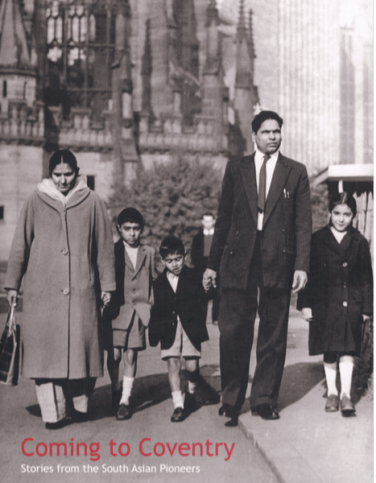
This week Coventry successfully won the bid to be the city of culture in 2021. Subsequently, there have been numerous articles about Coventry in the media, reflecting both the history and lived experiences of the city. The response has also been mixed in the sense that some people have continued to dwell on the lack of culture and “beauty” in the city, and in part this is true. The more optimistic see this as an opportunity to revive the glorious past with renewed energy.
Tag Archives: migration
Durga Mandir/Juma Masjid
In an unassuming side street of an old residential area in Sonipat is a hidden gem and remnant of the past. Durga Mandir of Mohalla Kalan in Sonipat is still popularly known as Badi Masjid (big/greater Mosque). The latter should give an insight into the former life of this Mandir, which once was a Masjid. Even today looking at the exterior of this mandir it could quite easily be confused for a masjid. It stands tall and looks grand in the red stone façade with a courtyard for Friday prayers which probably attracted many of the local Muslims in pre-partitioned Punjab. Apart from the obvious changes of installing flags and idols, the three main domes and minarets are easily identifiable with that of a small Juma masjid.
Like many other places of East Punjab, the Muslims of Sonipat migrated to Pakistan, leaving behind their homes and places of worship. These were quickly claimed by the incoming Hindus and Sikhs. Muslims were often the second largest group in these areas. For example, Muslims were significantly present in cities like Hissar (28%), Gurgaon (34%), Karnal (32%) and Ambala (32%) Rohtak (17%); all of these are part of present-day Haryana State. Most of the Muslims abandoned their homes in the ensuing violence of August 1947 and fled to Pakistan. Similarly, in Pakistan, many of the old abandoned religious (Gurdwaras and mandirs) buildings were converted/neglected by the incoming populations to be utilised for their own purposes. See link below for more about this.
In this case, the masjid has been converted into a Durga Mandir, a temple for worshiping Goddess Durga. It is now known as ‘Sri Sanatan Dharm Sabha Panji Durga Mandir.’ The Goddess Durga assumes the central position in the mandir and is surrounded by other deities; outside in the courtyard is an encased idol of Baba Sai. The dome interior has recently been filled to mask the obvious Islamic style architecture but the exterior remains as before. The link below provides further information on the Badi Masjid but more interesting are the photos. The short article was posted in October 2015, and the pictures shared are quite different from when I went to visit the site recently. The interior now has been changed to hide all signs of its former existence as a masjid. The pictures from 2015 show the perfect domes and remnants of frescoes and tiling from before. The fact that much of the interior has been transformed in the past two years is telling of the Hindutva agenda prevailing in the region.
Sonipat in August 1947 was a small city in united Punjab, then it became a city in East Punjab and eventually a part of Haryana after the reorganisation of East Punjab in 1966. There is little in the history books about the intervening years before it became part of Haryana, yet a lot has changed in this area. Looking at Sonipat today, it is difficult to tell that this historic city was once communally diverse with Punjabi Hindus, Sikhs, Muslims and Christians. Today it feels very much like a Hindu city. Perhaps the latter is more of a reflection of the current climate in India. But hidden away are these old structures that remind us of a different time and a different history.
Read further about Sonepat’s Badi Masjid and see pictures from 2013. http://www.gounesco.com/badi-masjid-sonipat/
Pakistan’s long forgotten Hindu temples and gurdwaras. http://blogs.tribune.com.pk/story/15785/pakistans-long-forgotten-hindu-temples-and-gurdwaras/
The Politics of Partition and its Memory
Now that the euphoria over independence day “celebrations” and remembering partition are over, it is worthwhile remembering that it was in fact today, 70 years ago, that the Radcliffe Line was made public. Millions of people woke up on 15 August not knowing which side of border they would be on, today their fate was sealed. Sitting in Delhi on this day, having seen the way both Pakistan and India remember 14/15 August 1947, it is a stark reminder of how chaotic this process must have been.
The month of August in the sub-continent is when the monsoon rains gush down intermittently. The heavy rains leave places incapacitated due to the deluge that falls. Even today, where there is improved drainage, the monsoon rains have the capacity to bring towns and cities to a standstill. So, thinking about this back in August 1947, it is staggering to think that the last Viceroy, Louis Mountbatten, decided that 15 August would be the date for independence. The date was chosen because it coincided with the date when Japan surrendered after it was devastated by the nuclear bombs in Hiroshima and Nagasaki. Mountbatten was clearly sentimental about the date because he was Supreme Allied Commander of South-East Asia when Japan surrendered. But he also failed to show any foresight when it came to the sub-continent. All the leaders failed to anticipate that millions of people would be engulfed by violence and thus forced to flee and that too in the difficult month of August. This only added further to their misery and fuelled diseases in refugee camps. It must be kept in mind that the violence that was unleashed in August 1947 was not an isolated incident, it was a culmination and continuation of previous episodes of horrific communal/political violence in which many lost their lives and were displaced. It was thus not entirely unexpected, nor was it just spontaneous.
The British media (TV, Radio and Print) has decided to cover partition/independence extensively and interestingly for this decennial anniversary they have been giving full coverage to the voices of ordinary people. The BBC has had a full season of programmes (one of which I contributed to) devoted to India and Pakistan at 70. I have personally spent the last sixteen years working on partition and its wider impact on the Punjab region, so the ordinary voices are not new to me. In fact, this trend in scholarship has been evolving and growing for the past twenty years. What is sobering is how the coverage has differed in India, Pakistan and the UK. I can only speak about these three because I know them well and they were of course at the epicentre of this.
While there is still a huge gap in our understanding of empire and its consequences, these programmes are important in reaching out to ordinary citizens, to educate, to inform, to illuminate the travesty of empire and its end. They also serve as important markers of remembering, but that alone is not enough. Which is why being in India/Pakistan during the days of August has been important. It highlights the disparity between the diaspora and those who live here. Capturing and sharing the narratives of survivors is important but from an academic perspective, what do these voices mean, what do they tell us, why are they still relevant? The memorialisation of this memory and how it tells this story is also significant. There is little worth in collecting hundreds and thousands of accounts by survivors if this is not contextualised or critically framed in the existing historiography. A simple account of someone’s life and their experiences is important but what about beyond that? What lessons can we take from this?
And our politicians are still in the business of selling a myth of a glorious past and a dream for the future. It is that future which needs to be critically examined in relation to the previous seventy years. Pakistan today seems fragile as ever but (and more importantly its people) it is a resilient country. For the best part of the last seventy years Pakistan has been swinging between military dictatorship and democratic rule, while India, largely a democracy, has been busy playing and expanding upon the Hindutva card. A future in which we see a further entrenchment of Islamic Pakistan and Hindu India is entirely possible and while not a recent development, it does need to be contextualised firstly in colonial history and secondly in the how the developments of the past seventy years led to this. Of concern for everyone should be that in this vision to be exclusively majoritarian, both India and Pakistan would lose an asset: its significant minorities. The diversity in all its richness is what makes these countries vibrant and valuable, they should be celebrated rather than suppressed and targeted. And so, seventy years on, while we remember the people who suffered in the great partition, let us not forget that there a battle going on today for the hearts and minds of people. Which is why it is seemingly more poignant being here in the sub-continent at this moment because it is a reminder of the unfinished business of azaadi beyond empire.
Freedom and Fear: India and Pakistan at 70

In the midst of the monsoon of August 1947, British India ceased to be and gave way to two independent nations. The logic of this Partition being religious and regional, the older and larger India was reinforced as a Hindu majoritarian society, while the newer and smaller Pakistan emerged as an Islamic country. No Partitions are total and absolute but this one was especially terrible and ambiguous and left a little less-or-more than 20% religious minority population on both sides. Moreover, it created two wings of Pakistan with a hostile Indian body-politic in the midst.
This event was not entirely of sub-continental making. The British Empire in Asia had begun to crack at the hands of the Japanese army during World War Two, most spectacularly with the fall of Singapore in February 1942, and crumbled in South Asia afterwards. Along with India and Pakistan, the-then Burma and Ceylon (both 1948) too emerged independent at this time. All this was to bring about many changes, both internally in India and internationally. Europe, the ravaged battlefield of the World Wars, ceased to be the centre of the Western world, with political and economic power shifting decisively to the former Soviet Union and the United States, representing two contrasting and conflicting ideological visions for the post-1945 world.
The end of the British rule in South Asia happened alongside the emergence of this conflict, christened the Cold War. The road to freedom and partition of India and creation of Pakistan was a long one and accompanied with fundamental social, economic and political changes. From the mutiny of 1857 from Calcutta to Delhi to the massacre of 1919 in Jallianwala Bagh, Amritsar, from the formation of the Indian National Congress in 1885 to the establishment of the All-India Muslim League in 1906, from fighting for King and country in two World Wars to seeking self-rule in the inter-war years, and, from the development of an elaborate civil and military bureaucratic and infrastructural apparatus and a space for provincial politics, all these were to completely transform Indian society.
Read the complete article via: http://magazine.thediplomat.com/#/issues/-Kq0QJtC_OQiU3Dy0tQ6
No Man’s land: the Wagah-Attari Border


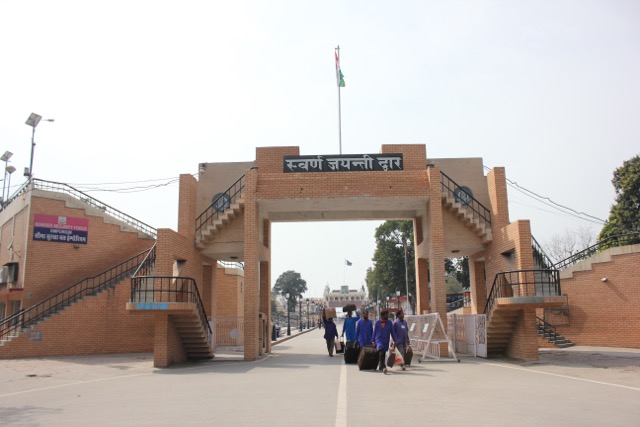
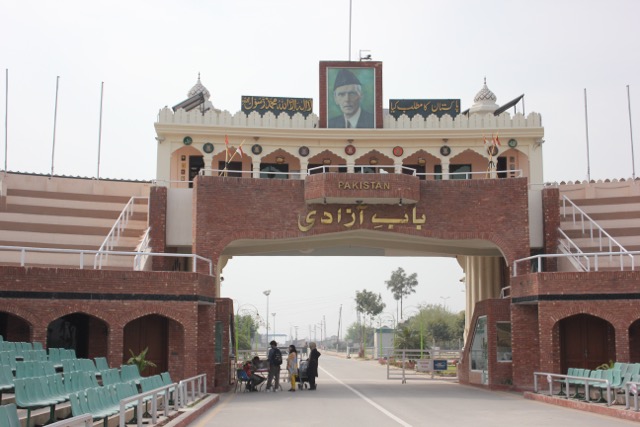
Located at a short distance of 24 kilometers from Lahore, Wagah is a small village in Pakistan and placed strategically on the Grand Trunk Road and serves as the main goods and railway station between India and Pakistan. The Indian counterpart is Attari and both serve as the only official land border crossing between India and Pakistan. The Radcliffe Line that divides them was the scene of both immense horror and gratitude for those fleeing to the “promised lands” in August 1947. Poignantly for writers such as Sadat Hasan Manto, many migrants were torn between the two spaces of no man’s land. This legacy continues today for those divided by this border.
The Wagah-Attari border is more accessible to foreigners who cross the border rather than the citizens of India and Pakistan. Having used this route numerous times, it brings up all sorts of surprises every time. There is always a sense of uncertainty about the political climate between the two countries, which can change at short notice. When relations are good between them, the border seems a little more open and less hostile, there is generally more traffic of people, especially people with green and blue passports. Otherwise, there are hardly that many people using the border only the diplomats, foreigners and the select few. I am one of the privileged few. The Pakistani’s always ask me if I’ve enjoyed my stay and have I faced any problems? I always reassure them that I’ve had a wonderful time. The Indians it has to be said are less talkative, though on occasions I have been “treated” to cups of chai.
There is usually plenty of dramatic material for the writers, artists, and peaceniks etc that want to spend time here for inspiration. There is sadness as people (de)part, despair as people fail to crossover due to lack of proper paperwork, there are covert (or not so covert) spies keeping an eye on passengers, and then there are security/customs people who are keen to show their power and within the ordinary, there are the money changers and inquisitive coolies working hard, often in the full sun. But there are always people wondering about the “other”.
When I first crossed this border, over fifteen years ago, the border was a basic set-up in old colonial bungalows. You could literally walk across from one side to the other. Today, both have made this border into an airport style, elaborate process with scanners and plenty of formalities and paperwork. Previously the coolies were employed to help carry people’s luggage to the international boundary that divides the two countries and they would also exchange goods that were permissible under trade agreements; the two carried on side by side. Now trade is exchanged more formally via the goods and transit terminal and the coolies make their livelihoods through the meagre travellers passing through. Most of the coolies belong to Wagah and Attari and come from a generation of families who have lived and worked in this border area. It is unlike any other place in India or Pakistan. They have seen many changes and have many tales to share, often from divided migrant families themselves.


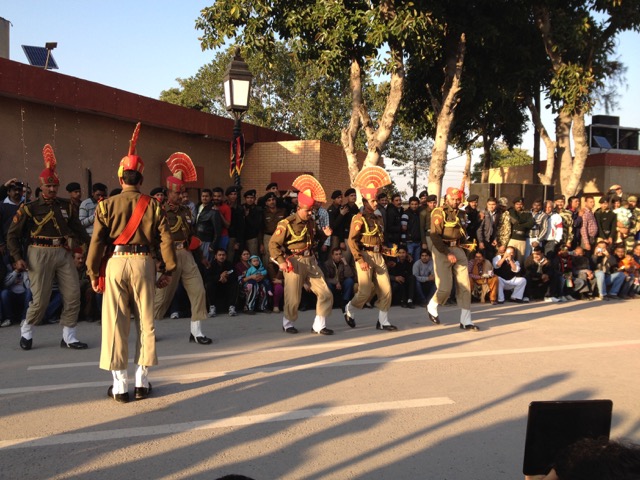
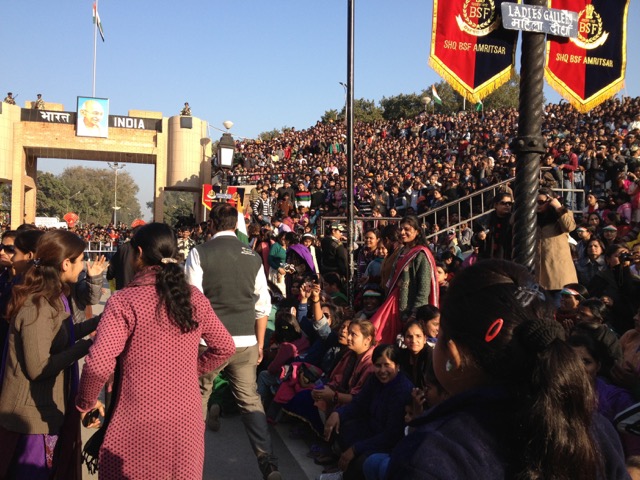
The Indian Border Security Force and the Pakistani Rangers have their daily ritual of lowering of the flag ceremony at the end of the day before sunset. Immaculately dressed, in Indian khaki and Pakistani Black, the soldiers walk and strut in their fast paced and intimidating style. Michael Palin, during his travels around the world, compared this to the Ministry of Silly Walks from the Monty Python sketches; this is not too far-fetched. Often referred to as the strut of the peacocks, this is a show of prowess, power, and pride of the most superficial nature. Hundreds of Indians and Pakistanis flock to see this spectacle of jingoistic and patriotic display. Few would wonder about how this well choreographed ceremony actually happens. It is in many ways an obscene drama that takes time to practice and perfect, and requires the two forces to work together. They do this away from the public gaze, so as to not taint the public image. This tradition started back in the 1950s has evolved now to only provoke the nationalist desire to fuel this antagonistic relationship between the two countries. It has continued to grow, attracting foreign as well as local tourists and the seating arrangements at the border are yet again being upgraded and expanded to accommodate the demand. Large crowds chant “Pakistan Zindabad!” or “Jai Hind!” to show their patriotism, waving their flags with unwavering allegiance to the idea of India and Pakistan. It is now nearly seventy years when the Radcliffe Line was drawn, and if anything, it seems this border has become even harder than previously.
Some useful links:
Peacock at Sunset by Frank Jacobs: https://opinionator.blogs.nytimes.com/2012/07/03/peacocks-at-sunset/
The Wagah border ceremony in India: https://adventuresofagoodman.com/wagha-india-pakistan-border-history/
The State of Statelessness
All photos from Banksy’s temporary “bemusement” park installation in Weston-Super-Mare, 2015.
It appears that the new political landscape across the globe is colliding with old ideas of liberty, freedom and basic human rights. This is particularly palpable in the movement of people; what is heart wrenching is the curtailment of that freedom to flee from persecution, have the chance to live your life without fear and to seek sanctuary. Those who are forced to flee do not do this out of choice; they are forced to do so for a reason. Basic humanity means under the circumstance most of us would readily help those in need. But in a “globalised” world, it seems that goods and trade have more freedom to travel the world than humans. We want the benefits of living in an integrated global community but actually in reality we cannot cope with the consequences, which also bring cultures and people together. It brings about change and impacts local communities and threatens the very notions of what make a nation-state.
A few snippets that appeared in the last 12 hours to highlight the uncertainty of moving towards hard borders.

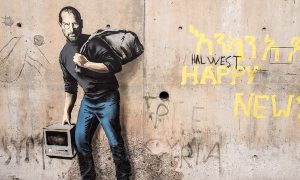
Banksy uses Steve Jobs to highlight the refugee crisis. Jobs was the son of a Syrian migrant who came to America after the Second World War and Apple is number one brand that has connected people across borders with the revolutionary smart phones.
Precarious Trajectories: Understanding the human cost of the migrant crisis in the central Mediterranean. The film by Dr Simon Parker is set on location in Libya, Italy and Greece during 2015-2016, at the height of the Mediterranean migration crisis. It focuses on the perilous sea crossings that hundreds of thousands of refugees have undertaken in recent years in order to arrive at what they hope will be the safer shores of Europe through the eyes of Ruha from Syria and Ahmed from Somalia. See project website: https://precarioustrajectories.wordpress.com/
Equally compelling was the 3-part documentary by the BBC, Exodus. This is a compelling and powerful journey across the deadly Mediterranean Sea. Read a review of it in the Guardian: https://www.theguardian.com/tv-and-radio/2016/jul/12/exodus-our-journey-europe-review-bbc-documentary-bbc
Link to the programme: http://www.bbc.co.uk/programmes/b07ky6ft
Pakistan’s Stepchildren – an in-depth and powerful analysis of the plight of millions of Afghans who sought sanctuary in Pakistan, but they remain “refugees” despite the vast majority who were born in Pakistan.
Citizenship for Afghan refugees and migrants, or their descendants has long been a contentious issue. According to the Pakistan Citizenship Act 1951, anyone born in Pakistan is a national by birth, except those whose parents are ‘aliens’ — someone “who is not citizen of Pakistan”.
Furthermore, Pakistan is not a signatory to the 1951 Convention Relating to the Status of Refugees, nor to its 1967 additional protocol. As such, according to the Pakistani government, it is not obligated to “facilitate the assimilation and naturalisation of refugees.”
Read the full article: http://www.dawn.com/in-depth/afghan-refugees/
Prisoner of war
‘The Chinese man trapped in India for half a century’ is the tragic story of Wang Qi who was a Chinese army surveyor in 1963 following the Sino-Indian war; but he ended up on the wrong side of the border by accident. The story highlights the plight of Wang Qi, who is now settled in India and has a family but he does not have any legal rights in India. He is caught up in the quagmire of legalities surrounding his rights and citizenship. [Read full article: http://www.bbc.co.uk/news/world-asia-india-38715056%5D The story is reminiscent of the many people who have been trapped for months and years on the wrong side of the border between the futile politics of India and Pakistan. Though more worrying is the current trend, in not just Trump’s America but in Modi’s India. India is also making discrimination against Muslims a key ingredient of its refugee and immigration policy. The following is a small extract from the article, ‘Indians Angry at Trump’s Ban on Muslim Refugees should look at what Modi is doing,’ highlights the current mood of India’s current government:
The Citizenship (Amendment) Bill proposes a redefinition of “illegal immigrant”:
“Provided that persons belonging to minority communities, namely, Hindus, Sikhs, Buddhists, Jains, Parsis and Christians from Afghanistan, Bangladesh and Pakistan, who have been exempted by the Central Government by or under clause (c) of sub-section (2) of section 3 of the Passport (Entry into India) Act, 1920 or from the application of the provisions of the Foreigners Act, 1946 or any order made there under, shall not be treated as illegal migrants for the purposes of this Act.”
This effectively means that persons from minority religious communities from our neighbouring Muslim majority countries shall not be considered as illegal migrants and subjected to prosecution.
Trump’s executive order cleverly does not use the word ‘Muslim’ in the ban it imposes on those seeking to enter the US. India’s Citizenship (Amendment) Bill, on the other hand, by identifying explicitly and arbitrarily the intended beneficiaries of its refugee policy, directly excludes Muslim communities which may or do face persecution in India’s Muslim-majority neighbours (eg. Ahmadis, Hazaras, Shias) as well as Muslims who are in a minority elsewhere, like Myanmar or China.
Read the full article:https://thewire.in/104236/indians-angry-trumps-new-travel-ban-muslims-look-modi/
The Afghani Burger
Since last year Pakistan has requested that an estimated two million Afghan refugees (no one really knows the true figure) in Pakistan should leave and return back “home”. This has caused enormous amount of chaos along the Pakistan-Afghan border, not to mention the huge amount of distress and uncertainty for the people themselves. In these times when Europe is mostly focused on the refugees crisis in its own borders, there is a tendency to overlook the fact the majority of the world’s refugees are in fact located largely in neighbouring countries from which they flee. According to the UNHCR figures the top five hosting countries are:
Turkey 2.5m
Pakistan 1.6m
Lebanon 1.1m
Iran 979,400
Ethiopia 736,100
Visit the UNCHR website for a quick overview of figures, they are quite illuminating: http://www.unhcr.org/uk/figures-at-a-glance.html
The Afghani refugees initially arrived in Pakistan following the Soviet invasion of Afghanistan in 1979. They poured into Pakistan to seek sanctuary and most of them made new, but admittedly temporary, lives along the two provinces bordering Afghanistan. In the late 80s this figure was approximately 3.3 million, all located in refugee camps along Afghan-Pakistan border. A second wave of refugees poured into Pakistan following the US-led war in Afghanistan after 2001. By the end of 2001 the numbers rose up to approximately 5 million. By the end of 2012 there were however, almost 2 million Afghan nationals living in Pakistan largely in Khyber Pakhtunkhwa and Baluchistan province but others were scattered across the country. Some of these people have been there for such a long time that this is the only home they have known. While they have legal refugee status in Pakistan, the Government of Pakistan still considers them citizens of Afghanistan, even though many have subsequently been born in Pakistan. Large numbers of refugees have already been repatriated back to Afghanistan with the assistance of the UNHCR; their future is yet again uncertain.
Despite this many of them have made their lives in the “foreign” land that has become “home”. They carve out a living whichever way they can and the Afghani burger place is a just a small way in which they hang onto their identity. I first came across this when a colleague insisted that when one is in Islamabad an Afghani Burger is a must. Intrigued to find out more we visited a shabby looking place, the modern day dhaba. The place is quite small, unassuming and ordinarily I would have walked past it. The burger itself is not a burger; it is more of a wrap to be precise. The food is made on site and in front of your eyes to entice you. The contents of the wrap include a mix of different influences, chips (limp and apparently Afghani style), frankfurters (made with chicken or beef), salads, and an assortment of different sauces/chutneys – eastern influenced mint ones, the ubiquitous tomato sauce (with added spices) and some eastern spices thrown in too.
Read more about the Afghani burger phenomenon in Dawn: http://www.dawn.com/news/1130547
Motivating the Afghanis in Pakistan is essentially the instinctive need for survival and whilst the State (and Pakistani citizens) does not consider them citizens, it does not stop the success and popularity of the Afghani burger from spreading. Food is of course the easiest and most sublime ways in which people both retain their identity and also share it with those around; it starts to infuse the landscape until it is absorbed into the existing culture. The result is that the Afghani burger has given life and thrived in a stale, bureaucratic city to give it some character. The politics remain but no one questions the joy that food can bring to the people and places far away from “home”.
A short hop from Ludhiana to Lyallpur
Getting into a taxi can often lead to interesting conversations with the drivers. So when one evening I request a Careem (much like Uber around the world), I get into the car and as it happens quite often, the driver is usually baffled by the name (not an obvious Pakistani name) and the person who is sitting in the car (could be Asian but looks “foreign”). I explain that I am indeed Punjabi and use my best Punjabi accent to prove the point! However, the response from the driver is quite often in Urdu, even though I carry on speaking in Punjabi. This will continue or then sometimes the driver will feel comfortable enough to speak in Punjabi.
So then on this one evening, a young driver who turns out to be from Faisalabad (previously known as Lyallpur); he lives not far from Samundri, which is a tehsil of Faisalabad district. Lyallpur district began life in 1904 following the development of the canal colonies in West Punjab in the late nineteenth century. From being a small market town, Lyallpur has been transformed into Pakistan’s main agro-industrial centre following the partition of Punjab. One which has fundamentally changed Lyallpur in modern times is migration. Firstly following the development of these canal colonies and secondly, the migration following Partition in 1947.
Having discovered the driver was from Faisalabad, I choose to converse with him in Punjabi. He was both astonished and ecstatic at the same time. The joy of sharing the same language and accent as you, can sometimes do this to people. He had been in Lahore for some months now and was making a living driving for Careem. The familiar tones of someone, and in this case someone who he thought was a foreigner, speaking the same language that he had perhaps not heard so frequently since he arrived in Lahore immediately allowed us to bond during the short ride. The ride is in fact less than ten minutes, but it is amazing what can be gleaned in these short conversations.
As we discussed our mutual language I suggested to him that the elders in his family might have migrated over from Jullundar or Ludhiana, and he immediately said that yes, his paternal grand-father was from Jullundar. The distance that divide these two places is approximately 250 km. He came over after partition and settled in Lyallpur. I went on the make the connections between the two places, the place where I grew up on the other side of the border, and the place on this side of the border but both conversing in the same language in a neutral city. Perhaps it had never occurred to him that he also had some connection to the Indian side of Punjab via the language that he speaks.
At the end of the ride, his joy at making these small connections translated into him refusing to take any money from me. He said he could not do this. Sometimes life brings about things which cannot be measured in monetary terms, they are passing moments, glimpses of human kindness that leave you feeling richer.