Tag Archives: migration

Across Three Continents with a Sewing Machine in Tow


© Pippa Virdee

A fragment of my personal history in celebration of International Women’s Day and in memory of my own mother, who played such an important part in shaping my ideas. Visit the Indian Memory Project to read the full piece which I wrote in 2013.

Freedom and Fear: India and Pakistan at 70

IMG_2257
© 2017 Pippa Virdee

The role of any democratic country, with a well-defined rule of law, is to protect ALL its citizens, ensuring that their rights and freedoms are safeguarded. It is in fact difficult to imagine these lands without the heterogeneity that forms the essence of being South Asian. It is this vibrancy and diversity that gives it character and strength. To move toward a homogenous culture is not only problematic but also dangerous because it is based on exclusivity.

Extract:

In the midst of the monsoon of August 1947, British India ceased to be and gave way to two independent nations. The logic of this partition being religious and regional, the older and larger India was reinforced as a Hindu majoritarian society, while the newer and smaller Pakistan emerged as an Islamic country. No partitions are total and absolute but this one was especially terrible and ambiguous; it left about a 20 percent religious minority population on both sides. Moreover, it created two wings of Pakistan with a hostile Indian body-politic in the middle.

This event was not entirely of subcontinental making. The British Empire in Asia cracked under the hands of the Japanese army during World War II, most spectacularly with the fall of Singapore in February 1942, and began to crumble in South Asia after the war. Along with India and Pakistan, Burma (today’s Myanmar) and Ceylon (Sri Lanka) also emerged independent (both in 1948) at this time. All this was to bring about many changes, both internally in India and internationally. Europe, the ravaged battlefield of the world wars, ceased to be the center of the Western world, with political and economic power shifting decisively to the Soviet Union and the United States, representing two contrasting and conflicting ideological visions for the post-1945 world.

The end of British rule in South Asia happened alongside the emergence of this conflict, christened the Cold War. The road to freedom and partition of India and the creation of Pakistan was a long one and accompanied with fundamental social, economic, and political changes. From the mutiny of 1857 to the massacre of 1919 in Jallianwala Bagh, Amritsar; from the formation of the Indian National Congress in 1885 to the establishment of the All-India Muslim League in 1906; from fighting for king and country in two world wars to seeking self-rule in the interwar years; and from the development of an elaborate civil and military bureaucratic and infrastructural apparatus and a space for provincial politics – all these were to completely transform Indian society.

This transformation and its underlying tensions ultimately contributed to that final moment, when in the middle of August 1947, Britain finally bid farewell to its prized colony after being there in one form or another as traders, marauders, administrators, and rulers for over 300 years. Weakened by World War II, the British were forced to accept the new realities of a determined nationalist struggle and an emerging new world order in which old-fashioned colonialism no longer seemed feasible. The journey toward this reality was slow and painful.

This year, on August 14 and 15, the Pakistani and Indian state and society, respectively, will mark 70 years of freedom. The bulk of both countries will be in celebratory mode as much of them were in 1947. Neither will want to remember the hard history of this freedom, nor face the harsh realities of it today. Back in 1947, Mohammad Ali Jinnah was in Karachi and Jawaharlal Nehru in Delhi, both welcoming a new dawn of freedom, but also engulfed in the fear and flames of communal violence. The worst of this was in the partitioned province of the Punjab in North India, where from March 1947 onward in Rawalpindi, communal violence and forced migration of people completely changed the landscape. Over the next year, but largely concentrated in August-December 1947, approximately 1 million were massacred and over 10 million were forced to move from one side of the Radcliffe line to the other. Bengal in East India, the other province to be partitioned, experienced similar, if slower, migration but not murder on the same scale. Other provinces, like Sindh, United Province, Bihar, Assam, Bombay, and the North-Western Frontier Province, also saw religious riots and exchanges of refugee populations.

Partitions are never easy; they are fraught with physical uprooting and dislocation, emotional and psychological separations, and, often, bitter memories of enmities. The partition of British India, though, appeared inescapable in early 1947, once constitutional attempts to secure a confederal arrangement for the Muslims in India to live in a post-colonial Hindu-majority country, without fear, collapsed. The movement for a home for Indian Muslims had gained currency in the interwar period, with poet-philosopher Muhammad Iqbal’s presidential address to the 25th session of the All-India Muslim League in December 1930, envisioning “a consolidated, North-West Indian Muslim State” amalgamating “the Punjab, North-West Frontier province, Sind, and Baluchistan” and self-governing “within or without the British Empire.” It culminated, almost 10 years later, in March 1940, in the lawyer- politician Jinnah’s speech at another session of the League. Describing Muslims as a “nation,” not merely a community, Jinnah demanded “homeland, territory, and state” for them.

Full article in The Diplomat, Issue 33, August 2017 or contact me.

(Inhabiting) the Space between Black and White: Indian/Sikh Community in Kenya

This slideshow requires JavaScript.

Much of my early childhood in the late seventies and early eighties was spent growing up in Kenya (Nakuru and Nairobi), giving me fond memories of a nostalgic past. Having been back a number of times since, it is inevitably not quite the way I have preserved it in my recollections. Childhood memories are filtered, sedate and full of innocence. The contemporary is much more austere, different and distant. The Sikh community in Kenya is small, perhaps only a few thousand. It is close-knit, largely urban based and relatively wealthy. The wider South Asian community originate from a handful of places like Gujarat, Punjab and Goa but it does reflect microcosm of Indian society with its myriad of ethnicities, languages, religion and cuisine but one in which no one community dominates.

There is of course a long history of trade from the west coast of Indian subcontinent to the east coast of Africa from about the second century AD. However, most of the people of Indian origin moved during the British colonial period, initially as indentured labourers, who were brought to Eastern Africa to help with the construction of the Ugandan Railway during 1896 to 1901. The Indian labourers helped with the construction of the line that went from the coast of Mombasa to Kisumu near Lake Victoria (then-known as the Ugandan Railway). They already had experience from constructing the railways in British India, which started much earlier in the 1850s.

The Asian African Heritage Trust notes that:
“In these six years, these labourers and artisans, through difficult terrain, laid 582 miles (931 kilometres) of railway. They built the Salisbury Bridge, over 1,200 feet long, joining Mombasa Island to the mainland, 35 viaducts in the Rift Valley, and 1,280 smaller bridges and culverts. All this was done by hand. No machines were available to them in these massive and technical tasks. 31,983 workers came from India during these years on these contracts. 2,493 died in the construction. That is, four workers died for each mile of line laid; more than 38 dying every month during the entire six years. A further 6,454 workers became invalid. They also built the subsequent railway towns of Nakuru and Kisumu”.  (Asian African Heritage Trust: http://asianafricanheritage.com/index.htm)

Pascale Herzig notes that most of these indentured labourers left after the completion of the project but they were then followed by voluntary migrants (with a large Muslim population, from Gujarat). This second group moved to explore trade opportunities but within this group were also professionals such as teachers, doctors, administrators. And with globalisation, the Kenyan Asians have become much more of a transnational community. Today the petty trader with a small family run business exists alongside the transnational globe-trotter. The former is declining in numbers and latter is adapting with the new business opportunities in an interconnected world.

Many of the Sikhs that came to East Africa were skilled workmen from the Ramgharia community and were associated with the carpentry, blacksmithery and masonry. Quick to adapt and take advantage of these opportunities, they moved into construction and mechanical engineering in order to up-skill themselves. Over subsequent years, the community increased and established its roots in Kenya. The population census of the South Asians (India and Pakistan) below provides a good overview of how the population has grown and declined over a hundred-year period.

Year Population ±% p.a.
1911 11,787
1921 25,253 +7.92%
1931 43,623 +5.62%
1948 97,687 +4.86%
1962 176,613 +4.32%
1969 139,037 −3.36%
1979 78,600 −5.54%
1989 89,185 +1.27%
1999 89,310 +0.01%
2009 81,791 −0.88%

At its height, the Asian population of Nairobi was almost one third Asian in 1962 and 2% of Kenyans were of Asian origin, at the time of Kenya’s independence in 1963. Since then though, the numbers have declined considerably. Within the colonial racial hierarchies, the Indians occupied the spaces between the white and black, a legacy that has been hard to surrender (See further Burton, Brown over Black). They lived, and continue to do so, in their own communities, segregated from the rest which is a source of tension but also emanates from a source of fear. Indians often occupied the middle ranking positions in the colonial period, acting as the buffer between white and black, and, with the top layer gone, the privileged position of the “brown” people became a source of much antagonism and resentment. They were privileged in terms of education, job opportunities and many had established successful businesses. They lived in palatial houses and socially only mixed within their own communities and, thus unsurprisingly, were caught up in the wave of euphoria brought in by African nationalism. The outgoing colonial power however offered a fig-leaf:

“When Kenya received independence in 1963, the Indians were offered the choice of obtaining either British or Kenyan citizenship. Because the painful, post-independence experience of the Congo was still fresh then, and because many Indians felt that the growing demand for position and power from the newly educated African middle class would lead inevitably to their exclusion from the job market, only about 10 percent of the Indian population applied for Kenyan citizenship. The rest chose what later turned out to be “devalued” British passports”. [https://www.nybooks.com/articles/1971/10/07/the-lost-indians-of-kenya/] Ian Sanjay Patel suggests that around 20,000 Kenyan South Asian applied to register for Kenyan citizenship between 1963-1965, out of total population of 176,613. (P.214)

Patel’s recent book, We’re Here Because You Were There (2021) provides an interesting discussion on citizenship and belonging, while focusing on Kenya where his own ancestral roots are. He highlights how Kenyan South Asian British citizens appeared to belong to three different states, as they were resident in Kenya, but some had assumed British citizenship and of course their ancestral roots were in the sub-continent. (Patel p 215). The 1950 Indian Constitution had granted Indian citizenship to persons outside India, if they had parents or grandparents born in India. However, at the same time Apa Pant, the first Indian high commissioner in Nairobi, urged Indians to identify with Kenya rather than India. By 1955, India’s Citizenship Act further removed the possibility of duel nationality. (Patel, p 215).

During the unsuccessful coup attempt in Kenya, against then-President Daniel arap Moi in 1982, many of the Asian shops and homes were also targeted. The fear of violence, looting and nationalisation of business further reinforced the need to remain segregated and aloof in order to survive and preserve their livelihoods. Although many of the Asians fled and relocated, a sizeable Indian diaspora still exists in Kenya, which is quite distinct in character. Old established businesses still exist, and they are still one of the most prosperous communities in Kenya. And interestingly, in 2017, the government announced that the Asian community would be officially recognised as the 44th tribe in Kenya, perhaps an indication of the acceptance that Indians are an integral part of Kenya.

References:

Aiyar, Sana. Indians in Kenya. Harvard University Press, 2015.

Burton, Antoinette M. Brown over black: Race and the politics of postcolonial citation. Three Essays Collective, 2012.

Herzig, Pascale. South Asians in Kenya: Gender, generation and changing identities in diaspora. Vol. 8. LIT Verlag Münster, 2006.

Mangat, Jagjit S. A History of the Asians in East Africa, c. 1886 to 1945. Clarendon Press, 1969.

Onyango Omenya, Gordon. ‘A Global History of Asian’s Presence In Kisumu District of Kenya’s Nyanza Province.’ Les Cahiers d’Afrique de l’Est/The East African Review 51 (2016): 179-207.

Patel, Ian Sanjay. We’re Here Because You Were There. Verso, 2021.

The Status of Punjabi after 1947

Reorg of Punjab 1966
Reorganisation of East Punjab after 1966. © Pippa Virdee 

Punjabi is an Indo-European (or Aryan) language and is the native language of Punjab, a land divided between India and Pakistan. It has approximately 100 million speakers, largely in north India and Pakistan but it is also widely spoken amongst the Punjabi diaspora around the world.

The Partition in 1947 not only divided the province of Punjab but it also divided the language, and this has been the source of much tension in post-47 in both India and Pakistan. Being a phonetic language, Punjabi was/is written largely in three different scripts: the Persian script (sometimes referred as Shahmukhi) is used mostly in Pakistan; Sikhs use the Gurmukhi script and less common is the Devanagari script which is associated with Hindu Punjabis. Punjabi interestingly was never given official state patronage; this is true for the Mughal period, Ranjit Singh’s reign and also under the British. The preferred state or official language was Persian and Urdu. Farina Mir argues that part of the problem under the British colonial period was the plurality of the scripts used to write Punjabi; all three scripts (Indo-Persian, Gurmukhi, and Devanagari) were used but none of them dominated (Farina Mir, The Social Space of Language: Vernacular Culture in British Colonial Punjab, London: University of California Press, 2010).

It is not until after 1947 that Punjabi begins to get official state patronage, at least in India that is. It is officially recognised as one of the 22 official state languages in India. In West Punjab (Pakistan), Punjabi is confined largely to an informal language with no official status despite being spoken by the majority of people. And even though the number of Punjabi speakers in Pakistan has been declining over the decades, Punjabi is still the most widely spoken language. East Punjab after the Partition in 1947 was a fragmented province of its former self. It consisted of territory that was an amalgamation of divided Punjab, Patiala and East Punjab States Union (the former princely states), and the Hill States to the north of the province. By the 1950s, a Punjabi Suba (province) movement had started which hoped to create a Punjabi-language state, taking inspiration from the linguistic reorganisation taking place in other parts of India. This is eventually achieved in 1966, with the Punjab Reorganisation Act that created a new state of Haryana and also transferred territory (such as the Hill States) to Himachal Pradesh.

Leading up to this though was of course an enormous amount of discussion and political agitation, so, it is interesting to see some of the initial correspondence between Bhim Sen Sachar, Chief Minister of East Punjab and Jawaharlal Nehru, the Prime Minister of India and Nehru to Vallabhbhai Patel, the Deputy Prime Minister on the question of introducing Punjabi as the medium of instruction in schools. 

BS Sachar to Nehru, 9 July 1949 (JN SG 26-I):

‘In my letter [of] 13 May, I referred to the two outstanding demands of the Sikhs, namely (I) representation in services, and (II) Punjabi in Gurmukhi script as the medium of instruction and court language…No compromise on them was considered possible…since then, I have had informal discussions on the language controversy with the Governor, my colleagues, various leaders of public opinion and the general view of government is as below. Before the Partition, Ambala division, excepting Ropar and Kharar tehsils of the Ambala district, spoke Hindustani, while Punjabi was spoken in the rest of the Punjab, barring Kangra district. After it, nearly a million displaced persons from the West Punjab moved into the Ambala division and, therefore, it cannot now be said that all the people [there] speak Hindustani. Nevertheless, the distinction which held good before exists even now, to a lesser a degree. With the gradual elimination of English and Urdu from the province, the question [of] their [replacement] has assumed great importance…the present controversy is not over the language [Punjabi] spoken but the script [Devanagari or Gurmukhi] in which it should be written…The unanimous demand of the Sikhs is that Punjabi in Gurmukhi should be adopted all over the province as medium of instruction, as the official and court language. This would not be acceptable to Hindus in general and especially to the Hindustani-speaking region of the Ambala division and Kangra district of the Jullundur division. It will be unfair to force it on them…The best solution would be to recognise the province as consisting of two distinct linguistic regions, Punjabi and non-Punjabi. Government would agree to the following: (i) Punjabi in Gurmukhi should be the medium of instruction in the Punjabi-speaking region of the province, up to and including the 5th class; (ii) In the Punjabi-speaking region, Hindi should be compulsorily taught as a second language from the 4th class; (iii) Reversal of the same arrangement in the non-Punjabi region; (iv) English and Urdu should for the present continue as the official and court languages. There are differences of opinion on two points: (i) whether girls’ schools should be allowed the option; (ii) whether the existing boundaries of the Jullundur and Ambala divisions should be regarded as correctly [representative]. The Sikhs would not agree to distinguish girls’ schools from boys’ schools…whereas Hindus should be in favour of it…The Sikhs would include the whole of Jullundur division and the whole of Ambala district in the Punjabi-speaking region whereas Hindus would like to exclude Kangra district and three tehsils, Ambala, Naraingarh and Jagadhari, of the Ambala district from it…No agreement on [these] appears to be possible…would be grateful [for your] decision on them’.

Nehru to Patel, 22 July 1949 (JN SG 26-II):

‘Giani Kartar Singh came to see me this morning…on the language issue in East Punjab…I told him that there is no point in our considering the [matter] unless we knew that the parties concerned would abide by our decision…He said that an agreement had been arrived at between the Hindu and Sikh Ministers and the Governor agreed…(1) Punjabi in Gurmukhi, (2) two linguistic areas, (3) Punjabi compulsory from 1st-5th standard in Punjabi area, Hindi vice-versa, (4) from 4th standard upwards, the other language should be compulsory…There was no agreement on the delimitation of linguistic areas. More especially, the Pahari Ilaqa – Sikhs considered as Punjabi areas…another point was Hindus wanted option to be exercised in regard to languages, the Sikhs did not…I made it quite clear that our general policy was against compulsion in regard to choice of the mother-tongue…I further pointed that Bengali, Marathi, Gujarati were well-developed languages…He confessed that Punjabi was not suited for higher education [but] should be used up to the Matriculation… [But] that there was a great deal of feeling behind the Sikh demand…I think some facts have to be obtained about the linguistic divisions of the province but the issue is quite clear…If the Punjabis want two linguistic divisions, they might have them but I just do not see how we can do away with the option of a parent to decide which shall be the mother-tongue…’

These two letters provide a glimpse into the discussions taking place in 1949. However, the two letters from 1951 provide a different lens, especially the DAV College correspondence which is clear that the medium of instruction should be Hindi, despite the considerations of the State Language Policy. 

Jullundur City, 3 May 1951, DAV College Managing Committee (Bal Raj, President) To the managers of all the schools in the Punjab under the control of the DAV College Managing Committee (JN SG 92 II):

Please refer to the Punjab Education Department on the State Language Policy in the schools: it is [an] ill-conceived policy…I am to convey to you in very unmistakable language the views of the DAV College Managing Committee vis-a-vis this policy. Our schools should go ahead in their work undeterred by considerations of State Language Policy. To us, teaching of Hindi in our schools is a matter of supreme importance and on this point, there is to be no compromise. We would much rather let our schools face the consequences than submit to any direction from the Education Department, that weakens the position of Hindi in them. In case there is any trouble on this score from Education Department, the schools affected can rely on our fullest support, and we shall see to it that they do not suffer.

In our schools, Hindi will be the medium of instruction for all classes and Punjab will start as optional vernacular from V in place of IV as laid down by the Education Department because we consider its teaching in IV class too early. It should be clearly understood that Punjabi from V class will be optional i.e. only for those students, who would like to learn it. Provision should, however, be made for teaching in Punjabi medium for students coming from outside, and effort should be made to switch them on to Hindi medium as early as possible.

It is just possible that the Local Bodies’ Schools or Khalsa Schools might not make provisions for teaching in Hindi medium on grounds of non-availability of suitable Hindi teaching personnel or lack of demand for Hindi medium on part of students or that Hindi students might be persuaded to receive instruction in Punjabi rather than in Hindi. Proper vigilance will have to be exercised over these schools, and in case they do not implement the state policy, they should be brought to our notice to be reported to the Education Department.

A strong public opinion will have to be created in your area in favour of Hindi, so that students wishing to be taught in Hindi medium declare fearlessly their desire to be taught in this medium, undeterred by the local influence or pressure from teachers, not well disposed towards this medium.

Amritsar, 21 July 1951, The Shiromani Gurdwara Parbanbhak Committee (Kartar Singh, Publicity Secretary) To Prime Minister Jawaharlal Nehru JN SG 92 (II)

Enclose herewith a copy of the [above] letter…A perusal of this document will reveal to you which way the wind blows in those quarters. On the one hand, the Hindu schools are exhorted to go ahead in their work of shutting their doors to Panjabi “undeterred by considerations of State Language Policy” and not to “submit to any direction from the Education Department”. On the other hand, the Local Bodies’ Schools and the Khalsa Schools are to be compelled to make all arrangements for the teaching of Hindi in accordance with the State Language Policy. The attitude…is not only one of flagrant defiance of the government’s orders, but is also calculated to accentuate communal bitterness and vitiate the general atmosphere in the province. Due notice be taken of such anti-national and subversive attitude and activity as is being exhibited by these people.

Impact Of Nationalization On BECO And Pakistan Economic Development

Little known history of CM Latif and Batala Engineering Company (BECO), Lahore.

Anika Khan's avatarRamblings of a Pakistani Woman.

There had been many times in Pakistan’s history when stupid decisions were taken by the government. Nationalization in Bhutto’s era was one of those decisions. 22 Families lost everything that they had worked  for all their lives. BECO (Batala Engineering Company) is one such example.

Late Chaudhry Mohammad Latif was the founder and chairman of the Batala Engineering Company (BECO). After attending a meeting of leading Muslims in Batala, who wanted to establish Muslim industries in the face of Hindu dominance of retail, that he struck upon the idea of forming BECO.The company was established in 1932. , He sold its first 10 shares to a lime merchant for Rs 10. In the early years, he worked almost single-handedly to build up the company from its first workshop in two rooms and a veranda. Over the course of the next forty years, and in spite of losing much of his business…

View original post 864 more words

‘Foreign marriages’

Model Town, Lahore
Model Town, Lahore. © 2017 Pippa Virdee

Going through some archival footage from The Pakistan Times I come across this gem from 28 April 1960 in Letters to the editor. Written in 1960 but some of the issues highlighted in the letter still exist even today, especially in the second paragraph. What is also fascinating is how many men were really marrying ‘foreign’ girls during this period? Was it really that prevalent, enough to prompt a letter to the editor? If anyone knows more or knows of such stories please do share these with me.

May I invite your attention to a grave social problem which is becoming more and more acute day by day.

It has been observed that large number of our young men who get an opportunity to go abroad for higher education, professional studies or training come back with foreign wives. This is very frustrating for our own eligible girls. It deprives them of intelligent marriage partners. On the other hand, those who marry these foreign ladies become status conscious and become eager to raise their standards of living. Their wives feel like fish out of water in our society. They cannot freely mix with us due to a great difference in cultural, social and religious background. Naturally, they try to divert their husbands from the country’s social stream. Thus these young men – our own kith and kin – virtually become foreigners in their own milieu. This is no fault of theirs. It is a natural process.

The question is why do these young men marry abroad? The answer is very simple, in our society they have no opportunity to come in contact with girls and hence no understanding can possibly develop between them. It does not need much imagination to foresee the serious consequences of this tendency, which is the product of our defective social pattern and of the ignorance of the parents. If they give their children even a limited opportunity to mix with one another and then chose their life companions our young men will not even dream of marrying aboard, this will make for social integration and give a chance to our girls to contract suitable marriages.

Abu Saeed Ahsan Islahi, Rawalpindi

From Mano Majra to Faqiranwalla: Revisiting the Train to Pakistan

New Delhi train station. © Pippa Virdee 2016

By Pippa Virdee and Arafat Safdar in South Asian Chronicle.

Khushwant Singh’s novel Train to Pakistan was published in 1956, almost ten years after the partition of India/ creation of Pakistan in 1947. Its publication inaugurated what has been called ‘South Asian Partition Fiction in English’ (Roy 2010). It remains, to date, one of the most poignant and realistic fictional accounts depicting the welter of partition and saw a sensitive screen adaptation in 1998 by Pamela Rooks. It captures one of the most horrific symbols of partition—that of the burning, charred and lifeless trains that moved migrants and evacuated refugees from one side of the border to the other. The trains that previously served to bring people and goods from disparate worlds closer together were overnight turned into targets of mob attacks and transporters of mass corpses. They thus became an emblem, a much-photographed representation (Kapoor 2013) of the wider violence and ethnic cleansing that was taking place in Panjab (Ahmed 2002: 9-28); one of the two regions divided to make way for the two new nation-states.

Selecting some key individuals in the village, relevant to and representative of our efforts to excavate the myths and memories associated with partition, and situating their sensibilities vis-à-vis the sentiments exhibited in the novel, we conducted interviews to collect and compare experiential accounts. An attempt in the Wildean spirit to attest that ‘life imitates art far more than art imitates life’, the article, located in the Faqiranwalla of 2017, looks back to the Mano Majra of 1947. In doing so, not only does it reflect on this intervening time-span and what it has done to those remembrances, but, also brings to fore the well-remarked realisation that, in this case too, ‘the past is another country’ (Judt 1992). Like in the novel then and life today, the connecting link in this article too, between Faqiranwalla and Mano Majra, is the train, as both share the overweening presence of the railways in the village, through which its life is/was governed.

Read full article: https://edoc.hu-berlin.de/handle/18452/19508

Südasien-Chronik – South Asia Chronicle 7/2017, S. 21-44 © Südasien-Seminar der Humboldt-Universität zu Berlin

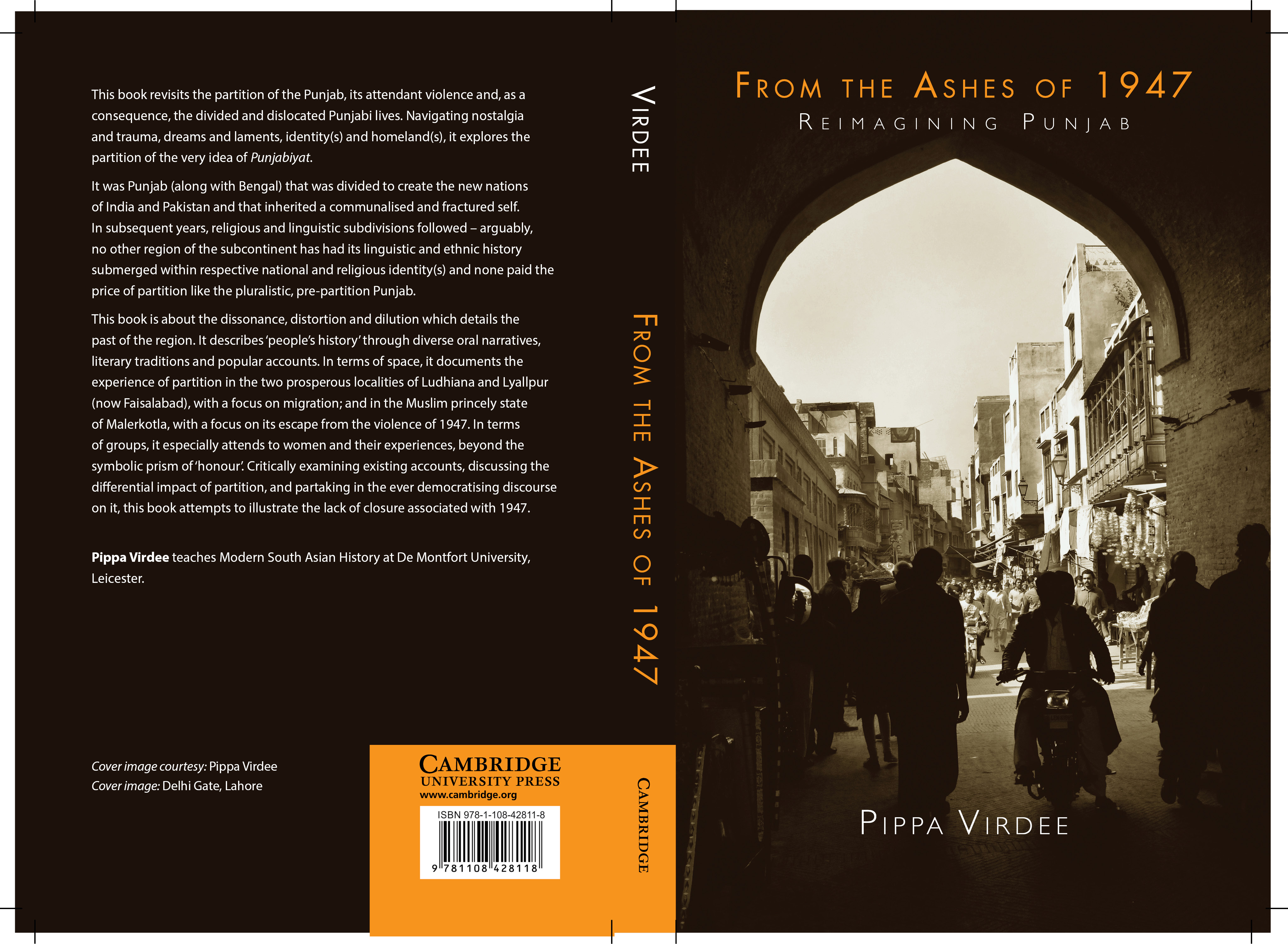
From the Ashes of 1947: Reimagining Punjab

From the Ashes_Full Cover

Full details: From the Ashes of 1947

Watch the panel discussion with Pippa Virdee (De Montfort University, UK), Afzal Saahir (Poet and Radio Host) and Sajid Awan (Quaid-e-Azam University) of my book From the Ashes of 1947 at the Afkar-e-taza, January 2018 Panel Discussion