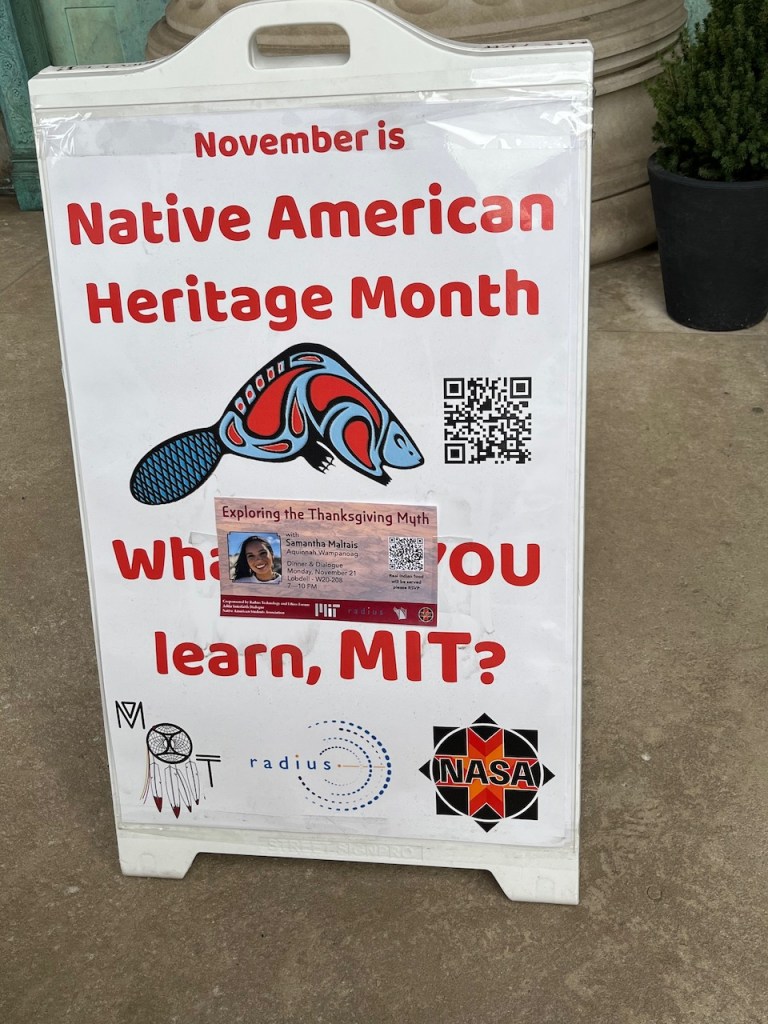
In 1990 President George H. W. Bush approved a joint resolution designating November 1990 “National American Indian Heritage Month.” Similar proclamations, under variants on the name (including “Native American Heritage Month” and “National American Indian and Alaska Native Heritage Month”) have been issued each year since 1994. Read more about this.
At the same time I can’t help but notice that more detailed demographic data emerges from the ONS, in which ‘Leicester and Birmingham have become the first “super-diverse” cities in the UK, where most people are from black, Asian or minority ethnic (BAME) backgrounds, according to the 2021 census’. Read further ‘Diversity is a beautiful thing’: the view from Leicester and Birmingham. As I’m based in Leicester, I hope to explore some of the recent changes in the city in more detail.
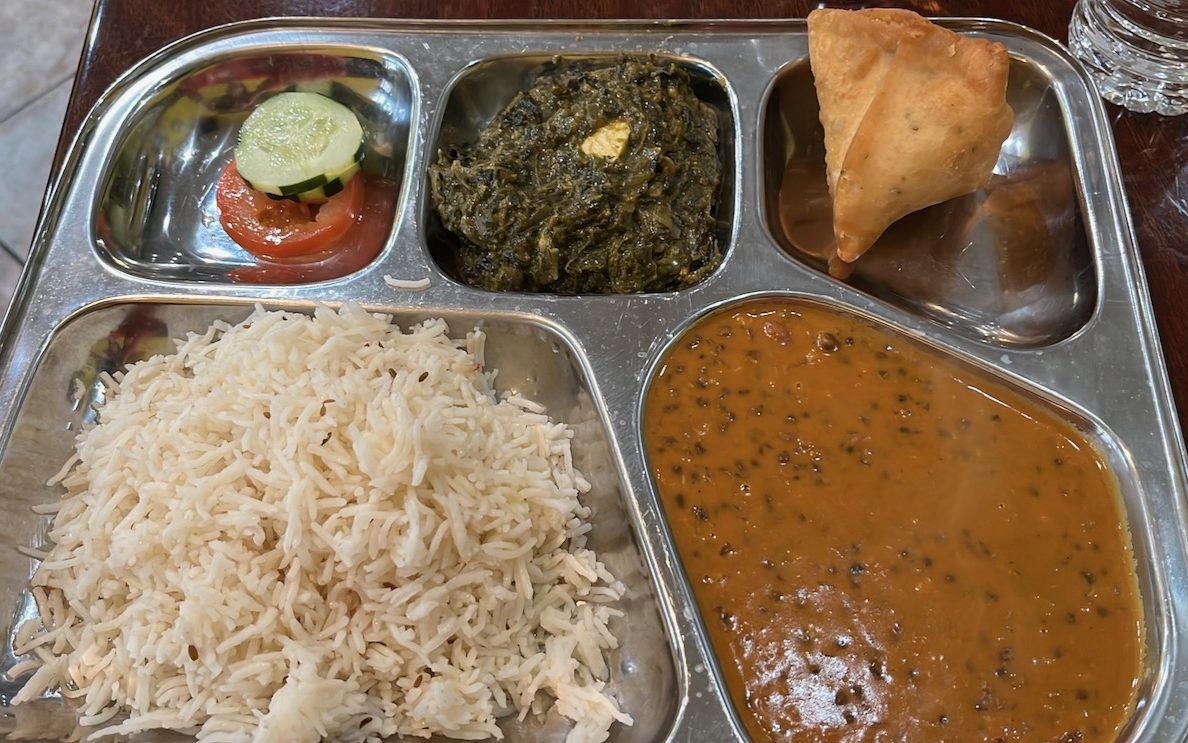
A basic thali with palak paneer, daal and rice.
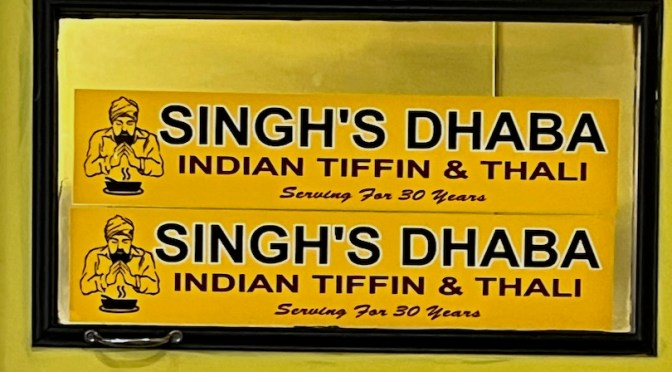
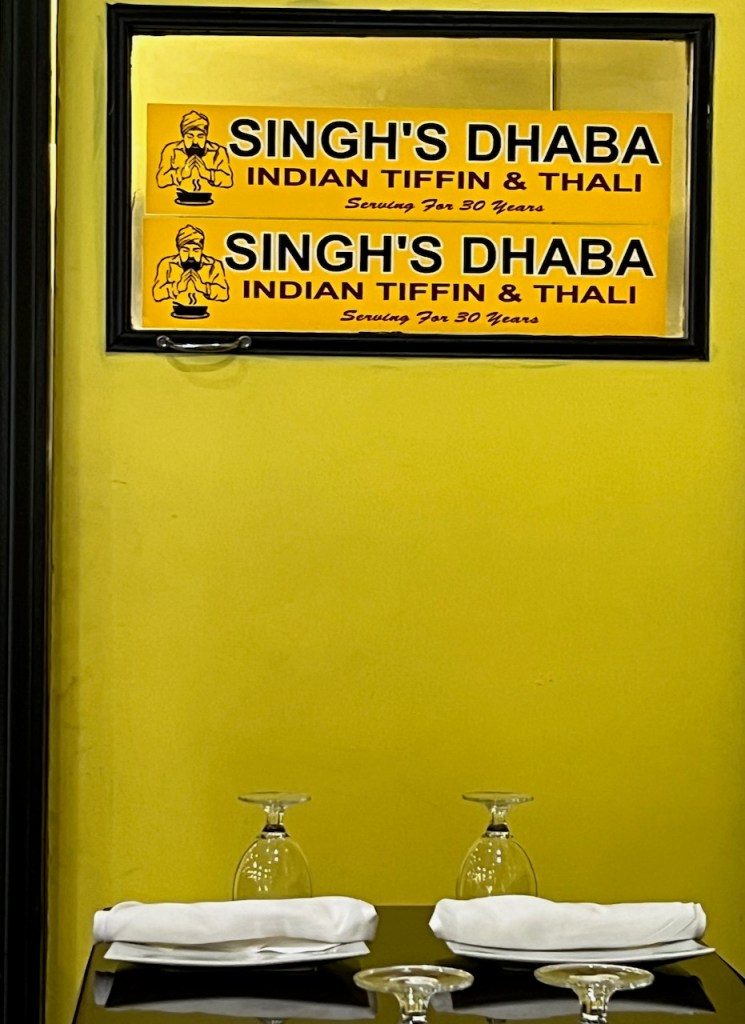
In the meantime, I indulge in the desi ‘home made’ food offered by Mr Harpreet Singh at Singh’s Dhaba. He established his business in 1990 and like many other diasporic Sikhs he came from Virk, a village near Phagwara, in the Jalandhar district.
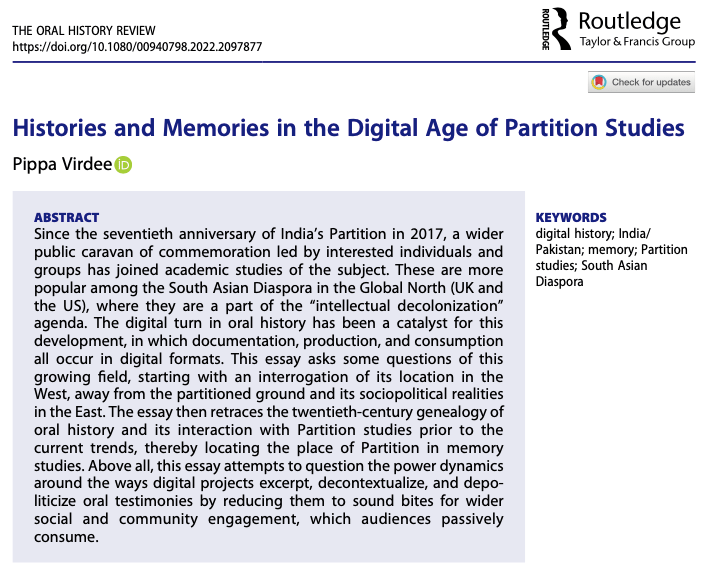
August is the time when anyone who has any interest in the history, politics, and society of South Asia will be talking, tweeting, and sharing about the time of Partition/Independence. Here in the UK, I have noticed how much discussion about Partition has entered the public discourse, whether it is TV, radio, newspapers etc. In this essay, recently published in The Oral History Review, I have attempted to show how the historiography of Partition has developed, especially over the past twenty-five years. It is an attempt to contextualise and understand how this field of Partition Studies has evolved and what role technology, new forms of social media and the South Asian diaspora, have played in taking this field into new directions. I was keen to highlight the disparities, and structural inequalities that have been produced and strengthened in this process, despite appearances to the contrary.
As a side-note and not completely unrelated to the article, access to information/knowledge must not be taken for granted as there are institutional and economic barriers, which prevent a level-playing field. This article is NOT open access because 1) my post-92 university in the UK does not subscribe to the costly Gold Open Access scheme, and 2) the article was not written with the support of any UKRI research grant. It means that my article will remain behind a paywall, unless an institution subscribes to the journal. Again, many institutions are now cutting back to save money (esp. post-92 universities) and so subscriptions to costly academic journals are often subject to scrutiny of disciplinary demands and budgetary considerations. It is likely that this article will only reach a limited number of people compared with any open access article, thus the readership, citations and engagement will remain confined.
If you have institutional access that’s great, if you don’t and you are interested in reading the full article, please feel free to contact me.
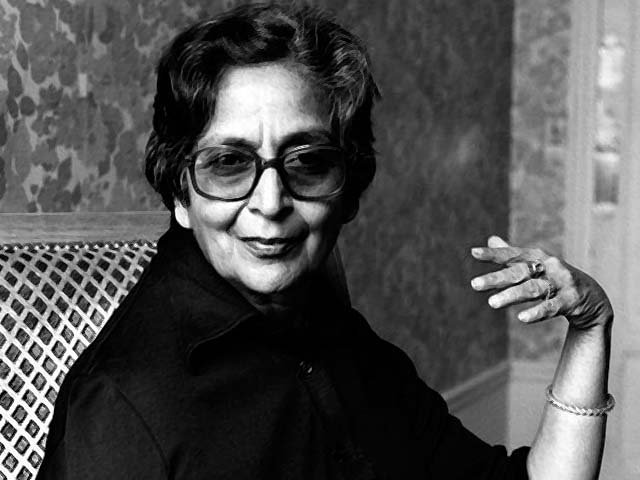
Amrita Pritam (1919-2005) was one the most distinguished Punjabi poets and fiction writers. She was born in Mandi Bahauddin, Punjab and was living in Lahore when in 1947 she, along with the millions others, was forced to migrate during the partition of the Punjab.
Her first collection of poems Amrit Lehrcm was published in 1936 when she was barely 17 years old. Starting as a romantic poet, she matured into a poetess of revolutionary ideas as a result of her involvement with the Progressive Movement in literature.
Ajj Aakhaan Waris Shah Nu (Today I Say unto Waris Shah) is a heartrending poem written during the riot-torn days that followed the partition of the country. (Apnaorg.com). The poem is addressed to Waris Shah, (1706 -1798), a Punjabi poet, best-known for his seminal work Heer Ranjha, based on the traditional folk tale of Heer and her lover Ranjha. Heer is considered one of the quintessential works of classical Punjabi literature.
Her body of work comprised over 100 books of poetry, fiction, biographies, essays, a collection of Punjabi folk songs and an autobiography that were all translated into several Indian and foreign languages
Ajj Aakhaan Waris Shah Nu (Today I Say unto Waris Shah – Ode to Waris Shah)
Translation from the original in Punjabi by Khushwant Singh. Amrita Pritam: Selected Poems. Ed Khushwant Singh. (Bharatiya Jnanpith Publication, 1992)
To Waris Shah I turn today!
Speak up from the graves midst which you lie!
In our book of love, turn the next leaf.
When one daughter of the Punjab did cry
You filled pages with songs of lamentation,
Today a hundred daughters cry
0 Waris to speak to you.
O friend of the sorrowing, rise and see your Punjab
Corpses are strewn on the pasture,
Blood runs in the Chenab.
Some hand hath mixed poison in our live rivers
The rivers in turn had irrigated the land.
From the rich land have sprouted venomous weeds
flow high the red has spread
How much the curse has bled!
The poisoned air blew into every wood
And turned the flute bamboo into snakes
They first stung the charmers who lost their antidotes
Then stung all that came their way
Their lips were bit, fangs everywhere.
The poison spread to all the lines
All of the Punjab turned blue.
Song was crushed in every throat;
Every spinning wheel’s thread was snapped;
Friends parted from one another;
The hum of spinning wheels fell silent.
All boats lost the moorings
And float rudderless on the stream
The swings on the peepuls’ branches
I lave crashed with the peepul tree.
Where the windpipe trilled songs of love
That flute has been lost
Ranjah and his brothers have lost their art.
Blood keeps falling upon the earth
Oozing out drop by drop from graves.
The queens of love
Weep in tombs.
It seems all people have become Qaidos,
Thieves of beauty and love
Where should I search out
Another Waris Shah.
Waris Shah
Open your grave;
Write a new page
In the book of love.
NOTES
Waris Shah (1706 -1798) was a Punjabi poet, best-known for his seminal work Heer Ranjha, based on the traditional folk tale of Heer and her lover Ranjha. Heer is considered one of the quintessential works of classical Punjabi literature.
Qaido – A maternal uncle of Heer in Heer Ranjha is the villain who betrays the lovers.
The Punjab – the region of the five rivers east of Indus: Jhelum, Chenab, Ravi, Beas, and Sutlej.
For the seventh issue of Chapati Mystery Roundtable (CMRT), we are delighted to host a conversation on Pippa Virdee’s From the Ashes of 1947: Reimagining Punjab. The CMRT is a series that presents multiple, in-depth reviews of an exciting new book. We thank each of our distinguished panelists for engaging in this public dialogue. We especially thank Abraham Akhter Murad for convening and introducing this Round Table.
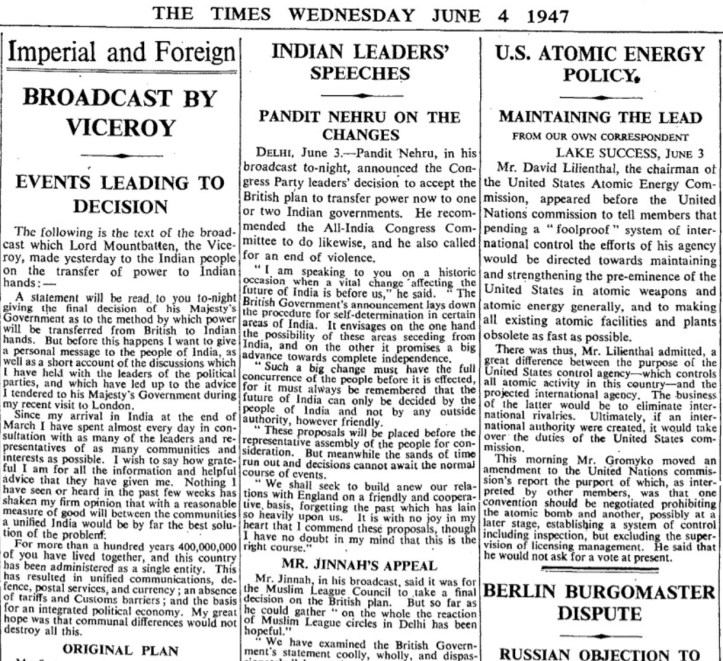
Below is the full transcript of the speech, which was delivered by Lord Mountbatten, the last Viceroy of India. It is followed by statements by Attlee, Nehru, Jinnah and Baldev Singh. The latter’s parting words make for interesting, wishful reading considering that it was the Sikh community that was impacted the most by this Partition Plan. This is also fully acknowledged by Mountbatten in his speech.
BROADCAST BY VICEROY EVENTS LEADING TO DECISION
The following is the text of the broadcast which Lord Mountbatten, the Viceroy, made yesterday to the Indian people on the transfer of power to Indian hands:-
A statement will be read to you tonight giving the final decision of his Majesty’s Government as to the method by which power will be transferred from British to Indian hands. But before this happens I want to give a personal message to the people of India, as well as a short account of the discussions which I have held with the leaders of the political parties, and which have led up to the advice I tendered to His Majesty’s Government during my recent visit to London.
Since my arrival in India at the end of March I have spent almost every day in consultation with as many of the leaders and representatives of as many communities and interests as possible. I wish to say how grateful I am for all the information and helpful advice that they have given me. Nothing I have seen or heard in the past few weeks has shaken my firm opinion that with a reasonable measure of good will between the communities a unified India would be far the best solution of the problem.
For more than a hundred years, 400,000,000 of you have lived together, and this country has been administered as a single entity. This has resulted in unified communications, defence, postal services and currency; an absence of tariffs and Customs Barriers; and the basis for an integrated political economy. My great hope was that communal differences would not destroy this.
ORIGINAL PLAN
My first course, in all my discussions, was therefore to urge the political leaders to accept unreservedly the Cabinet mission plan of May 16, 1946. In my opinion that plan provides the best arrangement that can be devised to meet the interests of all the communities of India. To my great regret it has been impossible to obtain agreement either on the Cabinet mission plan or on any other plan that would preserve the unity of India. But there can be no question of coercing any large areas in which one community has a majority to live against their will under a Government in which another community has a majority—and the only alternative to coercion is partition.
But when the Muslim League demanded the partition of India, Congress used the same arguments for demanding in that event the partition of certain provinces. To my mind this argument is unassailable. In fact neither side proved willing to leave a substantial area in which their community have a majority under the government of the other. I am, of course, just as much opposed to the partition of provinces as I am to the partition of India herself, and for the same basic reasons. For just as I feel there is an Indian consciousness which should transcend communal differences, so I feel there is a Punjabi and Bengali consciousness which has evoked a loyalty to their province. And so I felt it was essential that the people of India themselves should decide this question of partition.
The procedure for enabling them to decide for themselves whether they want the British to hand over power to one or two governments is set out in the statement which will be read to you. But there are one or two points on which 1 should like to add a note of explanation. It was necessary, in order to ascertain the will of the people of the Punjab. Bengal, and part of Assam, to lay down boundaries between the Muslim majority areas and the remaining areas, but I want to make it clear that the ultimate boundaries will be settled by a boundary commission and will almost certainly not be identical with those which have been provisionally adopted.
POSITION OF SIKHS
We have given careful consideration to the position of the Sikhs. This valiant community forms about an eighth of the population of the Punjab, but they are so distributed that any partition of this province would inevitably divide them. All of us who have the good of the Sikh community at heart are very sorry to think that the partition of the Punjab which they themselves desire, cannot avoid splitting them to a greater or lesser extent. The exact degree of the split will be left to the boundary commission on which they will, of course, be represented.
The whole plan may not be perfect: but like all plans its success will depend on the spirit of good will with which it is carried out. I have always-felt that once it was decided in what way to transfer power, the transfer should take place at the earliest possible moment, but the dilemma was that if we waited until a constitutional set-up for all India was agreed, we should have to wait a long time, particularly if partition were decided on, whereas if we handed over power before the Constituent Assemblies had finished their work we should leave the country without a constitution.
The solution to this dilemma, which I put forward, is that his Majesty’s Government should transfer power now to one or two governments of British India each having Dominion status as soon as the necessary arrangements can be made. This I hope will be within the next few months. I am glad to announce that his Majesty’s Government have accepted this proposal and are already having legislation prepared for introduction in Parliament this session. As a result of these decisions the special function of the India Office will no longer have to be carried out, and some other machinery will be set up to conduct future relations between his Majesty’s Government and India.
I wish to emphasize that this legislation will not impose any restriction on the power of India as a whole or of the two new States if there is partition, to decide in the future their relationship to each other and to other member states of the British Commonwealth.
Thus the way is now open to an arrangement by which power can be transferred many months earlier than the most optimistic of us thought possible, and at the same time leave it to the people of British India to decide for themselves on their future, which is the declared policy of his Majesty’s Government.
INDIAN STATES
I have made no mention of the Indian States, since the new decisions of his Majesty’s Government are concerned with the transfer of power in British India.
If the transfer of power is to be effected in a peaceful and orderly manner, every single one of us must bend all his efforts to the task. This is no time for bickering, much less for the continuation in any shape or form of the disorders and lawlessness of the past few months. Do not forget what a narrow margin of food we are all working on. We cannot afford any toleration of violence. All of us are agreed on that.
Whichever way the decision of the Indian people may go, I feel sure any British officials or officers who may be asked to remain for a while will do everything in their power to help implement that decision. His Majesty as well as his Government have asked me to convey to all of you in India their sincere good wishes for your future and the assurance of their continued good will.
I have faith in the future of India and am proud to be with you all at this momentous time. May your decisions be wisely guided and may they be carried out in the peaceful and friendly spirit of the Gandhi-Jinnah appeal.
MR. ATTLEE’S MESSAGE
A recording of the Viceroy’s message to the Indian people was broadcast in this country last night. It was introduced by the Prime Minister who said that the twofold purpose of the plan now put forward was to make possible the maximum degree of harmony and cooperation between the Indian political parties in order that the partition of India, if decided upon, might involve as little loss and suffering as possible, and secondly to enable the British Government to hand over its responsibilities in an orderly and constitutional manner at the earliest opportunity.
“I would make an earnest appeal to everyone to give calm and dispassionate consideration to these proposals,” Mr. Attlee went on. “It is, of course, easy to criticize them, but weeks of devoted work by the Viceroy have failed to find any alternative that is practicable. They have emerged from the hard facts of the situation in India”.
INDIAN LEADERS’ SPEECHES
PANDIT NEHRU ON THE CHANGES
DELHI, June 3.-Pandit Nehru, in his broadcast to-night, announced the Congress Party leaders’ decision to accept the British plan to transfer power now to one or two Indian governments. He recommended the All-India Congress Committee to do likewise, and he also called for an end of violence.
“I am speaking to you on a historic occasion when a vital change ‘affecting the future of India is before us,” he said. The British Government’s announcement lays down the procedure for self-determination in certain areas of India. It envisages on the one hand the possibility of these areas seceding from India, and on the other it promises a big advance towards complete independence.
“Such a big change must have the full concurrence of the people before it is effected, for it must always be remembered that the future of India can only be decided by the people of India and not by any outside authority, however friendly.
“These proposals will be placed before the representative assembly of the people for consideration. But meanwhile the sands of time run out and decisions cannot await the normal course of events.
“We shall seek to build anew our relations with England on a friendly and cooperative, basis, forgetting the past which has lain so heavily upon us. It is with no joy in my heart that I commend these proposals, though I have no doubt in my mind that this is the right course.”
MR. JINNAH’S APPEAL
Mr. Jinnah, in his broadcast, said it was for the Muslim League Council to take a final decision on the British plan. But so far as he could gather “on the whole the reaction of Muslim League circles in Delhi has been hopeful.”
“We have examined the British Government’s statement coolly, wholly, and dispassionately,” he went on. “We have to take momentous decisions, and have very big issues facing us in the solution of this complex political problem. Therefore we must galvanize and concentrate all our energies to see that the transfer of power is effected in a peaceful and orderly manner.
“It is clear that the plan does not meet in some important respects our point of view, and we cannot say or feel that we are satisfied or that we agree with some of the matters dealt with by the plan. It is for us now to consider whether the plan as presented to us by the British Government should be accepted by us as a compromise or a settlement. On this point I do not wish to prejudge the decision of the council of the All-India Muslim League, which has been summoned to meet on Monday. I appeal to every community in India, and especially to the Muslims, to maintain peace and harmony.”
Sardar Baldev Singh, the Sikh leader, said: We have closed a dreary chapter. It would be untrue if I were to say that we are altogether happy. Our common quest for freedom need never have divided and torn us asunder one from the other. This has actually taken place. The shadow of our differences has thrown its gloom over us. We have let ourselves be rent apart.”
The British plan did not please everybody, “not the Sikh community, anyway, but it is certainly something worthwhile. Let us take it at that.
“I believe with all my heart that the divisions that tend to keep us apart now will not last long. The very blueprint of our plans, so soon as we view it with care, will bind us together.”
This account has rekindled memories of visiting the Rock Gardens in Chandigarh. I have pre-digital age photographs and will share those on my blog but this is a wonderful piece on the unique history of Nek Chand.
The Nek Chand Rock Gardens had been on our radar for a long time before we finally made it there. Located in the city of Chandigarh, at the foot of …
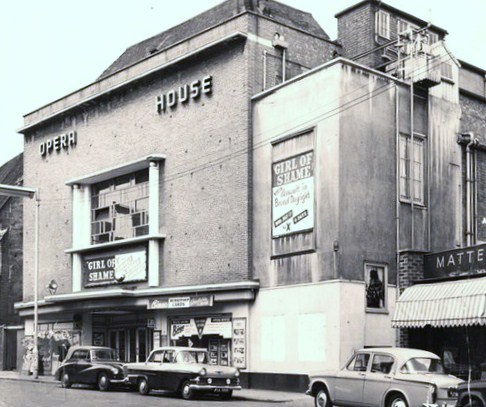
Many times browsing through archives, especially the digital kind, leads you from one place to another. I was scanning the British Newspaper Archive for material related to the North-West Frontier of British India and ended up finding a small snippet in the Public Notices section of TheCoventry Evening Telegraph on an Indian film, Padosi, hosted by the IWA at the Opera House in 1945.
The Coventry Evening Telegraph, Thursday, April 26, 1945
The Indian Workers Association (IWA) was founded in 1938 in Coventry to mobilise for Indian independence amongst the small working-class Indian community living in the UK. Many of its early members were from Sikh and Muslim Punjabi backgrounds. Some of these members were sympathetic to and inspired by the Ghadr Party (est. 1913 in California). The British government naturally kept an eye on their activities; not only for their nationalist motivations but also for their leftist leanings. The extract below is taken from a document on the IWA, dated 14 April 1942.
The Hindi (or Hindustani) Mazdur Sabha, now more usually referred to as the Indian Workers’ Association (or union), has come gradually into being as a result of war conditions. In the two years preceding the outbreak of war a number of disaffected Sikhs – some of them with Ghadr Party contacts – who had come to the United Kingdom to work as pedlars decided to start, if possible, an organisation of Indians which should give all possible aid to the movement for Indian independence. At first the only practical step towards carrying out this decision were the secret collections and remittances to India of sums of money for payment to the dependents of political prisoners. The fund in India which received these sums of money was created by the Ghadr Party in California and there can be little doubt that the Indians in the UK who were chiefly interested in these collections were actuated by motives and by a long-range policy which were identical with these of the Ghadr Party. Some of them were in receipt of the “Hindustan Ghadr” until the close watch of the postal censorship succeeded in imposing an effective check on the entry of the paper into the UK. From the very beginning Coventry was the headquarters of the movement, for it so happened that the Indians chiefly interested were pedlars who sold their goods in the Coventry area. (File no. L/PJ/12/645)
Read further about the IWA:
Gill, Talvinder. “The Indian Workers’ Association Coventry 1938–1990: Political and Social Action.” South Asian History and Culture 4, no. 4 (2013): 554-573. DOI: 10.1080/19472498.2013.824683
Virdee, Pippa. Coming to Coventry: Stories from the South Asian Pioneers. The Herbert, 2006.
Communities in Action: the Indian Workers’ Association – Our Migration Story
The film listed in the Public Notices snippet is “Parosi” (sic). This was a social drama directed by V. Shantaram and was set in the back drop of Hindu-Muslim unity. The Indian national movement was remarkably communalised in its last years, leading to unprecedented violence accompanying the end of British India. In 1941, it was unclear when and how this end would come. Alongside this rising tide of deteriorating inter-communal relations, there were progressive voices in the diversifying public sphere, now including cinema. One of these was the film’s legendary director, Shantaram, who pointedly got a Muslim actor to play a Hindu character and vice versa, to promote harmony between the communities. It is the type of film I imagine the IWA would want to show, as the organisation wished to emphasise class unity over communal politics in the battle against colonialism.
The Opera House in Coventry was opened in 1889. During World War II, the building was damaged by bombing but it was quickly repaired and transformed into a cinema when it re-opened in 1941. The Opera House closed in 1961 and, while there were plans to restore it to a live theatre venue, this never happened.






 BAGICHA