Tag Archives: Ludhiana

2 Nov 84.

BBC Details Incidents. London BBC World Service 0015 2 Nov 84

[From “Radio Newsreel” program]

The outburst of anger against the Sikh community in India following the assassination of Mrs Gandhi by two Sikhs of her bodyguards has claimed about 150 lives and left more than 1,000 people injured. Mob vengeance took its tool in a number of centres and curfews have been imposed, including one in the capital, Delhi. Tim Llewelyn saw the violence there.

It was the worst day of violence in Delhi’s recent history. No area was spared – rich, poor, residential, commercial. Angry youths acting without apparent organisation gathered on the streets attacking Sikh stores, taxis, homes, and Sikhs themselves. Usually, they burned or looted whatever they could lay their hand on, twice Sikhs themselves and in one case, lynching two adults near a Sikh temple, then setting the corpses alight. Cars were attacked and burned because the mob in India identifies the Sikhs with the car and the taxi. Sometimes – but not always – the police intervened, and I watched the security forces with bayonets fixed rescue the man whose house was being put to the torch by the angry crowds of youths. A number of Sikh temples were surrounded and threatened but mostly escaped damage. They were often defended by Sikhs themselves brandishing their medieval weapons – swords and staves and spears. The prime minster, Rajiv Gandhi, has ordered that the violence must not be repeated. There are indefinite curfews in 30 towns and cities, including Delhi and parts of Calcutta.


52 Killed in Bihar. Paris AFP 0759 2 Nov 84

At least 52 people were today reported killed in Bihar state, bringing the nationwide death toll in the anti-Sikh violence sparked by Prime Minister Indira Gandhi’s murder by two Sikh bodyguards to about 200.

The PTI said the 52 deaths took place in Bokaro, in the northeastern state of Bihar, where police fired on rioters. Security forces were under order to shoot on sight anyone committing violence.

PTI said another 50 people were wounded in Bokaro.

Meanwhile in New Delhi, a dozen bodies were found in an express train which arrived from Ludhiana in the predominantly Sikh of Punjab early today, station officials reported. They gave no further details.


Death Toll Reaches 227. Paris AFP 1005 GMT 2 Nov 84

Fresh outbreak of sectarian violence rocked New Delhi and other Indian towns today as the death toll in the anti-Sikh backlash sparked by the assassination of Prime Minister Indira Gandhi soared to 227.

In East Delhi, Hindu mobs defied shoot-on-sight orders and Army and paramilitary troops to set fire to a cinema, police said. They also reported mob violence in two localities in south Delhi.

Police confirmed that 70 people had been killed in the capital since Mrs Gandhi was gunned down outside her home on Wednesday by two Sikh members of her bodyguard.

Bihar in the north-east, Uttar Pradesh in the north and Madhya Pradesh in central India were reported to be the worst hit among a dozen states reeling under the wave of violence, despite repeated calls by Prime Minister Rajiv Gandhi over the radio for calm.

The reports said that 92 people had so far been killed in Bihar, with 35 dead in Uttar Pradesh and 30 dead in Madhya Pradesh. Other casualties were reported in the western coastal state of Maharashtra.

The worst incidents occurred in Bihar state, where at least 52 people were killed as Hindus sought to revenge Mrs. Gandhi’s murder, the PTI reported.

The incidents took place in the steel town of Bokaro, PTI said, adding that the state authorities had issued security forces with shoot-on-sight orders to quell further violence. PTI said another 50 people were wounded.

Police Deputy Inspector-General Y.N. Srivastava told PTI that police in Bokaro opened fire on rival Sikh and Hindu mobs, killing one person and injuring two. Riot police were patrolling the streets.

Newspapers earlier reported other slayings in the industrial town of Ranchi as well as Hazaribagh, Arrah and Daltongaj, also in Bihar state.

An indefinite curfew was reportedly imposed on Ujjain in the central Indian state of Madhya Pradesh following a number of cases of arson and looting, while angry mobs violated curfew restrictions in nearby [words indistinct].

Trains arriving here from the Punjab reportedly carried bodies of people believed to have been lynched by crowds en route to the capital for Mrs Gandhi’s funeral tomorrow,

Eye witnesses and railway officials said they saw six bodies lying on New Delhi railway platform.

Other eye witnesses said that as many as 18 bodies were found in a train that ran between two Punjabi towns of Bhatinda and Ferozepur.

Prime Minister Rajiv Gandhi broadcast repeated radio calls for an end to the orgy of violence, but with little effect.


Death Toll Climbs. Paris AFP 1308 2 Nov 84

Thirty more people were killed in inter communal violence in New Delhi today, officials said, as the [word indistinct] nationwide death toll in violence sparked by the murder of Indira Gandhi climbed past 300.

A total of 100 people, including some reportedly burned alive in [word indistinct] New Delhi, have been killed in the capital since the prime minister was gunned down by Sikh bodyguards on Wednesday.

Police reportedly opened fire to separate Hindus and Sikhs clashing in a village in west Delhi. The groups exchanged fire, leaving some people dead before police intervened.

A toll compiled from official and unofficial sources and quoted by Indian news agencies put the dead at more than 300 nationwide.


Source: all daily reports are from the Foreign Broadcast Information Service Archive.

Ludhiana’s Clock Tower (Ghanta Ghar)

Ghanta Ghar is one of the most iconic landmarks of Ludhiana city. It stands tall amongst the hap-hazard development of the industrial city. Previously it was the pride and the centre piece of the historic area of Chaura Bazaar, which was the hub of economic and political activity in the city. Located at the entrance of the commercial centre, the Clock Tower was and still remains a landmark in the city’s landscape. The railway station is conveniently located a short (walking) distance away from the Clock Tower, allowing for trade activity to flourish easily in the area. Apart from commercial activity Ghanta Ghar also attracts political activities, as it is a convenient location to hold political party protests and dharanas. Today the Clock Tower has receded into the background as a flyover dominates the urban landscape. Although, Ludhiana as a city has grown manifold since the Ghanta Ghar was built, and much of the commercial activity has moved to The Mall Road or Ferozepur Road, Chaura Bazaar still remains popular amongst old and new inhabitants. There is the old charm of the traditional sub-continental bazaar with its nooks and crannies. The narrow lanes, tucked away behind the wide and partial Chaura Bazaar, remain hidden gems for jewellery – gold, silver or artificial. And then there are the scrumptious aloo tikkis, gol guppas and chaats to satisfy the hungry shopper. It is a shame that the Ludhiana Municipal Corporation has not invested more in the city’s historic sites and made more of these places. But, this is part of a wider problem with preservation of heritage and history in the sub-continent.

The history of the Clock Tower, of course, evokes the British colonial heritage: Ghanta Ghar/Clock Tower was designed by the then-Municipal Chief Engineer of Amritsar, John Gordon. The design reflects the traditional European Gothic style and uses an interesting red brick, which is striking even amongst the colourful and vibrant Chaura Bazaar. Although the construction began in 1862, it was not officially inaugurated until 1906 by Sir Charles Montgomery, who was the Lieutenant Governor of Punjab, along with Diwan Tek Chand, Deputy Commissioner of Ludhiana.

Ludhiana actually came under British rule in 1835, when Rajah Sangat Singh died. The Gazetteer of Ludhiana District (Punjab Government, 1888) notes that it was under Sir Claude Wade (1823-38) and his successors that the town increased in its size and importance. Trade expanded, and Ludhiana became a centre for trade in grain, sugar, cloth. The small presence of Kashmiri weavers (approximately 8-10 families) expanded after the famine in 1833 to around 1,500-2,000 Kashmiris, who settled in the town. Following the Sutlej campaign (1845-1847), Ludhiana district was formed, and the civil offices were removed to the cantonment side of the city. In 1854-55, the Grand Trunk Road was metalled and realigned to its present position.

The opening of the Railway from Delhi to Lahore in 1870 undoubtedly gave a great stimulus to trade and commercial activity in Ludhiana. In addition, the number of shops and sarais along the Grand Trunk Road, facing the station were also growing. According to the Gazetteer, the new town to the south of Chaura Bazaar had all the hallmarks of being modern. The streets were wide and straight, and the houses and shops were uniformly designed, giving them a modern appearance. ‘The principal streets, the Chaura Bazaar and the Hazuri Sarak, were designed by Sir Claude Wade himself; and, one of his projects, the Iqbal Ganj, is a standing proof that he was rather too sanguine about the speedy development of the two for which he did so much’ (p. 216).

The population of town was modest compared to the 1.6 million people living in the city today. In 1868 Ludhiana had 39,983 (Males 21,701 and Females 18,282) and in 1881 this rose to, 44,163 (Males 24,685 and Females 19,478)

CENSUS REPORT 1881

Total Population – 44,168

Hindus – 12,969; Sikhs – 1,077; Jains – 752; Muslims – 29,045; and Others – 320

The population of Ludhiana started to grow, most likely with opening of the railway and consequently the establishment of the town a collecting centre for the grain traffic. But in 1878, there was a huge loss of life due to malaria fever following the monsoon season. It was estimated that around 6-7 per cent of the population died especially, ‘half-starved Kashmiris and others of the lower classes not having sufficient stamina’ (p. 217). According to the 1881 census, the town was overwhelming Muslim and indeed even in 1947, Ludhiana was a Muslim majority town. The city today is dominated by the Sikhs but there are still some remnants of a former history scattered around the city, like the Ghanta Ghar and Chaura Bazaar.

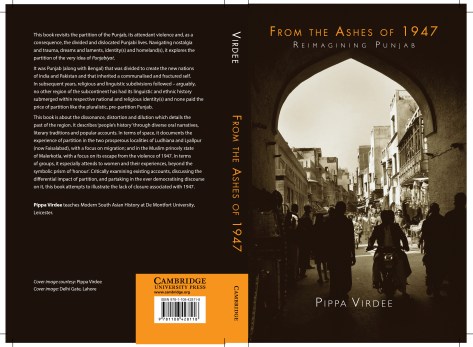
From the Ashes of 1947: Reimagining Punjab

From the Ashes_Full Cover

Full details: From the Ashes of 1947

Watch the panel discussion with Pippa Virdee (De Montfort University, UK), Afzal Saahir (Poet and Radio Host) and Sajid Awan (Quaid-e-Azam University) of my book From the Ashes of 1947 at the Afkar-e-taza, January 2018 Panel Discussion

A short hop from Ludhiana to Lyallpur


Getting into a taxi can often lead to interesting conversations with the drivers. So when one evening I request a Careem (much like Uber around the world), I get into the car and as it happens quite often, the driver is usually baffled by the name (not an obvious Pakistani name) and the person who is sitting in the car (could be Asian but looks “foreign”). I explain that I am indeed Punjabi and use my best Punjabi accent to prove the point! However, the response from the driver is quite often in Urdu, even though I carry on speaking in Punjabi. This will continue or then sometimes the driver will feel comfortable enough to speak in Punjabi.

So then on this one evening, a young driver who turns out to be from Faisalabad (previously known as Lyallpur); he lives not far from Samundri, which is a tehsil of Faisalabad district. Lyallpur district began life in 1904 following the development of the canal colonies in West Punjab in the late nineteenth century. From being a small market town, Lyallpur has been transformed into Pakistan’s main agro-industrial centre following the partition of Punjab. One which has fundamentally changed Lyallpur in modern times is migration. Firstly following the development of these canal colonies and secondly, the migration following Partition in 1947.

Having discovered the driver was from Faisalabad, I choose to converse with him in Punjabi. He was both astonished and ecstatic at the same time. The joy of sharing the same language and accent as you, can sometimes do this to people. He had been in Lahore for some months now and was making a living driving for Careem. The familiar tones of someone, and in this case someone who he thought was a foreigner, speaking the same language that he had perhaps not heard so frequently since he arrived in Lahore immediately allowed us to bond during the short ride. The ride is in fact less than ten minutes, but it is amazing what can be gleaned in these short conversations.

As we discussed our mutual language I suggested to him that the elders in his family might have migrated over from Jullundar or Ludhiana, and he immediately said that yes, his paternal grand-father was from Jullundar. The distance that divide these two places is approximately 250 km. He came over after partition and settled in Lyallpur. I went on the make the connections between the two places, the place where I grew up on the other side of the border, and the place on this side of the border but both conversing in the same language in a neutral city. Perhaps it had never occurred to him that he also had some connection to the Indian side of Punjab via the language that he speaks.

At the end of the ride, his joy at making these small connections translated into him refusing to take any money from me. He said he could not do this. Sometimes life brings about things which cannot be measured in monetary terms, they are passing moments, glimpses of human kindness that leave you feeling richer.

Golgappas/Panipuri

Golgappas have to be one of the most popular street foods in India. For me it’s a ritual, when I go to Ludhiana, I have to have golgappas. It is a simple hollow, fired puri, made with flour or semolina. The flour ones are more crispy and more popular. A small hole is inserted and then filled with any combination of chickpeas, onions, potatoes and then filled with flavoured water. The water is what makes the golgappa; from simple tamarind based pani, the street vendor now has multiple flavours. Sweet, tangy, spicy to appeal to all taste buds. Affordable by all and enjoyed by all, this is the simple attraction that keeps bringing me back to India.