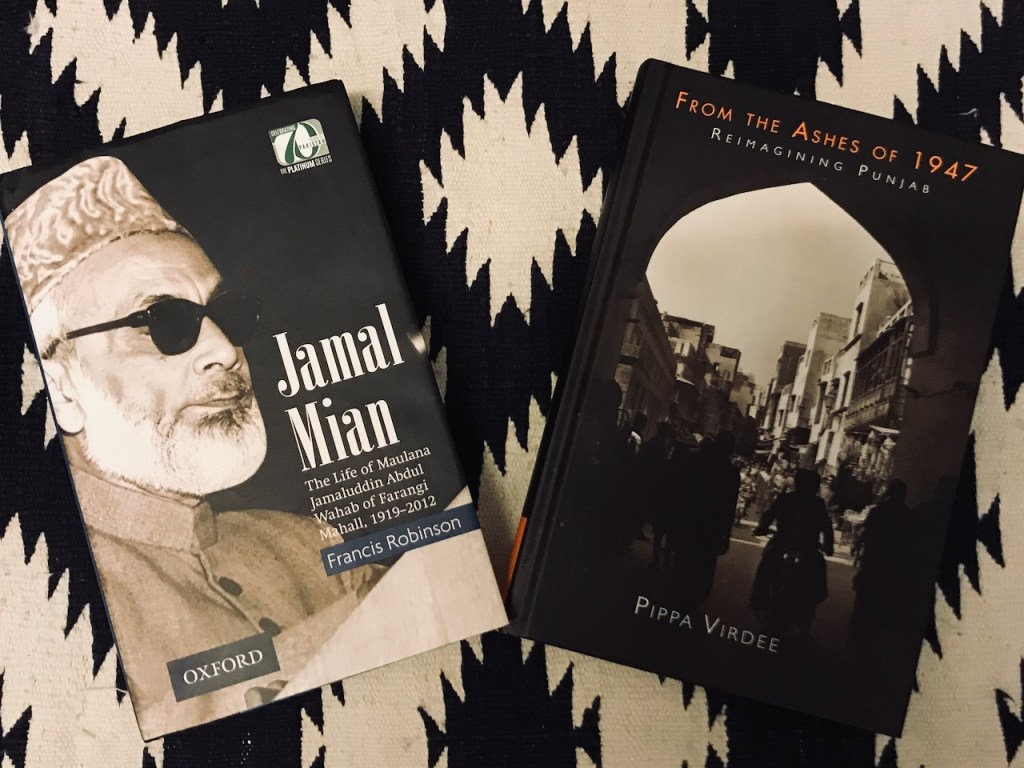
The two books are placed on a traditional handmade dhurrie/dari by my mother.
ONE is the biography of Jamal Mian (1919-2012), a life across British India, independent India, East Pakistan and Pakistan. The kind of life, which would be unimaginable to most people of the subcontinent today. At the core, this is a detailed history of the changing political landscape of North India told through the life and times of an extraordinary life. The story unfolds with authority and simplicity, the kind of old-fashioned narrative history writing that barely exists. Stories and history writing are barely written like like because they do not command the short-term impact and they take years, generations to unfold through the relationship of the historian and his subject. But importantly it brings together the life and times of an individual and his milieu – showcasing the kind of “Hindustan” that no longer exists, other than in history books.
Pippa Virdee, FRANCIS ROBINSON. Jamal Mian: The Life of Maulana Jamaluddin Abdul Wahab of Farangi Mahall, 1919–2012, The English Historical Review, ceaa186, https://doi.org/10.1093/ehr/ceaa186
TWO is an account of the province(s) of Punjab; rising From the Ashesof 1947 but simultaneously being reimagined. This too is about a political landscape that has been transformed and only exists in the history books, kinder memories and sepia imaginations of some of its people. It is about the shorter, shocking and longer, hardening consequences of dividing the land of five rivers. It too has been written over a long period and reveals the changing nature of my understanding of Partition, from the beginning of my doctoral work in 2000, to the point of this publication in 2017. It has changed further still because history is about engaging with the past through the unfolding present and “reveals how far nostalgia combined with the lingering aftershocks of trauma and displacement have shaped memories and identities in the decades since 1947.”
Sarah Ansari, PIPPA VIRDEE. From the Ashes of 1947: Reimagining Punjab, The American Historical Review, Volume 125, Issue 2, April 2020, Pages 635–636, https://doi.org/10.1093/ahr/rhz695
Saifuddin Saif was born in Amritsar in 1922. He wrote some very powerful poems during his college days. He was always inclined towards writing for films, but the films for which he had written lyrics before partition were not released due to the unfavorable conditions in the subcontinent. Saif penned songs for Teri Yaad (1948) which was the first film to be released in Pakistan and received admiration for the freshness of his poetry. (courtesy of Rekta: https://www.rekhta.org/Poets/saifuddin-saif/profile)
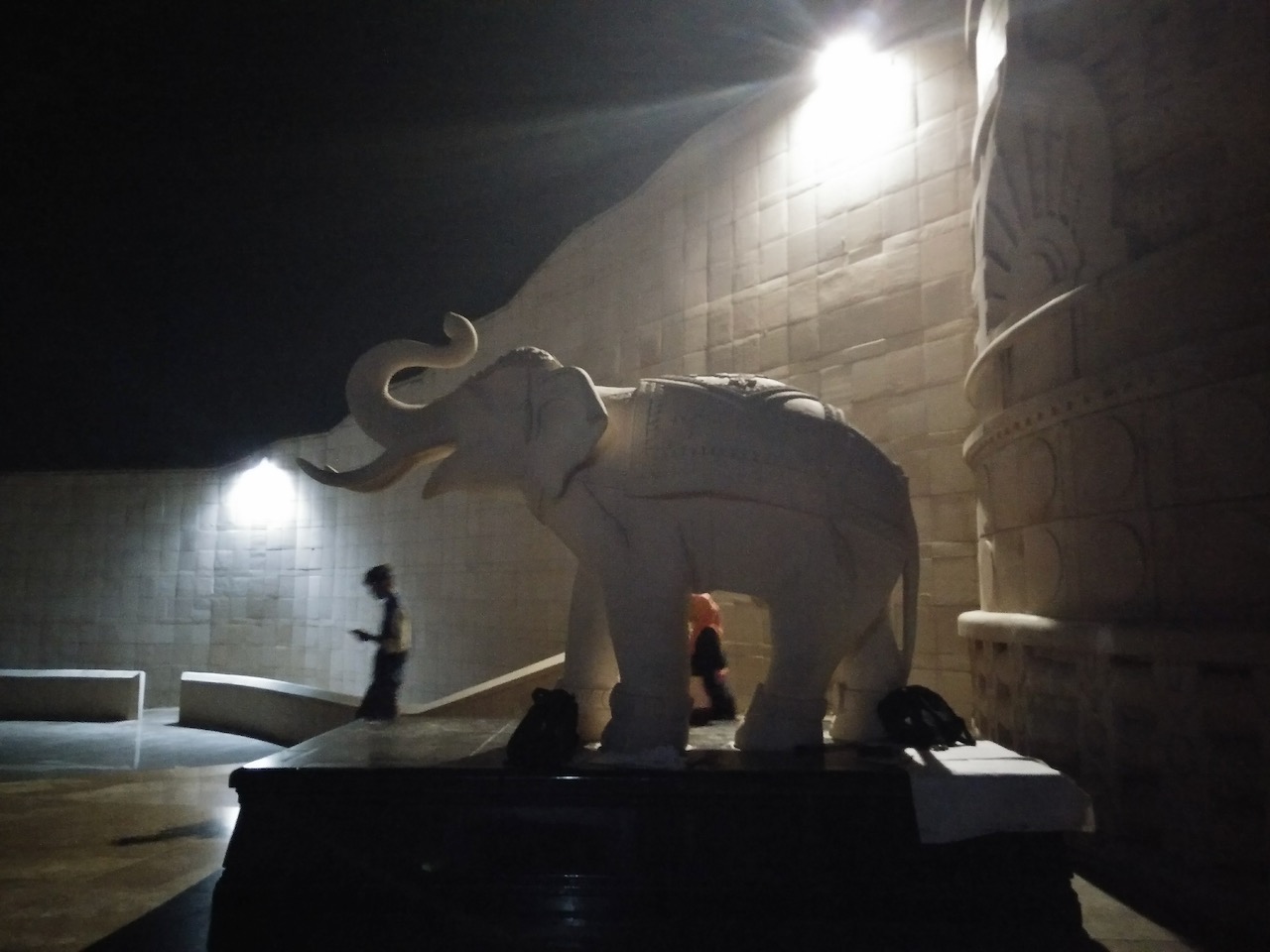
Patangbaazi greets one at the magnificent Parivartan Sthal (Ambedkar Memorial Park) complex constructed by the orders of Chief Minister Mayawati and completed by 2009-10. It is a park today and has from khomche to ice-cream, from couples to families, from beggars to bourgeoisie and all castes in the midst. Stretching along the river-front, a tourist-spot complete with statues and footpaths, in marbles and sandstones, it has a marvellous sense of space. An extraordinary, larger-than-life and gargantuan assertion of identity, dignity and deities – Ambedkar and wife, Kanshiram and Mayawati on opposite sides – this is not merely a reclaiming, recovery of history. It is not even an attempt to re-write history. This set-up, so reminiscent of the Lincoln and Luther King Memorials in Washington, is a grabbing of past and present by its throat and laying down a marker for future.
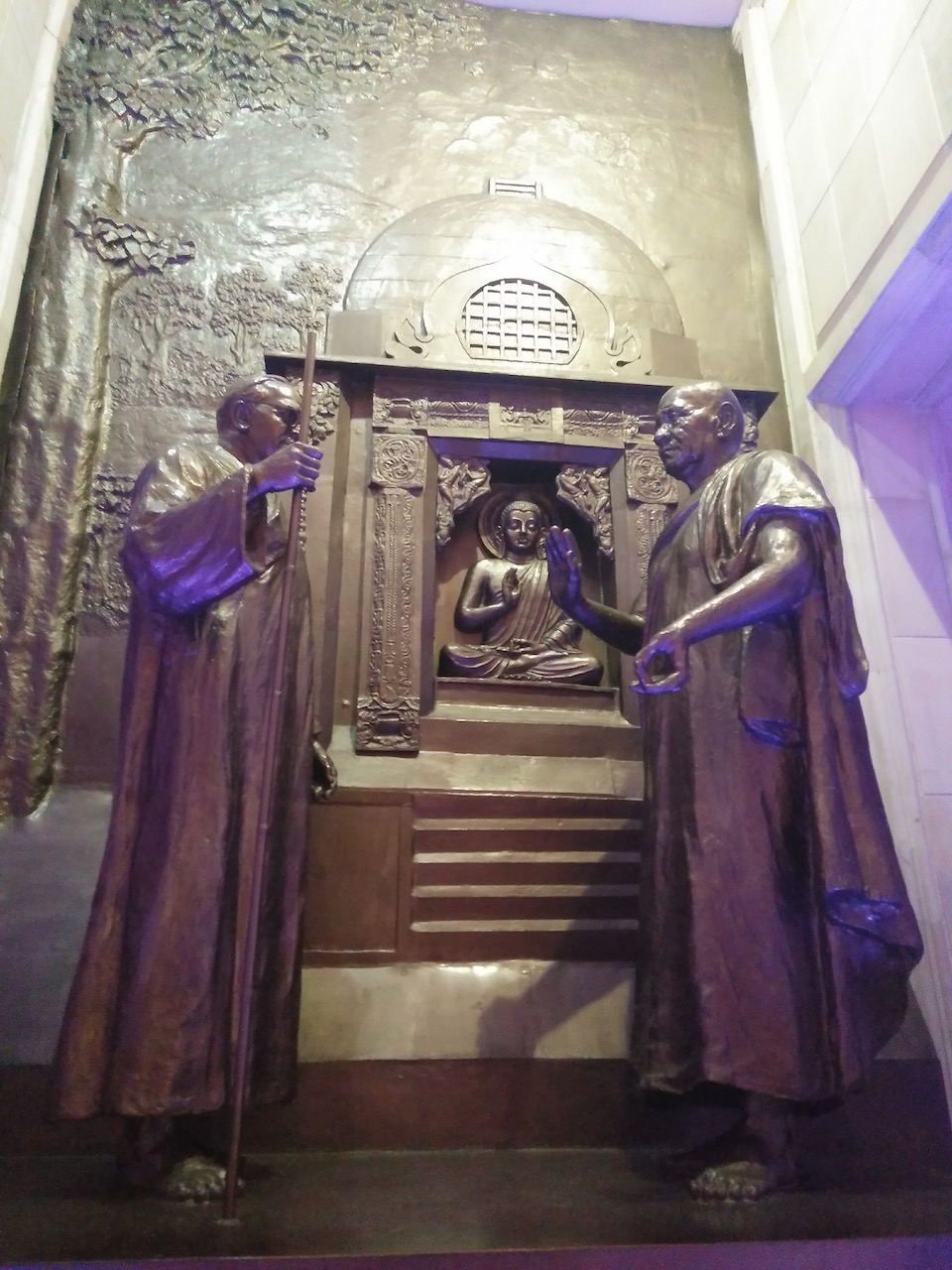
The geometrically precise, expansive space – rational and theistic with its human-Gods – has a jarring note struck by the VIP Lounge on one side of the entrance with the other side being for reserved for others. One long path takes tourist-pilgrims to a stupa-hill, rock-cut alignment with huge mural depictions of Ambedkarite Buddhism from deeksha to nirvana. Hues of blue lighting enhanced the sandstone, soil-coloured backdrop amidst which stood exceptionally well-done, real-life-likeness statues. Ambedkar is sitting majestically in the Lincoln pose in the sanctum-sanctorum. On the circular walls, on one side, Ambedkar is ‘giving’ the gift of Constitution to Babu Rajendra Prasad, the upper-caste Chairman of the Indian Constituent Assembly and on the other, Ambedkar is shown receiving the gift of deeksha from a Baudh-Bhikshu.
Lucknow is the capital of the Indian subcontinent’s Awadhi ‘heartland’, in historian Gyanesh Kudaisya’s evocative words. Less evocatively, it is the capital of the Indian State of Uttar Pradesh (UP) and its largest city with a population of three million people, of which 26 per cent are Muslim. It is the centre of Shia Islam in India, historically the capital of Awadh, it was one of the major centres during the rebellion in 1857, the cultural capital of north India and home to the famous Chikankari embroidery work, thought to be popularised by Nur Jahan. The Nawabs of Lucknow were known for their refined tastes as much as their extravagant lifestyles, and the city has most beautifully been captured and bought to life in the 1977 film, Shatranj ke Khiladi that was based on the Hindi short-story of the same name by Munshi Premchand and the 1981 film, Umrao Jaan that was based on the Urdu novel Umrao Jaan Ada by Mirza Hadi Ruswa. Set in mid-nineteenth century Lucknow, they show the decadence of the Lucknavi high society through the life of Nawabs and courtesans, the moral decay/hypocrisy around their lives in the backdrop of political intrigue and rebellion. Shift to the present-day Lucknow/UP and the state is better known for returning a thumping win in the state election of 2017 for an ascending Hindu ‘nation’ led by Narendra Modi and, in return, finding itself being ruled by a Yogi. A milieu previously famous for its adab-tehzeeb is now the habitus of Adityanath and his terrific to many, terrifying to some, presence.
A recent visit their began at the annexe of the Charbagh station, past the pillars of the fly-overs of the-then on-going metro constructions and a rather tasteful red-and-white façade of the Charbagh metro-station with its Jali décor; apropos which my auto-wallah remarked, ‘Akhilesh ne kaam to bahut kiya par chacha ne harwa diya’. In no time, we were in old Lucknow; the narrow, congested streets of Aminabad, where the first thing noticeable was that while many shops had named the lane we were on as Latouche Road, others had it as G.B. Road, for, Gautam Buddha. The incongruity of being in a space that marked its time from both the British Lt-Governor Sir James Latouche (AD 1901-06) and the Shakyamuni Siddhartha (563-483 BC) did not end there. It was also reflected in much of the arms, air guns et al, and ammunitions market on one side being stared at by hundreds of chickens from their kens in many of the poultry-khanas on the other. While the arms stores dated back to 1933, 1940s-50s, prominent among these being Gupta Brothers, Hashim Manzil, with their colonial, hanging, dilapidated balconies, small windows, tapering and peeling pillars, darkening, decaying visage, plants growing out of lime plastered walls, the poultry-khanas seemed without pedigree. Amidst this sea of noisy chatter around the selling of guns and the stoically silent birds, there was also a serene and strikingly yellow-coloured masjid/madrasa and its school of calligraphy. It plainly stood apart and alone in its intent and purpose.
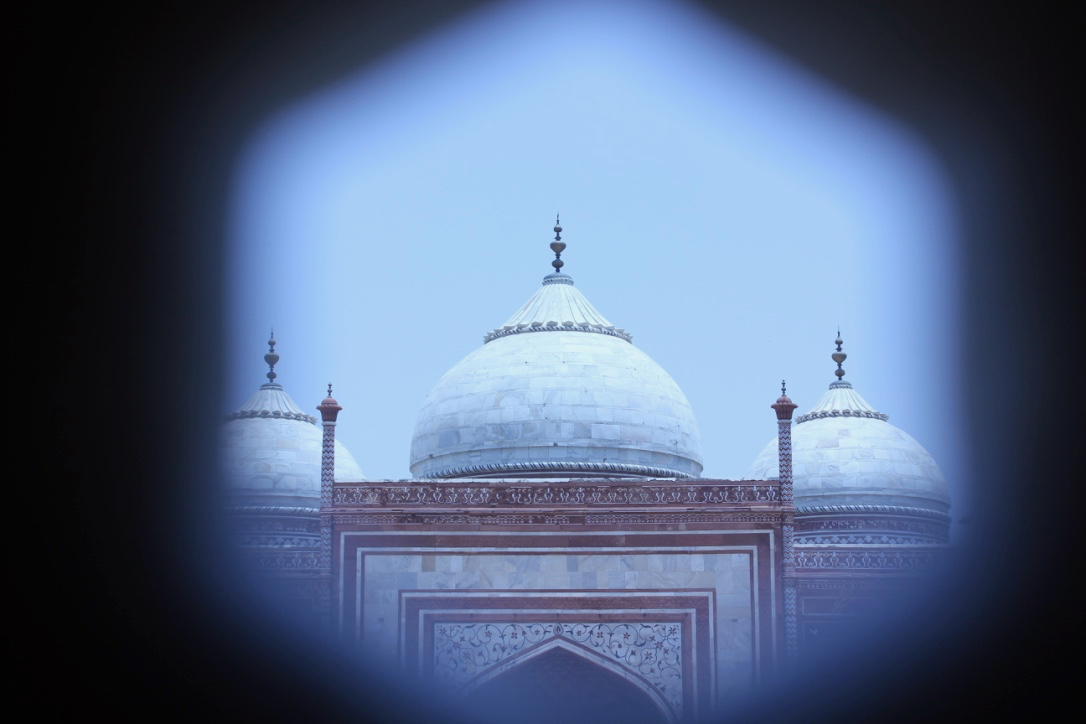
The Masjid at the Taj Mahal, Agra. (C) 2017 Pippa Virdee
By Maaz Bin Bilal
I want to tell them frankly that mere declarations of loyalty to the Indian Union will not help them at this critical juncture. They must give practical proof of their declarations.
— You Cannot Ride Two Horses (Speech by Sardar Patel on 6 January 1948, in Lucknow)
I
Why did you sell your house now, O Khadim?
As hereditary guard of the Taj Mahal, must you not be prim
and proper, when for Pakistan has left,
all your family, most of your kin?
II
There are four reasons for the sale, Sahib:
I owed debts, and I have daughters to be married,
The refugees living in my house misused it,
My sons have gone, I need money, for when I die, to be buried.
III
Tut, tut, I am sorry, I am not convinced,
Why now? Never before you felt pinched?
Go fetch positive proof of your faith, in a month,
else lose your job, we believe in your guilt.
IV
Here, Sir, I have brought back from Lahore,
my two single daughters, orphaned grandchildren—four.
The rest won’t come, they fear their old neighbours,






















 BAGICHA