The Masjid at the Taj Mahal, Agra. (C) 2017 Pippa Virdee
By Maaz Bin Bilal
I want to tell them frankly that mere declarations of loyalty to the Indian Union will not help them at this critical juncture. They must give practical proof of their declarations.
— You Cannot Ride Two Horses (Speech by Sardar Patel on 6 January 1948, in Lucknow)
I
Why did you sell your house now, O Khadim?
As hereditary guard of the Taj Mahal, must you not be prim
and proper, when for Pakistan has left,
all your family, most of your kin?
II
There are four reasons for the sale, Sahib:
I owed debts, and I have daughters to be married,
The refugees living in my house misused it,
My sons have gone, I need money, for when I die, to be buried.
III
Tut, tut, I am sorry, I am not convinced,
Why now? Never before you felt pinched?
Go fetch positive proof of your faith, in a month,
else lose your job, we believe in your guilt.
IV
Here, Sir, I have brought back from Lahore,
my two single daughters, orphaned grandchildren—four.
The rest won’t come, they fear their old neighbours,
Sadly, I came to know that the young forgotten heroine of the independence movement passed away at the weekend. I interviewed Fatima Sughra in 2009 and only came across her by accident. Below is an extract from the amazing interview with her and sadly many Pakistanis are not even aware her or that she quietly lived in Johar Town, Lahore. At the age of 14 she became involved in local processions/protests being organized by the women working for the All-India Muslim League. Inspired by what was going on Fatima joined them and recalls one eventful day:
I was studying in 9th class. Fatima Begum was very active worker of the Muslim League. She worked with Quaid-i-Azam. She established the imposing Jinnah Islamia College on Multan Road, Lahore. Quaid-i-Azam inaugurated this college. There were usually meetings of the Muslim League in her house. She was sister-in-law of one of my aunty. I often visited my auntie’s house and at the time could not understand what was happening…I only thought that the Muslim League is our party, a party of the Muslims.
I was born in 1931; our house was between Mochi Gate and Shah Alam Gate Lahore. I was 14 and half year old that time and studying in 9th class. In those days, there was a disobedient movement against the Khizr Government and the Muslim League leadership made regular protests and processions in the streets. I read Zamindar newspaper and came to know that Begum Shahnawaz, Begum Salma Tassaduq Hussain, Begum Jalandhri and Fatima Begum were arrested in Lahore. I asked for permission from my father to participate in the processions; finally he allowed me. I along with my friends reached the Assembly Hall that day. I saw at that time a big crowd was shouting and chanting slogans: ‘(Zindabad) Long live Muslim League; long live Qauid-i-Azam; Pakistan will be created whatever it cost to the Muslims (bun kay ray ga Pakistan).
I think it was in February or March 1947. Daily processions were arranged and we took processions to the Radio station, at Mall Road, Jail Road, High Court and Civil Secretariat. We took the procession to the inner city. Hindus laughed at us. I remember the day I took off the Union Jack and replaced it with hoisting a [makeshift] Muslim League flag. Many Muslim women, (who had never stepped out from their house before) came out from their houses and took over the street of the city. This was happening all over because the Begums [elite Muslim League Women leadership] went door to door and convinced the Muslim women to come out from their homes for the protests. I do know what sort of passion was inside me at time; I just jumped over the Secretariat Gate.
There was a girl who was very tall…. I think her name was Begum Aslam. I put my foot on her shoulder and reached at the top of the Secretariat building Lahore. I did not know even, I pulled out the doori (thread) and flag…That day Begum Hadiat Ullah was leading the procession she said to me: ‘are you alright? I shouted, yes, I am alright’. The crowds were shouting slogans. I became very emotional and replaced the Union Jack with the Muslim League flag. Afterwards the Police arrived there; some boys escorted me and helped to get down from the stairs. The police sprayed heavy tear gas and used lati charge over the crowd. I rented a tonga and paid 4 anna and reached home safely. At home I told my mother about hoisting of Muslim League flag……she replied: ‘ok, I know you are doing such things every day’. At our house the daily Zamindar used to come every day and there was big news in the next day’s issue: Fatima Fada Hussian took off the Union Jack and hoisted the Muslim League flag. My father kissed me when I was sleeping because of this act. My father was very proud on me and said to me ‘my daughter I’m proud of you, you have done a big task’. That day I did break my fasting and again went to join the street processions. Begum Sikandar Hayat, Zahida Hayat, Asmat Hayat and Shamim were with me. They had been released from jail. We brought them in the Nasar Bagh in a procession. There was a big gathering and all Begums delivered very stimulating speeches. They called me on the stage and put a har of fruits around my neck. My friend ate most of the fruits and remaining part I showed to mum when I went home. [Laughing]
My father was a well-reputed person in our mohalla and people of the mohalla asked him many things about us. In those days, the people were very good and they cared about other people of mohalla. Now-a-days nobody cared about anything.
I had little interest in politics. I just went to join the processions for enjoyment. I thought that Muslim League represented the Muslims and Quaid-i-Azam was their leader and struggling for the creation a Muslim country. When I hoisted the Muslim League flag in the Secretariat building, many people came to my house to congratulate me and my family. I became a renowned girl.
I got certificate and gold medal. In 1987, Pakistan Government arranged a similar sort of the 1947 flag hoisting occurrence in the Lahore Secretariat building. I did perform and climbed at the Secretariat building even in this old age.
This was an extract from an interview conducted with Fatima Sughra in her house in Johar Town, 2009.
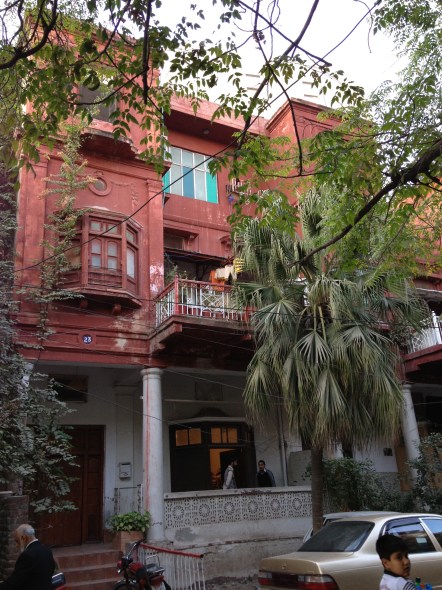
A few years back I had the pleasure of wondering around and exploring the old city remnants of Lahore, accompanied by Najum Latif, a migrant of 1947 and resident of the Androon Shehr. We start off where he lives, Sir Ganga Ram Mansion located just behind The Mall and a hidden gem of the who’s who in the history of Lahore’s former life. In its heyday of the 1930s, Lahore was a cultural centre for North India and writers such as Khushwant Singh and the artist like Abdur Rahman Chughtai (and a friend of Amrita Sher-Gil’s father) lived nearby. Only a few doors away from Latif’s house was where Amrita Sher-Gil rented an apartment with her husband, Dr Victor Egan. When Latif was growing up he was a frequent visitor to No 23, at the time he was unaware that Sher-Gil, the great Punjabi-Hungarian painter once lived there.
Sher-Gil was born in 1913 in Budapest, her father was the aristocratic landlord Sardar Umrao Singh Majitha and her mother a Hungarian opera singer. Educated in Paris, she took to the bohemian lifestyle of the Parisian art scene that allowed her to express herself truly. European in style, yet her paintings also reflect the multiple layers and textures of her own life and identity. Influenced by the work of Paul Cezanne, Amedeo Modigliani and Paul Gaugain, she later looked to India for inspiration, trying to fuse these two together. After spending four years in Paris, Amrita decided to return to India. She noted that, “My professor had often said that, judging by the richness of my colouring, I was not really in my element in the grey studios of the West, that my artistic personality would find its true atmosphere in the colour and light of the East” (Rizvi). During her time in India, she painted scenes from India, learning new techniques and getting inspiration from the breath of the sub-continent. Today she is considered one of the most important Indian painters of the 20th Century and certainly one of the most expensive female painters in India.
She was only 28 when died at 23 Sir Ganga Ram Mansion apartments, where she spent the last few months of her life. Her husband had a clinic on the ground floor and she painted upstairs, where they also lived. She first came to Lahore in 1937 from Paris when her work was exhibited at the famous Faletti’s Hotel. It was a resounding success and challenged the status quo of the art world. In September 1941 she came to Lahore so that she could plan for her solo exhibition in December; this never happened as she was suddenly taken ill and died in a matter of days. The planned discussion between Abdur Rahman Chugtai and Amrita Sher-Gil never happened and instead the exhibition opened but posthumously. Most of these works are now located in the National Gallery of Modern Art in New Delhi.
Amrita Sher-Gil still remains an enigma in death, as she was in life. The young artist was never to see the great legacy that she would leave behind and sadly few Lahoris would be aware that she once lived and worked in the great historic city. Her painting, Vina Player, still finds space in Lahore Museum but otherwise sadly her association with Lahore has all but evaporated. She was cremated on banks of the Ravi in Lahore on December 7, 1941, a river that now forms a natural boundary between India and Pakistan.
Other articles to read more about Amrita Sher-Gil:
As I leave Lahore and arrive in Amritsar there is a feeling, as always, of self-consciousness about crossing over an international border. This is a border that I have crossed many times but surprises me every time. The experiences on the whole have nearly always been courteous. On a personal level the staff, the Pakistani Rangers and the Indian Border Security Force, have been polite, sometimes engaging but nearly always looking at me with some uncertainty, unable to quite place me. Since September 2016, when the Indian security forces were attacked in Uri, relations between India and Pakistan have continued to decline. This inevitably leads to the fall in the foot traffic at the Wagha-Attari border crossing. By default it means the porters have little or no work. It is the ordinary people who are always targeted, unable to get visas due to the strained relationship between the two. The silence at the border was noticeable, hardly anyone crossing the border today. In one short hour I was on the small open train from Wagha to the barely cold AC bus in Attari, India. I did not make much small talk; it was almost all a matter of fact. Sometimes they pull you aside, invite you for chai, and ask inquisitive questions, but not today. Today it was unusually quiet. In the searing summer heat who would want to walk across the border? Moreover, in the hostile lands, who wants to risk crossing the border? The Indian immigration officer, after stamping my passport quips to his friend standing near him that you hardly get any Pakistanis travelling across, I quipped back and said that’s because you don’t give them visas and walked off.
This is a hard and harsh international border; it was imagined in the drawing rooms by the outgoing colonial power but it has been re-imagined by the nation-states today. It is a stark reminder of the animosity and mistrust the two nations have of each other, yet it also conceals other truths. The border is open for all foreigners yet it is the most restrictive for the very citizens of those two nations that it is located in. Indians and Pakistanis are the most scrutinised people at the border. Looking around, one is never quite sure who performs what role; the “secret” agents are always lurking around. The border is harsher and more cumbersome for the ordinary citizens because they lack the right networks and knowledge, others, often elites of both countries, can still manage to cross the border. Thus the reality of this harsh border is dictated by the accessibility to power and while the rhetoric in the media is jingoistic, the lived experiences can be different. This applies also to the staff that regular work at the border. But the silence at the border this time also felt different, the Modi government in India is sending out a different message, a much more aggressive tone is palpable. Jinnah put forward the two-nation theory in 1940 and it seems that seventy years on, he was more perceptive than we imagined.
The Shahi Hammam is also known as the Wazir Khan Hammam. This is a Persian-Style bath, located in the heart of the Walled City of Lahore and close to Delhi Gate. It was built in 1634 and has recently be restored to expose the full glory and extent of the Hammam. It appears to be attracting many tourists and if you find yourself in the Walled City, this place is definitely worth a trip. The restoration work was done by Aga Khan Trust for Culture and the Walled City of Lahore Authority between 2013 and 2015. Funding also came from the Government of Norway.
Muslim majority Tehsils and contiguous majority areas of Muslims.
Available in the National Documentation Wing, Islamabad.
By the summer of 1947, it was obvious that a one-state solution for British departure from India was not a possibility and so serious discussions were necessary regarding the division of British India. Above is one of the maps used by the Punjab Muslims League, Boundary Commission Office to make its case about how to divide the Punjab.
The 3 June Plan, or as it was more popularly known as the Mountbatten Plan, was accepted by the main leaders, Nehru, Jinnah and the Sikh leader Sardar Baldev Singh. According to the Plan, the areas of Bengal and the Punjab would be divided between Muslim and non-Muslim districts. The Commission consisted of four judges, Justice Din Muhammad and Justice Muhammad Munir (both Muslim) and Justice Mehr Chand Mahajan (Hindu) and Justice Teja Singh (Sikh). The Commission chairman was the British barrister, Sir Cyril Radcliffe. During the public sittings, all the parties were allowed to present their cases to the Commission.
The Muslim case largely rested on the basis that their population majority in contested areas should be considered a major consideration in demarcation of the boundary line. Amongst the numerous documents used by the Commission, the map above highlights the Muslim majority tehsils and contiguous majority areas of Muslims. The yellow area in the middle is around Amritsar in central Punjab. Punjab generally and more specifically this area was incredibly complex and mixed in terms of communal composition and so immediately it is obvious that the dividing up people and land would be no easy task. How would they undo hundreds of years of people living together, co-existing and now being forced into accepting a new nation state? In addition to looking at the distribution of different communities, the Boundary Commission also examined the existing boundary lines of the tehsils, the location of the railway lines, the Grand Trunk Road (which is the main artery of the Punjab and indeed North India, connecting Kabul right through to Calcutta), the rivers and canals, the irrigation system, natural boundaries etc and some of these are marked on the map. Of course each community further made a case before the judges to make recommendations about where the line should be. This is particularly pertinent in areas where we see the concentration or pockets of the “other” community. Justice Mehr Chand Mahajan in his report makes an interesting point about the city of Lahore, which historically and at the time of partition was claimed by all communities. The city has a rich history and was once the seat of power under Ranjit Singh. The Justice says:
“The town of Lahore in my view stands on a special footing. It has been metropolis of the Punjab for several hundred years. Both east and west have contributed to its prosperity. Its economic life has mainly been developed by the enterprise of the non-Muslims. In truth both the Muslims and non-Muslims can legitimately claim Lahore as their own town thought on different grounds…. If I could, I would have suggested that this town should be left in the joint management of both the communities as a free city, it freedom being guaranteed by the two Dominions with a suitable constitution in which one community may not dominate over the other.” (Kirpal Singh (ed), Select Documents on Partition of Punjab 1947 India and Pakistan (Delhi: National Book Shop, 1991, p333-4).
I was rather excited by the prospect of being invited for High Tea at Faletti’s Hotel in Lahore. Admittedly it was a work-related event followed by High Tea. For all these years, I wondered how I managed to avoid having High Tea in the sub-continent, considering this old colonial legacy still lingers on in a reformatted and repackaged form of eating in between lunch and dinner. Moreover, it is often associated with ladies of leisure spending a lazy afternoon socialising and chatting away. What was more enticing for me was the concept of High Tea itself rather than the food because I suspected that being in Pakistan, the delicacies presented were not going to be light finger food. Indeed it was a buffet-style meal consisting of chicken drumsticks, chicken kebabs, channa (chickpeas), chicken sandwiches, cream cakes and of course tea. Although Pakistan produces some tea, it is in fact the third largest importer of tea in the world. Hugely popular in cities like Lahore, it is difficult to imagine a day with a cup of tea.
The English High Tea usually had some form of bread (sandwiches), vegetables, cheese, sometimes meat but always tea. It was considered an essential part of eighteenth and nineteenth century meal times, providing another opportunity for social gatherings amongst the upper classes. It was also easy to prepare in case their servants were not around. Thus, a practical solution for those late afternoon moments, when the evening meal was served around 8 pm. Today, High Tea is more popularly referred to as Afternoon Tea and is often marketed at the tourists (foreign or local) looking for that quintessential tea and scone moments in small “English” tea shops.
During the expansive years of British colonial rule, tea drinking became a must have beverage for the upper classes, a beverage which was too expensive for the working classes because of the heavy import taxes. By the nineteenth century, these taxes declined and of course, tea drinking starts to spread to become an essential part of our daily routine. Today the UK stands as fifth largest consumers of tea per capita. The demand for the commodity is what motivated the British to start tea production in India, where it was initially only consumed largely by Anglicised Indians. It was later during the 1920s, through extensive marketing by the Tea Board that the Indians start to consume tea. Today of course India is the largest producer of tea in the world, yet it only ranks 44th in terms of consumption per capita.
For many us, a morning or afternoon is not complete without that cup of tea, a cheap simple drink which hides so many stories. It is amazing that tea, due to being so expensive, was often locked up and key was kept by the lady of the house. Now it is one of the most common beverages around the world and only recently has it been challenged by the pervasiveness of coffee in some parts of the world.
A fascinating history of the Early Victorian Tea Set
‘In Britain between 1840 and 1900 the consumption of tea and sugar quadrupled. Mass consumption required mass production on an industrial scale and huge tea plantations were developed by the British in India and Sri Lanka. New sources of sugar were also developed, reducing the role of the former slave plantations in the Caribbean. Tea drinking was regarded as patriotic as it supported British trade and empire, unlike wine and coffee, beverages of imperial rivals.’




 BAGICHA