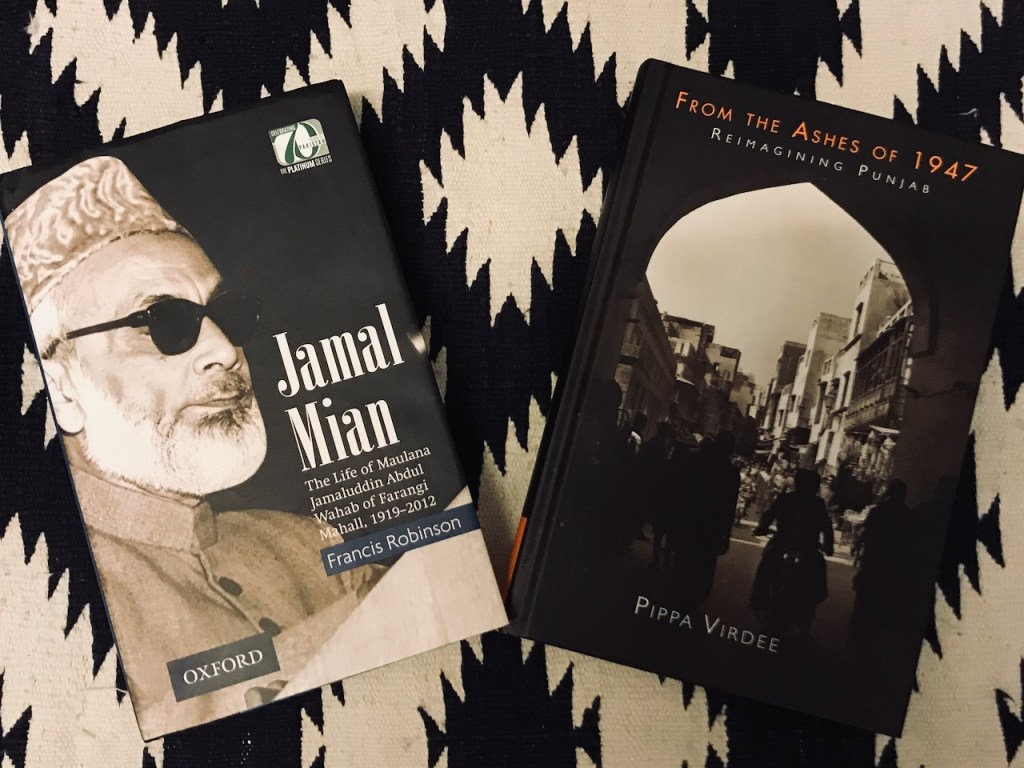
The two books are placed on a traditional handmade dhurrie/dari by my mother.
ONE is the biography of Jamal Mian (1919-2012), a life across British India, independent India, East Pakistan and Pakistan. The kind of life, which would be unimaginable to most people of the subcontinent today. At the core, this is a detailed history of the changing political landscape of North India told through the life and times of an extraordinary life. The story unfolds with authority and simplicity, the kind of old-fashioned narrative history writing that barely exists. Stories and history writing are barely written like like because they do not command the short-term impact and they take years, generations to unfold through the relationship of the historian and his subject. But importantly it brings together the life and times of an individual and his milieu – showcasing the kind of “Hindustan” that no longer exists, other than in history books.
Pippa Virdee, FRANCIS ROBINSON. Jamal Mian: The Life of Maulana Jamaluddin Abdul Wahab of Farangi Mahall, 1919–2012, The English Historical Review, ceaa186, https://doi.org/10.1093/ehr/ceaa186
TWO is an account of the province(s) of Punjab; rising From the Ashesof 1947 but simultaneously being reimagined. This too is about a political landscape that has been transformed and only exists in the history books, kinder memories and sepia imaginations of some of its people. It is about the shorter, shocking and longer, hardening consequences of dividing the land of five rivers. It too has been written over a long period and reveals the changing nature of my understanding of Partition, from the beginning of my doctoral work in 2000, to the point of this publication in 2017. It has changed further still because history is about engaging with the past through the unfolding present and “reveals how far nostalgia combined with the lingering aftershocks of trauma and displacement have shaped memories and identities in the decades since 1947.”
Sarah Ansari, PIPPA VIRDEE. From the Ashes of 1947: Reimagining Punjab, The American Historical Review, Volume 125, Issue 2, April 2020, Pages 635–636, https://doi.org/10.1093/ahr/rhz695
Pities of Partition: Fragmented archives, claims and counter-claims, ‘actual facts’ & contested-truths, sacred and scarce, state against society, naya Pakistan & naya Bharat.
1. 31 January 1950, N. Gopalaswami Ayyangar (Minister for Transport & Railways, Govt. of Ind.) to N. Liaquat Ali Khan (Prime Minister, Govt. of Pak.):
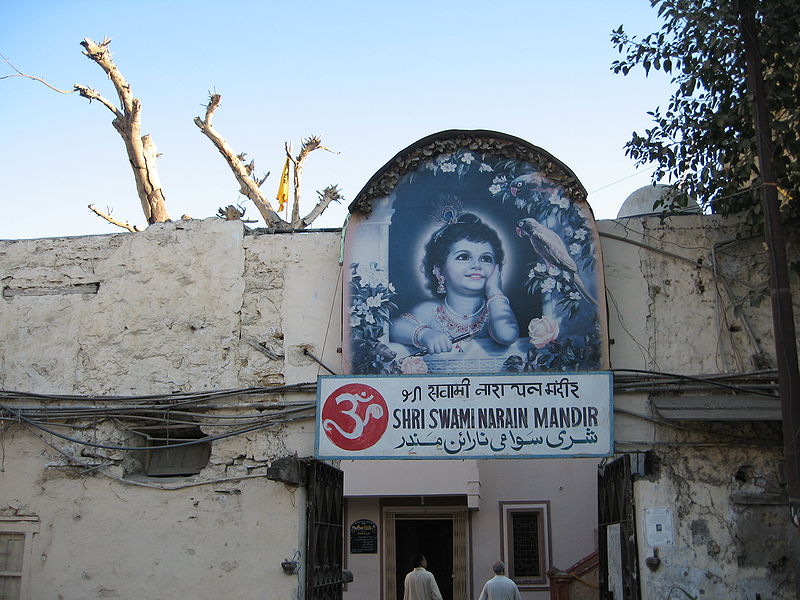
‘I have been distressed about the action taken by the Pakistan authorities in relation to the Swaminarayan Temple at Karachi. When an allotment of a portion of the Swaminarayan Temple building was first made to a Muslim, our High-Commissioner at Karachi in December 1948, requested the Administrator, Karachi, to ensure that, for reasons of the sanctity of the temple and security of Hindus living in the temple precincts, the temple building should be reserved for the exclusive use of Hindus. By January 1949, the Administrator, Karachi, confirmed…that the Muslim allottee would be fixed up elsewhere… Later a committee of Hindus was also appointed to allot accommodation within the precincts of the temple. Lately the Administrator has abolished this committee and has withdrawn the previous assurance that the temple would be reserved for the exclusive use of Hindus. Meanwhile, further tenements in the precincts of the temple have been occupied by Muslims. The temple has not only catered for the religious and social needs of Hindus at Karachi but has also been used for accommodating Hindu refugees in transit to India…The Governments of India and Pakistan have undertaken to maintain the sanctity of the religious shrines within their territories. It is contrary to this agreement to disturb the sanctity of this temple, which is one of the important ones in Sind, particularly as Hindus in Karachi still continue to offer worship in the temple. I would strongly urge your taking suitable action in the matter…
2. 20 February 1950, N. Liaquat Ali Khan to N. Gopalaswami Ayyangar (in reply):
‘I made inquiries…The temple is surrounded by a big courtyard; all around the courtyard there are a number of tenements used as residential flats by Hindus, Muslims and others, but most of the flats do not open in the temple courtyard. A number of Muslims lived in these flats even before Pakistan was established. However, the sanctity of the temple is as well maintained as before. In order to obviate all chances of misapprehension on the part of the Hindu minority, the Administrator was willing to reserve all the flats around the temple exclusively for Hindus. Therefore, a committee of Hindus was appointed by him to recommend allotment of accommodation…It was however found that the committee took no interest in the work and allowed a number of flats to remain unoccupied. At the same time, it came to notice that the intending Hindu evacuees were transferring possession of the flats, with or without the connivance of the committee on pugree money. In view of the acute shortage of accommodation in Karachi and the recurring complaints of corruption, the Administrator had to dissolve the committee and resume the practice of making allotments direct…Preference is always given to Hindus, but when they are not available, residential accommodation cannot be allowed to remain vacant in the present-day conditions. I would reiterate that so far as the temple is concerned, its sacred position is fully maintained and the Hindus of Karachi continue to offer worship in it without let or hindrance. The High Commissioner for India recently held some of his Independence Day celebrations at the temple, which goes to show that he considered the premises exclusive enough…As regards the allocation of this whole area as a transit camp for Hindus, it is regretted that in view of the present acute shortage of accommodation, it is not possible to reserve any area in the city for this purpose. An offer is however being made to the High Commissioner for India, for allotment of sufficient land just outside Karachi for maintaining a regular transit camp…’
3. 16 March 1950, N. Gopalaswami Ayyangar to N. Liaquat Ali Khan (in reply):
‘I write to acknowledge your letter…Before replying, I had necessarily to obtain full information from our High Commissioner at Karachi in respect of the specific points you have raised…This information has since been received…You will find from [it] that the information given to you – such as that a number of Muslims lived in the flats even before Pakistan was established, that the committee of Hindus set up for advising on the allotment of accommodation took no interest in the work, that possession of some of the flats had been transferred with or without the connivance of the committee on pugree money etc. – is not in accordance with actual facts. I trust you will agree that the temple and its precincts together with the flats physically connected with it, should, for obvious reasons, be allowed to be occupied exclusively by Hindus for residential purposes and for serving as a transit camp for Hindus who pass through Karachi on their way to and back from India. You will appreciate, I am sure, the Hindu sentiment in regard to this…temple… [which] has been used as such a transit camp for over two years…I understand that our High Commissioner has been offered land at Malir for locating a transit camp. Malir is 14 miles away and the inconveniences of locating a transit camp at such a place are obvious…It is impossible for us to accept the offer and I do hope that you will be good enough to reconsider the whole matter…’
Source: File No. 12 (4)-PMS/50 (Government of Pakistan, Prime Minister’s Secretariat)
4. 12 January 2014, ‘City Faith – Shri Swaminarayan temple’, The Karachi Walla:
‘A…landmark on M.A. Jinnah Road…the temple is 200 years old according to the priest in-charge…The priest was originally from Thar. The architecture of temple is very similar to those of Jain temples in Karoonjhar range…The temple is built in the honour of Shri Swaminarayan who…lived his life in Gujrat…Naturally a link has been established between this temple and those in Gujrat and every few years, priests from both sides visit each other. The compound accommodates a Sikh Gurdwara as well. There is a sacred cowshed at the back and a gate, which leads to a neighbourhood with those fabulous balconies from yore. It is the biggest temple in Karachi and naturally a centre of celebrations during…festivals. There’s a significant Hindu population living around the temple…’
‘…was built in 1849…over 32,306 square yards…on the M. A. Jinnah Road in Karachi city. The temple celebrated its anniversary of 150 years in April 2004. The temple is located at the centre of a Hindu neighbourhood in Karachi, and it is believed that not only Hindus but also adherents of Islam visit the temple…There is a sacred cowshed within the premises of this temple. [It] became a refugee camp in 1947…People who wished to settle in India from all over Sindh awaited their departure to India by ship at this temple, where they were also visited by Muhammad Ali Jinnah, during this period. In 1989, for the first time since 1947, a group of sadhus from the Shri Swaminarayan Mandir, Ahmedabad (India) visited the temple. Since then, small groups…visit every few years in a pilgrimage’.
Earlier in June, I shared a piece about Pakistani Truck Artist Haider Ali and his homage to George Floyd. It resonated with many people. At the same time, I was also writing a separate piece around the cultural landscape and art scene in Pakistan. Originally, I had planned to include something about Truck Art, which I have always been intrigued and charmed by. I even wrote about it but in the end, I had to exclude it from the final version. But words are never wasted, and here I share some of that in an extended version.
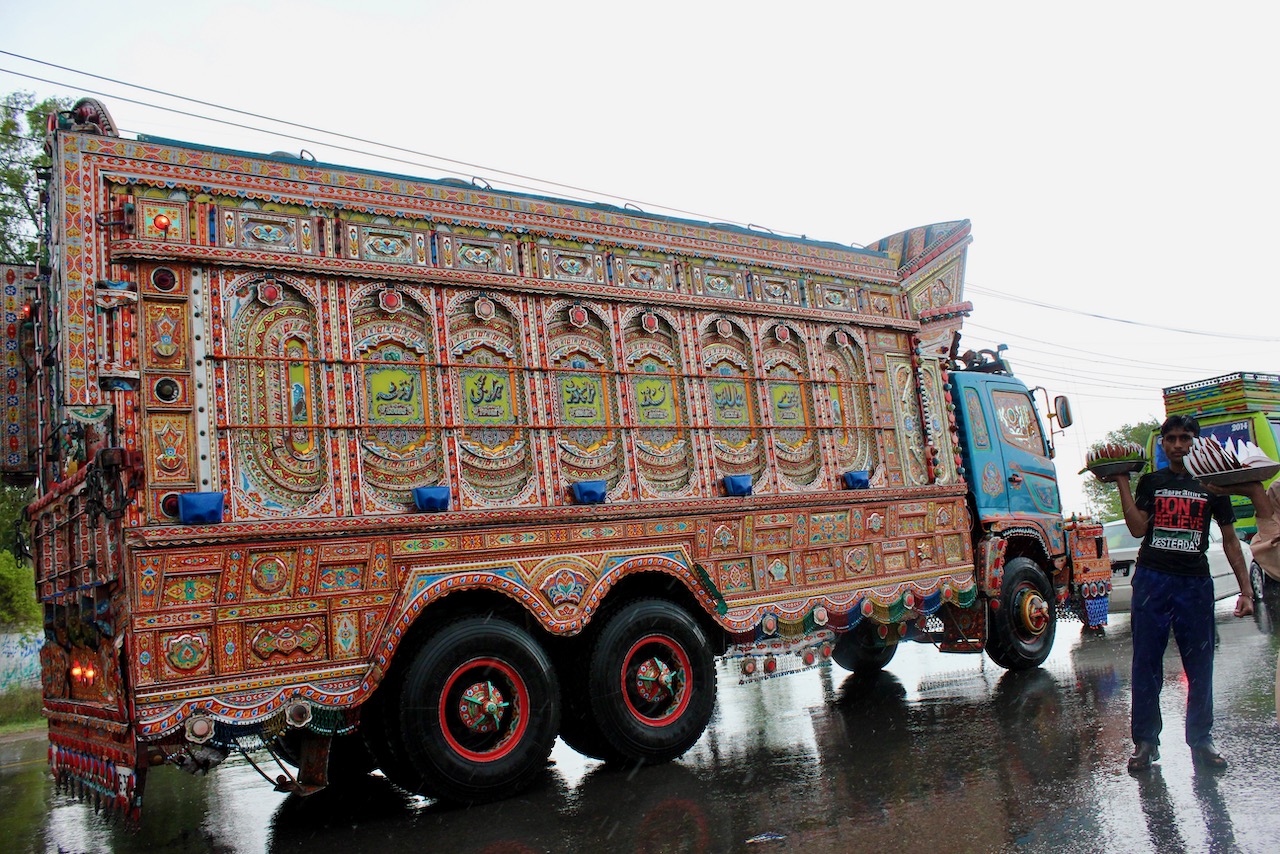
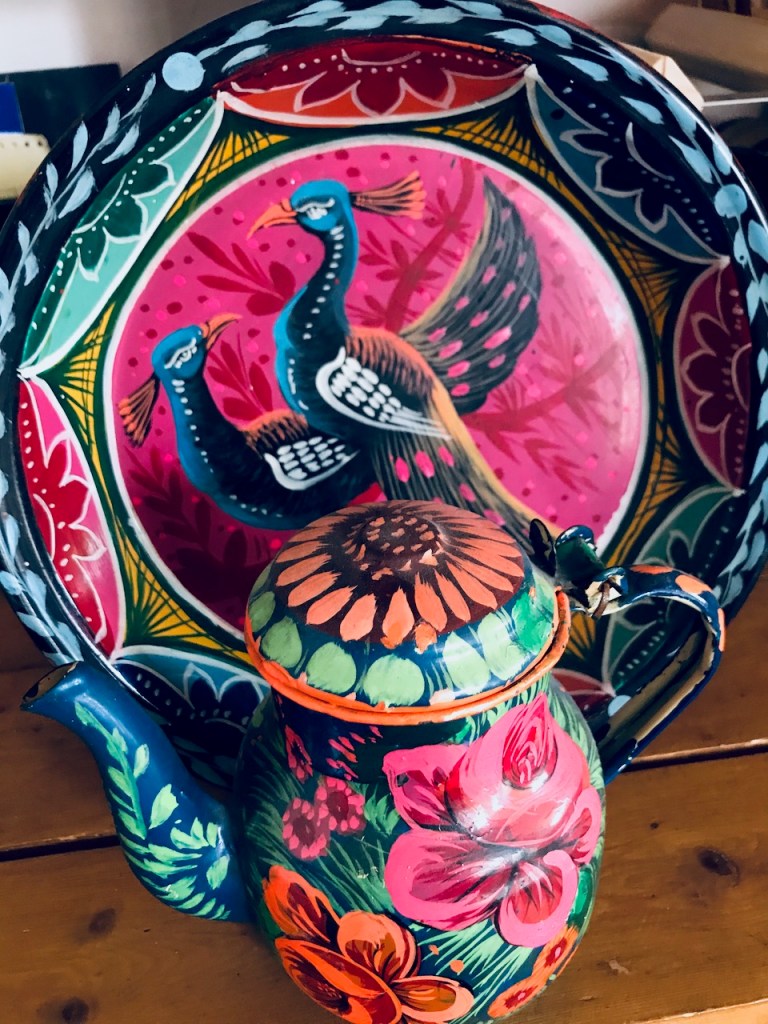
Anyone who has visited Pakistan, seen it on screen or in pictures, would have encountered the vibrant, highly distinctive, and perhaps even outlandish, painted trucks. This form of decorating and customising trucks is popular in South Asia, but the designs and passion displayed are quite exceptional in Pakistan. Over the years these truck designs have transformed and evolved from depicting religious iconography and Sufi saints to a much more dynamic art-form. The lively and loud paintings incorporate animals, fauna and flora in a psychedelic array of colours. The artwork is paired with poetry, calligraphy, popular idioms, and popular iconography to represent an individual expression of the trucker’s identity and background. On the surface, they may appear the same but deeper inspection reveals the regional identity and character of the person and the location. Although it is thought that specialism in truck art was prevalent in NWFP/KP, it has travelled through migration of labour to the port city of Karachi, where it has found fertile ground and flourished.
History
The exact origins of this kind of art-form are unknown, but it does date back to the early 20th century. According to Paracha, a more restrained version of this art-form was present in the subcontinent in the 1940s. That of course would also have something to do with the lack of accessibility to the materials used to paint and decorate these trucks. Paracha suggests that, “It first appeared on trucks and lorries driven by Sikh transporters who would paint a portrait of their spiritual Gurus, or those who helped form the Sikh religion. The portraits were painted with the loudest of colours. Simultaneously, Muslim transporters and drivers began to paint portraits of famous Sufi saints on their trucks and lorries.”
On Pinterest there is a popular quote suggesting that “In the 1920s, the Kohistan Bus Company hired Ustad Elahi Buksh, a master craftsman, to decorate their buses to attract passengers. It was not long after that truck owners followed with their own designs. Within the last few years trucks and buses have been further embellished with full lighting systems.”
Another source elaborates and suggests: “This extraordinary tradition has its routes in the days of the Raj when craftsmen made glorious horse drawn carriages for the gentry. In the 1920s, the Kohistan bus company asked the local Michaelangelo, Ustad Elahi Buksh, a master craftsman to decorate their buses to attract passengers. Buksh employed a community of artists from the Punjabi town of Chiniot, whose ancestors had worked on many great palaces and temples dating back to the Mughal Empire.”
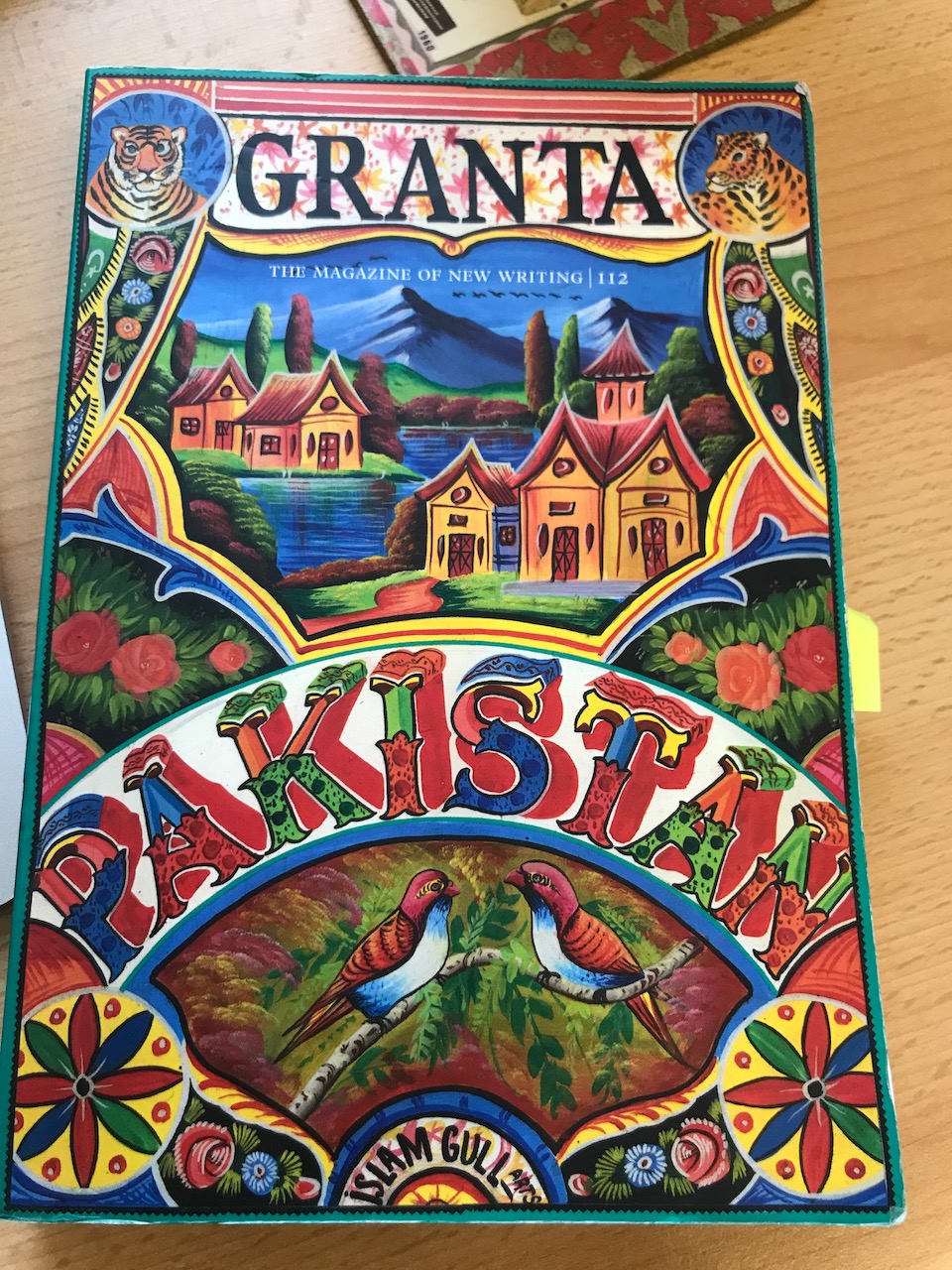
The special edition of Granta in 2010 also suggests that there were links with the “ornate horse-drawn carriages of the Raj to the pioneering craftsmanship featured on the Kohistan Bus Company’s fleet in the 1920s.”
The vast majority of the privately-owned Pakistani trucks are decorated with any combination of paint, wood carvings, mirror work, hammered metal work. They are heavily decorated and most often highly personalised to driver’s vision or interests. No one truck is the same. The truck drivers spend large sums of money on customising their trucks, which are not just “painted” but also involve structural work to modify the interior and exterior. According to Jamal Elias, in 2007 the cost of customising these trucks could go up to Rs. 400,000 (US$7,000 at the time), which included having the “coachwork completed on a Bedford truck, the iconic vehicle of Pakistani truck arts. In contrast, the cost of decorating a triple-axle unibody vehicle such as a Hino or Nissan in the Balochistan style was between US$12,000 and US$16,000.” (Elias, 2012). The vast majority (96%) of freight in Pakistan is carried by trucks for transporting goods and this art-form by extension then generates livelihoods for many households.
Samina Zia Sheikh (2018) writing about the expansion of truck art as popular culture notes how, “Decoration of these trucks gives us clear idea of competition between owners of these vehicles in execution of outrageous and daring images, designs and ornamental patterns. These aesthetically adorned vehicles are pleasure for the eyes of observers. Truck art represents a truck driver’s journey that drives this vehicle for long hours.”
The ‘jingle trucks’ as they are referred to sometimes play an important function for the drivers. Sheikh notes that the, “Hanging chains on the front and back-fenders with different shapes like bell, hearts, pīpal leaf or pān kā pattā attached with ghungrū, give off delightful jingling sound whenever vehicle hits furrows or ditches on road. Nazir Hussain is an expert in this field and, working since sixteen years, tells that this work is not only an element of embellishment but has its significant importance in decoration and otherwise. Jingling sounds of chains on rough roads works well on the psyche of truckers and helps them concentrate on driving more watchfully. He said, the sound of ghugrū and zanjīr keeps the driver active and awake during long routes of driving.”
Master of Truck Art “Haider Ali”
Profile of Haider Ali
Karachi based artist, Haider Ali, has played an important part in taking this art-form to an international audience with his first exhibition in 2002 at the Smithsonian Folklife Festival. The festival was important because, for the first time, it allowed international markets and artists to see and experience this work first-hand, as painter Haider Ali and bodywork expert Jamiluddin shipped a truck from Karachi to Washington DC. For Haider, who has worked for many years, it is important that young artists are trained properly, especially if this craft is to carry on and grow.
Haider Ali’s family originally belonged from Jullundur before the 1947 Partition of Punjab. His family migrated and settled in Karachi, which has become a hub for Truck artists. The whole neighbourhood around Garden Market in Karachi is devoted to truck decorations. Haider recalls that the market started around 1955 and gradually grew as the usage of trucks started growing in the 1960s. He recalls how truck owners would come and request that they paint images often associated with their own homes, villages and interests. These moving visual memories of home would travel with them while they criss-crossed the land and breath of Pakistan.
Haider Ali Truck Artist – Profile
At the same time Elias suggests that, “Pakistani truck is a cultural vehicle in the sense that it carries in it and on it an array of cultural messages and expectations…It is also the most widespread expression of visual material culture in the country, saying more about the visual regime of Pakistan than other forms of art and visual expression that are traditionally treated as legitimate windows into the beliefs, practices, and dispositions of members of Pakistani society at an individual and a collective level.” (Elias, 2012)
This unique form of self-expression has today taken on a completely new life in popular imagination. It has carved out a space in the re-branding of modern Pakistan and usage now extends far and beyond the world of Trucks. Popular amongst tourists, keen to take a little piece of Pakistan, the world of Truck art is also very reminiscent of Canal Barge art.
Jamal J. Elias, ‘The Politics of Pashtun and Punjabi Truck Decoration.’ In Bashir, Shahzad, and Robert D. Crews. Under the Drones: Modern Lives in the Afghanistan-Pakistan Borderlands, Harvard University Press, 2012. Pp. 192-214. Ebook.




 BAGICHA