Earlier this year, I visited Ludhiana, Punjab, a place I try to make time for whenever I have an opportunity or a slight reason. As is often the case, no visit feels complete without visiting Mau Sahib, my father’s ancestral village near Phillaur. Although no immediate family members live there anymore, Mau Sahib holds a special place in our hearts, especially for my sister. She remembers it with warmth and nostalgia, as a place of her childhood.
Our visits have become something of a ritual—paying respects at the historic Gurudwara, partaking in the langar, and then visiting the nearby Sufi shrine. It’s a quiet pilgrimage that connects us with both our heritage and the memory of those who came before us.
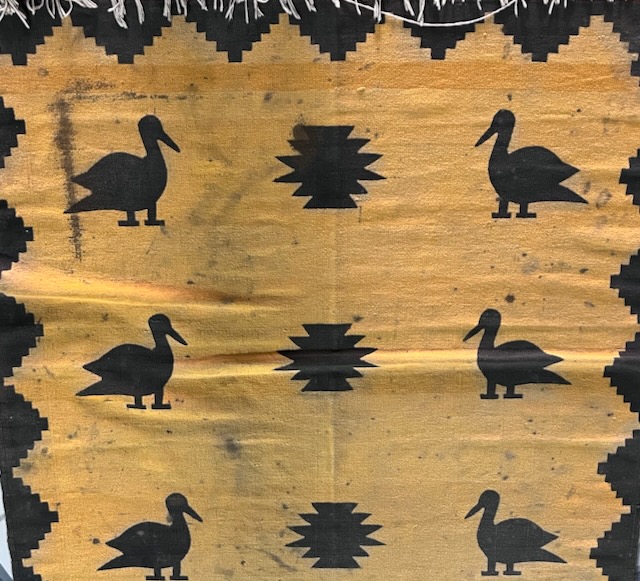
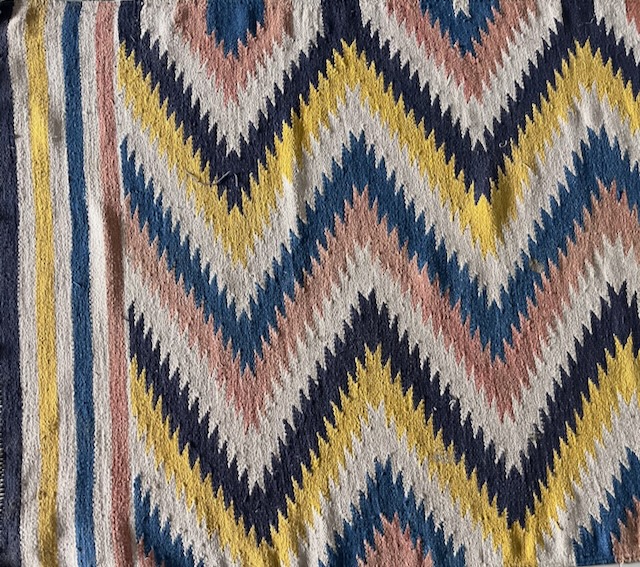
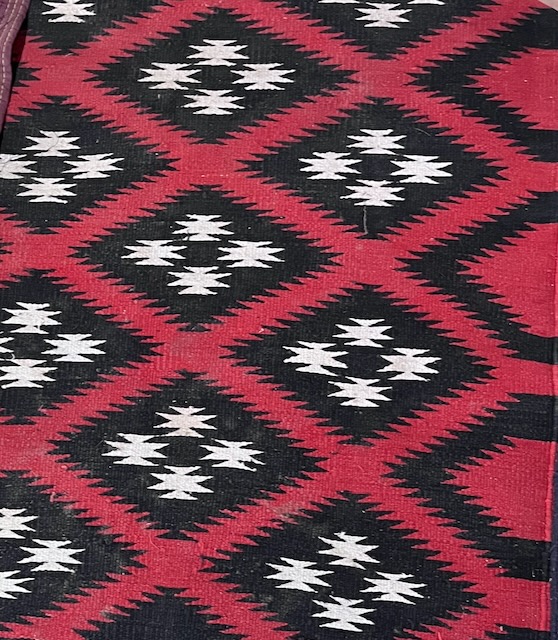
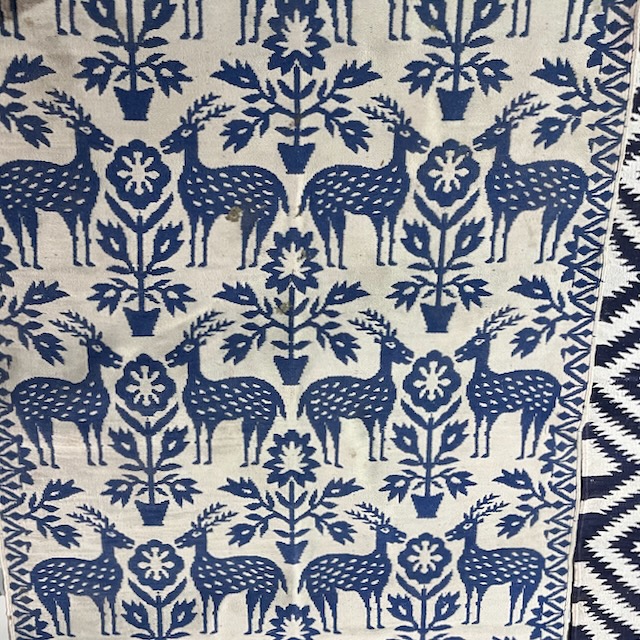
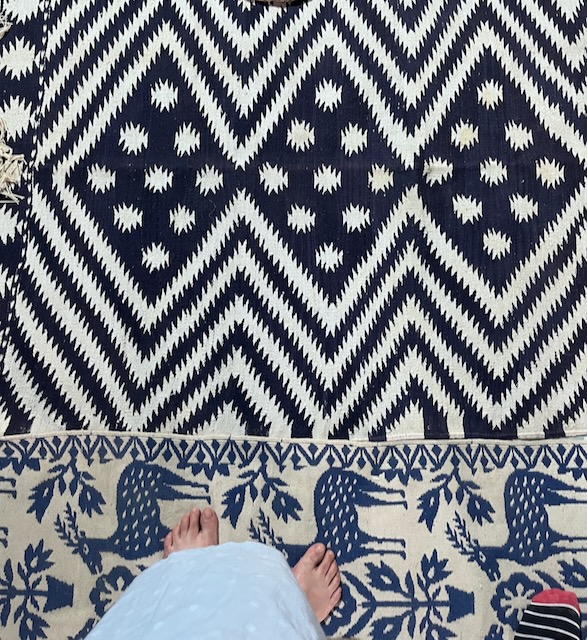
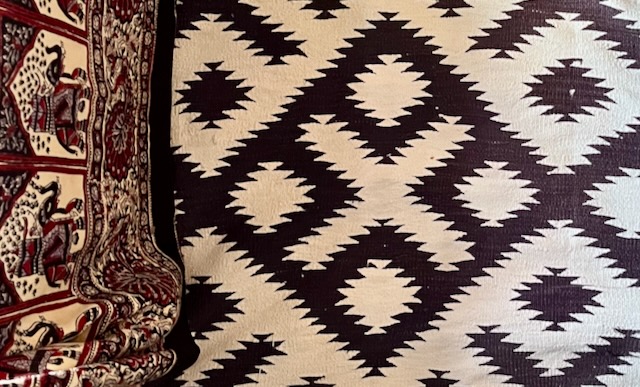
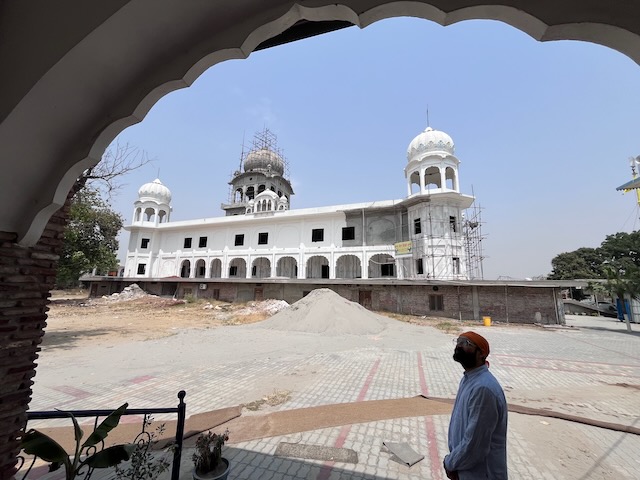
During this visit, the Gurdwara was undergoing renovations. Amid the scaffolding and signs of change, we made our way to the basement area; a large, echoing hall that was mostly empty and only partially completed. The Guru Granth Sahib rested there with solemn grace in the middle of the hall, surrounded by an assortment of vibrant dhurries scattered across the floor. The scene was simple yet striking. I couldn’t help but take photos of the colourful, handwoven patterns.
In that quiet moment, surrounded by these beautiful pieces of craft, I was instantly transported to my study back home. There, in the middle of my room, lies a black-and-white dhurrie—a treasured piece handmade by my mother. The rug, is now a relic and a reminder of her remarkable talent, one of many handcrafted creations she lovingly produced over the years.
At the time, I must admit, I didn’t fully appreciate the time, effort, and skill that went into these works of art. But today, that dhurrie is a cherished heirloom. It reminds me not only of her hands at work but also of the deeper cultural traditions that she carried within her.
For those unfamiliar, a dhurrie is a handwoven rug or flat-weave carpet, traditionally made in India and Pakistan. They were mostly made from cotton or jute and thus accessible for all. Dhurries are often lighter, reversible, more versatile and useful for everyday use; they can be used as floor coverings, bedding, or even wall hangings. In rural Punjabi households, you often find these dhurries spread out for meals, prayers, weddings, and community gatherings, making them silent witnesses to the everyday rituals and rhythms of life.
What makes them so striking are the geometric patterns, vivid stripes, or sometimes floral designs, each inspired by the region and culture from which they originate. The bold designs are usually in bright colours such as red, blue, yellow, as well as using black and white.
Historically, dhurrie weaving was a thriving cottage industry in rural India. But it was also something more intimate and symbolic, especially for women. Young brides-to-be were often taught the art from a young age. Many dhurries formed part of a woman’s dowry, and their patterns weren’t just decorative. They carried stories—symbols of personal, familial, and spiritual identity, passed down through generations, like a family recipe.
In many villages, it was common to see women sitting on charpoys under the shade, rhythmically working on pit looms while chatting about daily life. Though machine-made textiles are now more common, the tradition of handwoven dhurries survives in some artisan clusters, supported by cultural preservation efforts and a renewed appreciation for handmade goods.
As I stood in that hall, looking at the scattered dhurries beneath my feet, I realised how deeply woven this craft is into the fabric of our collective memory. These are not just utilitarian objects; they are vessels of heritage, art, and emotion. Each thread, each motif, tells a story.
In many ways, my mother’s dhurrie now tells mine. And you may well be wondering about the one I have? This was prized away from my sister my years ago. She had a number of them, given to her when she got married, and I convinced her to part with one which then travelled with me to England!
I recently visited Mau Sahib, my father’s ancestral village, located about 10 km from Phillaur in the Jalandhar district of Punjab. The village is home to a historic gurdwara associated with Guru Arjan Dev Ji, who was married to Mata Ganga there. Although we no longer have family residing in Mau Sahib, my sister and I continue to feel a deep spiritual connection to the place. It offers us a profound sense of warmth and belonging—a tether to our roots. Being older, my sister holds many more memories of life in Mau Sahib; by the time I was born, we had already moved to Ludhiana.
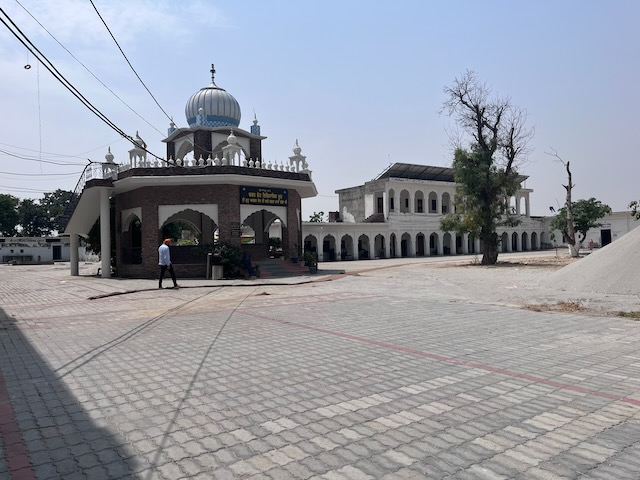
In recent years, the gurdwara has undergone extensive renovations after being taken over by the Shiromani Gurdwara Parbandhak Committee (SGPC), the central organisation established in 1920 to manage Sikh places of worship. For us, the gurdwara had always been a serene space—an anchor of peace and devotion, quietly resonating with those who visited and lived nearby. But with ongoing development, it has transformed into a large and imposing complex, drawing increasing public attention. This seems to reflect the growing trend of spiritual tourism, which, regardless of faith tradition, continues to expand.
Mau Sahib is also well known for its annual mela (fair) commemorating the marriage of Guru Arjan Dev Ji. Yet the mela carries a meaning that transcends the religious—imbued with secular and humanistic values, it is a story I was raised with and continue to cherish deeply.
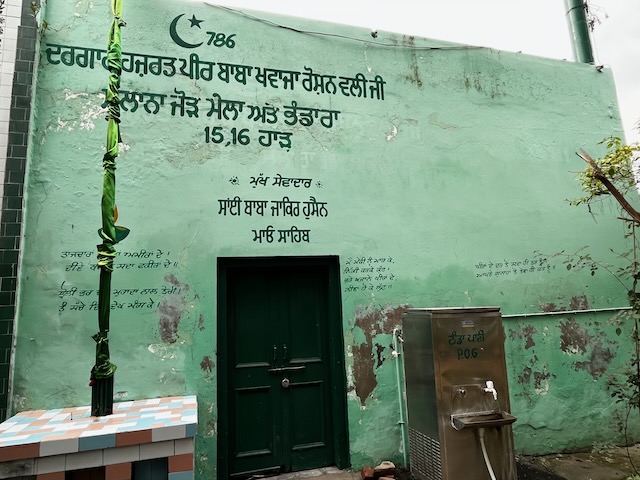
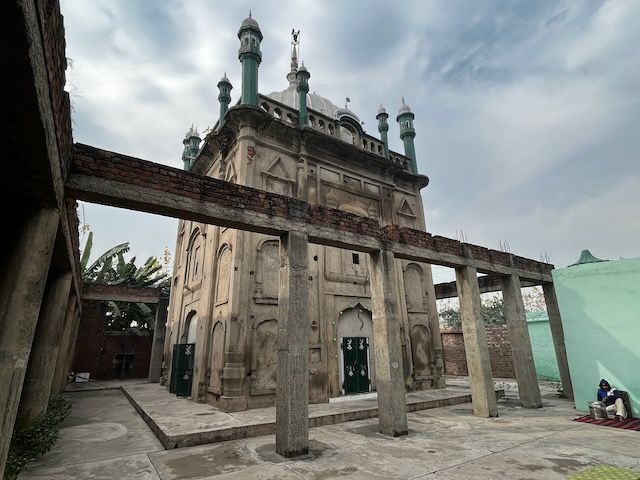
The tale recounts that when Guru Arjan Dev Ji arrived in Mau Sahib to marry Mata Ganga, who was born there, a local leader opposed the union and imposed a condition that had to be met for the marriage to proceed. In fulfilling this demand, the Guru’s horse tragically died. As the newlywed couple prepared to depart, a local Muslim saint, Khwaja Roshan Wali, generously offered his own horse to Guru Arjan Dev Ji. Touched by this act of kindness, the Guru declared that anyone seeking blessings in Mau Sahib should first pay their respects at the dargah (shrine) of Khwaja Roshan Wali before visiting the gurdwara. To this day, the mela reflects this legacy: it begins at the dargah on the 15th and 16th in the month of Harh and continues at the gurdwara on the 21st, 22nd, and 23rd.
This tradition shaped my understanding of faith, coexistence, and the values of mutual respect. Growing up, it was always natural for us to visit both the shrine and the gurdwara when seeking blessings. However, I have noticed that in recent years, the narrative surrounding the shrine has become increasingly marginalised. At a time when populism and division are gaining ground, it is more important than ever to remember the spirit of those earlier times—when pluralism was not just accepted, but celebrated, and when communities of different faiths coexisted in mutual respect and harmony.
See and hear more about this in the following two short videos on the Gurdwara and the Shrine.
Langar at Gurdwara Pehli Patshahi, Lahore, Pakistan.
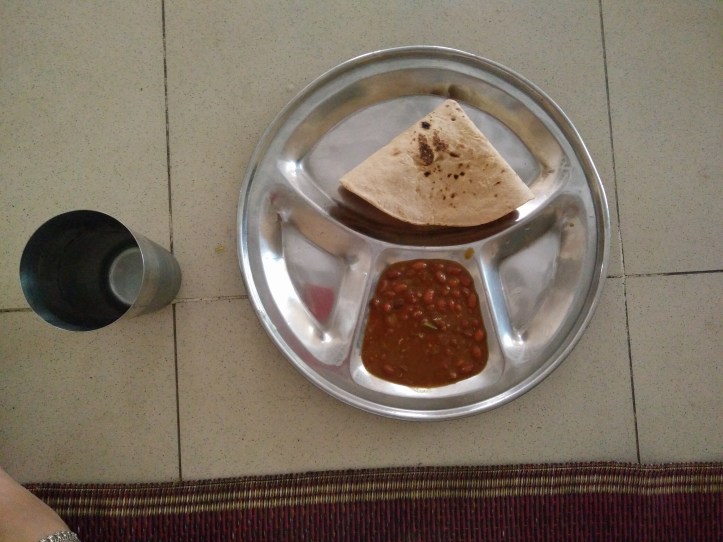
One of the earliest pieces I started with on this blog was with this picture of Guru ka Langar (or food for the congregation) in Lahore. The simplicity of daal (lentils) or in this case rajma (kidney beans) with roti (bread) is the basis of most langar served in a Gurdwara. As a child, I remember most children enjoyed going there in part because of the karah parshad (sweet halwa made from whole wheat flour) given at the end of the service and followed by the (free) food, which had its own distinctive divine taste, impossible to recreate at home.
Langar is the communal partaking of food when visiting Gurdwara. The concept has in recent years been popularised globally by Sikh organisations such as Khalsa Aid, which plan, produce and distribute langar to people across the crisis-ridden world, be it to the truckers stranded in Dover over the ongoing Christmas period or in recent war-torn Syria. With Langar spreading so does knowledge about and experience of the Sikh community. Currently, closer to the home of Sikhism in Punjab, Langar has been making headlines via the ongoing farmers’ movement against new farm laws in India. Communal kitchens have been set-up by the roadside to feed the thousands gathered on the borders of capital, Delhi.
Origins
The word ‘langar’ (meaning ‘anchor’) is thought to have come into the Punjabi language from Persian (Nesbitt: 29); although the idea was not unique to the Sikhs, as ‘both the Sufis and the Nath Yogis have a system of collective eating (langar khanah and bhandaras). The Sikhs, however, used it as venue for both service and charity and provided the food themselves [unlike] the Nath Yogis, who begged for food, and the Sufis, who often accepted land-grants to run their kitchens’ (Mann: 27).
Pictures are of Gurdwara Sacha Sauda, Farooqabad, Pakistan and about 37 miles away from Lahore. This gurdwara is revered with the origins of the langar and is situated not far from Nankana Sahib, the birth place of Guru Nanak.
Baba Farid (1170s-1260s), a Sufi saint from the Chishti order, living in the Punjab, would distribute sweets amongst his visitors; a precursor to langar-khana near shrines, a practice documented in Jawahir al-Faridi (1620s) by a descendent of his. The khanqahs of the Chishti and other Sufi orders kept a langar open for the needy, but also others. It is said that ‘Khwaja Muinuddin established the tradition of an open kitchen for all who came…in an age of feudalism and violence’ (Talib: 6).
There is, of course, a much older practice of the alms house or dharmshala/sarai to feed travellers and poor for free, which is thought to have existed through the Gupta and Maurya (esp. Buddhist) times that is on either side of the BC/AD divide.
Faith
The connections between the Sufis and the Bhakti (devotional) traditions are well documented, inspired as both were by the idea of feeding the poor, the pilgrim and thereby removing divisions/discrimination among people. The idea concretised with the rooting of faith in the region and by early 17th century, it had become a recognised Sikh fixture (Desjardins).
Eleanor Nesbitt notes that, ‘in institutional terms, it was the third Guru, Amar Das [1479-1574], who gave prominence to the langar… [integral as] sharing food [was] to Guru Nanak’s Kartarpur community…it was Guru Amar Das who particularly emphasised the requirement for everyone to dine side by side, regardless of caste and rank’ (Desjardins: 29).
There were two women, who especially, ‘nurtured the development of the langar tradition in its formative period: Mata Khivi (1506-82) and Mata Sundri, the second and tenth Gurus’ wives’. The Guru Granth Sahib notes that ‘Khivi…is a noble woman, who…distributes the bounty of the Guru’s langar; the kheer—the rice pudding and ghee—is like sweet ambrosia’. After the death of Guru Gobind Singh (1666-1708), ‘his widow Mata Sundri worked hard to continue the free community kitchen service. Records show her active role in fundraising for this purpose when the very survival of Sikhism was in question… (Desjardins).
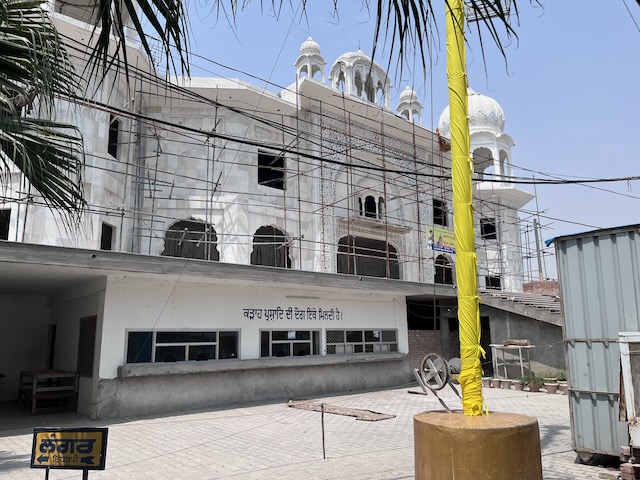
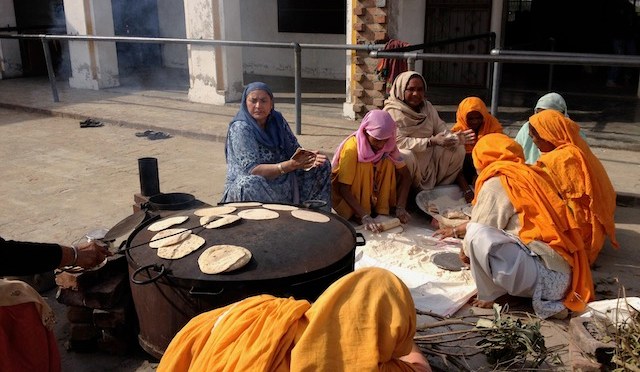
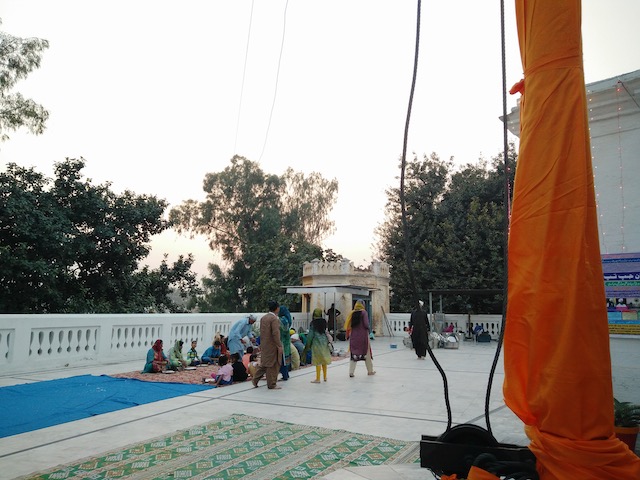
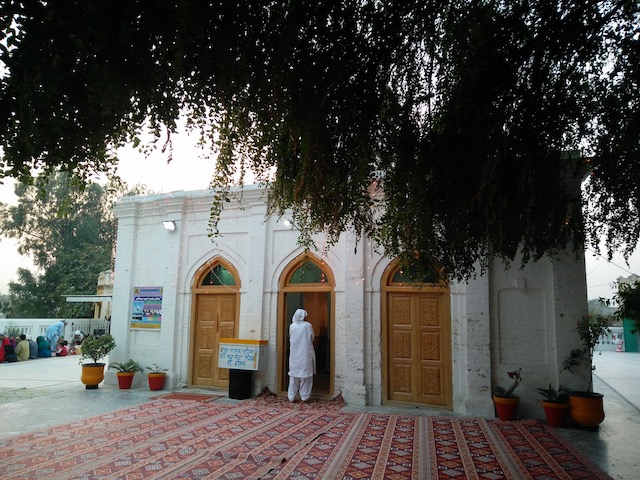
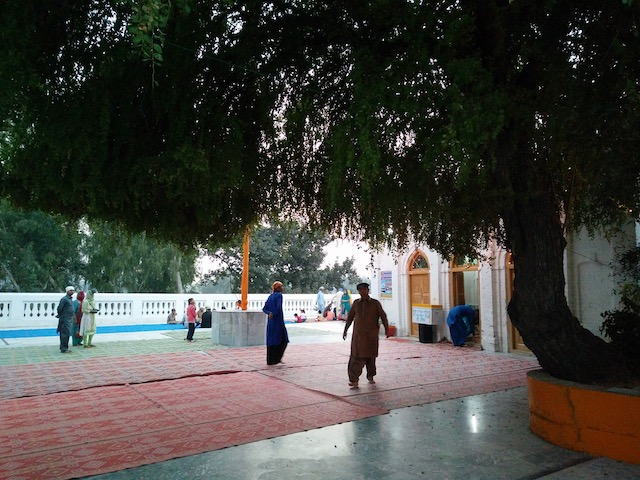
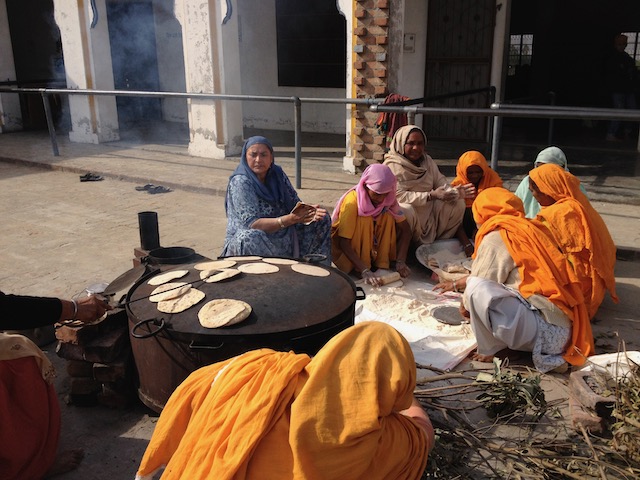
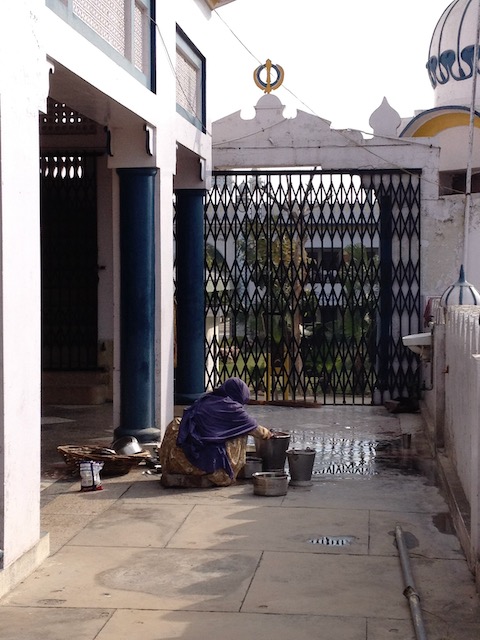
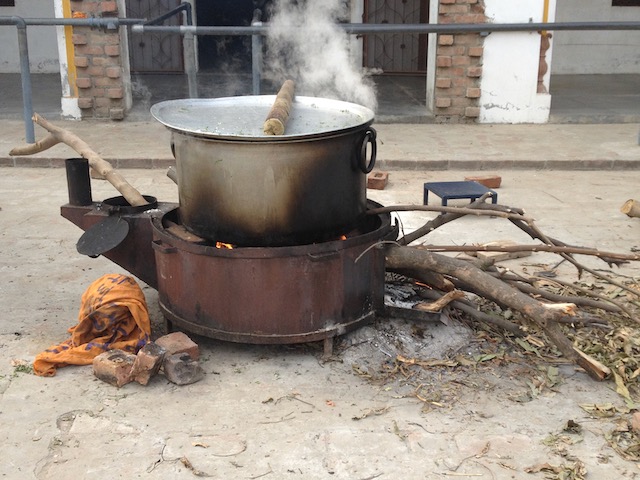
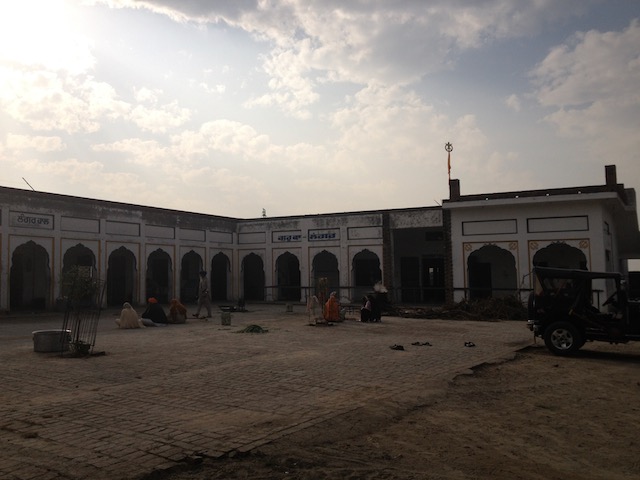
The langar since is thus an integral part of the faith/religion, its compassion through the concept of Seva (self-less service); essential for all practicing Sikhs. Donating food or money is not as important as the practice of giving one’s time and service. Today the most famous community kitchen serving langar has to be the Golden Temple (Amritsar), where around 100,000 people are served on a daily basis. However, most Sikhs grow up visiting and worshipping at small local gurdwaras, where everyday worshippers and volunteers prepare food on a daily basis. These photos are taken from the local gurdwara at Mao Sahib (my father’s village, Jalandhar district), where the congregation prepare, serve, consume the langar and then clean afterwards. As the gurdwaras become more institutionalised, and as the historic gurdwara Mao Sahib (associated with the fifth Guru Arjan and his consort Mata Ganga, d. 1621) has come under the administration of the SGPC (the Sikh body responsible for the management of gurdwaras), voluntary seva has been added to by paid sevadars.
The pictures are of Mao Sahib, 2012, when the langar hall was undergoing a renovation and some of the langar preparation was taking place outside.
Equality
The idea of sitting and sharing food together is fundamental among Sikhs because it demonstrates the abolition of caste and dramatically asserts humble equality amongst all the people; regardless of their religious or caste background. The food is generally simple and vegetarian, to appeal to all and offend no one. Four core Sikh principles are enshrined in the langar: equality, hospitality, service, and charity.
Eleanor Nesbitt writes about how, ‘the Gurus were reformers who abolished the caste system or that caste is Hindu, not Sikh’. It is important to remember how revolutionary this was/is in a caste-ridden society. Nesbitt notes how, ‘the langar subverted Brahminical rules about commensality, according to which only caste fellows could eat together’ (118). Instead, it was proclaimed that, ‘a Sikh should be a Brahmin in piety, a Kshatriya in defence of truth and the oppressed, a Vaishya in business acumen and hard work, and a Shudra in serving humanity. A Sikh should be all castes in one person, who should be above caste’ (117). The Gurus, like the Bhagats Namdev, Kabir, and Ravidas, proclaimed the irrelevance of people’s inherited status to their spiritual destiny. In Guru Nanak’s view:
Worthless is caste (Jati) and worthless an exalted name,
For all humanity there is but a single refuge (Adi Granth 83)
Quoted in Nesbitt: 118
Similarly, according to Guru Amar Das:
When you die you do not carry your Jati with you:
It is your deeds which determine your fate. (Adi Granth 363)
Quoted in Nesbitt: 118
References
Bowker, John (ed.), The Concise Oxford Dictionary of World Religions (OUP, 1997)
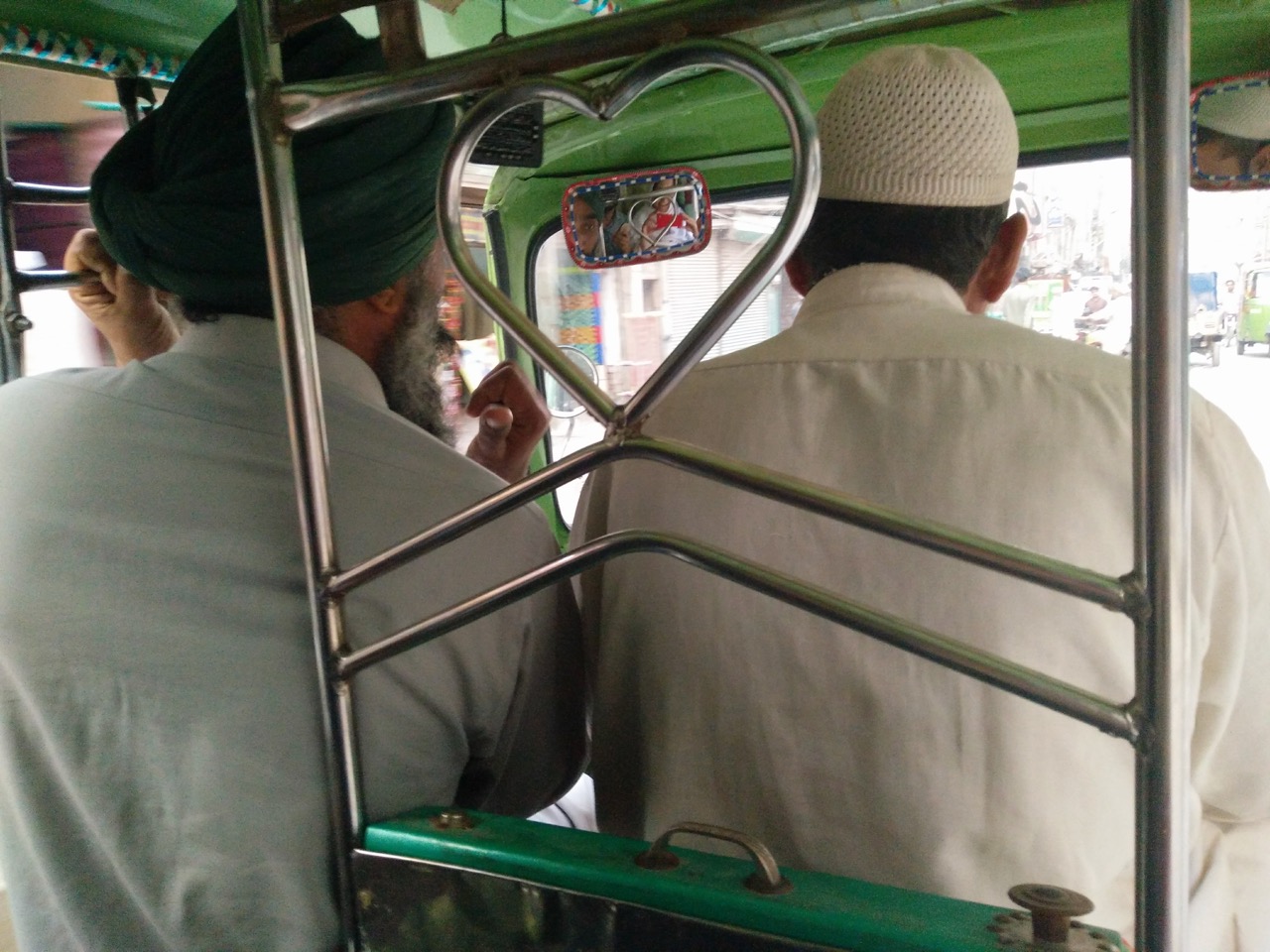
This picture was taken by me during one of the most memorable tuk tuk rides in Peshawar in 2017, when I was exploring the city and trying to find a gurdwara in the narrows lanes of the congested city. Along came this sardar ji who jumped on the tuk tuk and navigated us to Gurdwara Bhai Joga Singh. As the sounds and sights gather momentum around the opening of the Kartarpur corridor, I share this moment that speaks silently for the hopes of many.
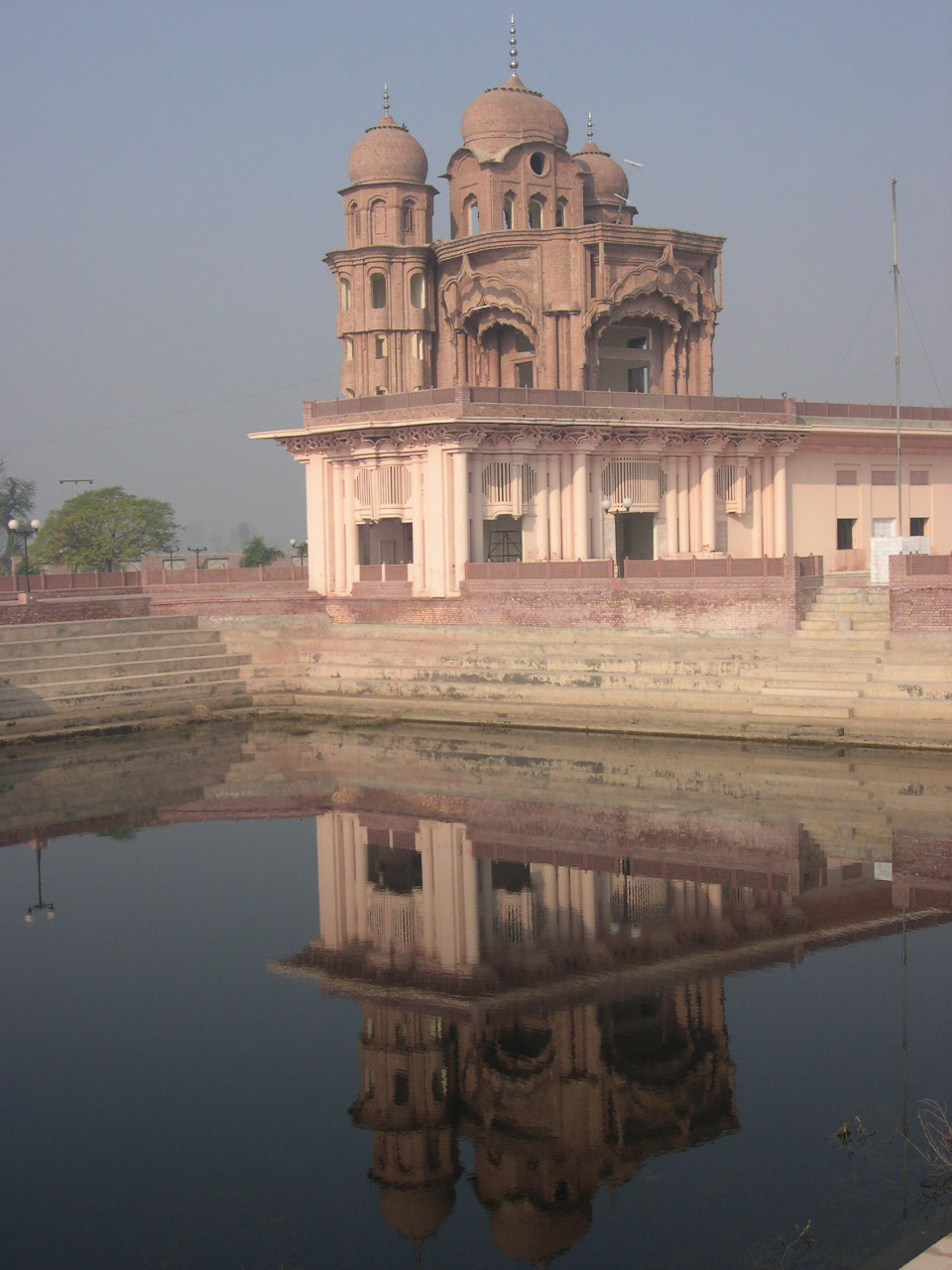
Gurdwara Sri Rori Sahib, Eminabad, Gujranwala (c) 2004 Pippa Virdee
A reflective essay on the lack of women in history writing and Punjab history. This was originally published in The Friday Times, 5 July 2019.
My first visit to Pakistan was in 2002. It was primarily to do research as a PhD student. At that time, I came with the religious baggage of belonging to a Sikh family and venturing into the known unknown. When I finally got my visa, I was very excited about travelling to the ‘near other’; unknown yet somehow familiar. After all, I rationalised, the cultural region of Punjab is, well, Punjab across both sides of the Radcliffe Line. And so, the journey into Pakistan’s history begun, a space in which the personal and the academic intermingled and boundaries became a metaphor for more than just the relationship between India and Pakistan.
The Sikhs in Pakistan are a small community; one of the smallest minorities in Pakistan. Exact numbers are difficult to estimate but they vary from around 6,000 to perhaps 20,000. They are largely concentrated around places like Peshawar, Nankana Sahib and Lahore. The interesting thing is that apart from the ethnic Punjabi Sikhs, many of the Sikhs that remained in Pakistan after 1947 were Pathan Sikhs. The latter were scattered in small numbers across Balochistan, Federally Administered Tribal Areas and Khyber Pakhtunkhwa. Most have been forced to relocate since, often seeking sanctuary in numbers. Though small, the Sikh community over the past few years has come to enjoy some state patronage. In an otherwise ‘Islamic’ milieu, Sikh men are easily identifiable by their turbans. Added to this are the old persistent colonial stereotypes of the Sikhs being a ‘martial’ race (even in Pakistan). And of course, the ‘Khalistani’ Sikhs have the sympathetic ears of the Pakistan establishment since the early 1980s. Thus, in Pakistan today, the medieval shadow of the Sikh-Muslim rivalry of Mughal India, as well as the pall of 1947 have receded to create a strange co-existence and a convenient acceptance of current realpolitik rather than a bitter dwelling in the past. However, this convenient relationship does not necessarily translate easily or well in the Sikh diaspora, especially here in the United Kingdom, where I am based.
While my main purpose for visiting Pakistan in 2002 was for my doctoral research, there was inevitably an interest to visit Sikh Gurdwaras and shrines; those remnants of pre-1947 which still existed. I have subsequently visited Pakistan more times than I can remember and have seen the changes in many of these shrines and their localities. Over the last 15 years, there has been a transformation of many of these shrines; from being small and poorly maintained to now being considered as one of the growing areas for pilgrim tourism in Pakistan. Every year, especially at the time of Vaisakhi and Guru Nanak’s birth anniversary, pilgrims come in their thousands from the UK, USA, Canada, which are home to significant Sikh diaspora communities. Depending on political temperatures, Indian Sikhs also make this pilgrim trip. For instance, this year, the Government of Pakistan issued 2,200 visas to Sikhs pilgrims in India for Vaisakhi. There is much trepidation amongst these of falling under the radar of intelligence agencies on both sides. Beyond the politics of two paranoid and securitised states though, growth in this tourism has benefitted local communities, as infrastructure around the ‘important’ shrines has improved to facilitate foreign tourists. These bring in the much-needed foreign exchange. They travel, stay, eat, drink, shop and thus spend their foreign currencies in Pakistan and, ultimately, some of this does make its way into the local economy. But this development is localised and centred around a handful of shrines, with the majority still largely neglected.
Social media and its ability to connect across borders, has spurred on a handful of people to seek adventure in Pakistan and document the ‘lost’ history of the Sikhs. Conversely, there has been more interest in these forgotten histories within Pakistan too. Combined with increased pilgrim tourism, there is almost a fascination and a sense of lost kinship that many Sikh Punjabis have with Pakistan and Pakistani Punjabis. These complex historicised feelings are under-girded by a common language, culture, biradari connections, and bhaichara. There is an old romantic connection that many have with reaching Lahore (formally Maharaja Ranjit Singh’s capital) captured in the phrase, Jis Lahore Nai Dekhya O Jamyai Nai/ Jine Lahore Nai Vekhya O Jamya Nai, meaning ‘One who has not seen Lahore has not been born’! This has been recited countless times and it helps to maintain the old pluralistic image of colonial Lahore. In this quest then, for the lost history of Sikhs in Pakistan, there has been a profusion of activity which has generated research in universities, fictional/non-fiction literature and pictorial books on Sikhs. These latter easily detract and divert from the difficult issues of politics, while sticking to the sites of nostalgia and neglect. Even the research at Pakistani universities (not exclusively though) is largely focused on the Ranjit Singh period (1801-39). When the bearded young man boasts of Ranjit Singh, of the contribution of the Punjabi (but usually Sikh) soldiers, of the great martial tradition, they rarely give women a thought.
These histories perpetuate and create a myth of the splendour associated with this lost history of the Sikhs. Even hard leftists have a soft spot for an otherwise unelected, unrepresentative, hereditary maharaja. While this greater interest and curiosity amongst scholars and students is welcome, it also serves to reinforce old stereotypes by avoiding the more difficult question of the broader issue of non-Islamic histories of Pakistan. Moreover, the study of history and its periodisation retains much of the colonial interpretations, hardly allowing us to interrogate these boundaries intellectually and dispassionately.
In the quest for academic “impact” and to connect with the general public, many academics in the west have been compelled to promote themselves. Social media again has been the route for this seemingly altruistic self-promotion. Articles, blogs and personal posts on social media, of travelling around Pakistan and bonding with the locals, for people’s immediate consumption and gratification. Moreover, the Punjabis express this in their usual flamboyant style of visiting their ‘lost’ Punjab, bonding with the local Punjabis and then sharing these ‘amazing’ bonding experiences. On closer inspection though, these all have something else in common. They are all invariably shared by men and are about their fraternal experiences. Statistically, we know that on average women are 26 percent less likely to own a mobile than men and 70 percent less likely to use mobile internet. Naturally, this means less women are visible and even when they are, they use it differently. Women largely use social networking to make connections and keep in touch with family or friends, in contrast men use social media to gather information they need to build influence. In South Asia, this discrepancy stems from the fact that men usually have better educational opportunities, have mobile phones, have greater levels of digital literacy, and this advantage over women fuels their privileged status.
Much of this social conditioning starts from the home, through to schools and universities. The social system perpetuates and emboldens men, making them entitled from a young age. As young women, we often have to fight our way to pursue our aspirations and dreams. Wanting to study politics and history at university for me was not easy because this was not considered an appropriate subject for a girl, even though it eventually reaped rewards. Universities themselves are supposed to be some of the most intellectually progressive spaces but actually they are not. They are just a reflection of society itself. They have the same prejudices and reflect the same class, caste, gender biases that society has. This is reflected in the largely male student body in South Asia, and although the number of girls is increasing and often, they perform better, many still see this as way of improving their choice of marriage partners. This is not a criticism of their desire to improve their lives, but rather a reflection of the limited value of education. The staff fraternity also tends to be male-dominated, especially the senior staff. Although this is no better than in the UK where the Royal Historical Society recently published a study on Race, Ethnicity and Equality (2018) and found that there was an over-whelming dominance of white male professors compared to females and the numbers are even smaller for those from Black and Ethnic minorities.
These centres of learning, therefore, do not reflect the voices of everyone because even here, the skewed societal power structures remain intact. Men control the institutions and therefore they control the narrative. They are the gatekeepers of knowledge and learning and without challenging these structures the narrative cannot be changed.
My experiences of being a (Sikh) woman living and working in Pakistan (largely Lahore and the Punjab) has been quite ordinary in many ways and extraordinary in other ways. I have never been given a free taxi ride; unlike the numerous accounts one reads of visiting Sikhs (i.e. Sikh men) who have struck a long-lost kinship with the taxi driver, who then from the kindness of his heart refuses to charge the client. In fact, I have struggled to speak with taxi drivers and men in public spaces in Punjabi because they consider this to be impolite. Unlike men, I am usually compelled to speak in the Urdu, which imposes a certain level of distance and formality to the conversation. While I cannot have my ‘bromances’ with most of those around me, I can, however, quietly enter the zenana spaces. And these, like the history pages that neglect them, are often hidden away.
I have learnt over the years that women, whether in South Asia or in the West, do not boast of their achievements. They work like ants, running around, keeping busy and building structures out of crumbs. The obstacles they encounter en route can be difficult and they are not always successful. More often than not they will encounter men who are in positions of authority and wield substantial power over the lives (and bodies) both in the home and the outside world. And the outside world is designed by men and for the needs of men. They would rarely acknowledge the privileged position they have in the home and the outside world and the freedom this gives them.
While I have spent many years working in Pakistan, on Punjab’s history, I have rarely felt the need to write about my “non-academic” experiences. The motivation has largely come from the fact that despite all these years, there is still not enough progress and even today there are few female historians coming forward. Even today we are judged on how we look, what we wear rather than what we think and write. Intellectually there is a stale and over-bearing concern for constantly writing about conflict, nationalism, religion, battles, and hero-worshipping; a reflection perhaps of an insecure male society that seeks glory from former victories to validate its present. The only way we can get diversity in the way we view and write about our history is to have that diversity in the people who write it. As a society we need to challenge these hyper-masculinised and hyper-nationalised histories that distort our past and shape our future. If we want to be part of the narrative, we have to take responsibility for writing it. As women we need to make ourselves visible in both the past and the present.
Three kilometres from the Indian border, in the tranquil green plains of the Narowal district of Punjab in Pakistan is an unassuming sacred shrine: Gurdwara Kartarpur Sahib. It’s the final resting place of Guru Nanak (1469-1539), founder of the Sikh faith.
On the other side of the river Ravi, about a kilometre inside the border in the Gurdaspur district of Punjab in India, is the bustling holy town of Dera Baba Nanak. Here stands Gurdwara Shri Darbar Sahib, associated with the life and family of the same first Sikh guru.
On a clear day, both are visible to each other. But the Radcliffe Line, drawn in August 1947 between Pakistan and India, ensures that travel for the average Indian or Pakistani is impossible across this international border. India’s Sikh community is roughly around 20m people – under 2% of India’s population of over a billion. More than half of them live in the Punjab, India and are cut off from the most significant shrines associated with the founder of their faith, all located in Punjab, Pakistan.
Gurdwara Panja Sahib, Hasan Abdul, Pakistan, 2004. The gurdwara is revered because it has the presence of a rock believed to have the hand print of Guru Nanak.
Gurdwara Rori Sahib is two km from Eminabad and about 55 km north of Lahore. It is located not too far from Gujranwala and the Grand Trunk Road. The Gurdwara marks an important site, where Guru Nanak after the destruction of the town had stayed with Bhai Lalo. The plaque at the gurdwara reads, ‘This is the holy place where Guru Nanak Dev ji came in his first pilgrimage. Guru Nanak dev I came here at Bhai Laalo ji’s home (Eminabad). It was a beautiful and silent place away from city, this’s why Guru Nanak ji sat down here and was prayed the almighty god regularly.’
The gurdwara was originally constructed on a large estate of nine marabbas. This has gradually been reduced down now. The land was originally endowed to the gurdwara during Maharaja Ranjit’s period and the gurdwara’s architecture is also from this period. The location and size of the gurdwara attracted large crowds of Sikhs, particularly during the Vaisakhi festival in April. There used to be a week-long fair during this period and attracted people from all the surrounding areas. The estate left today is a reminder of the old grandeur that would have existed when there was a sizeable Sikh population prior to 1947.
The entrance to Rori Sahib is grand, imposing and awe-inspiring, with the beautiful exposed red brick. The dome work and the columns are all in cut brick work. Accompanying the gurdwara is a large sarovar, which when I revisited the gurdwara ten years later, the water had evaporated.
Below are some of the pictures from when I first visited the gurdwara in 2006 and then most recently in October 2016.












 BAGICHA