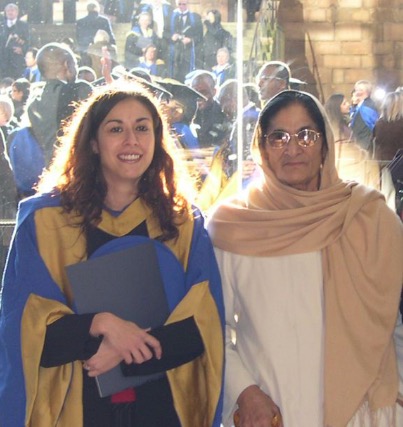
It is coming to 11 years since my mother died at the age of 83. She had great courage and conviction, illustrated in her decision to come to far-off England – and not go to the familiar India – from Kenya, a few years after my father’s untimely death in 1979. In doing so, with two young children, she was adding considerably to the challenges that she had faced hitherto. Alone, in an alien land, with two growing daughters, she drew upon her inner reserves of strength to provide for us. Moreover, what I do today is down to her encouragement and support throughout my life.
This was not always an easy position for her to take because of wider socio-economic pressures, but she saw education as the master-key to unlock many of these. As her youngest child, I was fortunate to be the first to go to university, for my sisters – we were all girls – were capable of more. She would have preferred that I study something “sensible” like law, medicine, finance, or engineering – like my father – but I showed no interest in these. Instead, I was motivated by art and politics as in 1988-90, an increasingly unequal Britain saw a churn and I was intrigued as Margaret Thatcher was losing her grip.
Studying politics and increasingly history was an unusual and therefore difficult step for me, but despite the misgivings, my mother – open to persuasion – supported me. She didn’t always understand my aims, for that matter nor did I, but instinctively it felt the right thing to pursue. I became increasingly aware of my social identity in university – beyond the name-calling in school – because I was one of only two “brown” girls in a cohort of approx. 70. But the rest of the group too came from different backgrounds, especially that of economic class. This introduction to class was a life-lesson in terms of one’s ability to aspire and imagine.
Thirty years on from when I entered university, this social reality has not changed. Rather it has only metamorphosed, and I now see class difference at play in the post-1992 university that I teach, among the students whom I encounter. Sure, the absolute number of black/brown students coming to study history and politics has increased albeit marginally. Anyhow, this post is not on this social phenomenon but the persona that my mother was, who encouraged me to follow my heart. In those days, it was enough, for the state supported education; there were no student fees, and I was eligible for a maintenance grant.
Otherwise, a mother’s goodwill alone would not have paid for my loan-laced BA/MA, which would have been too big a risk to take. I would not have then followed it up by applying for the Penderel Moon studentship for my PhD, at the turn of the century. My mother was incredibly proud when I got my doctorate, even as I was not untouched by an imposter syndrome. But time and its temper waxes and wanes, on gender, on humanities subjects, and on doubts of the two getting together. Today, the UK higher education is a near-total market, like much of the rest of its society and politics.
In which though, there is also some sliver of charity and that is why I write this post. It was at the Myton Hospice in 2012 that my mother spent her last few hours, with my sister and me, and tomorrow I am doing a 6-mile walk to help raise money for them. Simultaneously, I remember my mother, and reflect on her life and how she shaped me. I take great strength from her ability to start from nothing, having faith, and resilience to carry on with whatever life throws at us.
I share the link for Just Giving for Myton Hospice.
“Of all the social sciences, it is history which rouses the greatest interest in the minds of the politicians. There are various reasons for this. It has always had an inventive and purposive use. The line between history and mythology is thought to be thin; the past can be used to lend legitimacy to any aspect of the present….”
Extract published from ‘RSS and School Education’ from the book RSS, School Texts and the Murder of Mahatma Gandhi, written by Aditya Mukherjee, Mridula Mukherjee and Sucheta Mahajan, 2008. Published by Indian History Collective.
R. Mahalakshmi, ‘Communalising history textbooks’ Frontline, 2 August 2021
Sylvie Guichard. The Construction of History and Nationalism in India. Textbooks, Controversies and Politics. London / New York: Routledge, 2010.
Kusha Anand & Marie Lall (2022) The debate between secularism and Hindu nationalism – how India’s textbooks have become the government’s medium for political communication, India Review, 21:1, 77-107, DOI: 10.1080/14736489.2021.2018203
Neeladri Bhattacharya, ‘Teaching History in Schools: The Politics of Textbooks in India.’ History Workshop Journal, no. 67 (2009): 99–110. http://www.jstor.org/stable/40646212.
Romila Thapar, “The History Debate and School Textbooks in India: A Personal Memoir.” History Workshop Journal, no. 67 (2009): 87–98. http://www.jstor.org/stable/40646211.
Sanjay Joshi, Contesting histories and nationalist geographies: A comparison of school textbooks in India and Pakistan. South Asian History and Culture. 1. (2010) 357-377. 10.1080/19472498.2010.485379.
Yuji Kuronuma, ‘Hindu nationalism creeping into Indian textbooks’ Asia Nikkei, 25 June 2016.
Alex Traub, ‘India’s Dangerous New Curriculum’ The New York Review, 6 December 2018
S. S. Dikshit, Nationalism and Indian Education, Sterling Publishers, 1966.
Raksha Kumar, ‘Hindu right rewriting Indian textbooks’ Al Jazeera, 4 Nov 2014.
Eviane Leidig ‘Rewriting history: The ongoing controversy over textbooks in India’ LSE Blogs 1 June 2016.
Murali Krishnan, ‘Is the BJP altering textbooks to promote Hindu nationalism?’ DW 25 May 2022.
Seema Chishti, ‘Rewriting India’s History Through School Textbooks’ New Lines Magazine, 9 March 2023.
Kamala Visweswaran; Michael Witzel; Nandini Manjrekar; Dipta Bhog; Uma Chakravarti, “The Hindutva View of History: Rewriting Textbooks in India and the United States,” Georgetown Journal of International Affairs 10, no. 1 (Winter/Spring 2009): 101-112.
Naseem, Mohamed Ayaz, Ratna Ghosh, James McGill, and William C. Mcdonald. “Construction of the ‘other’in history textbooks in India and Pakistan.” In Interculturalism, society and education, pp. 37-44. Brill, 2010. DOI: https://doi.org/10.1163/9789460912498_004
Sridhar, M., and Sunita Mishra, eds. Language Policy and Education in India: Documents, contexts and debates. Routledge, 2016.
Krishan Kumar, Political agenda of education: A study of colonialist and nationalist ideas. SAGE Publications India, 2005.
Sanjay Seth. “Rewriting histories of nationalism: The politics of “moderate nationalism” in India, 1870–1905.” The American Historical Review 104, no. 1 (1999): 95-116. https://doi.org/10.2307/2650182
Carey A Watt. “Education for National Efficiency: Constructive Nationalism in North India, 1909–1916.” Modern Asian Studies 31, no. 2 (1997): 339-374. DOI: https://doi.org/10.1017/S0026749X00014335
Lars Tore Flåten, Hindu nationalism, history and identity in India: Narrating a Hindu past under the BJP. Taylor & Francis, 2016.
Marie Lall, “Educate to hate: The use of education in the creation of antagonistic national identities in India and Pakistan.” Compare: A Journal of Comparative and International Education 38.1 (2008): 103-119. https://doi.org/10.1080/03057920701467834
Janaki Nair, “Textbook Controversies and the Demand for a Past: Public Lives of Indian History.” History Workshop Journal. Vol. 82. No. 1, 2016. https://doi.org/10.1093/hwj/dbw023
Romila Thapar, “Politics and the rewriting of history in India.” Critical Quarterly 47.1‐2 (2005): 195-203.
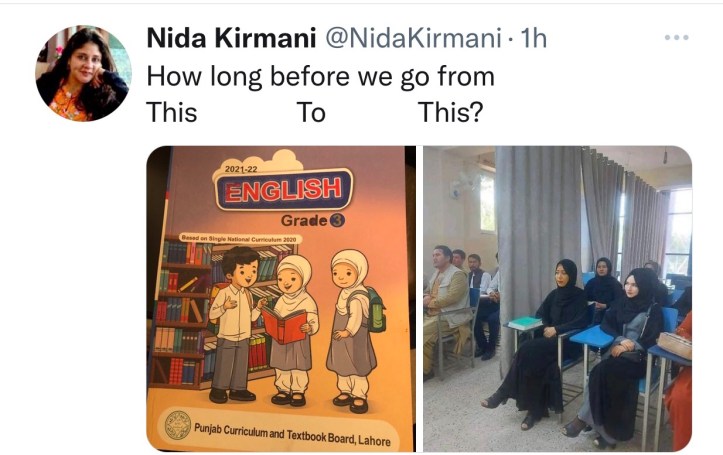
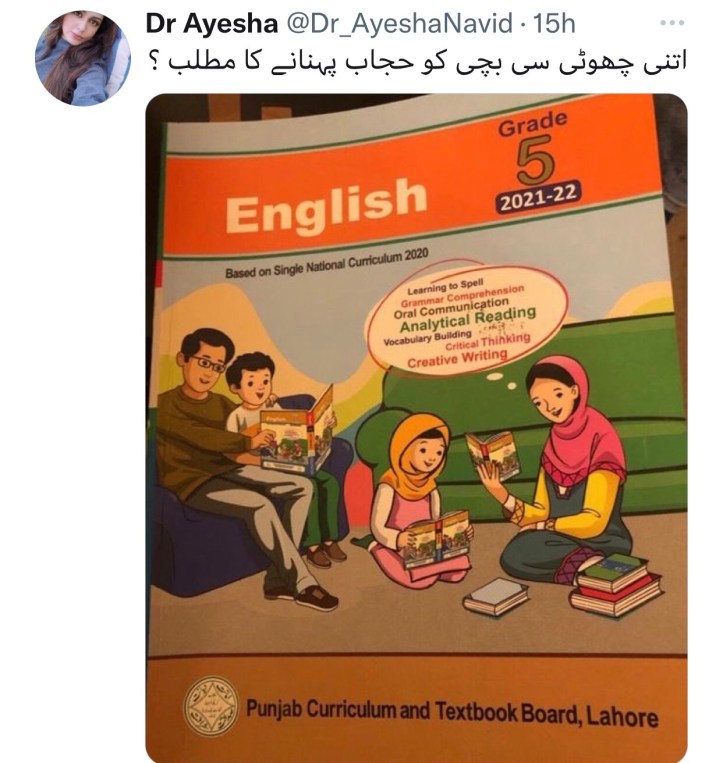
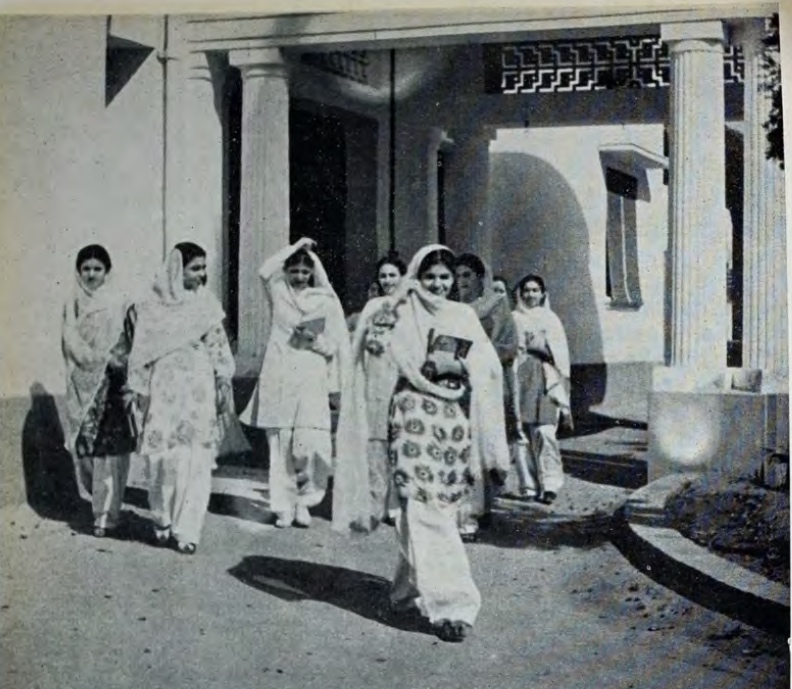
Yesterday morning started with a few tweets that I saw regarding the new Single National Curriculum being introduced in Pakistan. It has generated plenty of discussion and criticism, and rightfully so. The pictures and discussion in these tweets immediately took me back to the day before, when I was in fact going through the pages of Pakistan Quarterly, from the 1950s. I’ve been looking at the formative years of Pakistan and the role played by women, which is far too often side-lined or a footnote in support of the main body.
Below are extracts from two articles, which illustrate some of the discussions that were taking place on the importance of education in the making of a “new Pakistan” and the role of religion (especially girl’s education). Julian Duguid was a journalist, writer and wrote his article while posted in Pakistan. The second article though is by the Vice-Chancellor of Peshawar University, Raziuddin Siddiqi. Dr Siddiqi was born in 1908 and educated in the newly established Osmania University, Hyderabad. Indeed, he was from the first batch that graduated from there and later went on to serve as the Vice-Chancellor of Osmania. In 1950, however, Dr Siddiqi migrated to Karachi and joined Karachi University, at the request of the Government of Pakistan. There was a serious skills shortage in Pakistan following the Partition, and the development of educational institutions and an educated workforce was key to future prosperity.
Lifting of the Veil by Julian Duguid
Pakistan Quarterly, Vol. 2, No. 3, 1952
After hearing the story of the chaos, so bravely met and overcome, I watched with a special interest the young girl students whom it freed. A few still went in burqas, but most of them walked and bicycled as if they’d never heard of purdah. At lunch time, they passed Zam-Zammah, the gun on which Kim used to sit; and in the evenings they did athletics or played tennis. There was nothing whatever to distinguish them from any other healthy young students. Yet, even four years ago, many of them could hardly have dreamt of such freedom.
Of course, liberation on this scale has not gone quite uncriticised. Now and then, a fanatical old mullah, his beard abristle with zeal, will creep behind a girl and cut her hair off to teach her not to be shameless. When this happens, he is taken to the police-station and lectured on the new Pakistan and kept in jail for a few days to cool his ardour. He leaves unconvinced, and muttering; but his generation will pass, and then the veil will be lifted more and more widely among the middle-class city-dwellers as it is among the labouring village people whether in town or country.
It may take many years, but it will come.
Education in Pakistan by Raziuddin Siddiqi, Vice-Chancellor, Peshawar University.
Pakistan Quarterly, Vol. 3, No. 4, 1953.
Immediate steps were, therefore, taken in all Provinces to rehabilitate the old schools and Colleges and establish new ones. Classes were held in several shifts to cope with the enormous increase of students. Adequate measures were adopted for training school teachers in large numbers. Education was given high priority along with defence and law and order in the Central and Provincial budgets. A number of new Universities were established in order to provide suitable teachers for the schools and colleges. Educational materials, such as books, journals and scientific equipment, was imported in a large quantity from Europe and America. Young men and women were sent in considerable numbers for training abroad. A six years Plan was formulated to give effect to considered policy of all-round educational development.
It would not be out of place to give here a short account of our policy in this scheme of educational development. The fundamental aim before the authorities in this matter has been ensure to that each and every individual gets the best and highest education and training commensurate with his capabilities. Islam lays down the acquisition of knowledge as an integral part of the duties of every individual Muslim of either sex. It is a unique and distinguishing feature of this religion, which enjoins its followers to think and know for themselves. It has been explicitly stated in the Holy Quran that “God exalteth and elevates to higher ranks only those who are believers, and who have been accorded knowledge”.
Islam does not allow the sharp division of an individual’s existence into a religious and secular life, as believed necessary by the people following other religions. There is no priest-class among the Muslims. Non-observance of this essential principle of Islam, has been one of the main factors in the deterioration of our condition in the past. On the one hand the general body of Muslims were educated in secular schools, and knew very little of the fundamental principles of their religion. For even a little bit of information about their faith, they were entirely at the mercy of the ‘Mullas’. On the other hand, the ‘Mullas’ studied in religious institutions which were completely divorced from all modern knowledge. This was affecting adversely the national life at both ends. The educated young Muslims were generally absorbing atheistic or agnostic tendencies more and more, and instead of proving a source of strength to the community, were undermining its very existence. The ‘Mullas’ were becoming more and more ignorant, fanatic and narrow minded, thus bringing the religion itself into disrepute and contempt.
It was necessary, therefore, to evolve a new system of education, or rather to revive the older system of the early days of Islam in which all knowledge was one, and there was no artificial distinction between religious and non-religious knowledge.
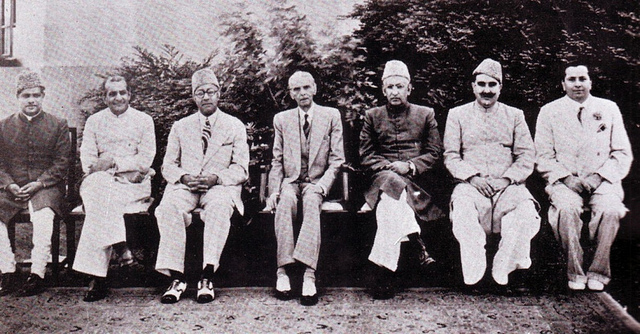
Fazlur Rehman, Ghulam Muhammad, Liaquat Ali Khan, M A Jinnah, Ibrahim Ismail Chundrigar, Abdul Rab Nishtar and Abdul Sattar Pirzada. Picture credit, Dr. Ghulam Nabi Kazi
Fazlur Rahman, then-Minister for Commerce & Education, was born in then-Dacca and was a lawyer-politician of the Bengal Provincial Muslim League, who had served as Revenue Minister of the pre-partitioned province. On 14 September 1949, he sent a 14-page letter (F. No. 14-313/49-Est) to Prime Minister Liaquat Ali Khan, in which he set out his trenchant comments and an accompanying template for the ‘two-fold task’ confronting them namely (1) ‘to lay the foundations of an educational system based on “Islam”’ and (2) to imbue children ‘with an international outlook’.
Recalling the first Pakistan Educational Conference of November 1947 and its resultant educational ideology and institutions – ‘the Advisory Board of Education, the Council of Technical Education and the Inter-University Board’ – he felt that the time had come to overcome ‘the existing system of education, with its alien background, Hindu and Christian ideas, foreign to our ideology’, for as long as it continued, it could not be expected ‘to produce men and women who would realise the value of the Islamic way of life and would make loyal and zealous citizens of Pakistan’.
For the successful achievement of this task, two things were essential: (i) text-books and (ii) teachers. As far as text-books were concerned, the need for Rahman was ‘to draw up the syllabus for every subject on the basis of Islamic ideology (as distinct from instruction in Islamic theology) and get text-books written by competent authors’. He wanted ‘Urdu readers – fundamentally the same all over Pakistan’, necessitating ‘a change in the existing system of publication – whose sole motive is profit-making’. Thus, ‘the Central Government should have them written under supervision’.
There was also the matter of ‘compiling a national history as a kind of reference book’ comprising researched topics like (a) ‘Islamic history and civilisation, (b) the rise and fall of Muslim states all over the world and (c) the contribution made by Muslims to the Indo-Pakistan sub-continent’. For the adoption of Islamic ideology, it was ‘essential to establish a Research Institute in Islamiyat’. As regards teachers and their training, ‘a number of Central Training Institutions’ were needed. These two were ‘fundamental problems which exclusively concerned the Central Government’.
While education was constitutionally the responsibility of the provinces – like in India – their ‘limited resources’ and its ‘all-Pakistan character’ made it ‘incumbent on the Central Government’ to take the lead – ‘from adult to university education’. For ‘democracy and illiteracy go ill together. The illiteracy percentage for India [before 1947] was nearly 90, but with the establishment of Pakistan and the exodus of non-Muslims (educationally more advanced) and the influx of Muslim refugees (to a large extent illiterate)’, there was an increased mass illiteracy in Pakistan.
Adult education, however, was not ‘mere imparting of literacy’ but included ‘spiritual, civic and vocational motives’ for the creation of a patriotic and productive citizenry. This involved infrastructure, implements, literature, teachers and audio-visual aids, for the provision of which, ‘the Central Government must assume certain powers’. Equally important was ‘the provision of free, universal, compulsory primary education’, involving a vast expenditure. ‘Free, compulsory secondary education’ was ‘unfeasible and must be left to future’.
Anyhow, the Central Government had the ‘clear responsibility’ to produce ‘patriotic citizens not warped by narrow provincialism or alien cultural elements as the Hindu influence in East Bengal’. National solidarity therefore required ‘the speedy revision of curricula and syllabi and re-writing of textbooks’. Another problem was the ‘place of Urdu in national life’. As Jinnah had made it ‘abundantly clear’ that Urdu was to be ‘the national language’ and as, by adopting Hindi in Devanagari script, India had ‘dealt a blow’ to Urdu – ‘the cultural heritage of Indian Muslims’.
For Rahman, language was a ‘potent means’ to maintain ‘cultural ascendancy and a separate political consciousness’. Urdu with its Persian and Arabic words was ‘alien in spirit to Hindu culture’, essentialising its ‘elimination from Indian national life’. Conversely, in Pakistan it was ‘a matter of vital necessity to have Urdu in Arabic declared forthwith as state language, a compulsory subject in schools’ overcoming the ‘narrow provincialism’ and ‘parochial mentality’ of East Bengal and Sind and resistance of West Punjab and NWFP ‘to assimilate the vocabulary and culture of these two’.
It was a no-brainer for ‘all employees of the Central Government be required to know Urdu’ and a Bureau of Translation be set up for all technical-scientific terms. In this connection, it is important to remember that in 1949, the Hindu community in East Bengal constituted one third of its population, among whom were ‘the caste Hindus – wedded to the Bengali language – the hard-core of resistance’. Rahman was concerned about their potential for ‘an anti-national mentality’ without ‘a pro-Islamic outlook’; ‘dependable citizens of Pakistan with due regard to their religious rights’.
His suggestion was to ‘reconstruct the Bengali language’ with ‘the Arabic script’ thereby ‘putting an end to the disruptive activity being carried in the name of the common culture of the two Bengals’. Moreover, the ‘present Bengali language with its Sanskrit script’ was ‘steeped in Hindu influence, full of Sanskrit words, Hindu mythology and [thus] anti-Islamic’. The Arabic script would ‘eliminate Hindu influence, facilitate adult education, link up East and West Pakistan [and] ensure East Bengal’s willing acceptance of Urdu as a national language’.
In technical education, Pakistan then had only 3 ‘engineering colleges’, like its 3 universities, for a population of 80 million, ‘impaired by the exodus of non-Muslim teachers’. A ‘Grants Committee’ for both was needed. Here, the ‘main obstacle’ was ‘the attitude of the Ministry of Finance’, to which education was a ‘provincial responsibility’. Rahman had forged the establishment of a History Board, Adult Education Centres in East Bengal, a Central Syllabus Committee with its Bengali sub-committee, a Committee of adopting Arabic script and a Committee on Technical Education.
His future proposals were less piece-meal and included the Central Government assuming ‘direct responsibility for the general planning and coordination of education’, a central-provincial sharing of adult education expenditure, central financial assistance for free, compulsory primary education in provinces, Urdu as state language, Arabic script for regional languages and centres for translation, Islamiyat, teachers’ training and a University Grants Committee.
First Cabinet of Pakistan – Ministers of Liaquat Ali Khan & Muhammad Ali Jinnah in 1947
Richard Southwell Bourke (1822-72), 6th Earl of Mayo, 4th Viceroy of India (1869-72)
Born and educated in Dublin; MP (Conservative Party) for Kildare (1847-52), Coleraine (1852-57) and Cockermouth (1857-68); Chief Secretary for Ireland (1852, 1858, 1866); Assassinated in Andaman Islands by Sher Ali Afridi (1872); Memorial Statue in Cockermouth (1875)
It was of course his legacy that is most associated with the city of Lahore, where the Mayo School of Industrial Art was set up in 1875, following his assassination in 1872. The Mayo School later became the National Collage of Arts (NCA) in 1958 and this still remains the premier institution for the Arts in Pakistan.
Lockwood Kipling was appointed the first Principal of Mayo School, alongside his other role of Curator of the Lahore Museum, which was the Ajaib Ghar in Rudyard Kipling’s Kim.
The building that once housed a famous college. [Text and photos by Mayank Austen Soofi] Red bricks, sprawling gardens and a cute little chapel. That’s St Stephen’s College in Delhi University’s North Campus. But this dream destination for millions of aspiring college students earlier used to be housed in this stone edifice here in Kashmere…
Punjabi is an Indo-European (or Aryan) language and is the native language of Punjab, a land divided between India and Pakistan. It has approximately 100 million speakers, largely in north India and Pakistan but it is also widely spoken amongst the Punjabi diaspora around the world.
The Partition in 1947 not only divided the province of Punjab but it also divided the language, and this has been the source of much tension in post-47 in both India and Pakistan. Being a phonetic language, Punjabi was/is written largely in three different scripts: the Persian script (sometimes referred as Shahmukhi) is used mostly in Pakistan; Sikhs use the Gurmukhi script and less common is the Devanagari script which is associated with Hindu Punjabis. Punjabi interestingly was never given official state patronage; this is true for the Mughal period, Ranjit Singh’s reign and also under the British. The preferred state or official language was Persian and Urdu. Farina Mir argues that part of the problem under the British colonial period was the plurality of the scripts used to write Punjabi; all three scripts (Indo-Persian, Gurmukhi, and Devanagari) were used but none of them dominated (Farina Mir, The Social Space of Language: Vernacular Culture in British Colonial Punjab, London: University of California Press, 2010).
It is not until after 1947 that Punjabi begins to get official state patronage, at least in India that is. It is officially recognised as one of the 22 official state languages in India. In West Punjab (Pakistan), Punjabi is confined largely to an informal language with no official status despite being spoken by the majority of people. And even though the number of Punjabi speakers in Pakistan has been declining over the decades, Punjabi is still the most widely spoken language. East Punjab after the Partition in 1947 was a fragmented province of its former self. It consisted of territory that was an amalgamation of divided Punjab, Patiala and East Punjab States Union (the former princely states), and the Hill States to the north of the province. By the 1950s, a Punjabi Suba (province) movement had started which hoped to create a Punjabi-language state, taking inspiration from the linguistic reorganisation taking place in other parts of India. This is eventually achieved in 1966, with the Punjab Reorganisation Act that created a new state of Haryana and also transferred territory (such as the Hill States) to Himachal Pradesh.
Leading up to this though was of course an enormous amount of discussion and political agitation, so, it is interesting to see some of the initial correspondence between Bhim Sen Sachar, Chief Minister of East Punjab and Jawaharlal Nehru, the Prime Minister of India and Nehru to Vallabhbhai Patel, the Deputy Prime Minister on the question of introducing Punjabi as the medium of instruction in schools.
BS Sachar to Nehru, 9 July 1949 (JN SG 26-I):
‘In my letter [of] 13 May, I referred to the two outstanding demands of the Sikhs, namely (I) representation in services, and (II) Punjabi in Gurmukhi script as the medium of instruction and court language…No compromise on them was considered possible…since then, I have had informal discussions on the language controversy with the Governor, my colleagues, various leaders of public opinion and the general view of government is as below. Before the Partition, Ambala division, excepting Ropar and Kharar tehsils of the Ambala district, spoke Hindustani, while Punjabi was spoken in the rest of the Punjab, barring Kangra district. After it, nearly a million displaced persons from the West Punjab moved into the Ambala division and, therefore, it cannot now be said that all the people [there] speak Hindustani. Nevertheless, the distinction which held good before exists even now, to a lesser a degree. With the gradual elimination of English and Urdu from the province, the question [of] their [replacement] has assumed great importance…the present controversy is not over the language [Punjabi] spoken but the script [Devanagari or Gurmukhi] in which it should be written…The unanimous demand of the Sikhs is that Punjabi in Gurmukhi should be adopted all over the province as medium of instruction, as the official and court language. This would not be acceptable to Hindus in general and especially to the Hindustani-speaking region of the Ambala division and Kangra district of the Jullundur division. It will be unfair to force it on them…The best solution would be to recognise the province as consisting of two distinct linguistic regions, Punjabi and non-Punjabi. Government would agree to the following: (i) Punjabi in Gurmukhi should be the medium of instruction in the Punjabi-speaking region of the province, up to and including the 5th class; (ii) In the Punjabi-speaking region, Hindi should be compulsorily taught as a second language from the 4th class; (iii) Reversal of the same arrangement in the non-Punjabi region; (iv) English and Urdu should for the present continue as the official and court languages. There are differences of opinion on two points: (i) whether girls’ schools should be allowed the option; (ii) whether the existing boundaries of the Jullundur and Ambala divisions should be regarded as correctly [representative]. The Sikhs would not agree to distinguish girls’ schools from boys’ schools…whereas Hindus should be in favour of it…The Sikhs would include the whole of Jullundur division and the whole of Ambala district in the Punjabi-speaking region whereas Hindus would like to exclude Kangra district and three tehsils, Ambala, Naraingarh and Jagadhari, of the Ambala district from it…No agreement on [these] appears to be possible…would be grateful [for your] decision on them’.
Nehru to Patel, 22 July 1949 (JN SG 26-II):
‘Giani Kartar Singh came to see me this morning…on the language issue in East Punjab…I told him that there is no point in our considering the [matter] unless we knew that the parties concerned would abide by our decision…He said that an agreement had been arrived at between the Hindu and Sikh Ministers and the Governor agreed…(1) Punjabi in Gurmukhi, (2) two linguistic areas, (3) Punjabi compulsory from 1st-5th standard in Punjabi area, Hindi vice-versa, (4) from 4th standard upwards, the other language should be compulsory…There was no agreement on the delimitation of linguistic areas. More especially, the Pahari Ilaqa – Sikhs considered as Punjabi areas…another point was Hindus wanted option to be exercised in regard to languages, the Sikhs did not…I made it quite clear that our general policy was against compulsion in regard to choice of the mother-tongue…I further pointed that Bengali, Marathi, Gujarati were well-developed languages…He confessed that Punjabi was not suited for higher education [but] should be used up to the Matriculation… [But] that there was a great deal of feeling behind the Sikh demand…I think some facts have to be obtained about the linguistic divisions of the province but the issue is quite clear…If the Punjabis want two linguistic divisions, they might have them but I just do not see how we can do away with the option of a parent to decide which shall be the mother-tongue…’
These two letters provide a glimpse into the discussions taking place in 1949. However, the two letters from 1951 provide a different lens, especially the DAV College correspondence which is clear that the medium of instruction should be Hindi, despite the considerations of the State Language Policy.
Jullundur City, 3 May 1951, DAV College Managing Committee (Bal Raj, President) To the managers of all the schools in the Punjab under the control of the DAV College Managing Committee (JN SG 92 II):
Please refer to the Punjab Education Department on the State Language Policy in the schools: it is [an] ill-conceived policy…I am to convey to you in very unmistakable language the views of the DAV College Managing Committee vis-a-vis this policy. Our schools should go ahead in their work undeterred by considerations of State Language Policy. To us, teaching of Hindi in our schools is a matter of supreme importance and on this point, there is to be no compromise. We would much rather let our schools face the consequences than submit to any direction from the Education Department, that weakens the position of Hindi in them. In case there is any trouble on this score from Education Department, the schools affected can rely on our fullest support, and we shall see to it that they do not suffer.
In our schools, Hindi will be the medium of instruction for all classes and Punjab will start as optional vernacular from V in place of IV as laid down by the Education Department because we consider its teaching in IV class too early. It should be clearly understood that Punjabi from V class will be optional i.e. only for those students, who would like to learn it. Provision should, however, be made for teaching in Punjabi medium for students coming from outside, and effort should be made to switch them on to Hindi medium as early as possible.
It is just possible that the Local Bodies’ Schools or Khalsa Schools might not make provisions for teaching in Hindi medium on grounds of non-availability of suitable Hindi teaching personnel or lack of demand for Hindi medium on part of students or that Hindi students might be persuaded to receive instruction in Punjabi rather than in Hindi. Proper vigilance will have to be exercised over these schools, and in case they do not implement the state policy, they should be brought to our notice to be reported to the Education Department.
A strong public opinion will have to be created in your area in favour of Hindi, so that students wishing to be taught in Hindi medium declare fearlessly their desire to be taught in this medium, undeterred by the local influence or pressure from teachers, not well disposed towards this medium.
Amritsar, 21 July 1951, The Shiromani Gurdwara Parbanbhak Committee (Kartar Singh, Publicity Secretary) To Prime Minister Jawaharlal Nehru JN SG 92 (II)
Enclose herewith a copy of the [above] letter…A perusal of this document will reveal to you which way the wind blows in those quarters. On the one hand, the Hindu schools are exhorted to go ahead in their work of shutting their doors to Panjabi “undeterred by considerations of State Language Policy” and not to “submit to any direction from the Education Department”. On the other hand, the Local Bodies’ Schools and the Khalsa Schools are to be compelled to make all arrangements for the teaching of Hindi in accordance with the State Language Policy. The attitude…is not only one of flagrant defiance of the government’s orders, but is also calculated to accentuate communal bitterness and vitiate the general atmosphere in the province. Due notice be taken of such anti-national and subversive attitude and activity as is being exhibited by these people.







 BAGICHA