The building that once housed a famous college. [Text and photos by Mayank Austen Soofi] Red bricks, sprawling gardens and a cute little chapel. That’s St Stephen’s College in Delhi University’s North Campus. But this dream destination for millions of aspiring college students earlier used to be housed in this stone edifice here in Kashmere…
Punjabi is an Indo-European (or Aryan) language and is the native language of Punjab, a land divided between India and Pakistan. It has approximately 100 million speakers, largely in north India and Pakistan but it is also widely spoken amongst the Punjabi diaspora around the world.
The Partition in 1947 not only divided the province of Punjab but it also divided the language, and this has been the source of much tension in post-47 in both India and Pakistan. Being a phonetic language, Punjabi was/is written largely in three different scripts: the Persian script (sometimes referred as Shahmukhi) is used mostly in Pakistan; Sikhs use the Gurmukhi script and less common is the Devanagari script which is associated with Hindu Punjabis. Punjabi interestingly was never given official state patronage; this is true for the Mughal period, Ranjit Singh’s reign and also under the British. The preferred state or official language was Persian and Urdu. Farina Mir argues that part of the problem under the British colonial period was the plurality of the scripts used to write Punjabi; all three scripts (Indo-Persian, Gurmukhi, and Devanagari) were used but none of them dominated (Farina Mir, The Social Space of Language: Vernacular Culture in British Colonial Punjab, London: University of California Press, 2010).
It is not until after 1947 that Punjabi begins to get official state patronage, at least in India that is. It is officially recognised as one of the 22 official state languages in India. In West Punjab (Pakistan), Punjabi is confined largely to an informal language with no official status despite being spoken by the majority of people. And even though the number of Punjabi speakers in Pakistan has been declining over the decades, Punjabi is still the most widely spoken language. East Punjab after the Partition in 1947 was a fragmented province of its former self. It consisted of territory that was an amalgamation of divided Punjab, Patiala and East Punjab States Union (the former princely states), and the Hill States to the north of the province. By the 1950s, a Punjabi Suba (province) movement had started which hoped to create a Punjabi-language state, taking inspiration from the linguistic reorganisation taking place in other parts of India. This is eventually achieved in 1966, with the Punjab Reorganisation Act that created a new state of Haryana and also transferred territory (such as the Hill States) to Himachal Pradesh.
Leading up to this though was of course an enormous amount of discussion and political agitation, so, it is interesting to see some of the initial correspondence between Bhim Sen Sachar, Chief Minister of East Punjab and Jawaharlal Nehru, the Prime Minister of India and Nehru to Vallabhbhai Patel, the Deputy Prime Minister on the question of introducing Punjabi as the medium of instruction in schools.
BS Sachar to Nehru, 9 July 1949 (JN SG 26-I):
‘In my letter [of] 13 May, I referred to the two outstanding demands of the Sikhs, namely (I) representation in services, and (II) Punjabi in Gurmukhi script as the medium of instruction and court language…No compromise on them was considered possible…since then, I have had informal discussions on the language controversy with the Governor, my colleagues, various leaders of public opinion and the general view of government is as below. Before the Partition, Ambala division, excepting Ropar and Kharar tehsils of the Ambala district, spoke Hindustani, while Punjabi was spoken in the rest of the Punjab, barring Kangra district. After it, nearly a million displaced persons from the West Punjab moved into the Ambala division and, therefore, it cannot now be said that all the people [there] speak Hindustani. Nevertheless, the distinction which held good before exists even now, to a lesser a degree. With the gradual elimination of English and Urdu from the province, the question [of] their [replacement] has assumed great importance…the present controversy is not over the language [Punjabi] spoken but the script [Devanagari or Gurmukhi] in which it should be written…The unanimous demand of the Sikhs is that Punjabi in Gurmukhi should be adopted all over the province as medium of instruction, as the official and court language. This would not be acceptable to Hindus in general and especially to the Hindustani-speaking region of the Ambala division and Kangra district of the Jullundur division. It will be unfair to force it on them…The best solution would be to recognise the province as consisting of two distinct linguistic regions, Punjabi and non-Punjabi. Government would agree to the following: (i) Punjabi in Gurmukhi should be the medium of instruction in the Punjabi-speaking region of the province, up to and including the 5th class; (ii) In the Punjabi-speaking region, Hindi should be compulsorily taught as a second language from the 4th class; (iii) Reversal of the same arrangement in the non-Punjabi region; (iv) English and Urdu should for the present continue as the official and court languages. There are differences of opinion on two points: (i) whether girls’ schools should be allowed the option; (ii) whether the existing boundaries of the Jullundur and Ambala divisions should be regarded as correctly [representative]. The Sikhs would not agree to distinguish girls’ schools from boys’ schools…whereas Hindus should be in favour of it…The Sikhs would include the whole of Jullundur division and the whole of Ambala district in the Punjabi-speaking region whereas Hindus would like to exclude Kangra district and three tehsils, Ambala, Naraingarh and Jagadhari, of the Ambala district from it…No agreement on [these] appears to be possible…would be grateful [for your] decision on them’.
Nehru to Patel, 22 July 1949 (JN SG 26-II):
‘Giani Kartar Singh came to see me this morning…on the language issue in East Punjab…I told him that there is no point in our considering the [matter] unless we knew that the parties concerned would abide by our decision…He said that an agreement had been arrived at between the Hindu and Sikh Ministers and the Governor agreed…(1) Punjabi in Gurmukhi, (2) two linguistic areas, (3) Punjabi compulsory from 1st-5th standard in Punjabi area, Hindi vice-versa, (4) from 4th standard upwards, the other language should be compulsory…There was no agreement on the delimitation of linguistic areas. More especially, the Pahari Ilaqa – Sikhs considered as Punjabi areas…another point was Hindus wanted option to be exercised in regard to languages, the Sikhs did not…I made it quite clear that our general policy was against compulsion in regard to choice of the mother-tongue…I further pointed that Bengali, Marathi, Gujarati were well-developed languages…He confessed that Punjabi was not suited for higher education [but] should be used up to the Matriculation… [But] that there was a great deal of feeling behind the Sikh demand…I think some facts have to be obtained about the linguistic divisions of the province but the issue is quite clear…If the Punjabis want two linguistic divisions, they might have them but I just do not see how we can do away with the option of a parent to decide which shall be the mother-tongue…’
These two letters provide a glimpse into the discussions taking place in 1949. However, the two letters from 1951 provide a different lens, especially the DAV College correspondence which is clear that the medium of instruction should be Hindi, despite the considerations of the State Language Policy.
Jullundur City, 3 May 1951, DAV College Managing Committee (Bal Raj, President) To the managers of all the schools in the Punjab under the control of the DAV College Managing Committee (JN SG 92 II):
Please refer to the Punjab Education Department on the State Language Policy in the schools: it is [an] ill-conceived policy…I am to convey to you in very unmistakable language the views of the DAV College Managing Committee vis-a-vis this policy. Our schools should go ahead in their work undeterred by considerations of State Language Policy. To us, teaching of Hindi in our schools is a matter of supreme importance and on this point, there is to be no compromise. We would much rather let our schools face the consequences than submit to any direction from the Education Department, that weakens the position of Hindi in them. In case there is any trouble on this score from Education Department, the schools affected can rely on our fullest support, and we shall see to it that they do not suffer.
In our schools, Hindi will be the medium of instruction for all classes and Punjab will start as optional vernacular from V in place of IV as laid down by the Education Department because we consider its teaching in IV class too early. It should be clearly understood that Punjabi from V class will be optional i.e. only for those students, who would like to learn it. Provision should, however, be made for teaching in Punjabi medium for students coming from outside, and effort should be made to switch them on to Hindi medium as early as possible.
It is just possible that the Local Bodies’ Schools or Khalsa Schools might not make provisions for teaching in Hindi medium on grounds of non-availability of suitable Hindi teaching personnel or lack of demand for Hindi medium on part of students or that Hindi students might be persuaded to receive instruction in Punjabi rather than in Hindi. Proper vigilance will have to be exercised over these schools, and in case they do not implement the state policy, they should be brought to our notice to be reported to the Education Department.
A strong public opinion will have to be created in your area in favour of Hindi, so that students wishing to be taught in Hindi medium declare fearlessly their desire to be taught in this medium, undeterred by the local influence or pressure from teachers, not well disposed towards this medium.
Amritsar, 21 July 1951, The Shiromani Gurdwara Parbanbhak Committee (Kartar Singh, Publicity Secretary) To Prime Minister Jawaharlal Nehru JN SG 92 (II)
Enclose herewith a copy of the [above] letter…A perusal of this document will reveal to you which way the wind blows in those quarters. On the one hand, the Hindu schools are exhorted to go ahead in their work of shutting their doors to Panjabi “undeterred by considerations of State Language Policy” and not to “submit to any direction from the Education Department”. On the other hand, the Local Bodies’ Schools and the Khalsa Schools are to be compelled to make all arrangements for the teaching of Hindi in accordance with the State Language Policy. The attitude…is not only one of flagrant defiance of the government’s orders, but is also calculated to accentuate communal bitterness and vitiate the general atmosphere in the province. Due notice be taken of such anti-national and subversive attitude and activity as is being exhibited by these people.
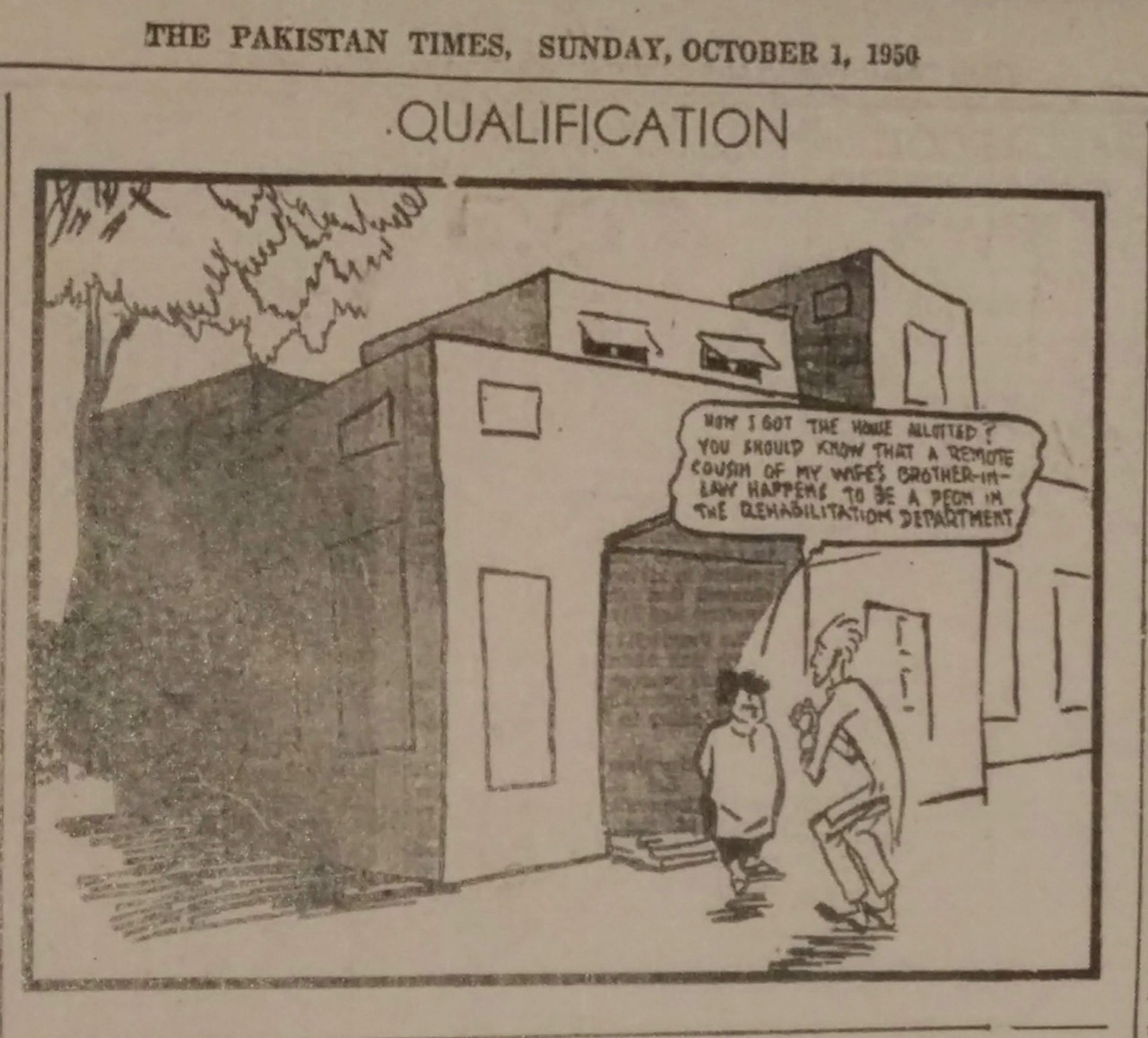
The Pakistan Times, 1 October, 1950. Qualification. “How I got the house allotted? You should know that a remote cousin of my wife’s brother-in-law happens to be a peon in the Rehabilitation Department.”
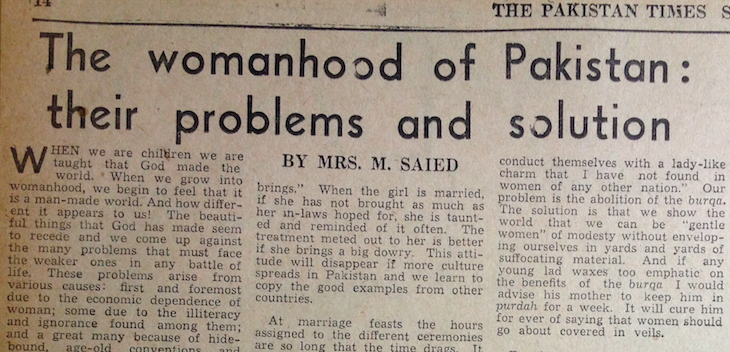
This is a small section from a discussion on the problems and solution regarding women in Pakistan. It is a full page piece written in The Pakistan Times Supplement, there is no information on the writer, other than her name, Mrs M. Saied. It offers a detailed discussion/opinion on women in relation to education, purdah, tradition, customs, marriage, economic dependency and more.
THE PURDAH
One of the greatest enemies of womanhood in Pakistan is the rigid religious code that tradition seems to demand. There is no code or rule or law, ancient or modern which has been passed for the whim or amusement of those in authority. Necessity of some kind or the other has demanded the code and it has been given out as a law to be obeyed. The only trouble in Pakistan is that traditions which are not now necessary are still being followed. Take purdah the biggest bone of contention between the bearded maulvis and the “Europeanised” young men and women. Which Muslim country is observing purdah with the rigidity with which people in Pakistan do? Yet we acknowledge they are Muslim countries. When their men and women come here, we embrace them and hail them as our Islamic brothers. Yet if a Pakistani woman is without a burqa what pious hands of Ya Allah Tauba! are lifted to heaven and the women are told that they are not Muslims but Kaffirs. Why? Is the purdah a hukum for only Pakistani women? I would request all pro-Purdah people to remember that if a Turk, Irani, Iraqi, Arabian or Egyptian woman without a burqa is a Muslim, so is the Pakistani woman who goes with no veil. Whether to be in purdah or to be out of it, worries many women. For the future of womanhood in this country, the girls should be allowed to lead their lives unburdened by the burqa. This will teach them to face the world untrammelled by the handicaps that a woman brought up in burqa suffers from. The other solution is that those already out of burqa should behave in a modest manner. I do not mean that they should sit or walk with hesitant steps and downcast eyes. No, but rather a quiet gentle manner of speech and behaviour. During 1944 in Calcutta, a British Colonel, talking of the W.А.С.ls said to me, “The Indian (pre-partition days, remember) girls never seem to lose their dignity.
Even the eighteen-year old girls conduct themselves with a lady-like charm that I have not found in women of any other nation.” Our problem is the abolition of the burqa. The solution is that we show the world that we can be “gentle women” of modesty without enveloping ourselves in yards and yards of suffocating material. And if any young lad waxes too emphatic on the benefits of the burqa I would advise his mother to keep him in purdah for a week. It will cure him for ever of saying that women should go about covered in veils. For those girls who have to attend schools or colleges and who do not go in buses but have to walk there in groups of three or four; for those who might take an outing with other women neighbours and friends; for those who make up a picnic party or who decide to go to a cinema show there is the loathsome problem of goondaism. It fills me with horror, I feel as if I am touching something putrid when I have to talk of this. This is nevertheless a very present and definite problem for women in Pakistan.
Three girls of school age used to pass along a certain road every day. And every day a certain young man would call out to them, telling them. The girls would go along their way in silence. The third day of this occurrence, when the same young man began to pass remarks, the tallest of the girls turned round, snatched the cane which the young fellow was carrying and gave him the beating he was itching for! The passers-by collected; cries of “Shabash! Zindabad! Changa! Changa!” rang out on all sides. The boy was taken to the Police Station. The three girls still pass on that road on their way to school.
If the women have courage, they will in time get rid of these goonda elements. Let there be no secrecy, no false shame about these occurrences. They must all be brought to right. When public opinion condemns a thing or a person, it has to go. Pressure from all sides must be put on the Government that they should deal very harshly, mercilessly and with absolute justice when a goonda is caught in any act of molestation. Women here are just getting used to the outside world. They must be given adequate protection to step out and be as free to move as they require. Instead of this they are jeered at, their personal appearance and their garments are discussed, they are deliberately pushed and shoved.
Heads of male institutions should arrange for lectures on etiquette. By the help of posters and other publicity, every Pakistani should be taught how to behave in the presence of women. It is very sad that in Pakistan there are many so-called educated men who are ill-mannered. They must be punished if seen doing or saying anything unbecoming before a woman.
One problem which does not arise for every woman and is yet of vital importance to the womanhood of Pakistan is that of divorce. There are so many rights which belong to women and which are very clearly given to them by the Prophet himself. When a woman does not observe purdah there are so many who twist and misquote the Holy Quran to prove their point. But when it comes to anything favourable to women and the women themselves quote it, they are told, Oh No, that is not the meaning at all.”
I hold no brief for divorce. It should be the last resort for ending an unhappy married life; but under circumstances which must be judged by an unbiased tribunal, a woman must be given the right to ask for and to apply for a divorce. No stigma or stain should be attached to a woman who is granted a divorce after the case has been judged by Muslim judges. The only way by which women can get these rights is by becoming active in the political sphere. The slogan of every woman here must be Educate, Educate, Educate!”
Problems are solved by everyone concerned doing their bit. And certainly it will be only by raising the standard of the women that Pakistan will find her rightful place in the modern world.



 BAGICHA