Just published in The International History Review
Abstract:
This article weaves together several unique circumstances that inadvertently created spaces for women to emerge away from the traditional roles of womanhood ascribed to them in Pakistan. It begins by tracing the emergence of the Pakistan International Airlines (PIA) as a national carrier that provided an essential glue to the two wings of Pakistan. Operating in the backdrop of nascent nationhood, the airline opens an opportunity for the new working women in Pakistan. Based on first-hand accounts provided by former female employees, and supplementing it with official documents, newspaper reports and the advertising used for marketing at the time, it seeks to provide an illuminating insight into the early history of women in Pakistan. While the use of women as markers of modernity and propaganda is not new, here within the context of Cold War and American cultural diplomacy, the ‘modernist’ vision of the Ayub-era in Pakistan (1958-69), and its accompanying jet-age provide a unique lens through which to explore the changing role of women. The article showcases a different approach to understanding the so-called ‘golden age’ of Pakistani history: a neglected area of the international history on Pakistan, which is far too often one-dimensional.
Sadly, I came to know that the young forgotten heroine of the independence movement passed away at the weekend. I interviewed Fatima Sughra in 2009 and only came across her by accident. Below is an extract from the amazing interview with her and sadly many Pakistanis are not even aware her or that she quietly lived in Johar Town, Lahore. At the age of 14 she became involved in local processions/protests being organized by the women working for the All-India Muslim League. Inspired by what was going on Fatima joined them and recalls one eventful day:
I was studying in 9th class. Fatima Begum was very active worker of the Muslim League. She worked with Quaid-i-Azam. She established the imposing Jinnah Islamia College on Multan Road, Lahore. Quaid-i-Azam inaugurated this college. There were usually meetings of the Muslim League in her house. She was sister-in-law of one of my aunty. I often visited my auntie’s house and at the time could not understand what was happening…I only thought that the Muslim League is our party, a party of the Muslims.
I was born in 1931; our house was between Mochi Gate and Shah Alam Gate Lahore. I was 14 and half year old that time and studying in 9th class. In those days, there was a disobedient movement against the Khizr Government and the Muslim League leadership made regular protests and processions in the streets. I read Zamindar newspaper and came to know that Begum Shahnawaz, Begum Salma Tassaduq Hussain, Begum Jalandhri and Fatima Begum were arrested in Lahore. I asked for permission from my father to participate in the processions; finally he allowed me. I along with my friends reached the Assembly Hall that day. I saw at that time a big crowd was shouting and chanting slogans: ‘(Zindabad) Long live Muslim League; long live Qauid-i-Azam; Pakistan will be created whatever it cost to the Muslims (bun kay ray ga Pakistan).
I think it was in February or March 1947. Daily processions were arranged and we took processions to the Radio station, at Mall Road, Jail Road, High Court and Civil Secretariat. We took the procession to the inner city. Hindus laughed at us. I remember the day I took off the Union Jack and replaced it with hoisting a [makeshift] Muslim League flag. Many Muslim women, (who had never stepped out from their house before) came out from their houses and took over the street of the city. This was happening all over because the Begums [elite Muslim League Women leadership] went door to door and convinced the Muslim women to come out from their homes for the protests. I do know what sort of passion was inside me at time; I just jumped over the Secretariat Gate.
There was a girl who was very tall…. I think her name was Begum Aslam. I put my foot on her shoulder and reached at the top of the Secretariat building Lahore. I did not know even, I pulled out the doori (thread) and flag…That day Begum Hadiat Ullah was leading the procession she said to me: ‘are you alright? I shouted, yes, I am alright’. The crowds were shouting slogans. I became very emotional and replaced the Union Jack with the Muslim League flag. Afterwards the Police arrived there; some boys escorted me and helped to get down from the stairs. The police sprayed heavy tear gas and used lati charge over the crowd. I rented a tonga and paid 4 anna and reached home safely. At home I told my mother about hoisting of Muslim League flag……she replied: ‘ok, I know you are doing such things every day’. At our house the daily Zamindar used to come every day and there was big news in the next day’s issue: Fatima Fada Hussian took off the Union Jack and hoisted the Muslim League flag. My father kissed me when I was sleeping because of this act. My father was very proud on me and said to me ‘my daughter I’m proud of you, you have done a big task’. That day I did break my fasting and again went to join the street processions. Begum Sikandar Hayat, Zahida Hayat, Asmat Hayat and Shamim were with me. They had been released from jail. We brought them in the Nasar Bagh in a procession. There was a big gathering and all Begums delivered very stimulating speeches. They called me on the stage and put a har of fruits around my neck. My friend ate most of the fruits and remaining part I showed to mum when I went home. [Laughing]
My father was a well-reputed person in our mohalla and people of the mohalla asked him many things about us. In those days, the people were very good and they cared about other people of mohalla. Now-a-days nobody cared about anything.
I had little interest in politics. I just went to join the processions for enjoyment. I thought that Muslim League represented the Muslims and Quaid-i-Azam was their leader and struggling for the creation a Muslim country. When I hoisted the Muslim League flag in the Secretariat building, many people came to my house to congratulate me and my family. I became a renowned girl.
I got certificate and gold medal. In 1987, Pakistan Government arranged a similar sort of the 1947 flag hoisting occurrence in the Lahore Secretariat building. I did perform and climbed at the Secretariat building even in this old age.
This was an extract from an interview conducted with Fatima Sughra in her house in Johar Town, 2009.
Now that the euphoria over independence day “celebrations” and remembering partition are over, it is worthwhile remembering that it was in fact today, 70 years ago, that the Radcliffe Line was made public. Millions of people woke up on 15 August not knowing which side of border they would be on, today their fate was sealed. Sitting in Delhi on this day, having seen the way both Pakistan and India remember 14/15 August 1947, it is a stark reminder of how chaotic this process must have been.
The month of August in the sub-continent is when the monsoon rains gush down intermittently. The heavy rains leave places incapacitated due to the deluge that falls. Even today, where there is improved drainage, the monsoon rains have the capacity to bring towns and cities to a standstill. So, thinking about this back in August 1947, it is staggering to think that the last Viceroy, Louis Mountbatten, decided that 15 August would be the date for independence. The date was chosen because it coincided with the date when Japan surrendered after it was devastated by the nuclear bombs in Hiroshima and Nagasaki. Mountbatten was clearly sentimental about the date because he was Supreme Allied Commander of South-East Asia when Japan surrendered. But he also failed to show any foresight when it came to the sub-continent. All the leaders failed to anticipate that millions of people would be engulfed by violence and thus forced to flee and that too in the difficult month of August. This only added further to their misery and fuelled diseases in refugee camps. It must be kept in mind that the violence that was unleashed in August 1947 was not an isolated incident, it was a culmination and continuation of previous episodes of horrific communal/political violence in which many lost their lives and were displaced. It was thus not entirely unexpected, nor was it just spontaneous.
The British media (TV, Radio and Print) has decided to cover partition/independence extensively and interestingly for this decennial anniversary they have been giving full coverage to the voices of ordinary people. The BBC has had a full season of programmes (one of which I contributed to) devoted to India and Pakistan at 70. I have personally spent the last sixteen years working on partition and its wider impact on the Punjab region, so the ordinary voices are not new to me. In fact, this trend in scholarship has been evolving and growing for the past twenty years. What is sobering is how the coverage has differed in India, Pakistan and the UK. I can only speak about these three because I know them well and they were of course at the epicentre of this.
While there is still a huge gap in our understanding of empire and its consequences, these programmes are important in reaching out to ordinary citizens, to educate, to inform, to illuminate the travesty of empire and its end. They also serve as important markers of remembering, but that alone is not enough. Which is why being in India/Pakistan during the days of August has been important. It highlights the disparity between the diaspora and those who live here. Capturing and sharing the narratives of survivors is important but from an academic perspective, what do these voices mean, what do they tell us, why are they still relevant? The memorialisation of this memory and how it tells this story is also significant. There is little worth in collecting hundreds and thousands of accounts by survivors if this is not contextualised or critically framed in the existing historiography. A simple account of someone’s life and their experiences is important but what about beyond that? What lessons can we take from this?
And our politicians are still in the business of selling a myth of a glorious past and a dream for the future. It is that future which needs to be critically examined in relation to the previous seventy years. Pakistan today seems fragile as ever but (and more importantly its people) it is a resilient country. For the best part of the last seventy years Pakistan has been swinging between military dictatorship and democratic rule, while India, largely a democracy, has been busy playing and expanding upon the Hindutva card. A future in which we see a further entrenchment of Islamic Pakistan and Hindu India is entirely possible and while not a recent development, it does need to be contextualised firstly in colonial history and secondly in the how the developments of the past seventy years led to this. Of concern for everyone should be that in this vision to be exclusively majoritarian, both India and Pakistan would lose an asset: its significant minorities. The diversity in all its richness is what makes these countries vibrant and valuable, they should be celebrated rather than suppressed and targeted. And so, seventy years on, while we remember the people who suffered in the great partition, let us not forget that there a battle going on today for the hearts and minds of people. Which is why it is seemingly more poignant being here in the sub-continent at this moment because it is a reminder of the unfinished business of azaadi beyond empire.
The coming of the jet-age: women, advertising and tourism in Pakistan
Appearing on 23 September, 1956, The Pakistan Times article, ‘About women travellers’ is a commentary by their woman correspondent on travelling in the jet-age and ends optimistically with, ‘Times are changing rapidly. Gone are the days when women could not move unchaperoned, for now they travel the globe, and although there are no undiscovered continents, they still travel paths yet untrodden by women.’ This article appeared at a time when Orient Airways was merging with Pakistan International Airlines Corporation to form what is now more popularly known as PIA.
Shortly after PIA’s establishment, in 1959 the new managing director, Air Commodore Nur Khan, took over; he was considered to be a dynamic and forward-thinking visionary and well placed to take advantage of the coming jet-age that would revolutionise air travel. By its own admission, PIA considered his tenure as the ‘golden years of PIA’. Enver Jamall, former chairman and chief executive of PIA, highlights the competition PIA had with Air-India, which had already placed orders for Boeing 707s to be delivered in 1960. There was much determination within PIA to be the first airline in the East to operate jets and so an agreement was reached with Pan American World Airways (Pan Am) for the lease of one of its Boeing 707s. This would operate on the London-Karachi-Dacca route with an extension to New York once a week. The flights began in March 1960, giving PIA the coveted prize and the route was a financial and operational success.[1]
Writing on the tenth anniversary since independence the General Manager of PIA, Zafarul Ashan, notes how the bold concept of air transport helped Pakistan maintain national unity. He goes further and adds that ‘In air transportation, more than in anything else, the Pakistanis discovered their true genius, striving as a modern nation to achieve a happy blend of the values of their rich cultural past with values and concepts of this age.’ Ultimately, PIA’s impact extended beyond merely connecting the two wings. Apart from the trade between the two wings, the ‘low cost air transport within Pakistan started a revolution in the travel habits’ of people and ‘it opened up new venues of business and recreation.’[2] With the jet age, there was simultaneously an emerging middle class with more disposable income both globally and within in Pakistan. So while the majority of the early travellers were wealthy businessmen, the affluent middle class was the way ahead for expansion. Nur Khan recognised this opportunity for growth and expansion.
PIA also made some interesting strategic moves. In 1955, the first flight ‘to the glittering, glitzy capital city of London, via Cairo and Rome’ started. There was some criticism of this from the public who regarded other projects as more urgent for a developing country like Pakistan but this was rebuked with the substantial foreign exchange earned through the international service. Indeed the foreign tourist market was crucial to the business model in the early days of PIA, it is only by the 1970s that the shift towards catering for the diaspora market takes place. Travelling abroad was an aspirational luxury for an elite group of Pakistanis but PIA in its early years was also tapping into the lucrative international tourist market. This is certainly evident in the early marketing and advertising by PIA, they were appealing to the foreign market and indeed the airline was successfully establishing a reputation for excellent services and was increasingly capturing the international market.[3] It was consistently considered as one of the best airlines in the East and was increasingly competing with likes of Pan Am and the British Overseas Airways Corporation (BOAC) for foreign tourists coming to Pakistan.
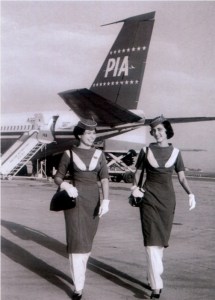
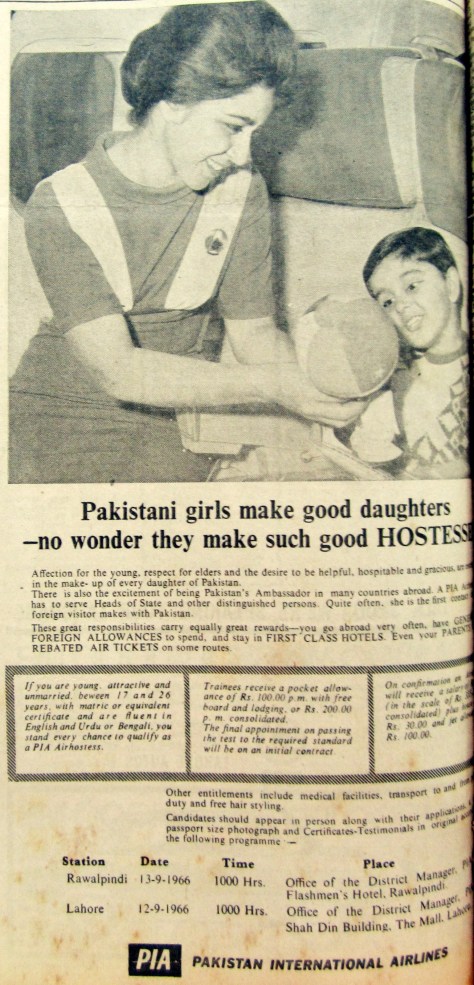
What is often over-looked in this story is the role of the women in promoting the PIA brand. PIA often used traditional notions of womanhood in their ads to attract more girls into the profession. We can see this from the text below taken from a 1966 tagline:
‘Pakistani girls make good daughter – no wonder they make such good Hostesses’
The advert depicts a young, elegant lady playing with a child on board a flight and continues, ‘Affection for the young, respect for elders and the desire to be helpful, hospitable and gracious…make-up of every daughter of Pakistan.’ These attributes can easily be applied to any “good” daughter (and potential daughter-in-law). But instead of representing the home, PIA airhostesses were ‘Pakistan’s Ambassador in many countries abroad’ and often she would be the first point of contact that a foreign visitor would make with Pakistan.[4] While playing on some of the traditional roles of women, the advert is also breaking new ground by legitimising the role of the airhostess. It sends out a message that this is a “respectable” profession and thereby quelling any fears parents may have about their daughters wanting to join the profession. On the other hand, the use of glamorous young females in exotic locations, also promotes an image of Pakistan which modern, progressive, internationalist and welcoming. There is then a dual role in the marketing and branding of the advertising.
There is also a sense that this was an age of new discovery and opportunity, democratisation in the travel and adventure industry, no longer the preserve of wealthy elites. An ever-increasing number of people now had the opportunity to explore and venture into new areas and the newly created nation of Pakistan had many attractions. The Government of Pakistan was also keenly promoting tourism, as is evident in the promotional literature of the 1960s. Foreign travelogues and magazines like the National Geographic were similarly featuring Pakistan as a tourist destination. While Karachi was the hub of activity, it was the old Silk Route, Peshawar, Swat, Chitral, Gilgit and the Karakorum Highway that attracted the adventure tourists. Mack Millar was a flight instructor assisting PIA during its early days and notes. ‘Although PIA is a national airline and the Pakistani government was founded to give the Muslim people their won country, the airline, like the nation itself, shows a wonderful tolerance for people of other persuasion. Many of the pilots are of mixed lineage-Anglo-Indian and Portuguese-Goanese, for example-and many are Christians.’[5] The feeling is that this was a more tolerant age; it was more open to foreigners and ideas. Internally it presented opportunities for Pakistanis to be part of an international community. The social and political changes that have taken place in Pakistan in the past 40 years have polarised this landscape.
The advances made in air travel were crucial to the existence of having a nation state divided by 1100 miles of hostile land mass. Zafarul Ashan was only too aware of this, ‘Nothing could have been worse than isolation for the cultural development and the expansion of the economy of the two wings. Political equality demanded that East and West Pakistan should be brought very close to each other in terms of time.’[6] The timing for Pakistan’s existence as a nation-state is therefore crucial in that the airline industry was just beginning to take off during the 1940s and not long after, the jet-age would revolutionise air travel. But along with this, a number of other opportunities also opened up. Foreign travel increasingly filtered down to the classes and was no longer just an elite activity. Out of this emerged a tourist industry attracting people to visit Pakistan and a domestic market, based not just on travel between the wings of Pakistan but looking to travel and experience the world beyond Asia. It also fundamentally opened opportunities for women to work and explore the globe. In an age where women were restricted to largely working in “respectable” jobs like teaching or medicine, here PIA was making the idea of working in the airline industry and as an airline hostesses a respectable profession. This was ground-breaking for the age.
[1] ‘Birth of a Nation; Birth of an Airline: The History of PIA,’ Enver Jamall in The Putnam Aeronautical Review 1990.
[2]The Pakistan Times, ‘P.I.A. Plans for Increased Capacity’ by Zafarul Ashan, 14 Aug 1957.
[3]The Pakistan Times, Independence Supplement, ‘PIA is flying high’ 14 Aug 1960.
Since last year Pakistan has requested that an estimated two million Afghan refugees (no one really knows the true figure) in Pakistan should leave and return back “home”. This has caused enormous amount of chaos along the Pakistan-Afghan border, not to mention the huge amount of distress and uncertainty for the people themselves. In these times when Europe is mostly focused on the refugees crisis in its own borders, there is a tendency to overlook the fact the majority of the world’s refugees are in fact located largely in neighbouring countries from which they flee. According to the UNHCR figures the top five hosting countries are:
The Afghani refugees initially arrived in Pakistan following the Soviet invasion of Afghanistan in 1979. They poured into Pakistan to seek sanctuary and most of them made new, but admittedly temporary, lives along the two provinces bordering Afghanistan. In the late 80s this figure was approximately 3.3 million, all located in refugee camps along Afghan-Pakistan border. A second wave of refugees poured into Pakistan following the US-led war in Afghanistan after 2001. By the end of 2001 the numbers rose up to approximately 5 million. By the end of 2012 there were however, almost 2 million Afghan nationals living in Pakistan largely in Khyber Pakhtunkhwa and Baluchistan province but others were scattered across the country. Some of these people have been there for such a long time that this is the only home they have known. While they have legal refugee status in Pakistan, the Government of Pakistan still considers them citizens of Afghanistan, even though many have subsequently been born in Pakistan. Large numbers of refugees have already been repatriated back to Afghanistan with the assistance of the UNHCR; their future is yet again uncertain.
Despite this many of them have made their lives in the “foreign” land that has become “home”. They carve out a living whichever way they can and the Afghani burger place is a just a small way in which they hang onto their identity. I first came across this when a colleague insisted that when one is in Islamabad an Afghani Burger is a must. Intrigued to find out more we visited a shabby looking place, the modern day dhaba. The place is quite small, unassuming and ordinarily I would have walked past it. The burger itself is not a burger; it is more of a wrap to be precise. The food is made on site and in front of your eyes to entice you. The contents of the wrap include a mix of different influences, chips (limp and apparently Afghani style), frankfurters (made with chicken or beef), salads, and an assortment of different sauces/chutneys – eastern influenced mint ones, the ubiquitous tomato sauce (with added spices) and some eastern spices thrown in too.
Motivating the Afghanis in Pakistan is essentially the instinctive need for survival and whilst the State (and Pakistani citizens) does not consider them citizens, it does not stop the success and popularity of the Afghani burger from spreading. Food is of course the easiest and most sublime ways in which people both retain their identity and also share it with those around; it starts to infuse the landscape until it is absorbed into the existing culture. The result is that the Afghani burger has given life and thrived in a stale, bureaucratic city to give it some character. The politics remain but no one questions the joy that food can bring to the people and places far away from “home”.
(c) Copyright 2016 Pippa Virdee. Boat trip in the backwaters of Kerala.
The Cloths of Heaven
Had I the heaven’s embroidered cloths,
Enwrought with golden and silver light,
The blue and the dim and the dark cloths
Of night and light and the half-light;
I would spread the cloths under your feet:
But I, being poor, have only my dreams;
I have spread my dreams under your feet;
Tread softly because you tread on my dreams.
By W. B. Yeats




 BAGICHA