Tag Archives: caste

Dr. B.R. Ambedkar: Castes in India: Their Mechanism, Genesis, & Development

© 2017 Pippa Virdee

Dr. B.R. Ambedkar (born April 14, 1891, Mhow, India—died December 6, 1956, New Delhi), leader of the Dalits (Scheduled Castes; formerly untouchables), chairman of the drafting committee of the Constituent Assembly of India (1946-49) and law minister of the government of India (1947-51).

On his 131st birth anniversary, I share below an excerpt from a paper read by a 25-year-old Ambedkar titled Castes in India: Their Mechanism, Genesis, and Development, at Columbia University, New York, U.S.A. on 9 May 1916:

Subtler minds and abler pens than mine have been brought to the task of unravelling the mysteries of Caste ; but unfortunately it still remains in the domain of the “unexplained”, not to say of the “un-understood” I am quite alive to the complex intricacies of a hoary institution like Caste, but I am not so pessimistic as to relegate it to the region of the unknowable, for I believe it can be known. The caste problem is a vast one, both theoretically and practically. Practically, it is an institution that portends tremendous consequences. It is a local problem, but one capable of much wider mischief, for “as long as caste in India does exist, Hindus will hardly intermarry or have any social intercourse with outsiders; and if Hindus migrate to other regions on earth, Indian castes would become a world problem.”

Dr Babasaheb Ambedkar: Writings and Speeches, Vol. 1, pp. 5-6

And pasted below are a slice of the meagre UK newspaper reportage across the first three decades after Ambedkar’s death, when he was not the indispensable icon that he has become in the India since 1990-91:

“Dr Ambedkar”, ‘…had once thought of asking to be received as a Sikh’ – political rather than theological conversion to Buddhism, therefore – opinion is equally divided on whether Untouchability is dying out or whether the caste system is still rigid, though it may take rather new forms’ – ‘the Untouchables would be happier if, without exaggerating their separateness from the main body of Hindus, they can produce more leaders to carry on Ambedkar’s work’.

7 December 1956, The Manchester Guardian, p. 10

“India’s former Untouchables seek arrest” – ‘Harijans all over India have launched an agitation to press their demands…yesterday 500 demonstrators courted arrest…but the Harijans lack the political organisation or the strength within society to raise anything more than a matter of discontent, easily ignored…the Harijan agitation is being directed by the RPI, the descendent of the old SCF, which the late Dr Ambedkar made a political force in the years before independence but which has shrunk in influence [since]…the agitation was launched on Dr Ambedkar’s birthday yesterday in support of a charter of 10 demands placed before the PM two months ago (land, houses, fair distribution of food grains, enforcement of the laws against untouchability and “immediate cessation of harassment” of Harijans)…the Harijans are stirring…stiffening through desperation or anger [as evidenced] by clashes between caste Hindus and “neo-Buddhists” (Harijans who have converted to Buddhism) in Maharashtra’.

8 December 1964, The Times, p. 9

“The timeless untouchable Indian problem” – ‘not a small minority: 20% in UP, WB, Haryana, Punjab; 10% in Gujarat, Maharashtra, Kerala, and Assam… ‘what has happened to [them] in these past 30 years? Very little, according to Mr. Dilip Hiro, The Untouchables of India. [On] the Untouchability (Offences) Act, 1955, ‘if we took this law seriously, said one state police chief, half the population in the state would have to be arrested’. [Reservation] ‘has tended to break up or drain off any kind of movement fighting for untouchable rights…Dr Ambedkar, the first Untouchable leader, believed that their status would be ameliorated only when the caste system itself was ended in India and there are no signs at all of that. Among western anthropologists, this…may be seen as an effective and defensible ordering of society. Nor does it seem likely that Mrs. Gandhi’s new order, powered by the authority of Kashmiri Brahmins, is going to start at the bottom of the Indian social heap’.

23 February 1976, The Times, p. 6

“14 killed as caste violence strikes at Bihar village” – ‘the third serious outbreak of caste violence [against Harijans by middle-ranking caste Hindus] in northern India in just over one month’ – ‘during the Janata rule in Bihar, the middle-ranking so-called “backward” castes seized the advantage over the former upper castes’ – ‘atrocities had increased recently against Harijans and other economically weaker groups…because other communities had become jealous of their advance, according to Mrs. Savita Ambedkar, widow of Mr. B.R. Ambedkar, the prominent Harijan leader who helped to draft the Indian constitution’.

27 February 1980, The Times, p. 9

Postscript:

On 7 August 1990, Vishwanath Pratap Singh, the prime minister at the time, announced that Other Backward Classes (OBCs) would get 27 per cent reservation in jobs in central government services and public sector units. The announcement was made before both Houses of Parliament. The decision was based on a report submitted on 31 December 1980 that recommended reservations for OBCs not just in government jobs but also central education institutions. The recommendation was made by the Mandal Commission, which was set up in 1979 under the Morarji Desai government and chaired by B.P. Mandal (former chief minister of Bihar). 30 years since Mandal Commission recommendations  — how it began and its impact today by Revathi Krishnan 7 August 2020, The Print.

Read more:

Educate, Agitate, Organise – a short biography of Dr B R Ambedkar by Sonali Campion, 26 April 2016.

Mr. Gandhi and the Emancipation of the Untouchables by Dr. B. R. Ambedkar.

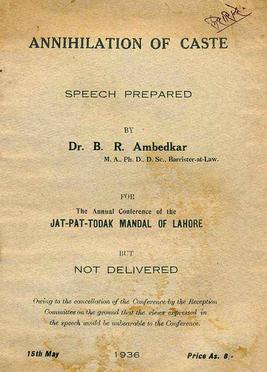
The Annihilation of Caste by Dr. B. R. Ambedkar.
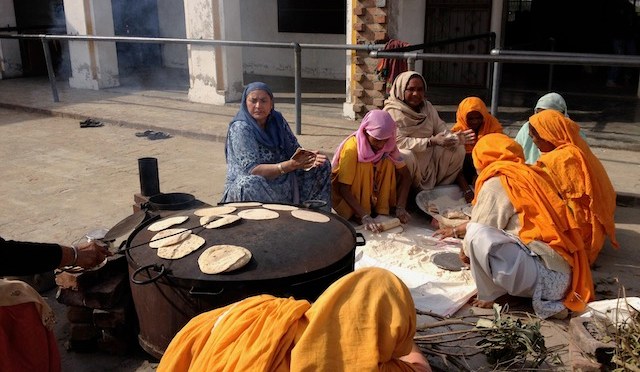
Guru ka langar

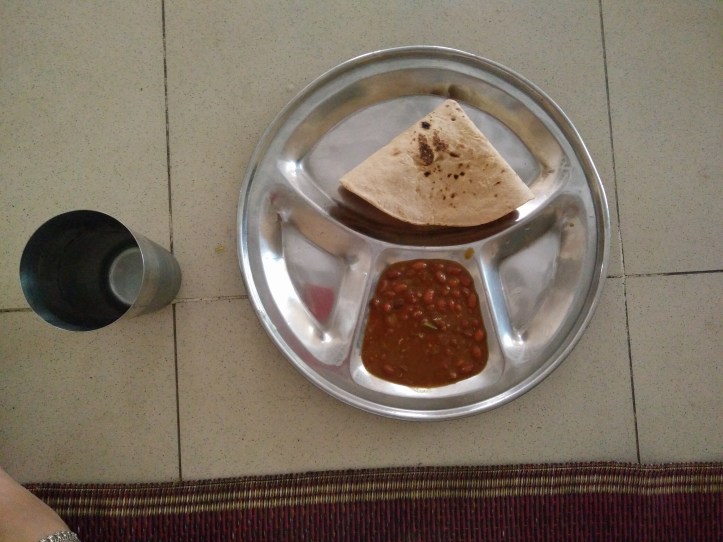
Langar at Gurdwara Pehli Patshahi, Lahore, Pakistan.

One of the earliest pieces I started with on this blog was with this picture of Guru ka Langar (or food for the congregation) in Lahore. The simplicity of daal (lentils) or in this case rajma (kidney beans) with roti (bread) is the basis of most langar served in a Gurdwara. As a child, I remember most children enjoyed going there in part because of the karah parshad (sweet halwa made from whole wheat flour) given at the end of the service and followed by the (free) food, which had its own distinctive divine taste, impossible to recreate at home. 

Langar is the communal partaking of food when visiting Gurdwara. The concept has in recent years been popularised globally by Sikh organisations such as Khalsa Aid, which plan, produce and distribute langar to people across the crisis-ridden world, be it to the truckers stranded in Dover over the ongoing Christmas period or in recent war-torn Syria. With Langar spreading so does knowledge about and experience of the Sikh community. Currently, closer to the home of Sikhism in Punjab, Langar has been making headlines via the ongoing farmers’ movement against new farm laws in India. Communal kitchens have been set-up by the roadside to feed the thousands gathered on the borders of capital, Delhi.

Origins

The word ‘langar’ (meaning ‘anchor’) is thought to have come into the Punjabi language from Persian (Nesbitt: 29); although the idea was not unique to the Sikhs, as ‘both the Sufis and the Nath Yogis have a system of collective eating (langar khanah and bhandaras). The Sikhs, however, used it as venue for both service and charity and provided the food themselves [unlike] the Nath Yogis, who begged for food, and the Sufis, who often accepted land-grants to run their kitchens’ (Mann: 27).

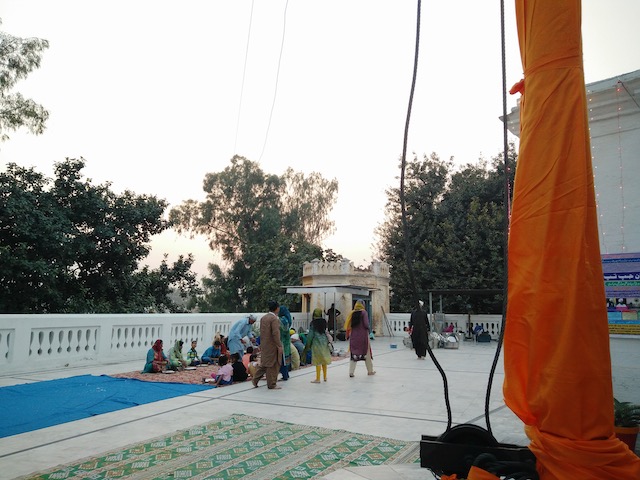
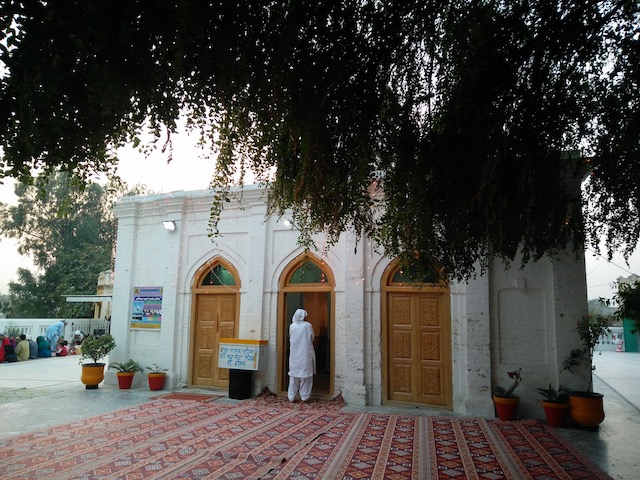
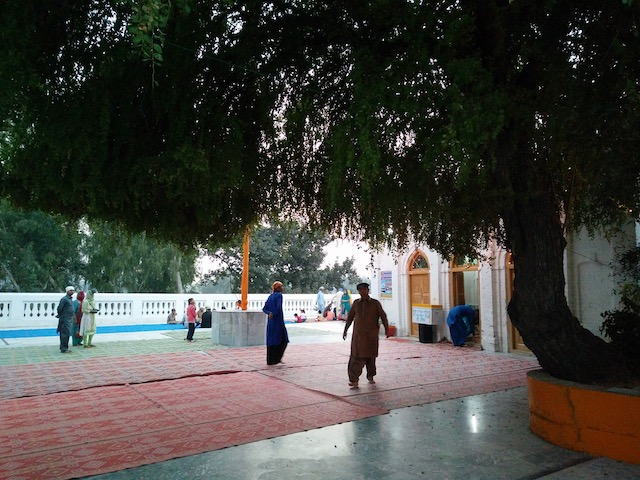
Pictures are of Gurdwara Sacha Sauda, Farooqabad, Pakistan and about 37 miles away from Lahore. This gurdwara is revered with the origins of the langar and is situated not far from Nankana Sahib, the birth place of Guru Nanak.

Baba Farid (1170s-1260s), a Sufi saint from the Chishti order, living in the Punjab, would distribute sweets amongst his visitors; a precursor to langar-khana near shrines, a practice documented in Jawahir al-Faridi (1620s) by a descendent of his. The khanqahs of the Chishti and other Sufi orders kept a langar open for the needy, but also others. It is said that ‘Khwaja Muinuddin established the tradition of an open kitchen for all who came…in an age of feudalism and violence’ (Talib: 6).

There is, of course, a much older practice of the alms house or dharmshala/sarai to feed travellers and poor for free, which is thought to have existed through the Gupta and Maurya (esp. Buddhist) times that is on either side of the BC/AD divide.   

Faith

The connections between the Sufis and the Bhakti (devotional) traditions are well documented, inspired as both were by the idea of feeding the poor, the pilgrim and thereby removing divisions/discrimination among people. The idea concretised with the rooting of faith in the region and by early 17th century, it had become a recognised Sikh fixture (Desjardins).

Eleanor Nesbitt notes that, ‘in institutional terms, it was the third Guru, Amar Das [1479-1574], who gave prominence to the langar… [integral as] sharing food [was] to Guru Nanak’s Kartarpur community…it was Guru Amar Das who particularly emphasised the requirement for everyone to dine side by side, regardless of caste and rank’ (Desjardins: 29).

There were two women, who especially, ‘nurtured the development of the langar tradition in its formative period: Mata Khivi (1506-82) and Mata Sundri, the second and tenth Gurus’ wives’. The Guru Granth Sahib notes that ‘Khivi…is a noble woman, who…distributes the bounty of the Guru’s langar; the kheer—the rice pudding and ghee—is like sweet ambrosia’. After the death of Guru Gobind Singh (1666-1708), ‘his widow Mata Sundri worked hard to continue the free community kitchen service. Records show her active role in fundraising for this purpose when the very survival of Sikhism was in question… (Desjardins).

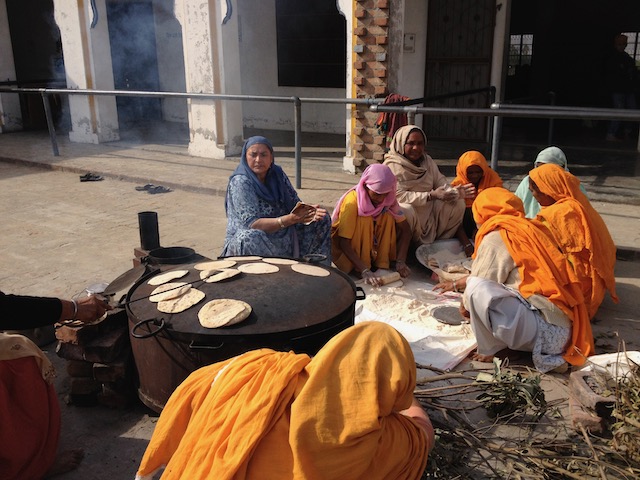
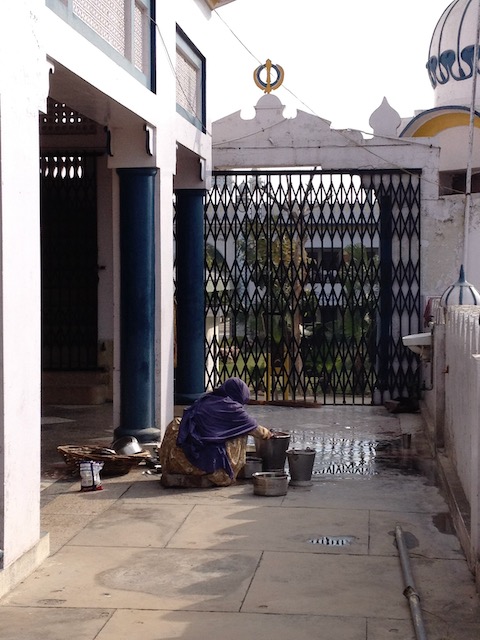
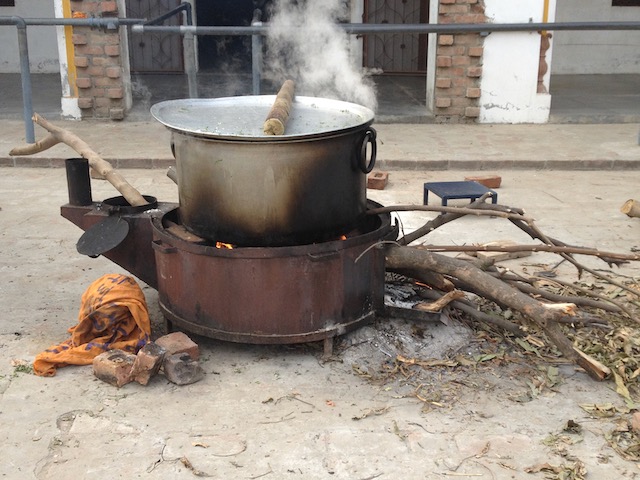
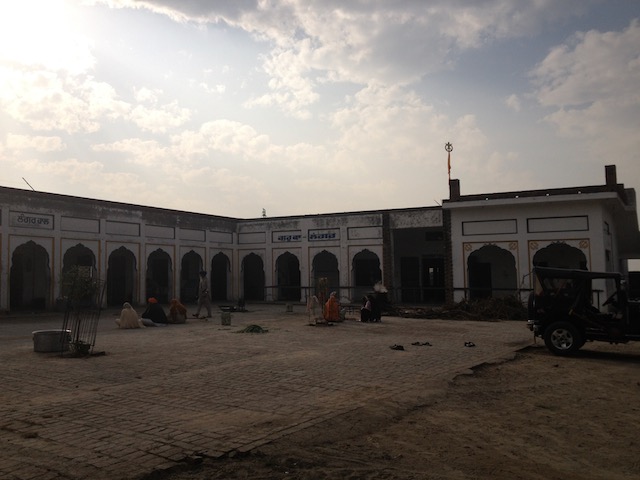
The langar since is thus an integral part of the faith/religion, its compassion through the concept of Seva (self-less service); essential for all practicing Sikhs. Donating food or money is not as important as the practice of giving one’s time and service. Today the most famous community kitchen serving langar has to be the Golden Temple (Amritsar), where around 100,000 people are served on a daily basis. However, most Sikhs grow up visiting and worshipping at small local gurdwaras, where everyday worshippers and volunteers prepare food on a daily basis. These photos are taken from the local gurdwara at Mao Sahib (my father’s village, Jalandhar district), where the congregation prepare, serve, consume the langar and then clean afterwards. As the gurdwaras become more institutionalised, and as the historic gurdwara Mao Sahib (associated with the fifth Guru Arjan and his consort Mata Ganga, d. 1621) has come under the administration of the SGPC (the Sikh body responsible for the management of gurdwaras), voluntary seva has been added to by paid sevadars.

The pictures are of Mao Sahib, 2012, when the langar hall was undergoing a renovation and some of the langar preparation was taking place outside.

Equality

The idea of sitting and sharing food together is fundamental among Sikhs because it demonstrates the abolition of caste and dramatically asserts humble equality amongst all the people; regardless of their religious or caste background. The food is generally simple and vegetarian, to appeal to all and offend no one. Four core Sikh principles are enshrined in the langar: equality, hospitality, service, and charity.

Eleanor Nesbitt writes about how, ‘the Gurus were reformers who abolished the caste system or that caste is Hindu, not Sikh’. It is important to remember how revolutionary this was/is in a caste-ridden society. Nesbitt notes how, ‘the langar subverted Brahminical rules about commensality, according to which only caste fellows could eat together’ (118). Instead, it was proclaimed that, ‘a Sikh should be a Brahmin in piety, a Kshatriya in defence of truth and the oppressed, a Vaishya in business acumen and hard work, and a Shudra in serving humanity. A Sikh should be all castes in one person, who should be above caste’ (117). The Gurus, like the Bhagats Namdev, Kabir, and Ravidas, proclaimed the irrelevance of people’s inherited status to their spiritual destiny. In Guru Nanak’s view:

Worthless is caste (Jati) and worthless an exalted name,

For all humanity there is but a single refuge (Adi Granth 83)

Quoted in Nesbitt: 118

Similarly, according to Guru Amar Das:

When you die you do not carry your Jati with you:

It is your deeds which determine your fate. (Adi Granth 363)

Quoted in Nesbitt: 118

References

Bowker, John (ed.), The Concise Oxford Dictionary of World Religions (OUP, 1997)

Desjardins, Michel, and Ellen Desjardins, ‘Food that builds community: the Sikh Langar in Canada’, Cuizine: The Journal of Canadian Food Cultures/Cuizine: revue des cultures culinaires au Canada 1, no. 2 (2009) https://www.erudit.org/en/journals/cuizine/2009-v1-n2-cuizine3336/037851ar/

Mann, Gurinder Singh, Sikhism (Prentice Hall, 2004)

Nesbitt, Eleanor, Sikhism: A Very Short Introduction (OUP, 2016)

Talib, Gurbachan Singh, Baba Sheikh Farid Shakar Ganj (NBT India, 1974)

More about Gurdwara Sacha Sauda: http://pakgeotagging.blogspot.com/2018/02/084-gurdwara-sacha-sauda-farooqabad.html

The Persistence of Caste

Bhimrao Ramji Ambedkar (14 April 1891 – 6 December 1956)

© 2017 Pippa Virdee

Ambedkar, Bhimrao Ramji, and Frances W. Pritchett. Pakistan or Partition of India. Thacker, 1946

The Muslim League’s Resolution on Pakistan has called forth different reactions. There are some who look upon it as a case of political measles to which a people in the infancy of their conscious unity and power are very liable. Others have taken it as a permanent frame of the Muslim mind and not merely a passing phase and have in consequence been greatly perturbed.The question is undoubtedly controversial. The issue is vital and there is no argument which has not been used in the controversy by one side to silence the other. Some argue that this demand for partitioning India into two political entities under separate national states staggers their imagination; others are so choked with a sense of righteous indignation at this wanton attempt to break the unity of a country, which, it is claimed, has stood as one for centuries, that their rage prevents them from giving expression to their thoughts. Others think that it need not be taken seriously. They treat it as a trifle and try to destroy it by shooting into it similes and metaphors. “You don’t cut your head to cure your headache,” “you don’t cut a baby into two because two women are engaged in fighting out a claim as to who its mother is,” are some of the analogies which are used to prove the absurdity of Pakistan. In a controversy carried on the plane of pure sentiment, there is nothing surprising if a dispassionate student finds more stupefaction and less understanding, more heat and less light, more ridicule and less seriousness. My position in this behalf is definite, if not singular. I do not think the demand for Pakistan is the result of mere political distemper, which will pass away with the efflux of time. As I read the situation, it seems to me that it is a characteristic in the biological sense of the term, which the Muslim body politic has developed in the same manner as an organism develops a characteristic. Whether it will survive or not, in the process of natural selection, must depend upon the forces that may become operative in the struggle for existence between Hindus and Musalmans. I am not staggered by Pakistan; I am not indignant about it; nor do I believe that it can be smashed by shooting into it similes and metaphors. Those who believe in shooting it by similes should remember that nonsense does not cease to be nonsense because it is put in rhyme, and that a metaphor is no argument though it be sometimes the gunpowder to drive one home and imbed it in memory. I believe that it would be neither wise nor possible to reject summarily a scheme if it has behind it the sentiment, if not the passionate support, of 90 p.c. Muslims of India. I have no doubt that the only proper attitude to Pakistan is to study it in all its aspects, to understand its implications and to form an intelligent judgement about it.

First_edition_of_Annihilation_of_CasteAmbedkar, Bhimrao Ramji. Annihilation of Caste: The annotated critical edition. Verso Books, 2014.

The Annihilation of Caste was an undelivered speech written in 1936 and to be delivered at the Jat-Pat Todak Mandal (Society for the Abolition of Caste system). However, the organiser found elements within the speech objectionable and Ambedkar refused to censor his words.

Roy, Arundhati, B. R. Ambedkar, and S. Anand. Annihilation of Caste: The Annotated Critical Edition. (2014). 

Other contemporary abominations like apartheid, racism, sexism, economic imperialism and religious fundamentalism have been politically and intellectually challenged at international forums. How is it that the practice of caste in India – one of the most brutal modes of hierarchical social organisation that human society has known – has managed to escape similar scrutiny and censure? Perhaps because it has come to be so fused with Hinduism, and by extension with so much that is seen to be kind and good – mysticism, spiritualism, non-violence, tolerance, vegetarianism, Gandhi, yoga, backpackers, the Beatles – that, at least to outsider, it seems impossible to pry it loose and try to understand it.

Listen to The Doctor and The Saint: The Ambedkar—Gandhi debate: Race, Caste and Colonialism with Arundhati Roy (2014)


O’Boyle, Jane “The New York Times and the Times of London on India Independence Leaders Gandhi and Ambedkar, 1920–1948” American Journalism, Volume 35, 2018 – Issue 2, 214-235.

During the years before India’s independence, the Times of London published news stories that were derisive and skeptical of Mahatma Gandhi, reflecting a national policy to diminish his power in the process to “quit India.” The Times was respectful of the untouchables’ leader Bhimrao Ambedkar and his civil rights movement for untouchables, perhaps to further distract from Gandhi’s popularity. The New York Times lavished positive attention on Gandhi and largely ignored Ambedkar altogether. The American newspaper framed a hero of colonial independence and never his oppression of untouchables, adhering to news policy during the Jim Crow era of racial persecution.

Teltumbde, Anand. The Persistence of Caste: The Khairlanji murders and India’s hidden apartheid. Zed, 2010. 

While the caste system has been formally abolished under the Indian Constitution, according to official statistics, every eighteen minutes a crime is committed in India on a Dalit-untouchable. The Persistence of Caste uses the shocking case of Khairlanji, the brutal murder of four members of a Dalit family in 2006, to explode the myth that caste no longer matters. In this exposé, Anand Teltumbde locates the crime within the political economy of post-Independence India and across the global Indian diaspora. This book demonstrates how caste has shown amazing resilience – surviving feudalism, capitalist industrialization and a republican constitution – to still be alive and well today, despite all denial, under neoliberal globalization.

Teltumbde, Anand. “Deconstructing Ambedkar,” Economic and Political Weekly (May 2, 2015).

Electoral politics became competitive bringing to the fore vote blocks in the form of castes and communities, both skilfully preserved in the Constitution in the name of social justice and religious reforms, respectively. The competing Ambedkar icons offered by various political manufacturers in India’s electoral market have completely overshadowed the real Ambedkar and decimated the potential weaponry of Dalit emancipation. The rhetoric of aggressive development, modernity, open competition, free market, etc, necessitated the projection of a new icon which would assure people, particularly those of the lower strata whom it would hit most, of the possibility of a transition from rags to riches with the adoption of the free-market paradigm.

Further Reading

Ministry of External Affairs (GoI): Writings & Speeches of Dr. Babasaheb Ambedkar https://www.mea.gov.in/books-writings-of-ambedkar.htm

Jaffrelot, Christophe. India’s silent revolution: the rise of the lower castes in North India. Orient Blackswan, 2003.

Jodhka, Surinder S. “Caste: why does it still matter?.” In Routledge Handbook of Contemporary India, pp. 259-271. Routledge, 2015.

Pandey, Gyanendra. A history of prejudice: race, caste, and difference in India and the United States. Cambridge University Press, 2013.

From Ambedkar to Mayawati

This slideshow requires JavaScript.

Patangbaazi greets one at the magnificent Parivartan Sthal (Ambedkar Memorial Park) complex constructed by the orders of Chief Minister Mayawati and completed by 2009-10. It is a park today and has from khomche to ice-cream, from couples to families, from beggars to bourgeoisie and all castes in the midst. Stretching along the river-front, a tourist-spot complete with statues and footpaths, in marbles and sandstones, it has a marvellous sense of space. An extraordinary, larger-than-life and gargantuan assertion of identity, dignity and deities – Ambedkar and wife, Kanshiram and Mayawati on opposite sides – this is not merely a reclaiming, recovery of history. It is not even an attempt to re-write history. This set-up, so reminiscent of the Lincoln and Luther King Memorials in Washington, is a grabbing of past and present by its throat and laying down a marker for future. 

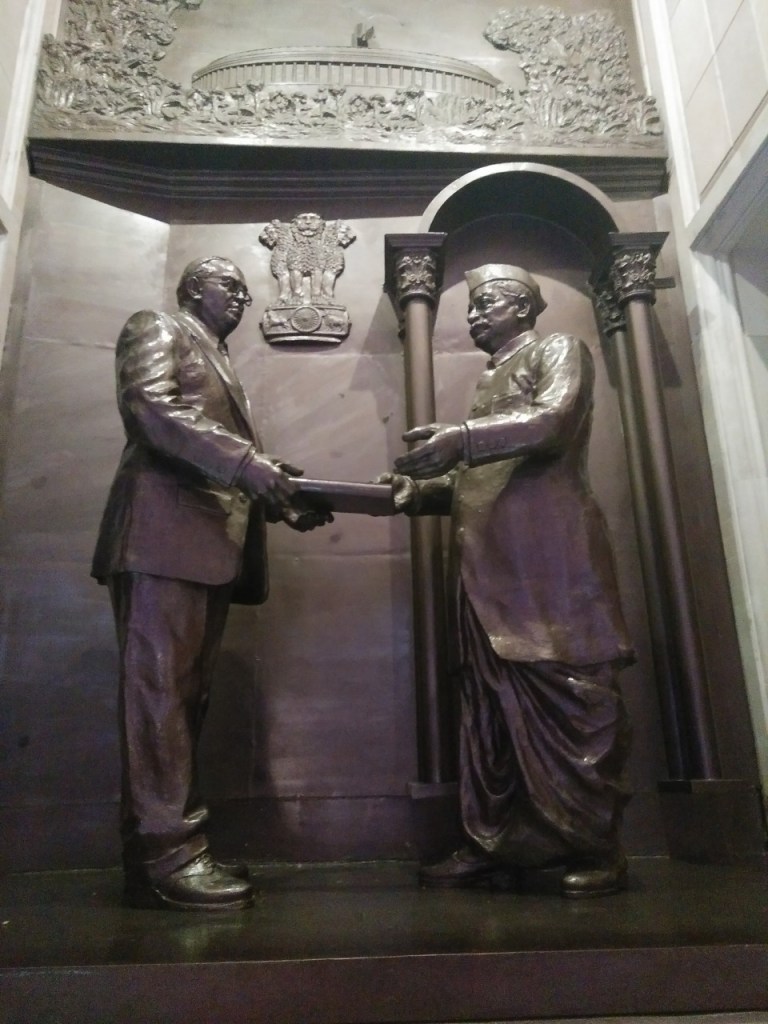
The geometrically precise, expansive space – rational and theistic with its human-Gods – has a jarring note struck by the VIP Lounge on one side of the entrance with the other side being for reserved for others. One long path takes tourist-pilgrims to a stupa-hill, rock-cut alignment with huge mural depictions of Ambedkarite Buddhism from deeksha to nirvana. Hues of blue lighting enhanced the sandstone, soil-coloured backdrop amidst which stood exceptionally well-done, real-life-likeness statues. Ambedkar is sitting majestically in the Lincoln pose in the sanctum-sanctorum. On the circular walls, on one side, Ambedkar is ‘giving’ the gift of Constitution to Babu Rajendra Prasad, the upper-caste Chairman of the Indian Constituent Assembly and on the other, Ambedkar is shown receiving the gift of deeksha from a Baudh-Bhikshu. 

Guest Post.