Tag Archives: 1947

From Mano Majra to Faqiranwalla: Revisiting the Train to Pakistan

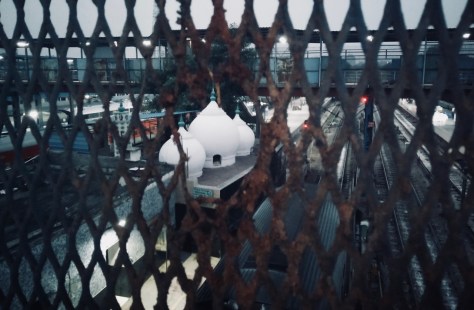
New Delhi train station. © Pippa Virdee 2016

By Pippa Virdee and Arafat Safdar in South Asian Chronicle.

Khushwant Singh’s novel Train to Pakistan was published in 1956, almost ten years after the partition of India/ creation of Pakistan in 1947. Its publication inaugurated what has been called ‘South Asian Partition Fiction in English’ (Roy 2010). It remains, to date, one of the most poignant and realistic fictional accounts depicting the welter of partition and saw a sensitive screen adaptation in 1998 by Pamela Rooks. It captures one of the most horrific symbols of partition—that of the burning, charred and lifeless trains that moved migrants and evacuated refugees from one side of the border to the other. The trains that previously served to bring people and goods from disparate worlds closer together were overnight turned into targets of mob attacks and transporters of mass corpses. They thus became an emblem, a much-photographed representation (Kapoor 2013) of the wider violence and ethnic cleansing that was taking place in Panjab (Ahmed 2002: 9-28); one of the two regions divided to make way for the two new nation-states.

Selecting some key individuals in the village, relevant to and representative of our efforts to excavate the myths and memories associated with partition, and situating their sensibilities vis-à-vis the sentiments exhibited in the novel, we conducted interviews to collect and compare experiential accounts. An attempt in the Wildean spirit to attest that ‘life imitates art far more than art imitates life’, the article, located in the Faqiranwalla of 2017, looks back to the Mano Majra of 1947. In doing so, not only does it reflect on this intervening time-span and what it has done to those remembrances, but, also brings to fore the well-remarked realisation that, in this case too, ‘the past is another country’ (Judt 1992). Like in the novel then and life today, the connecting link in this article too, between Faqiranwalla and Mano Majra, is the train, as both share the overweening presence of the railways in the village, through which its life is/was governed.

Read full article: https://edoc.hu-berlin.de/handle/18452/19508

Südasien-Chronik – South Asia Chronicle 7/2017, S. 21-44 © Südasien-Seminar der Humboldt-Universität zu Berlin

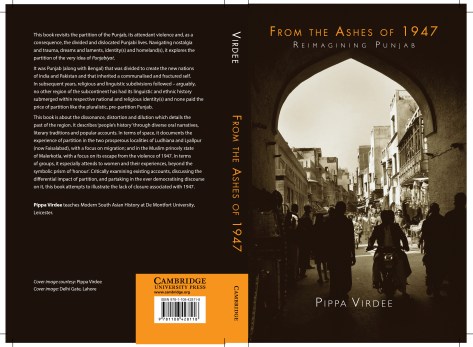
From the Ashes of 1947: Reimagining Punjab

From the Ashes_Full Cover

Full details: From the Ashes of 1947

Watch the panel discussion with Pippa Virdee (De Montfort University, UK), Afzal Saahir (Poet and Radio Host) and Sajid Awan (Quaid-e-Azam University) of my book From the Ashes of 1947 at the Afkar-e-taza, January 2018 Panel Discussion

Durga Mandir/Juma Masjid

This slideshow requires JavaScript.

In an unassuming side street of an old residential area in Sonipat is a hidden gem and remnant of the past. Durga Mandir of Mohalla Kalan in Sonipat is still popularly known as Badi Masjid (big/greater Mosque). The latter should give an insight into the former life of this Mandir, which once was a Masjid. Even today looking at the exterior of this mandir it could quite easily be confused for a masjid. It stands tall and looks grand in the red stone façade with a courtyard for Friday prayers which probably attracted many of the local Muslims in pre-partitioned Punjab. Apart from the obvious changes of installing flags and idols, the three main domes and minarets are easily identifiable with that of a small Juma masjid.

Like many other places of East Punjab, the Muslims of Sonipat migrated to Pakistan, leaving behind their homes and places of worship. These were quickly claimed by the incoming Hindus and Sikhs. Muslims were often the second largest group in these areas. For example, Muslims were significantly present in cities like Hissar (28%), Gurgaon (34%), Karnal (32%) and Ambala (32%) Rohtak (17%); all of these are part of present-day Haryana State. Most of the Muslims abandoned their homes in the ensuing violence of August 1947 and fled to Pakistan. Similarly, in Pakistan, many of the old abandoned religious (Gurdwaras and mandirs) buildings were converted/neglected by the incoming populations to be utilised for their own purposes. See link below for more about this.

In this case, the masjid has been converted into a Durga Mandir, a temple for worshiping Goddess Durga. It is now known as ‘Sri Sanatan Dharm Sabha Panji Durga Mandir.’ The Goddess Durga assumes the central position in the mandir and is surrounded by other deities; outside in the courtyard is an encased idol of Baba Sai. The dome interior has recently been filled to mask the obvious Islamic style architecture but the exterior remains as before. The link below provides further information on the Badi Masjid but more interesting are the photos. The short article was posted in October 2015, and the pictures shared are quite different from when I went to visit the site recently. The interior now has been changed to hide all signs of its former existence as a masjid. The pictures from 2015 show the perfect domes and remnants of frescoes and tiling from before. The fact that much of the interior has been transformed in the past two years is telling of the Hindutva agenda prevailing in the region.

Sonipat in August 1947 was a small city in united Punjab, then it became a city in East Punjab and eventually a part of Haryana after the reorganisation of East Punjab in 1966. There is little in the history books about the intervening years before it became part of Haryana, yet a lot has changed in this area. Looking at Sonipat today, it is difficult to tell that this historic city was once communally diverse with Punjabi Hindus, Sikhs, Muslims and Christians. Today it feels very much like a Hindu city. Perhaps the latter is more of a reflection of the current climate in India. But hidden away are these old structures that remind us of a different time and a different history.

Read further about Sonepat’s Badi Masjid and see pictures from 2013. http://www.gounesco.com/badi-masjid-sonipat/

Pakistan’s long forgotten Hindu temples and gurdwaras. http://blogs.tribune.com.pk/story/15785/pakistans-long-forgotten-hindu-temples-and-gurdwaras/

The Politics of Partition and its Memory


Now that the euphoria over independence day “celebrations” and remembering partition are over, it is worthwhile remembering that it was in fact today, 70 years ago, that the Radcliffe Line was made public. Millions of people woke up on 15 August not knowing which side of border they would be on, today their fate was sealed. Sitting in Delhi on this day, having seen the way both Pakistan and India remember 14/15 August 1947, it is a stark reminder of how chaotic this process must have been.

The month of August in the sub-continent is when the monsoon rains gush down intermittently. The heavy rains leave places incapacitated due to the deluge that falls. Even today, where there is improved drainage, the monsoon rains have the capacity to bring towns and cities to a standstill. So, thinking about this back in August 1947, it is staggering to think that the last Viceroy, Louis Mountbatten, decided that 15 August would be the date for independence. The date was chosen because it coincided with the date when Japan surrendered after it was devastated by the nuclear bombs in Hiroshima and Nagasaki. Mountbatten was clearly sentimental about the date because he was Supreme Allied Commander of South-East Asia when Japan surrendered. But he also failed to show any foresight when it came to the sub-continent. All the leaders failed to anticipate that millions of people would be engulfed by violence and thus forced to flee and that too in the difficult month of August. This only added further to their misery and fuelled diseases in refugee camps. It must be kept in mind that the violence that was unleashed in August 1947 was not an isolated incident, it was a culmination and continuation of previous episodes of horrific communal/political violence in which many lost their lives and were displaced. It was thus not entirely unexpected, nor was it just spontaneous.

The British media (TV, Radio and Print) has decided to cover partition/independence extensively and interestingly for this decennial anniversary they have been giving full coverage to the voices of ordinary people. The BBC has had a full season of programmes (one of which I contributed to) devoted to India and Pakistan at 70. I have personally spent the last sixteen years working on partition and its wider impact on the Punjab region, so the ordinary voices are not new to me. In fact, this trend in scholarship has been evolving and growing for the past twenty years. What is sobering is how the coverage has differed in India, Pakistan and the UK. I can only speak about these three because I know them well and they were of course at the epicentre of this.

While there is still a huge gap in our understanding of empire and its consequences, these programmes are important in reaching out to ordinary citizens, to educate, to inform, to illuminate the travesty of empire and its end. They also serve as important markers of remembering, but that alone is not enough. Which is why being in India/Pakistan during the days of August has been important. It highlights the disparity between the diaspora and those who live here. Capturing and sharing the narratives of survivors is important but from an academic perspective, what do these voices mean, what do they tell us, why are they still relevant? The memorialisation of this memory and how it tells this story is also significant. There is little worth in collecting hundreds and thousands of accounts by survivors if this is not contextualised or critically framed in the existing historiography. A simple account of someone’s life and their experiences is important but what about beyond that? What lessons can we take from this?

And our politicians are still in the business of selling a myth of a glorious past and a dream for the future. It is that future which needs to be critically examined in relation to the previous seventy years. Pakistan today seems fragile as ever but (and more importantly its people) it is a resilient country. For the best part of the last seventy years Pakistan has been swinging between military dictatorship and democratic rule, while India, largely a democracy, has been busy playing and expanding upon the Hindutva card. A future in which we see a further entrenchment of Islamic Pakistan and Hindu India is entirely possible and while not a recent development, it does need to be contextualised firstly in colonial history and secondly in the how the developments of the past seventy years led to this. Of concern for everyone should be that in this vision to be exclusively majoritarian, both India and Pakistan would lose an asset: its significant minorities. The diversity in all its richness is what makes these countries vibrant and valuable, they should be celebrated rather than suppressed and targeted. And so, seventy years on, while we remember the people who suffered in the great partition, let us not forget that there a battle going on today for the hearts and minds of people. Which is why it is seemingly more poignant being here in the sub-continent at this moment because it is a reminder of the unfinished business of azaadi beyond empire.
The Partition Museum, Amritsar

This slideshow requires JavaScript.

The Partition Museum is an attempt to preserve the history and memories of 1947, that saw the creation of India and Pakistan and as a result the partition of Punjab and Bengal. Located in Amritsar the museum deals with mostly the effects of partition on Punjab rather Bengal. It is the initiative of Lady Kishwar Desai and The Arts and Cultural Heritage Trust, along with other organisations. The Partition Museum is in Amritsar’s Town Hall and located in the newly renovated area near Hall Bazaar. The renovation work is a delight in the hustle and bustle of the walled city of Amritsar. The surrounding area all carry remnants from the colonial period and ironically the museum itself is housed in the colonial Town Hall built in the 19th century.

The museum contains mainly pictures, a few artefacts and newspaper clippings from the independence period. It is spread across 3-4 rooms which use multimedia, visual and documentary sources to illustrate and memorialize the Partition. It is therefore a small exhibition and largely provides an overview of what happened.

I wish I could have connected better with the endeavours and intentions of the museum but it left me feeling empty and concerned with the lack of reflection. The museum unfortunately reflects the elite vision with which it was conceptualised. Having spent the last sixteen years working on the history of Partition, I realise that people still need to learn more about this period. But sadly, seventy years on we hardly have any empathy for the collective guilt that we all share in this legacy. The newspapers presented were from the Indian perspective, the horrors of violence were those perpetrated by Muslims against Hindus and Sikhs. Had we been on the other side of the Radcliffe Line, I imagine similar one-sided accounts would be shown of how Muslims were killed at the hands of Hindus and Sikhs. So, when do we move away from this communalized history of partition that still lingers on?

The pictures and voices shared were not of the ordinary people suffering but of prominent people and those who have come to “symbolise” partition history. This is certainly not a people’s history. Even the Tree of Hope presented me with little hope as it was covered in nationalistic and jingoistic slogans written by school children and visitors. Hardly giving secular India hope for the future. Instead the Tree of Hope just reinforces the new powerful and bullish India, unleashed by Modi’s vision.

My main concerns were with the well that has been installed in the museum. It is obviously designed to educate people but what sort of story is it trying to tell us? By simply stating that many women were forced to or rather martyred themselves by jumping into the wells is simplifying a very complex history. Women as the torch bearers of community honour were in some cases (we can hardly guess the numbers) forced to jump into wells by the patriarch of the family or community. Some went willingly but others were more reluctant; afraid of what was expected of them. We can most poignantly see this in the film Kamosh Pani. And so, to show this well in the middle of exhibition represents what exactly? If this was the original location, as in Jallianwala Bagh, it would make sense but to install it for effect is problematic. What kind of history and memory is being preserved by these acts to recreate history selectively? With little intellectual engagement with these selective symbolic fragments from our collective past we can only serve to re-enforce the communalised identities that led to 1947 in the first place.

Visit the website: http://www.partitionmuseum.org/

Dividing Punjab, 1947

Map of Punjab. Scale 1:16 Miles.

Muslim majority Tehsils and contiguous majority areas of Muslims.

Available in the National Documentation Wing, Islamabad.

By the summer of 1947, it was obvious that a one-state solution for British departure from India was not a possibility and so serious discussions were necessary regarding the division of British India. Above is one of the maps used by the Punjab Muslims League, Boundary Commission Office to make its case about how to divide the Punjab.

The 3 June Plan, or as it was more popularly known as the Mountbatten Plan, was accepted by the main leaders, Nehru, Jinnah and the Sikh leader Sardar Baldev Singh. According to the Plan, the areas of Bengal and the Punjab would be divided between Muslim and non-Muslim districts. The Commission consisted of four judges, Justice Din Muhammad and Justice Muhammad Munir (both Muslim) and Justice Mehr Chand Mahajan (Hindu) and Justice Teja Singh (Sikh). The Commission chairman was the British barrister, Sir Cyril Radcliffe. During the public sittings, all the parties were allowed to present their cases to the Commission.

The Muslim case largely rested on the basis that their population majority in contested areas should be considered a major consideration in demarcation of the boundary line. Amongst the numerous documents used by the Commission, the map above highlights the Muslim majority tehsils and contiguous majority areas of Muslims. The yellow area in the middle is around Amritsar in central Punjab. Punjab generally and more specifically this area was incredibly complex and mixed in terms of communal composition and so immediately it is obvious that the dividing up people and land would be no easy task. How would they undo hundreds of years of people living together, co-existing and now being forced into accepting a new nation state? In addition to looking at the distribution of different communities, the Boundary Commission also examined the existing boundary lines of the tehsils, the location of the railway lines, the Grand Trunk Road (which is the main artery of the Punjab and indeed North India, connecting Kabul right through to Calcutta), the rivers and canals, the irrigation system, natural boundaries etc and some of these are marked on the map. Of course each community further made a case before the judges to make recommendations about where the line should be. This is particularly pertinent in areas where we see the concentration or pockets of the “other” community. Justice Mehr Chand Mahajan in his report makes an interesting point about the city of Lahore, which historically and at the time of partition was claimed by all communities. The city has a rich history and was once the seat of power under Ranjit Singh. The Justice says:

“The town of Lahore in my view stands on a special footing. It has been metropolis of the Punjab for several hundred years. Both east and west have contributed to its prosperity. Its economic life has mainly been developed by the enterprise of the non-Muslims. In truth both the Muslims and non-Muslims can legitimately claim Lahore as their own town thought on different grounds…. If I could, I would have suggested that this town should be left in the joint management of both the communities as a free city, it freedom being guaranteed by the two Dominions with a suitable constitution in which one community may not dominate over the other.” (Kirpal Singh (ed), Select Documents on Partition of Punjab 1947 India and Pakistan (Delhi: National Book Shop, 1991, p333-4).

See some of the documents related to Indian independence at British Library: http://www.bl.uk/reshelp/findhelpregion/asia/india/indianindependence/indiapakistan/index.html

Read commentary and analysis by Lucy Chester, ‘The 1947 Partition: Drawing the Indo-Pakistani Boundary’. http://www.unc.edu/depts/diplomat/archives_roll/2002_01-03/chester_partition/chester_partition.html

A short hop from Ludhiana to Lyallpur


Getting into a taxi can often lead to interesting conversations with the drivers. So when one evening I request a Careem (much like Uber around the world), I get into the car and as it happens quite often, the driver is usually baffled by the name (not an obvious Pakistani name) and the person who is sitting in the car (could be Asian but looks “foreign”). I explain that I am indeed Punjabi and use my best Punjabi accent to prove the point! However, the response from the driver is quite often in Urdu, even though I carry on speaking in Punjabi. This will continue or then sometimes the driver will feel comfortable enough to speak in Punjabi.

So then on this one evening, a young driver who turns out to be from Faisalabad (previously known as Lyallpur); he lives not far from Samundri, which is a tehsil of Faisalabad district. Lyallpur district began life in 1904 following the development of the canal colonies in West Punjab in the late nineteenth century. From being a small market town, Lyallpur has been transformed into Pakistan’s main agro-industrial centre following the partition of Punjab. One which has fundamentally changed Lyallpur in modern times is migration. Firstly following the development of these canal colonies and secondly, the migration following Partition in 1947.

Having discovered the driver was from Faisalabad, I choose to converse with him in Punjabi. He was both astonished and ecstatic at the same time. The joy of sharing the same language and accent as you, can sometimes do this to people. He had been in Lahore for some months now and was making a living driving for Careem. The familiar tones of someone, and in this case someone who he thought was a foreigner, speaking the same language that he had perhaps not heard so frequently since he arrived in Lahore immediately allowed us to bond during the short ride. The ride is in fact less than ten minutes, but it is amazing what can be gleaned in these short conversations.

As we discussed our mutual language I suggested to him that the elders in his family might have migrated over from Jullundar or Ludhiana, and he immediately said that yes, his paternal grand-father was from Jullundar. The distance that divide these two places is approximately 250 km. He came over after partition and settled in Lyallpur. I went on the make the connections between the two places, the place where I grew up on the other side of the border, and the place on this side of the border but both conversing in the same language in a neutral city. Perhaps it had never occurred to him that he also had some connection to the Indian side of Punjab via the language that he speaks.

At the end of the ride, his joy at making these small connections translated into him refusing to take any money from me. He said he could not do this. Sometimes life brings about things which cannot be measured in monetary terms, they are passing moments, glimpses of human kindness that leave you feeling richer.