Category Archives: Short Essays

The Persistence of Caste

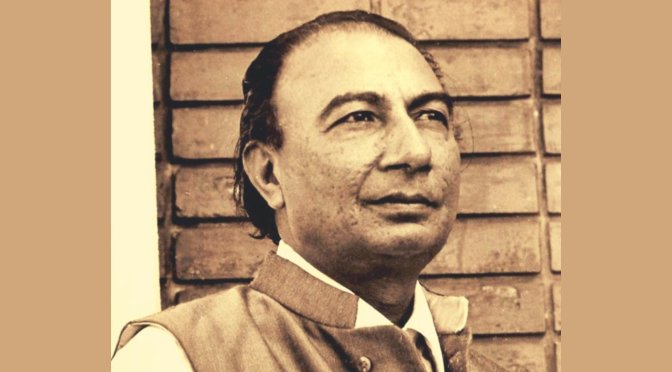
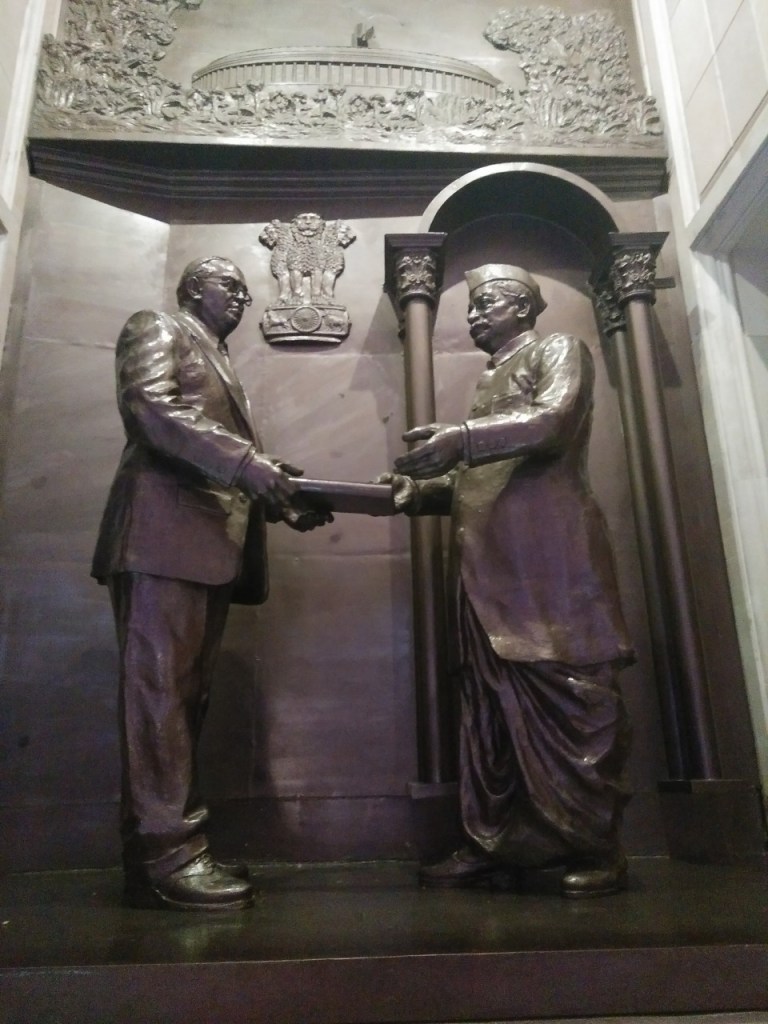
Bhimrao Ramji Ambedkar (14 April 1891 – 6 December 1956)
© 2017 Pippa Virdee

Ambedkar, Bhimrao Ramji, and Frances W. Pritchett. Pakistan or Partition of India. Thacker, 1946

The Muslim League’s Resolution on Pakistan has called forth different reactions. There are some who look upon it as a case of political measles to which a people in the infancy of their conscious unity and power are very liable. Others have taken it as a permanent frame of the Muslim mind and not merely a passing phase and have in consequence been greatly perturbed.The question is undoubtedly controversial. The issue is vital and there is no argument which has not been used in the controversy by one side to silence the other. Some argue that this demand for partitioning India into two political entities under separate national states staggers their imagination; others are so choked with a sense of righteous indignation at this wanton attempt to break the unity of a country, which, it is claimed, has stood as one for centuries, that their rage prevents them from giving expression to their thoughts. Others think that it need not be taken seriously. They treat it as a trifle and try to destroy it by shooting into it similes and metaphors. “You don’t cut your head to cure your headache,” “you don’t cut a baby into two because two women are engaged in fighting out a claim as to who its mother is,” are some of the analogies which are used to prove the absurdity of Pakistan. In a controversy carried on the plane of pure sentiment, there is nothing surprising if a dispassionate student finds more stupefaction and less understanding, more heat and less light, more ridicule and less seriousness. My position in this behalf is definite, if not singular. I do not think the demand for Pakistan is the result of mere political distemper, which will pass away with the efflux of time. As I read the situation, it seems to me that it is a characteristic in the biological sense of the term, which the Muslim body politic has developed in the same manner as an organism develops a characteristic. Whether it will survive or not, in the process of natural selection, must depend upon the forces that may become operative in the struggle for existence between Hindus and Musalmans. I am not staggered by Pakistan; I am not indignant about it; nor do I believe that it can be smashed by shooting into it similes and metaphors. Those who believe in shooting it by similes should remember that nonsense does not cease to be nonsense because it is put in rhyme, and that a metaphor is no argument though it be sometimes the gunpowder to drive one home and imbed it in memory. I believe that it would be neither wise nor possible to reject summarily a scheme if it has behind it the sentiment, if not the passionate support, of 90 p.c. Muslims of India. I have no doubt that the only proper attitude to Pakistan is to study it in all its aspects, to understand its implications and to form an intelligent judgement about it.
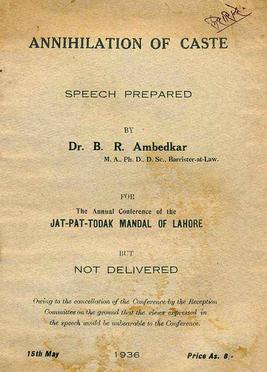
First_edition_of_Annihilation_of_CasteAmbedkar, Bhimrao Ramji. Annihilation of Caste: The annotated critical edition. Verso Books, 2014.

The Annihilation of Caste was an undelivered speech written in 1936 and to be delivered at the Jat-Pat Todak Mandal (Society for the Abolition of Caste system). However, the organiser found elements within the speech objectionable and Ambedkar refused to censor his words.

Roy, Arundhati, B. R. Ambedkar, and S. Anand. Annihilation of Caste: The Annotated Critical Edition. (2014). 

Other contemporary abominations like apartheid, racism, sexism, economic imperialism and religious fundamentalism have been politically and intellectually challenged at international forums. How is it that the practice of caste in India – one of the most brutal modes of hierarchical social organisation that human society has known – has managed to escape similar scrutiny and censure? Perhaps because it has come to be so fused with Hinduism, and by extension with so much that is seen to be kind and good – mysticism, spiritualism, non-violence, tolerance, vegetarianism, Gandhi, yoga, backpackers, the Beatles – that, at least to outsider, it seems impossible to pry it loose and try to understand it.

Listen to The Doctor and The Saint: The Ambedkar—Gandhi debate: Race, Caste and Colonialism with Arundhati Roy (2014)


O’Boyle, Jane “The New York Times and the Times of London on India Independence Leaders Gandhi and Ambedkar, 1920–1948” American Journalism, Volume 35, 2018 – Issue 2, 214-235.

During the years before India’s independence, the Times of London published news stories that were derisive and skeptical of Mahatma Gandhi, reflecting a national policy to diminish his power in the process to “quit India.” The Times was respectful of the untouchables’ leader Bhimrao Ambedkar and his civil rights movement for untouchables, perhaps to further distract from Gandhi’s popularity. The New York Times lavished positive attention on Gandhi and largely ignored Ambedkar altogether. The American newspaper framed a hero of colonial independence and never his oppression of untouchables, adhering to news policy during the Jim Crow era of racial persecution.

Teltumbde, Anand. The Persistence of Caste: The Khairlanji murders and India’s hidden apartheid. Zed, 2010. 

While the caste system has been formally abolished under the Indian Constitution, according to official statistics, every eighteen minutes a crime is committed in India on a Dalit-untouchable. The Persistence of Caste uses the shocking case of Khairlanji, the brutal murder of four members of a Dalit family in 2006, to explode the myth that caste no longer matters. In this exposé, Anand Teltumbde locates the crime within the political economy of post-Independence India and across the global Indian diaspora. This book demonstrates how caste has shown amazing resilience – surviving feudalism, capitalist industrialization and a republican constitution – to still be alive and well today, despite all denial, under neoliberal globalization.

Teltumbde, Anand. “Deconstructing Ambedkar,” Economic and Political Weekly (May 2, 2015).

Electoral politics became competitive bringing to the fore vote blocks in the form of castes and communities, both skilfully preserved in the Constitution in the name of social justice and religious reforms, respectively. The competing Ambedkar icons offered by various political manufacturers in India’s electoral market have completely overshadowed the real Ambedkar and decimated the potential weaponry of Dalit emancipation. The rhetoric of aggressive development, modernity, open competition, free market, etc, necessitated the projection of a new icon which would assure people, particularly those of the lower strata whom it would hit most, of the possibility of a transition from rags to riches with the adoption of the free-market paradigm.

Further Reading

Ministry of External Affairs (GoI): Writings & Speeches of Dr. Babasaheb Ambedkar https://www.mea.gov.in/books-writings-of-ambedkar.htm

Jaffrelot, Christophe. India’s silent revolution: the rise of the lower castes in North India. Orient Blackswan, 2003.

Jodhka, Surinder S. “Caste: why does it still matter?.” In Routledge Handbook of Contemporary India, pp. 259-271. Routledge, 2015.

Pandey, Gyanendra. A history of prejudice: race, caste, and difference in India and the United States. Cambridge University Press, 2013.

Padosi (1941) – Neighbour

Many times browsing through archives, especially the digital kind, leads you from one place to another. I was scanning the British Newspaper Archive for material related to the North-West Frontier of British India and ended up finding a small snippet in the Public Notices section of The Coventry Evening Telegraph on an Indian film, Padosi, hosted by the IWA at the Opera House in 1945.

The Coventry Evening Telegraph, Thursday, April 26, 1945

The Indian Workers Association (IWA) was founded in 1938 in Coventry to mobilise for Indian independence amongst the small working-class Indian community living in the UK. Many of its early members were from Sikh and Muslim Punjabi backgrounds. Some of these members were sympathetic to and inspired by the Ghadr Party (est. 1913 in California). The British government naturally kept an eye on their activities; not only for their nationalist motivations but also for their leftist leanings. The extract below is taken from a document on the IWA, dated 14 April 1942.

The Hindi (or Hindustani) Mazdur Sabha, now more usually referred to as the Indian Workers’ Association (or union), has come gradually into being as a result of war conditions. In the two years preceding the outbreak of war a number of disaffected Sikhs – some of them with Ghadr Party contacts – who had come to the United Kingdom to work as pedlars decided to start, if possible, an organisation of Indians which should give all possible aid to the movement for Indian independence. At first the only practical step towards carrying out this decision were the secret collections and remittances to India of sums of money for payment to the dependents of political prisoners. The fund in India which received these sums of money was created by the Ghadr Party in California and there can be little doubt that the Indians in the UK who were chiefly interested in these collections were actuated by motives and by a long-range policy which were identical with these of the Ghadr Party. Some of them were in receipt of the “Hindustan Ghadr” until the close watch of the postal censorship succeeded in imposing an effective check on the entry of the paper into the UK. From the very beginning Coventry was the headquarters of the movement, for it so happened that the Indians chiefly interested were pedlars who sold their goods in the Coventry area. (File no. L/PJ/12/645)

Read further about the IWA:

Gill, Talvinder. “The Indian Workers’ Association Coventry 1938–1990: Political and Social Action.” South Asian History and Culture 4, no. 4 (2013): 554-573. DOI: 10.1080/19472498.2013.824683

Virdee, Pippa. Coming to Coventry: Stories from the South Asian Pioneers. The Herbert, 2006.

Communities in Action: the Indian Workers’ Association – Our Migration Story

Indian Workers’ Association – Making Britain

The film listed in the Public Notices snippet is “Parosi” (sic). This was a social drama directed by V. Shantaram and was set in the back drop of Hindu-Muslim unity. The Indian national movement was remarkably communalised in its last years, leading to unprecedented violence accompanying the end of British India. In 1941, it was unclear when and how this end would come. Alongside this rising tide of deteriorating inter-communal relations, there were progressive voices in the diversifying public sphere, now including cinema. One of these was the film’s legendary director, Shantaram, who pointedly got a Muslim actor to play a Hindu character and vice versa, to promote harmony between the communities. It is the type of film I imagine the IWA would want to show, as the organisation wished to emphasise class unity over communal politics in the battle against colonialism.

The Opera House, Hales Street, Coventry. Picture Source: http://cinematreasures.org/theaters/37902

The Opera House in Coventry was opened in 1889. During World War II, the building was damaged by bombing but it was quickly repaired and transformed into a cinema when it re-opened in 1941. The Opera House closed in 1961 and, while there were plans to restore it to a live theatre venue, this never happened.

Read more about the former cinemas in Coventry.

Sahir Ludhianvi and the anguish of Nehruvian India

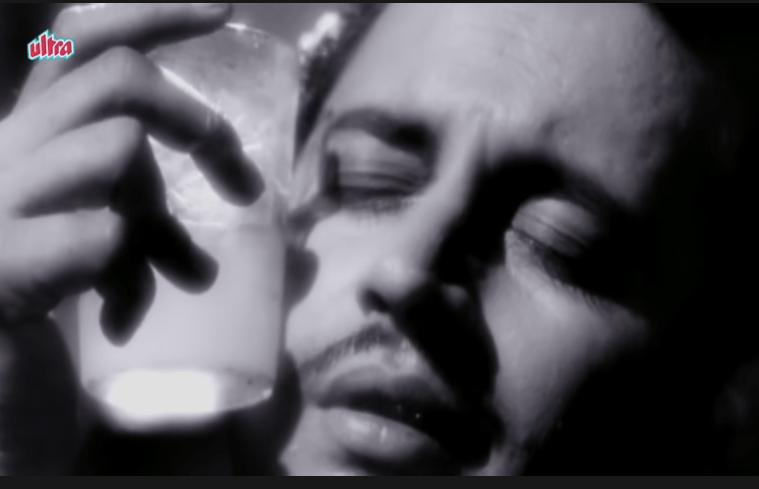
This song/poem written by Sahir Ludhianvi for the film Pyaasa, starring Guru Dutt, has as much relevance today as it did in 1957 at the height of the Nehruvian age. The lyrics and translation below are courtesy of Proud Indians, Are We? – Jinhe Naaz Hai Hind Par – Pyaasa By Deepa.

It is also worth reading the broader article, which is on Guru Dutt, “a man clearly ahead of his time.” Follow link for the song via YouTube. Make sure if you listen to any other versions that it has the last Antara of the song, which has been cut in some versions.

Ye kooche ye nilaam ghar dilkashi ke
Ye lutate huye caravan zindagi ke
Kahaan hain kahan hain muhafiz khudi ke
Jinhe naaz hai hind par wo kahaan hain
Kahaan hain kahaan hain kahaan hain

Look at these lanes, alluring houses which are up for sale/auction everyday. Look at these robbed caravans of life. Where are those protectors of self respect and pride? Where are those who say we are proud Indians? What are you exactly proud of?

Ye purpech galiyaan ye badnaam bazaar
Ye gumnaam raahi ye sikkon ki jhankaar
Ye ismat ke saude ye saudon pe taqraar
Jinhe naaz hai hind par wo kahaan hain
Kahaan hain kahaan hain kahaan hain

These complicated streets, these defamed, scandalized markets. The unknown pedestrians who walk in anytime with bagful of money. This trade of honour and chastity followed by the bargains of the same. Are we Indians proud for this? Where are those who say this?

Ye sadiyon se bekhauf sehmi si galiyaan
Ye masli huyi adhkhili zard kaliyaan
Ye bikti huyi khokhli rangraliyaan
Jinhe naaz hai hind par wo kahaan hain
Kahaan hain kahaan hain kahaan hain

These lanes which for years have been under pressure of fear, distress, angst. This place where the pale half blossomed buds are crushed (referring to young girls who fall prey to the flesh trade). The hollow festivities which are sold in this market. Show all this to those who say, they are proud of this country. Where are those people?

Wo ujle darichon mein paayal ki chhan chhan
Thaki haari saanson pe table ki dhandhan
Ye berooh kamron mein khaansi ki thanthan
Jinhe naaz hai hind par wo kahaan hain
Kahaan hain kahaan hain kahaan hain

The sound of the trinkets, anklets which come from the shimmering windows. Those tired, ill heartbeats which try to keep pace with the pace. This soul less room which filled with the unpleasant sound of coughing. For those who say they are proud Indians, please come and see this.

Ye phoolon ke gajre ye pikon ke chhinte
Ye bebaak nazrein ye gustaakh fiqrein
Ye dhalke badan aur ye bimar chehre
Jinhe naaz hai hind par wo kahaan hain
Kahaan hain kahaan hain kahaan hain

The flowers, the garlands, the stains of betel juice. The bold stares, the blunt, audacious comments. The deteriorating, decaying bodies and weak faces. Look at them, those who say, they are proud of their country.

Yahan piir bhi aa chuke hain jawaan bhi
Tanaumand bete bhi abba miyaan bhi
Ye biwi bhi hai aur behan bhi hai maa bhi
Jinhe naaz hai hind par wo kahaan hain
Kahaan hain kahaan hain kahaan hain

The ambassadors of religion, the young and the old, the sons and the fathers, all are regular visitors to this place. Here you will find someone’s wife, someone’s sister or mother too. Come and have a look at this place. Will this place make you proud?

Madad chaahti hai ye hawwa ki beti
Yashoda ki hamjins Radha ki beti
Payambar ki ummat Zulaykha ki beti
Jinhe naaz hai hind par wo kahaan hain
Kahaan hain kahaan hain kahaan hain

The girls, women here need help. They are no different from Eve, Yashoda, Radha, Zulaykha who are seen with regard and respect. Come and help them, they need you.

Zara mulk ke rahbaron ko bulaao
Ye kooche ye galiyaan ye manzar dikhaao
Jinhe naaz hai hind par unko laao
Jinhe naaz hai hind par wo kahaan hain
Kahaan hain kahaan hain kahaan hain

Someone please call the so called guides, leaders of the country. Show them these lanes, show them this miserable scene. Call them those who say they are proud of their country. Where are they?

Across Three Continents with a Sewing Machine in Tow


© Pippa Virdee

A fragment of my personal history in celebration of International Women’s Day and in memory of my own mother, who played such an important part in shaping my ideas. Visit the Indian Memory Project to read the full piece which I wrote in 2013.

Reconciliation…

A reminder of the human cost of conflict…

The text on the plaque reads:

Reconciliation

In 1995, 50 years after the end of the Second World War this sculpture by Josefina de Vasconcellos has been given by Richard Branson as a token of reconciliation. An identical sculpture has been placed on behalf of the people of Coventry in the Peace Garden, Hiroshima, Japan.

Both sculptures remind us that, in the face of destructive forces, human dignity and love will triumph over disaster and bring nations together in respect and peace.

Josefina de Vasconcellos said that, “The sculpture was originally conceived in the aftermath of the War. Europe was in shock, people were stunned. I read in a newspaper about a woman who crossed Europe on foot to find her husband, and I was so moved that I made the sculpture. Then I thought that it wasn’t only about the reunion of two people but hopefully a reunion of nations which had been fighting.”

In 1995 (to mark the 50th anniversary of the end of World War II) bronze casts of the sculpture Reconciliation were placed in the ruins of Coventry Cathedral and in the Hiroshima Peace Park in Japan.

Read Josefina de Vasconcellos’ obituary in The Guardian.

The Remains of Buddha in Taxila

While the present nation-states of Pakistan and Afghanistan are Islamic Republics, there was a time when the religion of Buddha registered a strong presence in areas, now part of these states. Back in 2001, when the ‘Buddhas of Bamiyan’ were blasted by the Taliban in Afghanistan, the visuals were received with astonishment and horror across the world. These ancient, iconic carvings were UNESCO protected monuments and represented the classic syncretic style of Gandhara art. The Taxila Museum in Punjab province of Pakistan is home to the largest collection of ancient Gandharan artefacts in the country dating back to the time from the 1st to the 7th c. AD. Most of these were excavated at the nearby ruins of the ancient city of Taxila. The museum itself dates back to 1918.

John Marshall (1876-1958), was one of the most famous directors of the Archaeological Survey of India and excavator of the city of Taxila. Marshall began the excavations at Taxila in 1913, which carried on for another twenty years, apart from laying the foundation stone of the museum in Taxila. Later, he produced An Illustrated Account of Archaeological Excavation of Taxila in 1951. This 3-volume work details the Taxila excavations of 1913-1934 and opens with an apt description of the importance of topography in situating ancient Taxila:

‘The remains of Taxila are situated immediately to the east and north-east of Sarai-kala, a junction on the railways, 20 miles north-west of Rawalpindi. The valley in which they lie is a singularly pleasant one, well-watered by the Haro river and its tributaries, and protected by a girdle of hills – on the north and east by the snow mountains of Hazara and the Murree ridge, on the south and west by the well-known Margalla spur and other lower eminences. This position on the great trade route, which used to connect Hindustan with Central and Western Asia, coupled with strength of its natural defences, the fertility of its soil, and a constant supply of good water, readily account for the importance of the city in early times’.

While Buddha (5th-4th c. BC) did not venture to Gandhara, growth of Buddhism in this region happened under the Mauryan Empire (322-185 BC). Gandhara was a province of the Persian Empire under Darius I. In 327 BC, Alexander advanced as far as Taxila in his conquests, but shortly thereafter, the region was consolidated with the territorial reach the Mauryan dynasty. It was Chandragupta’s grandson, Emperor Ashoka, who converted to Buddhism in c. 263 BC, following the especially bloody Kalinga War.

It was under the Kushans’ (people of Scythian origin) rule that the Gandhara region assumed its important place in the history of Buddhism and especially its art. Under ruler Kanishka in the 1st c. AD, ‘Buddhist sages made Gandhara a sacred region by the compilation of texts associating local sites with previous incarnations of the Buddha’ (1956). The Kushans’ ‘greatest contribution of Gandhara to the art of Asia was the invention of the Buddha image. The first anthropomorphic representation of the Great Teacher was probably related to the emergence of the devotional sects of Buddhism and demand for the portrayal of the object of worship in an accessible human form in place of the entirely symbolic portrayals of the master in the art of early Hinayana Buddhism’ (1960).

Great Stupas were subsequently built in the region, of which some still survive and are preserved in the Taxila Museum. In Takht-i-Bahi (Mardan, KP province), there is a large Buddhist monastic complex, which forms an important site of this period in the region, representing the Gandhara school of art and architecture. Dating from 1st – 2nd c. AD, Buddhism flourished here, leading to a new, syncretic Greco-Buddhist art/architecture & culture. Mediterranean and Persian influences gave Gandhara sculpture characteristics, which distinguishes it from other Buddhist art notably the Mathura school (1956).

While the archaeological evidence of the extent and importance of Gandhara only came to light in early-20th c., textual evidence and knowledge about it was available through accounts by Chinese Buddhist pilgrims. They recorded and left behind incredibly detailed descriptions of their travels, for example, the stories of Fa Hsien’s journey in c. 400 AD, the journey of Sung Yun in the 6th c., and the most detailed of all, Hiuen Tsang’s Hsi Yii Chi, Records of the Western Countries, composed in early-7th c. (1960).  


Sources:

Marshall, John. Taxila: An Illustrated Account of Archaeological Excavations Carried out at Taxila under the Orders of the Government of India between the years 1917 and 1934. 3 Volumes. Cambridge University Press, 1951.

Rowland, Benjamin. Gandhara Sculpture from Pakistan Museums. Asia Society, 1960.

Gandhara Sculpture in the National Museum of Pakistan, published for the Department of Archaeology by The Department of Advertising, Films and Publications. Printed by Ferozsons, October 1956.

Further Reading:

Asif H., Rico T. ‘The Buddha Remains: Heritage Transactions in Taxila, Pakistan’. In: Rico T. (eds) The Making of Islamic Heritage. Heritage Studies in the Muslim World. Palgrave Macmillan, (2017).

Van Aerde, M. E. J. J. ‘Revisiting Taxila: A new approach to the Greco-Buddhist archaeological record.’ Ancient West & East 2018 (2018).

Two perceptions of the language divide in (East) Punjab, 1951

Punjabi 1951 Census
Gupta, Jyotirindra Das, and Jyotirindra Dasgupta. Language conflict and national development: Group politics and national language policy in India. Univ of California Press, First published 1970. PP.46-7

Punjabi 1961 Census
Gupta, Jyotirindra Das, and Jyotirindra Dasgupta. Language conflict and national development: Group politics and national language policy in India. Univ of California Press, First published 1970. PP.46-7

Swaran Singh (Civil Lines, Jullundur City) to Sardar Baldev Singh, 6 March 1951 (Nehru Papers post-47 file 75)

“A very serious situation has arisen in Jullundur district over the language controversy. You must be already aware of the propaganda which was carried on by a certain class of Hindus for persuading the Harijan classes to state at the time of census that Hindi was their mother tongue. Partly as a result of this propaganda and partly on account of the predominance of Hindus amongst the enumerators, a very large section of Harijan population has been recorded as Hindi-speaking population…Illiterate Harijans in the villages who cannot speak or understand even one word of Hindi have been recorded as Hindi-speaking individuals. This has naturally caused resentment in the minds of the Sikhs and they have in a quiet and peaceful manner told the Harijans that the latter have nothing to do with them and a state of peaceful boycott prevails in a fairly large number of villages…The Hindu communalists nakedly in some cases and under the grab of Congress and nationalism in other cases, have fully exploited this situation. They have instigated the Harijans to pick up some quarrel or the other and thus to afford a pretext to the police to make arrests. During the last 3-4 days over 100 persons have already been arrested from villages situated in the different tehsils of the district. Of the arrested persons, about 30-40 so far are the Harijans and the remaining persons are Sikhs, mostly Jats. The action is taken for breach of peace and bails are purposely delayed in order to demoralize the rural people…I had a long talk with [Chief Minister] Dr. Gopi Chand who was on tour at Jullundur yesterday, but as usual he is extremely indecisive. [Some] MLAs are doing their worst to instigate the Harijans and are poisoning the ears of the local officers. Lala Jagat Narain [future founder/editor of Punjab Kesari] has been particularly poisonous in his writings. A very serious situation prevails, and I won’t be surprised if the province is hurled into chaos and if serious effort is not made to straighten out this matter…The self-styled leaders, the press and the local officers should be made to realize that they are playing with fire and the consequence can be extremely disastrous”.

PV Bhaskaran (Deputy Director – Intelligence Bureau) to HVR Iengar (Ministry of Home Affairs), VP Menon (Ministry of States) & Dharma Vira (Pr. PS to PM), 15 March 1951 (Nehru Papers post-47 file 75)

“The bitter animosity which has been witnessed in Punjab and the PEPSU between the Sikhs and the Hindus over the Punjabi-Hindi language controversy in the census has had unpleasant repercussions for the Harijans in many centres of these two states. There have been several complaints of the coercion [arson] and economic boycott [departure] of the Harijans of the PEPSU by the Sikhs, [across villages] in Kapurthala and Patiala district(s). Security proceedings have had to be commenced against Harijans and Sikh Jats…

A deputation of Hindus and Harijans of [some] villages of Kapurthala district, waited on the District Commissioner with complaints of oppression, but were reported to have been told that they had themselves invited this trouble by furnishing Hindi as their language, while living in a Punjabi-speaking area…of Sikh Zamindars. Some of them complained that Akali workers had forcibly obtained their thumb impressions on applications, which sought to have their language changed from Hindi to Punjabi. Some harassment of Harijan women has also been mentioned, [amidst] reported, [en]forced [departures]…Some Harijans, apparently acting under intimidation, actually applied to the DC to alter their language from Hindi to Punjabi in the census returns. In Sangrur district, the Harijans are reported to have been boycotted by the Sikh Zamindars, with the result that they had to march long distance to the town to fetch their food-grains and other daily necessities of life. The districts of Bhatinda and Fatehgarh Saheb were the [other] areas from which such trouble has been reported [with] Harijans of rural areas reported to have moved to town for safety.

In Punjab, Jullundur district has been the worst affected. 98 Jat Sikhs and 45 Harijans have been arrested in this district. A Harijan was murdered by Jat Sikhs…on February 28. Some of the houses of the Harijans who furnished Hindi as their language were reported to have been set on fire…It is reported that the Harijans of these areas have refused to remove the dead bodies of the animals belonging to the Sikhs, and that the latter have boycotted them…Similar complaints have also been made against the Sikhs by the Hindus and the Harijans of some centres of Gurdaspur district…Hoshiarpur and Ferozepur district have also been scenes of similar communal trouble.

The PEPSU Achhut Federation has protested strongly against the “unprovoked high-handedness and injustice” done to Harijans during the census and has demanded their immediate resettlement in their own villages. [There was] a well-attended conference of the depressed classes’ league at Patiala on March 4. A resolution was then accepted, urging the central government to order an independent enquiry on the high-handedness of the Sikhs and the maltreatment of the Harijans of Punjab and the PEPSU in the course of the census operations. [A] speaker warned that the Harijans could cause havoc by staging a week’s hartal of sweepers. [Another] warned the Sikhs not to poison the atmosphere with the language controversy.

The Harijan Sabha of Amritsar convened a meeting on March 6 and warned the Harijans to beware of the tactics of both the Hindus and the Sikhs, and to remain aloof as a separate group. The government was also requested to take the necessary action against the aggressors, failing which, it was warned that a movement of satyagraha would be commenced by refusing to do scavenging and other menial services. The Sweepers Federation of Simla also held a meeting, to deplore the communal tension created by the census operations due to the coercion of the Sikhs. One of the speakers…threatened a strike of sweepers. Resolutions were adopted protesting against the victimisation of the Harijans and demanding the appointment of an enquiry committee consisting of officials drafted from other states.

A refugee camp has been set up at Amritsar by the Hindu Mahasabha and the RSSS, with the assistance of the local Scheduled Castes Federation, to shelter the Harijans who have been migrating from rural areas…There are now only 25 inmates in this camp, but about 245 other Harijans are in shelter in the town with the help of local Hindu hide merchants…This situation was mentioned by NC Chatterjee of the Hindu Mahasabha, at a public meeting at Amritsar on March 11, when he said that the social boycott of the Harijans of Punjab would lead to civil war and anarchy. [A] Punjab Hindu Mahasabha [speaker] advised the Sikhs to stop their oppression of the Harijans in rural areas, warning them that the Sikhs might similarly be victimised in other states of India where they were n a minority.

As is well-known, Master Tara Singh and other leaders of the Shiromani Akali Dal have been bitterly critical of the Hindus and their action in recording Hindi as their language in the census…[Their] visit in Patiala, in the last week of February, gave rise to rumours of impending communal disturbances…Several refugees are reported to have left…Unless firm measures are taken both at official and non-official levels, there may be the danger of the situation getting out of hand”.

Further reading: Singh, Atamjit. “The Language Divide in Punjab.” South Asian Graduate Research Journal 4, no. 1 (1997). Available via Apna.org

Faletti’s

Faletti’s Hotel is the oldest colonial hotel in Lahore. It opened in 1880 in the old walled city. Back then, it claimed to be one of the finest hotels. By modern standards, this is not a big place, but it is certainly one of the most sought after. It retains the colonial architecture along with a matching attitude. One of the reasons that Faletti’s continues to attract so much attention is to do with the famous guests that have stayed there, over the years.

Read about the origins and owner, Giovanni Faletti on Faletti’s website.

A fascinating account in Dawn about the owners changing hand:

According to tales recounted by old hotel employees, Faletti’s Hindu clerk, Oberoi, offered to buy some shares, and Faletti was so impressed and delighted that someone whose job was to haul coal for the rooms had saved enough to buy the shares of his hotel that he allowed him to become his trusted employee. When Faletti finally left Pakistan, he gifted Oberoi all his hotels on the condition that he would not change the name of Faletti’s. Oberoi stayed true to his word and earned so much from just Faletti’s alone that he invested in a hotel in Delhi, the famous Oberoi, following which he established more hotels in India…After the 1965 war, Oberoi decided to move to India and sold majority shares of the hotel to PTDC — again on the condition that the hotel name would not be changed.

Everyone from the great Quaid-i-Azam to Hollywood actors have stayed at the hotel. Ava Gardner and Stewart Granger stayed here for three months during the filming of Bhowani Junction, which took place in 1955. The room in which she stayed is now known as the ‘Ava Gardner Suite.’ Marlon Brando stayed here when he was visiting the country on behalf of UNICEF. One of the Chief Justices of Pakistan, A.R. Cornelius, took up residence at Faletti’s and stayed at the hotel for over 40 years until his death in 1991. Whereas Mohammad Ali Jinnah stayed at Faletti’s when he came to Lahore to argue the appeal of Ghazi Ilm-ud-Din Shaheed before the Lahore High Court in July 1929.

Other guests have included the cricketer Sir Garfield Sobers, Jawaharlal Nehru, Dilip Kumar, Raj Kapoor, and Mohammad Rafi.