
In January 1972, Sheikh Mujibur Rahman — released from prison in Pakistan — flew to independent Bangladesh from Rawalpindi (Pakistan) via London and …
Mujibur Rahman’s First Secret Meeting with an Indian Officer — Me
In January 1972, Sheikh Mujibur Rahman — released from prison in Pakistan — flew to independent Bangladesh from Rawalpindi (Pakistan) via London and …
Mujibur Rahman’s First Secret Meeting with an Indian Officer — Me
Kabirdas was a 15th century Indian mystic poet and is revered as a saint by many, across regions, communities, castes, and, now, nations. A disciple of Ramananda (in Banaras), his writings fed the syncretic Bhakti movement, which in turn influenced the development of Nanak and his teachings, to the extent that Kabir’s immortal verses are included in Adi Granth. Kabir was critical of all organised, institutionalised, hierarchical faiths, and their rites and rituals, sanctioned by sanctimonious and exploitative clergy. For Kabir, the Truth was not in these trappings, nor in their egoistic traders.
Read this wonderful explanation and translation: https://www.petervis.com/gallery/web/bollywood-translations/chadariya-jhini-re-jhini-english-translation.html
Kabir and The Kabir Panth by Rev. G.H. Westcott, Fellow of Allahabad University (Cawnpore, 1907) https://archive.org/details/KabirAndTheKabirPanth_466/mode/2up Page 1-5
It is generally allowed that of all the great Reformers, Kabir (1440-1518) and Tulsi Dass (1544-1624) have had the greatest influence for good among…Northern and Central India. Kabir has been described…as the Indian Luther (1483-1546)…
Among those who acknowledge their indebtedness to Kabir as a spiritual guide are Nanak Shah (1469-1538) of the Panjab, the founder of the Sikh community; Dadu of Ahmedabad (1544) founder of the Panth that bears his name, and Jag Jiwan Dass of Oudh (1760) the founder of the Sat Nami sect. Among religious teachers whose doctrine is said to be largely based upon the teaching of Kabir are Bribhan, founder of the Sadh community (1658), Baba Lal of Malwa and Shiva Narain of Ghazipur.
In modern days the number of those who have in one way or another come under the influence of Kabir is very great. In the Census Report of 1901, the number of Kabir Panthis alone is returned as 843,171 and the actual number is probably considerably larger, as in the United Provinces many Kabir Panthis seem to have been returned as Ramanandis and the figures for the Panjab are not included.
The hymns of Kabir are still sung by many a wandering minstrel, while his pithy sayings are frequently employed to win the attention of a dreamy audience or to clench a lengthy argument.
Unfortunately, the material for a life of Kabir is miserably scanty. It is admitted by all Kabir Panthis that Kabir was brought up as a child in the house of Niru, a weaver. In the Adi Granth occur these lines: By caste a weaver and patient of mind: utters Kabir with natural ease the excellences of Ram.
One Hundred Poems of Kabir, translated by Rabindranath Tagore, assisted by Evelyn Underhill (Macmillan, 1915) https://archive.org/details/OneHundredPoems/mode/2up?q=kaaba Page XV
It does not need much experience of ascetic literature to recognise that boldness and originality of this attitude in such a time and place. From the point of view of orthodox sanctity, whether Hindu or Mohammedan, Kabir was plainly a heretic; and his frank dislike of all institutional religion, all external observance – which was a thorough and as intense as that of the Quaker themselves – completed, as far as ecclesiastical opinion was concerned, his reputation as a dangerous man. The God whom he proclaimed was “neither in Kaaba nor in Kailash.”
 Mo ko kahan dhunro bande
 O servant, where dost thou see Me?
 Lo! I am beside thee
 I am neither in temple nor in mosque:
 I am neither in Kaaba nor in Kailash:
 Neither am I in rites and ceremonies, nor in Yooga and renunciation.
 If thou art a true seeker, thou shalt at once see Me: thou shalt meet Me in a moment of time.
 Kabir say, “O Sadhu! God is the breath of all breath.”

 Santan jat na pucho nirguniyan
 It is needless to ask of a saint the caste to which he belongs;
 For the priest, the warrior, the tradesman, and all the thirty-six castes, alike are seeking for God.
 It is but folly to ask what the caste of a saint may be;
 The barber has sought God, the washerwoman, and the carpenter –
 Even Raidas was a seek after God.
 The Rishi Swapacha was a tanner by caste.
 Hindus and Moselms alike have achieved that End, where remains no mark of distinction.
HAD ANHAD (Bounded Boundless): Journeys with Ram & Kabir (103 min, English Subtitles) A film by Shabnam Virmani – Kabir was a 15th century mystic poet of north India who defied the boundaries between Hindu and Muslim. He had a Muslim name and upbringing, but his poetry repeatedly invokes the widely revered Hindu name for God – Ram. Who is Kabir’s Ram? This film journeys through song and poem into the politics of religion, and finds myriad answers on both sides of the hostile border between India and Pakistan.
Further Reading see Purushottam Agrawal: Kashi ka Kabir and Akath Kahani Prem Ki: Kabir Ki Kavita Aur Unka Samay (An Ineffable Tale of Love: Kabir’s Poetry and his Times) (Rajkamal Prakshan, 2009).
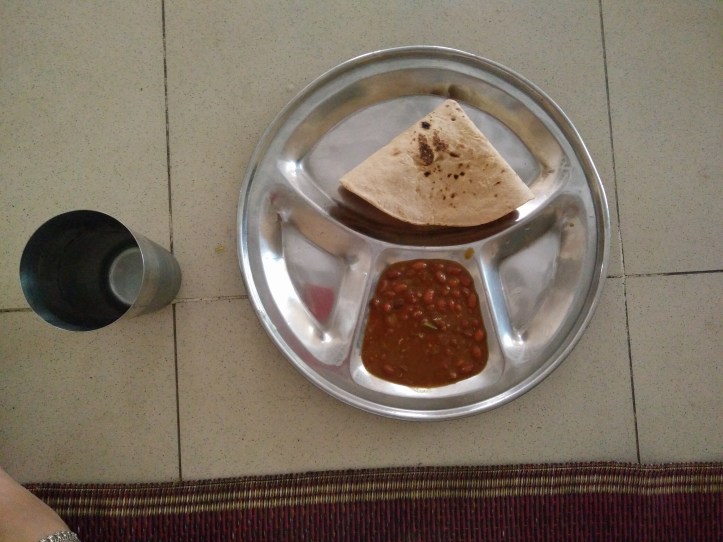
One of the earliest pieces I started with on this blog was with this picture of Guru ka Langar (or food for the congregation) in Lahore. The simplicity of daal (lentils) or in this case rajma (kidney beans) with roti (bread) is the basis of most langar served in a Gurdwara. As a child, I remember most children enjoyed going there in part because of the karah parshad (sweet halwa made from whole wheat flour) given at the end of the service and followed by the (free) food, which had its own distinctive divine taste, impossible to recreate at home.
Langar is the communal partaking of food when visiting Gurdwara. The concept has in recent years been popularised globally by Sikh organisations such as Khalsa Aid, which plan, produce and distribute langar to people across the crisis-ridden world, be it to the truckers stranded in Dover over the ongoing Christmas period or in recent war-torn Syria. With Langar spreading so does knowledge about and experience of the Sikh community. Currently, closer to the home of Sikhism in Punjab, Langar has been making headlines via the ongoing farmers’ movement against new farm laws in India. Communal kitchens have been set-up by the roadside to feed the thousands gathered on the borders of capital, Delhi.
Origins
The word ‘langar’ (meaning ‘anchor’) is thought to have come into the Punjabi language from Persian (Nesbitt: 29); although the idea was not unique to the Sikhs, as ‘both the Sufis and the Nath Yogis have a system of collective eating (langar khanah and bhandaras). The Sikhs, however, used it as venue for both service and charity and provided the food themselves [unlike] the Nath Yogis, who begged for food, and the Sufis, who often accepted land-grants to run their kitchens’ (Mann: 27).
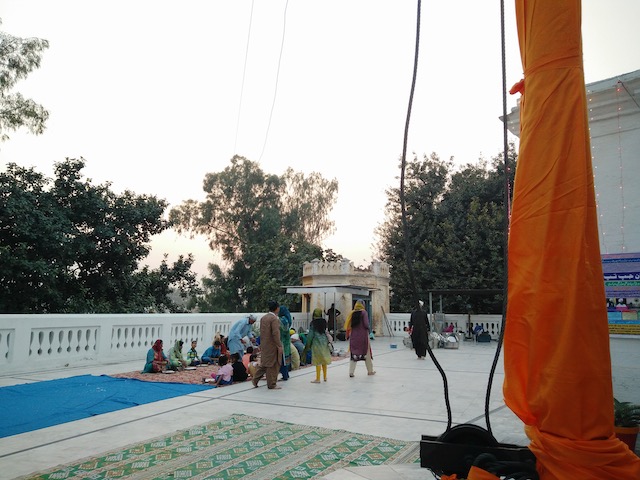
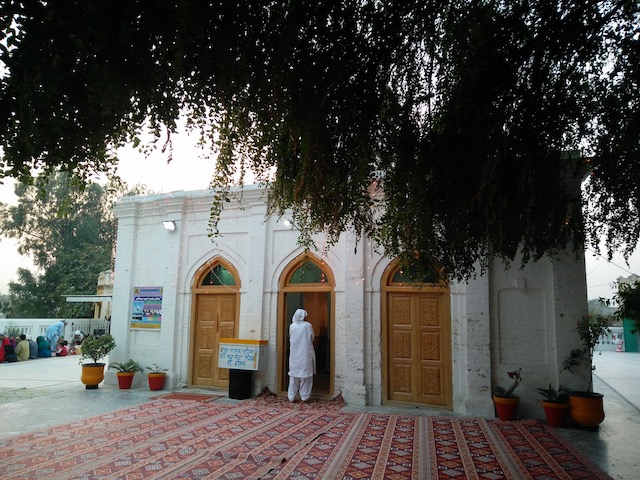
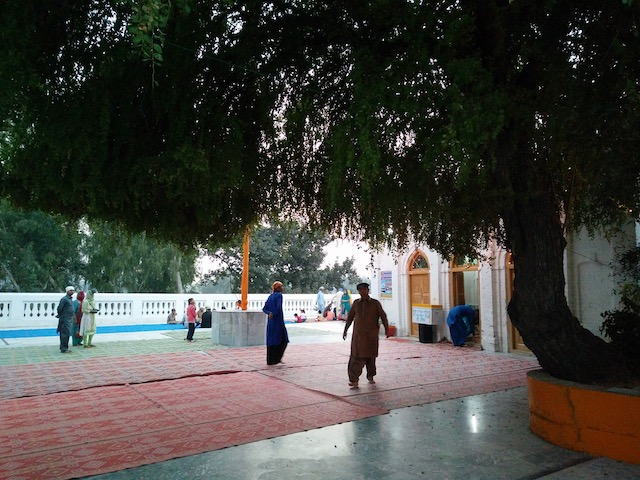
Pictures are of Gurdwara Sacha Sauda, Farooqabad, Pakistan and about 37 miles away from Lahore. This gurdwara is revered with the origins of the langar and is situated not far from Nankana Sahib, the birth place of Guru Nanak.
Baba Farid (1170s-1260s), a Sufi saint from the Chishti order, living in the Punjab, would distribute sweets amongst his visitors; a precursor to langar-khana near shrines, a practice documented in Jawahir al-Faridi (1620s) by a descendent of his. The khanqahs of the Chishti and other Sufi orders kept a langar open for the needy, but also others. It is said that ‘Khwaja Muinuddin established the tradition of an open kitchen for all who came…in an age of feudalism and violence’ (Talib: 6).
There is, of course, a much older practice of the alms house or dharmshala/sarai to feed travellers and poor for free, which is thought to have existed through the Gupta and Maurya (esp. Buddhist) times that is on either side of the BC/AD divide.
Faith
The connections between the Sufis and the Bhakti (devotional) traditions are well documented, inspired as both were by the idea of feeding the poor, the pilgrim and thereby removing divisions/discrimination among people. The idea concretised with the rooting of faith in the region and by early 17th century, it had become a recognised Sikh fixture (Desjardins).
Eleanor Nesbitt notes that, ‘in institutional terms, it was the third Guru, Amar Das [1479-1574], who gave prominence to the langar… [integral as] sharing food [was] to Guru Nanak’s Kartarpur community…it was Guru Amar Das who particularly emphasised the requirement for everyone to dine side by side, regardless of caste and rank’ (Desjardins: 29).
There were two women, who especially, ‘nurtured the development of the langar tradition in its formative period: Mata Khivi (1506-82) and Mata Sundri, the second and tenth Gurus’ wives’. The Guru Granth Sahib notes that ‘Khivi…is a noble woman, who…distributes the bounty of the Guru’s langar; the kheer—the rice pudding and ghee—is like sweet ambrosia’. After the death of Guru Gobind Singh (1666-1708), ‘his widow Mata Sundri worked hard to continue the free community kitchen service. Records show her active role in fundraising for this purpose when the very survival of Sikhism was in question… (Desjardins).
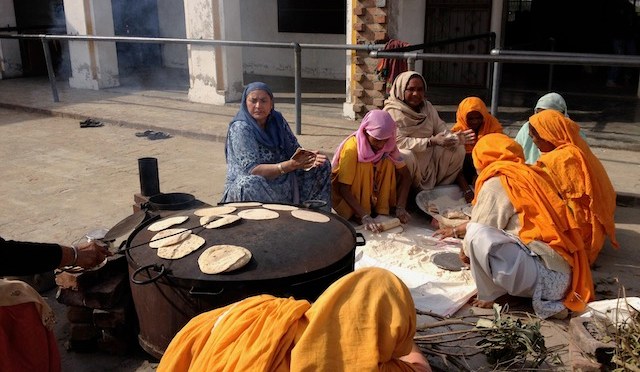
The langar since is thus an integral part of the faith/religion, its compassion through the concept of Seva (self-less service); essential for all practicing Sikhs. Donating food or money is not as important as the practice of giving one’s time and service. Today the most famous community kitchen serving langar has to be the Golden Temple (Amritsar), where around 100,000 people are served on a daily basis. However, most Sikhs grow up visiting and worshipping at small local gurdwaras, where everyday worshippers and volunteers prepare food on a daily basis. These photos are taken from the local gurdwara at Mao Sahib (my father’s village, Jalandhar district), where the congregation prepare, serve, consume the langar and then clean afterwards. As the gurdwaras become more institutionalised, and as the historic gurdwara Mao Sahib (associated with the fifth Guru Arjan and his consort Mata Ganga, d. 1621) has come under the administration of the SGPC (the Sikh body responsible for the management of gurdwaras), voluntary seva has been added to by paid sevadars.
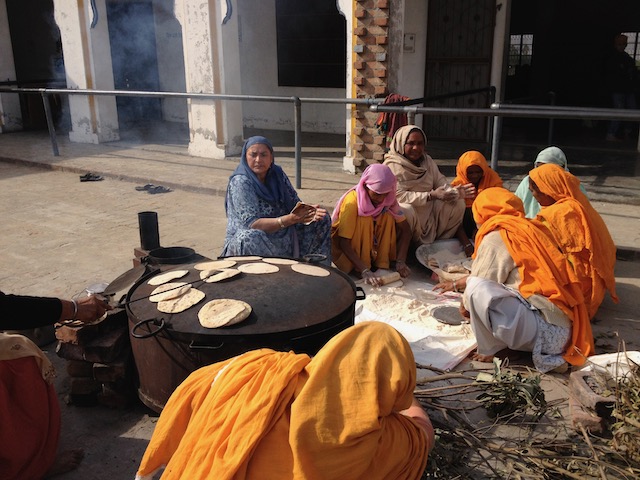

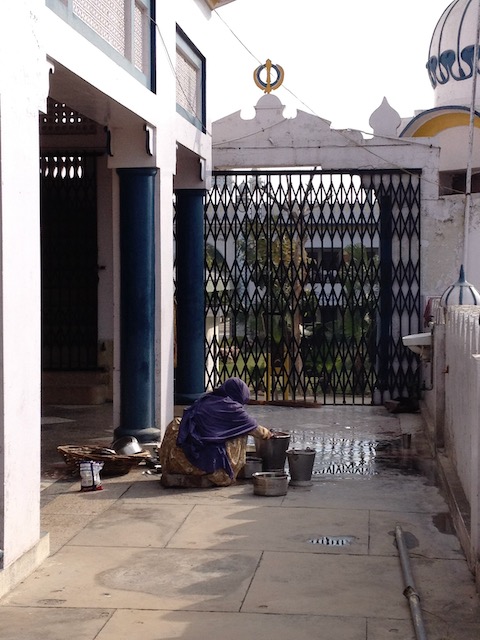
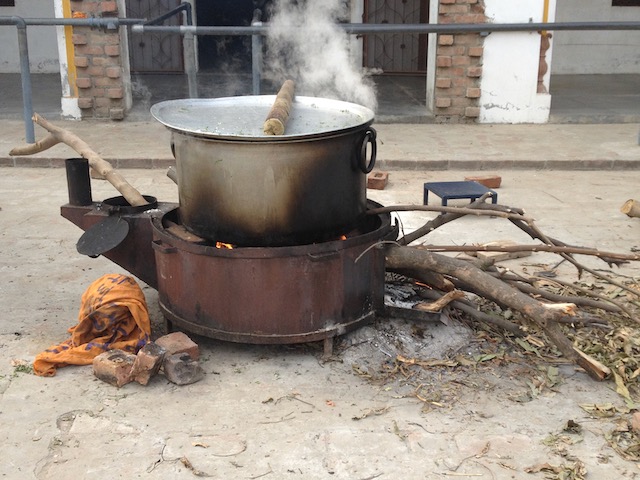
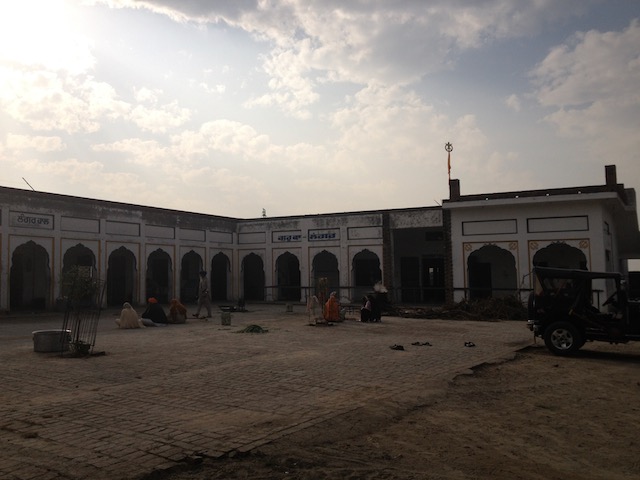
The pictures are of Mao Sahib, 2012, when the langar hall was undergoing a renovation and some of the langar preparation was taking place outside.
Equality
The idea of sitting and sharing food together is fundamental among Sikhs because it demonstrates the abolition of caste and dramatically asserts humble equality amongst all the people; regardless of their religious or caste background. The food is generally simple and vegetarian, to appeal to all and offend no one. Four core Sikh principles are enshrined in the langar: equality, hospitality, service, and charity.
Eleanor Nesbitt writes about how, ‘the Gurus were reformers who abolished the caste system or that caste is Hindu, not Sikh’. It is important to remember how revolutionary this was/is in a caste-ridden society. Nesbitt notes how, ‘the langar subverted Brahminical rules about commensality, according to which only caste fellows could eat together’ (118). Instead, it was proclaimed that, ‘a Sikh should be a Brahmin in piety, a Kshatriya in defence of truth and the oppressed, a Vaishya in business acumen and hard work, and a Shudra in serving humanity. A Sikh should be all castes in one person, who should be above caste’ (117). The Gurus, like the Bhagats Namdev, Kabir, and Ravidas, proclaimed the irrelevance of people’s inherited status to their spiritual destiny. In Guru Nanak’s view:
Worthless is caste (Jati) and worthless an exalted name,
For all humanity there is but a single refuge (Adi Granth 83)
Quoted in Nesbitt: 118
Similarly, according to Guru Amar Das:
When you die you do not carry your Jati with you:
It is your deeds which determine your fate. (Adi Granth 363)
Quoted in Nesbitt: 118
References
Bowker, John (ed.), The Concise Oxford Dictionary of World Religions (OUP, 1997)
Desjardins, Michel, and Ellen Desjardins, ‘Food that builds community: the Sikh Langar in Canada’, Cuizine: The Journal of Canadian Food Cultures/Cuizine: revue des cultures culinaires au Canada 1, no. 2 (2009) https://www.erudit.org/en/journals/cuizine/2009-v1-n2-cuizine3336/037851ar/
Mann, Gurinder Singh, Sikhism (Prentice Hall, 2004)
Nesbitt, Eleanor, Sikhism: A Very Short Introduction (OUP, 2016)
Talib, Gurbachan Singh, Baba Sheikh Farid Shakar Ganj (NBT India, 1974)
More about Gurdwara Sacha Sauda: http://pakgeotagging.blogspot.com/2018/02/084-gurdwara-sacha-sauda-farooqabad.html
Nothing has captured contemporary adjectives around India more than its seemingly inevitable and irresistible MIDDLE-CLASS; a cursory survey yields an expansive collection of studies on the subject. The key question in them often is how to define this broad category.


According to Abhijit Roy and based on data by “the World Bank and the Organization for the Economic Cooperation and Development (OECD), for those in the middle classes, the earnings typically lie in the range of US $10 to $100 per day, as expressed in the 2015 purchasing power parities”. Using the India Human Development Survey II (2011–12), Maryam Aslany reveals significant findings about the Indian middle class:
“(1) It calculates the size of the middle class to be 28.05% of the urban and rural population. (2) It demonstrates that despite the occupational diversity that exists, a large proportion of the middle class are salaried employees. (3) It demonstrates that contrary to common assumptions, a considerable segment of the Indian middle class resides in rural areas. (4) The fastest growth is in the lower middle classes, who spend between US $4 and $6 per day. This group includes carpenters, street vendors, decorators and drivers”.
Statistical evidence aside, one of the key elements of a middle class is how this class shifts from need to want – a key component of the capitalist model, which creates the desire to consume something, even when it is not required. This is an aspirational desire and in India, the strong connection to society/samaaj ensures that this “want and desire” has a strong market, from whose epicentre – Bombay/Mumbai – economists have defined the middle class as “consumers spending from US $2 to $10 per capita per day. By this definition, approximately half of India’s population of 1.3 billion is in the middle class” (Roy).
Employable education is often seen as one of the key routes to this upward mobility. But once successful, there is also potentially a “tussle between individuality and community: seeking novel self-expression in new jobs and leisure or taking risks with autonomy (the divorce rate is growing, from a low base), but also attempting to keep a sense of community, with dutiful support of parents (a high number of IT professionals buy cars for their parents) and strenuous attempts at maintaining a social circle (oriented around alcohol, movies, resorts and restaurants)” (Ram-Prasad).
One of the challenges with understanding how class works in India is the overlaps with caste. It is often difficult to disaggregate the two. “Upper-caste elites have, in recent decades, become used to those below them in the hierarchy accruing economic power, especially since liberalisation in the early 1990s. The new middle class argues that since it had no help from older elites, its success is self-made and ought to be the model for the poor. But the poor are still usually from castes traditionally lower than those of the new middle class—and this acts as an obstacle to their advancement” (Ram-Prasad).
One of the key things that I have observed over my three decades of travelling to India is the shift in people’s attitude after the liberalisation of the economy. Over a period of time, an airy sense of arrogance, importance and arrival at the global stage has replaced the grounded humility, self-reflection and non-aggression that had wider traction. In part, these attitudes can be traced back to the freedom movement and it is interesting to reflect back to when India had only recently gained independence.
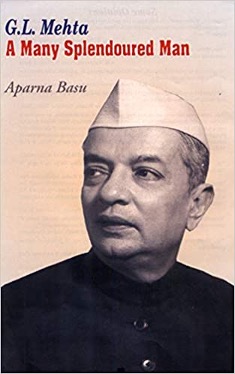
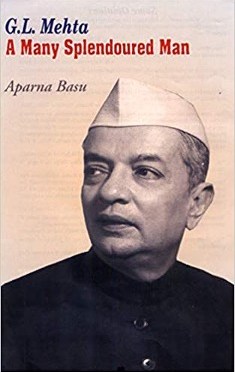
The following extracts from G. L. Mehta, a long-serving Indian Ambassador to America in the mid-1950s, highlight the then- “numerical insignificance” of this ubiquitous group of the middle classes:
“In India, government officials, professional men like lawyers and doctors, technicians and teachers, shop-keepers and clerks are all part of the inchoate group, which goes by the name of “middle classes”. Although merchant classes and officials in medieval India were a group, the middle classes are of a comparatively recent origin. In a society, where caste and status determined the social structure, the middle-income group did not wield any political power nor did they enjoy any social prestige…
…the rise of the middle classes has been due as much to the advent of foreign rule as to the impact of economic forces…There is no gainsaying the fact that our national movement has had its origin and impulse from the middle class. Indeed, the leaders of the labour movement have also been drawn mostly from the middle classes. These classes have largely helped to make India what it is, both in its strength and in its weaknesses…
…the striking fact, however, is their numerical insignificance. An examination of the income-tax statistics shows that in the Indian Union, the numbers of those earning between Rs. 300/- and Rs. 2000/- per month add up to only a little over 3 lakhs. Allowing for 5 dependents to every income earner, it would appear from this that the core of the middle classes in India consists of less than 2 million out of 350 million people…
…in 1938-39, their share of the national income was roughly 5%; today their share is more 3 ½-4%. While the rising prices of the last decade have created higher incomes and pushed up people, it is only a few in the upper income groups, who have stood to gain. Those earning between Rs. 500/- and Rs. 1000/- per month had an annual income of Rs. 80 crores in 1948-49 compared to Rs. 50 crores in 1938-39 but those in Rs. 1000/- and Rs. 2000/- group had Rs. 100 crores in 1948-49 compared to Rs. 30 crores in 1938-39 and those with incomes of Rs. 2000/- per month shared nearly Rs. 160 crores in 1948-49 compared to Rs. 30 crores in 1938-39…
…these distributional changes, together with the general stagnation in the economy, have created a situation of great stress and strain. The middle classes have, on the whole, stopped recruiting from below. Unless the middle classes can improve their economic condition in pace with the growth in their numbers, they are bound to suffer frustration and disillusionment, in proportion with unemployment and inflation. As the London Economist said recently commenting on the situation in India, “when the shop-keeper flourishes and the clerk starves, revolution is round the corner, for the educated middle class will tolerate only so much” (!)…
…but the future of a class, which is not allied to any special interest in uncertain. Equally, if the middle classes are to maintain their leadership, they should avoid freezing into a static group. They will have, therefore, to absorb continuously waves of people ascending from the ranks of peasants, artisans and labourers. At the other end they would have also to discard those whose stakes in the system are so great that they become an impediment to change…because the middle class, and its professional core in particular, can check the acquisitive instincts of the Economic Man. Perhaps it may be the role of the middle-class, to show us the middle way between freedom and order, enterprise and social security”.
References:
Above extracts from an All-India Radio talk, 14 January 1951 by G.L. Mehta (A Many Splendoured Man, Aparna Basu, 2001)
Maryam Aslany, ‘The Indian middle class, its size, and urban-rural variations’, Contemporary South Asia, 2019, 27:2, 196-213, DOI: 10.1080/09584935.2019.1581727
Abhijit Roy, ‘The Middle Class in India: From 1947 to the Present and Beyond’, Spring 2018. https://www.asianstudies.org/publications/eaa/archives/the-middle-class-in-india-from-1947-to-the-present-and-beyond/
Ram-Prasad Chakravarthi, ‘India’s middle-class failure’, 30 September 2007. https://www.prospectmagazine.co.uk/magazine/indias-middle-class-failure
Brant Moscovitch, ‘A Liberal Ghost? The Left, Liberal Democracy and the Legacy of Harold Laski’s Teaching,’ The Journal of Imperial and Commonwealth History, 2018, 46:5, 935-957, DOI: 10.1080/03086534.2018.1519245
The Trolley Times has been launched recently by a group of four youngsters at the Singhu border. The idea was conceived by Ajaypal Natt from Mansa, along with Surmeet Mavi, Gurdeep Singh and Narinder Bhinder. The YouTube interview provides an insight into how the idea was developed, its purpose of reaching out and communicating with people who do not have smart phones and are not connected to social media. Moreover, telecom signals around protest areas are typically suppressed to slow down exchanges and mainstream electronic/print media in India is better known as “godi media”, not just unsympathetic to the thousands currently protesting against the farmers laws brought in September but simply the government’s voice. The first issue of the Trolley Times “carried Bhagat Singh’s quote on struggle; photographs from the centre of the struggle; story of a woman farmer, Gurmail Kaur, who died during the protest; some works of art and the lead article gave the message of unity, struggle and victory. ” The Tribune
The list below provides some references for reading further about the Punjab peasant in a historical context, focusing on some of its radical moments. The region was one of the last to be annexed by the British in the subcontinent in 1849, and subsequently underwent phenomenal transformation with their development of the canal colonies from 1885 onward. Punjab was divided and sub-divided following the Partition of 1947 but agriculture has remained at the core of Punjabi culture and identity.
This is not an exhaustive list, so please do share any other references in the comments.

Read this fascinating article by Jasvinder Kaur in The Tribune on the history of knitting in Punjab.
It is hard to believe that knitting, a favourite pastime of women in the subcontinent during winter, came to India only during the British Raj. Christian missionaries helped in spreading this skill as girls were taught knitting in schools. Gradually, it became popular among women and replaced spinning as more people starting wearing hand-knitted sweaters and socks.
In the 19th century, people in Punjab were not in the habit of wearing sweaters, even when it was really cold in the winter. The wealthy preferred Pashmina shawls and the poor used woollen lois — for wrapping around oneself, as well as for bedding. Baden Powell (in 1872) writes, ‘It is a remarkable fact that in the plains during the cold weather natives do not like woollen goods, it is only the poorer class that resorts to kambal or blanket. Everyone who could afford it, much prefers wearing several thicknesses of cotton cloth and coats padded with cotton wool are universally worn.’
Sir George Watt and Percy Brown also expressed similar thoughts in 1904 that, in general, cotton, rather than wool, was preferred throughout India. This has also been corroborated by other writers and gazetteers of the period. Hand-spun khaddar was thicker and warmer than mill-made cotton and women used it to stitch their suits. Men often used a khes as a wrap instead of a warm chaddar. This practice was common in Punjab even in the 1990s and might still be prevalent at certain places by the older generation.
Read full article: https://www.tribuneindia.com/news/punjab/how-british-brought-knitting-to-punjab-177371

Hector Bolitho’s Jinnah: Creator of Pakistan is how it ended, in 1954; below is how it started, in 1951-2:
Hotel Metropole (Karachi), 4 February 1952, Bolitho to S.M. Ikram (Ministry of Information & Broadcasting, Government of Pakistan)
‘I have just returned from a conversation with Miss Jinnah [who had ‘issued a statement that she neither knew about, nor had anything to do with, Bolitho’s assignment’] and I feel that time has come for us to review the circumstances in which I have attempted to write the official biography of Quaid-i-Azam.
I have now been in Pakistan for almost one month [government had to issue a press note explaining the decision to engage ‘a foreigner’, in response to ‘a section of Pakistan Press’ raising a controversy], and I feel that, in the present circumstances, it would be dishonest and impossible for me to write a biography that would be worthy of the subject or acceptable to any reputable firm of publishers.

Since I have been engaged on my task, which began on October 22nd [the cabinet of Liaquat Ali Khan had approved minister I.H. Qureshi’s proposal to commission Bolitho on June 20, 1951], I have been refused all help from those officials who knew Quaid-i-Azam personally. K.H. Khurshid, his secretary, now in London, has expressed his regrets that he will not help. M.H. Saiyid, sent to me by you, has also refused to co-operate.
[Khurshid would later publish his Memories of Jinnah (1990, 2001). Saiyid would also publish A Political Study of Jinnah (1953, 1962), titled The Sound of Fury (1981)]
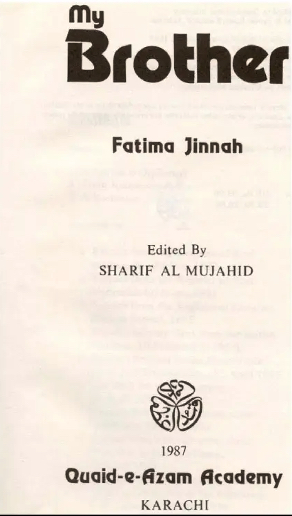
Mazhar Ahmad, A.D.C. to the Quaid, whom you promised as my helper, has not been made available. Prof. Mahmud Brelvi [?], appointed to help me, has not appeared for six days. Although he has been scrupulous in his courtesy, your office has ignored my situation, and has offered no explanation of Prof. Brelvi’s withdrawal. Nor has anyone been deputed to take his place. Nor, in this past month, have I been given even one of the promised documents relating to the Quaid. Nor has Miss Jinnah been approached by the Government. I have taken legal advice, and I find that Miss Jinnah owns the copyright of all her brother’s documents. She has stated to me that these are being used for the biography on which she is now engaged [Ghazanfar Ali Khan (then Pakistan’s Ambassador in Iran) had given a statement ‘welcoming Miss Jinnah’s decision’, adding that ‘she “should have been the first person to be consulted by the Government”’. I.H. Qureshi had been ‘seeking the assistance of his colleagues acquainted with Miss Jinnah to approach her, but these efforts failed’. Her book My Brother (1955) came out in 1987.]
As an indication of the frustration and discouragement I have endured from your department, I would draw your attention to my letter of January 19th. There I mentioned the Aga Khan’s offer to help me. His collaboration would be almost as valuable as that of Miss Jinnah. Sixteen days have passed since I wrote this, without the courtesy of a reply from you.
All this suggests that the Government is apparently unable, or unwilling, to abide by our contract. I consider that I have been deceived in this matter of documents, and the promised help of “members of the family” of the Quaid. I am wondering, therefore, if it would not be best for us to terminate our contract, under terms which I shall made as reasonable as possible. I propose:
I am anxious to conclude this matter as soon as possible, because it is desirable for both of us that the story should not become distorted in the world press. I have already been approached to make a statement to a New York newspaper, and to an Indian newspaper.
I have no wish to see the Government embarrassed, and I am sure that we could come to an arrangement. I ask only for speed. Although our agreement was made in London, and, therefore, any legal action would no doubt have to be taken there, I trust that we can close the matter amicably, thus avoiding publicity unpalatable.
[The agreement text spoke of ‘not less than 90, 000 words’ biography for ‘the fee’ of 1000 GBP ‘on the signing of this contract’, 1000 GBP ‘on delivery of the finished manuscript to the publisher’ and, 1000 GBP ‘on publication in England or America (whichever first) + 1st class return sea passages, rail fares, travelling facilities and hotel accommodation for a period of 4 months, a liaison officer and all ‘reasonable assistance and facilities for the purpose of obtaining information, examining documents and interviewing government officials and members of the family’]
A disgruntled Bolitho, before writing the above letter, gave an interview to the Sind Observer, without warning to the government, published on 29 January 1952, in which he ‘hinted at the possibility of his giving up the assignment and seeking compensation because he had put all his work aside to fulfil this request which came first from Liaquat Ali Khan’.
Source: File No. 3 (6) – PMS/52 (Government of Pakistan, Prime Minister’s Secretariat)

What happened in-between, recalled In Quest of Jinnah: Diary, Notes and Correspondence of Hector Bolitho, edited by Sharif al Mujahid, 2007.
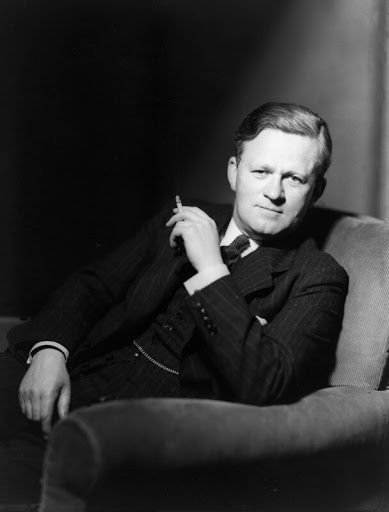
Hector Bolitho of New Zealand (1897-1974); author of 59 (!) books & biographer of George VI, Victoria & Albert and Edward VIII). Further Bio details.

Following the assassination of Prime Minister Indira Gandhi by her Sikh Bodyguards on 31 October 1984, parts of Delhi, North India and other areas with Sikh populations became engulfed in an anti-Sikh pogrom. From 31 October to 3 November 1984 in the national capital, organised violence against the Sikh community was unleashed, unlike anything it had witnessed previously since the anti-Muslim carnage of September 1947. The ‘official’ claim later was that 2,800 Sikhs were killed in Delhi and 3,350 elsewhere in the country. However, independent sources suggest a much high figure. Among these, one of the first to come out was this fact-finding report by political scientist Rajni Kothari of the People’s Union For Civil Liberties and Gobinda Mukhoty of the People’s Union for Democratic Rights, which investigated the murders, looting and rioting that took place during those 10 days and published it later the same month. It starkly concluded that:
…the attacks on members of the Sikh Community in Delhi and its suburbs during the period, far from being a spontaneous expression of “madness” and of popular “grief and anger” at Mrs. Gandhi’s assassination, as made out to be by the authorities, were the outcome of a well organised plan marked by acts of both deliberate commissions and omissions by important politicians of the Congress (I) at the top and by authorities in the administration. Although there was indeed popular shock, grief and anger, the violence that followed was the handiwork of a determined group which was inspired by different sentiments altogether.
Further reading:
Manoj, Mitta & H S Phoolka. When a tree shook Delhi: the 1984 carnage and its aftermath. Lotus. 2007.
Mukhopadhyay, Nilanjan. Sikhs: The Untold Agony of 1984. Westland, 2015.
Pandey, Gyanendra. “Partition and Independence in Delhi: 1947-48.” Economic and Political Weekly (1997): 2261-2272.
Suri, Sanjay. 1984: The Anti-Sikh Riots and After. HarperCollins, 2015.

 BAGICHA