Category Archives: Partition

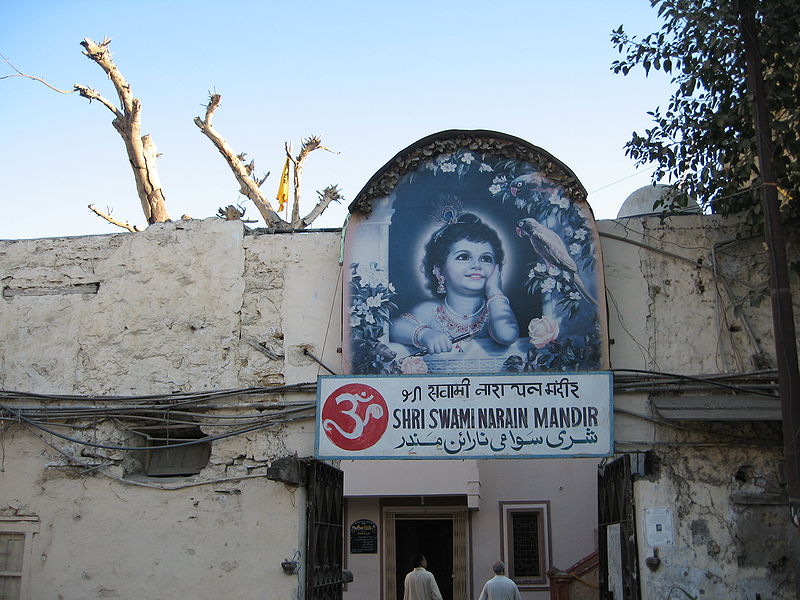
Swaminarayan Temple, Karachi: Past and Present

Shri Swaminarayan Mandir. Source: https://www.discover-pakistan.com/shri-swaminarayan-mandir.html.

Pities of Partition: Fragmented archives, claims and counter-claims, ‘actual facts’ & contested-truths, sacred and scarce, state against society, naya Pakistan & naya Bharat.

1. 31 January 1950, N. Gopalaswami Ayyangar (Minister for Transport & Railways, Govt. of Ind.) to N. Liaquat Ali Khan (Prime Minister, Govt. of Pak.):

‘I have been distressed about the action taken by the Pakistan authorities in relation to the Swaminarayan Temple at Karachi. When an allotment of a portion of the Swaminarayan Temple building was first made to a Muslim, our High-Commissioner at Karachi in December 1948, requested the Administrator, Karachi, to ensure that, for reasons of the sanctity of the temple and security of Hindus living in the temple precincts, the temple building should be reserved for the exclusive use of Hindus. By January 1949, the Administrator, Karachi, confirmed…that the Muslim allottee would be fixed up elsewhere… Later a committee of Hindus was also appointed to allot accommodation within the precincts of the temple. Lately the Administrator has abolished this committee and has withdrawn the previous assurance that the temple would be reserved for the exclusive use of Hindus. Meanwhile, further tenements in the precincts of the temple have been occupied by Muslims. The temple has not only catered for the religious and social needs of Hindus at Karachi but has also been used for accommodating Hindu refugees in transit to India…The Governments of India and Pakistan have undertaken to maintain the sanctity of the religious shrines within their territories. It is contrary to this agreement to disturb the sanctity of this temple, which is one of the important ones in Sind, particularly as Hindus in Karachi still continue to offer worship in the temple. I would strongly urge your taking suitable action in the matter…

2. 20 February 1950, N. Liaquat Ali Khan to N. Gopalaswami Ayyangar (in reply):

‘I made inquiries…The temple is surrounded by a big courtyard; all around the courtyard there are a number of tenements used as residential flats by Hindus, Muslims and others, but most of the flats do not open in the temple courtyard. A number of Muslims lived in these flats even before Pakistan was established. However, the sanctity of the temple is as well maintained as before. In order to obviate all chances of misapprehension on the part of the Hindu minority, the Administrator was willing to reserve all the flats around the temple exclusively for Hindus. Therefore, a committee of Hindus was appointed by him to recommend allotment of accommodation…It was however found that the committee took no interest in the work and allowed a number of flats to remain unoccupied. At the same time, it came to notice that the intending Hindu evacuees were transferring possession of the flats, with or without the connivance of the committee on pugree money. In view of the acute shortage of accommodation in Karachi and the recurring complaints of corruption, the Administrator had to dissolve the committee and resume the practice of making allotments direct…Preference is always given to Hindus, but when they are not available, residential accommodation cannot be allowed to remain vacant in the present-day conditions. I would reiterate that so far as the temple is concerned, its sacred position is fully maintained and the Hindus of Karachi continue to offer worship in it without let or hindrance. The High Commissioner for India recently held some of his Independence Day celebrations at the temple, which goes to show that he considered the premises exclusive enough…As regards the allocation of this whole area as a transit camp for Hindus, it is regretted that in view of the present acute shortage of accommodation, it is not possible to reserve any area in the city for this purpose. An offer is however being made to the High Commissioner for India, for allotment of sufficient land just outside Karachi for maintaining a regular transit camp…’

3. 16 March 1950, N. Gopalaswami Ayyangar to N. Liaquat Ali Khan (in reply):

‘I write to acknowledge your letter…Before replying, I had necessarily to obtain full information from our High Commissioner at Karachi in respect of the specific points you have raised…This information has since been received…You will find from [it] that the information given to you – such as that a number of Muslims lived in the flats even before Pakistan was established, that the committee of Hindus set up for advising on the allotment of accommodation took no interest in the work, that possession of some of the flats had been transferred with or without the connivance of the committee on pugree money etc. – is not in accordance with actual facts. I trust you will agree that the temple and its precincts together with the flats physically connected with it, should, for obvious reasons, be allowed to be occupied exclusively by Hindus for residential purposes and for serving as a transit camp for Hindus who pass through Karachi on their way to and back from India. You will appreciate, I am sure, the Hindu sentiment in regard to this…temple… [which] has been used as such a transit camp for over two years…I understand that our High Commissioner has been offered land at Malir for locating a transit camp. Malir is 14 miles away and the inconveniences of locating a transit camp at such a place are obvious…It is impossible for us to accept the offer and I do hope that you will be good enough to reconsider the whole matter…’

Source: File No. 12 (4)-PMS/50 (Government of Pakistan, Prime Minister’s Secretariat)

4. 12 January 2014, ‘City Faith – Shri Swaminarayan temple’, The Karachi Walla:

‘A…landmark on M.A. Jinnah Road…the temple is 200 years old according to the priest in-charge…The priest was originally from Thar. The architecture of temple is very similar to those of Jain temples in Karoonjhar range…The temple is built in the honour of Shri Swaminarayan who…lived his life in Gujrat…Naturally a link has been established between this temple and those in Gujrat and every few years, priests from both sides visit each other. The compound accommodates a Sikh Gurdwara as well. There is a sacred cowshed at the back and a gate, which leads to a neighbourhood with those fabulous balconies from yore. It is the biggest temple in Karachi and naturally a centre of celebrations during…festivals. There’s a significant Hindu population living around the temple…’

5. ‘The Shri Swaminarayan Mandir…:

‘…was built in 1849…over 32,306 square yards…on the M. A. Jinnah Road in Karachi city. The temple celebrated its anniversary of 150 years in April 2004. The temple is located at the centre of a Hindu neighbourhood in Karachi, and it is believed that not only Hindus but also adherents of Islam visit the temple…There is a sacred cowshed within the premises of this temple. [It] became a refugee camp in 1947…People who wished to settle in India from all over Sindh awaited their departure to India by ship at this temple, where they were also visited by Muhammad Ali Jinnah, during this period. In 1989, for the first time since 1947, a group of sadhus from the Shri Swaminarayan Mandir, Ahmedabad (India) visited the temple. Since then, small groups…visit every few years in a pilgrimage’.

How the Photographs of Margaret Bourke-White became the Images of Partition.

When we visualise India’s Partition of 1947, we almost always do so through the images of Margaret Bourke-White. For the past seven decades, her images have saturated the cover of numerous books, newspaper articles, magazine features, documentaries et al related to Partition. She was, of course, one of the most iconic photographers of the last century. Born in 1904 (d. 1971) in New York City and raised in rural New Jersey, she was the daughter of Joseph White (who was of Jewish descent from Poland) and Minnie Bourke, an Irish Orthodox Catholic. Joseph was an inventor and engineer and perhaps thus an early influence on his daughter’s eventual interest.

This interest matched the tenor of those times, as Henry R Luce, the publisher tycoon realising the potential of photography, felt that America was ready for a magazine that documented events the through photographs. In 1936, Luce bought Life magazine and relaunched it, with Bourke-White becoming one of the first photojournalist to be offered a berth there (Kapoor: 13). America then was in the midst of the Great Depression and Bourke-White ‘took to documentary photography in order to disseminate the idea of inconvenient truth’ for a readership of 2.86 million people (Bhullar: 301).

In India, she is primarily known for her photographs that captured the Partition-related violence and migration, as it ushered in the new dawn of independence. Her photographic essay, The Great Migration: Five Million Indians Flee for Their Lives, was published in Life magazine on 3 November 1947. It had commissioned her to cover the exchange of populations that was taking place across the plains of the divided Punjab and she writes thus what she saw: “All roads between India and Pakistan were choked with streams of refugees. In scenes reminiscent of the Biblical times, hordes of displaced people trudged across the newly created borders to an uncertain future” (Kapoor: 14).

Recently, in 2010, Pramod Kapoor published Witness to life and freedom: Margaret Bourke-White in India & Pakistan with a reprint of over 100 of her photographs. Kapoor wrote about them thus: “They offer a kind of stately, classical view of misery, of humanity at its most wretched, yet somehow noble, somehow beautiful”. His book gives us into a glimpse beyond the frames. Bourke-White had arrived in India in March 1946 and travel around documenting low life and high people: “She was there to photograph Gandhi at his spinning wheel. She was there to photograph Jinnah with his fez. And soon after, both men were to meet their Maker” (Kapoor: 14). Her frames on them served to reinforce their pervading stereotypes of the saint and shrewd. Kapoor details:

“Margaret photographed Gandhi many times afterward. He called her, fondly, she thought, ‘the torturer’. His inconsistencies puzzled her rational mind; it was not until she saw his self-sacrificing bravely in the face of India’s convulsive violence that she began to think him akin to the saint she made him out to be with her camera. She also photographed Mohammed Ali Jinnah; whose features were as sharp as the creases in his western business suits. Jinnah would almost single-handedly bring about the partition of India and the creation of Pakistan”.

Bourke-White documented the aftermath of the so-called Direct-Action Day in August 1946, which was announced by Jinnah following the failure of the Cabinet Mission Plan. Her photographs of the riots in Calcutta then are sometimes confused with the images she took following the Partition, a year later. The article ‘The Vultures of Calcutta’ featured in the 9 September 1946 issue of Life, showing vultures waiting to prey on the bodies of dead victims was later, intermittently and inaccurately, used for depicting the carnage in August 1947.

Vicki Goldberg, the biographer of Bourke-White, writes that when she heard about the Calcutta Riots, Bourke-White immediately flew to Calcutta, and “badgered photographer Max Desfor (1913-2018), the first foreigner to photograph the aftermath of the riots, to tell her where to find the most carnage. While others were sickened by the sight of the bodies, Bourke-White kept working and wrote the scene reminded her of concentration camps in Germany: “the ultimate result of racial and religious prejudice” (Forbes: 7). Desfor’s images were not published by the Associated Press because they were “too revolting for its readers”. Bourke-White’s comrade was Lee Eitingon, a Life reporter based in India, in whose words, “Both of us were whatever the female equivalent of macho is. The smells were so terrible, the officers accompanying us would have handkerchiefs over their faces. We would not…that was part of the time and the period. Being women, we had to be tougher” (Kapoor: 27).

Much of Bourke-White’s archive are housed in Syracuse University’s Bird Library Special Collections section. Here “one can find some of the original photos that include the British soldiers who accompanied Bourke-White and Lee Eitingon” but, as Forbes notes, “the soldiers were cropped from the published pictures”, which dramatically changes the visual narrative (12). It now appears that Bourke-White staged photographs: “Eitingon wrote about her directing a group of starving Sikh refugees…to go back again and again”. She adds, “they were too frightened to say no. They were dying”. When Eitingon protested, Bourke-White told her “to give them money!” (Forbes: 11-12). Even Patrick French writes about how some of these images were staged. When the contact sheets were discovered, they provided an insight into the wider context in which these photographs were being taken. Some of this approach of a pushy, zealous and ambitious American, has been noted in the writing of Claude Cookman. In his examination of how Bourke-White and her French counterpart Henry Cartier-Bresson (1908-2004) approached the coverage of Gandhi’s funeral he notes:

“Flash had become a contentious issue in Bourke-White’s coverage of Gandhi. She had used a flash bulb to make her famous portrait of Gandhi by his spinning wheel. Gandhi…tolerated the technique, but his inner circle never did. They thought flash was disrespectful, and they feared the bright light would harm his sensitive eyes. Flash became a serious liability for Bourke-White in her coverage of Gandhi’s funeral. With her camera concealed, she slipped into the room, where his body lay surrounded by grieving relatives, supporters and government officials. It was about 6:30 p.m.…When she ignited a flash bulb to make her exposure, his followers became enraged by her violation of their privacy and grief. They seized her camera and threatened to destroy it. Hannah Sen intervened, calming the group. After Bourke-White’s film was removed and exposed to the light, Mrs. Sen escorted her from the room. She returned the camera with the understanding that Bourke-White would leave Birla House and not return. Not one to give up after one rebuff, she reloaded her camera and tried to re-enter the room to get another picture. Eventually, Bourke-White yielded to Mrs. Sen’s pleas to honour her promise and left empty-handed. The stereotype of the rude, aggressive American news photographer, who would trample on anybody’s toes or sensitivities to get the picture was a commonplace during the 1940s…Cartier-Bresson deplored this rough-and-tumble approach to photo-journalism: ‘We are bound to arrive as intruders’, he wrote, ‘it is essential, therefore, to approach the subject on tiptoe. It’s no good jostling or elbowing’. As part of his approach, he rejected artificial lighting: ‘And no photographs taken with the aid of flashlight either, if only out of respect…Unless a photographer observes such conditions as these, he may become an intolerably aggressive character’. When Cartier-Bresson wrote this rejection of flash in 1952, he may well have been recalling Bourke-White’s experience at Gandhi’s wake four years earlier” (Cookman: 200).

Geraldine Forbes also notes the differences between Cartier-Bresson and Bourke-White. The former is less known but his images exude a sensitivity, absent in the work of Bourke-White. Upon receiving a photography award, Bourke-White claimed, “The photographer must know. It is his sacred duty to look on two sides of a question and find the truth”. And she cited her work to reference this point (Kapoor: 26). However, when we look at her work, we rarely observe that her work, almost entirely based on the Punjab migration, has yet been made to stand for Independence/Partition exclusively, without acknowledging the vast and diverse range of experiences. The visual record which is taken as “the truth” is rarely explored critically or contextually, while less said so of the racial-ethnic cultural capital of a white American female to travel freely to photograph this momentous carnage at the end of empire. These were foreign journalists writing for a predominately American and western audience, yet these photographs have come to represent Partition.

References:

Dilpreet Bhullar, ‘The Partition of the Indian Subcontinent Seen through Margaret Bourke-White’s Photographic Essay: ‘The Great Migration: Five Million Indians Flee for their Lives’, Indian Journal of Human Development, (2012) 6 (2): 299-307.  

Claude Cookman, ‘Margaret Bourke-White and Henri Cartier-Bresson: Gandhi’s funeral’, History of Photography 22, no. 2 (1998): 199-209.

Geraldine Forbes, ‘Margaret Bourke-White: Partition for Western Consumption’, In Reappraising the Partition of India edited by K. Mitra and S. Gangopadhyay (Readers Service, 2019), pp. 3-16.

Patrick French, ‘A New Way of Seeing Indian Independence and the Brutal ‘Great Migration’, Time, 14 August 2016.

Vicki Goldberg, A Biography. New York: Harper & Row. 1986.

Pramod Kapoor, Witness to Life and Freedom: Margaret Bourke-White in India & Pakistan. New Delhi: Roli & Janssen. 2010. 

Asma Naeem, ‘Partition and the Mobilities of Margaret Bourke-White and Zarina’, American Art 31, no. 2 (2017): 81-88.

Pramod K. Nayar, ‘The Trailblazing Lens of Photojournalist Margaret Bourke-White’, The Wire, 28 Sept 2019.

Bio/profile/work:

Alan Taylor, ‘The Photography of Margaret Bourke-White’, The Atlantic, 28 August 2019.

The Pioneering Photography of Margaret Bourke-White by Google Arts & Culture

The Life Picture Collection

Original Life Magazines

Flavours of India – Punjab

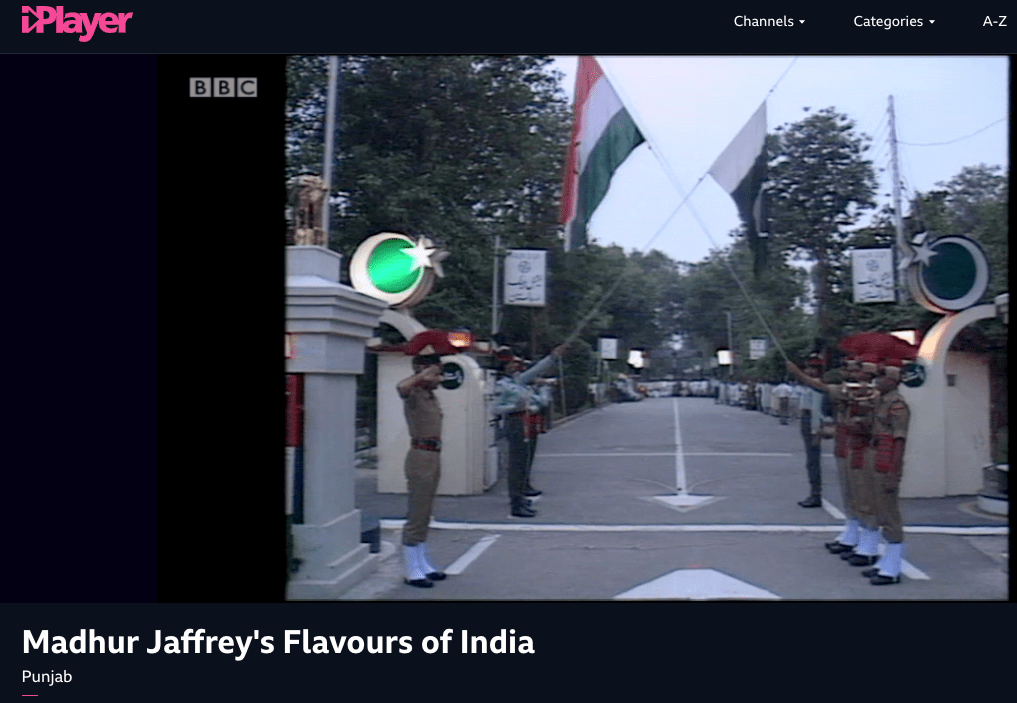
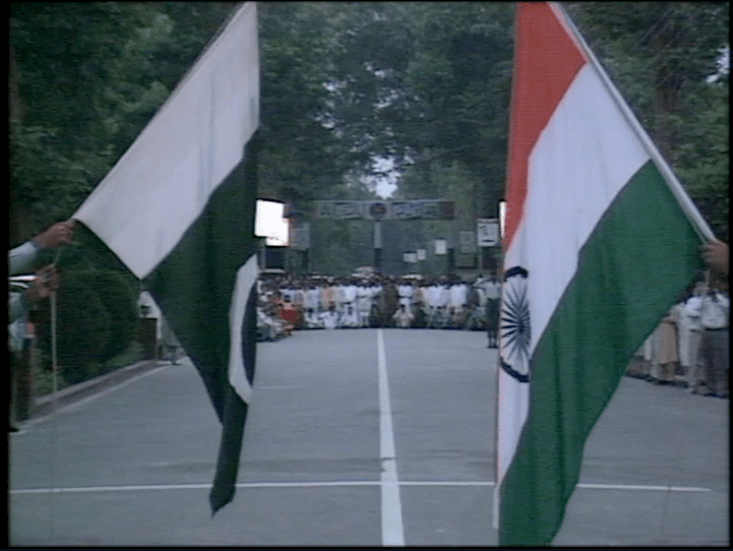
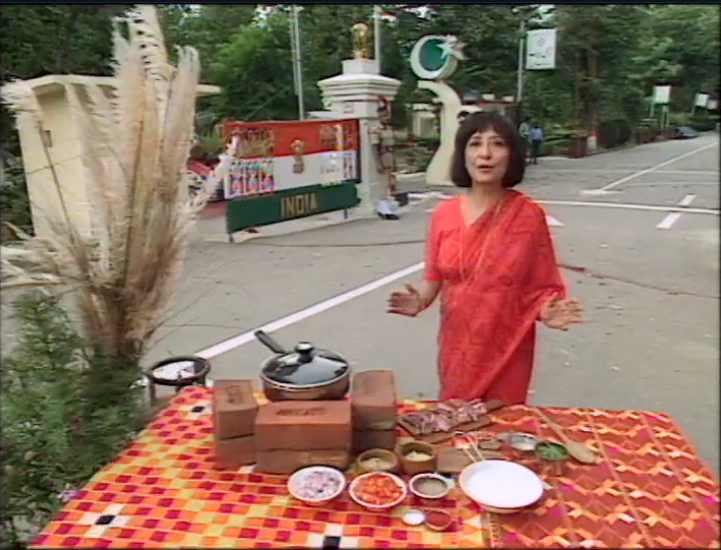
I accidentally stumbled across Madhur Jaffrey’s Flavour of India, which is being repeated on BBC iPlayer. I remember watching this when there were hardly any Indian chefs or Indian cooking on mainstream TV, so I decided to watch some of these again…it is a Sunday morning! As I sat through the episode on Punjab, near the end of the programme I was amazed to see her making lamb chops on the Wagah-Attari border. I have crossed this border numerous of times and I have also seen now much it has changed from a leafy road with colonial bungalows acting as the immigration/custom points to a harsh border with a daily dose of jingoism and national pride on full display. These few minutes have just reminded me how much India (and Pakistan) has changed since 1995. I wonder where the BSF walla tasting the lamb chop is today…

Other posts on Wagah-Attari:

The Spectre of Partition

No Mans Land: the Wagah-Attari Border

Borders and Boundaries

The Spectre of Partition

IMG_20170811_162942
Wagha-Attari Border. © 2017 Pippa Virdee

Sharing a screen grab from the last page of my book From the Ashes of 1947Balraj Sahni captured the human tragedy of Partition in this poem, the spectre of which still continues to haunt us everyday. We seem to be unable to be human first.

Screenshot 2020-02-26 at 10.31.46

Freedom and Fear: India and Pakistan at 70

IMG_2257
© 2017 Pippa Virdee

The role of any democratic country, with a well-defined rule of law, is to protect ALL its citizens, ensuring that their rights and freedoms are safeguarded. It is in fact difficult to imagine these lands without the heterogeneity that forms the essence of being South Asian. It is this vibrancy and diversity that gives it character and strength. To move toward a homogenous culture is not only problematic but also dangerous because it is based on exclusivity.

Extract:

In the midst of the monsoon of August 1947, British India ceased to be and gave way to two independent nations. The logic of this partition being religious and regional, the older and larger India was reinforced as a Hindu majoritarian society, while the newer and smaller Pakistan emerged as an Islamic country. No partitions are total and absolute but this one was especially terrible and ambiguous; it left about a 20 percent religious minority population on both sides. Moreover, it created two wings of Pakistan with a hostile Indian body-politic in the middle.

This event was not entirely of subcontinental making. The British Empire in Asia cracked under the hands of the Japanese army during World War II, most spectacularly with the fall of Singapore in February 1942, and began to crumble in South Asia after the war. Along with India and Pakistan, Burma (today’s Myanmar) and Ceylon (Sri Lanka) also emerged independent (both in 1948) at this time. All this was to bring about many changes, both internally in India and internationally. Europe, the ravaged battlefield of the world wars, ceased to be the center of the Western world, with political and economic power shifting decisively to the Soviet Union and the United States, representing two contrasting and conflicting ideological visions for the post-1945 world.

The end of British rule in South Asia happened alongside the emergence of this conflict, christened the Cold War. The road to freedom and partition of India and the creation of Pakistan was a long one and accompanied with fundamental social, economic, and political changes. From the mutiny of 1857 to the massacre of 1919 in Jallianwala Bagh, Amritsar; from the formation of the Indian National Congress in 1885 to the establishment of the All-India Muslim League in 1906; from fighting for king and country in two world wars to seeking self-rule in the interwar years; and from the development of an elaborate civil and military bureaucratic and infrastructural apparatus and a space for provincial politics – all these were to completely transform Indian society.

This transformation and its underlying tensions ultimately contributed to that final moment, when in the middle of August 1947, Britain finally bid farewell to its prized colony after being there in one form or another as traders, marauders, administrators, and rulers for over 300 years. Weakened by World War II, the British were forced to accept the new realities of a determined nationalist struggle and an emerging new world order in which old-fashioned colonialism no longer seemed feasible. The journey toward this reality was slow and painful.

This year, on August 14 and 15, the Pakistani and Indian state and society, respectively, will mark 70 years of freedom. The bulk of both countries will be in celebratory mode as much of them were in 1947. Neither will want to remember the hard history of this freedom, nor face the harsh realities of it today. Back in 1947, Mohammad Ali Jinnah was in Karachi and Jawaharlal Nehru in Delhi, both welcoming a new dawn of freedom, but also engulfed in the fear and flames of communal violence. The worst of this was in the partitioned province of the Punjab in North India, where from March 1947 onward in Rawalpindi, communal violence and forced migration of people completely changed the landscape. Over the next year, but largely concentrated in August-December 1947, approximately 1 million were massacred and over 10 million were forced to move from one side of the Radcliffe line to the other. Bengal in East India, the other province to be partitioned, experienced similar, if slower, migration but not murder on the same scale. Other provinces, like Sindh, United Province, Bihar, Assam, Bombay, and the North-Western Frontier Province, also saw religious riots and exchanges of refugee populations.

Partitions are never easy; they are fraught with physical uprooting and dislocation, emotional and psychological separations, and, often, bitter memories of enmities. The partition of British India, though, appeared inescapable in early 1947, once constitutional attempts to secure a confederal arrangement for the Muslims in India to live in a post-colonial Hindu-majority country, without fear, collapsed. The movement for a home for Indian Muslims had gained currency in the interwar period, with poet-philosopher Muhammad Iqbal’s presidential address to the 25th session of the All-India Muslim League in December 1930, envisioning “a consolidated, North-West Indian Muslim State” amalgamating “the Punjab, North-West Frontier province, Sind, and Baluchistan” and self-governing “within or without the British Empire.” It culminated, almost 10 years later, in March 1940, in the lawyer- politician Jinnah’s speech at another session of the League. Describing Muslims as a “nation,” not merely a community, Jinnah demanded “homeland, territory, and state” for them.

Full article in The Diplomat, Issue 33, August 2017 or contact me.

Two villages, two nations: Ganda Singh Wala-Hussainiwala


This slideshow requires JavaScript.

The villages of Ganda Singh Wala and Hussainiwala are two villages divided by Cyril Radcliffe’s line. Rather counter-intuitively in these times of Hindu/Sikh India and Muslim Pakistan, Ganda Singh Wala is a village in Kasur District in Punjab, Pakistan, while Hussainiwala is its Indian counterpart, located 11 km away from Ferozepur city. Until the early 1970s, this was the primary border crossing between the two countries but it now only functions as a ceremonial border. Like Wagha-Attari, the now-primary border crossing between India and Pakistan, there is a daily Retreat Ceremony with the lowering of the national flag. There are, however, a few differences between the two ceremonies as Ganda Singh-Hussainiwala is generally not open to foreign tourists and is therefore more intimate with fewer attendees coming largely from the local area. The seating, especially on Ganda Singh side, is right next to the Pakistani Rangers and thus provides a spectacular viewing of this daily spectacle.

While restricted to mostly locals, there remains some jingoistic overtures around it; more palpable during tense times between the two countries. The ceremony lasting 40 minutes, is shorter than the Wagha-Attari version and has less of a fanfare and build-up. People loiter around, catching the opportunity to be close to Indian/Pakistani people and take photos of the Rangers and Indian BSF. According to Ferozepur district’s webpage (http://ferozepur.nic.in/html/indopakborder.html), there was no joint parade and retreat ceremony here until 1970. It was apparently, “Inspector General BSF, Ashwani Kumar Sharma, called upon both authorities to have joint retreat ceremony and since than it has become a tradition”. In 2005, there were discussions about opening this border crossing, to no avail. Today it is easy to forget that this was once a thriving check-point. In 1970, Paul Mason, while travelling the sub-continent, excitedly crossed the border from Ganda Singh to Hussainiwala. He recalls this experience in his travelogue, Via Rishikesh: an account of hitchhiking to India in 1970 (2005):

“In the morning we have little difficulty in locating the Ministry of the Interior and are supplied the necessary chits which give permission for us to travel along the restricted road to the border. For the sum of two rupees apiece we obtain bus seats and are soon headed off down the dusty track, but the trip is much longer than I expect and it is mid-afternoon before we arrive at the Pakistani customs of Ganda Singh Wala.

At the customs post on the Indian side of the border, a worryingly intelligent young woman who reminds me much of my elder sister Margaret deals me with. I do my best to conceal my anxiety about the concealed roll of banknotes. She eyes me carefully and exchanges a few words with me before turning to the next in line without first acquainting herself with the contents of my underpants.

We have made it to India! We are here in India! At last! Amazing, amazing, amazing!

I take a look at stamp in my passport; it states simply; ‘ENTRY 16-10-70 Hussainiwala Distt, Ferozepore’ – not even a mention of India! Oh well, we’re here, and that’s all that counts!

We follow the flow of other new arrivals along a path beside a wide still river [Sutlej]. There is also a disused railway track, which presumably used to connect the two countries.”

[See full account: http://www.paulmason.info/viarishikesh/viarishikeshch16.htm]

We see from Mason’s account of the simplicity through which he crossed the border with only a slight mention of Ganda Singh and Hussainiwala printed in his passport (pictures of the entry stamps are available on his website above). Today when crossing via the land route, there is a clear stamp with Attari (India) and Wagha (Lahore) in the passport. Mason also mentions the hundreds of cars left abandoned at the border because it was too costly to take them across. But, this was at least possible to do then; impossible today. Equally, the disused railway track lies there abandoned but remains as a reminder of the two broken halves.

Ferozepur, India is the land of martyrs and Hussainiwala is the site of the National Martyrs Memorial, where Bhagat Singh, Sukhdev and Rajguru were cremated on 23 March 1931. This is also the cremation place of Batukeshwar Dutt, who was also involved in bombing the Central Legislative Assembly with Singh. Bhagat Singh’s mother, Vidyawati, was also cremated here according to her last wishes. Interestingly, the spot of the memorial, which is only 1 km away from Hussainiwala and on the banks of the Sutlej river and built in 1968, was originally part of Pakistan. On 17 January 1961, it was returned to India in exchange for 12 villages near Sulemanki Headworks.

Read ‘Making of a Memorial’ by K. S. Bains, http://www.tribuneindia.com/2007/20070923/spectrum/main2.htm

-, ‘Shaheedon ki dharti’ in The Tribune: http://www.tribuneindia.com/1999/99jul03/saturday/regional.htm#3

See a short clip of the ceremony at Ganda Singh Wala: https://www.youtube.com/watch?v=vZR-eLVYo6s

From before and beyond the international border that divides them, there is a story that connects these villages. Majid Sheikh writes about the ‘Spiritual connect of two villages’ in Dawn and brings out their historic connections. To commemorate a highly decorated soldier, Risaldar Major Ganda Singh Dutt, the British had named this village after him, while the village Hussainiwala derived its name during colonial days from Pir Ghulam Husseini, whose tomb is now in the BSF headquarters. Today they exist as two halves of the same story.

Read ‘Spiritual connect of two villages on both sides of the divide’ by Majid Sheikh: https://www.dawn.com/news/1379906

From Mano Majra to Faqiranwalla: Revisiting the Train to Pakistan

New Delhi train station. © Pippa Virdee 2016

By Pippa Virdee and Arafat Safdar in South Asian Chronicle.

Khushwant Singh’s novel Train to Pakistan was published in 1956, almost ten years after the partition of India/ creation of Pakistan in 1947. Its publication inaugurated what has been called ‘South Asian Partition Fiction in English’ (Roy 2010). It remains, to date, one of the most poignant and realistic fictional accounts depicting the welter of partition and saw a sensitive screen adaptation in 1998 by Pamela Rooks. It captures one of the most horrific symbols of partition—that of the burning, charred and lifeless trains that moved migrants and evacuated refugees from one side of the border to the other. The trains that previously served to bring people and goods from disparate worlds closer together were overnight turned into targets of mob attacks and transporters of mass corpses. They thus became an emblem, a much-photographed representation (Kapoor 2013) of the wider violence and ethnic cleansing that was taking place in Panjab (Ahmed 2002: 9-28); one of the two regions divided to make way for the two new nation-states.

Selecting some key individuals in the village, relevant to and representative of our efforts to excavate the myths and memories associated with partition, and situating their sensibilities vis-à-vis the sentiments exhibited in the novel, we conducted interviews to collect and compare experiential accounts. An attempt in the Wildean spirit to attest that ‘life imitates art far more than art imitates life’, the article, located in the Faqiranwalla of 2017, looks back to the Mano Majra of 1947. In doing so, not only does it reflect on this intervening time-span and what it has done to those remembrances, but, also brings to fore the well-remarked realisation that, in this case too, ‘the past is another country’ (Judt 1992). Like in the novel then and life today, the connecting link in this article too, between Faqiranwalla and Mano Majra, is the train, as both share the overweening presence of the railways in the village, through which its life is/was governed.

Read full article: https://edoc.hu-berlin.de/handle/18452/19508

Südasien-Chronik – South Asia Chronicle 7/2017, S. 21-44 © Südasien-Seminar der Humboldt-Universität zu Berlin

The Politics of Partition and its Memory


Now that the euphoria over independence day “celebrations” and remembering partition are over, it is worthwhile remembering that it was in fact today, 70 years ago, that the Radcliffe Line was made public. Millions of people woke up on 15 August not knowing which side of border they would be on, today their fate was sealed. Sitting in Delhi on this day, having seen the way both Pakistan and India remember 14/15 August 1947, it is a stark reminder of how chaotic this process must have been.

The month of August in the sub-continent is when the monsoon rains gush down intermittently. The heavy rains leave places incapacitated due to the deluge that falls. Even today, where there is improved drainage, the monsoon rains have the capacity to bring towns and cities to a standstill. So, thinking about this back in August 1947, it is staggering to think that the last Viceroy, Louis Mountbatten, decided that 15 August would be the date for independence. The date was chosen because it coincided with the date when Japan surrendered after it was devastated by the nuclear bombs in Hiroshima and Nagasaki. Mountbatten was clearly sentimental about the date because he was Supreme Allied Commander of South-East Asia when Japan surrendered. But he also failed to show any foresight when it came to the sub-continent. All the leaders failed to anticipate that millions of people would be engulfed by violence and thus forced to flee and that too in the difficult month of August. This only added further to their misery and fuelled diseases in refugee camps. It must be kept in mind that the violence that was unleashed in August 1947 was not an isolated incident, it was a culmination and continuation of previous episodes of horrific communal/political violence in which many lost their lives and were displaced. It was thus not entirely unexpected, nor was it just spontaneous.

The British media (TV, Radio and Print) has decided to cover partition/independence extensively and interestingly for this decennial anniversary they have been giving full coverage to the voices of ordinary people. The BBC has had a full season of programmes (one of which I contributed to) devoted to India and Pakistan at 70. I have personally spent the last sixteen years working on partition and its wider impact on the Punjab region, so the ordinary voices are not new to me. In fact, this trend in scholarship has been evolving and growing for the past twenty years. What is sobering is how the coverage has differed in India, Pakistan and the UK. I can only speak about these three because I know them well and they were of course at the epicentre of this.

While there is still a huge gap in our understanding of empire and its consequences, these programmes are important in reaching out to ordinary citizens, to educate, to inform, to illuminate the travesty of empire and its end. They also serve as important markers of remembering, but that alone is not enough. Which is why being in India/Pakistan during the days of August has been important. It highlights the disparity between the diaspora and those who live here. Capturing and sharing the narratives of survivors is important but from an academic perspective, what do these voices mean, what do they tell us, why are they still relevant? The memorialisation of this memory and how it tells this story is also significant. There is little worth in collecting hundreds and thousands of accounts by survivors if this is not contextualised or critically framed in the existing historiography. A simple account of someone’s life and their experiences is important but what about beyond that? What lessons can we take from this?

And our politicians are still in the business of selling a myth of a glorious past and a dream for the future. It is that future which needs to be critically examined in relation to the previous seventy years. Pakistan today seems fragile as ever but (and more importantly its people) it is a resilient country. For the best part of the last seventy years Pakistan has been swinging between military dictatorship and democratic rule, while India, largely a democracy, has been busy playing and expanding upon the Hindutva card. A future in which we see a further entrenchment of Islamic Pakistan and Hindu India is entirely possible and while not a recent development, it does need to be contextualised firstly in colonial history and secondly in the how the developments of the past seventy years led to this. Of concern for everyone should be that in this vision to be exclusively majoritarian, both India and Pakistan would lose an asset: its significant minorities. The diversity in all its richness is what makes these countries vibrant and valuable, they should be celebrated rather than suppressed and targeted. And so, seventy years on, while we remember the people who suffered in the great partition, let us not forget that there a battle going on today for the hearts and minds of people. Which is why it is seemingly more poignant being here in the sub-continent at this moment because it is a reminder of the unfinished business of azaadi beyond empire.