All posts by Pippa

A short hop from Ludhiana to Lyallpur


Getting into a taxi can often lead to interesting conversations with the drivers. So when one evening I request a Careem (much like Uber around the world), I get into the car and as it happens quite often, the driver is usually baffled by the name (not an obvious Pakistani name) and the person who is sitting in the car (could be Asian but looks “foreign”). I explain that I am indeed Punjabi and use my best Punjabi accent to prove the point! However, the response from the driver is quite often in Urdu, even though I carry on speaking in Punjabi. This will continue or then sometimes the driver will feel comfortable enough to speak in Punjabi.

So then on this one evening, a young driver who turns out to be from Faisalabad (previously known as Lyallpur); he lives not far from Samundri, which is a tehsil of Faisalabad district. Lyallpur district began life in 1904 following the development of the canal colonies in West Punjab in the late nineteenth century. From being a small market town, Lyallpur has been transformed into Pakistan’s main agro-industrial centre following the partition of Punjab. One which has fundamentally changed Lyallpur in modern times is migration. Firstly following the development of these canal colonies and secondly, the migration following Partition in 1947.

Having discovered the driver was from Faisalabad, I choose to converse with him in Punjabi. He was both astonished and ecstatic at the same time. The joy of sharing the same language and accent as you, can sometimes do this to people. He had been in Lahore for some months now and was making a living driving for Careem. The familiar tones of someone, and in this case someone who he thought was a foreigner, speaking the same language that he had perhaps not heard so frequently since he arrived in Lahore immediately allowed us to bond during the short ride. The ride is in fact less than ten minutes, but it is amazing what can be gleaned in these short conversations.

As we discussed our mutual language I suggested to him that the elders in his family might have migrated over from Jullundar or Ludhiana, and he immediately said that yes, his paternal grand-father was from Jullundar. The distance that divide these two places is approximately 250 km. He came over after partition and settled in Lyallpur. I went on the make the connections between the two places, the place where I grew up on the other side of the border, and the place on this side of the border but both conversing in the same language in a neutral city. Perhaps it had never occurred to him that he also had some connection to the Indian side of Punjab via the language that he speaks.

At the end of the ride, his joy at making these small connections translated into him refusing to take any money from me. He said he could not do this. Sometimes life brings about things which cannot be measured in monetary terms, they are passing moments, glimpses of human kindness that leave you feeling richer.

Poetry Corner: Serendipity

kerala boat
(c) Copyright 2016 Pippa Virdee. Boat trip in the backwaters of Kerala.

The Cloths of Heaven
Had I the heaven’s embroidered cloths,
Enwrought with golden and silver light,
The blue and the dim and the dark cloths
Of night and light and the half-light;
I would spread the cloths under your feet:
But I, being poor, have only my dreams;
I have spread my dreams under your feet;
Tread softly because you tread on my dreams.
By W. B. Yeats

Poetry Corner: Transience

12742844_10154060423823128_7084941959373216862_n

Transience by Sarojini Naidu and a glimpse of the moon to compliment her words.

Nay, do not grieve tho’ life be full of sadness,
Dawn will not veil her splendour for your grief,
Nor spring deny their bright, appointed beauty
To lotus blossom and ashoka leaf.

Nay, do not pine, tho’ life be dark with trouble,
Time will not pause or tarry on his way;
To-day that seems so long, so strange, so bitter,
Will soon be some forgotten yesterday.

Nay, do not weep; new hopes, new dreams, new faces,
The unspent joy of all the unborn years,
Will prove your heart a traitor to its sorrow,
And make your eyes unfaithful to their tears.

The One-Unit, 1955

one-unit-pakisatnLike the previous post, to commemorate the inauguration of the One-Unit in Pakistan, three postage stamps were issued:
  • 1½-anna, bottle green.
  • 2-anna, dark brown.
  • 12-anna, deep red.

The picture above is a first day cover issued on 7 December 1955, with a 1 ½ anna stamp which I just happened to came across during my stroll at the book fair on The Mall, Lahore which is held on Sundays.

One of the biggest challenges facing Pakistan after independence was maintaining the links between the two wings. This led to wider constitutional issues and so even after eight years of existence Pakistan did not have a constitution; it was still operating on colonial laws. Moreover, the two wings were divided by more a thousand (hostile Indian) miles. This of course would present challenges to the most stable of regimes and this is just a nascent nation trying to carve out a post colonial identity.

To bridge the multiple gaps between the two wings, the Government of Pakistan under Prime Minister Muhammad Ali Bogra, decided that all four of the provinces in West Pakistan should be merged to constitute one-unit against East Pakistan. This would in effect mean that Bengalis, Punjabis, Sindhis, Pathans, Balochis would cease to have their regional identity and adhere to a yet another artificial political construct designed to posit the two wings against each other.

While geographically these two vast areas are split into two units, ethnic, religious and linguistic differences remained despite the political rationalization that was being put forward. Furthermore, while Urdu and Bengali were both accepted as state languages, English, the language of the colonial power and spoken a small minority of people, remained the official language of Pakistan. There was of course inevitably resistance from the four provinces who were being asked to relinquish their regional identity in a direct counter-measure against increased Bengali nationalism.

The uneasy relationship between the linguistic and ethnic differences encapsulated in the two wings of Pakistan created a divide which was difficult to resolve by the time the first general election was held at the end of 1970. In reality the longer-term impact of the one-unit was to create further division rather than bringing coherence and rationalization to the administrative landscape in Pakistan.

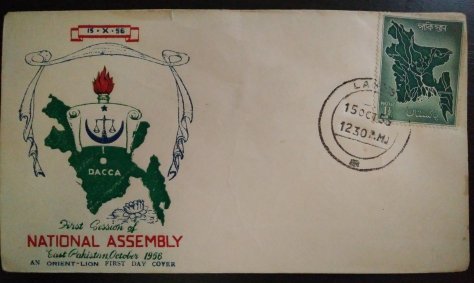
The first session of the National Assembly, Dacca, 1956

national-assembly-pakistan

To commemorate the first session at Dacca, East Pakistan, of the National Assembly of Pakistan, three postage stamps were issued on and from the 15th October 1956:—

  • 1½-anna, bottle green
  • 2-anna, dark brown
  • 12-anna, deep red

The picture above is the first day cover with a 1 ½ anna stamp. I just came across it during a stroll at the book fair on The Mall, Lahore which is held on Sundays. The commemorative stamp was issued on the eve of Pakistan becoming the first Islamic Republic in the world. At the time Pakistan was made up of two wings, East Pakistan (now Bangladesh) and West Pakistan. The National Assembly of Pakistan is the lower house of parliament and initially met in the capital Karachi. However, this was the first session of the National Assembly in Dacca and in fact the last time as well because two years later Ayub Khan became the first military dictator in Pakistan and eventually by the 1971, the country was on the brink of splitting up.

The stamp encapsulates the period when Pakistan ended its status as a dominion and was declared an Islamic Republic of Pakistan on 23 March. Hence this is day is celebrated as Republic Day in Pakistan. This of course is also the same day that Mohammad Ali Jinnah adopted the Pakistan Resolution (Lahore Resolution) outlining the two-nation theory. The full text of the 1940 Resolution is available via: http://www.columbia.edu/itc/mealac/pritchett/00islamlinks/txt_jinnah_lahore_1940.html.

The Constituent Assembly became the interim National Assembly with Governor General Iskander Mirza as the first President of Pakistan. The Assembly had 80 members, half each from East Pakistan and West Pakistan. A turning point in Pakistan’s history, the Constitution required the president to be a Muslim and he (typically it was a he), had the power appoint the Prime Minister and he was also empowered with the ability to remove the Prime Minister, if there was a lack of confidence in his abilities. The Constitution of 1956 was written almost ten years after Pakistan was created, but crucially it set in motion a dangerous precedent; the President had the power to suspend fundamental rights in case of an emergency. Crucially though the Constitution of 1956 was short-lived because by 7 October, 1958, General Mirza dissolved the constitution and declared Martial law in Pakistan.


Borders and Boundaries

As an academic my main pre-occupation has been centred around the partition of India and creation of Pakistan in 1947. I have been fortunate enough to have been able to spend time on both sides of the border, comparing the impact of this division on the people of Punjab; the area that has been severely affected by the decision taken in 1947. From being the bread basket of British India and the major recruiting ground for the colonial Indian army, East Punjab becomes the hostile border with Pakistan and West Punjab, while politically dominate, recedes culturally. The culturally, linguistically and economically rich land of Punjab is Balkanised after 1947 and now exists as a mere skeleton of its former self. The land has been reconfigured along religious identities which evaporate the pluralistic history; it tries to re-imagine itself for the new global order but lacks the former strength it had.

For the past 14 years I have crossed the official border crossing at Wagha/Attari between India and Pakistan numerous times; I’m lucky because I don’t have a green or blue passport, both of which immediately open you up tedious amounts of scrutiny. By virtue of being “foreign” and at the same time a “desi”, you get to experience this place in a different manner. Although I have Indian heritage, the Indians are on the whole sterner, matter of fact during the immigration and customs. Sometimes I will strike a conversation and there is rare chance to get their views. For example, during my last trip, the Indian official wanted me to recommend some history books to read, especially those that were impartial. On the Pakistan side, there are of course always questions, inquisitions about what, why, who…but there appears to be more “conversation”. There is always intrigue and sometimes joy that a “foreigner” would want to spend time in Pakistan. I have also been unlucky enough to be stuck on both sides of the border just as it is about to close for crossing. And both sides have blamed the other, “madam ji, we will let you go through but the Indians/Pakistanis will not accept you”. Both behave in this rather childish and tit for tat manner. It is a shame then that politics is also conducted in this manner. While Delhi and Islamabad exchange words of war, the ordinary people suffer, as they have suffered in the past 69 years.

The new global trend for hyper nationalism, as seen in the impact Trump is having in America, the growing influence, both emotionally and politically, of right wing politics can also be seen in the UK, France, Denmark, Sweden, and so socially progressive countries which are now retracting and adopting more defensive policies. While in India, the impact of Modi and his cosy relationship with RSS has unleashed and legitimatised a form of nationalism and patriotism which makes it difficult to question governments and their policies. In the name of showing loyalty to the state, Indianess/Hinduness and the armed forces, it has become unpatriotic to say anything which may offend. Have we become so insecure that we cannot even tolerate any scrutiny? Surely we need reflect on our past and how we face the challenges of an increasingly globalised society. We cannot live in isolation, putting up barriers, preventing the movement of people and creating homogenous spaces. India and Pakistan did this in 1947 and we live with the legacies of that today. Homogenous (religiously or ethnically) societies does not equate with security, peace and harmony. Look at the challenges Pakistan has faced since it was founded as a country for the Muslims of India. Working together for a solution is the only option. But amongst this raft of change has also been the enormous disconnect between the politicians and the people and this is a global challenge.

It is therefore staggering to think that as we approach 70 years of independence, little has been gained and little has been achieved in our relationship with our closest neighbour. We cannot deny that we were once attached together and there are many cultural, ethnic, linguistic commonalities that unite us, yet we are determined to focus on the differences and maintain the status quo of a sibling rivalry. Unfortunately, there is no parent who can step in try to patch up things, we have to be mature enough to do that ourselves. Otherwise, this rivalry will remain for the next 70 years. People away from border states like Punjab and especially Kashmir cannot comprehend the negative impact this rivalry has had on the mind-set and livelihoods of the people. They live in the shadows of this rivalry, even though there is much more which unites them than divides them. They also have a right to live in peace and aspire for prosperity, we should not be so selfish to deny them this.

Gurdwara Rori Sahib, Eminabad

Gurdwara Rori Sahib is two km from Eminabad and about 55 km north of Lahore. It is located not too far from Gujranwala and the Grand Trunk Road. The Gurdwara marks an important site, where Guru Nanak after the destruction of the town had stayed with Bhai Lalo. The plaque at the gurdwara reads, ‘This is the holy place where Guru Nanak Dev ji came in his first pilgrimage. Guru Nanak dev I came here at Bhai Laalo ji’s home (Eminabad). It was a beautiful and silent place away from city, this’s why Guru Nanak ji sat down here and was prayed the almighty god regularly.’

The gurdwara was originally constructed on a large estate of nine marabbas. This has gradually been reduced down now. The land was originally endowed to the gurdwara during Maharaja Ranjit’s period and the gurdwara’s architecture is also from this period. The location and size of the gurdwara attracted large crowds of Sikhs, particularly during the Vaisakhi festival in April. There used to be a week-long fair during this period and attracted people from all the surrounding areas. The estate left today is a reminder of the old grandeur that would have existed when there was a sizeable Sikh population prior to 1947.

The entrance to Rori Sahib is grand, imposing and awe-inspiring, with the beautiful exposed red brick. The dome work and the columns are all in cut brick work. Accompanying the gurdwara is a large sarovar, which when I revisited the gurdwara ten years later, the water had evaporated.

Below are some of the pictures from when I first visited the gurdwara in 2006 and then most recently in October 2016.

Rori Sahib pictures from 2006.


Rori Sahib revisited in 2016.

Golgappas/Panipuri

Golgappas have to be one of the most popular street foods in India. For me it’s a ritual, when I go to Ludhiana, I have to have golgappas. It is a simple hollow, fired puri, made with flour or semolina. The flour ones are more crispy and more popular. A small hole is inserted and then filled with any combination of chickpeas, onions, potatoes and then filled with flavoured water. The water is what makes the golgappa; from simple tamarind based pani, the street vendor now has multiple flavours. Sweet, tangy, spicy to appeal to all taste buds. Affordable by all and enjoyed by all, this is the simple attraction that keeps bringing me back to India.