The moon is a multipurpose muse, at once a symbol of ishq (love), taqwa (piety), tanhaai (loneliness), hairat (wonder), khushi (happiness) and arzoo (longing). In Urdu literature, the moon manifests in all forms: aadha chaand (half moon), poora chaand or chaundhavi ka chaand (full moon) and badli ka chaand (moon hidden in clouds). The moon has also been a symbol of the poet’s promise to the beloved, with “tumhare waste main chaand tod laaunga (I will pluck out the moon for you),” being a familiar refrain.
‘The many moods of the moon; Urdu poetry’s favourite muse’, by Nawaid Anjum, July 22, 2019, The Indian Express
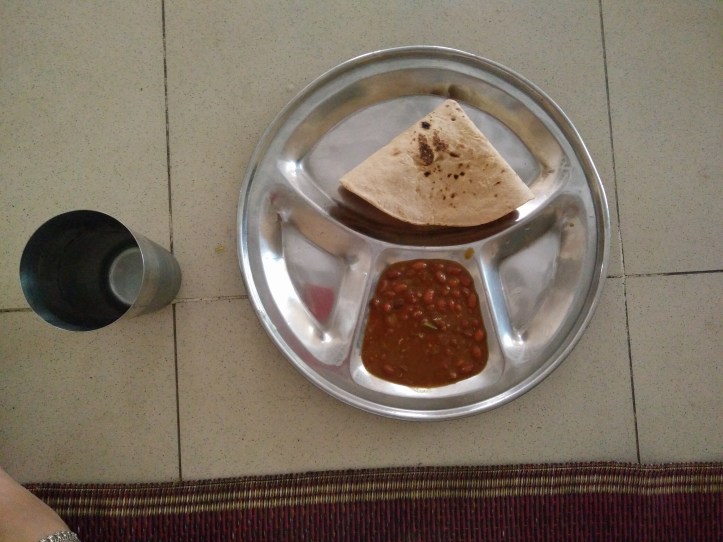
Langar at Gurdwara Pehli Patshahi, Lahore, Pakistan.
One of the earliest pieces I started with on this blog was with this picture of Guru ka Langar (or food for the congregation) in Lahore. The simplicity of daal (lentils) or in this case rajma (kidney beans) with roti (bread) is the basis of most langar served in a Gurdwara. As a child, I remember most children enjoyed going there in part because of the karah parshad (sweet halwa made from whole wheat flour) given at the end of the service and followed by the (free) food, which had its own distinctive divine taste, impossible to recreate at home.
Langar is the communal partaking of food when visiting Gurdwara. The concept has in recent years been popularised globally by Sikh organisations such as Khalsa Aid, which plan, produce and distribute langar to people across the crisis-ridden world, be it to the truckers stranded in Dover over the ongoing Christmas period or in recent war-torn Syria. With Langar spreading so does knowledge about and experience of the Sikh community. Currently, closer to the home of Sikhism in Punjab, Langar has been making headlines via the ongoing farmers’ movement against new farm laws in India. Communal kitchens have been set-up by the roadside to feed the thousands gathered on the borders of capital, Delhi.
Origins
The word ‘langar’ (meaning ‘anchor’) is thought to have come into the Punjabi language from Persian (Nesbitt: 29); although the idea was not unique to the Sikhs, as ‘both the Sufis and the Nath Yogis have a system of collective eating (langar khanah and bhandaras). The Sikhs, however, used it as venue for both service and charity and provided the food themselves [unlike] the Nath Yogis, who begged for food, and the Sufis, who often accepted land-grants to run their kitchens’ (Mann: 27).
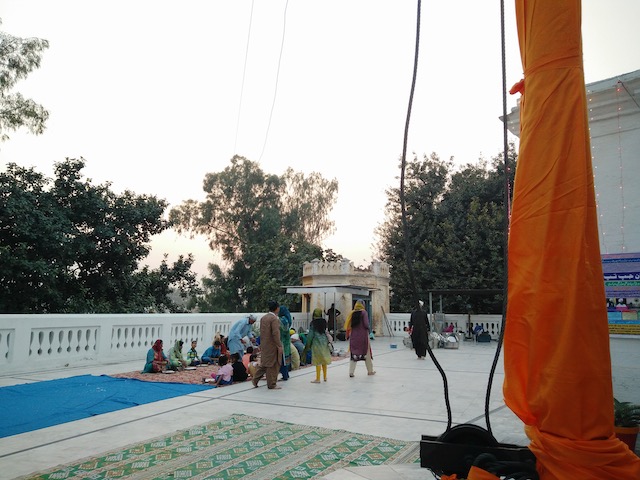
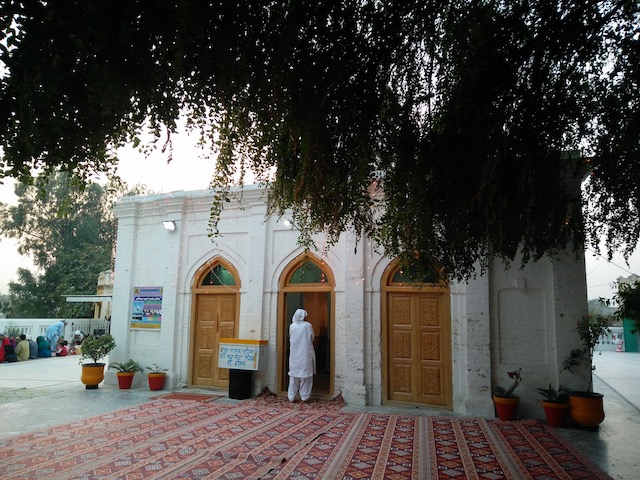
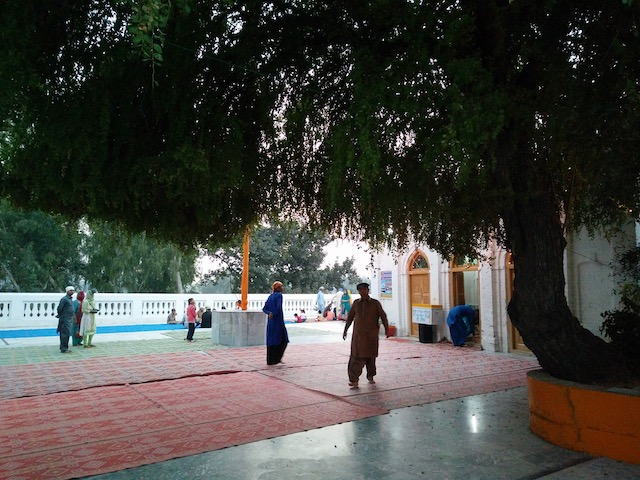
Pictures are of Gurdwara Sacha Sauda, Farooqabad, Pakistan and about 37 miles away from Lahore. This gurdwara is revered with the origins of the langar and is situated not far from Nankana Sahib, the birth place of Guru Nanak.
Baba Farid (1170s-1260s), a Sufi saint from the Chishti order, living in the Punjab, would distribute sweets amongst his visitors; a precursor to langar-khana near shrines, a practice documented in Jawahir al-Faridi (1620s) by a descendent of his. The khanqahs of the Chishti and other Sufi orders kept a langar open for the needy, but also others. It is said that ‘Khwaja Muinuddin established the tradition of an open kitchen for all who came…in an age of feudalism and violence’ (Talib: 6).
There is, of course, a much older practice of the alms house or dharmshala/sarai to feed travellers and poor for free, which is thought to have existed through the Gupta and Maurya (esp. Buddhist) times that is on either side of the BC/AD divide.
Faith
The connections between the Sufis and the Bhakti (devotional) traditions are well documented, inspired as both were by the idea of feeding the poor, the pilgrim and thereby removing divisions/discrimination among people. The idea concretised with the rooting of faith in the region and by early 17th century, it had become a recognised Sikh fixture (Desjardins).
Eleanor Nesbitt notes that, ‘in institutional terms, it was the third Guru, Amar Das [1479-1574], who gave prominence to the langar… [integral as] sharing food [was] to Guru Nanak’s Kartarpur community…it was Guru Amar Das who particularly emphasised the requirement for everyone to dine side by side, regardless of caste and rank’ (Desjardins: 29).
There were two women, who especially, ‘nurtured the development of the langar tradition in its formative period: Mata Khivi (1506-82) and Mata Sundri, the second and tenth Gurus’ wives’. The Guru Granth Sahib notes that ‘Khivi…is a noble woman, who…distributes the bounty of the Guru’s langar; the kheer—the rice pudding and ghee—is like sweet ambrosia’. After the death of Guru Gobind Singh (1666-1708), ‘his widow Mata Sundri worked hard to continue the free community kitchen service. Records show her active role in fundraising for this purpose when the very survival of Sikhism was in question… (Desjardins).
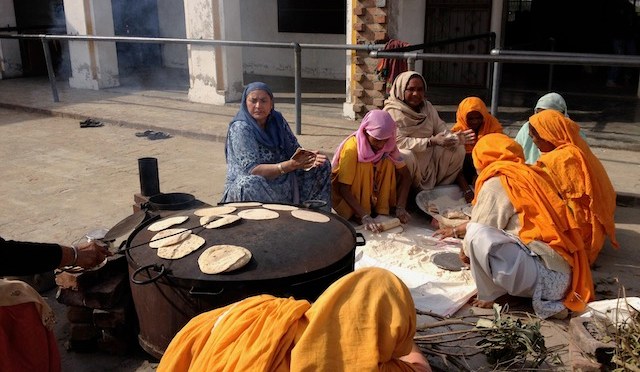
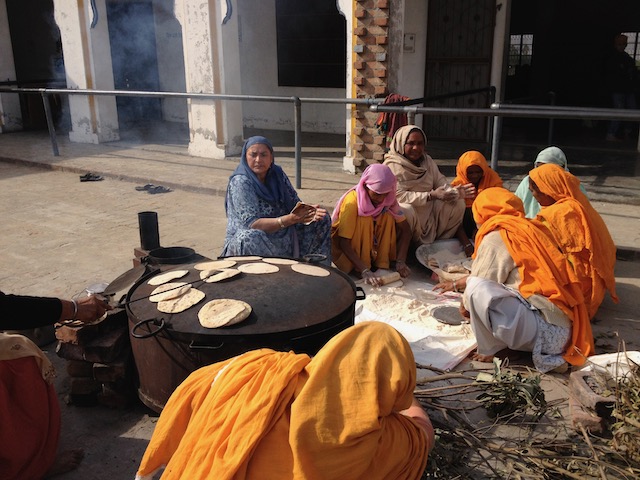
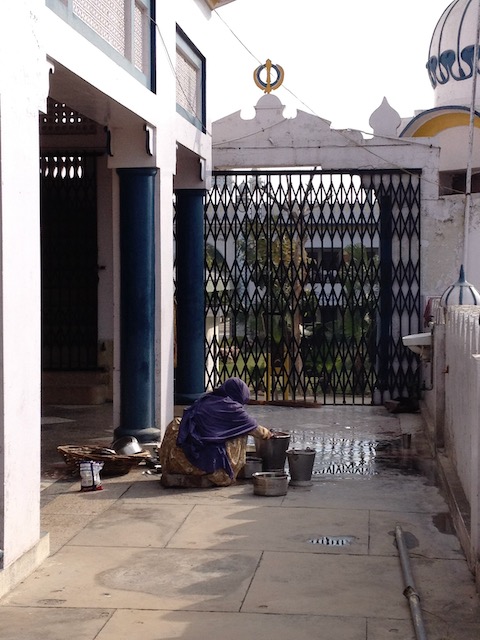
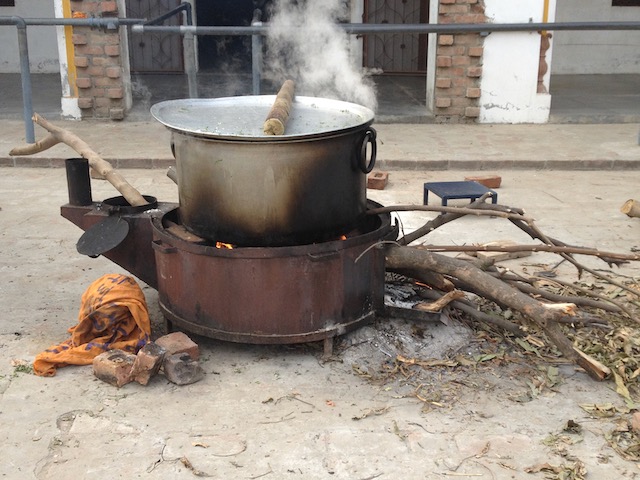
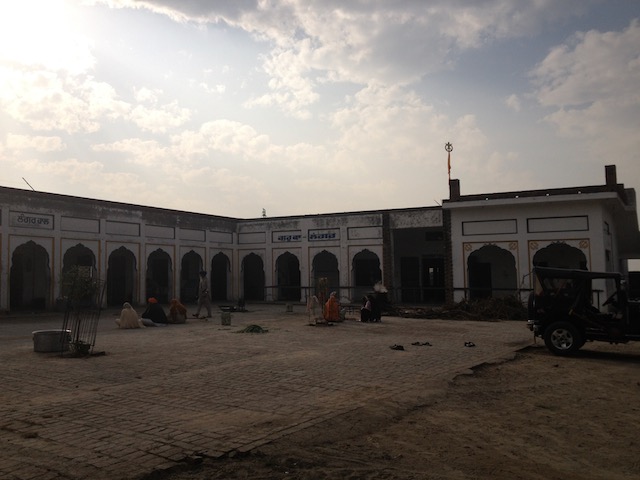
The langar since is thus an integral part of the faith/religion, its compassion through the concept of Seva (self-less service); essential for all practicing Sikhs. Donating food or money is not as important as the practice of giving one’s time and service. Today the most famous community kitchen serving langar has to be the Golden Temple (Amritsar), where around 100,000 people are served on a daily basis. However, most Sikhs grow up visiting and worshipping at small local gurdwaras, where everyday worshippers and volunteers prepare food on a daily basis. These photos are taken from the local gurdwara at Mao Sahib (my father’s village, Jalandhar district), where the congregation prepare, serve, consume the langar and then clean afterwards. As the gurdwaras become more institutionalised, and as the historic gurdwara Mao Sahib (associated with the fifth Guru Arjan and his consort Mata Ganga, d. 1621) has come under the administration of the SGPC (the Sikh body responsible for the management of gurdwaras), voluntary seva has been added to by paid sevadars.
The pictures are of Mao Sahib, 2012, when the langar hall was undergoing a renovation and some of the langar preparation was taking place outside.
Equality
The idea of sitting and sharing food together is fundamental among Sikhs because it demonstrates the abolition of caste and dramatically asserts humble equality amongst all the people; regardless of their religious or caste background. The food is generally simple and vegetarian, to appeal to all and offend no one. Four core Sikh principles are enshrined in the langar: equality, hospitality, service, and charity.
Eleanor Nesbitt writes about how, ‘the Gurus were reformers who abolished the caste system or that caste is Hindu, not Sikh’. It is important to remember how revolutionary this was/is in a caste-ridden society. Nesbitt notes how, ‘the langar subverted Brahminical rules about commensality, according to which only caste fellows could eat together’ (118). Instead, it was proclaimed that, ‘a Sikh should be a Brahmin in piety, a Kshatriya in defence of truth and the oppressed, a Vaishya in business acumen and hard work, and a Shudra in serving humanity. A Sikh should be all castes in one person, who should be above caste’ (117). The Gurus, like the Bhagats Namdev, Kabir, and Ravidas, proclaimed the irrelevance of people’s inherited status to their spiritual destiny. In Guru Nanak’s view:
Worthless is caste (Jati) and worthless an exalted name,
For all humanity there is but a single refuge (Adi Granth 83)
Quoted in Nesbitt: 118
Similarly, according to Guru Amar Das:
When you die you do not carry your Jati with you:
It is your deeds which determine your fate. (Adi Granth 363)
Quoted in Nesbitt: 118
References
Bowker, John (ed.), The Concise Oxford Dictionary of World Religions (OUP, 1997)
In her autobiography ਰਸੀਦੀ ਟਿਕਟ, Amrita Pritam, the poet laureate of Punjabi shares an anecdote.It was the time when Amrita left everything behind, even her love for Sahir Ludhianvi. She joined Imroz in Mumbai, they lived a very economical life, working hard and staying within one’s little means.Gurbaksh Singh Preetlari, the aged patriarch of Punjabi […]
Nothing has captured contemporary adjectives around India more than its seemingly inevitable and irresistible MIDDLE-CLASS; a cursory survey yields an expansive collection of studies on the subject. The key question in them often is how to define this broad category.
According to Abhijit Roy and based on data by “the World Bank and the Organization for the Economic Cooperation and Development (OECD), for those in the middle classes, the earnings typically lie in the range of US $10 to $100 per day, as expressed in the 2015 purchasing power parities”. Using the India Human Development Survey II (2011–12), Maryam Aslany reveals significant findings about the Indian middle class:
“(1) It calculates the size of the middle class to be 28.05% of the urban and rural population. (2) It demonstrates that despite the occupational diversity that exists, a large proportion of the middle class are salaried employees. (3) It demonstrates that contrary to common assumptions, a considerable segment of the Indian middle class resides in rural areas. (4) The fastest growth is in the lower middle classes, who spend between US $4 and $6 per day. This group includes carpenters, street vendors, decorators and drivers”.
Statistical evidence aside, one of the key elements of a middle class is how this class shifts from need to want – a key component of the capitalist model, which creates the desire to consume something, even when it is not required. This is an aspirational desire and in India, the strong connection to society/samaaj ensures that this “want and desire” has a strong market, from whose epicentre – Bombay/Mumbai – economists have defined the middle class as “consumers spending from US $2 to $10 per capita per day. By this definition, approximately half of India’s population of 1.3 billion is in the middle class” (Roy).
Employable education is often seen as one of the key routes to this upward mobility. But once successful, there is also potentially a “tussle between individuality and community: seeking novel self-expression in new jobs and leisure or taking risks with autonomy (the divorce rate is growing, from a low base), but also attempting to keep a sense of community, with dutiful support of parents (a high number of IT professionals buy cars for their parents) and strenuous attempts at maintaining a social circle (oriented around alcohol, movies, resorts and restaurants)” (Ram-Prasad).
One of the challenges with understanding how class works in India is the overlaps with caste. It is often difficult to disaggregate the two. “Upper-caste elites have, in recent decades, become used to those below them in the hierarchy accruing economic power, especially since liberalisation in the early 1990s. The new middle class argues that since it had no help from older elites, its success is self-made and ought to be the model for the poor. But the poor are still usually from castes traditionally lower than those of the new middle class—and this acts as an obstacle to their advancement” (Ram-Prasad).
One of the key things that I have observed over my three decades of travelling to India is the shift in people’s attitude after the liberalisation of the economy. Over a period of time, an airy sense of arrogance, importance and arrival at the global stage has replaced the grounded humility, self-reflection and non-aggression that had wider traction. In part, these attitudes can be traced back to the freedom movement and it is interesting to reflect back to when India had only recently gained independence.
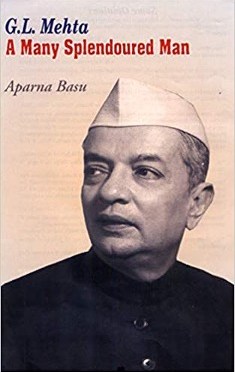
The following extracts from G. L. Mehta, a long-serving Indian Ambassador to America in the mid-1950s, highlight the then- “numerical insignificance” of this ubiquitous group of the middle classes:
“In India, government officials, professional men like lawyers and doctors, technicians and teachers, shop-keepers and clerks are all part of the inchoate group, which goes by the name of “middle classes”. Although merchant classes and officials in medieval India were a group, the middle classes are of a comparatively recent origin. In a society, where caste and status determined the social structure, the middle-income group did not wield any political power nor did they enjoy any social prestige…
…the rise of the middle classes has been due as much to the advent of foreign rule as to the impact of economic forces…There is no gainsaying the fact that our national movement has had its origin and impulse from the middle class. Indeed, the leaders of the labour movement have also been drawn mostly from the middle classes. These classes have largely helped to make India what it is, both in its strength and in its weaknesses…
…the striking fact, however, is their numerical insignificance. An examination of the income-tax statistics shows that in the Indian Union, the numbers of those earning between Rs. 300/- and Rs. 2000/- per month add up to only a little over 3 lakhs. Allowing for 5 dependents to every income earner, it would appear from this that the core of the middle classes in India consists of less than 2 million out of 350 million people…
…in 1938-39, their share of the national income was roughly 5%; today their share is more 3 ½-4%. While the rising prices of the last decade have created higher incomes and pushed up people, it is only a few in the upper income groups, who have stood to gain. Those earning between Rs. 500/- and Rs. 1000/- per month had an annual income of Rs. 80 crores in 1948-49 compared to Rs. 50 crores in 1938-39 but those in Rs. 1000/- and Rs. 2000/- group had Rs. 100 crores in 1948-49 compared to Rs. 30 crores in 1938-39 and those with incomes of Rs. 2000/- per month shared nearly Rs. 160 crores in 1948-49 compared to Rs. 30 crores in 1938-39…
…these distributional changes, together with the general stagnation in the economy, have created a situation of great stress and strain. The middle classes have, on the whole, stopped recruiting from below. Unless the middle classes can improve their economic condition in pace with the growth in their numbers, they are bound to suffer frustration and disillusionment, in proportion with unemployment and inflation. As the London Economist said recently commenting on the situation in India, “when the shop-keeper flourishes and the clerk starves, revolution is round the corner, for the educated middle class will tolerate only so much” (!)…
…but the future of a class, which is not allied to any special interest in uncertain. Equally, if the middle classes are to maintain their leadership, they should avoid freezing into a static group. They will have, therefore, to absorb continuously waves of people ascending from the ranks of peasants, artisans and labourers. At the other end they would have also to discard those whose stakes in the system are so great that they become an impediment to change…because the middle class, and its professional core in particular, can check the acquisitive instincts of the Economic Man. Perhaps it may be the role of the middle-class, to show us the middle way between freedom and order, enterprise and social security”.
References:
Above extracts from an All-India Radio talk, 14 January 1951 by G.L. Mehta (A Many Splendoured Man, Aparna Basu, 2001)
Maryam Aslany, ‘The Indian middle class, its size, and urban-rural variations’, Contemporary South Asia, 2019, 27:2, 196-213, DOI: 10.1080/09584935.2019.1581727
Brant Moscovitch, ‘A Liberal Ghost? The Left, Liberal Democracy and the Legacy of Harold Laski’s Teaching,’ The Journal of Imperial and Commonwealth History, 2018, 46:5, 935-957, DOI: 10.1080/03086534.2018.1519245
The Trolley Times has been launched recently by a group of four youngsters at the Singhu border. The idea was conceived by Ajaypal Natt from Mansa, along with Surmeet Mavi, Gurdeep Singh and Narinder Bhinder. The YouTube interview provides an insight into how the idea was developed, its purpose of reaching out and communicating with people who do not have smart phones and are not connected to social media. Moreover, telecom signals around protest areas are typically suppressed to slow down exchanges and mainstream electronic/print media in India is better known as “godi media”, not just unsympathetic to the thousands currently protesting against the farmers laws brought in September but simply the government’s voice. The first issue of the Trolley Times “carried Bhagat Singh’s quote on struggle; photographs from the centre of the struggle; story of a woman farmer, Gurmail Kaur, who died during the protest; some works of art and the lead article gave the message of unity, struggle and victory. ” The Tribune
The list below provides some references for reading further about the Punjab peasant in a historical context, focusing on some of its radical moments. The region was one of the last to be annexed by the British in the subcontinent in 1849, and subsequently underwent phenomenal transformation with their development of the canal colonies from 1885 onward. Punjab was divided and sub-divided following the Partition of 1947 but agriculture has remained at the core of Punjabi culture and identity.
Ali, Imran. The Punjab under imperialism, 1885-1947. Vol. 923. Princeton University Press, 2014.
Barrier, Norman G. “The formulation and enactment of the Punjab alienation of land bill.” The Indian Economic & Social History Review 2, no. 2 (1965): 145-165.
Chattha, Tohid Ahmad, Abdul Qadir Mushtaq, Sumera Safdar, and Khizar Jawad. “Historical Perspective of Kirti Kisan Party and its Politics in colonial Punjab.” Journal of the Research Society of Pakistan 55, no. 1 (2018).
Chopra, Radhika. Militant and Migrant: The Politics and Social History of Punjab. Routledge, 2012.
Darling, Malcolm Lyall. Punjab peasant in prosperity and debt. Humphrey Milford, London, 1925.
Deol, Amrit. “Workers and Peasants Unite: The Formation of Kirti and the Kirti-Kisan Party and the Lasting Legacy of the Ghadar Movement.” Journal of Sikh and Punjab Studies, 26, no. 1&2: 250.
Gajrani, S. “Role of Kirti Kisan Party in Agrarian Movement (1927-35).” Constitutional Schemes and Political Development in India: Towards Transfer of Power 2 (1994): 463.
Gill, Sucha Singh. “The farmers’ movement and agrarian change in the green revolution belt of North‐West India.” The Journal of Peasant Studies 21, no. 3-4 (1994): 195-211.
Highfield, Jonathan. “Finding the voice of the peasant: Agriculture, neocolonialism and Mulk Raj Anand’s Punjab Trilogy’.” Journal on Interdisciplinary Studies in Humanities 1, no. 2 (2009): 115-133.
Islam, M. Mufakharul. “The Punjab land alienation act and the professional moneylenders.” Modern Asian Studies 29, no. 2 (1995): 271-291.
Jodhka, Surinder S. “Beyond ‘crises’: rethinking contemporary Punjab agriculture.” Economic and Political Weekly (2006): 1530-1537.
Josh, Sohan Singh. Baba Sohan Singh Bhakna: Life of the Founder of the Ghadar Party. New Delhi: People’s Publishing House, 1970.
Kalra, Virinder S., and Shalini Sharma, eds. State of Subversion: Radical Politics in Punjab in the 20th Century. Routledge, Taylor & Francis Group, 2017.
Kalra, Virinder S., and Waqas M. Butt. “‘In one hand a pen in the other a gun’: Punjabi language radicalism in Punjab, Pakistan.” South Asian History and Culture 4, no. 4 (2013): 538-553.
Kessinger, Tom G. Vilyatpur, 1848-1968: Social and Economic Change in a North Indian Village. Vol. 19. University of California Press, 1974.
Mukherjee, Mridula. “Some Aspects of Agrarian Structure of Punjab 1925-47.” Economic and Political Weekly (1980): A46-A58.
Mukherjee, Mridula. “Peasant Protest in Punjab: Forms of Struggle and Mobilization.” In Proceedings of the Indian History Congress, vol. 59, pp. 812-823. Indian History Congress, 1998.
Mukherjee, Mridula. Colonizing agriculture: the myth of Punjab exceptionalism. Sage, 2005.
Raza, Ali. “Provincializing the International: Communist Print Worlds in Colonial India.” In History Workshop Journal, vol. 89, pp. 140-153. Oxford Academic, 2020.
Sharma, Shalini. Radical Politics in Colonial Punjab: Governance and Sedition. Routledge, 2009.
Singh, Nazer. “The Anti-British Movements from Gadar Lehar to Kirti Kisan Lehar.” PhD Diss., Punjabi University, Patiala, 2011.
Talbot, Ian. “The Punjab Under Colonialism: Order and Transformation in British India.” Journal of Punjab Studies 14, no. 1 (2011): 4.









 BAGICHA