Remembering Faiz: thirty-five years on…

When Faiz passed away at the age of 73, Dawn described him as:

The greatest Urdu poet of his time, Faiz became a legend in his lifetime for his intrepid struggle against what he himself once described as “the dark and dastardly superstitions of centuries untold”. He understood the agony of the dispossessed and the disinherited and he sang of them and for them to the last.

While these songs and poems need no introduction, he also wrote enduring prose. On his 35th death anniversary, pasted below are some selections:

‘The Role of the Artist’, Ravi (Lahore) 1982:

‘Who are we – we the writer, poets and artists and what can we contribute, if anything, to avert the moral calamities threatening mankind? We are the offspring, in the direct line of descent of the magicians and the sorcerers and music makers of old…They found for the hopes and fears of their people, for their dreams and longings, words and music that the people could not find for themselves. And by blending their collective will to a desired end, they would sometime make the dream come true…In our part of the world through long centuries…the magician of old became the post-mystic or the mystic poet, the forerunner of the modern humanist, who defied both emperor and priest to articulate the ills and afflictions of his fellow beings, to expose the injustices of their masters and their master’s collaborators, who taught them to believe in, and fight for, justice, beauty, goodness and truth, irrespective of personal loss and gain…So that is who we are, inheritors of this magic…And never was the power of this magic more devoutly to be wished than in the world of today when so many powerful agencies are at work to deny the validity of all ethical human values, to obliterate all refinements of human feeling…by extolling cynicism, insensitivity and brutishness as the hallmark of a he-man and a she-woman…’

Source: Coming Back Home: Selected Articles, Editorials and Interviews of Faiz Ahmed Faiz, compiled by Sheema Majeed, introduction by Khalid Hasan, Karachi: OUP, 2008, pp. 40-1.


‘The Writer’s Choice’:

‘Literature like science is a social activity…Literature unfolds in a similar fashion…the unexplored or dimly lit complexities of social reality, the given human situation of a given time. The impact…however, more insidious, more subtle and at the same time more direct…. The writer is directly manipulative and formative of the consciousness of the audience…He cannot plead, therefore, that he is unaware of, or unconcerned with, social implications…A writer may be tempted, coerced or bribed [by] vested interests to ignore, emasculate, or pervert the basic realities of social existence under various specious pretences, ‘pure’ literature, art for art’s sake, ‘pure’ entertainment etc., a mechanistic repudiation of these ‘purities’, however, poses another danger. In creative writing to ignore the demands and essentials of artistic creation can be inexcusable, although perhaps not as reprehensible, as the moral and social imperatives of reality. It is but another form of escapism…There is still considerable confusion in most African and Asian countries regarding the function of literature, the role of the writer and the modalities of literary expression. This confusion is partly a legacy of the colonial past, partly a recent import as a product of neo-colonialism…Whatever his social status, his intellect and education will automatically place him in the ranks of the elite minority…He will be called upon to make a choice of his audience – to write for his own class or to transcend the class barriers…’

Source: Coming Back Home: Selected Articles, Editorials and Interviews of Faiz Ahmed Faiz, compiled by Sheema Majeed, introduction by Khalid Hasan, Karachi: OUP, 2008, pp. 43-4.


‘Decolonizing Literature’:

‘When the process of colonial occupation got underway in Asia and Africa the literature and languages of the subject peoples were among the first victims of foreign cultural aggression. Its impact hit different communities in different ways depending on their level of social and cultural development, thus confronting each one of them with a different set of dilemmas in their quest for identity after liberation…(1) The study of Asian and African literatures should be incorporated in the relevant schemes of higher learning…Even language teaching in European languages need no longer be confined to European authors. (2) …publication and marketing of important Afro-Asian writings in still the monopoly of a few Western publishing houses…such publications are only marginal to their main business interests…The high cost of Western publications is another inhibiting factor…Efforts are needed for a re-orientation of the publication trade in Asian and African countries. (3) For many Asian and African writers, ‘international recognition’ still means some notice by the Western media. Some of them are thus induced to set their sights while writing on Western rather than their national readership…There are enough nations in Asia and Africa to make any writer ‘international’ without any Western certification…This needs some rectification not only in the outlook of the writer, but also of his readers’.

Source: Coming Back Home: Selected Articles, Editorials and Interviews of Faiz Ahmed Faiz, compiled by Sheema Majeed, introduction by Khalid Hasan, Karachi: OUP, 2008, pp. 49-52.


The Sikh Question: two thoughts


Jawaharlal Nehru to Baldev Singh, 23 November 1948 (JN SG File No. 15 Pt.-II):

‘[Your] note about the Sikh position in East Punjab…I was surprised and depressed to read it. I entirely agree with you that we should help the Sikhs wherever possible. But [your] proposals seem to me basically opposed to the very things we proclaim and stand for. Our government as well as the Constituent Assembly have declared themselves to be totally opposed to communalism. We may not be able to put an end to [it], but in all governmental activities we can give it no place…The Constituent Assembly [came] to certain decisions last year in regard to minorities which are applicable to all of them…no government can apply one principle to one community and totally different principle to other communities…This means joint electorates, reservation where desired by the minority, but on the basis of population only and no weightage.

Regarding the carving out of a new province or transfer of Gurgaon district to Delhi, I have been opposing suggestions for provincial redistribution or division…I believe that something of this kind will have to be done but [not] I at this particular time when we are grappling with very difficult problems…Let this matter be considered dispassionately somewhat later. The Punjab, as you remind us, is a frontier province now and we cannot allow the situation in the East Punjab to deteriorate. Nor will it be desirable to think in terms of communal provinces when refashioning our provincial areas…Any untoward development in East Punjab might have serious repercussions on the Kashmir situation…As for the formation of constituencies, any attempt made to gerrymander in favour of this or that group would also lead to bitterness and conflict.

I would very much like to do something to convince the Sikhs that their fears are groundless. Indeed, I do not myself see why a progressive and enterprising community like the Sikhs should be afraid of the future…It would be doing an ill-turn to the Sikhs to treat them as the Muslim League wanted the Muslims to be treated before the Partition. What I have been specially distressed is the strained similarity between the present demands of some of the Sikh leaders and the old Muslim League demands…Can we not learn from bitter experience? You have rightly complained of some articles and cartoons in the few Delhi papers. But whatever these papers may have written, it pales into insignificance before the speeches and statements of Master Tara Singh…extraordinarily irresponsible…open incitement to war and to internal conflict…upset me a great deal’.

Tara Singh (District Jail, Banaras) to Nehru and Patel, 19 April 1949 (JN SG 23 Pt.-I):

‘Since I read in the “Statesman” that the consideration of formation of linguistic provinces in northern India has been indefinitely postponed, I have been deeply thinking how to convince you that the Sikhs are in urgent necessity of maintaining Panthic entity in order to protect their religion…the Sikhs in order to exist, must have a home in the Indian Union where they have some power to practice and advance their culture, religion and language according to their own light…Why should the Congress yield to the communal demand of the Hindus of the Punjab and be a tool in the hands of the communalism of the majority? The vocal section of the Hindus in the East Punjab wish to dominate us and use us as chowkidars…it was the Hindu press which was the first to write that the Hindus cannot live in a province where the Sikhs be in majority…this is the mentality of the so-called nationalists…if the Hindus who have majority in the central government cannot stay in a province where the Sikhs may have majority, how can the Sikhs stay in a Hindu-majority province when they are in hopeless minority in the centre also?…It is of course easy for those in majority to pose as purely nationalists, for best nationalism and worst communalism coincide here…

I feel I am the person responsible for bringing the Sikhs to the present position…In 1929, when [Motilal] Nehru report was published, the Sikhs as a community went out of the Congress…I, with some colleagues, [persuaded] the leaders of the Central Sikh League to come to a settlement…I, with others, came back to the Congress. If the Congress now forgets its promise, I am not going to shirk my responsibility…I may give an example. A [Sikh] deputation met Sardar Patel some time ago and put some demands. He did not agree to any one of them. One of the demands was that while granting certain privileges and concessions to depressed classes, no distinction on religious ground be made…at present, if a Hindu of a depressed class embraces Sikhism, he is deprived of these privileges and if a Sikh of a depressed class embraces Hinduism, he gets the privileges…Congress leaders had [said] that if that distinction was removed, some of the depressed class Hindus would embrace Sikhism. This is how cat was let out of the bag…

Most of the Punjab Hindu leaders [are] communalist at heart…a Sikh protects every religion…Guru Teg Bahadur sacrificed himself to protect Hinduism…so I claim that the Khalsa Panth is not communal…most Hindus do not realise it…independence to them appears Hindu domination…I do believe in the fundamental oneness of the Hindu and Sikh religions, but I do not call myself a Hindu…I wish to save the Khalsa Panth which will prove a pillar of strength of the country, as it did in the past…Sardar Patel does not seem to realise this…my only hope and my only weapon is righteousness of my cause and my faith in Him who saved Prahlad…I make the following two demands: 1) Sikhs and Hindus of the depressed classes should have the same privileges and concessions; 2) a Punjabi-speaking province shall be created so that the bulk of the Sikh population shall not live under Hindu domination on provincial basis…I have never demanded and do not demand now an independent Sikh State…I do demand a self-governing unit within the Indian Union…we are a religious minority in dire need of protection…if my above two demands are not granted, I shall start my fast unto death…Kindly do not enter into technicalities while replying…’

Read further:

J.S. Grewal, Master Tara Singh in Indian History. Colonialism, Nationalism, and the Politics of Sikh Identity, (OUP, 2018)

J.S. Deol, Baldev Singh (1902-1961), Oxford Dictionary of National Biography (2004).

Looking Back…

Nakuru
© Pippa Virdee

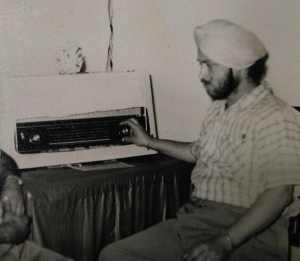
Growing up in tranquil Nakuru, Kenya, there was always one familiar sound floating around the house: the voice of Bhai Gopal Singh playing on a small cassette player, resting on the fridge just by the kitchen door, every day without fail. There was no TV in the house, only an old radio, which had prime position in the sitting room, as it connected us to the world outside. The radio was one of those big, vintage styles with a dial for tuning and it brought the sounds of Hindustani music to our ears. However, it was the cassettes with, often copied, hand-written recordings of shabads and their ragis that were the musical soul of the house.

They would play continuously the sound of a selected handful, among which Bhai Gopal’s were by far the most popular. These cassettes travelled with us, when we left Kenya and continued to be played at home, here in the UK that is until other technologies started to supersede it. The familiar dark grey coloured cassette, with Bhai Gopal Singh etched on both sides, written by my father, was my connection to the past, that continued to remain with us; providing remembrance of a past that no longer existed. And so, it is apt that this shabad, ‘mere mujh kichh nahin’, composed from the sayings of Guru Nanak (1469-1539), Kabir (1440-1518) and Guru Arjan Dev (1563-1606) and sung by Bhai Gopal, is all about letting go, of the material and physical.

There is very little that we know about Bhai Gopal Singh. He was from Amritsar/Gurdaspur. He excelled in kirtan and became a hazuri ragi in Harmandir Sahib. He later went to Delhi and was employed at Sis Ganj Gurdwara in Chandni Chowk. He lived in Delhi, married and also had a son. Anything more than that would be speculation about him and his life, yet he remains a remarkable figure. The tape is nowhere to be found but the voice of Bhai Gopal is preserved by technology for newer generations to discover. There is always something soothing and evocative about his voice and today, almost four decades on from Nakuru, his voice has the capacity to transport me back to the days of my childhood.

Also visit Gurmeet Manku to learn more about this shabad and of the Sufi/Bhakti influence in shabads.

Shoulder to Shoulder

Peshawar 2017
© 2017 Pippa Virdee

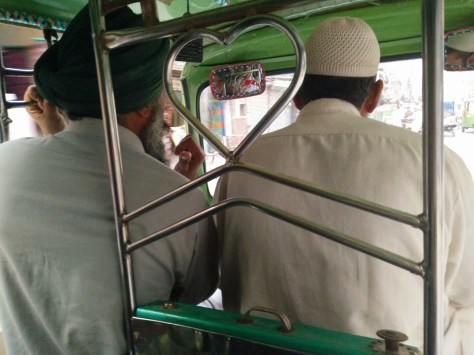
This picture was taken by me during one of the most memorable tuk tuk rides in Peshawar in 2017, when I was exploring the city and trying to find a gurdwara in the narrows lanes of the congested city. Along came this sardar ji who jumped on the tuk tuk and navigated us to Gurdwara Bhai Joga Singh. As the sounds and sights gather momentum around the opening of the Kartarpur corridor, I share this moment that speaks silently for the hopes of many.