Tag Archives: working women

The shame of work

This morning I came across a newsflash on the BBC about “The risqué business of selling underwear in Pakistan”, which serves as a click bait because the article-proper is titled “Pakistan: The man trying to improve women’s underwear”. Its content immediately resonated with me. The quotes from female workers therein took me back to the research I did on the women, who worked for Pakistan International Airline (PIA) in 1960s. The factory in-focus, where they are making the garments, is based in Faisalabad (Lyallpur), a city I know well because of my own doctoral research, while the business was started by a Leicester born businessman. Leicester/DMU where I work, is city renowned for its garment factories and indeed DMU has long pioneered research in the increasingly sophisticated lingerie industry.

The interesting element is of course that in Pakistan, women’s undergarments are either on full display in congested stalls in busy bazaars, where a majority of women shop (buying, most likely, from a man) or they are curiously hidden (veiled) behind the blackened windows in fancy shopping malls. This stark class disparity is also symbolic of a cultural disparity in a society where working women of the sub-urban informal sector in r-urban areas, rarely have the luxury to be veiled, while the newly middle-class women, of families with the means to be pious, are more prone to and secluded in world of purdah.

The focus of the said article is about comfort and ensuring that women have access to underwear garments that are fit for purpose – and not just for optics. The fact that society treats these necessities in life as taboo, something to be embarrassed about and to snigger at because we are unsure how to respond, is a fine example of how a patriarchal society works to keep women confined in both public and private spaces.

When I was doing my research on PIA, the airline was established in 1955 in part to meet the needs of keeping East and West Pakistan connected, it was obvious that to get it off the ground, it needed staff, male and female. I was intrigued by the women who worked for PIA in the 1950s and 1960s, what motivated them, what their background was, given that in this still-more socially conservative age, women working as “airhostesses” or cabin crew were yet-more objectified, with age/size/marital status being important to the job. So, it was not surprising when such women encountered reluctance from the family members. 

These quotes from the BBC article could have been from the women I spoke with: (1) “We had two people who came back and said their families do not want them to work in an undergarment factory.” (2) “My father instantly refused…I had to ask him to let me go and see for myself and if…I don’t like the atmosphere at the factory, I won’t accept the job.”

Women who wanted to work for PIA endured similar sentiments. Families were reluctant or worse at their sisters/daughters working in this “forward” industry and the potential shame. But this was the 1950s/60s, and many of these women were away from home, flying high and experiencing a completely different world. In their taking off, they were breaking new ground, pioneering and enabling others to work in professions other than the usual “respectable” teaching/medicine. And so, to read these quotes from women today, 60 years later and working for a factory that is making undergarments is emblematic of how Pakistan has rolled on the road of more piety and rituals, as a ruse for rule; cover for control.

Faisalabad/Lyallpur is the third largest city in Pakistan, after Karachi and Lahore, and is the hub of the textile industry. It is often referred to as the Manchester of Pakistan. Following the Partition of British India, the city witnessed mass movement of people, both those who left for India and the large number of refugees that transformed this colonial town into the city that it is today. When I was doing my research on the city in the early-2000s, it was a conservative city despite the vast wealth being generated in its bazaars; 20 years on, it continues to be so, perhaps because of the new capital and its renewed performance of customs and commodification of shame.

Read further:

Pippa Virdee, ‘Women and Pakistan International Airlines in Ayub Khan’s Pakistan’, The International History Review, 2019, 41:6, 1341-1366, DOI: 10.1080/07075332.2018.1472622

Saher Baloch, ‘Pakistan: The man trying to improve women’s underwear’, BBC News, 13 June 2021. https://www.bbc.co.uk/news/world-asia-57268691.

Women and Pakistan International Airlines in Ayub Khan’s Pakistan

pia-airhostesses

Abstract:

This article weaves together several unique circumstances that inadvertently created spaces for women to emerge away from the traditional roles of womanhood ascribed to them in Pakistan. It begins by tracing the emergence of the Pakistan International Airlines (PIA) as a national carrier that provided an essential glue to the two wings of Pakistan. Operating in the backdrop of nascent nationhood, the airline opens an opportunity for the new working women in Pakistan. Based on first-hand accounts provided by former female employees, and supplementing it with official documents, newspaper reports and the advertising used for marketing at the time, it seeks to provide an illuminating insight into the early history of women in Pakistan. While the use of women as markers of modernity and propaganda is not new, here within the context of Cold War and American cultural diplomacy, the ‘modernist’ vision of the Ayub-era in Pakistan (1958-69), and its accompanying jet-age provide a unique lens through which to explore the changing role of women. The article showcases a different approach to understanding the so-called ‘golden age’ of Pakistani history: a neglected area of the international history on Pakistan, which is far too often one-dimensional.

Link to the article: https://doi.org/10.1080/07075332.2018.1472622

History and Nostalgia: Pakistan’s “golden era”

This slideshow requires JavaScript.

In recent years there have been a number of articles which have explored the visual representation of a so-called “golden-era” of Pakistan. Nadeem F. Paracha[i] has been at the forefront with his attempts to show a Pakistan which many would struggle to recognise today. Just recently there was an article by Ally Adnan in The Friday Times which explored the history of Eid greeting cards via the writer’s own experiences;[ii] a more compelling and detailed account of vintage Eid greeting cards and their origin has been done by Yousuf Saeed.[iii] And then there was a short pictorial essay by Amna Khawar[iv] on vintage travel posters capturing the romantic side of Pakistani tourism. Many of these images relate to the 1950s and 1960s.

As a historian I have been thinking about these articles along with my own research, which has been exploring women’s representation in public spaces in the formative years of Pakistani history, especially the women who worked for PIA. I have been fascinated with the role of nostalgia and how this has been shaping the popular imagination in recent years. The pictures collectively evoke a period that is seen as being more liberal, tolerant of ‘others’, modern, sassy, energetic, optimistic and laced with a sprinkling of the colonial hangover. An early example of this is an ad by PIA from 1960, with the tag line “Move with the times.”[v] PIA was one of the leading brand ambassadors for Pakistan and combined with the emergence of the jet-age there was a growing tourism industry that is virtually non-existent now.

More broadly, and used a source, these images also depict the changes that have taken place in Pakistan and how these are reflected in society. While much has been written about the history of Pakistan, this has largely tended to focus on the political issues, ideological debates, economic concerns or the political leadership. Rarely do we get to glimpse history through the prism of the societal and cultural changes taking place. The ordinary lived experiences of people, especially women, rarely get coverage in the official histories, which are more concerned with the high politics. Yet, if we start to scratch around the pages of old newspapers, magazines, folklore, literature, and personal narratives, there are many untold stories waiting to be explored and unearthed.

So why this fascination now? There are a number of factors converging at the moment which are in many ways compelling commentators and writers to re-visit this history. The political changes and gradual encroachment of religious conservatism in Pakistan makes us want to explore alternative national histories. This is almost a reaction to the current political climate, which has rendered many helpless in their attempt to preserve a more secular and liberal vision of Pakistan, which was seen to be more prevalent in the early years of Pakistani history.

The distortion of history, both intentionally and now as a default position because the effect has been so pervasive, has helped to re-write how we understand and analyse the early history of Pakistan. This has been a gradual process but I would argue something that started especially after the break-up of Pakistan in 1971. The reaction, to the split was an attempt to force greater unity amongst the people and consequently more religiosity was prescribed to keep the nation from further fragmentation. This rather dogmatic approach meant a more exclusive understanding of Pakistani identity which frowned upon anything that deviated from the acceptable norms of the state-view.

The 1970s were also importantly a watershed for Pakistan because a number of factors converge together. The power of the petro-dollars and Saudi Arabia, the state-sponsored Islamisation during the Zia period, the rise of the pan-Islamic identity, the Russian invasion of Afghanistan, American interests in Pakistan, coupled with the break-up of Pakistan at the start of the decade result in a nation that was seeking a new identity. The response was almost an attempt to finally break away from the shackles of imperialism and create a new post-colonial nation. The replacement however, has seen this being replaced by a different form of colonialism, one that relies heavily on Saudi Arabia and ironically a dichotomous relationship with America.

Pakistan has thus undergone vast amount of change during the past forty years. Within all this change, which has been confused and contradictory at times, there is sentimentality and nostalgia for a period that seems so distant. The era of the 1950s and 1960s when, women were optimistic of their role in the nation-building project, and were visible in public spaces; economic prosperity offered hope for the future; a young nation looking and embracing internationalism; and the buoyancy and optimism of independence still reverberating. The reality may have been different but memory is quite subjective and revisionist. But sixty-eight years on, the optimism and expectations have somewhat dampened and have been replaced by cynicism, lack of faith in the state apparatus to deliver the basic needs for its people and an religious-ideological schism which is pulling people apart.

So it is within this context that increasingly there is a re-evaluation of trying to understand that period. It is in a sense a desperate attempt to hang on to a past that will be familiar to many but more radically it offers a space in which a nation is still trying to define itself. These cultural and social spaces are powerful, just as the margins are; so within these confines there is an opportunity to construct and revise a history that has become so distorted. Indeed History is never static; it is continually changing and is shaped by the present. Similarly, memory is equally revisionist and it is the fragility of the present, which compels many to seek answers in the past and contextualise this history in the present. By exploring these alternative spaces and histories of our collective past, we can perhaps better understand and hope for a more compassionate future.

[i] Nadeem F. Paracha, ‘Also Pakistan’, Dawn 9 Feb 2012. http://www.dawn.com/news/694239/also-pakistan-2

[ii] Ally Adnan, ‘I Love Eid Cards’, The Friday Times, 25 July 2014. http://www.thefridaytimes.com/tft/i-love-eid-cards/

[iii] Yousuf Saeed, ‘Cross-cultural Image Exchange in Muslim South Asia’, Tasveer Ghar: A Digital Archive of South Asian Popular Visual Culture.  http://tasveergharindia.net/cmsdesk/essay/117/

[iv] Amna Khawar, ‘Vintage Travel Poster Capture Pakistan’s Romantic Side’, Medium, 14 August 2014. https://medium.com/@amnak/vintage-travel-posters-capture-pakistans-romantic-side-95b5b8090909

[v] The advert appeared in the magazine, Pakistan Quarterly, Spring 1960.

A version of this article appeared in The News on Sunday [link: http://tns.thenews.com.pk/recovering-history-through-nostalgia/#.WJsT7BBpZE5%5D

PIA, the jet-age and working women

pia-good-daughters
The Pakistan Times, 11 September 1966

The coming of the jet-age: women, advertising and tourism in Pakistan

Appearing on 23 September, 1956, The Pakistan Times article, ‘About women travellers’ is a commentary by their woman correspondent on travelling in the jet-age and ends optimistically with, ‘Times are changing rapidly. Gone are the days when women could not move unchaperoned, for now they travel the globe, and although there are no undiscovered continents, they still travel paths yet untrodden by women.’ This article appeared at a time when Orient Airways was merging with Pakistan International Airlines Corporation to form what is now more popularly known as PIA.

Shortly after PIA’s establishment, in 1959 the new managing director, Air Commodore Nur Khan, took over; he was considered to be a dynamic and forward-thinking visionary and well placed to take advantage of the coming jet-age that would revolutionise air travel. By its own admission, PIA considered his tenure as the ‘golden years of PIA’. Enver Jamall, former chairman and chief executive of PIA, highlights the competition PIA had with Air-India, which had already placed orders for Boeing 707s to be delivered in 1960. There was much determination within PIA to be the first airline in the East to operate jets and so an agreement was reached with Pan American World Airways (Pan Am) for the lease of one of its Boeing 707s. This would operate on the London-Karachi-Dacca route with an extension to New York once a week. The flights began in March 1960, giving PIA the coveted prize and the route was a financial and operational success.[1]

Writing on the tenth anniversary since independence the General Manager of PIA, Zafarul Ashan, notes how the bold concept of air transport helped Pakistan maintain national unity. He goes further and adds that ‘In air transportation, more than in anything else, the Pakistanis discovered their true genius, striving as a modern nation to achieve a happy blend of the values of their rich cultural past with values and concepts of this age.’ Ultimately, PIA’s impact extended beyond merely connecting the two wings. Apart from the trade between the two wings, the ‘low cost air transport within Pakistan started a revolution in the travel habits’ of people and ‘it opened up new venues of business and recreation.’[2] With the jet age, there was simultaneously an emerging middle class with more disposable income both globally and within in Pakistan. So while the majority of the early travellers were wealthy businessmen, the affluent middle class was the way ahead for expansion. Nur Khan recognised this opportunity for growth and expansion.

PIA also made some interesting strategic moves. In 1955, the first flight ‘to the glittering, glitzy capital city of London, via Cairo and Rome’ started. There was some criticism of this from the public who regarded other projects as more urgent for a developing country like Pakistan but this was rebuked with the substantial foreign exchange earned through the international service. Indeed the foreign tourist market was crucial to the business model in the early days of PIA, it is only by the 1970s that the shift towards catering for the diaspora market takes place. Travelling abroad was an aspirational luxury for an elite group of Pakistanis but PIA in its early years was also tapping into the lucrative international tourist market. This is certainly evident in the early marketing and advertising by PIA, they were appealing to the foreign market and indeed the airline was successfully establishing a reputation for excellent services and was increasingly capturing the international market.[3] It was consistently considered as one of the best airlines in the East and was increasingly competing with likes of Pan Am and the British Overseas Airways Corporation (BOAC) for foreign tourists coming to Pakistan.

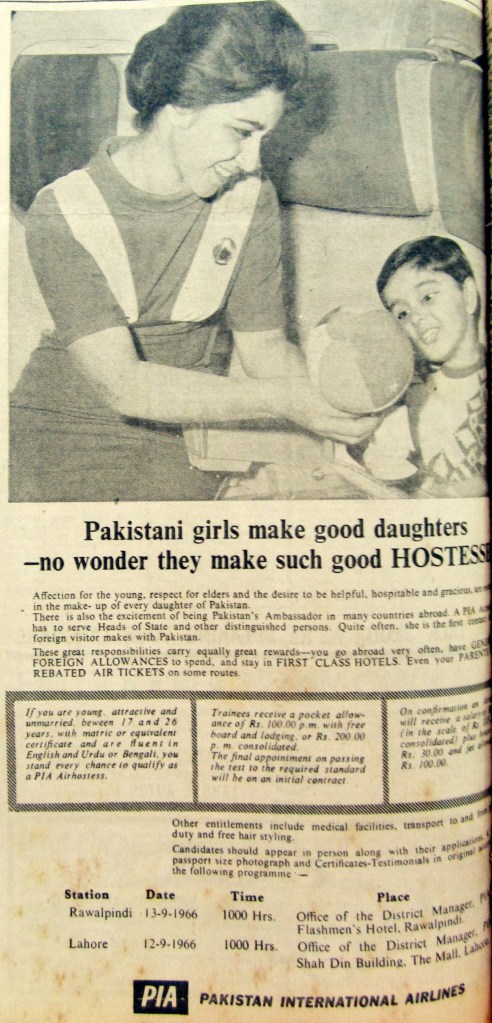
What is often over-looked in this story is the role of the women in promoting the PIA brand. PIA often used traditional notions of womanhood in their ads to attract more girls into the profession. We can see this from the text below taken from a 1966 tagline:

‘Pakistani girls make good daughter – no wonder they make such good Hostesses’

The advert depicts a young, elegant lady playing with a child on board a flight and continues, ‘Affection for the young, respect for elders and the desire to be helpful, hospitable and gracious…make-up of every daughter of Pakistan.’ These attributes can easily be applied to any “good” daughter (and potential daughter-in-law). But instead of representing the home, PIA airhostesses were ‘Pakistan’s Ambassador in many countries abroad’ and often she would be the first point of contact that a foreign visitor would make with Pakistan.[4] While playing on some of the traditional roles of women, the advert is also breaking new ground by legitimising the role of the airhostess. It sends out a message that this is a “respectable” profession and thereby quelling any fears parents may have about their daughters wanting to join the profession. On the other hand, the use of glamorous young females in exotic locations, also promotes an image of Pakistan which modern, progressive, internationalist and welcoming. There is then a dual role in the marketing and branding of the advertising.

There is also a sense that this was an age of new discovery and opportunity, democratisation in the travel and adventure industry, no longer the preserve of wealthy elites. An ever-increasing number of people now had the opportunity to explore and venture into new areas and the newly created nation of Pakistan had many attractions. The Government of Pakistan was also keenly promoting tourism, as is evident in the promotional literature of the 1960s. Foreign travelogues and magazines like the National Geographic were similarly featuring Pakistan as a tourist destination. While Karachi was the hub of activity, it was the old Silk Route, Peshawar, Swat, Chitral, Gilgit and the Karakorum Highway that attracted the adventure tourists. Mack Millar was a flight instructor assisting PIA during its early days and notes. ‘Although PIA is a national airline and the Pakistani government was founded to give the Muslim people their won country, the airline, like the nation itself, shows a wonderful tolerance for people of other persuasion. Many of the pilots are of mixed lineage-Anglo-Indian and Portuguese-Goanese, for example-and many are Christians.’[5] The feeling is that this was a more tolerant age; it was more open to foreigners and ideas. Internally it presented opportunities for Pakistanis to be part of an international community. The social and political changes that have taken place in Pakistan in the past 40 years have polarised this landscape.

The advances made in air travel were crucial to the existence of having a nation state divided by 1100 miles of hostile land mass. Zafarul Ashan was only too aware of this, ‘Nothing could have been worse than isolation for the cultural development and the expansion of the economy of the two wings. Political equality demanded that East and West Pakistan should be brought very close to each other in terms of time.’[6] The timing for Pakistan’s existence as a nation-state is therefore crucial in that the airline industry was just beginning to take off during the 1940s and not long after, the jet-age would revolutionise air travel. But along with this, a number of other opportunities also opened up. Foreign travel increasingly filtered down to the classes and was no longer just an elite activity. Out of this emerged a tourist industry attracting people to visit Pakistan and a domestic market, based not just on travel between the wings of Pakistan but looking to travel and experience the world beyond Asia. It also fundamentally opened opportunities for women to work and explore the globe. In an age where women were restricted to largely working in “respectable” jobs like teaching or medicine, here PIA was making the idea of working in the airline industry and as an airline hostesses a respectable profession. This was ground-breaking for the age.

[1] ‘Birth of a Nation; Birth of an Airline: The History of PIA,’ Enver Jamall in The Putnam Aeronautical Review 1990.

[2] The Pakistan Times, ‘P.I.A. Plans for Increased Capacity’ by Zafarul Ashan, 14 Aug 1957.

[3] The Pakistan Times, Independence Supplement, ‘PIA is flying high’ 14 Aug 1960.

[4] The Pakistan Times, 11 Sep 1966.

[5] Ed Mack Miller, ‘Pakistan International Airlines Great People to Fly With’ Flying, March 1963

[6] The Pakistan Times, ‘P.I.A. Plans for Increased Capacity’ by Zafarul Ashan, 14 Aug 1957.

A version of this appeared in The News on Sunday [link: http://tns.thenews.com.pk/the-coming-of-the-jet-age/#.WI_D3JJOuHk%5D