Tag Archives: violence

2 Nov 84.

BBC Details Incidents. London BBC World Service 0015 2 Nov 84

[From “Radio Newsreel” program]

The outburst of anger against the Sikh community in India following the assassination of Mrs Gandhi by two Sikhs of her bodyguards has claimed about 150 lives and left more than 1,000 people injured. Mob vengeance took its tool in a number of centres and curfews have been imposed, including one in the capital, Delhi. Tim Llewelyn saw the violence there.

It was the worst day of violence in Delhi’s recent history. No area was spared – rich, poor, residential, commercial. Angry youths acting without apparent organisation gathered on the streets attacking Sikh stores, taxis, homes, and Sikhs themselves. Usually, they burned or looted whatever they could lay their hand on, twice Sikhs themselves and in one case, lynching two adults near a Sikh temple, then setting the corpses alight. Cars were attacked and burned because the mob in India identifies the Sikhs with the car and the taxi. Sometimes – but not always – the police intervened, and I watched the security forces with bayonets fixed rescue the man whose house was being put to the torch by the angry crowds of youths. A number of Sikh temples were surrounded and threatened but mostly escaped damage. They were often defended by Sikhs themselves brandishing their medieval weapons – swords and staves and spears. The prime minster, Rajiv Gandhi, has ordered that the violence must not be repeated. There are indefinite curfews in 30 towns and cities, including Delhi and parts of Calcutta.


52 Killed in Bihar. Paris AFP 0759 2 Nov 84

At least 52 people were today reported killed in Bihar state, bringing the nationwide death toll in the anti-Sikh violence sparked by Prime Minister Indira Gandhi’s murder by two Sikh bodyguards to about 200.

The PTI said the 52 deaths took place in Bokaro, in the northeastern state of Bihar, where police fired on rioters. Security forces were under order to shoot on sight anyone committing violence.

PTI said another 50 people were wounded in Bokaro.

Meanwhile in New Delhi, a dozen bodies were found in an express train which arrived from Ludhiana in the predominantly Sikh of Punjab early today, station officials reported. They gave no further details.


Death Toll Reaches 227. Paris AFP 1005 GMT 2 Nov 84

Fresh outbreak of sectarian violence rocked New Delhi and other Indian towns today as the death toll in the anti-Sikh backlash sparked by the assassination of Prime Minister Indira Gandhi soared to 227.

In East Delhi, Hindu mobs defied shoot-on-sight orders and Army and paramilitary troops to set fire to a cinema, police said. They also reported mob violence in two localities in south Delhi.

Police confirmed that 70 people had been killed in the capital since Mrs Gandhi was gunned down outside her home on Wednesday by two Sikh members of her bodyguard.

Bihar in the north-east, Uttar Pradesh in the north and Madhya Pradesh in central India were reported to be the worst hit among a dozen states reeling under the wave of violence, despite repeated calls by Prime Minister Rajiv Gandhi over the radio for calm.

The reports said that 92 people had so far been killed in Bihar, with 35 dead in Uttar Pradesh and 30 dead in Madhya Pradesh. Other casualties were reported in the western coastal state of Maharashtra.

The worst incidents occurred in Bihar state, where at least 52 people were killed as Hindus sought to revenge Mrs. Gandhi’s murder, the PTI reported.

The incidents took place in the steel town of Bokaro, PTI said, adding that the state authorities had issued security forces with shoot-on-sight orders to quell further violence. PTI said another 50 people were wounded.

Police Deputy Inspector-General Y.N. Srivastava told PTI that police in Bokaro opened fire on rival Sikh and Hindu mobs, killing one person and injuring two. Riot police were patrolling the streets.

Newspapers earlier reported other slayings in the industrial town of Ranchi as well as Hazaribagh, Arrah and Daltongaj, also in Bihar state.

An indefinite curfew was reportedly imposed on Ujjain in the central Indian state of Madhya Pradesh following a number of cases of arson and looting, while angry mobs violated curfew restrictions in nearby [words indistinct].

Trains arriving here from the Punjab reportedly carried bodies of people believed to have been lynched by crowds en route to the capital for Mrs Gandhi’s funeral tomorrow,

Eye witnesses and railway officials said they saw six bodies lying on New Delhi railway platform.

Other eye witnesses said that as many as 18 bodies were found in a train that ran between two Punjabi towns of Bhatinda and Ferozepur.

Prime Minister Rajiv Gandhi broadcast repeated radio calls for an end to the orgy of violence, but with little effect.


Death Toll Climbs. Paris AFP 1308 2 Nov 84

Thirty more people were killed in inter communal violence in New Delhi today, officials said, as the [word indistinct] nationwide death toll in violence sparked by the murder of Indira Gandhi climbed past 300.

A total of 100 people, including some reportedly burned alive in [word indistinct] New Delhi, have been killed in the capital since the prime minister was gunned down by Sikh bodyguards on Wednesday.

Police reportedly opened fire to separate Hindus and Sikhs clashing in a village in west Delhi. The groups exchanged fire, leaving some people dead before police intervened.

A toll compiled from official and unofficial sources and quoted by Indian news agencies put the dead at more than 300 nationwide.


Source: all daily reports are from the Foreign Broadcast Information Service Archive.

Reportage: 1 Nov 84

Army Controls Kanpur. Paris AFP 0628 GMT 1 Nov 84

Army troops took control of the industrial city of Kanpur in northern Uttar Pradesh state early today following violence triggered by Prime Minister Indira Gandhi’s assassination by two Sikh members of her security guard yesterday.

Earlier, authorities clamped an indefinite curfew on four districts of the city or nearly four million people, PTI said.

PTI, quoting official sources, also reported a number of cases of arson and looting, but no further details were available.

Sikhs came under attack from angry Hindu crowds in several Indian cities, including New Delhi, yesterday as news of Mrs. Gandhi’s assassination spread.


Sporadic Violence in Country. Delhi Domestic Service 0837 GMT 1 Nov 84

There are reports of sporadic violence in some parts of the country following the assassination of Mrs Gandhi.

In Delhi, arson and violence have been reported from several areas. According to agency reports, curfew has been imposed in some places including Jammu, Kanpur, Patna, Sagar, Varanasi, and Raipur.

In Bombay, shops and business establishments have closed down as a mark of respect to the departed leader. In Trivandrum, people are wearing black badges to mourn the passing away of Mrs Gandhi.


AFP on Violence, Arrests. Paris AFP 0936 GMT 1 Nov 84

The authorities today imposed a curfew on the Indian capital as angry Hindus went on a rampage of burning and looting, seeking fresh revenge for the murder of Prime Minister Indira Gandhi by Sikh gunmen yesterday

A police announcement said the decision was made to stop the violence which last night left at least three Sikhs dead, according to eyewitnesses, and 200 injured, according to police.

Army troops patrolled the streets, amid reports of sporadic gunfire between police and unidentified gunmen holed up on rooftops.

Prime Minister Rajiv Gandhi, son of assassinated leader Mrs. Gandhi, held an emergency Cabinet meeting to review the situation. officials said.

In other parts of India, the Army reportedly took control of the industrial city of Kanpur in Uttar Pradesh while police in Bihar State were under orders to shoot troublemakers on sight.

Curfews were in force in most states.

Para-military forces fanned out across this city of six million people today as mobs armed with choppers and clubs set fire to houses, cars and other properties belonging to minority Sikhs in retaliation for Prime Minister Gandhi’s assassination, eyewitnesses said

“It is terrible, they are setting fire to houses, stopping vehicles and looking for Sikhs… it appears that we are in a jungle”, said a panicky resident from the southern district, where foreigners generally live.

One Sikh was found dead here, police said, but witnesses said they saw at least two bodies near the one recovered by police.

Police sources also said 200 people, mostly Sikhs, were injured and half of them were admitted to hospitals here as buses, trucks, cars, scooters, shops and Sikh temples were set on fire last night by outraged Hindus.

Security was tightened around New Delhi’s Sikh temples, which had come under attack yesterday.

Authorities banned the assembly of more than five people in public places were, but there was no report of any arrest.

There were no reports of any new casualties, as Sikhs here appeared to have gone underground for fear of reprisals.

Police this morning also reported cases of arson and looting in Ahmednagar, in the western coastal state of Maharashtra, where police had to open fire to disperse rioters, injuring three of them.

A total of 64 people were arrested following the incidents, in which about 30 shops and 13 vehicles were burned, police sources added.

In the central city of Jabalpur, police also burst tear gas shells to disperse looters and arsonists and similar incidents were reported in other localities, press reports said.


BBC on Worsening ‘Violence’. London BBC World Service 1200 GMT 1 Nov 84

Dispatch by correspondent Tim Llewelyn

There is no doubt that this worsening violence and uncontrollable anger is aimed at the Sikh community. Even as the Army took to the streets, backing up the police and paramilitary security units, large tracts of Delhi were the preserve of the mob. I saw taxis, taxi ranks, smart stores, and small shops and kiosks – almost exclusively Sikh-owned – set alight and burning furiously. Crowds besieged Sikh temples, though the police and Sikhs themselves mostly managed to prevent casualties or damage, the Sikhs brandishing their swords and clubs.

The violence has spread all over the city – residential areas as well as working class and commercial. Casualty figures are vague, but we know of at least five dead in Delhi over the past day, two of the policemen in an exchange of shots involving a mob outside a Sikh temple, and two Sikhs burned alive by frenzied attackers. In one incident, I watched a crowd surrounding a house and finally stuffing blazing wicker chairs to the windows to act as fire torches. Eventually the Army showed up, bayonets fixed, the crowd evaporated.

It is not just Delhi by any means. A similar pattern of anger harassment, and then burning and stealing has brought the Army out onto the streets in at least five other towns – Calcutta, Allahabad, Indore, Varanasi, and Kanpur. Curfews are being imposed in uncountable towns and districts in north and central India.

Sikhs I talked to in Delhi are not satisfied with the protection offered in the capital, and it did look in some incidents as if the police could have done more.


‘Large Scale Violence’ Reported. Paris AFP 1603 GMT 1 Nov 84

At least 65 people were killed, several hundred injured, and thousands rendered homeless today in an orgy of violence that swamped India in the wake of yesterday’s assassination of Prime Minister Indira Gandhi by two Sikh members of her security guard, local news agencies reported.

Large-scale violence hit 18 towns across India, forcing the administration to call out the Army and impose an indefinite curfew in certain parts of the capital. Curfews were also imposed in most other states.

The PTI news agency said that as many as 65 people, mostly Sikhs, died in the clashes. UNI put the death toll at 60.

An official government spokesman put the nationwide toll at 10.

In two cities of Kanpur and Patna police were given shoot at sight orders after Hindu mob violence against Sikh communities erupted. Earlier similar shoot-at-sight orders were issued in eastern Bihar State.

Source: all daily reports are from the Foreign Broadcast Information Service Archive.

70 years ago: extracts of the Sunderlal Report, Hyderabad 1948.

Nizam Patel
The Nizam of Hyderabad receiving Sardar Patel after Operation Polo
sunderlal
Extract from the Sunderlal Report

Operation Polo is the code name of Hyderabad “police action” in September 1948. On Day 5 of this operation, 17 September 1948, the Nizam announced a ceasefire which ended the armed action. The operation led to massive communal violence and violations by the police. This prompted Jawaharlal Nehru to appoint a commission, led by Pandit Sunderlal, to investigate the situation. The findings of the report remained buried until 2013 when it was finally released and was accessible from Nehru Memorial Museum and Library (New Delhi).

Subject File No. 2. Sunderlal Papers, NMML.

We were asked by the Government of India to proceed to Hyderabad state on a goodwill mission and beg to submit our report. The delegation consisting of Pandit Sunderlal, Qazi Abdul Ghaffar and Maulana Abdulla Misri arrived in Hyderabad on 19th November and left for Delhi on 21st December 1948. During this period, we toured through 9 out of the 16 districts of the state, visiting 7 district headquarters, 21 towns and 23 important villages. In addition, we met over 500 people from 109 villages which we had not visited. Further, 31 public meetings and 27 private gatherings…were addressed by the members of the Mission.

At all these meetings, the main problem discussed was that of the creation and maintenance of cordial relations between the communities. Appeals were made to the people to forget the past and to work unremittingly for the establishment of peace and harmony amongst themselves….special emphasis was laid on the objective which was the established of a secular government…Ours was not a commission of investigation or enquiry into events proceeding of following the police action…All the same we feel it our duty to bring to your notice what we saw and gathered in our two weeks.

Killing and Looting

Hyderabad State has 16 districts comprising nearly 22,000 villages. Out of them only three districts remained practically free of communal trouble which affected the state during first the activities the Razakars and then during the reprisals that followed the collapse of that organisation. In another four districts the trouble had been more serious but nothing like the havoc that overtook the remaining eight. Out of these again the worst sufferers have been the districts of Osmanabad, Gulbarga, Bidar, and Nanded, in which four the number of people killed during and after the police action was not less than 18,000. In the other four districts viz Aurangabad, Bir, Nalgonda and Medak, those who lost their lives numbered at least 5,000. We can say at a very conservative estimate that in the whole state at least 27,000 to 40,000 people lost their lives during and after the police action. It is a significant fact that the four worst affected districts had been the main strongholds of Razakars and the people of these districts had been the worst sufferers at the hands of the Razakars. In the town of Latur, the home of Qasim Razvi, which had been a big business centre, with rich Kuchchi Muslim merchants, the killing continued for over 20 days. Out of a population of about 10,000 Muslims there, we found barely 3,000 still in the town.

Other Crimes

Almost everywhere, communal frenzy did not exhaust itself in murder, in which at some places even women and children were not spared. Rape, abduction, loot, arson, desecration of mosques, forcible conversions, seizure of houses and land, followed or accompanied the killing. The sufferers were Muslims who formed a hopeless minority in rural areas. The perpetrators of these atrocities were not limited to those who had suffered at the hands of Razakars, not to the non-Muslims of Hyderabad State. These latter were aided and abetted by individuals and bands of people, with and without arms, from across the borders, who had infiltrated through in the wake of the Indian army. We found definite indications that a numbers armed and trained men belonging to a well-known Hindu communal organisation from Sholapur and other Indian towns as also some local and outside communists participated in these riots and in some areas actually led the rioters.

The Army and the Police

Duty also compels us to add that we had absolutely unimpeachable and independent evidence to the effect that there were instances in which men belonging to the Indian army and also the local police took part in looting and even other crimes. During our tour we gathered, at not a few places, that soldiers encouraged, persuaded and in a few cases even compelled the Hindu mob to loot Muslim shops and houses. At one district town, the present Hindu head of the administration told us that there was a general loot of Muslim shops by the military…Complaints of molestation and abduction of girls, against Sikh soldiers particularly, were by no means rare…unfortunately there was a certain element in the army that was not free from communal feelings probably because some of them could not forget the atrocities committed elsewhere on their kith and kin. Before concluding this summary of atrocities committed we would like to affirm that we have not made any of the above statements lightly or without realising to the full our responsibility in making them…we are prepared to place before you all the relevant material collected.

The Razakar organisation, had in the Muslim mind stood as an effective barrier against the establishment of a Hindu Raj, the latter being synonymous to the average Hyderabadi Muslim with the demand by state Congress of a responsible government as it would in effect be based on the will of the Hindu majority. Barring a microscopic minority, the Muslim masses generally were unable to realise that their sufferings were the inevitable reprisals of the Hindu masses to the atrocities committed on the latter only a few weeks before by the Razakars, who had the active sympathy if not the actual support of practically every single Muslim in Hyderabad from the Nizam downwards. There were some exception of course, but it is doubtful if they number more than a few dozen. Such of them as dared to publicly oppose the Razakars’ activities paid heavily for their temerity. Even those Muslims who traced their happenings to their original cause, the Razakars, considered the police action as their immediate cause for which they held the Indian government responsible. Like the Razakars, the perpetrators of these crimes against the Muslim actively encouraged and nurtured the belief that they had the backing of the administration of the day.

Colour was lent to this belief by some actions and omissions of such people in authority as had been unable to purge their minds of the communal virus. The doubts and suspicions as regards the good faith and the absolute impartiality of the Indian government as between the Hindus and the Muslims, however baseless, were thus not the unnatural outcome of the indiscriminate sufferings of hundreds of thousands of Muslims in which tens of thousands lost their lives…in this campaign of retaliation at least a hundred were made to suffer for the sins of each guilty individual. Unfortunately, the conduct of some of the congressmen added to the distrust of the Muslim population…it was reported to us during our tour that at some places, persons claiming to be congressmen took the law in their own hands and adopted various devices of extracting money from panicky Muslims…such persons were going about approaching Muslims who had not left their homes or those who had returned extracting money from them against promises of so-called protection…Congressmen had auctioned cultivatable land left behind by Muslims on condition that half the crops were to be handed over to the Congress.

Doubts and suspicions in the minds of the literate Muslims were aggravated by yet another factor, namely the complaints of those who had been in state service before the police action and had lost their jobs. We have received a long list of names of persons dismissed, degraded, suspended or otherwise penalised in various departments…we are quite prepared to believe that some of these were men who could not be allowed to continue in the best interest of the administration but we have reasons to believe that a large number have suffered and are suffering for no fault of theirs. There may be cases of mere suspicion or false accusation. In fact, we have incontrovertible evidence of the innocence of some of these men. We are sure these men can be depended upon for their loyalty to the new regime. The fact also remains that these readjustments have landed a large number of Muslims families in considerable difficulties…the fact is that bitter experience has brought home to the Hyderabadi Muslims the dire consequences of communalism. Naturally they now want to live and let live. We believe that they would be perfectly happy and contented if they can be taken out of the present atmosphere of distrust and frustration.

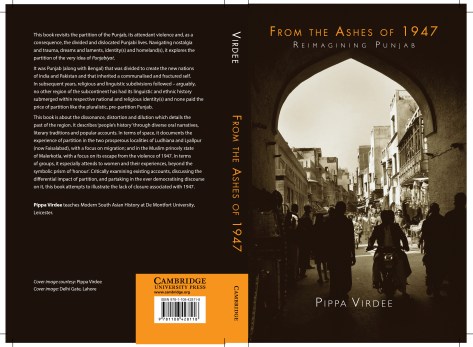
From the Ashes of 1947: Reimagining Punjab

From the Ashes_Full Cover

Full details: From the Ashes of 1947

Watch the panel discussion with Pippa Virdee (De Montfort University, UK), Afzal Saahir (Poet and Radio Host) and Sajid Awan (Quaid-e-Azam University) of my book From the Ashes of 1947 at the Afkar-e-taza, January 2018 Panel Discussion

The Politics of Partition and its Memory


Now that the euphoria over independence day “celebrations” and remembering partition are over, it is worthwhile remembering that it was in fact today, 70 years ago, that the Radcliffe Line was made public. Millions of people woke up on 15 August not knowing which side of border they would be on, today their fate was sealed. Sitting in Delhi on this day, having seen the way both Pakistan and India remember 14/15 August 1947, it is a stark reminder of how chaotic this process must have been.

The month of August in the sub-continent is when the monsoon rains gush down intermittently. The heavy rains leave places incapacitated due to the deluge that falls. Even today, where there is improved drainage, the monsoon rains have the capacity to bring towns and cities to a standstill. So, thinking about this back in August 1947, it is staggering to think that the last Viceroy, Louis Mountbatten, decided that 15 August would be the date for independence. The date was chosen because it coincided with the date when Japan surrendered after it was devastated by the nuclear bombs in Hiroshima and Nagasaki. Mountbatten was clearly sentimental about the date because he was Supreme Allied Commander of South-East Asia when Japan surrendered. But he also failed to show any foresight when it came to the sub-continent. All the leaders failed to anticipate that millions of people would be engulfed by violence and thus forced to flee and that too in the difficult month of August. This only added further to their misery and fuelled diseases in refugee camps. It must be kept in mind that the violence that was unleashed in August 1947 was not an isolated incident, it was a culmination and continuation of previous episodes of horrific communal/political violence in which many lost their lives and were displaced. It was thus not entirely unexpected, nor was it just spontaneous.

The British media (TV, Radio and Print) has decided to cover partition/independence extensively and interestingly for this decennial anniversary they have been giving full coverage to the voices of ordinary people. The BBC has had a full season of programmes (one of which I contributed to) devoted to India and Pakistan at 70. I have personally spent the last sixteen years working on partition and its wider impact on the Punjab region, so the ordinary voices are not new to me. In fact, this trend in scholarship has been evolving and growing for the past twenty years. What is sobering is how the coverage has differed in India, Pakistan and the UK. I can only speak about these three because I know them well and they were of course at the epicentre of this.

While there is still a huge gap in our understanding of empire and its consequences, these programmes are important in reaching out to ordinary citizens, to educate, to inform, to illuminate the travesty of empire and its end. They also serve as important markers of remembering, but that alone is not enough. Which is why being in India/Pakistan during the days of August has been important. It highlights the disparity between the diaspora and those who live here. Capturing and sharing the narratives of survivors is important but from an academic perspective, what do these voices mean, what do they tell us, why are they still relevant? The memorialisation of this memory and how it tells this story is also significant. There is little worth in collecting hundreds and thousands of accounts by survivors if this is not contextualised or critically framed in the existing historiography. A simple account of someone’s life and their experiences is important but what about beyond that? What lessons can we take from this?

And our politicians are still in the business of selling a myth of a glorious past and a dream for the future. It is that future which needs to be critically examined in relation to the previous seventy years. Pakistan today seems fragile as ever but (and more importantly its people) it is a resilient country. For the best part of the last seventy years Pakistan has been swinging between military dictatorship and democratic rule, while India, largely a democracy, has been busy playing and expanding upon the Hindutva card. A future in which we see a further entrenchment of Islamic Pakistan and Hindu India is entirely possible and while not a recent development, it does need to be contextualised firstly in colonial history and secondly in the how the developments of the past seventy years led to this. Of concern for everyone should be that in this vision to be exclusively majoritarian, both India and Pakistan would lose an asset: its significant minorities. The diversity in all its richness is what makes these countries vibrant and valuable, they should be celebrated rather than suppressed and targeted. And so, seventy years on, while we remember the people who suffered in the great partition, let us not forget that there a battle going on today for the hearts and minds of people. Which is why it is seemingly more poignant being here in the sub-continent at this moment because it is a reminder of the unfinished business of azaadi beyond empire.

Freedom and Fear: India and Pakistan at 70

IMG_1949
© 2014 Pippa Virdee

In the midst of the monsoon of August 1947, British India ceased to be and gave way to two independent nations. The logic of this Partition being religious and regional, the older and larger India was reinforced as a Hindu majoritarian society, while the newer and smaller Pakistan emerged as an Islamic country. No Partitions are total and absolute but this one was especially terrible and ambiguous and left a little less-or-more than 20% religious minority population on both sides. Moreover, it created two wings of Pakistan with a hostile Indian body-politic in the midst.

This event was not entirely of sub-continental making. The British Empire in Asia had begun to crack at the hands of the Japanese army during World War Two, most spectacularly with the fall of Singapore in February 1942, and crumbled in South Asia afterwards. Along with India and Pakistan, the-then Burma and Ceylon (both 1948) too emerged independent at this time. All this was to bring about many changes, both internally in India and internationally. Europe, the ravaged battlefield of the World Wars, ceased to be the centre of the Western world, with political and economic power shifting decisively to the former Soviet Union and the United States, representing two contrasting and conflicting ideological visions for the post-1945 world.

The end of the British rule in South Asia happened alongside the emergence of this conflict, christened the Cold War. The road to freedom and partition of India and creation of Pakistan was a long one and accompanied with fundamental social, economic and political changes. From the mutiny of 1857 from Calcutta to Delhi to the massacre of 1919 in Jallianwala Bagh, Amritsar, from the formation of the Indian National Congress in 1885 to the establishment of the All-India Muslim League in 1906, from fighting for King and country in two World Wars to seeking self-rule in the inter-war years, and, from the development of an elaborate civil and military bureaucratic and infrastructural apparatus and a space for provincial politics, all these were to completely transform Indian society.

Read the complete article via: http://magazine.thediplomat.com/#/issues/-Kq0QJtC_OQiU3Dy0tQ6