Tag Archives: travel

Two villages, two nations: Ganda Singh Wala-Hussainiwala


This slideshow requires JavaScript.

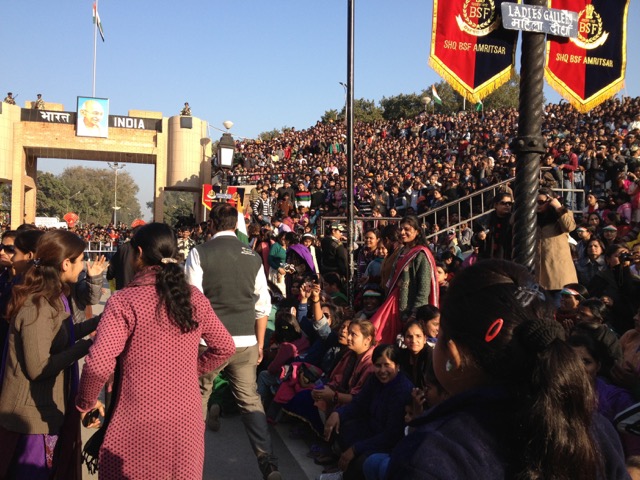
The villages of Ganda Singh Wala and Hussainiwala are two villages divided by Cyril Radcliffe’s line. Rather counter-intuitively in these times of Hindu/Sikh India and Muslim Pakistan, Ganda Singh Wala is a village in Kasur District in Punjab, Pakistan, while Hussainiwala is its Indian counterpart, located 11 km away from Ferozepur city. Until the early 1970s, this was the primary border crossing between the two countries but it now only functions as a ceremonial border. Like Wagha-Attari, the now-primary border crossing between India and Pakistan, there is a daily Retreat Ceremony with the lowering of the national flag. There are, however, a few differences between the two ceremonies as Ganda Singh-Hussainiwala is generally not open to foreign tourists and is therefore more intimate with fewer attendees coming largely from the local area. The seating, especially on Ganda Singh side, is right next to the Pakistani Rangers and thus provides a spectacular viewing of this daily spectacle.

While restricted to mostly locals, there remains some jingoistic overtures around it; more palpable during tense times between the two countries. The ceremony lasting 40 minutes, is shorter than the Wagha-Attari version and has less of a fanfare and build-up. People loiter around, catching the opportunity to be close to Indian/Pakistani people and take photos of the Rangers and Indian BSF. According to Ferozepur district’s webpage (http://ferozepur.nic.in/html/indopakborder.html), there was no joint parade and retreat ceremony here until 1970. It was apparently, “Inspector General BSF, Ashwani Kumar Sharma, called upon both authorities to have joint retreat ceremony and since than it has become a tradition”. In 2005, there were discussions about opening this border crossing, to no avail. Today it is easy to forget that this was once a thriving check-point. In 1970, Paul Mason, while travelling the sub-continent, excitedly crossed the border from Ganda Singh to Hussainiwala. He recalls this experience in his travelogue, Via Rishikesh: an account of hitchhiking to India in 1970 (2005):

“In the morning we have little difficulty in locating the Ministry of the Interior and are supplied the necessary chits which give permission for us to travel along the restricted road to the border. For the sum of two rupees apiece we obtain bus seats and are soon headed off down the dusty track, but the trip is much longer than I expect and it is mid-afternoon before we arrive at the Pakistani customs of Ganda Singh Wala.

At the customs post on the Indian side of the border, a worryingly intelligent young woman who reminds me much of my elder sister Margaret deals me with. I do my best to conceal my anxiety about the concealed roll of banknotes. She eyes me carefully and exchanges a few words with me before turning to the next in line without first acquainting herself with the contents of my underpants.

We have made it to India! We are here in India! At last! Amazing, amazing, amazing!

I take a look at stamp in my passport; it states simply; ‘ENTRY 16-10-70 Hussainiwala Distt, Ferozepore’ – not even a mention of India! Oh well, we’re here, and that’s all that counts!

We follow the flow of other new arrivals along a path beside a wide still river [Sutlej]. There is also a disused railway track, which presumably used to connect the two countries.”

[See full account: http://www.paulmason.info/viarishikesh/viarishikeshch16.htm]

We see from Mason’s account of the simplicity through which he crossed the border with only a slight mention of Ganda Singh and Hussainiwala printed in his passport (pictures of the entry stamps are available on his website above). Today when crossing via the land route, there is a clear stamp with Attari (India) and Wagha (Lahore) in the passport. Mason also mentions the hundreds of cars left abandoned at the border because it was too costly to take them across. But, this was at least possible to do then; impossible today. Equally, the disused railway track lies there abandoned but remains as a reminder of the two broken halves.

Ferozepur, India is the land of martyrs and Hussainiwala is the site of the National Martyrs Memorial, where Bhagat Singh, Sukhdev and Rajguru were cremated on 23 March 1931. This is also the cremation place of Batukeshwar Dutt, who was also involved in bombing the Central Legislative Assembly with Singh. Bhagat Singh’s mother, Vidyawati, was also cremated here according to her last wishes. Interestingly, the spot of the memorial, which is only 1 km away from Hussainiwala and on the banks of the Sutlej river and built in 1968, was originally part of Pakistan. On 17 January 1961, it was returned to India in exchange for 12 villages near Sulemanki Headworks.

Read ‘Making of a Memorial’ by K. S. Bains, http://www.tribuneindia.com/2007/20070923/spectrum/main2.htm

-, ‘Shaheedon ki dharti’ in The Tribune: http://www.tribuneindia.com/1999/99jul03/saturday/regional.htm#3

See a short clip of the ceremony at Ganda Singh Wala: https://www.youtube.com/watch?v=vZR-eLVYo6s

From before and beyond the international border that divides them, there is a story that connects these villages. Majid Sheikh writes about the ‘Spiritual connect of two villages’ in Dawn and brings out their historic connections. To commemorate a highly decorated soldier, Risaldar Major Ganda Singh Dutt, the British had named this village after him, while the village Hussainiwala derived its name during colonial days from Pir Ghulam Husseini, whose tomb is now in the BSF headquarters. Today they exist as two halves of the same story.

Read ‘Spiritual connect of two villages on both sides of the divide’ by Majid Sheikh: https://www.dawn.com/news/1379906

Lucknow: the Awadhi ‘heartland’.

This slideshow requires JavaScript.

Lucknow is the capital of the Indian subcontinent’s Awadhi ‘heartland’, in historian Gyanesh Kudaisya’s evocative words. Less evocatively, it is the capital of the Indian State of Uttar Pradesh (UP) and its largest city with a population of three million people, of which 26 per cent are Muslim. It is the centre of Shia Islam in India, historically the capital of Awadh, it was one of the major centres during the rebellion in 1857, the cultural capital of north India and home to the famous Chikankari embroidery work, thought to be popularised by Nur Jahan. The Nawabs of Lucknow were known for their refined tastes as much as their extravagant lifestyles, and the city has most beautifully been captured and bought to life in the 1977 film, Shatranj ke Khiladi that was based on the Hindi short-story of the same name by Munshi Premchand  and the 1981 film, Umrao Jaan that was based on the Urdu novel Umrao Jaan Ada by Mirza Hadi Ruswa. Set in mid-nineteenth century Lucknow, they show the decadence of the Lucknavi high society through the life of Nawabs and courtesans, the moral decay/hypocrisy around their lives in the backdrop of political intrigue and rebellion. Shift to the present-day Lucknow/UP and the state is better known for returning a thumping win in the state election of 2017 for an ascending Hindu ‘nation’ led by Narendra Modi and, in return, finding itself being ruled by a Yogi. A milieu previously famous for its adab-tehzeeb is now the habitus of Adityanath and his terrific to many, terrifying to some, presence.

A recent visit their began at the annexe of the Charbagh station, past the pillars of the fly-overs of the-then on-going metro constructions and a rather tasteful red-and-white façade of the Charbagh metro-station with its Jali décor; apropos which my auto-wallah remarked, ‘Akhilesh ne kaam to bahut kiya par chacha ne harwa diya’. In no time, we were in old Lucknow; the narrow, congested streets of Aminabad, where the first thing noticeable was that while many shops had named the lane we were on as Latouche Road, others had it as G.B. Road, for, Gautam Buddha. The incongruity of being in a space that marked its time from both the British Lt-Governor Sir James Latouche (AD 1901-06) and the Shakyamuni Siddhartha (563-483 BC) did not end there. It was also reflected in much of the arms, air guns et al, and ammunitions market on one side being stared at by hundreds of chickens from their kens in many of the poultry-khanas on the other. While the arms stores dated back to 1933, 1940s-50s, prominent among these being Gupta Brothers, Hashim Manzil, with their colonial, hanging, dilapidated balconies, small windows, tapering and peeling pillars, darkening, decaying visage, plants growing out of lime plastered walls, the poultry-khanas seemed without pedigree. Amidst this sea of noisy chatter around the selling of guns and the stoically silent birds, there was also a serene and strikingly yellow-coloured masjid/madrasa and its school of calligraphy. It plainly stood apart and alone in its intent and purpose.


“The real meaning of life”: the tomb of Khwaja Khizr

The city of Sonepat, in present day Haryana State, hardly has anything of note for the wandering and curious tourist but surprisingly there are a few gems hidden away. Tucked away in the semi-urban landscape is the tomb of Khwaja Khizr, surrounded by a lush green garden, buffaloes and residential housing. Standing tall and elevated on a mound is the tomb, overlooking the city of Sonepat. Local residents and the accidental tourists looking for scenic open spaces come here and congregate around the garden. Relaxing in the open air, families surround the tomb, passing time or having picnics; children play games and make merry. And the occasional visitor ventures inside the tomb to pay their respects or simply out of curiosity.

This stunning tomb was built over the remains of Khwaja Khizr. According to a Persian inscription on the site, Khwaja Khizr was the son of Darya Khan Sarwani. Darya Khan himself was an influential noble in the court of Sikandar Lodhi. Work commenced on the tomb in 1522 and was completed by 1524 by Ibrahim Lodhi.

Latif writing in 1889 notes:

Sikandar Lodi died in 1517 in Agra, his son Ibrahim Lodi ascended the throne. Dissatisfied with the court of Delhi, Doulat Khan Lodi (Sikandar’s uncle and viceroy of the Panjab) sent his agents to Kabul to urge Baber, the Moghal prince, a son of a great-grandson of Tymur, to attempt the subjugation of the empire of Hindostan, in imitation of his ancestor’s conquests. Baber, accordingly invaded India in 1526, and a battle was fought between the Moghals and Indians on the plains of Panipat, a battle-field on which the fate of India has so often been decided. This memorable battle, which was fought on the April 21, 1526, resulted in the victory of Baber. Ibrahim Lodi, the last of the dynasty, was slain on the field, and by his death a new dynasty under the Moghals was established. The reign of Ibrahim Lodi had lasted twenty years and the dynasty to which he belonged seventy-six in three successions, from 1450 to 1526. (Syed Muhammad Latif, History of the Panjab, 1889)

Locally Khwaja Khizr was revered as saint; he apparently renounced his courtly lifestyle in favour of pursuing a simple life inspired by the Sufi tradition. Like many before him, he was in search of the real meaning of life. Carefully leaving their shoes/slippers outside, the occasional devotees go inside the tomb to pay homage, lighting an incense stick, leaving offerings and tying treads for manants. The syncretic tradition associated with this historic land still finds places to hide-away and co-exist. For the curious visitor, the tomb itself is a rare example of being built with kankar (variety of limestone) blocks and red sandstone. The wide staircase leads to the two-arched gateway. The Indo-Islamic style of architecture sympathetically reflects the fusion and syncretic tradition. While reading around to find out more about the shrine, there was an article which suggests that ‘the tomb was once decorated with blue tiles – now missing – and that it was repaired in 1921-22 at a cost of Rs 130 although the sanctioned amount was Rs 167!’ (http://portofcall1.blogspot.in/2010/12/sonepat-beyond-toughs.html) Although the tomb could certainly do with some more care and attention, it is still worth a visit for the accidental or the intentional tourist who happens to pass by Sonepat. Neglect, whether this is willfully done or not, means that places like these fall into disrepair and with them they erase centuries old histories.

Tomb of Khwaja Khizr (Khijar Makbara and Park) – Sonepat, India https://www.youtube.com/watch?v=sZLZNr9bFdo

No Man’s land: the Wagah-Attari Border

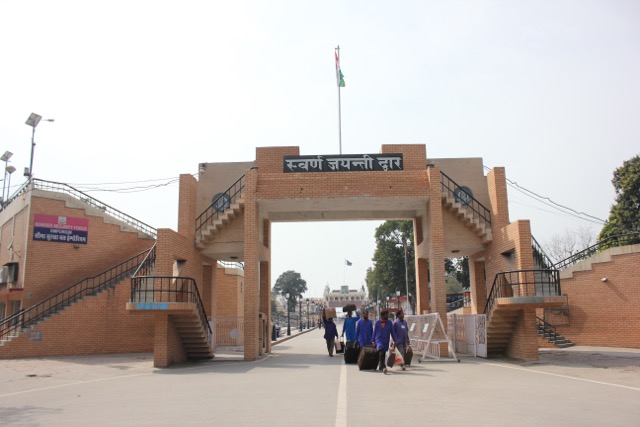
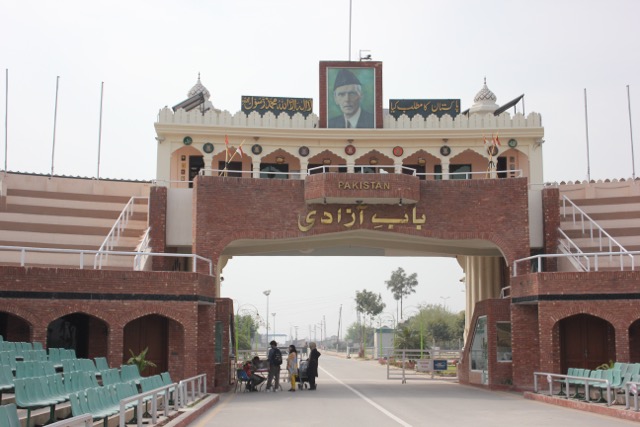
Located at a short distance of 24 kilometers from Lahore, Wagah is a small village in Pakistan and placed strategically on the Grand Trunk Road and serves as the main goods and railway station between India and Pakistan. The Indian counterpart is Attari and both serve as the only official land border crossing between India and Pakistan. The Radcliffe Line that divides them was the scene of both immense horror and gratitude for those fleeing to the “promised lands” in August 1947. Poignantly for writers such as Sadat Hasan Manto, many migrants were torn between the two spaces of no man’s land. This legacy continues today for those divided by this border.

The Wagah-Attari border is more accessible to foreigners who cross the border rather than the citizens of India and Pakistan. Having used this route numerous times, it brings up all sorts of surprises every time. There is always a sense of uncertainty about the political climate between the two countries, which can change at short notice. When relations are good between them, the border seems a little more open and less hostile, there is generally more traffic of people, especially people with green and blue passports. Otherwise, there are hardly that many people using the border only the diplomats, foreigners and the select few. I am one of the privileged few. The Pakistani’s always ask me if I’ve enjoyed my stay and have I faced any problems? I always reassure them that I’ve had a wonderful time. The Indians it has to be said are less talkative, though on occasions I have been “treated” to cups of chai.

There is usually plenty of dramatic material for the writers, artists, and peaceniks etc that want to spend time here for inspiration. There is sadness as people (de)part, despair as people fail to crossover due to lack of proper paperwork, there are covert (or not so covert) spies keeping an eye on passengers, and then there are security/customs people who are keen to show their power and within the ordinary, there are the money changers and inquisitive coolies working hard, often in the full sun. But there are always people wondering about the “other”.

When I first crossed this border, over fifteen years ago, the border was a basic set-up in old colonial bungalows. You could literally walk across from one side to the other. Today, both have made this border into an airport style, elaborate process with scanners and plenty of formalities and paperwork. Previously the coolies were employed to help carry people’s luggage to the international boundary that divides the two countries and they would also exchange goods that were permissible under trade agreements; the two carried on side by side. Now trade is exchanged more formally via the goods and transit terminal and the coolies make their livelihoods through the meagre travellers passing through. Most of the coolies belong to Wagah and Attari and come from a generation of families who have lived and worked in this border area. It is unlike any other place in India or Pakistan. They have seen many changes and have many tales to share, often from divided migrant families themselves.

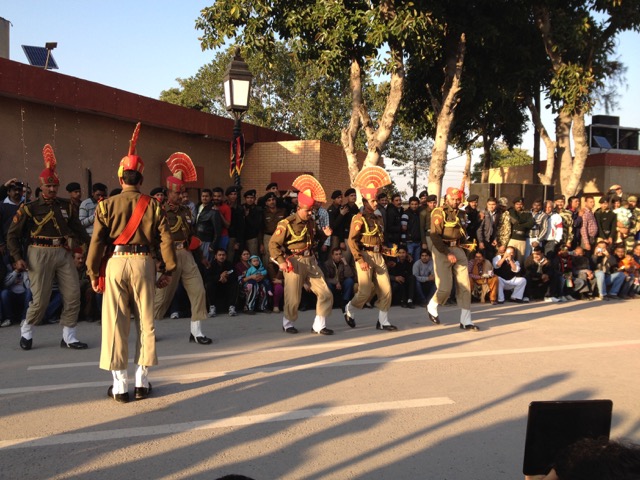
The Indian Border Security Force and the Pakistani Rangers have their daily ritual of lowering of the flag ceremony at the end of the day before sunset. Immaculately dressed, in Indian khaki and Pakistani Black, the soldiers walk and strut in their fast paced and intimidating style. Michael Palin, during his travels around the world, compared this to the Ministry of Silly Walks from the Monty Python sketches; this is not too far-fetched. Often referred to as the strut of the peacocks, this is a show of prowess, power, and pride of the most superficial nature. Hundreds of Indians and Pakistanis flock to see this spectacle of jingoistic and patriotic display. Few would wonder about how this well choreographed ceremony actually happens. It is in many ways an obscene drama that takes time to practice and perfect, and requires the two forces to work together. They do this away from the public gaze, so as to not taint the public image. This tradition started back in the 1950s has evolved now to only provoke the nationalist desire to fuel this antagonistic relationship between the two countries. It has continued to grow, attracting foreign as well as local tourists and the seating arrangements at the border are yet again being upgraded and expanded to accommodate the demand. Large crowds chant “Pakistan Zindabad!” or “Jai Hind!” to show their patriotism, waving their flags with unwavering allegiance to the idea of India and Pakistan. It is now nearly seventy years when the Radcliffe Line was drawn, and if anything, it seems this border has become even harder than previously.

Some useful links:

Peacock at Sunset by Frank Jacobs: https://opinionator.blogs.nytimes.com/2012/07/03/peacocks-at-sunset/

The Wagah border ceremony in India: https://adventuresofagoodman.com/wagha-india-pakistan-border-history/

The Curious Case of Multani Mitti and the Taj Mahal

This slideshow requires JavaScript.

In 2001 Pakistan’s president General Pervez Musharraf came to Agra to hold a historic summit between India and Pakistan, with the aim of resolving some of the long-term fractious issues between the two nations. It has now been nearly 16 years since the two countries came close to finally resolving their enmity. As the talks collapsed it paved the way for the lost opportunities that both nations now lament at leisure. At the back of the Agra Summit, Musharraf also made a trip the Taj Mahal. In preparation for this trip the Taj Mahal got a face-lift, literally. Multani Mitti (mud from Multan, Pakistan where this lime-rich clay was originally found) was used to cleanse the Taj Mahal which was suffering from years of exposure to pollution and general wear and tear. Although it is less clear whether the Multani Mitti actually came from Multan. The Multani Mitti, which is effectively mud therapy and has been used for centuries as a beauty product, cleansed away the pollutants that gave the Taj Mahal more of a yellowish (dirty) appearance and now it gleams bright and white. In a recent visit to the Taj Mahal, the process of cleaning the historic site continues, slowly and painstakingly. Despite the hundreds of daily visitors looking for the perfect picture at the Taj Mahal, they have to suffice with the scaffolding.

For me a visit to Agra is incomplete without also paying homage to Fatehpur Sikri, the city founded in 1569 by the Mughal Emperor Akbar, which also served as the capital of the great empire from 1571-1585. Akbar choose the site to honour the Sufi Saint Salim Chishti (his shrine overlooks the capital city complex) and took great care in the vision and architecture of the capital, sadly once finished the complex was difficult to sustain due to the shortage of water into the city. One of the most architecturally rich pieces in the Diwan-i-Khas, hall of private audience, is the octagonal pillar, encompassing the secular, open and embracing vision that Akbar had for the new capital. The pillar brings together different architectural designs (see picture) highlighting his own interest in inter-faith dialogue. And it is here that Akbar apparently held his many theological discussions.

What was apparent in visiting the Taj Mahal and Fatehpur Sikri in the same day was the way both sites are treated, the Taj Mahal is by far the superior site. It attracts hundreds of visitors and foreigners (and Indians if they fail to bring ID with them) pay a generous entry fee and it is a site which is promoted by the UP government extensively. Where would ‘Incredible India’ be without the presence of the Mughal built Taj Mahal. Yet for me the deserted city of Akbar is equally, if not more, significant. It is more spread out and beams with the beautifully craved red stone architecture with geometric patterns, and the extraordinary Tomb of Sheikh Salim Chisti who was a descendant of Khwaja Moinuddin Chishti of Ajmer. The Sufi Saint foretold the birth of Akbar’s son, who is named after him, Prince Salim (later Emperor Jahangir).

What connects the Multani Mitti and Agra is the myopic and selective amnesia that ‘Incredible India’ has towards its Mughal/Muslim heritage. Fatehpur Sikri is visibly less attractive as a tourist destination and visibly more ‘Muslim’ as a lived city and the Taj Mahal in its glorious white marble beauty is entirely a commercial complex and less of a tomb to Emperor Shah Jahan’s favorite wife, Mumtaz Mahal. While the irony of using Multani Mitti on the Taj Mahal to sustain Indian tourism is not lost on many, there is at the same time a marginalisation of other sites. This is of course intrinsically linked to the wider politics of identity and more importantly in terms of how the Indian state is re-affirming and re-positioning its own identity which is increasingly ‘Hindutva’ in essence and less embracing, thus moving away from Akbar’s pillar of inter-faith and tolerance. With this the hopes that President Musharraf and the Indian Prime Minister Vajpayee once bought to the tables have all but disappeared; seventy years on and we are still unable to live amicably with each other but at least we are alright with using Multani Mitti to cleanse away the superficial dirt that accumulates around us.

A (British) Indian in Lahore

This slideshow requires JavaScript.

As I leave Lahore and arrive in Amritsar there is a feeling, as always, of self-consciousness about crossing over an international border. This is a border that I have crossed many times but surprises me every time. The experiences on the whole have nearly always been courteous. On a personal level the staff, the Pakistani Rangers and the Indian Border Security Force, have been polite, sometimes engaging but nearly always looking at me with some uncertainty, unable to quite place me. Since September 2016, when the Indian security forces were attacked in Uri, relations between India and Pakistan have continued to decline. This inevitably leads to the fall in the foot traffic at the Wagha-Attari border crossing. By default it means the porters have little or no work. It is the ordinary people who are always targeted, unable to get visas due to the strained relationship between the two. The silence at the border was noticeable, hardly anyone crossing the border today. In one short hour I was on the small open train from Wagha to the barely cold AC bus in Attari, India. I did not make much small talk; it was almost all a matter of fact. Sometimes they pull you aside, invite you for chai, and ask inquisitive questions, but not today. Today it was unusually quiet. In the searing summer heat who would want to walk across the border? Moreover, in the hostile lands, who wants to risk crossing the border? The Indian immigration officer, after stamping my passport quips to his friend standing near him that you hardly get any Pakistanis travelling across, I quipped back and said that’s because you don’t give them visas and walked off.

This is a hard and harsh international border; it was imagined in the drawing rooms by the outgoing colonial power but it has been re-imagined by the nation-states today. It is a stark reminder of the animosity and mistrust the two nations have of each other, yet it also conceals other truths. The border is open for all foreigners yet it is the most restrictive for the very citizens of those two nations that it is located in. Indians and Pakistanis are the most scrutinised people at the border. Looking around, one is never quite sure who performs what role; the “secret” agents are always lurking around. The border is harsher and more cumbersome for the ordinary citizens because they lack the right networks and knowledge, others, often elites of both countries, can still manage to cross the border. Thus the reality of this harsh border is dictated by the accessibility to power and while the rhetoric in the media is jingoistic, the lived experiences can be different. This applies also to the staff that regular work at the border. But the silence at the border this time also felt different, the Modi government in India is sending out a different message, a much more aggressive tone is palpable. Jinnah put forward the two-nation theory in 1940 and it seems that seventy years on, he was more perceptive than we imagined.

The Colours of Vaisakh

Vaisakh is traditionally the month of crop-harvesting in the Punjab region, in both India and Pakistan. Different permutations also exist in the rest of the countries. It is usually around 13th April that farmers around Punjab will start harvesting their crops and so the month is accompanied with many festivities. Harvesting wheat is the traditional crop that has come to symbolise the month of Vaisakh. The festival of Vaisakhi is an ancient tradition of the Punjab region and while it used to be celebrated throughout undivided Punjabi with village melas or fairs, it is now mostly associated with the Sikh community. For the Sikhs, it marks the birth of the Khalsa, when the 10th Guru, Gobind Singh, laid the foundation of the Khalsa Panth and asked for the five Sikhs to be the first that were formally initiated and baptised into the faith in 1699.

Another important historical event that coincided with Vaiskahi was the Jallianwala Bagh massacre. Thousands of people were gathered in the Jallianwala Bagh in Amritsar to celebrate the holiday and festivities of Vaisakhi. However, in the political volatile climate there was also a curfew and so General Dyer and his troops opened fire on the crowd who were effectively trapped in the public garden complex that only had one exit. Officially 379 people died, unofficially it was closer to 1000 casualties. This is often seen as the beginning of the end of the British Empire in India.

While the month of Vaisakh is still culturally significant on both sides of the border, the religious association means that it has lost some of its importance in Pakistan. The pictures above were taken during a trip to Sahiwal where harvesting wheat was in full flow.

Portraits from Sahiwal

This slideshow requires JavaScript.