In 2001 Pakistan’s president General Pervez Musharraf came to Agra to hold a historic summit between India and Pakistan, with the aim of resolving some of the long-term fractious issues between the two nations. It has now been nearly 16 years since the two countries came close to finally resolving their enmity. As the talks collapsed it paved the way for the lost opportunities that both nations now lament at leisure. At the back of the Agra Summit, Musharraf also made a trip the Taj Mahal. In preparation for this trip the Taj Mahal got a face-lift, literally. Multani Mitti (mud from Multan, Pakistan where this lime-rich clay was originally found) was used to cleanse the Taj Mahal which was suffering from years of exposure to pollution and general wear and tear. Although it is less clear whether the Multani Mitti actually came from Multan. The Multani Mitti, which is effectively mud therapy and has been used for centuries as a beauty product, cleansed away the pollutants that gave the Taj Mahal more of a yellowish (dirty) appearance and now it gleams bright and white. In a recent visit to the Taj Mahal, the process of cleaning the historic site continues, slowly and painstakingly. Despite the hundreds of daily visitors looking for the perfect picture at the Taj Mahal, they have to suffice with the scaffolding.
For me a visit to Agra is incomplete without also paying homage to Fatehpur Sikri, the city founded in 1569 by the Mughal Emperor Akbar, which also served as the capital of the great empire from 1571-1585. Akbar choose the site to honour the Sufi Saint Salim Chishti (his shrine overlooks the capital city complex) and took great care in the vision and architecture of the capital, sadly once finished the complex was difficult to sustain due to the shortage of water into the city. One of the most architecturally rich pieces in the Diwan-i-Khas, hall of private audience, is the octagonal pillar, encompassing the secular, open and embracing vision that Akbar had for the new capital. The pillar brings together different architectural designs (see picture) highlighting his own interest in inter-faith dialogue. And it is here that Akbar apparently held his many theological discussions.
What was apparent in visiting the Taj Mahal and Fatehpur Sikri in the same day was the way both sites are treated, the Taj Mahal is by far the superior site. It attracts hundreds of visitors and foreigners (and Indians if they fail to bring ID with them) pay a generous entry fee and it is a site which is promoted by the UP government extensively. Where would ‘Incredible India’ be without the presence of the Mughal built Taj Mahal. Yet for me the deserted city of Akbar is equally, if not more, significant. It is more spread out and beams with the beautifully craved red stone architecture with geometric patterns, and the extraordinary Tomb of Sheikh Salim Chisti who was a descendant of Khwaja Moinuddin Chishti of Ajmer. The Sufi Saint foretold the birth of Akbar’s son, who is named after him, Prince Salim (later Emperor Jahangir).
What connects the Multani Mitti and Agra is the myopic and selective amnesia that ‘Incredible India’ has towards its Mughal/Muslim heritage. Fatehpur Sikri is visibly less attractive as a tourist destination and visibly more ‘Muslim’ as a lived city and the Taj Mahal in its glorious white marble beauty is entirely a commercial complex and less of a tomb to Emperor Shah Jahan’s favorite wife, Mumtaz Mahal. While the irony of using Multani Mitti on the Taj Mahal to sustain Indian tourism is not lost on many, there is at the same time a marginalisation of other sites. This is of course intrinsically linked to the wider politics of identity and more importantly in terms of how the Indian state is re-affirming and re-positioning its own identity which is increasingly ‘Hindutva’ in essence and less embracing, thus moving away from Akbar’s pillar of inter-faith and tolerance. With this the hopes that President Musharraf and the Indian Prime Minister Vajpayee once bought to the tables have all but disappeared; seventy years on and we are still unable to live amicably with each other but at least we are alright with using Multani Mitti to cleanse away the superficial dirt that accumulates around us.
As I leave Lahore and arrive in Amritsar there is a feeling, as always, of self-consciousness about crossing over an international border. This is a border that I have crossed many times but surprises me every time. The experiences on the whole have nearly always been courteous. On a personal level the staff, the Pakistani Rangers and the Indian Border Security Force, have been polite, sometimes engaging but nearly always looking at me with some uncertainty, unable to quite place me. Since September 2016, when the Indian security forces were attacked in Uri, relations between India and Pakistan have continued to decline. This inevitably leads to the fall in the foot traffic at the Wagha-Attari border crossing. By default it means the porters have little or no work. It is the ordinary people who are always targeted, unable to get visas due to the strained relationship between the two. The silence at the border was noticeable, hardly anyone crossing the border today. In one short hour I was on the small open train from Wagha to the barely cold AC bus in Attari, India. I did not make much small talk; it was almost all a matter of fact. Sometimes they pull you aside, invite you for chai, and ask inquisitive questions, but not today. Today it was unusually quiet. In the searing summer heat who would want to walk across the border? Moreover, in the hostile lands, who wants to risk crossing the border? The Indian immigration officer, after stamping my passport quips to his friend standing near him that you hardly get any Pakistanis travelling across, I quipped back and said that’s because you don’t give them visas and walked off.
This is a hard and harsh international border; it was imagined in the drawing rooms by the outgoing colonial power but it has been re-imagined by the nation-states today. It is a stark reminder of the animosity and mistrust the two nations have of each other, yet it also conceals other truths. The border is open for all foreigners yet it is the most restrictive for the very citizens of those two nations that it is located in. Indians and Pakistanis are the most scrutinised people at the border. Looking around, one is never quite sure who performs what role; the “secret” agents are always lurking around. The border is harsher and more cumbersome for the ordinary citizens because they lack the right networks and knowledge, others, often elites of both countries, can still manage to cross the border. Thus the reality of this harsh border is dictated by the accessibility to power and while the rhetoric in the media is jingoistic, the lived experiences can be different. This applies also to the staff that regular work at the border. But the silence at the border this time also felt different, the Modi government in India is sending out a different message, a much more aggressive tone is palpable. Jinnah put forward the two-nation theory in 1940 and it seems that seventy years on, he was more perceptive than we imagined.
The coming of the jet-age: women, advertising and tourism in Pakistan
Appearing on 23 September, 1956, The Pakistan Times article, ‘About women travellers’ is a commentary by their woman correspondent on travelling in the jet-age and ends optimistically with, ‘Times are changing rapidly. Gone are the days when women could not move unchaperoned, for now they travel the globe, and although there are no undiscovered continents, they still travel paths yet untrodden by women.’ This article appeared at a time when Orient Airways was merging with Pakistan International Airlines Corporation to form what is now more popularly known as PIA.
Shortly after PIA’s establishment, in 1959 the new managing director, Air Commodore Nur Khan, took over; he was considered to be a dynamic and forward-thinking visionary and well placed to take advantage of the coming jet-age that would revolutionise air travel. By its own admission, PIA considered his tenure as the ‘golden years of PIA’. Enver Jamall, former chairman and chief executive of PIA, highlights the competition PIA had with Air-India, which had already placed orders for Boeing 707s to be delivered in 1960. There was much determination within PIA to be the first airline in the East to operate jets and so an agreement was reached with Pan American World Airways (Pan Am) for the lease of one of its Boeing 707s. This would operate on the London-Karachi-Dacca route with an extension to New York once a week. The flights began in March 1960, giving PIA the coveted prize and the route was a financial and operational success.[1]
Writing on the tenth anniversary since independence the General Manager of PIA, Zafarul Ashan, notes how the bold concept of air transport helped Pakistan maintain national unity. He goes further and adds that ‘In air transportation, more than in anything else, the Pakistanis discovered their true genius, striving as a modern nation to achieve a happy blend of the values of their rich cultural past with values and concepts of this age.’ Ultimately, PIA’s impact extended beyond merely connecting the two wings. Apart from the trade between the two wings, the ‘low cost air transport within Pakistan started a revolution in the travel habits’ of people and ‘it opened up new venues of business and recreation.’[2] With the jet age, there was simultaneously an emerging middle class with more disposable income both globally and within in Pakistan. So while the majority of the early travellers were wealthy businessmen, the affluent middle class was the way ahead for expansion. Nur Khan recognised this opportunity for growth and expansion.
PIA also made some interesting strategic moves. In 1955, the first flight ‘to the glittering, glitzy capital city of London, via Cairo and Rome’ started. There was some criticism of this from the public who regarded other projects as more urgent for a developing country like Pakistan but this was rebuked with the substantial foreign exchange earned through the international service. Indeed the foreign tourist market was crucial to the business model in the early days of PIA, it is only by the 1970s that the shift towards catering for the diaspora market takes place. Travelling abroad was an aspirational luxury for an elite group of Pakistanis but PIA in its early years was also tapping into the lucrative international tourist market. This is certainly evident in the early marketing and advertising by PIA, they were appealing to the foreign market and indeed the airline was successfully establishing a reputation for excellent services and was increasingly capturing the international market.[3] It was consistently considered as one of the best airlines in the East and was increasingly competing with likes of Pan Am and the British Overseas Airways Corporation (BOAC) for foreign tourists coming to Pakistan.
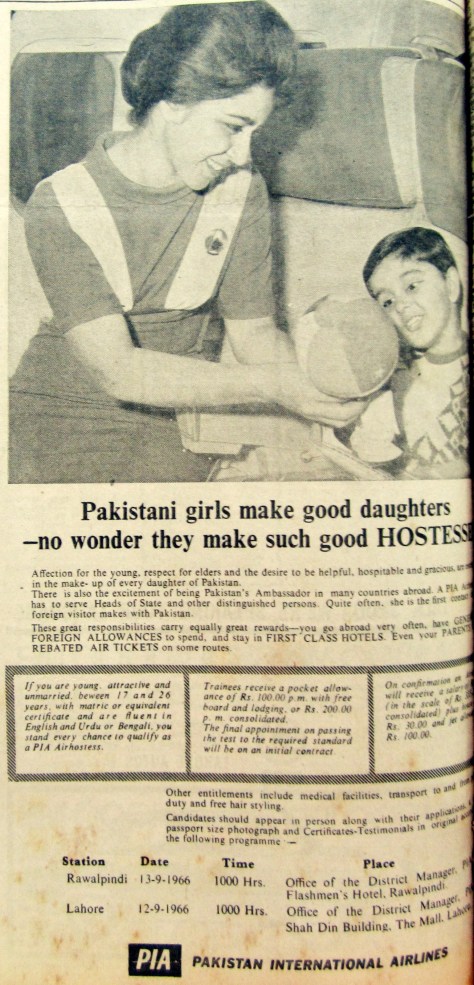
What is often over-looked in this story is the role of the women in promoting the PIA brand. PIA often used traditional notions of womanhood in their ads to attract more girls into the profession. We can see this from the text below taken from a 1966 tagline:
‘Pakistani girls make good daughter – no wonder they make such good Hostesses’
The advert depicts a young, elegant lady playing with a child on board a flight and continues, ‘Affection for the young, respect for elders and the desire to be helpful, hospitable and gracious…make-up of every daughter of Pakistan.’ These attributes can easily be applied to any “good” daughter (and potential daughter-in-law). But instead of representing the home, PIA airhostesses were ‘Pakistan’s Ambassador in many countries abroad’ and often she would be the first point of contact that a foreign visitor would make with Pakistan.[4] While playing on some of the traditional roles of women, the advert is also breaking new ground by legitimising the role of the airhostess. It sends out a message that this is a “respectable” profession and thereby quelling any fears parents may have about their daughters wanting to join the profession. On the other hand, the use of glamorous young females in exotic locations, also promotes an image of Pakistan which modern, progressive, internationalist and welcoming. There is then a dual role in the marketing and branding of the advertising.
There is also a sense that this was an age of new discovery and opportunity, democratisation in the travel and adventure industry, no longer the preserve of wealthy elites. An ever-increasing number of people now had the opportunity to explore and venture into new areas and the newly created nation of Pakistan had many attractions. The Government of Pakistan was also keenly promoting tourism, as is evident in the promotional literature of the 1960s. Foreign travelogues and magazines like the National Geographic were similarly featuring Pakistan as a tourist destination. While Karachi was the hub of activity, it was the old Silk Route, Peshawar, Swat, Chitral, Gilgit and the Karakorum Highway that attracted the adventure tourists. Mack Millar was a flight instructor assisting PIA during its early days and notes. ‘Although PIA is a national airline and the Pakistani government was founded to give the Muslim people their won country, the airline, like the nation itself, shows a wonderful tolerance for people of other persuasion. Many of the pilots are of mixed lineage-Anglo-Indian and Portuguese-Goanese, for example-and many are Christians.’[5] The feeling is that this was a more tolerant age; it was more open to foreigners and ideas. Internally it presented opportunities for Pakistanis to be part of an international community. The social and political changes that have taken place in Pakistan in the past 40 years have polarised this landscape.
The advances made in air travel were crucial to the existence of having a nation state divided by 1100 miles of hostile land mass. Zafarul Ashan was only too aware of this, ‘Nothing could have been worse than isolation for the cultural development and the expansion of the economy of the two wings. Political equality demanded that East and West Pakistan should be brought very close to each other in terms of time.’[6] The timing for Pakistan’s existence as a nation-state is therefore crucial in that the airline industry was just beginning to take off during the 1940s and not long after, the jet-age would revolutionise air travel. But along with this, a number of other opportunities also opened up. Foreign travel increasingly filtered down to the classes and was no longer just an elite activity. Out of this emerged a tourist industry attracting people to visit Pakistan and a domestic market, based not just on travel between the wings of Pakistan but looking to travel and experience the world beyond Asia. It also fundamentally opened opportunities for women to work and explore the globe. In an age where women were restricted to largely working in “respectable” jobs like teaching or medicine, here PIA was making the idea of working in the airline industry and as an airline hostesses a respectable profession. This was ground-breaking for the age.
[1] ‘Birth of a Nation; Birth of an Airline: The History of PIA,’ Enver Jamall in The Putnam Aeronautical Review 1990.
[2]The Pakistan Times, ‘P.I.A. Plans for Increased Capacity’ by Zafarul Ashan, 14 Aug 1957.
[3]The Pakistan Times, Independence Supplement, ‘PIA is flying high’ 14 Aug 1960.
 BAGICHA