Tag Archives: Sufi

Poetry Corner: Laeeq Babree

© 2017 Pippa Virdeeat every step

she is stricken with anguish and suffering

with the solitude of the victim

weeping and sobbing

she returns to her den

to say farewell

to trees and flowers

to say farewell

to the deep, slow moving river of solitude

to say farewell

to the fast fading shadows

of the helpless wilderness !

Translation of poetry from Harjeet Singh Gill, Sufi Rhythms. Interpreted in free verse (Patiala: Punjabi University, 2007), p 153.

Read about Laeeq Babree: https://www.dawn.com/news/112054

Poetry Corner: Sultan Bahu

© 2017 Pippa Virdeewithin and without

in and out

there is resonance of my Love

there are beats of His rhythm

in union there is light

in separation there is darkness

Bahu is the slave in the two worlds

who serves his Master in every breath

in every movement of his heart and hearth !


Translation of poetry from: Harjeet Singh Gill, Sufi Rhythms. Interpreted in free verse (Patiala: Punjabi University, 2007), p.75.

Read more about Sultan Bahu: https://sufipoetry.wordpress.com/poets/sultan-bahu/

“The real meaning of life”: the tomb of Khwaja Khizr

The city of Sonepat, in present day Haryana State, hardly has anything of note for the wandering and curious tourist but surprisingly there are a few gems hidden away. Tucked away in the semi-urban landscape is the tomb of Khwaja Khizr, surrounded by a lush green garden, buffaloes and residential housing. Standing tall and elevated on a mound is the tomb, overlooking the city of Sonepat. Local residents and the accidental tourists looking for scenic open spaces come here and congregate around the garden. Relaxing in the open air, families surround the tomb, passing time or having picnics; children play games and make merry. And the occasional visitor ventures inside the tomb to pay their respects or simply out of curiosity.

This stunning tomb was built over the remains of Khwaja Khizr. According to a Persian inscription on the site, Khwaja Khizr was the son of Darya Khan Sarwani. Darya Khan himself was an influential noble in the court of Sikandar Lodhi. Work commenced on the tomb in 1522 and was completed by 1524 by Ibrahim Lodhi.

Latif writing in 1889 notes:

Sikandar Lodi died in 1517 in Agra, his son Ibrahim Lodi ascended the throne. Dissatisfied with the court of Delhi, Doulat Khan Lodi (Sikandar’s uncle and viceroy of the Panjab) sent his agents to Kabul to urge Baber, the Moghal prince, a son of a great-grandson of Tymur, to attempt the subjugation of the empire of Hindostan, in imitation of his ancestor’s conquests. Baber, accordingly invaded India in 1526, and a battle was fought between the Moghals and Indians on the plains of Panipat, a battle-field on which the fate of India has so often been decided. This memorable battle, which was fought on the April 21, 1526, resulted in the victory of Baber. Ibrahim Lodi, the last of the dynasty, was slain on the field, and by his death a new dynasty under the Moghals was established. The reign of Ibrahim Lodi had lasted twenty years and the dynasty to which he belonged seventy-six in three successions, from 1450 to 1526. (Syed Muhammad Latif, History of the Panjab, 1889)

Locally Khwaja Khizr was revered as saint; he apparently renounced his courtly lifestyle in favour of pursuing a simple life inspired by the Sufi tradition. Like many before him, he was in search of the real meaning of life. Carefully leaving their shoes/slippers outside, the occasional devotees go inside the tomb to pay homage, lighting an incense stick, leaving offerings and tying treads for manants. The syncretic tradition associated with this historic land still finds places to hide-away and co-exist. For the curious visitor, the tomb itself is a rare example of being built with kankar (variety of limestone) blocks and red sandstone. The wide staircase leads to the two-arched gateway. The Indo-Islamic style of architecture sympathetically reflects the fusion and syncretic tradition. While reading around to find out more about the shrine, there was an article which suggests that ‘the tomb was once decorated with blue tiles – now missing – and that it was repaired in 1921-22 at a cost of Rs 130 although the sanctioned amount was Rs 167!’ (http://portofcall1.blogspot.in/2010/12/sonepat-beyond-toughs.html) Although the tomb could certainly do with some more care and attention, it is still worth a visit for the accidental or the intentional tourist who happens to pass by Sonepat. Neglect, whether this is willfully done or not, means that places like these fall into disrepair and with them they erase centuries old histories.

Tomb of Khwaja Khizr (Khijar Makbara and Park) – Sonepat, India https://www.youtube.com/watch?v=sZLZNr9bFdo

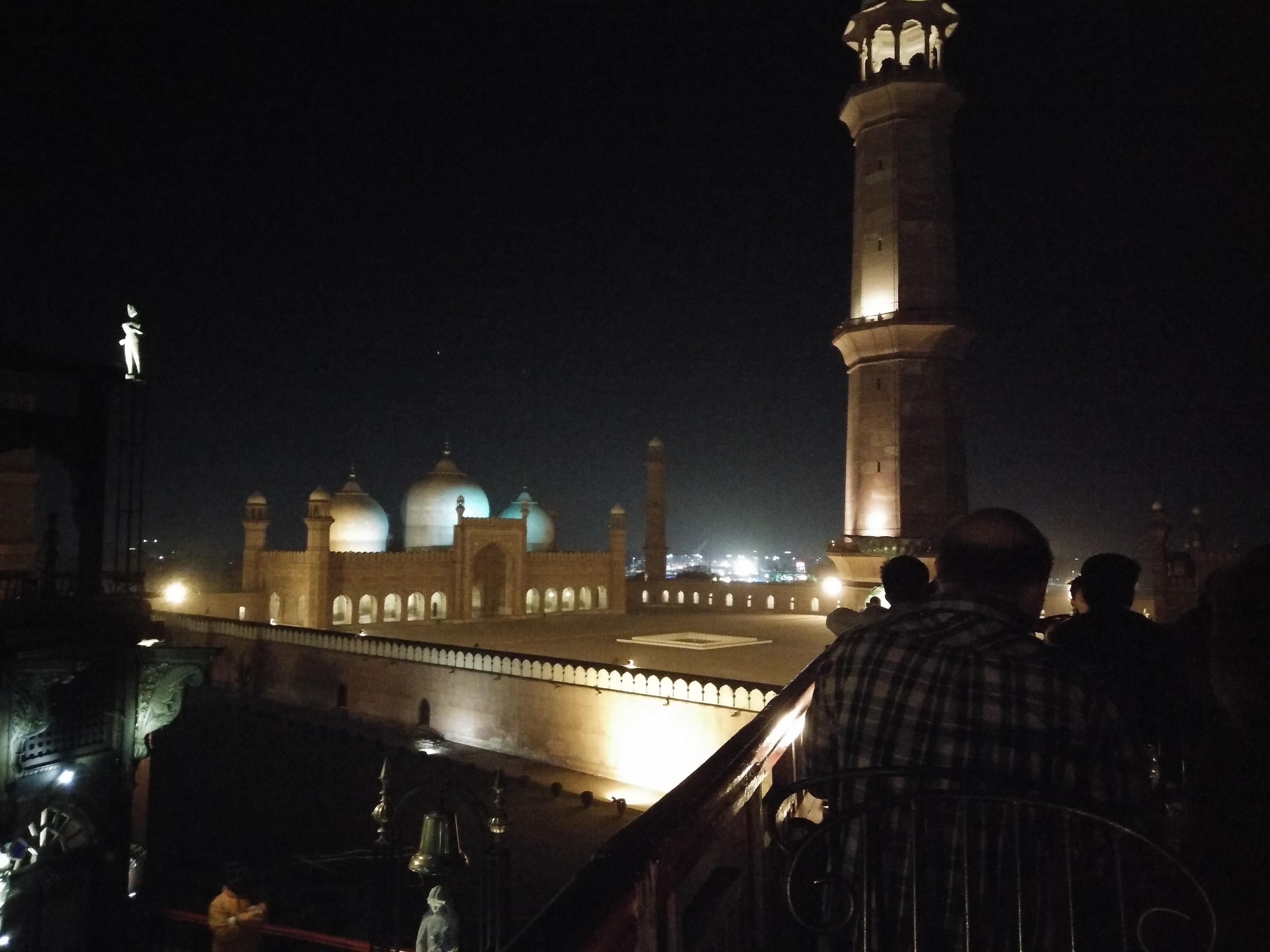
Poetry Corner: Lahore

Daal dus khaan shehar lahore e ander
(Tell me, in the city of Lahore)
Bai kinnein boohey tay kinnian barian nein
(How many doors and windows are there?)
Naley Das Khaan aothon dian ittaan
(Tell me also about its bricks.)
Kinnian tuttian tay kinnian saaran nein
(How many are still firm, and how many lie broken?)
Daal dus khaan shehr Lahore e Andar
(Tell me, inside the city of Lahore)
Khooian kinnian mithian tey kinnian khaarian nein
(How many wells have fresh water and how many are ruined with salt?)
Zara soch key dewien jawaab meinoon
(Think carefully before you answer.)
Aothey kinnian viyaeyan tay kinnian kunvarian nein
(How many are married and how many single?)
Daal Dassaan mein shehr lahore e ander
(I will tell you what lies in the city of Lahore.)
Bai lakhaan boohey tay lakhaan e baarian nein
(There are millions of doors and millions of windows.)
Jinnaan Ittaan tay tahar gaey paer aashiq
(The bricks burn in the memory of lovers’ footsteps.)
O heoon Tuttian tay baqi saarian nein
(Only those lie broken.)
Jinnaan Khooian toun paher gaey mashooq paarrien
(Only wells that quench a lover’s thirst)
Jerian behendian apnein naal sajraan dey
(Only those who sit with their lovers)
O heon viyaiyan teh baaqi kunvarian nein

Haji lok makkey nun jandey
(Pilgrims go to Mecca)
Mera ranjha mahi makkah
(My beloved Ranjha is my Mecca.)
Nein main kamli aan
(O! I am crazy)
Nein main kamli aan
(O! I am crazy)

Haji lok makkey nun jandey
(Pilgrims go to Mecca)
Mera ranjha mahi makkah
(My beloved Ranjha is my Mecca.)
Nein main kamli aan
(O! I am crazy)
Nein main kamli aan….
(O! I am crazy)

Ho Kajjal da ki pawana
(What is the use of wearing kohl)
Keh jeda athro wagan rurh jawey
(Which is washed away with streaming tears?)
Kach da key pehnana
(Why wear glass)
Jera Thece Lagey Tutt Jawey
(Which can shatters with a nudge?)
Rung da key Lawaran
(Why bother putting on color)
Keh Jera Boond Pawey Khurr Jawey
(That would melt away with every drop?)
Aashiq Noun Key Maarran
(Why bother killing the lover)
Keh Jera Cheherk Dawey Mur Jawey
(When he would die with the thought of your anger?)
Nein Mein Kamli Aan O!
(I am crazy indeed)
Nein Mein Kamli Aan O!
(I am crazy)

Ho Mein Tan Mung Ranjhan Di Hoean To Ranjha
(I am betrothed)
Mera Babul Dainda e Thaka
(My father pushes me)
Nein Main Kamli Aan
(O! I am crazy)
Nein main Kamli Aan
(O! I am crazy)
Nein Main Kamli
(O! I am crazy)

Jey Rab milda nahatian tohotian
(If God was to be found by bathing)
They milda daddoan machian
(Then fish and frogs would have found Him.)
Jey Rab milda jungle bailey
(If God was to be found by roaming jungles)
Tan milda gaoan wachian
(Then cows and calves would have found Him.)
Jey Rab milda wich maseetee
(If God was to be found in Mosques)
Tan Milda Chaam Charikian
(Then bats would have found Him.)
Bullia Rab aonan nu milda bullia!
(He is only found by those)
Bhai neetaan jinhan dian sachian
(Who are pure at heart.)
Nein Mein Kamli Aan
(O! I am crazy)

Parh Parh main hazaar kitabaan
(Yes, you have read a thousand books)
Kitabaan…
(Books…)
Parh Parh im hazaar kitabaan
(Yes, you have read a thousand books)
Kadee Aprain Aap Noun Perhia Nahein
(But you have never read your own self)
Jaan Jaan Warrdey Mandar Maseetee
(You rush to temples and mosques)
Kadee Mun Aprrain wich Warian Nahein
(But you never tried to enter your own heart)
Aewein Larrnaein Shaitaan Dey Naal Bundia
(All your battles with Satan are lost)
Kadee Nafs Aprrain Naal Larria Nahein
(For you have never tried to fight your own desires)
Aakhay Peer Bulleh Shah
(Saint Bulleh Shah says)
Aakhay Peer Bulleh Shah Aasmaani Pharr naen
(Saint Bulleh Shah says you try to touch the one in the sky)
Aakhay Peer Bulleh Shah Aasmaani Pharr naen
(Saint Bulleh Shah says you try to touch the one in the sky)
Allah…
Nein mein Kamli Aan
(O! I am crazy)
Nein mein Kamli Aan
(O! I am crazy)

Source: http://lyricsdna.com/songs/lyrics/kamlee-hadiqa-kiani-coke-studio-5

Lyrics: Bulleh Shah Singer: Hadiqa Kiani: Coke Studio, 2008