 Like the previous post, to commemorate the inauguration of the One-Unit in Pakistan, three postage stamps were issued:
- 1½-anna, bottle green.
- 2-anna, dark brown.
- 12-anna, deep red.
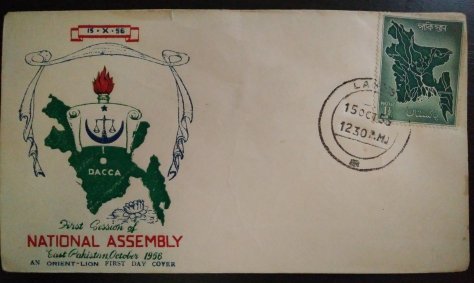
The picture above is a first day cover issued on 7 December 1955, with a 1 ½ anna stamp which I just happened to came across during my stroll at the book fair on The Mall, Lahore which is held on Sundays.
One of the biggest challenges facing Pakistan after independence was maintaining the links between the two wings. This led to wider constitutional issues and so even after eight years of existence Pakistan did not have a constitution; it was still operating on colonial laws. Moreover, the two wings were divided by more a thousand (hostile Indian) miles. This of course would present challenges to the most stable of regimes and this is just a nascent nation trying to carve out a post colonial identity.
To bridge the multiple gaps between the two wings, the Government of Pakistan under Prime Minister Muhammad Ali Bogra, decided that all four of the provinces in West Pakistan should be merged to constitute one-unit against East Pakistan. This would in effect mean that Bengalis, Punjabis, Sindhis, Pathans, Balochis would cease to have their regional identity and adhere to a yet another artificial political construct designed to posit the two wings against each other.
While geographically these two vast areas are split into two units, ethnic, religious and linguistic differences remained despite the political rationalization that was being put forward. Furthermore, while Urdu and Bengali were both accepted as state languages, English, the language of the colonial power and spoken a small minority of people, remained the official language of Pakistan. There was of course inevitably resistance from the four provinces who were being asked to relinquish their regional identity in a direct counter-measure against increased Bengali nationalism.
The uneasy relationship between the linguistic and ethnic differences encapsulated in the two wings of Pakistan created a divide which was difficult to resolve by the time the first general election was held at the end of 1970. In reality the longer-term impact of the one-unit was to create further division rather than bringing coherence and rationalization to the administrative landscape in Pakistan.
 BAGICHA