Tag Archives: Sikhs

Dhurries: the Woven Threads of Memory


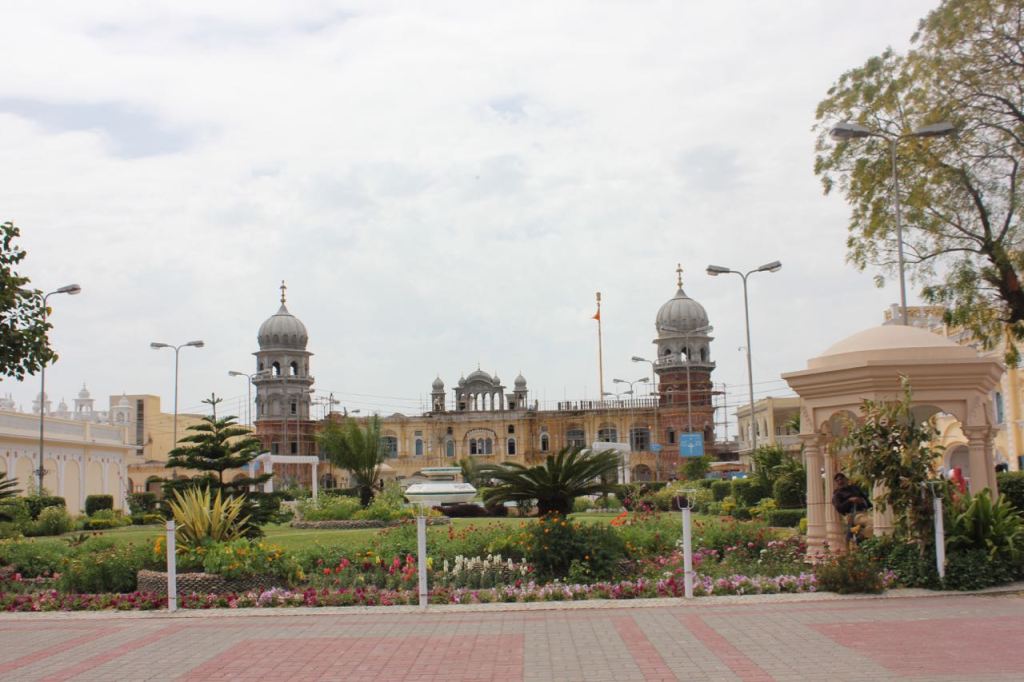
Earlier this year, I visited Ludhiana, Punjab, a place I try to make time for whenever I have an opportunity or a slight reason. As is often the case, no visit feels complete without visiting Mau Sahib, my father’s ancestral village near Phillaur. Although no immediate family members live there anymore, Mau Sahib holds a special place in our hearts, especially for my sister. She remembers it with warmth and nostalgia, as a place of her childhood.

Our visits have become something of a ritual—paying respects at the historic Gurudwara, partaking in the langar, and then visiting the nearby Sufi shrine. It’s a quiet pilgrimage that connects us with both our heritage and the memory of those who came before us.

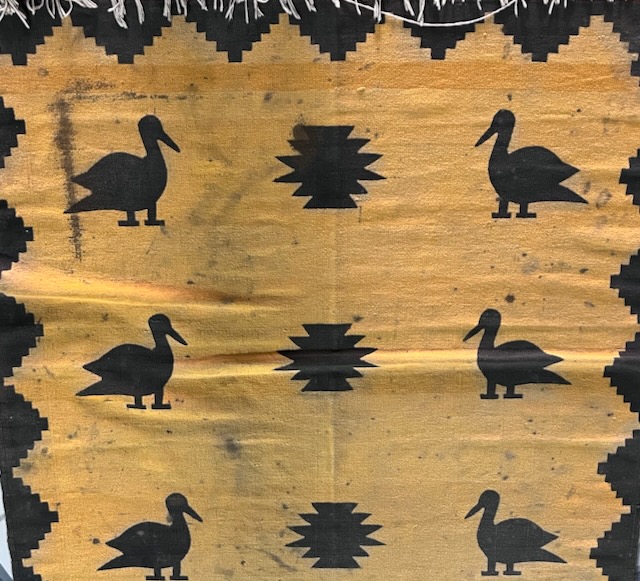
During this visit, the Gurdwara was undergoing renovations. Amid the scaffolding and signs of change, we made our way to the basement area; a large, echoing hall that was mostly empty and only partially completed. The Guru Granth Sahib rested there with solemn grace in the middle of the hall, surrounded by an assortment of vibrant dhurries scattered across the floor. The scene was simple yet striking. I couldn’t help but take photos of the colourful, handwoven patterns.

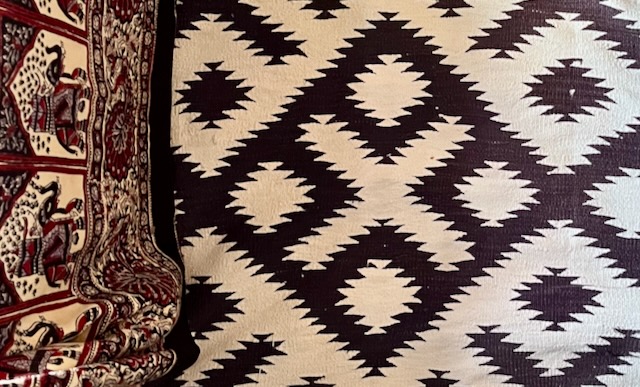
In that quiet moment, surrounded by these beautiful pieces of craft, I was instantly transported to my study back home. There, in the middle of my room, lies a black-and-white dhurrie—a treasured piece handmade by my mother. The rug, is now a relic and a reminder of her remarkable talent, one of many handcrafted creations she lovingly produced over the years.

At the time, I must admit, I didn’t fully appreciate the time, effort, and skill that went into these works of art. But today, that dhurrie is a cherished heirloom. It reminds me not only of her hands at work but also of the deeper cultural traditions that she carried within her.

For those unfamiliar, a dhurrie is a handwoven rug or flat-weave carpet, traditionally made in India and Pakistan. They were mostly made from cotton or jute and thus accessible for all. Dhurries are often lighter, reversible, more versatile and useful for everyday use; they can be used as floor coverings, bedding, or even wall hangings. In rural Punjabi households, you often find these dhurries spread out for meals, prayers, weddings, and community gatherings, making them silent witnesses to the everyday rituals and rhythms of life.

What makes them so striking are the geometric patterns, vivid stripes, or sometimes floral designs, each inspired by the region and culture from which they originate. The bold designs are usually in bright colours such as red, blue, yellow, as well as using black and white.

Historically, dhurrie weaving was a thriving cottage industry in rural India. But it was also something more intimate and symbolic, especially for women. Young brides-to-be were often taught the art from a young age. Many dhurries formed part of a woman’s dowry, and their patterns weren’t just decorative. They carried stories—symbols of personal, familial, and spiritual identity, passed down through generations, like a family recipe.

In many villages, it was common to see women sitting on charpoys under the shade, rhythmically working on pit looms while chatting about daily life. Though machine-made textiles are now more common, the tradition of handwoven dhurries survives in some artisan clusters, supported by cultural preservation efforts and a renewed appreciation for handmade goods.

As I stood in that hall, looking at the scattered dhurries beneath my feet, I realised how deeply woven this craft is into the fabric of our collective memory. These are not just utilitarian objects; they are vessels of heritage, art, and emotion. Each thread, each motif, tells a story.

In many ways, my mother’s dhurrie now tells mine. And you may well be wondering about the one I have? This was prized away from my sister my years ago. She had a number of them, given to her when she got married, and I convinced her to part with one which then travelled with me to England!

Notes from Lagos (Portugal): from Punjab to Lagos part 2

On a recent trip to Lagos, Portugal, I was struck by the presence of Indians, particularly young students, some were perhaps tourists and migrants who appeared to be seeking opportunities, others looked more settled and part of the local community.

The Indian diaspora in Portugal is diverse and can be broadly divided into three distinct regional groups:

  1. Gujaratis – The largest group, encompassing both Hindus and Muslims, reflects the deep-rooted trade and migration links between Gujarat and Portugal.
  2. Goans – Predominantly Christian, this group traces its heritage to Portugal’s colonial past, when Goa was under Portuguese rule for over four centuries. This historical connection has shaped their language, culture, and religious practices.
  3. Punjabis – Predominantly Sikhs, this community has migrated more recently, seeking opportunities in industries like hospitality and retail.

While walking around the streets of Lagos came alive with a rich tapestry of languages, including Gujarati, Punjabi, Hindi, Portuguese, and English, mingling seamlessly. This linguistic and cultural interplay highlighted the adaptability and integration of these communities within the Portuguese society.

Historical Roots and Migration Patterns

Historically, Portugal’s connection to India dates to the early 16th century when Vasco da Gama’s expeditions established trade and colonial links. [Read Lagos to Goa Part 1] Goa became a Portuguese territory in 1510, fostering a flow of people, goods, and cultural exchange between the two regions. Even after Goa’s annexation by India in 1961, ties between the two nations have persisted, enabling migration and cross-cultural connections.

Kristina Myrvold notes that significant Indian migration to Portugal began in the 1970s after the collapse of the Portuguese Empire and the 1974 democratic revolution. During this period, many Portuguese-speaking Hindus and Christians from former colonies like Mozambique and Goa migrated to Portugal. Later, in the 1990s, Portugal’s entry into the European Union and Schengen Zone made it an attractive destination for immigrants from India, including those with no prior cultural or linguistic ties to the country.

The Growing Sikh Community

Among the broader Indian diaspora, the growing number of Punjabi Sikhs particularly stood out during my visit. Many Indian restaurants appeared to be run by Sikhs, though ownership could belong to others. Myrvold explains that Sikh migration to Portugal began in the early 1990s, coinciding with a construction boom that created a high demand for labour. Many Sikhs initially worked in construction and agriculture, industries that required significant manpower. Over time, they expanded into other sectors, opening shops and restaurants, particularly in hospitality and retail.

Portugal’s relatively relaxed immigration policies and labour shortages during that period encouraged migration. Many Sikhs used Portugal as a stepping stone to secure residency or citizenship, drawn by the affordable cost of living and accessible legal pathways. This trend has driven the growth of the Sikh community in Portugal, which was estimated at 5,000 in 2007 and doubled to 10,000 by 2010. By 2024, the Indian Embassy in Portugal estimated the Sikh population at 35,000, highlighting their increasing settlement in the country.

Settlement and Challenges

Many Sikhs initially arrived in Portugal via other European countries, attracted by Portugal’s relatively lower cost of living and accessible legal pathways to residency and citizenship. Geographically, the Sikh community is spread across Portugal, with significant populations in major cities such as Lisbon and Porto, as well as in Albufeira and other towns along the Algarve. These regions have not only offered economic opportunities but also served as hubs for community life, where Sikhs have built places of worship, such as gurdwaras, and organized cultural events to preserve their traditions and strengthen community bonds.

The Sikhs community in Portugal is relatively new compared to other Indian groups with longer-established connections with the country. While travelling from Lagos to Faro, I had the chance to speak with a Sikh taxi driver who had been living in Albufeira for over 10 years. Despite the initial linguistic and cultural challenges, according to the taxi driver, the quality of life is much better in Portugal. They maintain their links with family back home in Jullundur but work and home is here.

The work is also seasonal and dependent on tourism, the summer being peak time to work long hours and earn double or triple the earnings to compensate for the winter periods when tourism drops. Looking into the future with rising living costs and increasing restrictions on settlement according to the taxi driver, it will make be harder for future migrants to establish themselves in Portugal.

Sources

Kristina Myrvold, ‘Sikhs in Portugal’ Religious Studies Commentaries, 11 August 2012. https://religionsvetenskapligakommentarer.blogspot.com/2012/08/sikherna-i-portugal.html

Inês Lourenco, From Goans to Gujaratis : a study of the Indian community in Portugal, Migration Policy Centre, CARIM-India Research Report, 2013/01 – https://cadmus.eui.eu/handle/1814/29463

Jennifer McGarrigle, and Eduardo Ascensão. “Emplaced mobilities: Lisbon as a translocality in the migration journeys of Punjabi Sikhs to Europe.” Journal of Ethnic and Migration Studies 44, no. 5 (2018): 809-828.

Pamila Gupta, “The disquieting of history: Portuguese (De) Colonization and Goan migration in the Indian Ocean.” Journal of Asian and African Studies 44, no. 1 (2009): 19-47.

“My spiritual guru is Nanak Dev and my trade guru is Baba Vishvakarma”

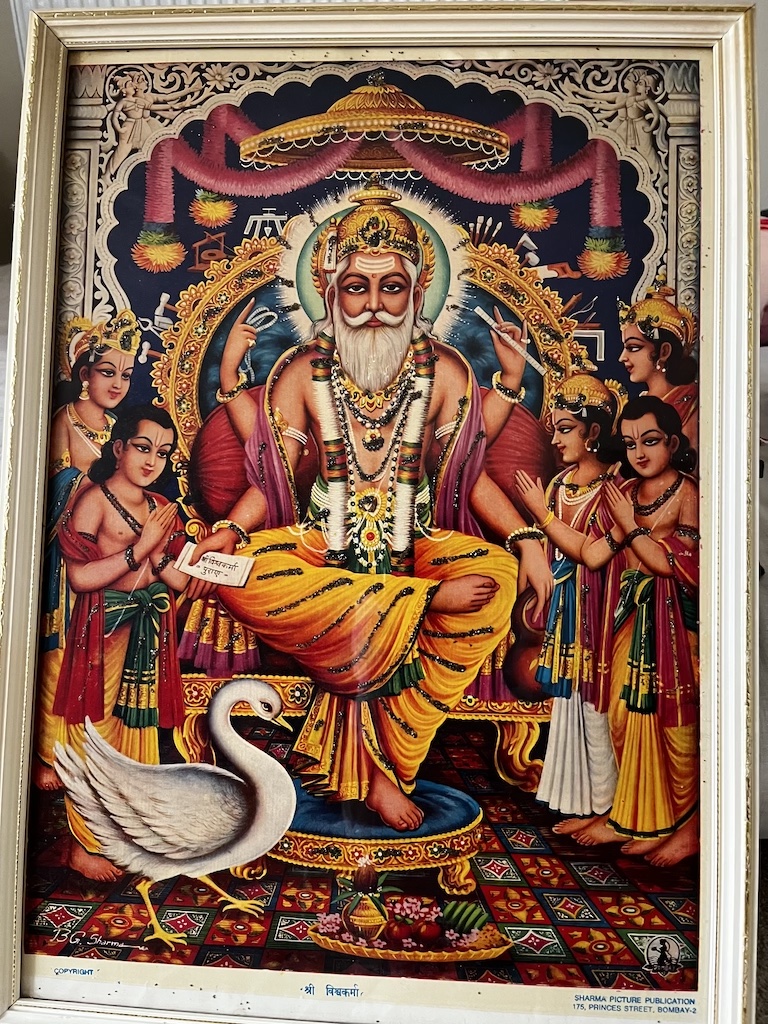
While reading the news from India, the celebrations of Baba Vishwakarma Day caught my imagination. Not least because as I was speaking to my sister earlier on, who had mentioned that the electricity went off due to heavy rains, and the local ‘bijli walla’ won’t come to fix it today. Why I asked? Well because it’s Baba Vishwakarma Day!

The discussion inevitably led us to reminisce about the past and we started talking about Baba Vishwakarma and what it meant to us, especially when growing up. I recall my mother having a photo of Baba Vishwakarma in her prayer room, but the day after Diwali was especially important because this is when we celebrated Vishwakarma Day. She would offer special prayers with prasad (offering) consisting of sweet boondi, that was bought for this purpose. The conversation with my sister prompted me to go and find that picture, which I had kept as a keepsake for many years.

My mother stitched clothes, mostly salwar kameezes, to make ends meet, a talent that she was well-known for in the local community. She was meticulous, everyone who had clothes made by her was aware of her fine cutting and stitching skills, and how well presented her clothes were when she delivered them. I helped when I was able to, but my standards were never high enough! The sewing machine was at the heart of her (our) survival and also how she was able to reinvent herself from a housewife to a single parent with young daughters in a new place.

So why are the Ramgarhia community associated with Vishwakarma? This is because the deity is associated with machinery, technical work, tools and is often described as the God of carpenters, goldsmiths, blacksmiths, and those who work in skilled crafts. The Ramgarhias were originally a community of artisans who worked in these professions, and adapted and upskilled to mechanical work during the 19th century, but the old associations and traditions remain, at least for some.

These stories are now a part of my memory and history, even though the narrative today may be different. My parents belonged to a generation that was more open, less prescriptive and the religious boundaries were more porous. I went to gurdwaras, I took a dip in the Ganges, and we went to Sufi shrines, it was part of the collective identity. Although Punjab witnessed some of the most horrific communal violence in the 1947 Partition, the region is also ironically one of the most pluralistic. For a devout Sikh, my mother was perfectly at ease with the presence of Baba Vishwakarma and indeed Baba Balak Nath in her prayer room, both of whom have a strong presence in Ludhiana amongst the Ramgarhia Sikhs.  

So, while doing some research for this post, I came across a PhD from the University of Leeds by Sewa Singh Kalsi (1989). It made interesting reading and I share some key extracts, which provide a glimpse into the history and transformation of the Tarkhan/Ramgarhia Sikhs. Kalsi’s study focused on the city of Leeds (UK) but the extracts below show the emergence and transformation of this small but important community.

“The entry of the Tarkhans into the Sikh Panth can be traced to Bhai Lalo, a carpenter of the village Aimnabad, now in Pakistan. On his first travels (udasi) Guru Nanak stayed with Bhai Lalo where he composed his celebrated hymn enunciating his mission. He addressed this hymn to Bhai Lalo, condemning the mass slaughter by the army of Babur, the first Moghul emperor of India. Commenting on the status of Bhai Lalo within the Sikh Panth, McLeod says that “Even higher in the traditional estimation stands the figure of Bhai Lalo, a carpenter who plays a central part in one of the most popular of all ianam-sakhi (biography) stories about Guru Nanak” (1974:86). Gurdial Singh Reehal in Ramgarhia Itihas (History of the Ramaarhias) (1979) notes the names of seventy two distinguished Punjabi carpenters who worked closely with the Sikh Gurus and made valuable contributions to the development of Sikh tradition. He says that “Bhai Rupa, a prominent Tarkhan Sikh officiated at the wedding of the 10th Guru, Gobind Singh. His descendants known as Bagrian-wale (belonging to the village of Bagrian) were the royal priests of the Sikh rulers of Phulkian states. They administered the royal tilak (coronation ceremony) and officiated on royal weddings” (Reehal 1979:162). It seems plausible that the entry of Tarkhans into the Sikh Panth took place under the leadership of distinguished Tarkhan Sikhs over a long period.” P 104

“Most prominent among the followers of Guru Gobind Singh were two Tarkhan Sikhs, Hardas Singh Bhanwra and his son, Bhagwan Singh, who fought battles under his command. After his death in 1708, both leaders joined forces under Banda Bahadur to lead the Sikh Panth. Commenting on the position of Bhagwan Singh Bhanwra within the Sikh Panth, Gurdial Singh Reehal says that “Bhagwan Singh was appointed governor of Doaba (Jullundar and Hoshiarpur districts) by Banda Singh Bahadur” (1979:209). Jassa Singh Ramgarhia was the eldest son of Bhagwan Singh. He inherited the skills of his father and grandfather and became the leader of Ramgarhia misl (armed band). Jassa Singh built the fort of Ramgarh (this means literally the fort of God) to defend the Golden Temple, Amritsar. McLeod notes that “In 1749, however, he (Jassa Singh) played a critical role in relieving the besieged fort of Ram Rauni outside Amritsar. The fort was subsequently entrusted to his charge, rebuilt and renamed Ramgarh, and it was as governor of the fort that he came to be known as Jassa Singh Ramgarhia” (1974:79). The title of Ramgarhia was bestowed on Jassa Singh by the leaders of the Sikh misls. According to the Dictionary of Punjabi Language (1895), the word “Ramgarrya” means a title of respect applied to a Sikh carpenter. Describing the position held by Jassa Singh among the leaders of Sikh misls, Saberwal in Mobile Men says that “We have noted the part played by Jassa Singh Ramgarhia in the 18th century; though a Tarkhan, by virtue of his military stature he sometimes emerged as a spokesman for all twelve Sikh misls in relation to other centres of power” (1976:99).” P 105

“In order to understand the emergence of Ramgarhia identity, we must locate the processes which have enabled them to move in large numbers from jajmani relationships in the village to urban-industrial entrepreneurship both within India and East Africa. The extension of British rule to the Punjab opened up enormous opportunities for the Punjabi Tarkhans. They channelled their energy and resources into going abroad in search of wealth and towards participating in the urban-industrial growth in India. Their technical skills were harnessed to build railways, canals and administrative towns both in India and East Africa. The Ramgarhias were the majority Sikh group, approximately 90 per cent of the whole Sikh population in East Africa (Bhachu 1985:14; McLeod 1974:87). In East Africa, they established their social and religious institutions like the Ramgarhia associations, Ramgarhia gurdwaras and clubs. By the 1960’s, the Ramgarhias had moved from being skilled artisans, indentured to build the railways, to successful entrepreneurs, middle and high level administrators and technicians. Bhachu argues that “Support structures developed during their stay in East Africa have not only helped manufacture their ‘East Africanness’ but have also aided the perpetuation of their identity as ‘staunch Sikhs’ in the South Asian diaspora, independent of the original country of origin” (1985:13). In East Africa, the Ramgarhias demonstrated a remarkable capacity for maintaining the external symbols of Sikhism, which is a clear indication of their commitment to the Khalsa discipline.” P 107

“The Ramgarhias achieved a noticeable measure of economic success in the urban-industrial sector, both in India and in East Africa. They were able to discard the low status of a village Tarkhan by transforming themselves into wealthy contractors and skilled artisans employed in railway workshops and other industries. In cities they were associated with the Khatri Sikhs, the mercantile group in urban Punjabi society. In the Punjab, the distinctive feature has been the concentration of Ramgarhia Sikhs in particular towns i.e. Phagwara, Kartarpur, Batala, and Goraya. These towns are known for car parts industries, furniture, foundries and agricultural machinery owned by the Ramgarhia Sikhs. This newly achieved economic status was one of the factors which encouraged them to build religious, social and educational institutions belonging to their biradari. In the town of Phagwara, they have built an educational complex which includes a degree college, a teacher training college, a polytechnic, an industrial training institute and several schools.” P 108

And finally, a line from where I take the title of this piece. One of the people interviewed notes: “My spiritual guru is Nanak Dev and my trade guru is Baba Vishvakarma. Many Ramgarhias feel ashamed to be associated with our trade deity.” P 117.

Further references include my own book, in which I discuss the community in relation to the transformation of Ludhiana.

Bhachu, P. (1985). Twice migrants: east African Sikh settlers in Britain (Vol. 31100). Tavistock Publications.

Kalsi, Sewa Singh (1989) The Sikhs and caste : a study of the Sikh community in Leeds and Bradford. PhD thesis, University of Leeds.

Kaur, P. (2017) The dynamics of urbanisation in Ludhiana city. International Journal of Advanced Research and Development, Volume 2; Issue 6, 547-550.

McLeod, W.H. (1974) Ahluwalias and Ramgarhias: Two Sikh castes, South Asia: Journal of South Asian Studies, 4:1, 78-90, DOI: 10.1080/00856407408730689

Virdee, P. (2018). From the Ashes of 1947. Cambridge University Press.

Remembering Partition in the Punjab – podcast

Earlier in the summer I recorded a podcast with Realms of Memory. There are two episodes for those interested in understanding more about the history of Partition, especially how it impacted the Punjab. The talk was based on my book, ‘From the Ashes of 1947: Reimagining Partition’ published by Cambridge University Press (2018). In the podcast I also discuss some of the recent changes that have taken place in the study in Partition.

You can listen to the podcast via most streaming sites, or via Realms of Memory

Remembering Partition in the Punjab: Part 1

Remembering Partition in the Punjab: Part 2

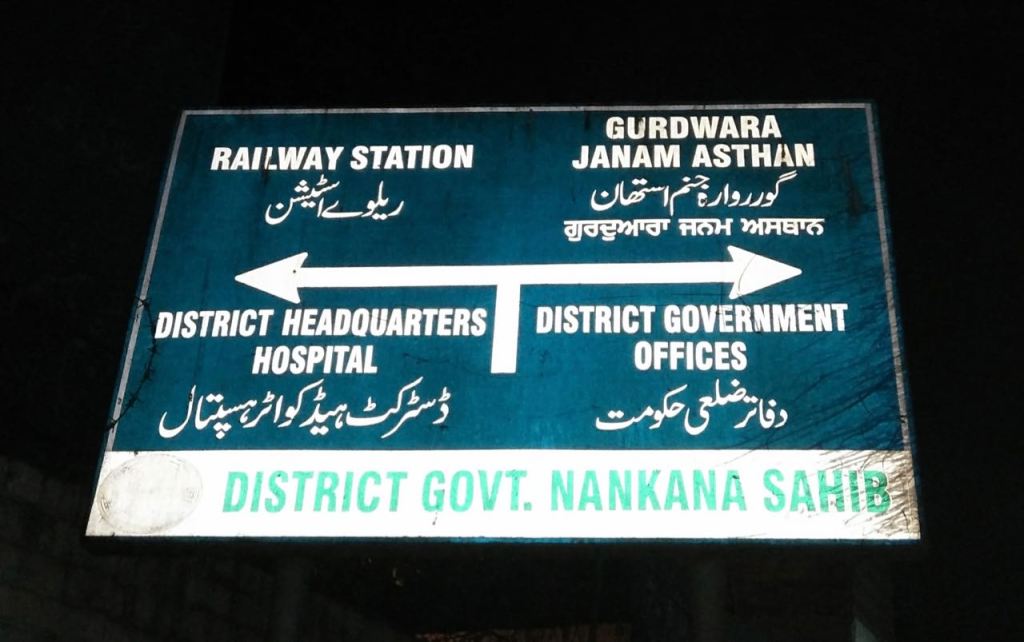
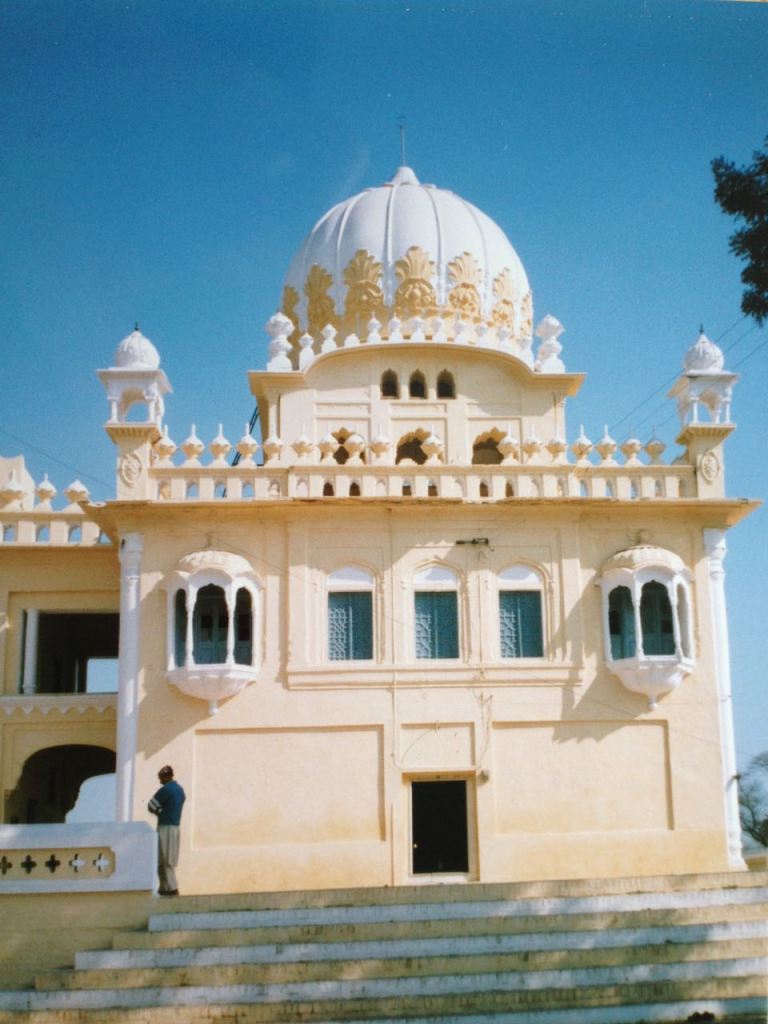
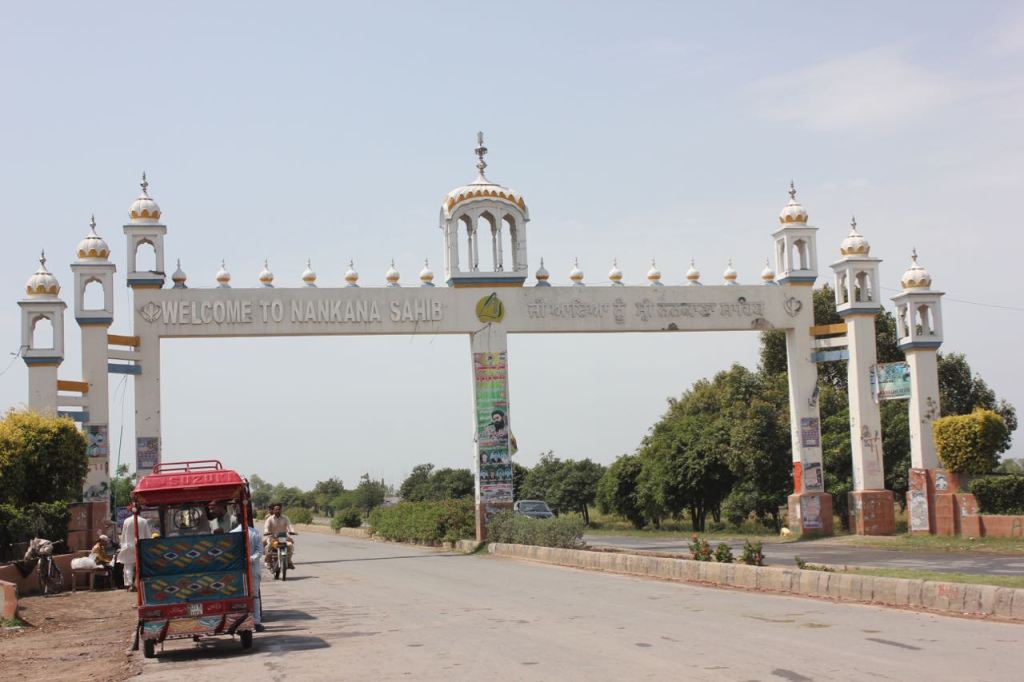
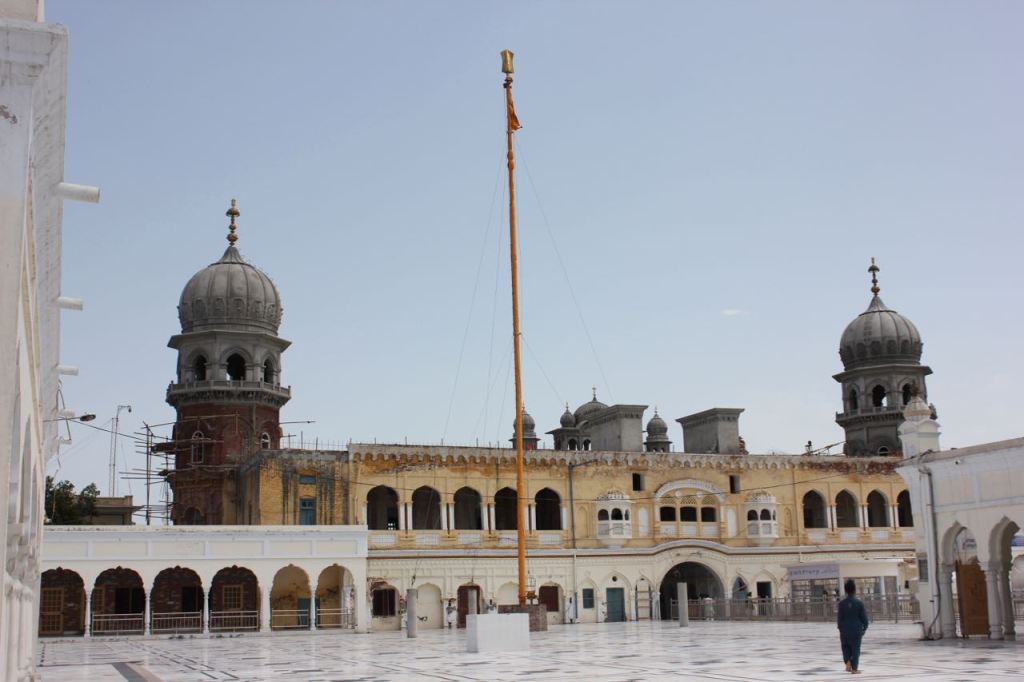
Welcome to Nankana Sahib

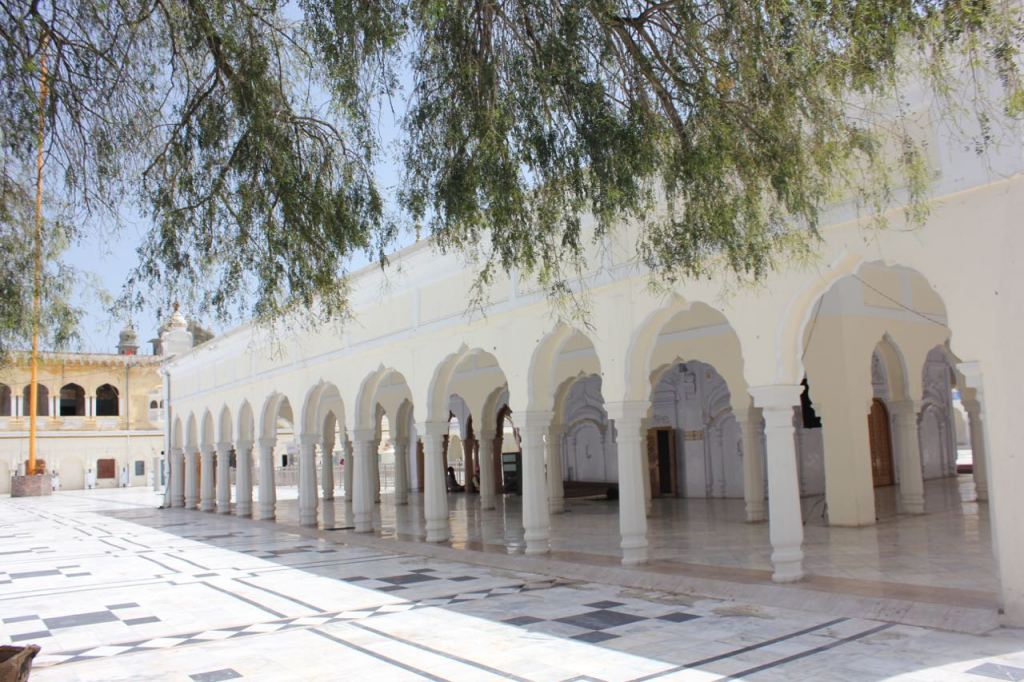
Nankana Sahib is the Birthplace of Guru Nanak. This town was originally known as Talwandi of Rai (Rai Bhoi di Talwandi) and today it forms the core of the small Sikh community in Pakistan. Every year on Guru Nanak’s birthday (Gurpurab), Sikhs (and others) gather around Nankana Sahib to remember the founder of the Sikh faith. Over the years the Gurdwara complex has grown considerable. I first went there in 2003 when it was a small gurdwara with a largely Pathan Sikh community of about 50 families who lived there. The last time I went there was on Gurpurab in 2016, and the small town was transformed into a mela of 20-30,000 people from around Pakistan, including the Nanak Panthis (mostly from Sindh) and Sikhs from around the globe (including India). The area now has district status and attracts the Sikh diaspora, who come here in huge numbers on pilgrim visas. The growth in the pilgrims and tourism is one of the main reasons for the growing investment in places like this and hence the transformation of this area.
I leave you with the voice of Nusrat Fateh Ali Khan – born in Lyallpur (Pakistan) with ancestral roots in Jalandhar (India) – who is performing/reciting Koi Bole Ram Ram Koi Khuda (Some call the Lord ‘Ram, Ram’, and some ‘Khuda’) at the Ramgarhia Sabha Gurdwara (Slough, UK) for the Sikh Diaspora in 1989 – many of whom appear to be from East Africa. But the words of the Guru and music know no borders.  

Ustad Nusrat Fateh Ali Khan Live in Slough Gurdawara, 1989 by Oriental Star Agency

If you are interested more in the shabad, the translation and the meaning, please click here.

Manmohan Singh Bedi (1924-2014): the first Sikh Mayor of Bombay

Caption from The Times of India, April 5, 1983. “The new mayor of Bombay. Mr Manmohansingh Bedi, cheered by Bhangra dancers in a victory procession in the Fort are on Monday. Photo by Girish Dikshit.”

On 30 October 2014 Manmohan Singh Bedi, the first Sikh Mayor of Mumbai (then Bombay) died, weeks short of his 90th birthday. He was a restaurateur and the founder of Sher-e-Punjab Restaurant chain in Bombay in 1937, and the President of Hotel & Restaurant Association of Western India. But it was his Bombay mayoral victory in April 1983 that caught my eye. Below are three articles from The Times of India. They cover the victory of Bedi. 

Bedi is city’s first Sikh mayor By A Staff Reporter, April 5, 1983.

R. Manmohansingh Harnamsingh Bedi of the Janata Party today became the first Sikh mayor of Bombay, amid unprecedented scenes of jubilation. Mr. Bedi polled 102 votes, the first time that a mayoral candidate crossed the 100-vote mark, against 32 of his lone opponent, Mr. Rameshkumer Mataprasad Dube of the Congress-I. No sooner was the 58-year-old Mr.Bedi declared elected by the outgoing mayor, Dr. P. S. Pai, than the house broke into thunderous cheers. Councillors and scores of supporters who had waited in the public gallery surged on to the dais with garlands end bouquets. A large number of Sikhs bad turned up to greet the new mayor, whose election was a foregone conclusion,

GARLANDS GALORE

Dr. Pai was the first to embrace and garland Mr. Bedi, followed by the municipal commissioner, Mr. D. M, Sukthankar, Mr. Dube, leaders of civic political groups, other councillors and the general public. Slogans hailing the Janata Party and the ruling Progressive Democratic Front (PDF) were raised to the accompaniment of the chant, “Bole So Nihe! Sat Sri Akal”. Security men, who had initially screened visitors to the corporation hall, relented in the face of popular enthusiasm and threw open the gate for streams of visitors carrying bouquets and garlands. As the crowds surged forward to greet him, Mr. Bedi was pushed back and the security men held on to the ornate mayoral chair to prevent it from toppling over the dais. Mr. P. H. Sehgal, a councillor, appealed to the crowd in Punjabi to disperse quickly. The new mayor was garlanded on behalf of a host of organisations, including the Guru Singh Sabha, the Punjab association, taxi-men’s unions and the association of automobile spare parts traders. The candidature of Mr. Bedi was submitted by the Janata Party last Thursday, after the party got the mandate from the PDF’s six-party constituents comprising 76 members in the house of 138. Of these, the Janata Party’s councillors total 40, followed by 20 of the BJP, 11 of the Congress-S, three of the Muslim League (Bukhari group) and one each from the CPM and the RPI. Mr. Bedi got the support of the Shiv Sena, a non-PDF group, with 20 members. The Sena decided support Mr. Bedi to prove its bonafides as “a truly anti-Congress-I organisation”.

“UNHAPPY FINANCES”

Two Muslim League councillors from the Banatwalla group, three from the CPI and an independent voted in favour of Mr. Bedi. The election was boycotted by three other independents-Mr. B. K. Boman-Behram, former mayor. Dr. (Mrs.) Bhaktawar Mahajan and Mr. G. B. Dutia—who said they resented the “bargaining” of the mayoralty and chairmanships of committees. Mr. Dube’s 32-strong Congress-I group stood firmly behind him. Delivering his first speech as mayor Mr. Bedi said the city of Bombay had honoured the Sikh community by electing him to the position. Hailing the old ties between Maharashtra and Punjab, he recalled the visit of Sant Namdeo to the Punjab region and the establishment of Sikh Centre at Nanded in Maharashtra by Guru Gobind Singh, the tenth guru. Mr. Bedi described the financial condition of the corporation as “not that happy” and said inflation was to blame. The corporation’s wage bill which was Rs. 39 crores in 1978-79. had risen to over Rs. 100 crores for 1983-84. The financial resources available to the corporation were limited and almost static. The new mayor called upon both the Central and state governments to assist in slum clearance. He said the state government was in arrears of Rs. 9.13 crores in the matter of slum improvement dues. He reminded the house that slum improvement formed part of the government’s 20-point programme. He also focused on water supply projects and said the government had yet 10 fulfil its commitment of Rs.23 crores for the first phase of the Bhatsai project which has been completed. Mr. Bedi pleaded for the implementation of the middle Vaitarna project for augmenting the water supply. He also called for the release of surplus lands under the Urban Land Ceiling Act to co-operative housing societies to ease the city’s housing problem.

Born on December 27, 1924 at Sargodha, now in Pakistan, Mr. Bedi’s family migrated to Bombay before the partition. Educated at Bharda New High School in Bombay, Mr. Bedi’s academic career was cut short by the “Quit India” movement. A councillor since 1957, Mr. Bedi represents the Bori Bander (VT) Constituency. He has served as the chairman of the markets and gardens committee (1961-62), of the works committee (1963-64), improvements committee (1967-68) and the BEST committee (1980-81). Now a treasurer of the state Janata Party, Mr. Bedi was a prominent Congressman in the past, holding the position of general secretary of the BPCC in 1968. A successful hotelier, owning a chain of restaurants, Mr. Bedi is a soft-spoken man, but a popular member of the house.

Moments after his maiden speech as mayor, which was delivered in English, Mr. Bedi garlanded the statues in the corporation hall, including those of Mahatma Gandhi, Shivaji, Sir Phirozshah Mehta and Dr. Babasaheb Ambedkar. He was taken in a procession to Hutatma Chowk where he paid a floral tribute at the Martyrs memorial. The procession included Bhangra dancers. Mr. Manohansingh Bedi is the third Janata Party mayor in the present house, after Mr. Raja Chimbuikar and Dr. A. U. Memon. Mr. Baburao Shete, who served as the first mayor in the present house was elected on the Congress-(S) ticket but later joined the Congress-(I). Dr.P. S. Pai whom Mr. Bedi succeeded, is a BJP councillor.

Vasantrao – was for unanimous election of mayor By S. T. Almeida, Bombay April 6, 1983

The chief minister, Mr Vasantrao Patil, was in favour of the Congress (I) candidate withdrawing from the race for the mayoralty as a gesture to enable Mr. Manmohansingh Bedi to become the first Sikh mayor of Bombay unopposed, it is reliably learnt. Mr. Patil had conveyed his feelings to the Congress (l) candidate, Mr. Rameshkumar Dube. saying that he was sure to lose and that gesture towards the Sikh candidate would be well-appreciated. Mr. Bedi had intimated to chief minister his wish that he be elected unopposed. But Congress (I) members in municipal corporation felt that mayoral election was too politicised an affair and that such a gesture would have been appropriate if Mr. Bedi was an independent candidate. They disapproved of Mr. Patil’s logic in supporting a candidate from minority community by recalling that when Congress (I) put up Mr. Zail Singh for presidency. Janata party went ahead in its support for Mr. Justice H. R. Khanna opposition candidate. Ironically, Mr. Bedi had lost the mayoral election to the Shiv Sena’s Mr. Wamanrao Mahadik in 1978. At that time. Mr. Bedi was a Congressman, but Mr. Vasantrao Patil, who was chief minister then, had instructed Congress (l) councillors to vote for Mr. Mahadik. Mr. Patil’s action had offended Mr. Bedi and other Congressmen, prompting them to leave the party.

Electing a mayor, by a Staff Reporter, April 11, 1983

Close on the heels of the election of the country’s first Sikh President, the city fathers voted Bombay’s first Sikh mayor and 54th in line, Mr Manmohansingh Bedi (59), at one of the noisiest mayoral polls in recent history. A huge gathering of the turbaned fraternity had ridden in their beflagged cars to the venue of the corporation meeting and rolled out three-metre-long chai crackers to announce the Sikh leader’s triumph. Not even the police could dampen their enthusiasm after warning them of the likely danger the crackers could cause to nearby cars and offices. The lane between the two MBC buildings and the main thoroughfares were choked with a major traffic snarl as vehicles continued to stream towards the civic building, reflecting the popular esteem in which Mr Bedi is held by a vast cross-section of the people. A troupe of bhangra dancers bedecked in their colourful regalia of bright yellow salwar-kameez topped by black tunics pirouetted to do a jig or two to celebrate the mayor-elect’s victory. The proceedings were redolent of the feisty nature of the Punjabis, extroverts to the core with their earthy style of living.

Epilogue

The dominant party in present-day Maharashtra, the Shiv Sena, was established in 1966 and in 1971 the party had its first victory under the mayoral candidature of Dr H. S. Gupte. Since 1985 the Shiv Sena has more or less dominated the mayoral seat of Bombay. In 1983 the BJP, the present ruling party in India had barely any presence, having only been established in 1980. This was also the year before Operation Blue Star in Amritsar, Punjab, when under PM Indira Gandhi the Indian security forces were sent into the Sikh’s sacred Harmandir Sahib to remove Jarnail Singh Bhindranwale in June 1984. This eventually culminated with the assassination of the prime minister, followed by the anti-Sikh pogroms in Delhi in November 1984.  

“Zameen nahi, per zameen hai”

The farmer’s thali.