
© 2017 Pippa Virdee

© 2017 Pippa Virdee

© 2017 Pippa Virdee

© 2017 Pippa Virdee

© 2017 Pippa Virdee

© 2017 Pippa Virdee
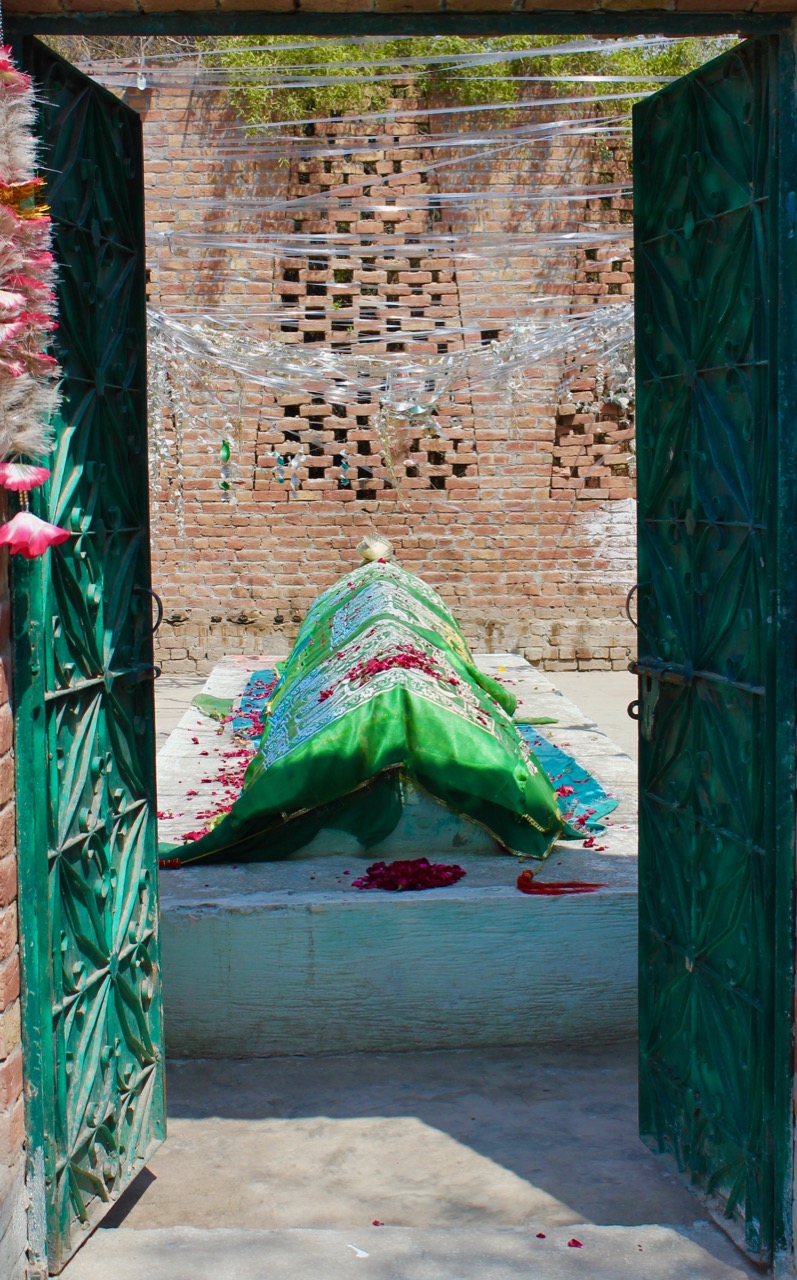
The city of Sonepat, in present day Haryana State, hardly has anything of note for the wandering and curious tourist but surprisingly there are a few gems hidden away. Tucked away in the semi-urban landscape is the tomb of Khwaja Khizr, surrounded by a lush green garden, buffaloes and residential housing. Standing tall and elevated on a mound is the tomb, overlooking the city of Sonepat. Local residents and the accidental tourists looking for scenic open spaces come here and congregate around the garden. Relaxing in the open air, families surround the tomb, passing time or having picnics; children play games and make merry. And the occasional visitor ventures inside the tomb to pay their respects or simply out of curiosity.
This stunning tomb was built over the remains of Khwaja Khizr. According to a Persian inscription on the site, Khwaja Khizr was the son of Darya Khan Sarwani. Darya Khan himself was an influential noble in the court of Sikandar Lodhi. Work commenced on the tomb in 1522 and was completed by 1524 by Ibrahim Lodhi.
Latif writing in 1889 notes:
Sikandar Lodi died in 1517 in Agra, his son Ibrahim Lodi ascended the throne. Dissatisfied with the court of Delhi, Doulat Khan Lodi (Sikandar’s uncle and viceroy of the Panjab) sent his agents to Kabul to urge Baber, the Moghal prince, a son of a great-grandson of Tymur, to attempt the subjugation of the empire of Hindostan, in imitation of his ancestor’s conquests. Baber, accordingly invaded India in 1526, and a battle was fought between the Moghals and Indians on the plains of Panipat, a battle-field on which the fate of India has so often been decided. This memorable battle, which was fought on the April 21, 1526, resulted in the victory of Baber. Ibrahim Lodi, the last of the dynasty, was slain on the field, and by his death a new dynasty under the Moghals was established. The reign of Ibrahim Lodi had lasted twenty years and the dynasty to which he belonged seventy-six in three successions, from 1450 to 1526. (Syed Muhammad Latif, History of the Panjab, 1889)
Locally Khwaja Khizr was revered as saint; he apparently renounced his courtly lifestyle in favour of pursuing a simple life inspired by the Sufi tradition. Like many before him, he was in search of the real meaning of life. Carefully leaving their shoes/slippers outside, the occasional devotees go inside the tomb to pay homage, lighting an incense stick, leaving offerings and tying treads for manants. The syncretic tradition associated with this historic land still finds places to hide-away and co-exist. For the curious visitor, the tomb itself is a rare example of being built with kankar (variety of limestone) blocks and red sandstone. The wide staircase leads to the two-arched gateway. The Indo-Islamic style of architecture sympathetically reflects the fusion and syncretic tradition. While reading around to find out more about the shrine, there was an article which suggests that ‘the tomb was once decorated with blue tiles – now missing – and that it was repaired in 1921-22 at a cost of Rs 130 although the sanctioned amount was Rs 167!’ (http://portofcall1.blogspot.in/2010/12/sonepat-beyond-toughs.html) Although the tomb could certainly do with some more care and attention, it is still worth a visit for the accidental or the intentional tourist who happens to pass by Sonepat. Neglect, whether this is willfully done or not, means that places like these fall into disrepair and with them they erase centuries old histories.
Tomb of Khwaja Khizr (Khijar Makbara and Park) – Sonepat, India https://www.youtube.com/watch?v=sZLZNr9bFdo















 BAGICHA