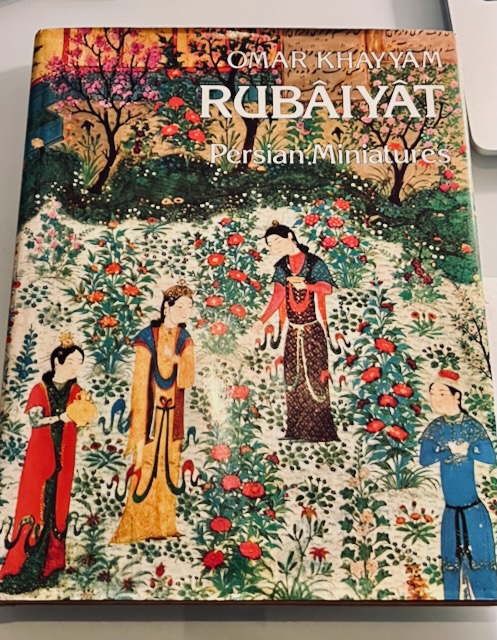
Some time back, while browsing a second-hand bookshop — the name and place now lost to memory — I stumbled upon a copy of Omar Khayyam’s Rubaiyat, translated from Persian by Edward FitzGerald. Published in 1981, it is a beautifully illustrated edition, adorned with miniature paintings. Time-worn as it is, the book carries a warm and inviting feel, and I always thought I would one day find the right words to write about it. It usually sits on the bookshelf directly in front of my desk, front cover on full display — a small splash of colour and beauty against what can otherwise be rather dry academic reading. The richness of the text and the miniature paintings breathe both life and warmth into the room and, on occasion, inspire me to write.
Omar Khayyam (1048–1131) was a Persian poet and polymath of remarkable range — a mathematician, astronomer, and philosopher as much as a literary figure. Born in Nishapur in present-day Iran, he flourished during the Seljuk era, a world away in time and place from the Crusades unfolding to the west. Though celebrated in his own time for his scientific and philosophical work, it is his poetry that secured his enduring fame in the modern world — largely thanks to Edward FitzGerald’s celebrated English translation, first published in 1859. FitzGerald’s Rubaiyat of Omar Khayyam is a loose but inspired rendering of quatrains drawn from the Bodleian manuscript, and its success was extraordinary: a bibliography compiled in 1929 listed over 300 separate editions, with many more appearing in the century since.
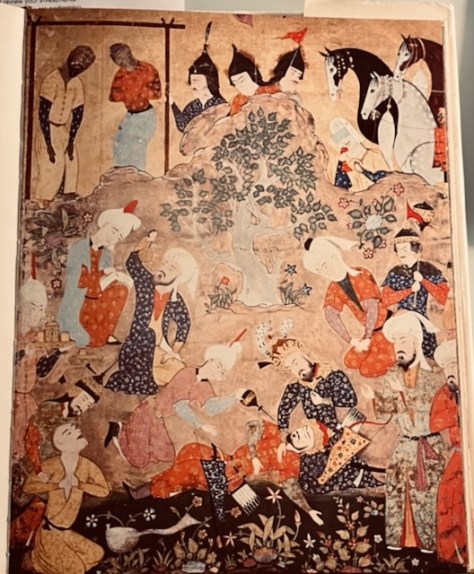
There is, of course, much to be said about FitzGerald and the liberties — and brilliance — of his translation, but that is a conversation for another time. For now, it was the events of the past few days that compelled me to lift the book from the shelf and turn its pages. Two quatrains, in particular, stopped me in my tracks.
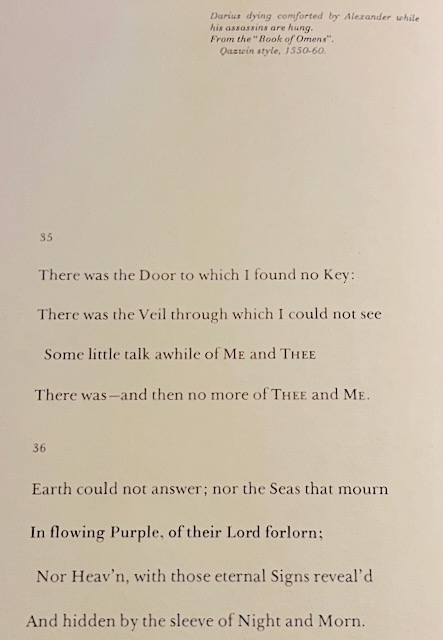
35
There was the Door to which I found no Key;
There was the Veil through which I could not see
Some little talk awhile of ME and THEE
There was—and then no more of THEE and ME.
36
Earth could not answer; nor the Seas that mourn
In flowing Purple, of their Lord forlorn;
Nor Heav'n, with those eternal Signs reveal'd
And hidden by the sleeve of Night and Morn
 BAGICHA