Tag Archives: politics

Coventry: A Migrant City in the Making

St Osburg’s Church, Coventry

As we approach another year-end in this season of merriment and reflection, and on the shortest day of the year, when daylight is most precious, many of us find time to catch up on projects long left pending. For me, this has meant returning to research into the city of Coventry.

While working on a chapter that uses photographic history to explore migration patterns, I’ve been reading Life and Labour in a 20th Century City: The Experience of Coventry, edited by Bill Lancaster and Tony Mason (1986). The chapter on ‘Migration into Twentieth Century Coventry’ revealed two significant threads: the presence and influence of the Irish Catholic community, and Coventry’s emergence as home to a South Asian community. At the same time, it also revealed the prevalence of racism then, which is comparable to the anxieties that are expressed today. Pages 71-76 are particularly illuminating in linking the political discourse and public fears of the post-war generation to contemporary shifts in British society.

The Myth of 1930s Cosmopolitanism

Coventry in the 1930s was often described as cosmopolitan, but this characterisation was somewhat misleading. Although the population was mixed, with migrants rising to 40% by 1935, most of these newcomers came from other UK regions. This trend continued throughout the war and the immediate post-war period. By 1951, while the overwhelming majority of Coventry’s citizens were of UK origin, some change was also evident.

Lancaster and Mason, page 71

The Irish Presence

The 9,993 Irish residents counted in the 1951 census marked a significant new wave of migration after the war. Although Irish regiments were often stationed at Coventry barracks and contributed labour during the early 20th century, the local Irish community remained small—only 2,057 in 1931. Nevertheless, this population grew rapidly during the construction boom of the 1930s.

Lancaster and Mason, page73

By the end of the Second World War, the streets around St. Osburg’s and St. Mary’s churches had taken on a unique Irish character. These inner-city neighbourhoods, filled with lodging houses and multiple-tenant buildings, and close to Roman Catholic churches, became popular stopping points for itinerant construction workers or individuals looking for factory jobs.

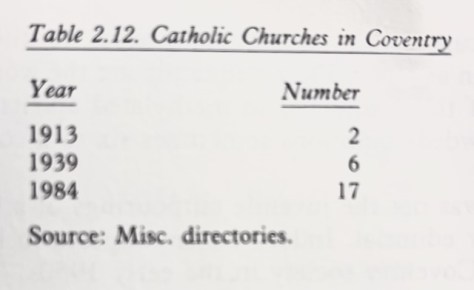
The growth of Catholicism in Coventry during the 20th century reflects both the expansion of the Irish community and their commitment to preserving their religious identity. Interestingly, two current Catholic churches in Coventry cater specifically to European congregations: the Polish and Ukrainian communities.

The South Asian Community and Racial Prejudice

By 1954, the small wartime Indian community had grown to about 4,000 people. Described as a “quiet, peace-loving ethnic minority,” they mainly settled in the older, rundown housing around Foleshill Road. Like many other migrants, they sought to preserve their culture and identity. In October 1952, Muslim members of the community submitted a request to the Planning and Redevelopment Committee for dedicated burial grounds and land to build a mosque.

Although small in numbers, Coventry’s Indian community was nonetheless affected by the growing racial prejudice across Britain. In October 1954, reports emerged that local estate agents were enforcing a colour bar. The week prior, the Coventry Standard published a troubling editorial — not the work of a biased junior reporter, but the newspaper’s primary editorial position:

The presence of so many coloured people in Coventry is becoming a menace. Hundreds of black people are pouring into the larger cities of Britain, including Coventry, and are lowering the standard of life. They live on public assistance and occupy common lodging houses to the detriment of suburban areas. They are frequently the worse for liquor, many of them addicted to methylated spirits, and live in overcrowded conditions, sometimes six to a room.

Lancaster and Mason observe that by the early 1950s, this racism had spread across a wide range of Coventry society. The Standard also reported that a branch of the AEU had contacted Elaine Burton, Labour MP for Coventry South, about the issue. This hostility is particularly notable given that the “coloured minority” made up less than 1.5% of Coventry’s population and, as Stephen Tolliday demonstrates elsewhere in the book, did not threaten the employment of local factory workers.

A City of Newcomers

By 1951, Coventry was mainly a city of recent arrivals, with estimates suggesting that only 30-35% of its population were born there. Many of the newcomers quickly left due to difficulties in finding housing or employment. A study noted that in 1949, 18,000 new residents moved to Coventry, while 17,000 people left.

Moreover, Coventry was hardly a melting pot. In addition to racial prejudice, residents were often unwelcoming to newcomers. Friendships and social networks usually aligned with regional and ethnic backgrounds, with clubs, pubs, and religious groups serving specific migrant communities. Ironically, Coventry’s long-standing identity as a migrant city since the early century may have reinforced the aloofness of the remaining native population – the latter is still palpable in the city’s streets and people.

Lancaster and Mason, page 75

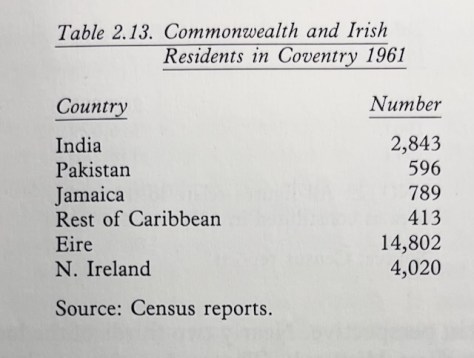
The 1961 census revealed that the 1954 estimate of Asians in Coventry was inflated. New Commonwealth migrants made up only 1.5% of the population, whereas 6.1% was from Eire and Northern Ireland. The flow of migrants from the new Commonwealth was minimal rather than overwhelming. However, between the 1961 census and the so-called mini-census of 1966, significant shifts in migration into Coventry occurred, shifts that would help shape the political rhetoric around immigration for decades to come.

Lancaster and Mason, page 75

Echoes of the Past

Reading the 1954 Coventry Standard editorial today, with its language about people “pouring in” and becoming a “menace,” makes it impossible not to hear echoes that resonate in British political discourse. Just fourteen years later, on April 20, 1968, Enoch Powell, Conservative MP for Wolverhampton South West, gave his infamous “Rivers of Blood” speech at a meeting of the Conservative Political Centre in Birmingham nearby. Powell heavily relied on letters and anecdotes from the West Midlands, predicting that communities would be “foaming with much blood” because of Commonwealth immigration. His apocalyptic language gained traction in a region that was experiencing real demographic change, even though the scale was often exaggerated by fear and prejudice.

Coventry’s history shows a striking pattern: a persistent disconnect between perception and reality regarding migration. In 1954, ‘coloured’ migrants made up less than 1.5% of Coventry’s population and were described as a menace and a threat to living standards. By 1961, the actual numbers were even lower than the overestimated figures. Despite this, anti-immigrant sentiment gained strength, reaching a peak with Powell’s speech, which appeared to validate fears that years of evidence had shown to be unfounded.

This kind of hostile and often racist political rhetoric continues to thrive today. When Nigel Farage displayed his “Breaking Point” poster in 2016, depicting a line of refugees, or when he claims to feel “like a foreigner in my own country” and warns that migration levels are “unsustainable,” he uses a similar approach: heightening anxiety about cultural change while often distorting the scale and effects. Words such as invasion, being “overwhelmed,” and threats to “our way of life”—these expressions form a continuous thread from that 1954 editorial through Powell to Farage.

Coventry’s historical record is particularly valuable because it allows us to compare predictions with actual outcomes. The threat predicted in 1954 never came true. There was no bloodshed or violence. Despite the panic, racial barriers, and inflammatory editorials, and despite migrants constituting less than 1.5% of the population, Coventry’s diverse communities—Irish, South Asian, Polish, Ukrainian, and others—became an integral part of the city. They did not pose the threats to jobs or living standards that were claimed. Indeed, the post-war boom would not have been possible without this labour migration into the city.

Coventry’s history shows that demographic change is neither easy nor without real challenges. However, the most provocative rhetoric often surfaces during times of economic uncertainty. The true story of Coventry, a city that has been profoundly shaped by migration as it continues to evolve and develop.

As we enter the new year, with migration remaining one of the most contentious political issues in Britain, Coventry’s history offers a lesson worth heeding: our fears of newcomers have consistently proved more destructive than the newcomers themselves. How can we learn from the past without repeating the same anxieties and prejudices?

References:

Ewart, H. (2011). “Coventry Irish”: Community, Class, Culture and Narrative in the Formation of a Migrant Identity, 1940–1970. Midland History36(2), 225–244.

Lancaster, Bill and Mason, Tony (eds), Life and Labour in a Twentieth Century City: The Experience of Coventry. Coventry: Cryfield Press, 1986.

Virdee, Pippa. Coming to Coventry: Stories from the South Asian Pioneers. The Herbert, 2006.

Women, Violence and the Silences: 1984

© Pippa Virdee 2024

Forty years ago, Delhi witnessed some of the worst violence since 1947. It was the events of October-November 1984, that prompted Urvashi Butalia to revisit the Partition of 1947 and to excavate the history of the violence that was perpetrated towards women. Both 1947 and 1984 have left indelible scars on the people and region. The opening in her book, The Other Side of Silence (1998), is worth quoting detail:

“Then, in October 1984 the prime minister, Indira Gandhi, was assassinated by her security guards, both Sikhs. For days afterwards Sikhs all over India were attacked in an orgy of violence and revenge. Many homes were destroyed and thousands died. In the outlying suburbs of Delhi more than three thousand were killed, often by being doused in kerosene and then set alight. They died horrible, macabre deaths. Black burn marks on the ground showed where their bodies had lain. The government – now headed by Mrs Gandhi’s son Rajiv remained indifferent, but several citizens’ groups came together to provide relief, food and shelter. I was among the hundreds of people who worked in these groups. Every day, while we were distributing food and blankets, compiling lists of the dead and missing, and helping with compensation claims, we listened to the stories of the people who had suffered. Often older people, who had come to Delhi as refugees in 1947, would remember that they had been through a similar terror before. ‘We didn’t think it could happen to us in our own country,’ they would say. This is like Partition again.” (Page 4-5) “It took 1984 to make me understand how ever-present Partition was in our lives too, to recognize that it could not be so easily put away inside the covers of history books. I could no longer pretend that this was a history that belonged to another time, to someone else.” (page 6)

But history keeps repeating itself, again and again. In 1984, people still had fresh memories of 1947, and so those three days of carnage evoked the spectre of Partition once again. Yet each time this happens, there is collective amnesia and each time there is no justice for the “chief sufferers”, the women who bear the brunt of political-communal violence. Below are a selection of articles and abstracts available on the subject and organised chronologically. At the end, there is a recent documentary by The Quint on “The Kaurs of 1984” which brings to the fore the accounts of the women who endured this and who have continued their fight for justice. .

The Justice G.T. Nanavati commission was a one-man commission, a retired Judge of the Supreme Court of India, appointed by the National Democratic Alliance (NDA) government in May 2000, to investigate the “killing of innocent Sikhs” during the 1984 anti-Sikh riots. The report was finally published in 2005.

Mander, Harsh. “Conflict and Suffering: Survivors of Carnages in 1984 and 2002.” Economic and Political Weekly (2010): 57-65. Even through these were separated by 18 years of history, there is tragically a great deal in common between the communal massacres that played out on the streets of Delhi in 1984 and in settlements and bye-lanes across Gujarat in 2002. This paper documents some of the findings of the research conducted with survivors of these two major pogroms over more than a year in the widows’ colony established by the Delhi government in Tilak Vihar and in four of the worst-hit district of Gujarat. It examines the paths of suffering, renegotiation and healing separately for the direct victims and the vicariously affected.

Kaur, Ravinder. “Wound, Waste, History Rereading 1984.” Economic and Political Weekly (2014): 34-38. Wounds are expected to heal. Our very conception of victims and victimhood is based on this hopeful axiom. But not all wounds heal, some remain in a constant state of decay, degenerate, and ultimately risk turning into waste too. It is this possibility of waste that this article explores. The 1984 violence is one of those historical wounds that has neither faded from public memory nor fully healed. At the heart of this unhealing wound is the question of justice that has long been denied to the victims. The judicial affidavits prepared in early 1985 not only narrate the violence that unfolded systematically, but three decades later testify to the inability of the state apparatus to help heal its wounded citizens

Saluja, Anshu. 2015. “Engaging with Women’s Words and Their Silences: Mapping 1984 and Its Aftermath.” Sikh Formations 11 (3): 343–65. doi:10.1080/17448727.2015.1102554. In studying the 1984 pogrom and its aftermath, I have attempted to capture the voices of women of succeeding generations of the victim families and to gauge some sense of the arduous path which these women have had to tread on. In the present paper, I have examined and assessed the ways and means which women survivors of the 1984 pogrom have relied on to cope with their sense of trauma and hurt, and to negotiate everyday existence. In accounts seeking to document and map the experiences of trauma survivors, the themes which they raise and the issues that they speak of are taken into cognisance, while the gaps in their speech often remain unnoticed and unexplained. But these silences and gaps need to be recognised and highlighted as much as the speech of the survivors. Women survivors of 1984 also do not speak of their own agency, leaving it mostly unarticulated in words. Gauging a sense of this requires going beyond the words that are spoken and attempting, even if tentatively, to unravel and interpret the silences.

Kaur, Ishmeet. “Narrating the Experience: Oral Histories and Testimonies of the 1984 anti-Sikh Carnage Victims.” Journal of Punjab Studies 23 (2016). http://giss.org/jsps_vol_23/6_kaur.pdf This essay attempts to understand the word “testimony” and asks how oral histories can also become testimonial. It considers how new histories can unfold from oral accounts of the victims in the context of 1984 anti-Sikh carnage in Delhi. It argues that formal testimonies may misrepresent events by diminishing the gravity of the violence experienced by the victims, while oral narrations may be considered useful historical sources. As a case study, we consider selected affidavits submitted to Nanavati Commission in 2000, as well as oral narratives of the survivors recorded during a field visit to the Tilak Vihar widow’s colony in April 2015.

Arora, Kamal. “Legacies of violence: Sikh women in Delhi’s” Widow Colony”.” PhD diss., University of British Columbia, 2017. https://open.library.ubc.ca/soa/cIRcle/collections/ubctheses/24/items/1.0343994 This dissertation examines how Sikh women who survived the anti-Sikh massacre in 1984 in Delhi, India, cope with the long-term legacies of violence and trauma amid the backdrop of the urban space of the city. After the assassination of then Prime Minister Indira Gandhi by her Sikh bodyguards, approximately thirty-five hundred Sikh men were killed in October and November 1984. Many of the survivors, Sikh widows and their families, were relocated shortly after to the “Widow Colony,” a designated slum also known as Tilak Vihar, within the boundary of Tilak Nagar in West Delhi, as a means of rehabilitation and compensation. The work arises from fieldwork carried out between December 2012 and March 2014. I begin by discussing in depth the space of the Widow Colony and its relation to the rest of the city of Delhi. I then analyze the events of the 1984 massacre through the narratives of Sikh widows and how they remember their experiences of violence. I discuss how violence can have long-term ramifications for everyday life in arenas such as kinship networks, economic stability, health and wellness, and social life. These experiences are further amplified by gender, caste, and class. I also examine the impact of the stigma of widowhood in this community. This research seeks to interrogate how memories of violence inform, and are constituted by, embodied, affective practices carried out in a gendered space produced by the state. I argue that Sikh widows cope with long-term trauma by creating new forms of sociality and memory through their everyday lives and religious practices in the Widow Colony. The memory of the 1984 violence figures heavily among the Sikh diaspora. Thus, I also explore the relationship between the Widow Colony and Sikhs in the transnational arena.

Arora, Kamal, ““I Get Peace:” Gender and Religious Life in a Delhi Gurdwara” Religions 11, no. 3: 135 2020. https://doi.org/10.3390/rel11030135 In October and November of 1984, after the assassination of Prime Minister Indira Gandhi by her Sikh bodyguards, approximately 3500 Sikh men were killed in Delhi, India. Many of the survivors—Sikh widows and their kin—were relocated thereafter to the “Widow Colony”, also known as Tilak Vihar, within the boundary of Tilak Nagar in West Delhi, as a means of rehabilitation and compensation. Within this colony lies the Shaheedganj Gurdwara, frequented by widows and their families. Based on ethnographic fieldwork, I explore the intersections between violence, widowhood, and gendered religious practice in this place of worship. Memories of violence and experiences of widowhood inform and intersect with embodied religious practices in this place. I argue that the gurdwara is primarily a female place; although male-administered, it is a place that, through women’s practices, becomes a gendered counterpublic, allowing women a place to socialize and heal in an area where there is little public space for women to gather. The gurdwara has been re-appropriated away from formal religious practice by these widows, functioning as a place that enables the subversive exchange of local knowledges and viewpoints and a repository of shared experiences that reifies and reclaims gendered loss.

Agarwal, Yamini. Urban Marginalization, Exclusion and Education-the Widows’ Colony in Delhi. Bonn: Max-Weber-Stiftung-Deutsche Geisteswissenschaftliche Institute im Ausland, 2020. This paper examines the many exclusions and marginalities experienced in urban neighbourhoods which are formed as a result of communal violence. It draws on an ethnographic study of Tilak Vihar, also known as the Colony of Widows, where the survivors of the 1984 anti-Sikh violence were resettled. By examining their life histories, the paper explores how women survivors have been caught up in a vicious circle of poverty and lack of educational and occupational opportunities due to their location in a highly stigmatized and gendered space. This has affected the education of their children, as reflected in limited school choices and poverty forcing young people to drop out of schools to fend for their families. The paper also looks into the role of community groups in Tilak Vihar, which have become the main source of support for families given the retreat of the state from this space. The paper underscores the everyday violence that survivors experience due to their gender and spatial location.

Saluja, Anshu. “Gendered Erasures in Memory: Silencing of Cases of Sexual Violence in 1984.” Sikh Formations 20 (3): 149–63, 2024. doi:10.1080/17448727.2024.2384843. In this paper, I have addressed the issue of sexual violence in the specific context of the 1984 anti-Sikh carnage in Delhi. Though a significant number of cases of sexual assault took place in Delhi in November 1984, they have largely remained shrouded in obscurity. I have attempted to analyse the reasons, prompting a near total silence on these instances. In undertaking this inquiry, the paper reflects on the selective, and often disempowering, nature of memory-making and preservation. It goes on to ask the critical question: what constitutes legitimate memory?

Kaur, Jasleen, and Vinita Mohindra. “Spectral Wounds of 1984: Sikh Massacre in Harpreet Kaur’s The Widow Colony: India’s Unsettled Settlement.” Sikh Formations, March, 1–11, 2024. doi:10.1080/17448727.2024.2321416. In 1984, Sikhs were massacred following the assassination of Prime Minister Indira Gandhi. Cultural expressions attempt to foreground the haunting legacies of this genocide. This paper explores Harpreet Kaur’s documentary, The Widow Colony- India’s Unsettled Settlement which unfolds as trauma testimony of the understudied conflict, contextualizing the spectral wounds of Sikh widows and their struggle for survival. Using hauntology and postmemory as critical lens, this article examines the spectral wounds of 1984 Sikh genocide. It also focuses on the gendered dimensions of violence against Sikh women by enunciating their doubly victimized sensibility through their experiences of shame, trauma and suffering.

Kaur, Jasleen, and Vinita Mohindra. “(Un)Dead Past of 1984 Sikh Massacre in Jaspreet Singh’s Helium.” Sikh Formations, September, 1–19, 2024. doi:10.1080/17448727.2024.2408859. Prime Minister Indira Gandhi’s assassination followed the 1984 state-sanctioned massacre of Sikhs. This historical violence haunts survivors, and its mediation in cultural texts reshapes the interplay between history and memory, voicing forgotten narratives. However, the complex historical agency and collective silences on the 1984 Sikh genocide leave its cultural and literary representations undertheorized. Jaspreet Singh’s Helium (2013), serving as a cultural archive, delves into the haunting legacies of this genocide, highlighting its role in memorializing historical loss. Applying hauntology and Agamben’s homo sacer, this article investigates how spectral wounds reveal dystopic violence, excluding Sikhs from legal protection.

The Kaurs of 1984. Quint Documentary.

The political economy of war…

Picture Via Cold War Steve

“The image, the imagined, the imaginary”

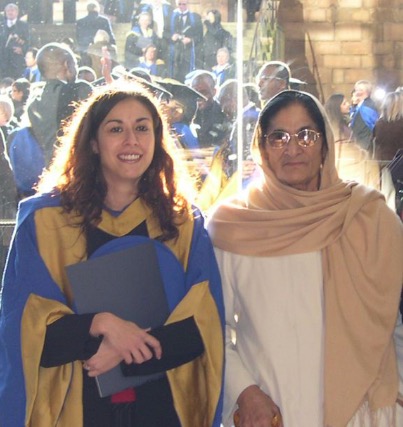
It is coming to 11 years since my mother died at the age of 83. She had great courage and conviction, illustrated in her decision to come to far-off England – and not go to the familiar India – from Kenya, a few years after my father’s untimely death in 1979. In doing so, with two young children, she was adding considerably to the challenges that she had faced hitherto. Alone, in an alien land, with two growing daughters, she drew upon her inner reserves of strength to provide for us. Moreover, what I do today is down to her encouragement and support throughout my life.

This was not always an easy position for her to take because of wider socio-economic pressures, but she saw education as the master-key to unlock many of these. As her youngest child, I was fortunate to be the first to go to university, for my sisters – we were all girls – were capable of more. She would have preferred that I study something “sensible” like law, medicine, finance, or engineering – like my father – but I showed no interest in these. Instead, I was motivated by art and politics as in 1988-90, an increasingly unequal Britain saw a churn and I was intrigued as Margaret Thatcher was losing her grip.

Studying politics and increasingly history was an unusual and therefore difficult step for me, but despite the misgivings, my mother – open to persuasion – supported me. She didn’t always understand my aims, for that matter nor did I, but instinctively it felt the right thing to pursue. I became increasingly aware of my social identity in university – beyond the name-calling in school – because I was one of only two “brown” girls in a cohort of approx. 70. But the rest of the group too came from different backgrounds, especially that of economic class. This introduction to class was a life-lesson in terms of one’s ability to aspire and imagine.

Thirty years on from when I entered university, this social reality has not changed. Rather it has only metamorphosed, and I now see class difference at play in the post-1992 university that I teach, among the students whom I encounter. Sure, the absolute number of black/brown students coming to study history and politics has increased albeit marginally. Anyhow, this post is not on this social phenomenon but the persona that my mother was, who encouraged me to follow my heart. In those days, it was enough, for the state supported education; there were no student fees, and I was eligible for a maintenance grant.

Otherwise, a mother’s goodwill alone would not have paid for my loan-laced BA/MA, which would have been too big a risk to take. I would not have then followed it up by applying for the Penderel Moon studentship for my PhD, at the turn of the century. My mother was incredibly proud when I got my doctorate, even as I was not untouched by an imposter syndrome. But time and its temper waxes and wanes, on gender, on humanities subjects, and on doubts of the two getting together. Today, the UK higher education is a near-total market, like much of the rest of its society and politics.

In which though, there is also some sliver of charity and that is why I write this post. It was at the Myton Hospice in 2012 that my mother spent her last few hours, with my sister and me, and tomorrow I am doing a 6-mile walk to help raise money for them. Simultaneously, I remember my mother, and reflect on her life and how she shaped me. I take great strength from her ability to start from nothing, having faith, and resilience to carry on with whatever life throws at us.  

I share the link for Just Giving for Myton Hospice.