Tag Archives: Pakistan

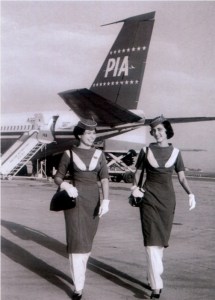
Women and Pakistan International Airlines in Ayub Khan’s Pakistan

pia-airhostesses

Abstract:

This article weaves together several unique circumstances that inadvertently created spaces for women to emerge away from the traditional roles of womanhood ascribed to them in Pakistan. It begins by tracing the emergence of the Pakistan International Airlines (PIA) as a national carrier that provided an essential glue to the two wings of Pakistan. Operating in the backdrop of nascent nationhood, the airline opens an opportunity for the new working women in Pakistan. Based on first-hand accounts provided by former female employees, and supplementing it with official documents, newspaper reports and the advertising used for marketing at the time, it seeks to provide an illuminating insight into the early history of women in Pakistan. While the use of women as markers of modernity and propaganda is not new, here within the context of Cold War and American cultural diplomacy, the ‘modernist’ vision of the Ayub-era in Pakistan (1958-69), and its accompanying jet-age provide a unique lens through which to explore the changing role of women. The article showcases a different approach to understanding the so-called ‘golden age’ of Pakistani history: a neglected area of the international history on Pakistan, which is far too often one-dimensional.

Link to the article: https://doi.org/10.1080/07075332.2018.1472622

The Final Resting Place: Gurdwara Kartarpur Sahib

This slideshow requires JavaScript.

In March 2017, in an impromptu adventure, I had the opportunity to visit Kartarpur Sahib in Pakistan. It came amidst an amazing road trip, which took me from the Radcliffe line to the Durand Line (almost). The trip was full of surprises – monuments (old and new) in situ and people on the move – and their discussion, especially of religious spaces and their historical significance. During one of these conversation, Dr. Yaqoob Khan Bangash (ITU Lahore) asked why the Sikhs never demanded Kartarpur Sahib during the discussions of the 1947 Radcliffe Boundary Commission.

Kartarpur is located in Narowal District in Pakistani Punjab. It is about 120 kms/2 hours away from Lahore and is located only 3 kms from the Indo-Pakistan border by the river Ravi. Indeed, Dera Baba Nanak is located about 1 km from the border, on the other side, east of the river Ravi in Indian Punjab. Both are visible to each other on clear days. The Gurdwara is the historic location where Guru Nanak (1469-1539) settled and assembled the Sikh community after his spiritual travels around the world. It is on the banks of the River Ravi and even today there is a nomadic and unkempt, wilderness feel to the place. Guru Nanak spent eighteen years living in Kartarpur, during which he spent time preaching to a growing congregation; the appeal of Nanak spreading from nearby areas to beyond and drawing the first Sangat to the area. Many devotees remained and settled in Kartarpur, dedicating their lives to the mission of Nanak.

The informal led to the formal, with the establishment of the first Gurdwara (the house of the guru) being built circa 1521-2. Here, free communal dinning (langar) was started, feeding all those that came and the langar remains a defining feature of Sikhism – providing free food to everyone without any prejudice. The food is simple and usually vegetarian. It is not a feast, nor does it offend anyone due to their dietary preferences. Everyone, rich or poor, sits together; equal in the house of the guru.

However, for Sikhs, Kartarpur is an especially significant place, as it marks not only the beginnings of Sikhism but also the final resting place of the first guru. The original Gurdwara complex was washed away by floods of the river Ravi and the present-day building was built with donations from Bhupinder Singh (1891-1938), Maharaja of Patiala. More recently, the Government of Pakistan has been contributing to its maintenance. The most fascinating thing about Kartarpur is the appeal of the Gurdwara to all communities. Baba Nanak is revered as a Pir, Guru and Fakir alike.

My trip to Kartarpur was during the “off-season” period and so, mostly Muslims were visiting the shrine/Gurdwara to offer their duas/prayers. Legend has it that when Guru Nanak died, his Hindu and Muslim devotees disagreed about how his last rites should be performed: cremation or burial? During this ruckus, Nanak appeared as an old man before his devotees and, seemingly, suggested delaying the decision until the following day. The following morning, the shroud covering the body was found with flowers, in place of the body. These flowers were divided, with the Hindus cremating theirs, and the Muslims buried theirs. And so, in the courtyard of the Gurdwara is a shrine to symbolise this story. Outside the Sikh tourism that takes place, which is limited, this shrine is mostly frequented by Muslims.

In August 1947, Kartarpur was in Gurdaspur district, which had all (almost) been delineated to be in Pakistan, until the late, controversial changes to the boundary line, which meant that parts of Gurdaspur went to India. Thus, at the last minute, Kartarpur ended being in close proximity of the international border. After Partition, the Sikhs were negligible in their numbers in Pakistan and Kartarpur remained closed and abandoned for over fifty years. More recently, there have been attempts to get a connecting corridor between the communities in India and Pakistan today, but this has not materialised. Going back to the question of why Kartarpur never figured as a specific request before the Boundary Commission, perhaps part of the answer lies in the fact that Sikhs believe in reincarnation of the soul and, therefore, death of the body is not the end of life’s journey.

‘Corridor connecting India with Kartarpur Sahib Shrine in Pakistan ruled out’ by Ravi Dhaliwal:

http://www.tribuneindia.com/news/punjab/community/-corridor-connecting-india-with-kartarpur-sahib-shrine-in-pak-ruled-out/400962.html

‘Visit to Kartarpur Sahib (Pakistan)’ by Dalvinder Singh Grewal: https://www.sikhphilosophy.net/threads/visit-to-kartarpur-sahib-pakistan.49707/

‘How Nanak’s Muslim followers in Pakistan never abandoned Kartarpur Sahib, his final resting place’ by Haroon Khalid: https://scroll.in/article/857302/how-nanaks-muslim-followers-in-pakistan-never-abandoned-kartarpur-sahib-his-final-resting-place

Everyone’s Guru by Yaqoob Khan Bangash: http://tns.thenews.com.pk/everyones-guru/#.WxAxiakh3OQ

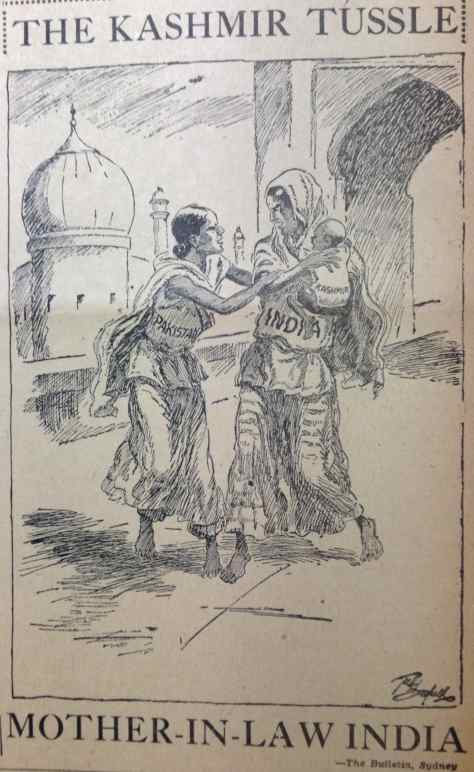
The Kashmir Tussle

The picture says it all, “The Kashmir Tussle” appearing in The Pakistan Times in July 1951.

5561 Kashmir
The Pakistan Times, 15 July 1951.

Time & PIA

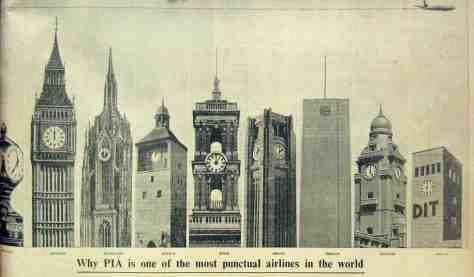
Going through my picture library for images, I found this advertisement by Pakistan International Airlines from 1963. Times have changed.

2388 26-7-63 PIA
PIA advertisement from The Pakistan Times, 26 July 1963.

Two villages, two nations: Ganda Singh Wala-Hussainiwala


This slideshow requires JavaScript.

The villages of Ganda Singh Wala and Hussainiwala are two villages divided by Cyril Radcliffe’s line. Rather counter-intuitively in these times of Hindu/Sikh India and Muslim Pakistan, Ganda Singh Wala is a village in Kasur District in Punjab, Pakistan, while Hussainiwala is its Indian counterpart, located 11 km away from Ferozepur city. Until the early 1970s, this was the primary border crossing between the two countries but it now only functions as a ceremonial border. Like Wagha-Attari, the now-primary border crossing between India and Pakistan, there is a daily Retreat Ceremony with the lowering of the national flag. There are, however, a few differences between the two ceremonies as Ganda Singh-Hussainiwala is generally not open to foreign tourists and is therefore more intimate with fewer attendees coming largely from the local area. The seating, especially on Ganda Singh side, is right next to the Pakistani Rangers and thus provides a spectacular viewing of this daily spectacle.

While restricted to mostly locals, there remains some jingoistic overtures around it; more palpable during tense times between the two countries. The ceremony lasting 40 minutes, is shorter than the Wagha-Attari version and has less of a fanfare and build-up. People loiter around, catching the opportunity to be close to Indian/Pakistani people and take photos of the Rangers and Indian BSF. According to Ferozepur district’s webpage (http://ferozepur.nic.in/html/indopakborder.html), there was no joint parade and retreat ceremony here until 1970. It was apparently, “Inspector General BSF, Ashwani Kumar Sharma, called upon both authorities to have joint retreat ceremony and since than it has become a tradition”. In 2005, there were discussions about opening this border crossing, to no avail. Today it is easy to forget that this was once a thriving check-point. In 1970, Paul Mason, while travelling the sub-continent, excitedly crossed the border from Ganda Singh to Hussainiwala. He recalls this experience in his travelogue, Via Rishikesh: an account of hitchhiking to India in 1970 (2005):

“In the morning we have little difficulty in locating the Ministry of the Interior and are supplied the necessary chits which give permission for us to travel along the restricted road to the border. For the sum of two rupees apiece we obtain bus seats and are soon headed off down the dusty track, but the trip is much longer than I expect and it is mid-afternoon before we arrive at the Pakistani customs of Ganda Singh Wala.

At the customs post on the Indian side of the border, a worryingly intelligent young woman who reminds me much of my elder sister Margaret deals me with. I do my best to conceal my anxiety about the concealed roll of banknotes. She eyes me carefully and exchanges a few words with me before turning to the next in line without first acquainting herself with the contents of my underpants.

We have made it to India! We are here in India! At last! Amazing, amazing, amazing!

I take a look at stamp in my passport; it states simply; ‘ENTRY 16-10-70 Hussainiwala Distt, Ferozepore’ – not even a mention of India! Oh well, we’re here, and that’s all that counts!

We follow the flow of other new arrivals along a path beside a wide still river [Sutlej]. There is also a disused railway track, which presumably used to connect the two countries.”

[See full account: http://www.paulmason.info/viarishikesh/viarishikeshch16.htm]

We see from Mason’s account of the simplicity through which he crossed the border with only a slight mention of Ganda Singh and Hussainiwala printed in his passport (pictures of the entry stamps are available on his website above). Today when crossing via the land route, there is a clear stamp with Attari (India) and Wagha (Lahore) in the passport. Mason also mentions the hundreds of cars left abandoned at the border because it was too costly to take them across. But, this was at least possible to do then; impossible today. Equally, the disused railway track lies there abandoned but remains as a reminder of the two broken halves.

Ferozepur, India is the land of martyrs and Hussainiwala is the site of the National Martyrs Memorial, where Bhagat Singh, Sukhdev and Rajguru were cremated on 23 March 1931. This is also the cremation place of Batukeshwar Dutt, who was also involved in bombing the Central Legislative Assembly with Singh. Bhagat Singh’s mother, Vidyawati, was also cremated here according to her last wishes. Interestingly, the spot of the memorial, which is only 1 km away from Hussainiwala and on the banks of the Sutlej river and built in 1968, was originally part of Pakistan. On 17 January 1961, it was returned to India in exchange for 12 villages near Sulemanki Headworks.

Read ‘Making of a Memorial’ by K. S. Bains, http://www.tribuneindia.com/2007/20070923/spectrum/main2.htm

-, ‘Shaheedon ki dharti’ in The Tribune: http://www.tribuneindia.com/1999/99jul03/saturday/regional.htm#3

See a short clip of the ceremony at Ganda Singh Wala: https://www.youtube.com/watch?v=vZR-eLVYo6s

From before and beyond the international border that divides them, there is a story that connects these villages. Majid Sheikh writes about the ‘Spiritual connect of two villages’ in Dawn and brings out their historic connections. To commemorate a highly decorated soldier, Risaldar Major Ganda Singh Dutt, the British had named this village after him, while the village Hussainiwala derived its name during colonial days from Pir Ghulam Husseini, whose tomb is now in the BSF headquarters. Today they exist as two halves of the same story.

Read ‘Spiritual connect of two villages on both sides of the divide’ by Majid Sheikh: https://www.dawn.com/news/1379906
From Mano Majra to Faqiranwalla: Revisiting the Train to Pakistan

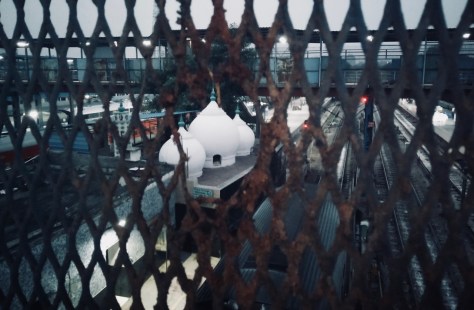
New Delhi train station. © Pippa Virdee 2016

By Pippa Virdee and Arafat Safdar in South Asian Chronicle.

Khushwant Singh’s novel Train to Pakistan was published in 1956, almost ten years after the partition of India/ creation of Pakistan in 1947. Its publication inaugurated what has been called ‘South Asian Partition Fiction in English’ (Roy 2010). It remains, to date, one of the most poignant and realistic fictional accounts depicting the welter of partition and saw a sensitive screen adaptation in 1998 by Pamela Rooks. It captures one of the most horrific symbols of partition—that of the burning, charred and lifeless trains that moved migrants and evacuated refugees from one side of the border to the other. The trains that previously served to bring people and goods from disparate worlds closer together were overnight turned into targets of mob attacks and transporters of mass corpses. They thus became an emblem, a much-photographed representation (Kapoor 2013) of the wider violence and ethnic cleansing that was taking place in Panjab (Ahmed 2002: 9-28); one of the two regions divided to make way for the two new nation-states.

Selecting some key individuals in the village, relevant to and representative of our efforts to excavate the myths and memories associated with partition, and situating their sensibilities vis-à-vis the sentiments exhibited in the novel, we conducted interviews to collect and compare experiential accounts. An attempt in the Wildean spirit to attest that ‘life imitates art far more than art imitates life’, the article, located in the Faqiranwalla of 2017, looks back to the Mano Majra of 1947. In doing so, not only does it reflect on this intervening time-span and what it has done to those remembrances, but, also brings to fore the well-remarked realisation that, in this case too, ‘the past is another country’ (Judt 1992). Like in the novel then and life today, the connecting link in this article too, between Faqiranwalla and Mano Majra, is the train, as both share the overweening presence of the railways in the village, through which its life is/was governed.

Read full article: https://edoc.hu-berlin.de/handle/18452/19508

Südasien-Chronik – South Asia Chronicle 7/2017, S. 21-44 © Südasien-Seminar der Humboldt-Universität zu Berlin

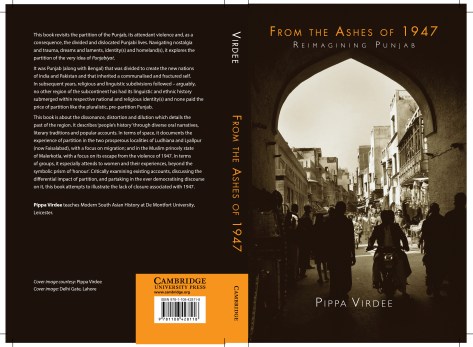
From the Ashes of 1947: Reimagining Punjab

From the Ashes_Full Cover

Full details: From the Ashes of 1947

Watch the panel discussion with Pippa Virdee (De Montfort University, UK), Afzal Saahir (Poet and Radio Host) and Sajid Awan (Quaid-e-Azam University) of my book From the Ashes of 1947 at the Afkar-e-taza, January 2018 Panel Discussion

Living in Coventry: from Thatcher to May

Screen Shot 2017-12-11 at 15.18.21This week Coventry successfully won the bid to be the city of culture in 2021. Subsequently, there have been numerous articles about Coventry in the media, reflecting both the history and lived experiences of the city. The response has also been mixed in the sense that some people have continued to dwell on the lack of culture and “beauty” in the city, and in part this is true. The more optimistic see this as an opportunity to revive the glorious past with renewed energy.

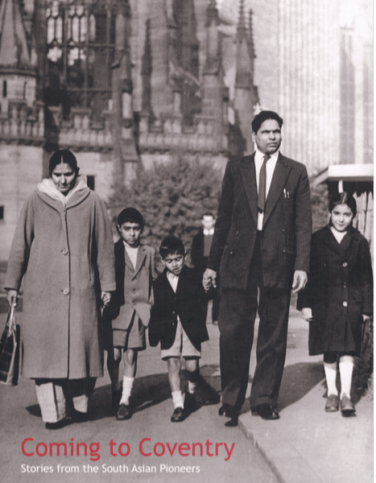
As I reflect on the city’s bid to become the city of culture, I remember an oral history project, which I did in 2005-6, Coming to Coventry. It was funded by the HLF and supported by The Herbert and documented the migration of South Asians to Coventry from the 1940-60s. We collected over fifty oral accounts of people, who migrated here and, through these testimonies and the beautiful pictures that people shared with us, we documented their journeys to Coventry in search of a better life. Many of the early migrants had intended to go back home but gradually, some of them made Coventry their home. They contributed to the growth and development of the city in the heyday of the post-war years. The 1970s were, of course, to bring about change and the consequent downturn was not kind to Coventry.
The time through the duration of the project gave me an insight into the city, which I did not fully comprehend before. It made me reflect on my own experiences of migrating to it. Coventry is a city that I came to, not out of choice but as a child accompanying my mother. At the time, I had no preconceptions of the city and my response was only that of a child, who could not quite understand the upheaval of migration and dislocation to a “foreign” land. It could have been anywhere and I suspect the response would have been the same. Nonetheless, Coventry became my home while growing up in 1980s Britain: a challenge in itself. In the backdrop were Thatcher’s Britain, the Falkland’s war, the vibrant music of the 80s, racism and the declining car industry in Coventry. Gradually the former car plants gave way for housing and retail parks. The city changed and adapted, as did I. But the years of the Thatcher administration left its mark on me, especially when I was beginning to see and understand the society around me, even though the Prime Minister would have us believe that there was no such thing as society. Studying politics, sociology and art seemed to me a perfect combination in response to the excesses of Thatcherism.
The pursuit of knowledge led me to University and I had two choices, University of Warwick or the newly created Coventry University. Despite having a place at the former, due to personal circumstances, I chose the latter. I had felt out of place at a visit to the former and besides, something caught my eye on the courses offered at Coventry University, namely, the opportunity to study the history of India and Pakistan – from where I and my parents originally came from. As that has become my life’s calling, I have stayed in Coventry, despite subsequent other opportunities. There is something quite strong and resilient in the city, which has kept me here, in my adopted home of over three decades. It is, as many have pointed out not the most attractive city and lacks many amenities, yet, there is a subaltern robustness and romance to Coventry. The city, for all its drawbacks, is standing, attempting to reinvent and reimagine itself. For me, it provides my base, which is provincial, on-the-margins and of the under-dog; these feed the spirit and space to keep hoping and doing.